NCERT Solutions for Class 11 English (Woven Words) Poetry 12 Ajamil and the Tigers
Finished viewing? Save it for later —
Download NCERT Solutions for Class 11 English (Woven Words) Poetry 12 Ajamil and the Tigers (PDF · 3 pages)About NCERT Solutions for Class 11 English (Woven Words) Poetry 12 Ajamil and the Tigers
NCERT Solutions for Class 11 English (Woven Words) Poetry 12 Ajamil and the Tigers is available here for free download. Published by NCERT for Class 11, this solution can be viewed online or downloaded as a PDF (3 pages). Candidates preparing for Class 11 can use NCERT Solutions for Class 11 English (Woven Words) Poetry 12 Ajamil and the Tigers to understand the exam pattern, the type of questions asked, and the overall difficulty level.
Frequently Asked Questions
How can I download NCERT Solutions for Class 11 English (Woven Words) Poetry 12 Ajamil and the Tigers?
Open this page and click the Download button to save NCERT Solutions for Class 11 English (Woven Words) Poetry 12 Ajamil and the Tigers as a PDF. It is completely free on AglaSem Docs.
Is NCERT Solutions for Class 11 English (Woven Words) Poetry 12 Ajamil and the Tigers free to download?
Yes. NCERT Solutions for Class 11 English (Woven Words) Poetry 12 Ajamil and the Tigers can be viewed online and downloaded as a PDF free of cost on AglaSem Docs.
How many pages does NCERT Solutions for Class 11 English (Woven Words) Poetry 12 Ajamil and the Tigers have?
NCERT Solutions for Class 11 English (Woven Words) Poetry 12 Ajamil and the Tigers contains 3 pages, which you can read online or download together as a single PDF.
Where can I find more Class 11 study material?
You can find more Class 11 question papers, sample papers, syllabus, and answer keys on AglaSem Docs.
NCERT Solutions for Class 11 English (Woven Words) Poetry 12 Ajamil and the Tigers – Text
Read the full text of this solution below — useful to quickly search, copy and reference the content online without downloading the PDF.
📄 View text version (3 pages)
Page 1
Subject : English
Chapter : 12
Chapter Name : Ajamil and the tigers
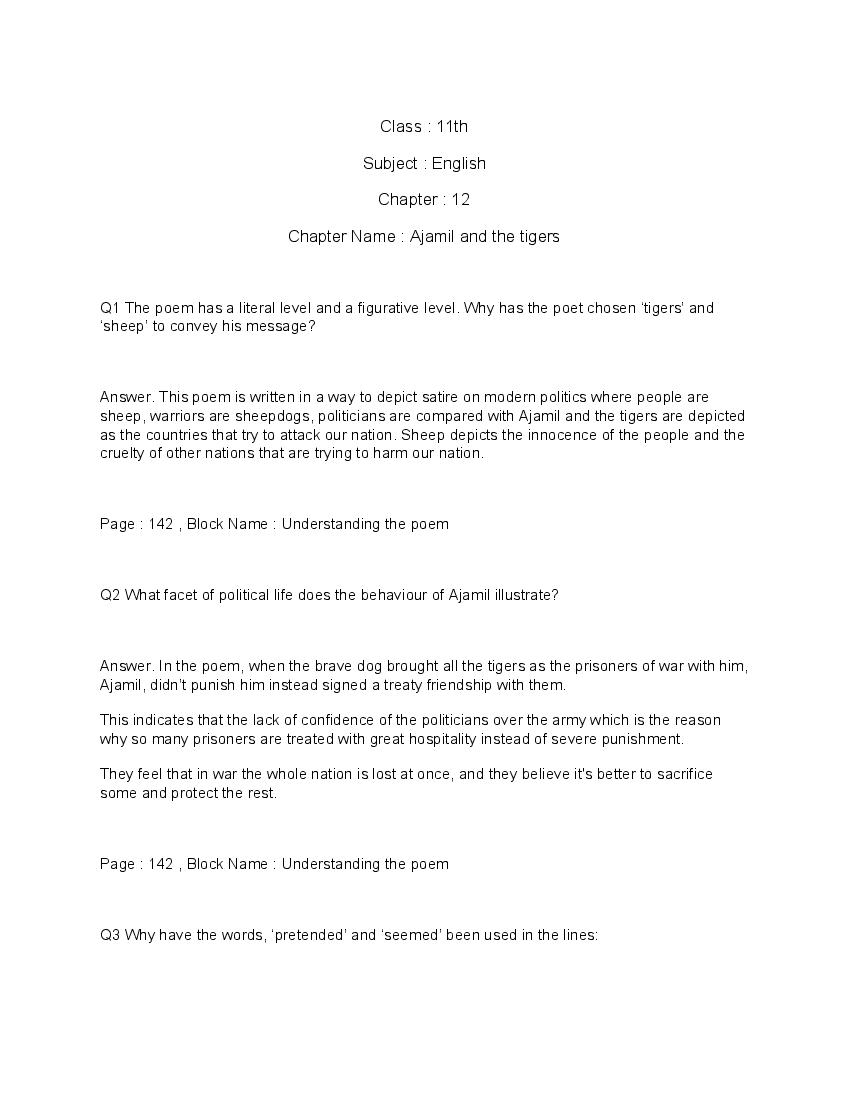
Q1 The poem has a literal level and a figurative level. Why has the poet chosen ‘tigers’ and
‘sheep’ to convey his message?
Answer. This poem is written in a way to depict satire on modern politics where people are
sheep, warriors are sheepdogs, politicians are compared with Ajamil and the tigers are depicted
as the countries that try to attack our nation. Sheep depicts the innocence of the people and the
cruelty of other nations that are trying to harm our nation.
Q2 What facet of political life does the behaviour of Ajamil illustrate?
Answer. In the poem, when the brave dog brought all the tigers as the prisoners of war with him,
Ajamil, didn’t punish him instead signed a treaty friendship with them.
This indicates that the lack of confidence of the politicians over the army which is the reason
why so many prisoners are treated with great hospitality instead of severe punishment.
They feel that in war the whole nation is lost at once, and they believe it's better to sacrifice
some and protect the rest.
Q3 Why have the words, ‘pretended’ and ‘seemed’ been used in the lines:
Page 2
And seemed to be taken in by all the lies.
How does the sense of these lines connect with the line ‘Ajamil wasn’t a fool’?
Answer. Ajmail is aware that the treaty he signed is not a permanent one and he was also
aware that the tigers are going to attack them one day. Still, he went ahead to sign the treaty for
a feeling of temporary peace.
Hence the words ‘pretended’ and ‘seemed’ are used to express Ajamil’s feeling that he didn’t
trust those tigers.
Q4 Why did Ajamil refuse to meet the sheepdog’s eyes?
Answer. Sheepdog is a brave warrior and is capable of winning the war against all the tigers.
And Ajmail was aware that the sheepdog wouldn’t be happy to sign a treaty with those tigers,
whom he can win. Hence he refused to meet the sheepdog’s eyes as was not ready to change
his decision of making peace with the tigers.
Q5 ‘He is free to play a flute all day as well fed tigers and fat sheep drink from the same pond
with a full stomach for a common bond.’ What do the phrases ‘play the flute all day’ and ‘a
common bond’ refer to?
Answer. The peace established between the two that is tigers and the sheep was a temporary
phase. So Ajamil can have some relaxation, at least for some days, which is referred by the
phrase ‘play flute all day’.
Page 3
and live for a common good, this was referred by the phrase ‘a common bond’.
Q6 The poem is a satire against the present political class. How effectively does it convey the
anger and anguish of the common man trapped in the system?
Answer. In the scenario of war and peace, the common man is the one who suffers the most.
He is the one who is losing his property, health and sometimes lives too. Yet in the process of
making good for most of the people, he doesn’t get justice. He is gets stuck in the system and
cannot turn back. The only thing that he can do is to keep pain buried in his heart till the time he
dies. This poem reflects the anger and pain that a common man faces.
Document Details
| Board / Org | NCERT |
| Exam | Class 11 |
| Type | Solution |
| Pages | 3 |
| Updated | 30 Apr 2026 |