NCERT Solutions for Class 11 English (Woven Words) Essays 5 What is a Good Book
Finished viewing? Save it for later —
Download NCERT Solutions for Class 11 English (Woven Words) Essays 5 What is a Good Book (PDF · 4 pages)About NCERT Solutions for Class 11 English (Woven Words) Essays 5 What is a Good Book
NCERT Solutions for Class 11 English (Woven Words) Essays 5 What is a Good Book is available here for free download. Published by NCERT for Class 11, this solution can be viewed online or downloaded as a PDF (4 pages). Candidates preparing for Class 11 can use NCERT Solutions for Class 11 English (Woven Words) Essays 5 What is a Good Book to understand the exam pattern, the type of questions asked, and the overall difficulty level.
Frequently Asked Questions
How can I download NCERT Solutions for Class 11 English (Woven Words) Essays 5 What is a Good Book?
Open this page and click the Download button to save NCERT Solutions for Class 11 English (Woven Words) Essays 5 What is a Good Book as a PDF. It is completely free on AglaSem Docs.
Is NCERT Solutions for Class 11 English (Woven Words) Essays 5 What is a Good Book free to download?
Yes. NCERT Solutions for Class 11 English (Woven Words) Essays 5 What is a Good Book can be viewed online and downloaded as a PDF free of cost on AglaSem Docs.
How many pages does NCERT Solutions for Class 11 English (Woven Words) Essays 5 What is a Good Book have?
NCERT Solutions for Class 11 English (Woven Words) Essays 5 What is a Good Book contains 4 pages, which you can read online or download together as a single PDF.
Where can I find more Class 11 study material?
You can find more Class 11 question papers, sample papers, syllabus, and answer keys on AglaSem Docs.
NCERT Solutions for Class 11 English (Woven Words) Essays 5 What is a Good Book – Text
Read the full text of this solution below — useful to quickly search, copy and reference the content online without downloading the PDF.
📄 View text version (4 pages)
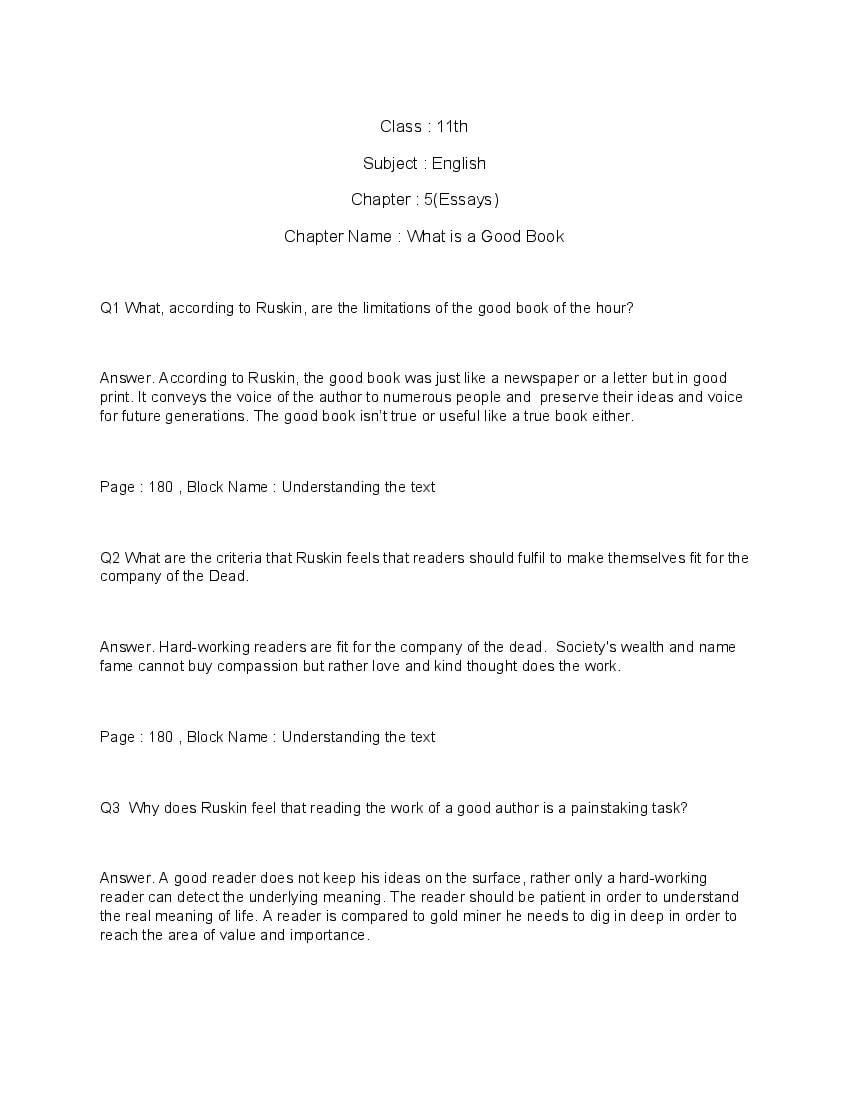
Page 1
Subject : English
Chapter : 5(Essays)
Chapter Name : What is a Good Book
Q1 What, according to Ruskin, are the limitations of the good book of the hour?
Answer. According to Ruskin, the good book was just like a newspaper or a letter but in good
print. It conveys the voice of the author to numerous people and preserve their ideas and voice
for future generations. The good book isn’t true or useful like a true book either.
Q2 What are the criteria that Ruskin feels that readers should fulfil to make themselves fit for the
company of the Dead.
Answer. Hard-working readers are fit for the company of the dead. Society's wealth and name
fame cannot buy compassion but rather love and kind thought does the work.
Q3 Why does Ruskin feel that reading the work of a good author is a painstaking task?
Answer. A good reader does not keep his ideas on the surface, rather only a hard-working
reader can detect the underlying meaning. The reader should be patient in order to understand
the real meaning of life. A reader is compared to gold miner he needs to dig in deep in order to
reach the area of value and importance.
Page 2
Answer. An educated person is different from an uneducated one as he knows what to read and
what to ignore. The educated man is aware of the pronunciation and word usage which is
unknown to an educated man. A person without precise knowledge is always at inferior stage of
education.
Q1 The text is an excerpt from Sesame and Lilies which consists of two essays, primarily,
written for delivery as public lectures in 1864. Identify the features that fit the speech mode.
Notice the sentence patterns.
Answer. The text was given as a lecture hence it shares the features of a speech. His use of the
first person or ‘I’ is the most direct feature. Repetition of certain expressions “if you could, you
would; you would write instead” is an interaction and spontaneous explanation. He, again and
again, asks questions like “Perhaps you think no book was ever so written?” which engages
another person in a speech.
The sentence is conversational and flowing. The number of times he uses ‘and’, ‘but’ or ‘so’
shows a spontaneity of thought and explanation rather than the corrected lines of a written text.
Q2 The lecture was delivered in 1864. What are the shifts in style and diction that make the
language different from the way it is used today?
Page 3
like ‘assuredly’ are less used and words like ‘most distant’ are now incorrect because it has
become ‘most distant’. Certain phrases like ‘peerage of words’ or national noblesse of words’ is
no longer used because aristocracy or nobility hardly exist anymore. Certain formations of
sentences are also different like ‘no one has yet said it’ as opposed to how it is said today- ‘no
one has said it yet’.
Q1 Ruskin’s insistence on looking intensely at words, and assuring oneself of meaning, syllable
by syllable—nay, letter by letter.
Answer. Ruskin believes in learning words by their roots to gain in depth knowledge. Just
learning knowledge by not gaining in depth knowledge is a sign of being uneducated . A scholar
is considered above the normal person as he has a great deal of knowledge.
Page : 180 , Block Name : Talking about the Text
Q2 Choice of diction is very crucial to the communication of meaning.
Answer. Communication relies on the mutual understanding of two or more people. The medium
of communication, language thereby becomes a very important part of the communication.
Without proper diction or choice of words, the meaning of what a person wants to convey may
change. Diction contributes a lot to the subtle meaning of the words and adds expression to it.
Page : 180 , Block Name : Talking about the Text
Q1 Many sentences and paragraphs in the excerpt begins with the word ‘And’. To what extent
does this contribute to the rhetorical style of the lecture?
Answer. John Ruskin gave ‘What is a Good Book’ as a public lecture in the nineteenth century.
The repetitive use of ‘And’ or ‘but’ helps in explaining an idea even further. It is more like a
conversation.
Q2 Study each of the following sentences and notice the balance between its parts. Pick out
other sentences in the text that reflect this kind of balance
Page 4
wrong that a false English meaning should not excite a frown there.
b. Let the accent of words be watched, by all means, but let the meaning be watched more
closely still, and fewer will do the work.
Answer. 1. A book is essentially not a talked thing but a written thing; and written, not with the
view of more communication, but of permanence.
2. They do not give it to you by way of help, but of reward, and will make themselves sure that
you deserve it before they allow you to reach it.
3. You may dig long and find none; you must dig painfully to find any.
4. You might read all the books in the British Museum (if you could live long enough), and
remain an utterly ‘illiterate’, uneducated person; but that if you read ten pages of a good book,
letter by letter—that is to say, with real accuracy—you are forever more in some measure with
an educated person.
Document Details
| Board / Org | NCERT |
| Exam | Class 11 |
| Type | Solution |
| Pages | 4 |
| Updated | 30 Apr 2026 |