NCERT Solutions for Class 11 English (Woven Words) Essays 6 The Story
Finished viewing? Save it for later —
Download NCERT Solutions for Class 11 English (Woven Words) Essays 6 The Story (PDF · 4 pages)About NCERT Solutions for Class 11 English (Woven Words) Essays 6 The Story
NCERT Solutions for Class 11 English (Woven Words) Essays 6 The Story is available here for free download. Published by NCERT for Class 11, this solution can be viewed online or downloaded as a PDF (4 pages). Candidates preparing for Class 11 can use NCERT Solutions for Class 11 English (Woven Words) Essays 6 The Story to understand the exam pattern, the type of questions asked, and the overall difficulty level.
Frequently Asked Questions
How can I download NCERT Solutions for Class 11 English (Woven Words) Essays 6 The Story?
Open this page and click the Download button to save NCERT Solutions for Class 11 English (Woven Words) Essays 6 The Story as a PDF. It is completely free on AglaSem Docs.
Is NCERT Solutions for Class 11 English (Woven Words) Essays 6 The Story free to download?
Yes. NCERT Solutions for Class 11 English (Woven Words) Essays 6 The Story can be viewed online and downloaded as a PDF free of cost on AglaSem Docs.
How many pages does NCERT Solutions for Class 11 English (Woven Words) Essays 6 The Story have?
NCERT Solutions for Class 11 English (Woven Words) Essays 6 The Story contains 4 pages, which you can read online or download together as a single PDF.
Where can I find more Class 11 study material?
You can find more Class 11 question papers, sample papers, syllabus, and answer keys on AglaSem Docs.
NCERT Solutions for Class 11 English (Woven Words) Essays 6 The Story – Text
Read the full text of this solution below — useful to quickly search, copy and reference the content online without downloading the PDF.
📄 View text version (4 pages)
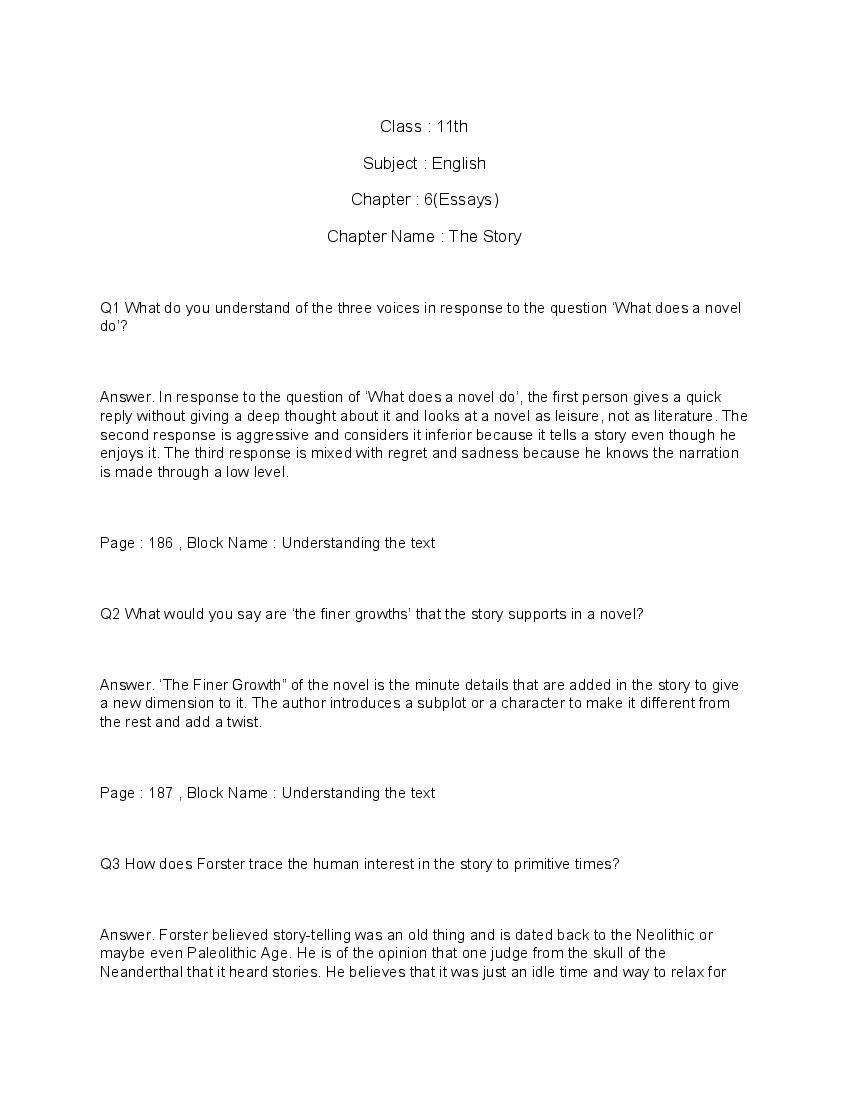
Page 1
Subject : English
Chapter : 6(Essays)
Chapter Name : The Story
Q1 What do you understand of the three voices in response to the question ‘What does a novel
do’?
Answer. In response to the question of ‘What does a novel do’, the first person gives a quick
reply without giving a deep thought about it and looks at a novel as leisure, not as literature. The
second response is aggressive and considers it inferior because it tells a story even though he
enjoys it. The third response is mixed with regret and sadness because he knows the narration
is made through a low level.
Page : 186 , Block Name : Understanding the text
Q2 What would you say are ‘the finer growths’ that the story supports in a novel?
Answer. ‘The Finer Growth” of the novel is the minute details that are added in the story to give
a new dimension to it. The author introduces a subplot or a character to make it different from
the rest and add a twist.
Q3 How does Forster trace the human interest in the story to primitive times?
Answer. Forster believed story-telling was an old thing and is dated back to the Neolithic or
maybe even Paleolithic Age. He is of the opinion that one judge from the skull of the
Neanderthal that it heard stories. He believes that it was just an idle time and way to relax for
Page 2
which they were so disinterested that they may have even killed a human being.
Q4 Discuss the importance of time in the narration of a story.
Answer. Time is the most important thing in the story. The narration revolves around time, no
story can be written without including time. Novels need a temporal balance in order to narrate
chronologically what happened first and then the next.
Q1 How does Forster use the analogy of Scheherazade to establish his point?
Answer. Forster takes the example of Scheherazade who married a king who executed all his
wives after the first night. So Scheherazade told him a story every night and left at a point of
suspense and hence the king didn’t have her executed because he wanted to know what
happened next. Forster says that this element of suspense is the only attraction of a story that
keeps the reader or listener hooked to it.
Page : 187 , Block Name : Appreciation
Q2 Taking off from Forster’s references to Emily Bronte, Sterne and Proust, discuss the
treatment of time in some of the novels you have read.
Answer. Over time, novels have creatively used the aspects of time. Most of the novels like To
Kill a Mockingbird, The Alchemist, Pride, and Prejudice, etc. follow a chronological pattern,
revealing the truth in time. However, some novels narrate the story going back and forth in time
and thereby becoming a thriller. The elements of flashbacks are used at times. Some genres
like dystopian novels are used in The Road in Cormac Mc Carthy that is totally narrated in plain
tone but the end keeps hooked to the story.
Page : 187 , Block Name : Appreciation
Q1 What does a novel do?
Answer. Novel is fictional way of displaying different situations. Numerous genres of novels
have emerged like historical, mystery, romance, fantasy, mythology, drama etc. However, when
Page 3
depict different plot.
Page : 187 , Block Name : Talking about the Text
Q2 ‘Our daily life reflects a double allegiance to ‘the life in time’ and ‘the life by values’.
Answer. ‘The life in time’ refers to following a particular work routine. ‘The life by values’ means
interest and values. Everyone has both of these lives even though the life by values is many
times more important.
Page : 187 , Block Name : Talking about the Text
Q3 The description of novels as organisms.
Answer. Novels are described as an organism because it grows on every page. It develops on
the characters, the plot, the events, and the dialogues etc. paying attention to small details. Like
an organism, it has various feelings and mood.
Page : 187 , Block Name : Talking about the Text
Q1 ‘Qua story’: what does the word mean? Find other expressions using the word qua.
Answer. ‘Qua’ means ‘in the capacity of’ so, ‘qua story’ means ‘in the capacity of being a story’.
Qua can also be used as a preposition meaning ‘as’ for example, the woman qua run the family.
Q2 Study the Note to Aspects of the Novel given at the end. Discuss the features that mark the
piece as a talk as distinguished from a critical essay.
Answer. The piece can be distinguished as talk by words like ‘I’, ‘You, ‘so to speak’, ‘only to
imagine’ etc. which displease a reader. But these words, although informal talkative, provide
effective pauses and improves expression in the sentences.
Page 4
novel is itself often colloquial, it may possibly withhold some of its secrets from the graver and
grander streams of criticism’.
Answer. Forster’s statement, ‘since the novel is itself often colloquial, it may possibly withhold
some of its secrets from the graver and grander streams of criticism’ talks about how novel
deals with the colloquial aspects of life and is written in a colloquial language so that it becomes
available to people of different strata too.
Document Details
| Board / Org | NCERT |
| Exam | Class 11 |
| Type | Solution |
| Pages | 4 |
| Updated | 22 Jul 2026 |