TIFR GS 2020 Question Paper Chemistry
Finished viewing? Save it for later —
Download TIFR GS 2020 Question Paper Chemistry (PDF · 18 pages)About TIFR GS 2020 Question Paper Chemistry
TIFR GS 2020 Question Paper Chemistry is available here for free download. Published by Default for TIFR GS, this question paper can be viewed online or downloaded as a PDF (18 pages). Candidates preparing for TIFR GS can use TIFR GS 2020 Question Paper Chemistry to understand the exam pattern, the type of questions asked, and the overall difficulty level.
Frequently Asked Questions
How can I download TIFR GS 2020 Question Paper Chemistry?
Open this page and click the Download button to save TIFR GS 2020 Question Paper Chemistry as a PDF. It is completely free on AglaSem Docs.
Is TIFR GS 2020 Question Paper Chemistry free to download?
Yes. TIFR GS 2020 Question Paper Chemistry can be viewed online and downloaded as a PDF free of cost on AglaSem Docs.
How many pages does TIFR GS 2020 Question Paper Chemistry have?
TIFR GS 2020 Question Paper Chemistry contains 18 pages, which you can read online or download together as a single PDF.
Where can I find more TIFR GS study material?
You can find more TIFR GS question papers, sample papers, syllabus, and answer keys on AglaSem Docs.
TIFR GS 2020 Question Paper Chemistry – Text
Read the full text of this question paper below — useful to quickly search, copy and reference the content online without downloading the PDF.
📄 View text version (18 pages)
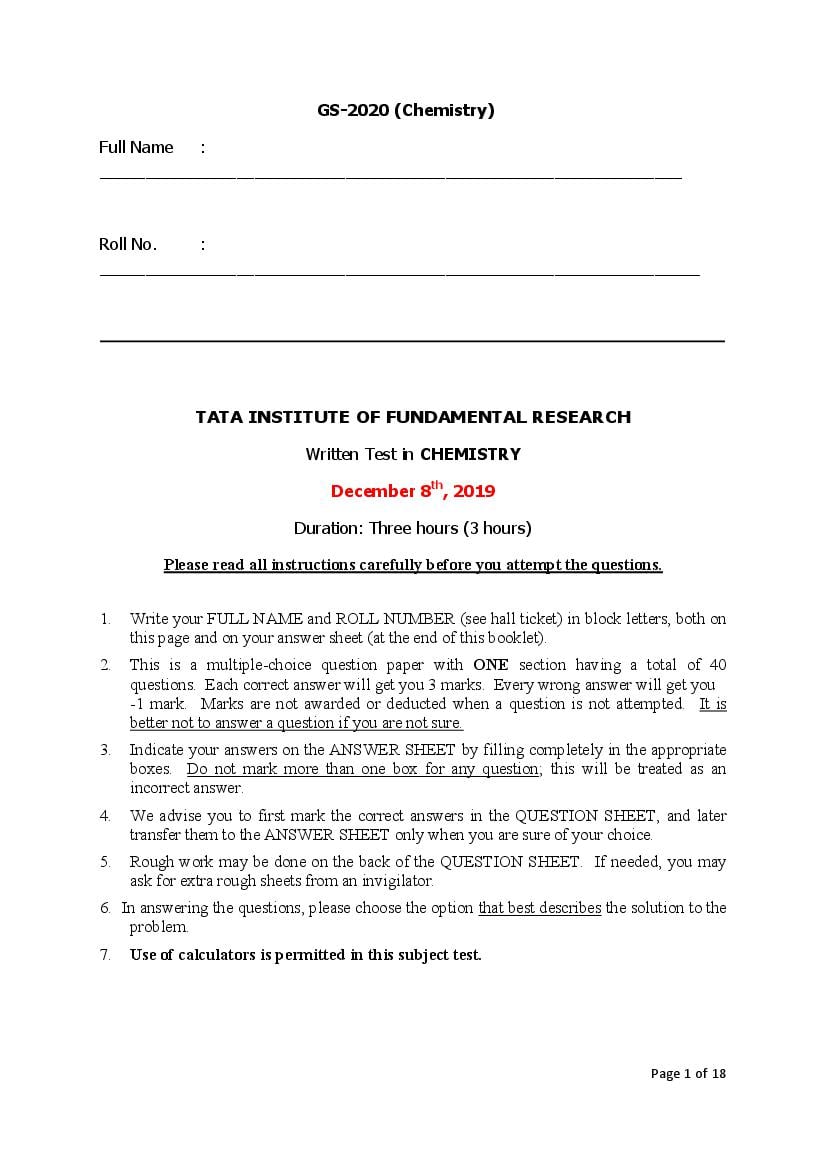
Page 1
Full Name :
________________________________________________________________
Roll No. :
__________________________________________________________________
TATA INSTITUTE OF FUNDAMENTAL RESEARCH
Written Test in CHEMISTRY
December 8th, 2019
Duration: Three hours (3 hours)
Please read all instructions carefully before you attempt the questions.
1. Write your FULL NAME and ROLL NUMBER (see hall ticket) in block letters, both on
this page and on your answer sheet (at the end of this booklet).
2. This is a multiple-choice question paper with ONE section having a total of 40
questions. Each correct answer will get you 3 marks. Every wrong answer will get you
-1 mark. Marks are not awarded or deducted when a question is not attempted. It is
better not to answer a question if you are not sure.
3. Indicate your answers on the ANSWER SHEET by filling completely in the appropriate
boxes. Do not mark more than one box for any question; this will be treated as an
incorrect answer.
4. We advise you to first mark the correct answers in the QUESTION SHEET, and later
transfer them to the ANSWER SHEET only when you are sure of your choice.
5. Rough work may be done on the back of the QUESTION SHEET. If needed, you may
ask for extra rough sheets from an invigilator.
6. In answering the questions, please choose the option that best describes the solution to the
problem.
7. Use of calculators is permitted in this subject test.
Page 1 of 18
Page 2
Avogadro number = 6.021023 mol1 e = 1.61019 C
RT/F = 0.0257 V at 25C h = 6.6261034 J s
Faraday constant = 96500 C/mol c = 3108 m s1
Boltzmann constant kB = 1.381023 J K1 R = 8.314 J K1 mol1
Mass of an electron = 9.1091031 kg
1. Order of field effect of alkyl groups are tert-butyl > iso-propyl > ethyl > methyl.
Which molecule among PhCH3, PhCH2CH3, PhCH(CH3)2 and PhC(CH3)3 has the
highest dipole moment in gas phase.
A) PhCH3
B) PhCH2CH3
C) PhCH(CH3)2
D) PhC(CH3)3
2. Predict the product of the following reaction.
Answer: B
Page 2 of 18
Page 3
A) H3O+/H2O
B) NaOH/H2O
C) NaCl/H2O
D) Pd/C, H2
4. The octanol-water partition coefficient (Log P) for the following amines are as shown
below:
Which amine will have the highest solubility in water?
Ans: D
Page 3 of 18
Page 4
180 gm of glucose as the only Carbon source for the bacteria. Provide a rough
estimate of the number of E. coli. that can grow upto the final stage given
a. A bacterium contains ~ 3 x 10⁶ protein molecules
b. An average protein has ~300 amino acids
c. Half of all glucose consumption goes to production
A) 106
B) 3 x 10¹⁴
C) 3 x 10¹⁶
D) 2.5 x 10¹³
Answer: B
6. An optically transparent thin crystal shows a quadratic response to visible light, i.e. it
scatters some of the light in a waveform that is square of the field of light that falls on
it. If light of 500 nm wavelength falls on it, what are the wavelengths of the scattered
light?
A) 500 nm and 750 nm
B) 500 nm and 250 nm
C) 500 nm and 1000 nm
D) 500 nm only
7. IR spectra of proteins have a peak in the 1600 – 1700 cm-1 region, known as the
“Amide I” region. This comes largely from the backbone C=O stretch vibration.
Given the natural abundance of different isotopes, would occasionally find a
backbone C=O at a different frequency? If so, what would be the next most common
frequency, assuming that the “Amide I” has a peak exactly at 1650 cm-1?
A) 1613 cm-1
B) 1693 cm-1
C) 1248 cm-1
Page 4 of 18
Page 5
8. An ideal gas obeys the gas law PV= nRT. However, real gases deviate from this, and
their behavior can be described in
PV/nRT = 1+ BPP + -----
where BP is the first virial coefficient in the expansion. Do you expect the BP to be
temperature dependent? If so, what would you expect the sign of BP to be at low
temperatures? (Near but above the critical point of condensation)
A) BP will be temperature independent
B) Negative
C) Positive
D) Can be either positive or negative
9. In a spherical polar coordinate system, a point A at (x, y, z) in the Cartesian coordinate
system can be described by (r, , ) where r, , and have their usual meaning.
Expression for the volume of an infinitesimally small cube confined by dx, dy, and dz
in terms of the spherical coordinate system is given by
A) drdd
B) rsindrdd
C) r2sin2drdd
D) r2sindrdd
10. The degeneracy of the energy level 12 h2/8 ma2 of a particle in a three dimensional
cube of length “a” is
A) 1
B) 3
C) 6
D) 12
Page 5 of 18
Page 6
is in Joules. If the rotational constant for H2 molecule is given as Be = 1.8324 E+12
Hz, the rotational period of the H2 molecule in J = 10 level will be
A) 1.33 10-19 sec
B) 5.0 10-15 sec
C) 5.46 10-13 sec
D) 7.39 10-7 sec
12. For a Harmonic Oscillator in its ground state, i.e., = 0 state, the energy is given by
E= ½hν, where ν is the vibrational frequency. This is due to its
A) Kinetic energy
B) Potential energy
C) Sum of Kinetic and Potential energies
D) Heat of formation
13. The Standard reaction Gibbs energy ( ) for the ATP hydrolysis
ATP(aq) ADP + Pi(aq) is -31 kJ/mol at 37 C.
In a typical bacterial cell, the concentration of ATP, ADP and Pi are 8 mmol ,1
mmol and 8 mmol , respectively. What is the reaction Gibbs energy under this
condition?
A) -31 kJ mol-1
B) -49 kJ mol-1
C) -18 kJ mol-1
D) -13 kJ mol-1
Page 6 of 18
Page 7
to 25 atm pressure. What will be the value of work involving the compression of 1
mol of liquid water from a pressure of 1 atm to 25 atm at 293 K in a reversible
process.
A) 21.75 10-5 atm dm3
B) 0.2234 10-5 atm dm3
C) 225.223 10-5 atm dm3
D) 2.752 10-5 atm dm3
15. For an ideal gas, ( ) is equal to
A) V
B) 0
C) ( )
D) ( )
16. The half-life for the decomposition of a substance dissolved in Chlorofom is 6 hours
at 298K. How much of the substance will be left after a day if the initial weight of the
dissolved substance is 160mg.
A) 40 mg
B) 160 mg
C) 10 mg
D) 27 mg
Page 7 of 18
Page 8
17. If 1.50 g of H2C2O4 2H2O were heated to drive off the water of hydration, how much
anhydrous H2C2O4 would remain?
A) 0.34 g
B) 0.92 g
C) 1.07 g
D) 1.50 g
18. How many absorption peaks will the following compound have in its 13C-NMR
spectrum?
H
A) 3
B) 4
C) 5
D) 6
19. An organic compound is estimated through Dumas method and was found to evolve 6
moles of CO2, 4 moles of H2O and 1 mole of N2 gas. The formula of the compound is:
A) C12H8N
B) C12H8N2
C) C 6 H8 N
D) C6H8N2
Page 8 of 18
Page 9
A) BF3
B) CH4
C) CH3OH
D) CHCl3
21. Within a circle of radius „b‟, four largest possible identical circles of radius „a‟ are fit
such that they do not cross each other. What is the ratio a/b?
A) ½
B) 1/(1+sqrt(2))
C) 2/(1+sqrt(2))
D) 1/2(1+sqrt(2))
22. Beer‟s law for electromagnetic radiation absorption through a medium can be
expressed as:
( )
Where, is the absorption coefficient, L is the path length through the medium, is
the incident intensity and is the transmitted intensity.
Consider an absorbing medium with two energy levels spaced by 600 cm-1. On this
medium, when monochromatic infrared radiation on resonance is made incident,
which of the following statement(s) holds true?
A) Light absorption will increase with increasing the temperature of the absorbing
medium
B) Beer‟s law is valid only for ultraviolet-visible part of the spectrum and is invalid
in the infrared spectral region
C) Light absorption will decrease with increasing temperature of the absorbing
medium
D) Light absorption not change with the temperature of the absorbing medium
Page 9 of 18
Page 10
following statements is true about the wavefunction (ψ(r)), its first (ψ‟(r) = dψ(r)/dr)
and second derivatives (ψ‟‟(r)= d2ψ(r)/dr2)?
A) All three quantities are continuous everywhere
B) ψ(r), ψ‟(r) are continuous but not ψ‟‟(r).
C) ψ(r) is continuous everywhere, but discontinuous at the boundaries of the box.
D) ψ(r) is continuous everywhere, ψ‟(r) and ψ‟‟(r) are continuous everywhere except
at the boundaries.
24. The nitrogen mustard Chlorambucil is an anti-cancer drug. Predict the product
obtained when Chlorambucil interacts with the DNA base pair AT shown below
under physiological conditions.
A)
Page 10 of 18
Page 11
C)
D)
Page 11 of 18
Page 12
symmetries other than C2v. What are the symmetries of the following three water
clusters?
A) All of them have C2v symmetry
B) i) C2v ii) D2h iii) Cs
C) i) Cs ii) D2h iii) Cs
D) i) C2v ii) D2h iii) C2v
26. Among the following, which molecule will have the smallest spacing between
vibrational levels? (superscripts denote the nuclear mass of the atoms)
A) 1H35Cl
B) 1H37Cl
C) 2H37Cl
D) 2H35Cl
27. A complex of Chromium (3+) in aqueous hydrochloric acid, was found to exist in two
geometric isomeric forms. A white precipitate was formed on addition of equimolar
amount of AgNO3 solution to the complex. The structure of the complex is:
A) [CrCl3(H2O)3]
B) [CrCl2(H2O)4]Cl
C) [CrCl(H2O)5]Cl2
D) [Cr(H2O)6]Cl3
Page 12 of 18
Page 13
subjected to an ammonium molybdate test for phosphate estimation. The result of the
molybdate test yielded a phosphate concentration of 36.0 mM for the mixture. What
are the concentrations of compound 1 and compound 2 in the mixture?
A) Compound 1: 30 mM
Compound 2: 6 mM
B) Compound 1: 24 mM
Compound 2: 6 mM
C) Compound 1: 28.8 mM
Compound 2: 7.2 mM
D) Compound 1: 24 mM
Compound 2: 12 mM
29. Methyl groups in the following compounds are
OCH3
COOH O O
Ph
S
NH2 H3C CH3 O
I II III
A) diastereotopic (I), enantiotopic (II), diastereotopic (III)
B) enantiotopic (I), enantiotopic (II), enantiotopic (III)
C) diastereotopic (I), neither enantiotopic nor diastereotopic (II), diastereotopic (III)
D) enantiotopic (I), neither enantiotopic nor diastereotopic (II), enantiotopic (III)
Page 13 of 18
Page 14
O
H H
I II III
A) II
B) III
C) I
D) All of them have equal dipole moment
31. How many normal modes does the CS2 molecule have? How many of them can be
observed using IR spectroscopy?
A) 3 modes, 2 can be observed
B) 6 modes, 5 can be observed
C) 4 modes, 3 can be observed
D) 3 modes, 3 can be observed
32. Light excitation of a molecule promotes an electron from a state ( ) to
( ), where are spatial coordinates with respect to the molecular centre of mass.
The change in the spatial position of the electron can be calculated as:
A) ∫ ( ) ( ) -∫ ( ) ( )
B) ∫ ( ) ( ) -∫ ( ) ( )
C) ∫ ( ) ( ) -∫ ( ) ( )
D) ∫ ( ) ( ) -∫ ( ) ( )
Page 14 of 18
Page 15
to its native state. Under which of the following conditions on changes in enthalpy
(H) and entropy (S) should such a transition be NOT favorable?
A) 0 > H > TS
B) H < 0 < TS
C) 0 > TS > H
D) H = 0 and TS > 0
34. A particle is thermally diffusing on a 1-dimensional harmonic potential given by
( ) , A where is the spring constant and is the position of the particle.
The equilibrium probability ( ) of finding the particle at a position follows:
A) ( )
B) ( )
C) ( ) ( ), where A is a constant
D) ( ) ( ), where A is a constant
35. Which reaction has the greatest increase in entropy?
A) C3H8(g) + 5O2 (g) ® 3CO2 (g) + 4H2O(g)
B) H2 (g) + Cl2 (g) ® 2HCl(g)
C) N2(g) + 3H2(g) ® 2NH3(g)
D) C2H4(g) + H2(g) ® C2H6(g)
Page 15 of 18
Page 16
Hz on a 500 MHz NMR spectrometer. Which of the following statements is incorrect?
A) The difference ∆δ for the two components of the doublet depends on the field
strength of the spectrometer.
B) For this doublet, the coupling constant measured in Hz depends on the field
strength of the spectrometer.
C) For this doublet, the coupling constant is 5.0 Hz when the spectrum of X is
recorded on a 250 MHz NMR spectrometer
D) The difference ∆δ for the two components of this doublet is 0.05ppm when
measured on a 100MHz spectrometer.
37. What is the last digit of 34798 ?
A) 3
B) 9
C) 1
D) 7
38. In a face centered arrangement of A and B atoms. Where A atoms are at the corners of
the unit cell and B atoms are at the face centers. For each unit cell, one A atom is
missing from a corner position and one B atom is missing from one face position. The
simplest formula of the resulting compound will be:
A) A14B40
B) A7B20
C) A1-xB3-x
D) AB2
Page 16 of 18
Page 17
of the following statements is true about ferromagnets:
A) In the presence of a magnetic field, the unpaired spins of a ferromagnet all align
with the external field. Then in the absence of the external magnetic field, these
spins then revert back immediately to their original state.
B) The origin of magnetism in a ferromagnet arises from randomly arranged paired
spins in a lattice.
C) A ferromagnetic material is weaker (in its attraction to an external magnetic field)
than a paramagnetic material
D) None of the above.
40. The major product formed in the following reaction is
D.
Page 17 of 18
Page 18
41) How much time did you take to complete this chemistry exam?
A) Less than 1 hour
B) Between 1 to 2 hours
C) Between 2 to 3 hours
D) Insufficient time was given
Page 18 of 18
Document Details
| Board / Org | Default |
| Exam | TIFR GS |
| Type | Question Paper |
| Pages | 18 |
| Updated | 09 Jun 2026 |