GSEB HSC Question Bank for Physics
Finished viewing? Save it for later —
Download GSEB HSC Question Bank for Physics (PDF · 89 pages)About GSEB HSC Question Bank for Physics
GSEB HSC Question Bank for Physics is available here for free download. Published by Gujarat Board for Class 12, this question bank can be viewed online or downloaded as a PDF (89 pages). Candidates preparing for Class 12 can use GSEB HSC Question Bank for Physics to understand the exam pattern, the type of questions asked, and the overall difficulty level.
Frequently Asked Questions
How can I download GSEB HSC Question Bank for Physics?
Open this page and click the Download button to save GSEB HSC Question Bank for Physics as a PDF. It is completely free on AglaSem Docs.
Is GSEB HSC Question Bank for Physics free to download?
Yes. GSEB HSC Question Bank for Physics can be viewed online and downloaded as a PDF free of cost on AglaSem Docs.
How many pages does GSEB HSC Question Bank for Physics have?
GSEB HSC Question Bank for Physics contains 89 pages, which you can read online or download together as a single PDF.
Where can I find more Class 12 study material?
You can find more Class 12 question papers, sample papers, syllabus, and answer keys on AglaSem Docs.
GSEB HSC Question Bank for Physics – Text
Read the full text of this question bank below — useful to quickly search, copy and reference the content online without downloading the PDF.
📄 View text version (89 pages)
Page 1
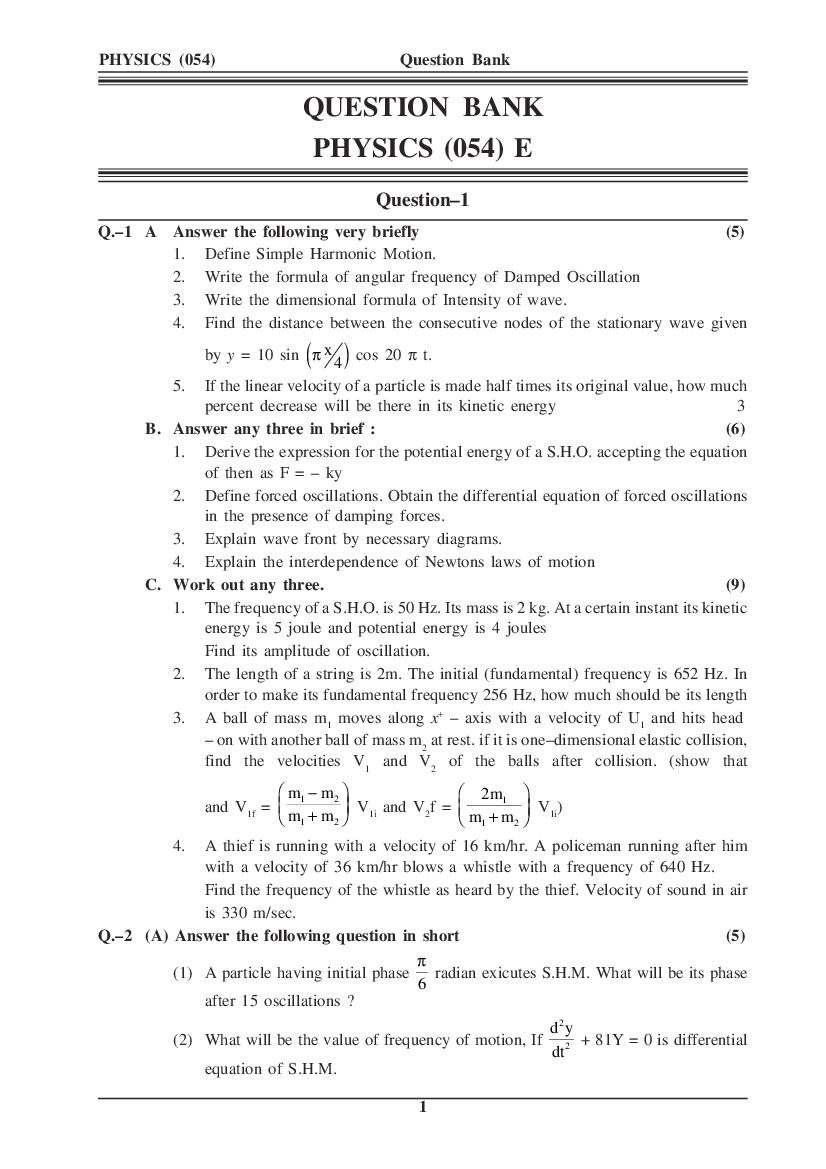
QUESTION BANK
PHYSICS (054) E
Question–1
Q.–1 A Answer the following very briefly (5)
1. Define Simple Harmonic Motion.
2. Write the formula of angular frequency of Damped Oscillation
3. Write the dimensional formula of Intensity of wave.
4. Find the distance between the consecutive nodes of the stationary wave given
by y = 10 sin p x 4 cos 20 p t.
e j
5. If the linear velocity of a particle is made half times its original value, how much
percent decrease will be there in its kinetic energy 3
B. Answer any three in brief : (6)
1. Derive the expression for the potential energy of a S.H.O. accepting the equation
of then as F = – ky
2. Define forced oscillations. Obtain the differential equation of forced oscillations
in the presence of damping forces.
3. Explain wave front by necessary diagrams.
4. Explain the interdependence of Newtons laws of motion
C. Work out any three. (9)
1. The frequency of a S.H.O. is 50 Hz. Its mass is 2 kg. At a certain instant its kinetic
energy is 5 joule and potential energy is 4 joules
Find its amplitude of oscillation.
2. The length of a string is 2m. The initial (fundamental) frequency is 652 Hz. In
order to make its fundamental frequency 256 Hz, how much should be its length
3. A ball of mass m1 moves along x+ – axis with a velocity of U1 and hits head
– on with another ball of mass m2 at rest. if it is one–dimensional elastic collision,
find the velocities V1 and V2 of the balls after collision. (show that
FG m - m IJ V and V f = F 2 m I V )
and V1f =
1
1
2
Hm +m K
2
1i 2 GH m + m JK
1
1
2
1i
4.A thief is running with a velocity of 16 km/hr. A policeman running after him
with a velocity of 36 km/hr blows a whistle with a frequency of 640 Hz.
Find the frequency of the whistle as heard by the thief. Velocity of sound in air
is 330 m/sec.
Q.–2 (A) Answer the following question in short (5)
p
(1) A particle having initial phase radian exicutes S.H.M. What will be its phase
6
after 15 oscillations ?
d2y
(2) What will be the value of frequency of motion, If 2 + 81Y = 0 is differential
dt
equation of S.H.M.
1
Page 2
(3) Write a dimentional formula for intensity of a wave.
(4) What is reverberation ?
(5) Write the law of conservation linear momentum.
(B) Answer the following question (Any Three) (6)
(1) Obtain a formula of mechanical energy of an S.H. oscillator and show that is does
not depend on displacement.
(2) Obtain an equation of one dimensional propagating wave travelling in a positive
direction
(3) Define a centrer of the mass for system of the particals and using it obtain equation
Æ Æ
M V cm = P
(4) What is Beats ? Prove that periodic time of amplitude of resultant oscillation
2
T=
f1 - f2
(C) Compute the following example (any three) (9)
(1) An oscillalor has an initial displacement 8–cm and initial velocity is 16 cm/sec.
If its angular frequency is 2 radian/sec then write an equation of S.H.M.
(2) Prove that motion represented by equation y = A sin wt + B cos wt is simple
harmonie motion
(3) An interval between 2 frequencies of the sound is 21/20. If we can hear a beat
5 per second by the sound, then find frequency of each.
(4) A small uniform sphere having radius "a" is cut off from a big sphere having radius
"R", then find a center of the mass of the rest part in the reference of center of
main sphere.
a
(4) Prove that b =
1- a
Q.–3 A. Answer in one line/word [5]
1. Phase difference between displacement and velocity of particle in SHM.
is ____________
2. Total energy of SHO is E when displacement is half of amplitude, its P.E
is _________
3. Periodic time of SHO is 2 second Ratio of its maximum velocity to maximum
acceleration is_________
4. By differentiating wave equation with respect to time wave velocity is obtained.
Do you agree ?
5. A bomb falling vertically down with constant velocity suddenly explodes.
Velocity of centre of mass would __________.
b. Answer in short (any–3) {6)
1. Write without deriving expression for displacement in SHM. Using differentiation
obtain expression for velocity and acceleration.
2. Write only expression for differential equation for forced oscillation with
damping. Obtain its solution in absence of damping.
2
Page 3
3.Define wavelength, wave – velocity, wave number and wave equation.
4.Write Newton's 2nd Law of motion and hence obtain F = ma. What assumption
is made in deriving this equation.
C Solve examples (any – 3) [9]
A
1. For damped oscillations find time for decrease of amplitude to
2n
2.
When a person of mass 60 kg is standing on spring balance, it executes SHM
with period of I sec. If amplitude of oscillations is O.I meter, find maximum and
minimum weights of person recorded by balance (p2 = 10, g = I0m/s2)
3. A thief is running at speed of 9 Km/Hr. Policeman is chasing him with speed
of 18 Km/Hr, and is also blowing whistle of frequency 1000 Hz. Calculate
frequency heard by thief. Velocity of sound is 340 m/s.
4. A batsman hits ball of 150 gm mass, moving with speed of 12 m/sec. As a
consequence, ball now moves in reverse direction at 20 met/sec. If force exerted
by bat is 480 N, find duration of contact between bat and ball.
Q.–4 A Answer the following questions very briefly : 5
1. What is resonance ?
2. Write the dimensional formula of impulse of force.
3. Two bodies of same mass are oscillating from two springs, one soft and the other
hard. Which of the two springs will oscillate with lesser periodic time ?
4. Define anti–node in the case of a Stationary wave.
5. State Newton's law of conservation of linear momentum.
B Attempt ANY THREE of the following : 6
1. Explain in geometrical representation of SHM.
2. Explain using a system of two particles, as an example, that only the external
Æ Æ Æ Æ
forces need to be taken into account in the expression M a cm F1 + F2 + - - - + Fn .
Hence explain the mutual dependence of Newton's laws of motion.
3. Write a short note on importance of good acoustics in a auditorium.
4. Define the terms : (i) Interval, (ii) Chord, (iii) Consonant interval and (iv) echo.
C. Solve ANY THREE of the following numerical problems : 9
1. A stationary wave formed on a string of length 100 cm has a fundamental
frequency of 196 Hz. If one wants a fundamental frequency of 40 Hz, what should
be the length of the string ?
2. A ball of 6 kg mass hits a wall at an angle of 30o and is then reflected making
an angle of 120o with its original direction. If the duration of the contact between
the ball and the wall is I sec; calculate the force exerted on the wall. The initial
and the final velocities of the ball is I m/s.
3. A lineman on a railway track sees two trains approaching him from opposite
directions. The frequency of the whistles of both the trains is 433 Hz. The
speeds of the trains are 54 km/hr and 36 km/hr respectively. Calculate the
number of beats per second heard by the lineman, Velocity of the sound in air
is 340 m/s.
3
Page 4
4.
A simple harmonic oscillator starts oscillating from its mean position in the
upward direction (i.e. + y). Its period is 12 seconds. Find the earliest time at which
its kinetic energy will be half of its mechanical energy.
Q.–5 A. Answer in very brief. [5]
(1) On attaching some weight to the end of spring and making it oscillate, its periodic
time is found to be T. Now, on attaching its four times mass and making it
oscillate, what will be its periodic time ?
(2) Define resonance
(3) Two sources A & B are sounding notes of frequency 680 Hz. A listner moves
from A to B with a constant velocity u. If the speed of sound is 340 m/s what
must be the value of u so that he hears 10 beats per sound ?
(4) A sound wave of frequency 1020 Hz falls normally on a perfectly reflecting wall.
If the speed of sound in air is 340 m/s. the shortest distance from the wall at which
the air particles have the maximum amplitude of vibration is ______ cm.
(5) The centre of mass of a system of two particles is on the line joing them at point
whose distance from each particle is proportional to the mass of that particle. True
or False ?
B. Answer any three in aboot 10 lines. [6]
(1) Show that angular speed of a reference particle is the angular frequency of the
corresponding S.H.O.
(2) Classifying the waves write an illustration for each of them.
(3) Write the equation of a stationary wave and with proper explanation derive
2L
ln = Write your conclusion from this equation.
n
Æ Æ Æ Æ
(4) In the equation Ma an = F1 + F2 .... Fn only external forces need to be taken into
consideration.' explain with an example of the system of two particles.
C. Solve any three [9]
(1) For damped oscillations, find the time for decrease of the amplitude of A/2n.
(2) A simple harmonic osicllator starts Oscillating from its mean position in the
upward direction (i. e. + y). It's period is 16 seconds Find the earliest time at which
its kinetic energy will be half its mechanical energy.
(3) f1, f2, ..... fn are the frequencies of a set of `n' forks. Any two consecutive forks
of the set generate 6 beats per second. If the nth fork has frequency n times the
first one, find the frequency of the first and (n – 1)th fork.
(4) A this rod of uniform cross section and length 5 m is
suspended from a support as shown. At the other end of the
rod a sphere of unform density is fixed in such a way that
the other end of the rod is at the centre of the sphere. Find
the centre of mass of the system with reference to the support
point, if M1 = 16 kg is the mass of the rod and M2 = 9 kg
is the mass of the sphere.
4
Page 5
Q.–6 A Answer in short. 5
(1) Write dimensional formula of damping co-efficient.
d2 y
(2) The differential eqation of an oscillator is 2 + 100 y = 0, then its periodic time.
dt
(3) The intensity ration of two wave is 4:9, then what is their amplitude ratio ?
(4) Define node in case of stationary waves.
(5) Two particles have masses in the ratio 1:2 but have value of the momentum, then
what is the ratio of their kinetic energies ?
B Answer any three of the following questions. 6
(1) Obtain differential equation for simple harmonic motion defien S.H.M.
(2) What is resonance ? Write two example of the resonance.
(3) State the law of conservation of linear momentum. Explain it with a suitable
example.
(4) Write short note on centre of mass of a rigid body.
C Attempt any three of the following problems. 9
(1) An oscillator having a mass of 100 gm is executing damped oscillation. After 100
oscillations the amplitud reduces to half its original value. Find the damping
co-efficient if its period is 2 sec.
(2) Interval between two sound freguencies is 21/20. If they generate 5 beats per
second find the frequencies.
(3) Distance between two particle having masses m1 and m2 is r. If the distance if
these particles from the centre of mass of the system are respectively r1 and r2,
show that r1 = r
LM m OP and r = r LM m OP
2 1
Nm + m Q
1 2 Nm + m Q
2
1 2
(4) A stationary wave formula on a string of length 100 cm has a fundamental
frequency of 196 Hz. If one wants a fundamental frequency of 400 Hz. what
should be the length of the string ?
Q.–7 A Answer in short (5)
(1) The amplitude of a damped oscillator between half in one minute. What is its
amplitude after 3 minutes ?
(2) Two particles vibrating in SHM along the same line and same period cross each
other at the mean position its oppotite direction what is the difference at its
phase ?
(3) A turning fork and a siren produce 18 beats in 3 sec. The frequency of the siren
is 256 z. Which decreases with adecrease in the speed of siren. What is the
frequency of turning fork.
(4) Write the statement of Huygen's Principle.
(5) A light and a heavy body have equal momenta which has the greater kinetic
energy ?
5
Page 6
B Attempt any three. (6)
(1) Define the term 'phase' in SHM. Which are the parameters of the motion that can
be deduced from the phase ?
(2) What is wave e the ? Obtain the eqn
y = A sin (Wt – kx) for one dimensional. harmonic wave propagating in x –
direction ?
(3) Explain the term "wave front" giving an appropriate figure.
(4) Explain what is the mutaul dependence at Newton's Laws for a system of particle.
C Solve the following (Any three) (9)
(1) A simple harmanic oscillator starts oscillatig from its mean position is the upward
direction (ie five) Its period is 6 seconds find the earliest time which its kinetic
energy will be one fourth. Its mechanical energy.
(2) Initial placement at a damped oscillator is zero and its initial velocity is Vo. Obain
the values of the constants in the expression. for its displacement. Take angular
frequency as W'.
(3) Ratio of the frequencies of the horn of a car when approaching to that when
receding as heard by a stationary traffic polive is 1.6 Taking speed of sound as
340 m/sec. Fidn the speed of the car.
(4) A ball of 8 kg. mass hits a wall at an angle of 30o and is then reflected making
an angle of 60o with its original direction. If the duration of contact between the
ball and the wall is 0.1 sec. Calculate the force exerted on the wall. The initial
and the final velocities of the ball are 1 m/sec.
Q.–8 A Write short answer to the following questions. 5
1. If displacement of a simple harmonic oscillator is increased by 20% then what
will be the percentage increase in its potential energy ?
2. Give the definitions and magnitude of a wave vetor.
3. What kind of disturbance propagates in case of electromagnetic waves if a meduim
is not required for their propagation.
4. A bomb at rest explodes in two fragments of 2 kg and 3kg what will be the ratio
of their velocity after the explosion ?
5. The centre of mass of the substances having simple geometry symmetry can be
easily determined. True / False.
B. Write answer in eight to ten statements as asked (Any 3) 6
1. Write the equation of displacement of SHO with the help of differentiation obtain
the equation of velocity in terms of dissplacement and write the values of &
position of maximum & minimum velocities
2. What are natural & forced oscillations ? Derive differential equation of forced
oscillation with damping.
3. Explain beats effect in short.
4. Using the expression :
Æ Æ Æ Æ
M cm = m1 v1 + m2 v2 + ... + mn v n
6
Page 7
Æ Æ
for a system of particles Derive M a cm = F and show the forcess acting on the
system.
C. Solve the following (Any 3) 9
1. A given damped oscillator has period T. Prove that the decrease in the natural
logarithm of its amplitude per oscillations is bt/2m.
2. An oscillator having a mass of of 100 gm. is executing damped oscillations after
100 oscilations the amplitude reduces to half its original value. Find the damping
coefficient if its period is 2 sec.
3. A stationary listener experiences that the ratio of the frequency of the sound of
horn when a car is approaching him, to that when it is receding from him is 1.7
Taking velocity of sound as 340 m/s. Find the speed of car.
4. In a lake, a person is standing on a stationary raft. The distance between the person
and the bank is 50 meter. Mass of the person is 40 kg. and that of the raft is 60
kg. The person now starts running towards the bank with a velocity of 10 m/s
w.r. to the raft. How far will the person be from the bank after 4 sec ?
Q.–9 A. Answer the following in short 5
1. A S H O takes 1.5 sec to reach one of its ends from its equilibrium point. Find
its angular frequency.
2. Define resistive force co–effcient.
3. The velocity of wave propagated in a wire is 10 m/sec.
It wave length is 4cm. What will be the angular frequency ?
4. On what factors the place of center of mass of a rigid body depends ?
5. What are natural oscillations ?
B. Answer any three in eight to ten sentences. 6
2
1. For S H O obtain the expression U = 1/2 KY for its potentional energy.
2. Write down thee differential equation for forced oscillation without damping and
obtain its solution.
Æ
3. Give the formula of V cm for a syatem of particals. Accepting expression
Æ Æ
P = MV cm derive Newton’s second law of motion.
4. Discuss the reflection of wave from a rigid support for tx – direction
C. Solve the following (Any Three) 9
1. An oscillator having a mass of 100gm is executing damped oscillation After 100
oscillations the amplitude reduces to a forth of its original value. Find the damping
co–efficient if its period is 2 sec.
2. Interval between two sound frequencies are 12/11. If they generate 8 beats per
second find the frequencies.
3. Astationary wave formed on a string of length 100cm has fundamental frequency
of 196 Hz. What should be the length of the string. if one wants frequency of
400Hz.
4. Amplitude of a propagating wave is 10mts. A point located at 2mt from the source
has the displacement of 5mt at 2sec, and point located at 16mt the displacement
is 3 mt at 8sec. Find the angular frequency and the wave vector for this wave.
7
Page 8
Q.–10 A 5
1.
At which positions do the kinetic and potential energies become equal ?
2.
Phase difference of oscillationss of two medium particles during the propagation
of wave is 17 radian. what is the distance between the two particles in terms of
wavelength.
3. Write the dimensional formula of damping co–efficient (resistive force co–
efficient) of a medium.
4. What is the value of resultant amplitude at nodal point ?
5. At which point is the acceleration of a simple harmonic oscillator equal to the
linear acceleration of its reference particle ?
B. Answer the following questions in eight to ten sentences : (Any three) 6
1. Derive the equation of a stationary wave produced by the superposition of two
waves y1 = A sin (wt – kx) and y2 = A sin (wt + kx) Define nodes and Antinodes.
Æ Æ Æ Æ
2. In the expression M a = F1 + F2 + Fn ... only external forces are taken into
c.m
account. Explain using a system of two particles; when and how is this possible.
Hence explain what is meant by mutual dependence of Newton’s law of motion.
3. Explain the term “Wave front” giving an appropriate figure.
4. What is beat ? Prove that in the phenomena of beats the periodic time is
2
T= of the resultant oscillating amplitude.
f2 - f1
C. Solve the following examples (Any three) 9
1. A stationary listener expriences that the ratio of the frequency of the sound of
horn when a car is approaching him, to when it is receding from him is 1.5. Taking
velocity of sound as 340m/s, find the speed of the car.
2. Derive differential equation of damped oscillator. Explain the graph showing
relation of displacement with time in damped motion.
3. A stationary bomb explods, and on explosion it fragments into 3 parts. Two of
these parts having equal mass fly apart perpendicular to each other with a velocity
of 20 m/s each. The third part has a mass two times of other two. Find the
magnitude and the direction of motion of the third part.
4. Particles shown in the figure, having masses m1 = 1 kg, m2 = 2kg and m3 kg, are
placed at the verticles of an quilateral triangle having length of each side equal
to 1m. Find the center of mass of this system of particles.
Y
m3
1m
1m
m1 1m m2
8
Page 9
Q.–11 A Answer the following questions in very short. 5
1. At which point is the acceleration of a simple harmonic oscillator equal to the
linear acceleration of a reference particle ?
2. The dimensional formula of damping co-efficient (resistive force coe-fficient)of
a medium is ____
3. The wave propagting in a wire has 10 meter/sec wave velocity and wavelength
of 4 cm. What will be the angular frequency of the wave ?
4. What is a chord ?
5. ____ is the dimensional formula of impulse of force.
B. Answer the following questions in eight to ten sentences (any three) 6
1. Define phase and explain it in brief. What can we know from the phase ?
2. Prove that, when the progressive harmonic wave is reflected from the rigid
support, the phase of the reflected wave is increased by an amount p with respect
to the incident wave.
3. Give the definition, unit and dimensional formula of the linear momentum of a
particle with the help of an example, explain the advantage of defining linear
momentum.
4. State Newton’s second law of motion for a particle, and deduce the formula
Æ Æ
F = m a is this equation true for all cases.
C. Solve the following examples : (Any three) 9
1. A horizontal plank is executing simple harmonic oscillations in a vertical
direction. A coin of mass m is placed on the plank. Find the periodic time of
oscillations of the plank for which the coin will just lose contact with the plank.
(Amplitude of oscillation is A).
2. f1, f2 ... fn are the frequencies of a set of n forks. Any two consecutive forks of
the set generate 5 beats per second. If the nth fork has a frequency n times the
first one, find the frequency of the first and (n–1) fork.
20
3. Interval between two sound frequencies is . If they generate 5 beats per second,
21
find the frequencies.
4. A ball of 10 kg mass hits a wall at an angle 30o and is then reflected making
an angle of 120o with its original direction. If the duration of contact between the
ball and the wall is 0.2 s, calculate the force exerted on the wall. The initial and
the final velocities of the ball is 2 m/s.
Q.–12 A Answer in short of the following 5
1. For an elastic spring of force constant k, the slope of (M Æ T2) graph for
oscillation is _____ (Fill in th blank)
d2y
2. Differential equation for pure SHM is given by 2 + 8y = 0. If the mass of the
dt
oscillator is 5 Kg, find the force constant of the system.
3. Equation of a wave is given by y = 5 sin
p FG
2t -
x IJ
cm. Find the distance traveled
3 H 4 K
by the wave when the particle of the medium completes 5 oscillations.
9
Page 10
4. Huygen’s principle can be applied to any medium. Is it true ?
5. Write the factors affecting the position of centre of mass.
B. Answer any three of the following. 6
1. Define forced oscillation write the differential equation for such oscillation
without damping. Hence derive its solution.
2. State Huygen’s principle. Using this principle, explain how a plane wave front
is formed.
3. Define progressive, harmonic, one–dimentsional wave. Derive an equation for
such a wave propagating along negative X–direction.
4. Write a note on inter dependence of Newton’s laws of motion for system of
particles.
C. Solve any three of the following. 9
1. If a body of mass 50 g is suspended at the end of an elastic spring, its length
increases by 20 cm. In this condition, the body is displaced by 7 cm in upward
direction and then released, it executes SHM. Obtain the equation for its
displacement.
2. Prove that for a wave propagating in medium, the ratio of the instantaneous
velocity of a particle of the medium to the wave velocity is equal to the negative
value of the slope of waveform at the point.
d
3. From a thin disc of radius R and surface density , a part having radius R/3 is
cut off as shown in the figure. Find the center of mass of the remaining part of
the disc, with referencee to the center of original disc.
Y
R/3
O X
4.A batsman hits a ball of mass 150 g, moving with speed of 25 m/s. As a
consequence the ball now moves in the reverse direction at 30 m/s. If the time
of contact with the ball and the bat is 0.125 sec. calculate the force exerted on
the ball by the bat.
Q.–13 A Write the answer in very short : 5
1. Obtain the ratio of Maximum Acceleration and Maximum velocity of Simple
Harmonic Oscillator.
2.
FG
The equation of stationary Wave is y = 5 sin 30 p t -
x IJ
meter. Find out the
H 240 K
velocity of wave.
3. Write the name of physical quantity whose unit is Newton – Second.
4. Which information are obtained by knowing the Phase of Simple Harmonic
Oscillator ?
5. Write the dimensional equation of Intensity of a Wave.
10
Page 11
B. Write answer in eight to ten statements as asked : (Any three) 6
1. Accepting the equation of force for simple harmonic oscillator obtain its Periodic
Time.
2. State Huygene’s Principle and draw figure explaining the propagation of
Cylindrical Waves.
v + vs
3. Obtain the equation of wavelength l = for the waves approaches from
fs
source to listener in Doppler effct.
4. Write only the Newton’s Second law of motion for system of particles in the form
of equations. From that write the law of conservation of linear momentum and
state it’s importance.
C. Calculate Any three Numerical Problems. 9
1. Mass of S.H.O. is gm, frequency .. radian and Amplitude is 10 cm. Then obtain
Force constant of this spring.
2. The length of string is 200 cm. The fundamental frequency of a stationary wave
formed on it is 200 Hz. If the required fundamental frequency is 50 H. What should
be the length of a string ?
3. Three uniform spheres each of diameter 18 cm and uniform density are placed
on a horizontal surface so that their surface are in contact. Determine the center
of mass of the system taking origin at the center of any one sphere.
4. A spring of length l and force constant k is divided into two parts of lengths
l1 and l2 respectively. If l1 = nl2, (n being an integer) then prove that k2 = k(n + l).
Q.–14 A Answer the following questions in very short as asked. 5
(1) Whart is the angular frequency of S.H.O. whose maximum acceleration and
cm cm
maximum velocity are 4p 2 and 2 respectively ?
s s
(2) There are three loops in a 120 cm long string tied from both of its end. What
will be the distance between two consecutive nodes and antinodes ?
(3) What is impulse of force ? Write its unit.
(4) What will be the slope of the graph ln A(t) Æ t for a damped osillation ?
(5) A planee wave front of light is incident on a convex lens the wave front coming
out it will be – _______ (spherical, plane, cylindrical, of any irregular shape)
B Answer the following questions in eight to ten sentences. (Any three) 6
1
(1) Derive potential energy U = ky2 for a S.H.O.
2
(2) Explain the reflection of a progressive, harmonic wave from a rigid support.
(3) State the law of conservation of linear momentum and explain it with example
of explosion of a stationary, chemical bomb.
(4) Write a note – ‘Musical Scale’
C Slove the following examples. (any three)
(1) A spring of length l and force constant k, is divided into parts of length l1 and
l2 respctively. If l1 = nl2; n being an integer, obtain force constants k1 and k2 of
the two springs in terms of n and k.
(2) Obtain the equation of s stationary wave generated on superposition of waves,
y1 = 10 sin (3pt – px) and y2 = – 10 sin (3pt – px.) From x = 0 of stationary
11
Page 12
wave, find (i) the amplitude of the particle at x = 0.25m (ii) distance of the first
node and the first antinode from x = 0
(3) In a lake, a person is standing on a stationary raft. The distance between the person
and the bank is 30 meters. Weight of the person is 60 kg and that of the raft is
40 kg, the person now starts running towards the bank with a velocity if 10 m/
s with respect to the raft. After what time will the person reach the bank ?
(4) Prove that for a wave propagating in a medium, the ratio of the instantaneous
velocity of a particle of the medium to the wave – velocity is equal to the negative
value of the slope of the wave form at the point.
Q.–15 A Write short answer to the following questions. 5
1. The mechanical energy of a simple harmoni oscillator is E = ___ or ____.
2. Find the displacement of a simple harmonic oscillator when its velocity is
maximum.
3. Write the unit of the intensity of wave.
4. What is the rate of change of momentum of a body when the resultant external
force acting on it is zero ?
5. The position coordinates of two particles of mass 1 gm and 2 gm are (1, 2) cm
and (2, 1) cm respectively. Writee the coordinates of their center of mass.
B. Write answer in Eight to Ten statements as asked (Any Three) 6
1. Derive the equation of potential energy of the simple harmonie oscillator
accepting F = – ky
2. Derive equation of a stationary wave. Why is it called so ?
v + vs
3. Only with the help of figure derive the equation of wavelength l = , of
fs
the waves going from the source to the listener in Doppler’s effct.
Æ Æ
4. Define center of mass for a system of particles, thereby obtain P = MV cm.
C. Calculate any three Numerical Problems from following. 9
1. A particle executing SHM along y – axis has an initial displacement 2 cm and
an initial velocity 2cm /sec. If its period is 2 sce, obtain an exprssion for the
displacement. Take x – axis as the reference direction.
2. ASHO starts oscillating from its mean position in upward direction (i.e. + y.) The
period is 16 seconds. Find the earliest time at which its kinetic energy wil be half
the mechanical energy.
3. Prove that for a wave propagating in a medium, the ratio of the instananeous
velocity of a particle of the medium to the wave velocity is equal to the negative
value of the slope of the wave form at that point.
4. A stationary bomb explodes, and on explosin it fragments into three parts. Two
of these parts which ar of equal masses, fly apart perpendicular to each other with
a velocity of 15 m/s each. The third part has a mass 3 times the other two. Find
the magnitude and direction of motion of the third part.
Q.–16 A Answer the following questions in short as asked. 5
1. The period of oscillations of a spring is measured T, by suspending certain mass
at ts end. Now if the mass is taken nine times greater, what will be its new
period ?
12
Page 13
2.
The amplitude of a S.H.O. having massing A. IF = Y = 1 unit, the force is ‘b’
unit. What will be the maximum potential energy of the oscillator ?
3. The ratio of intensites of two waves is 1 : 16. Find the ratio of their amplitudes.
4. A 100 cm long string is fixed at its two ends. If there are four loops in the stationary
pattern constructed on it, find the distance between two consecutive autinodes.
5. If the Kinetic energy of a body becomes nine times that of its original value, the
increase in its momentumis .... %
B Answer the following questions in eight to ten sentences (any three) 9
1
1. For a S.H.O obtain the expression U = KY2 for its potential energy.
2
2. Discuss the reflection of a wave from a rigid support.
3. Write Huygen’s principle. Using this principle explain propagation of place wave
front.
4. Explain the law of conservation of linear momentum with a suitable illustration.
C Solve any three examples. 9
1. A spring of length ‘l’ having its force constant K is cut intio two parts. These
parts have their length in 4 : 1 proportion and their force constants are K1 and
5K
K2 respectively. Show that K1 = and K2 = 5K
4
2. A rectangular vessed of cross – sectional area A is closed by a block having same
cross – section So that the system is airtight. In the equilibrium position the
pressure inside the vessel is P and the volume enclosed is V. Now the block is
given a small displacement x and then released. Show that the block will perform
S.H.M Let. the motion be frictionless and take compression isothermal.
3. f1, f2, f3, .... f10 are the frequencies of a set of 10 forks. Any two consecutive forks
of the set generatee 6 beats per second. If the 10th fork has a frequences 4 times
the first one, find the frequency of the first & 10 th fork and also find the frequency
of 8th fork.
4. A sphere of mass m1, moving with a velocity v1 along the X – axis suffers an
elastic one dimensional collision with a sphere of mass m2, lying stationary on
the same axis. If the velocities are v1 and v2 respectively, prove that v1 =
LM m - m OP v & v = LM 2 m OP v
1 2 1
Nm + m Q
1 2
1 2
Nm + m Q
1 2
1
Q.–17 A Answer the following questions in very short as asked. 5
1. If a mass ‘a’ is suspended from a vertical spring of force constant ‘b’ & osicillated,
then frequency of oscillation is ____.
2. The phase difference between two waves represented by
y = A sin (wt – kx) and
y = A cos (wt – kx) is ____ radian
3. Two particles execute SHM on the same path. During the motion, when they meet
each other at the displacement half the amplitude, they are found to move in the
opposite direction Find the difference of their phase.
13
Page 14
4. The velocity of the centre of mass of a systen of total mass 25 kg changes
uniformly from 10m/sec to 50 m/sec. in the same direction in 5 sec. find the force
on it.
5. On what factors the amplitude of a forced oscillation of a body depend.
B. Answer the following in eight to ten sentences (Any Three) 6
1. Give an account of two forces acting on an oscillator undergoing damped
oscilations, there by derive, differential equation for it. Write the solutions of the
equation and draw the graph of amplitude –> time.
2. State and explain Huygen’s principle.
3. Give the general expression for Doppler effect and discuss all the special cases.
4. State the law of conservation of linear momentum. State the importance of the
law.
C. Solve the following (Any time) 9
1. Two sitar stringss A and B playing the note “Ga” are slightly out of tune and
produce brass of frequency 6Hz. The length of the string A is slightly increaed
and the beats frequency is found to reduce to 3Hz. If the original frequency of
A is 324 Hz what is the frequency of B ?
2. A wooden rod of mass M and cross section A floats in the liquid. Its centre of
mass is slightly under the liquid surface. If it is slightly pressed bellow and then
released show that it performs SHO. Obtain the formula for its periodic time.
3. The displacement of SHO is givein by y = 5 3 sin 10pt + 5 cos 10pt cm, where
t is in second. Find its amplitude and periodic time
4. Distance between two particle having masses m1 and m2 is r. If the distance of
these particles from the centre of mass of the system are respeectively r1 and r2,
prove that r1 = r
FG m IJ and
2
Hm +m K
1 2
r2 = r
FG m IJ
1
Hm +m K
1 2
Q.–18 (A) Answer the following questions in very short. (5)
1. A spring stretches by 9.8 cm on suspending a body of mass0.2 kg. What is the
force constant at the spring?
2. What are the natural oscillations?
3. Wavelength of wave is 25 cm and its frequency is 400 Hz. The velocity of the
wave =_______ m/s.
4. Define wave - vector and give it unit.
5. The centre of mass of the earth - moon is nearer to the earth? True or false?
(B) Answer the following questions in eight to ten sentence (Any Three) (6)
1. Explain reference circle and refrence particle with necessary figure.
2. explain with an example the various forms of waves depending on the medium
for their propagation.
3. Write the help of suitable diagram, explain the forces acting on a system of
particles and also explain the matual dependence of Newton’s law.
14
Page 15
(c) Solve the following examples. (Any Three) (9)
1. A.S.H.O. starts oscillating from its mean position in the upward direction ( ie +y).
Its period is 8 sec. find the earliest time at which its. Mechanical energy is half
15 kinetic energy.
2. When displacement of S.H.O. is 3 cm, its velocity is 4 cm/sec, and when the
displacemenet is 4 cm, its velocity 3 cm/sec. find its (i) amplitude (ii) angular
frequency and (iii) periodic time.
3. A thief running at a speed of 9 km/hr., a policeman is chasing him with a speed
of 18 km/hr, and is also blowing a whistle of frequency 1000 Hz. Calculate the
frequency heard by the thief.
4. Equation of propogating wave is y =20 sin (’t - 2’x) with y in metre and t in
second. What will be the phase difference of oscillation at two points located at
a distance of 5 mt at a given time? Also for a given point what will be charge
in the phase of oscillation after a time interval of 2 second?
Q.–19 (A) Answer the following in very short. (06)
(1) At what distance from mean position is the kinetic energy in simple harmonic
Osicllator equal to potential energy ?
(2) What are beats
(3) When a bomb at rest explodes suddenly. Where does - ue kinectic energy of the
ffragments come from ?
(4) A spring of length l has force constant K. If it is cut into two equal parts and
these parts are then joined in parallel, their effective force constant will be _____
fill in the blank.
(5) Two tuning forks at 256 Hz and 260 Hz are sounded together. In the beats
produced. How much time will it take for the amplitude to change from zero to
maximum value ?
(B) Answer any three of the following question in short. (06)
(1) What are natural oscillation? Derive differential equation for simple harmonic
motion?
(2) Elplain propogation and dissipation of energy in wave and give definition, unit
and dimensional formula of intensity of wave.
(3) Explain forces acting on the system of particles Hence explain what is meant by
mutual dependence of Newtin’s laws of motion.
(4) Obtain the expression for total energy of simple harmonic oscillator.
(C) Solve any three from the following example. (09)
25
(1) A 0.2 kg. mass executing simple harmonic motion has frequency equal to Hz.
p
At a particular instance its kinetic energy is 0.5 joule and potential energy is 0.4
joule, find the amplitade.
(2) Ratio of the frequencies of the horn of a car when approching to that when recedig,
as heard by a stationary traffic polce is 1.6 Taking speed of sound as 340 m/s.
Find the speed of the car.
(3) A rigth handed batsman is holding his bat obliquely, A ball hits the bat at 450
angle and gets reflected perpendicular to the surface of the bat with speed of 20
15
Page 16
m/sec. Initial velocity of the ball is 30 m/s and it weight 150 gm. If the duration
of contact between the ball and the bat is 0.1 second, find the force exerted on
p
the bat (Cos = 0.7071)
4
(4) f1, f2.....fn are the frequencies of a set of ‘n’ forks. Any two consecutive forks
of the set generate 5 beats per second If the n.....th frok has a frequency n times
the first one find the freqency of the first and (n-1) the fork.
Q.–20 (A) Answer in short as require: (05)
(1) Define the force constant of the spring.
(2) What are normal modes of vibrations of a string fixed at its two ends ?
(3) On what factors the place of centre of mass of rigid body depend ?
(4) Distance between two particles having masses 5 kg. & 6 kg. is 22 meter. Find
the distance of centre of mass from the particle of 6 kg. of mass.
(5) If three nodes are obtained on a string of length of 200 cm, fixed at its two ends
give the distance between consecutive antinodes.
(B) Answer in about 8-10 sentence. (Any three) (06)
(1) Draw and discuss the graphs of potential enegry, kinetic energy versus
displacement for a simple harmonic oscillator.
v
(2) Obtain the formula V = for a wave and define quantities occuring in it.
k
(3) Write Newton’s second law of motion for a particle and explain “the mutual
dependence of Newton’s laws”.
(4) Write down the differential equation for forced oscillations without damping and
obtain it solutiion.
(C) Solve following examples (any three) (9)
(1) An oscillator having a mass of 10 gm is executing damped oscillations. After 50
oscillations the amplitude reduces to half of its original value. Find the damping
coefficient if its period is 4 second.
(2) Two wires placed close to each other are vibrating in their first harmonic. If the
first harmonic of the smaller wire is 225 Hz and the sound produced by the two
wires produces 5 beats per second, find the length of the longer wire. The velocity
of waves in both wire is 299 m/s.
(3) A solider is firing bullets each having mass of 40 gm. with a speed of 1 km/s from
a machine gun. He can withstand at most an average recoil force of 360 Newton.
What is the maximum number of bullets that he can fire in one second ?
(4) For a wave propagating in a medium prove that the ratio of the instantaneous
velocity of a practicle of the medium to the wave velocity is equal to the negative
value of the slope of the wave form at that point.
Q.–21 (A) Answer the following questions as asked: (05)
(1) At which position of SHO, will the mechanical energy be four times the potential
energy ?
(2) What will be the amplitude of aparticle performing damped oscilliations, at time
16
Page 17
2m
t= ?
b
(3) What is an isotropic medium ?
(4) In case of sound, beats to be clearly heard, What should be the no. of beats per
second ?
(5) An object of mass 10 gm. experience 50 N.s impluse of force, what will be the
change in its momentum ?
(B) Answer any three of the following questions in eight to ten sentences: (06)
(1) Define Natural oscillations and forced oscillations. Obtain solution of differential
equation for forced oscillations, in the absence of damping.
(2) Using the general expession for the Doppler effect. discuss any two particular
cases.
(3) Using stationary wave equation for waves formed on the string, explain Normal
modes of vibrations.
(4) Define centre of mass system of particles. Using the definition, prove that
r r
P = M. Vcm
(C) Solve any three of the following examples : (09)
(1) Write down the expression for the total energy of a simple harmonic oscillation
in terms of sum of its potential and kinetic energies. Using the fact that total energy
does not change with displacement, obtain differential equation of Motion.
(2) When a person of mass 60 kg. is standing on a spring balance, the balance executes
S.H.M. with period of 1 second. If the amplitude of oscillations is 10 cm. then
find MAXIMUM and minimum weight of the person recorded by balance.
Take g =10 m/s2 and p2 = 10
(3) A stationary source is emitting frequency of 25 Hz. Find the minimum velocity
with which a listner would be receding from the source so that he does not
experience the sensation of sound. Speed of sound is 300 m/s.
(4) A batsman hits a ball of 150 gm. mass, moving with speed of 12 m/s. As a
consequence, the ball moves in the reverse direction at speed of 20 m/s. If the
force exterted by the bat is 480 ¥ 105 dyne then find the duration of contact
between the ball and ball.
Q.–22 (A) Answer the following questions in short. (05)
(1) When t =0 the S.H. Oscillator is at the end of negative terminal of its path write
the formula of its displacement at time t.
(2) At what point of the path, of S.H.O the potential energy and kinetic energy
becomes equal ?
(3) The velocity of a wave is 330 m/s and its frequency is 550 Hz. Two particles
on the wave have their phase difference 300 What is the distance between the two
particles ?
(4) The value of linear-momentum of a substance become half of its original value
of linear-momentum How much precentage will the K.E. will dicrease ?
(5) State the factor on which centre of mass of a rigid body depends.
(B) Answer any three of the following questions. (06)
(1) What is phase ? Explain with suitable figure and define.
17
Page 18
(2) Define wave-intensity. Give its unit and dimantional formula.
(3) What is beats ? Using the superposition of two waves given by y1 = A sin w1t
and y2 = A sin w2t at a point in a medium. Hence obtain the expression for the
number of beats per second.
(4) Write the statement of the law of conservation of linear momentum. Explain an
example of explosion of a chemical bomb.
(C) Attempt any three of the following problems. (09)
(1) When a person of mass 60 kg. is standing on a spring balance, the balance executes
S.H.M. with a period of 1 sec. of the amplitude of oscillators is 0.1 m then final
the maximum and minimum weights of the person recorded by the balance.
(Take p2 = 10, g = 10 m/s2)
(2) A string is 100 cm. long. Two consecutive harmonics of stationary waves formed
on that string have frequencies 300 Hz and 400 Hz respectively, (i) Find the
fundamental frequency (ii) Find the frequency when 5 antinodes are formed on
the string (iii) when the string is oscillating in the fundamental frequency the
maximum width of the loop formed is 10 cm. Find the equation for the
correspendig wave.
(3) Three uniform spheres each of raduice R and equal mass are placed on a horizontal
surface so that their surface are shown in the figure of mass of the system taking
origin at the centre of sphere 1 and axes are shown in the figure.
Y
3
m
1 2
m X
0
(4) A sphere of mass m1 moving witha velocity V1 along the X-axis suffers an elastic
one-dimensional collision with a sphere of mass m2 lying stationary on the same
axis. If the velocities of the spheres m1 and m2 after collisions are V1 and V2
respectively prove the :
V11 =
FG m - m IJ V and V = FG 2m IJ V
1 2
1 1
Hm +m K
1 2
1 Hm +m K
2
1 2
1
Q.–23 A Answer the following question in vey short as asked. 5
1. Define intensity of a wave.
2. Kinetic energy of simple harmonic oscillator, having total mechanical energy 50
J, is 20 J when its displacement is 2 cm then find force constant.
18
Page 19
3. What is the number of wave s in 1 cm distance in case of light waves of
5000Ao ?
4. Two bodies of the same mass are oscillating from the two spring one hard another
soft. Which one will have more periodic time ?
5. If mass of a distance remains some but kinetic energyu becomes 4 time then its
linear momentum increases by how many times its original value ?
B Answer the following questions in eight to ten sentences (Any three) 6
1. Derive the equation of the phase of SHO at time t.
2. Classify the waves and write an illustration for each of them.
3. Obtain the equation of resultant force acting on a body suspended from the lower hand
of an elastic spring when it is displaced by Y in downward direction from equilibrium.
Æ Æ
4. Write Newton's Second law for particle thereby deduce F = m a
C Solve the following examples (Any three) 9
1. A 0.2 kg mass executing simple harmonic motion has frequency equal to 25/p
Hz. At a particular instance. Its kinetic energy is 0.5 Joule and potential energy
is 0.4 Joule find the amplitude.
2. Prove that for a wave propagating in medium, the ratio of the instantaneous
velocity of a particle of the medium to the wave velocity is equal to the negative
value of the slope of the waveform at the point.
3. Two persons A and B posses source of sound with frequency 66 Hz. Now A starts
moving toward B who is staionary with respect to ground at 3 m/s. Find number
of beats as heard by A. Velocity of sound in air is 330 m/s.
4. From a thin disc of radius R and surfacee density p a part having radius R/2 is
cut off as shown in fig. Find the center of mass of the remaining part of the disc,
with reference to the center of the original disc.
X
R
Y
O R/2
19
Page 20
Question–2
Q.–1 A. Answer the following very briefly : (5)
1. Write the definitions of a Rigid body and a Solid body.
2. The velocity of a rolling body at the bottom of a plane is less than the velocity
of a slipping body there. Why ?
3. Find the ratio of the maximum range (Rmax) and the maximum height (Hmax)
of a projectile.
4. Write the value and unit of Stephen Boltz mann constant.
5. If the temperature of a black body is made 3 times, what will be the increase in
the emissive power of the body ?
B. Answer any three briefly : (6)
1. Obtain the expression for the frictional force acting on a cylinder rolling down
an inclined plane accepting the expression. V = 4
3 gh.
2. Explain "Thermal Steady State". In this state obtain the expression for heat
current.
3. Define Cannot cycle. Explain the working of Carnot Engine.
4. Explain the vector representation of Newton's Law of Grativitation.
C. Work out any three : (9)
1. A pendulum clock whose period on earth is 2 seconds is taken to the moon. Will
it go fast or slow ? By how much (slow or fast) per hour ? ge = 9.6 ms–2
gm = 1.6 ms–2
2. A lift weighing 1000 kg moves up with an acceleration of 2.2. m/s2.
What is the tension experienced by its cable? What is the tension if the lift comes
down in the acceleration 2.8 m/s2
3. In a Carnot's Engine, the temperature of the sink is 300o K. Its efficiency is 50%.
If its efficiency is to be made 60 %, by how much should the temperature of source
be increased keeping the temperature of sink fixed
4. Show that during an adiabatic process the work done is given by
P1V1 - P2 V2
W=
g -1
Q.–2 (A) Answer the following question (5)
(1) What are the aspects on which the moment of Inertia depends ?
(2) Define geodesic
(3) Define termperature gradients and write its unit
(4) A wheal having radius 50 cm, rotates 30 revolutions per minutes. What will be
linear speed of a particle situated at a circumference of it ?
(5) Explain "The death of Heat is not completely possible."
(B) Answer in brief (any three) (6)
(1) Derive Kepler's second law for the orbital motion of the planet.
20
Page 21
(2) What is projectile motion ? Obtain the expression for the range of a projectile
(3) What is thermal radiation ? Write stephen – Boltzmann law giving its
mathematical expression.
dx2
(4) Define a simple pendulum and obtain differential equation 2 + w2x = 0.
dt
(C) Compute the examples (any three) (9)
(1) A string is wound around a smooth disc of mass M and radius R. At its free end
a body of mass M in is attached the disc so that free to rotate about its geometric
axis. which is horizontal. When the mass M in descends it cover a distance "d"
in time "t" prove that the angular acceleration of the disc. a =
2 FG g - 2d IJ
R H tK 2
(2) A satellite weighting 200 kg is orbiting the earth at 1000 km height above the
surface. Find binding energy of the satelite and its escape velocity. Mass of the
earth = 6 ¥ 1024 kg. And its radius = 6400 km.
(3) An ideal gas is isothermally expanded so that its volume becomes double then
it is adiabatically compressed to its original volume. Find the pressure after the
adiabatic compression. (use original pressure = 1 atmosphere g = 1.4)
(4) The energy of the thermal radiation emitted per second per unit area for two
substances with the same surface emissivity has a ratio of 16 : 1. If the hotter
body is at 1000o K find the temperature of cooler body.
Q.–3 A. Answer in one line/word [5]
1. If the earth were to shrink suddenly (mass constant) what would happen to length
of day ?
2. Torque required to produce unit angular acceleration in a body is said to
be _______
3. Can there be motion in 2 – dimension with acceleration in one direction one. Give
one example.
4. Considering cold end of rod as reference point temperature gradient obtained is
negative _____ True/False.
5. What kind of heat transfer depend on gravitation ?
B. Answer in short (any –3) [6]
1. From expression for angular momentum of particle prove that rate of change of
angular momentum is torque applied.
2. Assume expression a = 2 3 g sinq for acceleration of cylinder rolling down a slope
without sliding. Using it obtain condition for it to roll without sliding.
3. Prove that square of periodic time of revolution of a satellite is proportional to
the cube of radius of its orbit.
4. Define thermal conductivity, temperature gradient and heat current. Also give
their units.
21
Page 22
C. Solve examples (any – 3) [9]
1. A hollow stationary cylinder has mass of 4 Kg and radius 2 meter. Cylinder can
rotate about its geometrical axis. Thin string is wound around this cylinder and
Force of 60 N is applied at its free end so that it acts tangentially to surface of
cylinder and starts executing rotational motion. Find torque acting on cylinder and
angular acceleration of cylinder.
2. On a smooth horizontal curved road with radios of curvature r and zero slope,
cycle is moving at speed v km/hr. Under given circumstances calculate inclination
to the vertical needed for cycle so that it does not slip off the road.
3. If earth were made of gold with uniform density of 19.3 ¥ 10" kg/m3, what would
be the value of acceleration due to gravity on its surface ? Radius of earth is 6400
km.
4. Prove that for adiabatic process if temperature changes from T1 to T2 work done
nR
by –an ideal gas is given as (T – T2)
g -1 1
Q.–4 A Answer the following questions very briefly : 5
1. Differentiate the terms "kinematics" and "dynamics" of rotational motion.
2. Under what circumstances does the direction of the angular acceleration coincide
with the rotational axis ?
3. Define Geodesic.
4. Write Max Planck's Statement of the second law of thermodynamics.
5. Write the % efficiency of a Carnot's engine operating between 27oC and 127oC.
B. Attempt ANY THREE of the following : 6
1. Obtain expression for work done by an ideal gas during an isothermal change.
2. Describe the sequence of strokes in an internal combustion engine; and write
expression for its efficiency. Draw the necessary p Æ V diagram.
3. What are geo–stationary satellites ? Obtain the expression for the height at which
a geo–stationary satellite should be orbiting.
4. Giving a suitable figure, explain (i) angular displacement, (ii) average and
instantaneous angular speed, and (iii) angular velocity of a rigid body.
C. Solve ANY THREE of the following numerical problems : 9
1. A car is moving at 108 km/hr. Its wheels are having a diameter of 100 cm. If
on applying the brakes, it comes to a halt after executing 30 rotations, how much
distance does it move after the brakes are applied ? Also find the angular
acceleration of the wheels.
2. When the position vector of a particle is (2, 3, 6) unit, its velocity vector is
3
(1, , 3) unit. Calculate the angular momentum of the particle. Mass of the particle
2
is 100 units.
3. A 10 kg block is sliding down an inclined plane having an angle of inclination
of (i) 30o and (ii) 60o. Calculate the force acting on it in each case.
4. A carnot engine converts one fifth of the heat absorbed from the source to work.
If the sink temperature is reduced by 70oC, its efficiency becomes twice. Calculate
the initial temperatures of the sink and the source.
22
Page 23
Q.–5 A. Answer in very brief. [5]
(1) When a particle moves under a central fore (i.e. a force whose line of action passes
through the reference point), the angular momentum about the centre is constant
& vicecersa. True or False, justify.
(2) A metalic ciruclar disc having a circular hole at its centre rotates about an axis
passing through its centre & perpendicular to its plane. When the disc is heated
its angular speed will _______.
(3) A satellite is orbiting the earth in circular orbit of radius R. It's frequency varies
with radius as ________
(4) The amount of energy radiated by a body depends upon which factors ?
(5) Define cyclic process.
B. Answer any three in about 10 lines. [6]
(1) Write a short note on the generalised motion of a rigid body.
(2) Write the expression which shows that the motion of a projectile is parabolic &
using it derive the expression for its range.
(3) Define carnot's cycle & describe the construction at a carnot's Engine.
(4) Write the general expression for heat current. What is thermal steady state ?
Deduce the formula for heat current for a uniform rod in thermal steady state if
its two ends are at fixed temp's T1 & T2 (T1 > T2)
C. Solve any three. [9]
(1) The second's hand of a watch is 2 cm long. Find (1) the angular velocity (2) linear
velocity (3) the angular acceleration (4) the radial acceleration (5) the tangential
acceleration & the total linear acceleration of a particle on the tip of it.
(2) Prove that the binding energy of a satellite orbiting the earth close to its surface
1
is = – mg Re
2
(3) One mole at ideal gas at NTP is expanded adiabatically to thrice its volume and
its temperature becomes 150oK. Calculate the change in the internal energy of
the gas during this expansion (Use g = 1.4, R = 8. J/mole oK)
(4) In a cannot engine, temperature of the source is 400 k and that of the sink is 285
k. If the engine is absorbing 550 kilo cal. from the source per cycle, calculate
(i) its efficiency (ii) work done by the engine per cycle (iii) calculate heat returned
to the sink. (J = 4.2 joule/cal)
Q.–6 A Answer in short. 5
(1) What is unit of gravitaional potential ?
(2) 1 Mks unit of universal gravitional constant is equal to howmany CGS units ?
(3) Escape velocity depends on the mass of the object. Do you agree with this
statement ?
(4) What are the kinematic variables of rotation motion ?
(5) the total omissive power of an object kept at 127oc is w1, what will be its emmisive
power at 527oc ?
23
Page 24
B Answer any three of the following question. 6
(1) Prove that rate of change of angular momentum of a rigid is equal to torque.
(2) What is a projectile motion ? Obtain expression for the maximum height attained
by a projectile.
(3) Write the theorem of paralled axis and obtain its mathematical expression.
(4) What is cycle process ? Derive expression for thermal efficiency for cycle process.
C Attempt any three of the following problems. (9)
(1) A solid sphere has a mass of 4 kg. on rolling down a slope with 7 met height
it attains a linear velocity of 10 meter/sec at bottom. Find its rotational kinetic
energy at the bottom of the slope. [g = 10 meter/sec2]
(2) If the earth were made of gold with a uniform density equal to 19.3 ¥ 103kg/meter3,
what would be value of accederation hue to gravity on its surface ? (Redius of
earth = 6400 km)
(3) Prove that the point where a projectile hits the horizontal plane, makes a same
angle with the –X direction as that made by it with the x directio at the point
from where it was projected, x being the /horizonatal direction from the point of
the projection.
(4) A carnot engine is operating between 1000 k and 500 k. In order to extract wark
of 210 joule per cycle from this engine, how much heat must be absorbed from
the source in each cycle ? (J =4.2 joule/cal)
Q.–7 A Answer the following in short. (5)
(1) What is the ratio of the SI Unit to the C.G.S unit of angular momentum ?
(2) A sphemical ball rolls on a table without slipping. What is the fraction at its total
energy associated with rotation ?
(3) The raduis of earth is reduced by 4% and the mass at the earth remains uncharged.
Wha is its escape velocity ?
(4) What is the ratio at length of two rod having thermal conductivity 4:3 ? If the
rods have the same diameter and equal heat (thermal) resistance.
(5) What is radiant energy ?
B Attempt any three. (6)
(1) Explain how the rotational motion of a rigid body is completely decribed when
motion at any single representative particle of the body is describe.
(2) Write and prove the theorem of parallel axis its moment of inertia.
(3) Obtain the expressive for the gravitational poleutial at a point or earth's surface.
(4) Obtain expression for work done by an ideal gas during an isothermal change.
C Attempt any three. (9)
(1) A string is wound around a smooth disc at mass m and of raduic R and at its
free end a body of mass m is attached. The disc is free torotate about its geomeric
axis which is horizantal. When the mass m descends, it covers distance "d" in
time 't' prove that the angular acceleration at the disc a =
2 LMg - 2d OP
R N tQ 2
24
Page 25
(2) a satellite is orbiting the earth at a height above its surface, egnal to its radius
find its (1) Orbital velocity (2) Period G = 6.67 ¥ 10–11 Mks. Redius of
earth = 6400 km., mass of earth 6 ¥ 1024 Kg.
(3) One mole at ideal gas at NTP is expanded adiabatically to twice its initial volume
and its temprature becomes 200 K Calculate the change in interval energy of the
garduring the expansion (use g = 1.4 R = 8.3 J/mol K)
(4) A thin rectangular plate is 15 cm. long and 12 cm. wide. Its temprature is 727o
An electrical water is use to maintain at this temprature if the emissivity at its
surface is 0.25 find the power rating at the heater to be used.
watt
s = 5.67 ¥ 10–8
m2 k 4
Q.–8 A Answer in short 5
1. State the law of conservation of angular momentum.
2. Mass of an artificial satellite moving around the earth is 1000 kg. and its angular
momentum is 4 ¥ 107 J – sec calculate its areal velocity.
3. Periodic time of a geostationary satellite is 1 day. Do you agree ?
4.Write Kelvin's statement of 2nd law of thermodynamics.
5.The efficiency of a canot's engine is 25% IF the engine absorbs 400 Calorie heat
per cycle then find cork done per cycle in calorie (J = 4.2 J/ cal).
B. Answer in eight to ten sentences (Any 3) 6
1. Prove that the velocity of a solid cylinder rolling down without slipping from the
top of an incined plane of height h is 4 gh at the bottom of the slope.
3
2. Deduce Newton's universal law of gravitation in vector form with figure.
3. Write the expression for acceleration due to gravity at distance ``r'' from the centre
of the earth (r > Re). Discuss the change in acceleration due to gravity with small
changes in a “r” ?
4. Write the main characteristics of a heat engine based on the cyclic proces. Define
its efficiency & derive the formula for its efficiency
C. Solve the following (Any 3) 9
1. A circular disc has mass of 3kg. and a diameter of 4 meter. Find it moment of
inertia about an axis whicfh is perpendicular to its plane and touching the edge.
2. The maxiumum safe speed for a vehicle on a curved road with 10o slope and a
radius of curvature of 200 m is 72 km/hr. If the same road has a radius of curvature
of 100 met, what would have been the maximum safe speed for the vehicle.
3. The compression ratio for an internal combustion engine is 8. The initial
temperature in the cylinder is 27oC at the begining of the stroke. Find the
temperature of the gas at the end of the compresion stroke. The compression is
adiabotic g = 1.5
4. Volume of a gas at normal temperature and pressure is 30 liters. One expanding
it adiabatically it becomes 40 litres. Find the resulting pressure Atmospheric
pressure = 105 N g = 1.4
m2
25
Page 26
Q.–9 A Answer the following questions in very short. 5
2
1. A rigid body performing rotational motion along a circle has ar = 3 m/s and
aT = 4 m/s2. Calculate its linear acceleratio.
2. Give the formula for moment of inertia of a solid sphere revolving about an axis
tangential to the sphere and is parallel to the axis passing through the canbe of
mass.
3. The MKS unit of gravitational potential is ____
4. An object is projected from the earth. It’s vertical component of initial velocity
is 29.4 m/s What will be the time taken by the object to reach maximum
height ?
5. ‘Work done in a cyclic process is always positive’ – Do you agree with this
statement ?
B. Ans the following questions in eight to ten sentences. (Any three) (6)
4
1. Obtain the formula for linear velocity v = gh of a solid cylinder rolling down
3
without slipin from the top of an inclined plane of height ‘h’ to its bottom.
2. Write short note on the general theory of relativity.
3. Obtain the expression for work done by an ideal gas during an isothermal change.
4. What is thermal radiation ? State the stephen – Boltman law and given an
expression for it.
C. Solve the following examples (Any three) (9)
1. A Fiat car is moving at 180 km/hr. Its wheels are having radiis of 50 cm. If on
applying the brakes it comes to a halt after executing 50 rotations, how much
distance does it move after the breaks were applied ? And also find the angular
acceleration of the wheels.
2. Earth is orbiting around the sun, with its orbital radius equal to 1.5 ¥ 108 km.
The orbital velocity is 30 km/s. Find the mass of the sun.
G = 6.67 ¥ 10–11 MKS.
3. Prove that for an adiabatic process, if the temperature changees from T1 to T2,
nR
the work done by an ideal gas is given by (T – T2)
g -1 1
4.
A cubic wooden box, contains 15 kg of ice. It is suspended from ceiling of a room
Internal length of the box is 50 cm and its sides are 7.5 mm thick. If thee
initial temperature of ice is 0oC; how much time will it take for ice to melt
completely ? Thermal conductivity of wood = 6 ¥ 10–4 C.G.S Temperature outside
base = 25oC. Latent heat of melting of ice = 80 cal/gm.
Q.–10 A Answer all the questions : 5
1. Why the angular displacement, angular velocity and angular acceleration are
chosen as kinematic variables of rotational motion ?
2. Write the condition for sliding of solid cylinder on an inclined plane ?
3. Write the unit of intensity of gravitational field.
4. Write the equation to calculate the slope of (y Æ x) graph for a projectile.
5. State Stephen – Boltzmann’s law on radiation.
26
Page 27
B. Answer any threee of the following 6
1. Define torque acting on a particle. Explain the physical significance of definition
of torque.
2. State and derive Kepler’s II law on planetary motion.
3. Define acceleration due to gravity. Explain its variation with respect to distance
above the surface of earth.
4. Explain the working of I and II stages of Carnot engine.
C. Solve any three of the following: 9
1. Angular speed of a wheel is changing from 300 rev/min to 600 rev/min in 5
minutes. Find the angular acceleration and the number of revolutions completed
by the whell during this time interval.
2. A simple pendulum, made by suspending a small sphere at the end of a string,
is having period T. Now, when the sphere is immersed in a liquid of density 1/
3rd of density of material of the sphere and oscillated, find its period of oscillation
in the liquid T’. Neglect all resistive forces.
3. A satellite is orbiting the earth at a height five times the radius of earth. Find the
period of revolution of the satellite. Take G = 6.67 ¥ 10–11 MKS unit, mass of
earth = 6 ¥ 1024 Kg and radius of earth = 6400 Km.
4. As shown in the figure, a horizontal tube closed at one end contains a
column of mercury of length 1.2 m. Pressure of either side of mercury column
is 105 N/m2. If the tube is now made vertical (closed end downwards) suddenly,
find the volume of the enclosed gas in terms of original volume (Density of
mercury = 13.6 ¥ 103 Kg/m3 and g = 1.4)
Enclosed gas
Q.–11 A Write Answer in very short : 5
1. What will be the difference in duration of a day if the ice at Poles of an earth
melts and water flow towards the equator ? Increase OR decreases ?
2. Sate the Moment of Inertia with respect to the axis touches solid sphere of uniform
density having mass M and radius R.
Œ
3. State the unit of ratio of Gravitational constant and Gravitational Acceleration
g
4. Write Kelvin’s statement for second law of thermodynamics.
5. State working efficiency of a Carnot Engine working between 27oC and 127oC
temperatures.
B. Writee answer in Eight to Ten statements as asked : (Any three) 6
1. Obtain the relation between angular velocity and linear velocity in scaler form.
2. What is Geostationary sattelite ? Obtain the necessary equation of height of a
Geostationary sateellite from the surface of an earth.
3. Define Isothermal Process. Obtain the equation of work done during Isothermal
expansion.
4. Obtain the eqn PVg = constant for an adiabatic process
27
Page 28
(C) Solve the following Numerical Problems : (Three out of four) 9
1. A body experiences an angular displacement of 250 radians in 4 seconds, at the
end of which it has attained an angular velocity of 25 rad/sec. Find its constant
angular acceleration and its initial angular velocity.
2. A Bomber Plane is flying horizontally with velocity of 1960 meter from the earth’s
surface. A Bomb is to be thrown exactly on a city from this plane. At how much
distance far away from the city, the plane should be situated that the Bomb falling
down from it, falls on the city ?
3. Prove that work done by an ideal gas during an adiabatic process is given by
P1V1 - P2 V2
W=
g -1
4.The energy of the thermal radiations emitted per second per unit area for two
substances with the same surface emissivity has a ratio of 8 : 1. If the hotter body
is at 1600 K, find the temperature of the cooler body.
Q.–12 A Answer the following questions in very short as asked. 5
(1) The angular speed of a particle 5 cm away from the axis of rotation of a
rigid body is 10 rads/s, then what will be the angular speed of a particle 10 cm
away ?
(2) What is the ratio of liner orbital velocity of a satellite orbiting close to the surface
if the earth, to the escape velocity of a stationary body on the earth.
(3) ____ is the condition for the motion of a cylinder rolling down a slope without
sliding.
(4) ‘Work done in a cyclic process is always positive’. Do you agree with statement ?
(5) Give Max Plank’s statement regarding thermodynamics second law.
B Answer the following question in eight to ten sentences. (Any three) 6
(1) Prove that rate of change of angular momentum is a Torque.
(2) Define gravitational potential and derive its expression at distance from Mass M.
(3) Derive the relation PV = Constant for an ideal gas undergoing an adiabatic change.
(4) Write a not on the general theory of relating.
C. Solve the following examples. (any three) 9
(1) One mole of an ideal gas is expended adiabatically to four times its initial volume
and its temperature becomes 250K. calculate the change in the internal energy
of the gas. (r = 1.5 and R = 8.3J/ Mole – K)
(2) A satellite weighting 200 kg is orbiting the earth at 1000 km height above thee
surfac. Find the binding energy of the satellite and its escape velocity. Mass of
earth if 6 ¥ 1024 and radius is 6400 km.
(3) In a system of three particles, the masses are 2, 3 and 5 kg and their respective
position co–ordinates are (2, 1, 3), (3, 9, 7) and (2, 2, 9) meter, calculate the
moment of inertia of the system about the Z – axis.
2
(4) A thin spherical shell is rolling down a slope without sliding. Taking I = MR2,
3
where M = Mass, R = radius for the moment of inertia of the shell obtain its linear
acceleration parallel to the surface of the slope.
28
Page 29
Q.–13 A Write short answer to the following questions. 5
1. Write Einsten’s opinion about the curvature of geodesic.
2. The equation of linear acceleration of a rigid body rotating with constant angular
velocity is ____
3. A hollow sphere is filled with water & suspended as the bob of a simple pendulum.
If water slowly flows out of the sphere through a fine hole at its bottom then how
does the period of the pendulum change ?
4. Write Max Plank’s statement of the second law of thermodynamics
5. Name thee methods of heat transmission.
B. Write answer in Eight to Ten statements as asked (Any three) 6
1. State theorem of parallel axis and explain its importance.
d 2q
2. Define a simple pendulum & draw its diagram. Taking l = – g sin q as given
dt 2
derive the formula for its periodic time.
3. Writ a detailed note on geo – stationary satellite.
4. Explain thermal conduction in solids.
C. Calculate any three Numerical problems from following. 9
2
1. A thin circular dis is rolling down a slope without sliding. Taking I = MR2
3
(M = mass, R = radius) for the moment of inertia of the disc obtain its linear
acceleration parallel to the surface of the slope.
2. A car is moving at 72 KM/Hr. Its wheels are having radii of 20 cm. If on applying
the brakes it comes to a halt after executing 20 rotations, how much distance does
it move after the brakes were applied ? Also find the angular acceleration ot the
wheel.
3. In a carnot engine, the temperature of sink is 27oC. Its efficiencyu is 25%. Find
the temprature of the source. If one wants to have 40% efficiency with the same
sink temperature, how much temperature increases for the source is required ?
4. Imagine a pendulum suspended from a support vertically above the surface of the
earth at on infinite height with thee suspended mass close to the surface of the
earth. Prove that such a (hypothetical) pendulum will have a periodic time
Re
T = 2p
g
Q.–14 A Answer the following questions in short as asked. 5
1. Radius of a wheel is 5 cm. It performs 300 rotations in one minute. Find out the
linear speed of a a particle at the rim of the wheel.
2. What are Geostationary satelites ?
H max
3. For a projectile = ........... (Fill in the gap)
R max
4. Compression ratio of an intrnal combustion engine is equal to 32. Find its
efficiency (r = 1.4)
5. State thee second law of thermodynamics given by Kelvin.
29
Page 30
B. Answer any three in eight to ten sentences. 6
2
1. Assumee the expression a = g sinq for the acceleration of a cylinder rolling
3
down a slope with out sliding. Using it obtain the condition for it to roll with out
sliding.
2. Derive the expression V = rw for a rigid body executing rotational motion with
proper diagram.
3. Deriving the necessary expression show that the trajectory of a projectile is a
prabola.
4. Draw the figure and P Æ V diagram of internal construction engine and explain
intake stroke and compression stroke.
C. Solve any three examples. 9
Æ
1. Find the torque produced if the force acting on a particle is F = 5i$ + 6 $j + 7 k$
Æ
and position vector of the particle is g = 2i$ + 2 $j + k$
2. If periodic time of a simple pendulum doubless on increassing its length by 3
meter, find its original length.
3. Prove that the projectiles thrown indirection making equal angles with that of 45o
to the horizontal direction have equal ranges.
4. In the figure of P Æ V diagram ab & be curves shows the isothermal and the
adiabatic process respectively prove that at the point b1 the ratio of the slope for
CP
the adiabatic curve to that for the isothermal curve is
CV
a
b
v
Q.–15 A Answer the following in very short as asked. 5
1. When rotating key chain which is wound around the finger, the rate of rotation
increases gradually why ?
2. What happens to the value of g when one goes above or below the surface of
earth.
T2
3. Efficiency of marine propulsion steam engine is given by n = 1 – Is the formula
T1
correct ?
4. State Max Plank law.
5. In 5 seconds 200 calorie of heat flows normally through a cross section of a slab
in its steady thermal state Find the heat current.
30
Page 31
B. Answer the following in eight to ten sentences (Any Three) 6
1. Define angular momentum and areal velocity write the law giving the geometrical
representation of law of conservation of angular monentum. Which scientist is
credited with this law ?
2. Write down the expression for gravitational potential and the gravitational
potential energy at a point on earth’s surface and from that obtain the expression
for escape velocity.
3. Describe the sequence of strokes is an internal combustion engine and write
expression for its efficiency. Drawthe necessary P Æ v diagram.
4. Prove that two different rings having differet diameter when allowed to roll from
the same slope they come to bottom of the scope at the same time.
C Solve the following (Any Three) 9
o
1. The maximum safe speed for a vehicle on a curved road with 10 slope and radius
of curvature of 200m is 54 km/hr. If the same road has a radius of curvature of
128 m what would have been the maximum safe speed for the vehicle.
2. Prove that a ring rolling down without sliding on a slope of angle q and height
1
h has a linear acceleration g sinq along the slope.
2
3.A carnot engine converts 1/5 of the heat absorbed from the source to work. If
the sink temperature is reduced by 70oC its efficiency becomes twice. Calculate
the initial temperature of the source and ths sink. A
4. Two spheres each of mass equal to 5 kg are placed
at points A and B as shown in figure. If a small 10 cm
sphere of 20 gm is placed at a point P, what will be
the acceleration experimented by it due to gravita-
75 cm 75 cm
tional force of masses at A and B ? (Assume that B C
mass at P experience only the force due to
gravitation of masses A and B)
Q.–16 A Answer the following in short 5
1. State Kelvin’s statement of 2nd of thermodynamics.
2. Write unit and value of Stephen – Boltzman’s constant
3. What are geostationary satellites.
4. Emissive power of a substance at 27oC temp is w1. What will be the emissive
power at 127oC temp ?
5. Define cyclic process.
B. Answer any three in eight to ten sentences. 6
Æ Æ Æ
1. Draw the necessary figure of a simple pendulum. Assuming t = l x m g derive
formula for its periodic time.
2. Define cyclic process Give characteristics of a heat engine based on cyclic
process.
31
Page 32
2
3. Assume the expression a = g sin q for the acceleration of a cylinder rolling
3
down a slope without sliding. Using this obtain the condition for it to roll without
sliding.
4. Prove v = mrg for a curved road without slope.
C. Slove the following (any three) 9
1. A car is running at a speed of 72 km/hr comes to acomplete halt in 10 sec, when
the brakes are applied to give a constant retardation. If the wheels of the car having
radius of 50 cm find angular acceleration of the wheels.
2. In a Cornot engine temp of the sink is at 7oC its efficiency is 40%. If one wants
to make the efficiency 50% how much should be the temperature the source be
reduced keeping temp of sink constant
3. Length of simple pendulum is l cm. Its periodic time is 10 sec. On increasing its
length by 10 cm its periodic time increases by 2sec find its original length.
4. A satellit of mass 200kg is orbiting the earth at 1000km height above the surface.
Find the binding energy and escape velocity of this satellite. Me = 6 ¥ 1024 kg,
Re = 6400 km, G = 6.67 ¥ 10–11 Nm2/kg.
Q.–17 A. 6
1. Which physical quantity has unit cal/m – sec – k ?
2. Write the condition of rolling without slipping from slope in case of a solid
cylinder.
3. Why is total energy of a satellite negative ?
4. State Kelvin’s second law of thermodynamics.
5. The ratio of temperatures of two bodies of same material are 2 : 3 What is the
ratio of their total emissive power ?
B. Answer the following questions in eight to ten sentences (Any three) 6
1. One end of a uniform rod is kept in contact with a heat source at temperature
T1 and the other end is kept in contact with a heat sink at Temperature T2. From
this state at time t = 0 to t = •, draw graphics of T Æ x at different times, hence
explain what is thermal steady state of the rod.
2. What is a geo–stationary satellite ? Derive the expression for height of a geo–
stationary satellite from the surface of the earth.
3. Draw the diagram to obtain the parallel axis theorem. Taking I = Âmi ri2 and
Ic = Âmirc2 using the distance formula derive the mathematical form of the parallel
axis theorem.
Æ Æ Æ
4. Using the formula v = w ¥ r obtain the formula for the radial and the tangential
accelerations.
C. Solve the following examples (Any three) 9
(1) On a smooth horizontal curved with a radius of curvatur 4 and zero slope (i.e;
unbanked) a cycle is moving at a speed of v km/m. Under the given circumstances
calculate the inclination to the vertical needed for the cycle so that it does not
slip off the road.
32
Page 33
(2) What should be the period of rotation of the earth with reference to its rotation
axis, so that the acceleration due to gravity becomes zero at equator on its
surface ?
(3) Prove that for a adiabatic process, if the temperature changes from T1 to T2, the
work done by an ideal gas is given by
nR
(T – T2)
g -1 1
(4) Consider the earth as a solid sphere of uniform density. If earth contracts
uniformly till its radius reduces to half of its present radius. What will be the
duration of a day ?
Q.–18 A Answer the following questions in very short as asked. (5)
(1) Rotation kinetic energy of a rigid body is 10 joule and its meoment of enertia
is 5 J.52 Then its angular momentum will be ________
(2) For what type of the road, any speed is not safe spees?
(3) What is the unit of thermal conductivity?
(4) Why are the handles of doors and windows kept away from the hings ?
(5) What are the assumptions taken in projectile motion.
B Answer any three of the following. (06)
(1) Show that the linear velocity of a solid cylinder rolling without sliding from the
4
top of a slope is V = gh at the bottom of the slope.
3
(2) For the projectile motion write the expression for the time taken to attain
maximum height. Hence obtain the expression for the range and write condition
for the maximum range.
(3) Give the statement of “Stephen Boltzmann Law” what is total emmissive power?
Write down the Stphen Boltzmann Law formula in the from of total emissive
power. Write the unit of constant occuring in it.
(4) What is escape velocity ? Obtain the expression for escape velocity for the body
stationary on the surface of the earth.
C Solve any three of the following. (09)
(1) Prove that for any particle of a rigid body performing rotation about a fixed axis
with a constant angular ecceleration and starting with zero angular velocity, its
radial acceleration is proportional to its angular displacement.
(2) If the earth were made of iron with a uniform density of 7.86 gm/cm3 What would
be the value of acceleration due to gravity on its surface ? Radius of the earth
= 6.37 ¥ 106 m and G = 6.658 ¥ 10-11m Nm2/kg2.
(3) 3 mole of gas at 1270c is isothermally compressed. Hence its volume reduce from
80 litre to 20 litre. Calculate the work done on the system and the heat lost durign
this compression. R = 8.3 Joule/mole K and J = 4.2 J/C.
(4) In a carnot engine temperature of the sink is 280 K and its efficiency is 40%.
To make its efficiency 50% how much should be reduced the temperature by
keeping the source temperature constant ?
33
Page 34
Q.–19 A Answer in short as required. (05)
(1) A cylinder, sphere and a ring are allowed to roll down an inclined plane; in which
order will they reach the bottom ?
(2) Mass of a disc is M and radius is r, moment of intertia of the disc about an axis
perpendicular to its plane and touching its edge is............
(3) If the radius of the earth were to decrease by 2% what would be the percentage
change in the acceleration due to gravity on its surface ?
(4) State Stefan - Boltxmann law.
(5) The compression ration of an internal combustion engine is 16 and g = 1.5, what
is its efficiency?
B Answer in about 8-10 sentence (any three) (06)
(1) Derive the formula for work done in case of an isothermal process of an ideal
gas.
(2) Explain how thermal conduction takes place in solids.
(3) Show that the motion of a simple predulum for small amplitudes is simple
harmonic.
(4) What is gravitational potential ? Derive its expression for any point on the surface
of the earth.
C Solve following examples (Any three) (09)
(1) A plane flying horizontally with a speed of 600 km/hr release a bomb when it
is 2 km vertically above a target. Find by how much distance the bomb will miss
the target. (Take g =10 m/s2)
(2) A car is turning on a curved road of radius 100 m having an inclination of 45o.
What is its maximum safe speed to avoid slipping ? Take g = 10 m/s2 and
coefficient of coefficient of friction between the tyres and the surface of the road
as 0.2.
(3) A car is moving with speed of 72 mh/hr. Suddenly brakes are applied and the
car comes to rest after 5 rotations of its wheel. Radius of its wheel is 40 cm. Find
the distance traveled after brakes are applied and the angular acceleration of its
wheels.
(4) ‘n’ moles of an ideal gas undergo adiabatic expansion from temperature T1 to T1.
nR
a
Show that the work done by it is W = g - 1 T 1 - T 2 f
Q.–20 A Answer the following question in very short. (05)
(1) What is the reason for the geodesic to be curved ?
(2) Unit of which physical quantity is joule. Sec2 ?
d2x
(3) If the differential equation of simple pendulumm is = - 9 x than what will
dt 2
be its periodic time ?
(4) At absolute zero temprature (00 K,) the heat energy of the OBject is equal to zero.
Do you agree?
34
Page 35
(5) The total emissive power of an object kept at 1270 is W1 ; What will be its emissive
power at 5270 c ?
B Answer any three of the following questions in eight to ten sentences : (06)
(1) Derive Kepler’s second law for the orbital motion of the planets.
2
(2) Assume the expression a = g sin q for the acceleratoion of a cylinder rolling
3
down a slope without sliding. Using it obtain the condition for it to roll without
sliding.
(3) What is projectile motion ? Obtain expression for the range of a projectile.
(4) Obtain expression for work done by an ideal gas during an isothernmal change.
C Solve any three of the following example : (09)
(1) The escape velocity for a body at earth’s syrface is 11.2 km/S. If a body is
projected with velocity 3 times this velocity then obtain its velocity beyond the
earths gravitational field.
(2) Position Co-ordinates of two point masses of 10 kg. and 20 kg. are respectively.
(5,10,15) and (10,15,20) meter then find the moment of inertia of the system about
the x -axis.
(3) In a carnot engine, the temprature of the sink is 2800 k and its efficiency is 40%.
If one wants to make the efficiency 60% then by how much the temprature of
the source should be increased, keeping temprature of sink constant.
(4) A (hypothetical) bulbs has ratting of 314 watt. Length of tungsten filament is 0.1
meter and its radius is 5 ¥ 10-5 m. If emissivity of the surface of the filament is
0.8 then claculate the temrature of the filament.
watt
-8
Use s = 5 ¥ 10 m2 k 4
Q.–21 A Answer the following questions in short: (05)
(1) A pendulum clock having a period 2 sec on earth is taken to moon. Will it run
faster or slower ?
(2) The angular speed of particle is 10 rad/sec. The distance of the particle from
rotational axis is 10 cm. what is the linear speed of the particle ?
(3) If the radius of the Earth is decreased by 10%, What is percentage increase in
‘g’ ?
(4) The projectiles thrown in direction making an angle of 60o to the horizontal
direction what is the ratio of the maximum height the range of the projectile ?
(5) Under what circumtances the efficency of carnot-engine become 100% ?
B Answer any three of the following questions. (06)
(1) Write and prove the theorem of parallel axis in moment of inertia.
(2) Derive keplers second law for the orbital motion of the planates.
(3) What is a projectile motion ? Deriving the necessary expression show that the
trajectory of a projectile is a parabola.
(4) Write stephen-Boltzmann Law, Give its mathematical expression and explain it.
35
Page 36
C Attempt any three of the following problems. (09)
(1) Prove that a ring rolling down without sliding on a slope of anlge q and and height
1
h has a linear acceleration g sin q along the slope.
2
(2) The maximum safe speed for a vehicle on a curved road with 100 slope and a
radius of curvature of 200 meter is 72 km/hr. It the same road had a radius of
curvature of 108 meter what would have been the maximum safe speed for the
vehicale ?
(3) A box is dropped from an aeroplane moving horizantally with a speed of 100 m/
sec. If the height of the aeroplane is 2 km. above the surface find (i) the time
taken by the box to reach the surface and (ii) by the time it reaches the surface
how much horizontal distance will it traverse ?
(4) One mole of gas at 270 c is adiabatically compressed so that its pressure becomes
8 times the initial pressure. Find the final temperature of the gas. (Use g = 1.4)
Q.–22 A. Answer in short 5
1. If the radius of the earth becomes double without the influence of external torque
then length of one day will become ____ hours.
2. The ratio of radii of orbits of two artificial satellites is 4.1 what is the ratio of
their periods ?
3. The efficiency of a cyclic proces is 40%. If the not heat absorbed at the end
of cycle is 200 cal then the not amount of work done at the end of a cycle is
= _____ J.
4. In case of projectile H = R what will be the value of q ?
5. Total emissive power of a body is X at temperature T. What will be its total
emissive power at temperature 3T ?
B. Answer any three of the following questions : 6
1. Using v = wr and drawing necessary diagram, deduc the corresponding vetor
relation.
2. Write the expression for time taken by a projectile to reach maximum height and
henc derive the expression for its rang. What is the condition to get maximum
range ?
3. Define angular momentum and areal velocity. Write the law giving thee
geometrical representation of the law of conservation angular momentum. Which
scientist is credited with this law ?
4. Write the names of the stays of the carnot's cycle and state the relation between
pressure and volume for each stage.
C. Attempt any three of the following problems : 9
1. A planet is orbiting around a star, with its orbital radius equal to 1.5 ¥ 10 Km.
8
The orbital velocity is 40 Km /Sec. Find mass of the star G = 6.67 ¥ 10–11 M.K.S.
2. For a gas, relation between pressure and volume is given by the following
expression :
a b
P= + 2,
v v
36
Page 37
Where a and b are constants depending on the temperature. Obtain an expression
for the work done when volume of this gas is changed isothermally from v1 to
v2.
3. Prove that the projectile thrown in direction making equal angles with that of 45o
to the horizontal direction have equal ranges.
4.The maximum saf speed for a vehicle on a curved road with 10o slope and a radius
of curvature of 100m is 54 Km/hr. If the same road had a radius of curvature of
200m, what would have been the maximum safe speed of the vehicle ?
Q.–23 A. Answer the following as directed : 5
(1) How will the time period of a simple pendulum change if its length doubled ?
(2) For a given object will moment of inertia change with change of the axis of
rotation ?
(3) ``The atmosphere is held to the earth by clouds.'' Correct the statement if it is
wrong.
(4) Escape velocity of a body of mas 1 kg. From the earth's earth's gravitational field
is 11.2 km/sec. \ Escape velocity of 10 kg of object under same conditions is
.... m/s
(5) Define isothermal change
B. Answer the following questions in eight to ten sentences. (Any three) 6
(1) State and prove parallel axes theorem.
(2) Define cyclic thermodynamic change. Obtain the equation of efficiency for thee
same.
(3) What is projectile motion ? Obtain expression for the maximum height attained
by it and time taken to acquire this height.
(4) Write a note on : Stefan – Bolz man law.
C. Solve any three 9
(1) Temperature of a perfect black body is 2000k and area of ists radiating surface
105
is cm2. What heat the body would have radiating in 15 minutes if it has two
5. 7
radiating surfaces.
s = 5.7 ¥ 104 erg. cm2. K–4/sec.
(2) Five mole of gas at 27oC is allowed to expand isothermally to twice its original
volume. Calculate the work done and heat absorbed in one complete cycle.
R = 8.314 MKS, 1 cal = 4.2 Joule
(3) On a smooth frictionless inner surface of a funnel. An insect is going along circle
of radius r without slipping off the path either way. Show that V = g g cot a ,
where ‘a’ is semi angle of the cone of the funnel.
(4) A50 kg mass is tield at the free end of a rope and accelerates vertically up. A
maximum tension the rope can stand–on is 107 dyne. Calculate what can be the
maxi acceleration produced in the rope.
37
Page 38
Question–3
Q.–1 A. Answer the following very briefly : (5)
1. What is meant by Resistivity ?
2. A student wrote : "Electromotive force is not a force". Give your opinion.
3. What is a "Solenoid" ?
4. The magnetic flux associated with a coil of 10 turns is changed from 2.5 weber
to zero in 0.25 second. Calculate the induced emf between the ends of the coil.
5. The resistance of a volt–meter is I kilo Ohm. Find the high resistance required
to make its range 5 times.
B. Answer any three briefly : (6)
1. Draw the Wheat stone's network Obtain the condition of balancing the bridge in
terms of resistances of its arms.
2. Write a note of Peltier Effect
3. Explain the principle of Potentiometer by suitable fig,
4. Define mutual inductance in two ways. State the factors on which the mutual
inductance of two coils depend.
C. Work out any three (9)
1. The resistance of an iron wire is 2.4 W at 24 C and 4.2 W at 124 C.
o o
Find the temperature coeff' of resistance of iron
2. For a thermocouple, a = 15 m v/oc and b = – 0.151. m v/oc2 find its neutral
temperature and inversion temperature.
3. A coil of N turns is made out ofa wire of length L metre Find the max torque
experienced by the coil when suspended in a uniform magnetic field B tesla and
when a current of I ampere passed through its wire.
4. The flux associated with a coil is given by (in weber)
f = 9t2 + 2t – 3 at time t sec.
when t = 5 sec, find the emf induced in the coil.
Q.–2 (A) Answer the following question (5)
(1) What do you mean by electric potential gradient ?
(2) What will be a nature of a graph plotted thermo electric power against temperature
in seeback's effect ?
(3) If 60 coulomb charges are passed in conducting wire for 5 min. then that what
will be number of electrons passing in unit time through wire ?
(4) Write a law of write hand for a direction of magnetic force for a wire carrying
current.
(5) What is Inductor ? Draw its circuit symbol.
(B) Answer the following (any three) (6)
(1) Prove the electric field E = for a wire having length L and potential difference
V volt is applied between two ends of it
(2) Write a brief not on Fuel cell
38
Page 39
(3) Obtain a formula for magnetic intensity at a point situated on axes of aring
carrying current with necessary diagram.
(4) Explain a mutual induction for two coils carrying an electric current.
(C) Compute (any three)
(1) A Q quantity of the charges is equally distributed on disc of non–conducting
material having radius R. If the disc is rotated around geometric axes with
frequency f then find the intensity produced at a center of the disc.
(2) A coil having surface area 0.15m2 has 400 number of the turns. When a value
of magnetic field intensity changes from 0.2 W/m2 to 0.4 W/m2 in 0.2 second
which perpendicularis to coil, then find an induced emf in the coil.
(3) Two wires of length L1 and L2 and equal cross–section A of the same material
are used as fuse, prove that they would melt in the equal time of interval when
the equal current is passed through them.
(4) A voltmeter of 1000 Ohms resistance is joint parallel to resistance R. This
comination is also connected in series with A meter. When P'D is applied,
observation for A meter and voltmeter is 0.07 amp and 50 volts respectively. Find
the values of R.
Q.–3 A. Answer in one line/word [5]
1. when potential difference across given wire is increased what happen to drift
velocity of charge carriers.
2. n equal resistors are first connected in series then in parallel. What is ratic of
maximum and minimum resistance.
3. How electrical energy is related to electrical power.
4. Which physical quantity has unit V–S/A
5. Define shunt
B. Answer in short (any – 3) [6]
1. What is resistivity? On which factor does it depend? Give its unit. Write equation
which describes change in resistivity of good conductor with temperature.
2. Write inferences drawn from study of electroplating process.
3. Rectangular coil carrying some current is suspended in uniform magnetic field
so that its area vector makes – angle q with direction of field. Taking appropriate
co–ordinate system obtain expression for forces acting on its sides.
4. Write and explain Farady's Law of electromagnetic induction.
C. Solve examples (any – 3) [9]
1. Two wires which are made of same material are having same cross–sectional area,
but are of different lengths are used as fuse wires, they will melt for same value
of current flowing through them in same time.
2. A current of 0.25 A is passed through and electrochemical cell containing AgNO3
solution for 10 minutes. Find amount of silver deposited on cathode. Faraday
constant = 96500 C/mole. Atomic weight of silver = 108 gm/mole valency of
silver = 1.
3. A– circular coil having N turns is made form a wire L meter long. If a current
of I ampere is passed through coil, which is suspended in a uniform magnetic
field B Tesla, Find maximum torque that can act on coil.
39
Page 40
Coil having 100 turns has surface area 15 ¥ 10–2 m2. Area vector of coil is kept
4.
parallel to field of 0.5 weber/m2. If coil is now given rotation of 90o in 0.05 second
at uniform rate, what is average emf included in coil.
Q.–4 A. Answer the following questions very briefly : 5
1. A 40 W and a 100 W bulbs are joined in series and connected to the mains. Which
bulb will glow brighter ?
2. Why is negative sign used in Faraday's law ?
3. What is open circuit condition?
4. Unit of flux density is........................ (a) volt, (b) Weber (c) Weber/meter2
(d) volt/sec.
5. The colour bands of a carbon resistor are red, green, blue and golden respectively.
What will be the value of the tolerance ?
B. Attempt ANY THREE of the following : 6
1. Explain parallel connection of resistances with an appropriate circuit diagram.
Derive the expression for its effective resistance.
2. What is Seebeck effect ? Explain how the effect arises. Write down the expression
relating the emf generated in a thermocouple with the temperature.
3. Explain the statement : "A simple table voltmeter measures the terminal voltage
of a battery and not its emf'.
4. Explain Faraday experiment for E.M. Induction.
C. Solve ANY THREE of the following numerical problems : 9
1. A coil having 100 turns has a surface area of 15 ¥ 10 The area vector of the
–2
coil is kept parallel to a flux of 0.5 weber/meter2 If the coil is now given a rotation
of 90o in 0.05 second at a uniform rate, what is the average emf induced in the
coil ?
2. Find the value of the self inductance of a very long solenoid of length /, having
total number of turns equal to N and cross–sectional area, A.
3. A proton is moving at an angle of 30o to a uniform field, with a velocity of
4 ¥ 106 m/s; and experiences a force of 6.4 ¥ 10–19 N. Find the intensity of the
magnetic field, e = 1.6 ¥ 10–19C.
4. A current of 0.5 A is passed through an electrochemical cell containing AgNO3
solution for 12 minutes. Find out the amount of silver deposited on the cathode.
Faraday constant = 96500 coulomb/mole.
Atomic weight of Silver = 108 gm/mole, valency of silver = I
Q.–5 A. Answer in very brief. [5]
(1) Your are provided with two fuse wires A & B having cross sectional areas in
the ratio 1 : 4. Which one of the two can withstand more current & by what
factors ?
1
(2) A student connects four cells having an internal resistance of W each in series
4
but one cell has its terminals reversed. If each cell has an e.m.f. of 1.5 v and the
external resistance is 2W, then the current flowing is _____ amp.
(3) A wire connected to a bulb does not glow, where as the filament of the bulb glows
when the same current flows through them why ?
40
Page 41
(4) In an ammeter 10% of the main current is passing through galvanometer. If
resistance of the galvanometer is G, what will be the valve of shunt ?
(5) Write Lenz's law.
B. Answer any three in about 10 lines. [6]
(1) How are thermistors made ? what are the uses of thermistor ? write their
expression of temp. coefficient of resistance of thermistor.
(2) Write the definitions & units of exlectrochemical equivalent and chemical
equivalent. What is Faradya's constant ? Obtain its unit.
(3) A rectangular conducting coil is suspended in a uniform magnetic field such that
it can freely rotate. Using the equation of force acting on its vertical sides as BlI,
Æ Æ Æ
derive equation of torque t = NIA . ¥ B
(4) Using Faladays law, obtain = – Blv.
C. Solve any three 9
(1) P & Q are two conducting wires having same mass and are made up of the same
material. Diameter of wire P is half that of Q. If resistance of wire P is 48 W,
find the resistance of wire Q.
(2) On passing a current of 5 amp for 1 hour through a copper Voltameter 7.2 gm
copper is deposited on its cathode. Atomic weights of copper & Nickel are
respectively 63.57 gm/mole and 58.68 gm/mole. Find the electro chemical
equivalent of Nickel. Copper & Nickel have the same valency.
(3) An electron in an atom is revolving around the nucleus in a circular orbit with a speed
of 2 ¥ 107 m/sec. If the radius of the orbit is 5 ¥ 10–10 meter. Find the resulting
Tesla . m
magnetic field at the centre [e = 1.6 ¥ 10–19 coulomb mo = 4p ¥ 10–7 ]
ampere
(4) Two long solenoids are of equal length l & the smaller solenoid having a cross
sectional area `a' is placed within the larger solenoid in such a way that their axes
coinside. Find the mutual inductance ot the system.
Q–6 A Answer in short (5)
(1) If the change in the length of a given wire is 1% what is percentage change in
its resistance ?
(2) Define Henry.
(3) A bulb is related 60W, 240V, then what is the maximum value of current which
can be allowed to pass through its filament without damaging it ?
(4) What is chemical equivalent of a substance ?
(5) When will emf and terminal voltage of a battery be equal ?
B Answer any three of the following question. (6)
(1) Explain 'joule heat' and 'joule effect'
(2) Write the kirchhoff's second law and show that it represent the law of conserve
of energy.
(3) Explain fuel cell with diagram.
(4) What is self induction ? Derive the formula L = Nf / 1 for solt inductance.
41
Page 42
C Attempt any three of the following problems. (9)
(1) 1.5 amp current is passing through conducting wire having cross-section of
1.76 ¥ 10–4 met2 area, The wire is made of a material having resistivity
2 ¥ 10–8 meter. Taking c/m for an electron as 1.76 ¥ 10–11 find the accederation
of electron in the wire.
(2) For a thermocouple a = 14 mv (C–1) and b = – 0.07 mv (oC–2) Find the neutral
and the inversion tempratures.
(3) A proton and a deuteron having the same kinetic energiers enter a region of
uniform magnetic field. Deteron's mass is twice that of a proton. Calculate the
ratio of the radii of their resulting circular paths.
(4) The resistance of a coil having 1000 turns is 25 ohm. At some definite time
6 ¥ 10–4 weber flux is linked with coil. If this flux reduce to 10–4 weber in 0.1
sec, Calculate the induced emf and total charge circulating in the coil.
Q.–7 A Answer in very short. 5
(1) A wire of resistance 3W is cut in to three equal pieces, which are then joined to
form a triangle what is equivlent resptance bet anytwo corners of the triangle.
(2) How much electrical energy is consumed by a 100 W lamp used for 6 hours every
day for 30 days ?
(3) Plote the graph at temp. Vs thremodectric power.
(4) 4 Voltmeter has aresistance "r" and ranye "V" What resistance should be
connected in series with it to increase its range to nV ?
(5) Write the statement of lenz's law.
B Answer the following (Any three) (6)
(1) Accepting the single value d ners of electric potential is a steady circuit, derive
Kirchhoff's second law.
(2) Draw the figure of electroplating and write four inferences.
(3) What is a potention meter ? Derive its principle.
dI1
(4) Explain mutaul inductance with the help at two coils. Derive e2 = – M21 . Hence
dt
derive mutual inductance.
C Attemp any three. (9)
(1) Two wires one at aluminium and the otehr made copper are of equal lengths
and they also have equal resistances which one at the two will be lighter ?
d
Al
= 2.63 ¥ 10–8 W m, Cu = 1.73 ¥ 10–8 W m.density at aluminium 2.7 ¥ 103
d
kg/m3 density of aluminium 2.7 ¥ 103 kg/m3 density of copper 8.9 ¥ 103 kg/m3
(2) A cell of 1.5 V and 0.1 internal resistance is joined in series with an ammeters
and a resistance. Ammeter reads 1.5 A Resistance af ammeter is neglected. Find
the rater at (2) Chemical energy used in the (2) energy dirsipated in the cell. (3)
energy dissipated in the resistance.
42
Page 43
(3) A potentionmeter wire, 2m long has a resistance of 20W it is connected in series
with 12V battery and some resistance box. Find the value at the resistance required
to be used in the resistance box, if a potential gradient at 0.2 V/m is desired (Take
r = 0)
(4) Self inductance of an inductor is 50 mH. A current of 1.5 A Flowing in it reduces
to zero in 0.5 sec. Find the induced emf.
Q.–8 A Answer in short : 5
1. Two resistances of 20 W are connected in parallel and a 20hm. resistance is
connecteed in series with the combination what will be te equivalent resistance
of the circuit
2. The resistivity of a conductor depends on _____ and _____
3. Define inversion temperature.
4. Write the use of an ammeter.
5. If the change in magnetic flux linked with a circuit is 60 weber in 2 minutes then
find the induced emf generated in the circuit.
B Answer the following in eight to ten sentences (Any 3) 6
1. Derive Kirchoff's 1st rule of accepting conservation of electri change
2. What is potentiometer ? Deduce the principle of potentiometer with the help of
necessary circuit diagram
3. Derive equation of force acting between two parallel conductor of length ``l''
carrying electric currents
4. Derive the expression for self inductance of a long solnoid.
C Solve the following (Any 3) 9
1. A and B are two conducting wires having the same mass and are made of the
same material. Diameter of A is half, that of B. If resistance of wire A is 48. Find
resistance of wire B.
2. A secondary cell has an internal resistance of 0.5 ohm and has emf. equal to 12
volt. It is to be changed using a d.c. source of 112 volts. If a changing current
of 4 amp. is required what should be the value of resistance needed in series
3. Obtain an expression for the magnetic field at the mid point on the axis of a
solenoid with n turns per unit length of length ``l'' raduis ``R'' and carrying a
current ``I'' unit.
4. A coil having 100 terns has a surface area 0.12 m2. A flux of strength 0.10
weber/m2. linked perpendiuclar to this area changes to 0.5 weber/m2 in 0.2 second.
Find the emf induced in the coil.
Q.–9 A Answer the following in short 5
1. What will be the resistance of a wire if it is stretched to increase its length for
four times ?
2. The unit of emf is ....
3. “Thermoelectric power is first derivative of thermo emf w.r.t time” true or false ?
4. Write Lenz’s law.
5. Write the statement of Joules law.
43
Page 44
B. Answer any three in eight to ten sentences. 6
1. Prove that the value of current is given by I = nAve
2. On which factors does the self Inductane of a coil depend ? Derive
dI Nf
E=L from L =
dt I
3.Accepting the single valuedness of electric potential in a steady circuit derive
Kirchoff’s second law.
4. Write note on “Thermistors”
C. Solve the following (Any three) 9
1. Resistance of silve wire is 3W at 30o C and at 100oC it is 3.5W Find its temperature
co–efficient of resistance.
2. Apotentiometer wire is 8 mt long. Its resistance is 8. It is connected in series with
a 2volt battery and a resistance box. Find the value of resistance required.
s = 10–3 V/cm
3. A circular coil having an average radius of 6cm has 100 turns. A current of 5
amp passes through it. Find the magnetic field at a point on its axis 8cm from
the center. m0 = 4 p ¥ 10–7 w/met – amp
4. A system formed by two coils has a mutual inductance of 16 ¥ 10–3 H If the rate
of change of current in one of the coils is 1.6 amp/sec find the emf induced in
the other coil.
Q.–10 A 5
1. A current of 5A flowing through a very long straight wire. What will be the
magnetic field at perpendicular distance 4cm from the wire ?
m0 = 4p ¥ 10–7 Tm A–1
2. Resistance of a galvanometer 50W. To obtain six times range. What should be
resistance of shunt to be connected in parallel.
3. Why is the magnetic field of a moving coil galvanometer kept radial ?
4. 30 Coulomb of charge passes through a conducting wire for 5 minutes. What will
be the number of electrons passing through the conductor in unit time ?
5. Explain the statement :
Potential difference is V volt between two ends of a conductor
B. Answer the following questions in eight to ten sentences. (Any three) 6
1. State, “Lenz’s Law” and explain that Lenz’s law is in consequence of the law
conservation of energy.
2. Magnetic field intensity at a point on the axis of a solenoid carrying current
m on dx Ia 2
B(x) =
2 a2 + x2 3
e j2
Assuming this derive the formula for magnetic field intensity produced in a very
long solenoid.
44
Page 45
3. Prove the relation :
d m
=
ne2t
4. Explain the working of a fuel cell with a neat diagram.
C. solve the following examples. (Any three) 9
1. A proton and a deutron having the same kinetic energies enter a region of uniform
magnetic field. Deuteron’s mass is twice that of a proton. Calculate ratio of the
radii of their resulting circular paths.
2. A conducting frame of U shape is placed in a uniform magnetic field B in a such
a way that the plane of the frame is perpendicular to the field lines. A conducting
rod is supported on the parallel arms of U, perpendicular to them and is given
a velocity V at time t = 0. Prove that the velocity of the rod at time t will be
given by
L - B l ◊ t OP
V =V M
2 2
t
N mR Q exp
R = resistance of the circuit
M = mass of the rod.
I = distance between two arms.
3. A current of 0.5A is passed through an electrochemical cell containing AgNo3
solution, for 12 minute. Find out the amount of silver deposited on the cathode.
Faraday constant = 96500 coulomb/ mole
Atomic weight of silver = 108 g/mole, valency of silver = 1.
4. A battery having an emf of 12 volt and an internal resistance of 2 ohm is connected
to another battery having an emf of 18 volt and an internal resistance of 2 ohm
in such a way that they are opposing each other, and the circuit is closed. Calculate
the following.
a. Terminal voltage of the two batteries.
b. Electric power consumeed in the batteries.
Q.–11 A Answer the following questions in very short. 5
1. ‘Drift velocity of the electron is from higher potential point to lower potential
point’ – Do you agree with this statement.
2. What is meant by kilo–watt hour ?
3. What is meant by potential gradient ?
4. A square coil having area of 10–2 m2 is placed in a uniform magnetic field
perpendicular to it, then flux passing through the coil is ____.
5. Two solinoids A and B have same length and equal self inductance. The number
of turns of solenoids A and B are 100 and 200 respectively. Calculate the ratio
of the radius of their cross – sections.
B. Answer the following questions in eight to ten sentences : (Any three) 6
1. Assuming that is a steady circuit, the electrical potential at any point is single
valved, derive Kirchoff’s second rule.
45
Page 46
2.Giving appropriate illastration, explain the process of electroplating. Write
important conclusions drawn from the study of electroplating process.
3. Derive the necessary formula for the series resistance for converting a
galvanometer into a voltmeter.
4. State and explain Lenz’s law.
C. Solve the following examples (Any three)
1. A and B are two conducting wires having the same mass and they are made of
the same material Diameter of wire A is double that of B. If resistance of wire
A is 20W, find the resistance of wire B.
2. A battery having an emf E and an internal resistance r is connected with a
resistance R. Prove that the power in the external resistance R is maximum when
R=r
3. Coil of galvanometer has a resistance of 20W. Full seale deflection is registered
on passing a current of 10 mA through it. Find the length of wire to be used as
a shunt with it so that it can measure 10 A full scale. Diameter of the wire is
2 mm and resisttivity of its material is 3.14 ¥ 10–7 ohm – meter.
4. Flux linked per each turn of a coil of N turns changes from f1 to f2. If the total
resistance of the circuit including the coil is R, prove that the charge Q induced
is given by
Q=
b
N f2 - f1 g
R
Q.–12 A Answer all the questions : 5
1. Resistive wires used in resistance box should have less value for temperature
coefficient of resistivity Why ?
2. Write the use of hydrometer.
3. State Biot–Savart’s law on magnetism.
4. Write Ampere’s method to find the direction of magnetic force acting on a current
element kept in a magnetic field.
5. A bar magnet is moving towards a coil, keeping its north pole towards the coil.
Find the type of pole induced at other end of the coil.
B. Answer any three of the following : 6
1. Write a note on Wheatstone bridge.
2. Write a note on fuel cell.
3. Derive an equation to calculate the intensity of magnetic field inside a solenoid
of infinite length.
4. State Faraday’s law on electromagnetic induction. A conducting rod is sliding on
a U shaped metallic frame kept in a magnetic field. If the length of the rod, its
direction of motion and the magnetic field are mutual perpendicular, derive an
equation to calculate the induced emf across a conducting rod.
C. Solve any three of the following : 9
1. A hollow cylindrical shell has inner radius 1 cm and outer radius 1.5 cm. Its length
is 5 m. If the resistivity of its material is 2.75 ¥ 10–6 W–m, find its resistance.
46
Page 47
2.Two electrochemical cells, one having CuSO4 and the other having AgNO3 as
electrolytes, are connected in parallel with a battery. On passing some current for
1000 sec, 1.12 g copper accumulates on one cathode and 0.66 g silver accumulates
on the cathode of th other cell. If the electrochemical equivalents of copper and
silver are respectively 11.2 ¥ 10–4 g/C and 6.6 ¥ 10–4 g/C, and the total power
consumed from the cell is 24 W, find the emf. of the battery. Neglect internal
resistance of the battery.
3. A charge Q is uniformly spread over a disc of radius R, made from a non
conducting material. This disc is now rotated about its geometrical axis with
frequency f. Find the magnetic field generated at the center of the disc.
4. Area vector of rectangular coil of 60 cm2 area makes an angle of 60o with a uniform
magnetic field. If, from this position the coil is rotated in 0.1 sec, so that the angle
made by the area vector with the field becomes 120o, find the average induced
emf in the coil. The magnetic field intensity is 0.6 T and number of turns in the
coil is 1000.
Q–13. A. Write answer in very short : 5
1. Write the equation of temperature co–efficient of a Thermistor.
2. “Most of the liquids are electrically non – conductor” why ?
3. For a thermo couple a = 14mV/oC and b = – 0.07 m V/oC2 the find out Neutral
temperature.
4. Define 1 Ampere electric current in reference of electric current passing through
two very long conducting wires placed parallel to each other.
5. f = 7t2 + 2t – 3 where f is in weber and t is in sec. Then find out e.m.f. at the
end of 2 sec.
B. Write Answer of any three in Eight to Ten statements from the following : 6
1. Draw circuit diagram of Wheastone Bridge. Derive the equation related the
resistances of its different arms in its equilibrium condition.
2. Draw the schematic diagram of a Fuel cell and state it’s uses.
3. State principle of pivoted Moving Coil Galvbanometer Prove that I a f here
f = deflection of coil.
4. Define ‘Mutual Inductance’ On which factors the mutual inductance of a system
of two coils.
C. Calculate any three Numerical Problems from following : 9
1. A charge Q is uniformly spread over a disc of radius R made from a non
conducting material. This disc is now rotated about its geometrical axis with
frequency f. Find the magnetic field generated at the center of the disc.
2. A coil having 500 turns has surface area 0.25 meter2. A flux of strength 0.20
wb/m2 linked perpendicular to this area charges to 0.70 wb/m2 in 0.4 second. Find
the e.m.f induced in the coil.
3. A and B are two conducting wires having the same mass and are made of the
same material. Diameter of wire A is half that of B. If resistance of wire A is
32 Ohm, find the resistance of wire B.
4. A and B are two electric bulbs with their ratings respectively 40W, 110v, and
100w, 110v. Find their respective filament resistances. If the bulbs are connected
in series with a supply of 220v. which bulb will fuse ?
47
Page 48
Q.–14 A Answer the following question in very short as asked. 5
(1) _____ electrons passes in one second through a cross section of a conductor
carrying 4.8 A current.
(2) The specific gravity of a fully charged lead storage cell is _____
(3) What is thermistor ? Where is it used ?
(4) On incressing the length of the potentiometer wire potential gradient on it _____
(5) State Lenz’s law.
B Answer the following questions in eight to ten sentences (any three) 6
(1) With a neat diagram explain “Electro plating.” State the important points to be
remembered during the process.
(2) Draw the circuit diagram of a wheat stone’s bridge and derive the condition to
get a balanced bridge.
(3) Obtain an expression for the torque on a rectangular coil carrying current
suspended in a uniform magnetic field.
(4) Explain – self Inductance
C Solve the following examples. (Any three) 9
(1) A conducting wire has resistance of 10 ohm. It is stretched uniformly till its length
increase by 3% Calculate the new resistance.
(2) 6 batterie, each of 2 volts are connected in series. So that they are helping each
other. Internal resistance of each is 0.5 ohm. They are being charged using a direct
voltage supply of 110 volts. To control the current, a resistance of 46 ohm is used
in the series. Obtain (i) power drawn from the supply and (ii) power dissipated
as heat.
(3) The resistance of a coil having 100 turns if 25 ohm. At same definite,
6 ¥ 10–4. Weber flux is linked with the coil. If this flux reduces to 10–4 Weber
in 0.1 sec, calculate the induced emf and total charge circulating in the coil.
(4) A porton and a deuteron having the same kinetic energies enter a region of uniform
magnetic field. Deuteron’s mass is twice that of proton. Calculate the ration of
the radii of their resulting circular paths.
Q.–15 A Write short answer to the following questions. 5
1. Colour bands of red, yellow, blu and gold are found on a carbon resistor. What
is the value of its resistance ?
2. On passing 2A current through a conductor for 10 sec, 30 J heat is produced then
find the resistance of the conductor.
3. Write the formula of Lorentz Force.
4. Write the use of R in potentiometer.
5. What is the effect of increasing the current in the self inductance of a coil ?
B. Write answer in Eight to Ten statements as asked. (Any Three) 6
1. Distinguish between ‘Series’ and ‘parallel’ connection by giving two points.
2. What is Seeback effect ? What are thermocouple and thermoelements ? Give
reason for e.m.f.
48
Page 49
3. In case of a ring carrying electric current, show that intensity of magnetic field
of a point on at the axis of the ring distance x from the center of the ring due
Æ m oI dl
to a current elements Id L is, dB(x) = cos f, f = angle made by the joining
4p r2
the element with given point and the line joining the element and the center of
the ring.
4. Derive the expression for self – inductance of a long solenoid.
C. Calculate any three Numerical Problems from following. 9
1. Two given materials, have their a1 and a2 are 6 ¥ 10 ( C) and –5 ¥ 10 ( C)
–4 o –1 –4 o
respectively. Resistivity of the first material is r20 = 2 ¥ 10–8 W m. If one wants
to prepare a material mixing these two such that its resistivity does not change
with the temperature, what should be the resistivity does not change with the
temperature, what should be the resistivity of the second material ? Assume that
the resistivity of the mixture is the sum of the resistivity of the individual
components.
2. Two wires which are made of the same material are having same cross sectional
area, but are different lengths l and l2. Prove that if they are used as fuse wires,
they will melt for the same value of the current flowing through them
3. Resistance of a galvenometer is 6 ohm. It is connected in series with a resistance
of g ohm and a battery of an internal resistance 1 ohm. The galvenometer deflects
by 65 divisions. Now if the galvanometer is shunted with a 6 ohm resistance. What
will be the deflection recorded.deflection recorded.
4. The resistance of 4 coil having 1000 turns, is 25 ohm. At some definite time
6 ¥ 10–4 weber flux is linked with coil. If this flux reduces to 10–4 weber in 0.1
sec, calculate the induced emf and total change circulating in the coil.
Q.–16 A. Answer in short as asked. 5
1. A circular resistive wire has resistance equal to 10W. Then what will be the
resistance between any two end points of the diameter ?
2. For which substance is the temperature coefficient of resistivity negative ?
3. Give the direction of e.m.f. in sb – Bi thermocouple
4. What is the unit of magnetic moment ?
5. Define the unit “henry”.
B. Answer any three in eight to ten sentences. 6
1. Potential difference V is applied between two ends of a conductor of length L.
d
Then prove that the electric field produced in the conductor is E = n ve
2. Describe th process of electroplating giving one example.
3. Explain the principle of potentiometer with a necessary diagram.
4. Explain mutual induction with an illustration of two coils. Give any one definition
dI1
of mutual inductance and obtain E2 – M21
dt
49
Page 50
C. Solve any three examples. 9
1. If g an infinite series R resistance are connected as shown in fig. belong
A
R R R R
R R R R
B
R R R R
Find the equivalent resistance between the points A and B.
2. A battery having an e.m.f. e and an internal resistance r is connected with a
resistance R. Prove that the power in the external resistance R is maximum when
R=r
3. If the voltage efficiency of a galvanometer is to be done n times then provve that
the required series rsistance is (n – 1) times that of the resistance of galvanometer.
4. Two solenoids, each of 1.5 meter length and having cross – sections such that
the larger onee just fits outside the smaller one are placed coaxially with their
ends matching each other. The smaller solenoid has 1500 turns and the larger one
has 500 turns. If the cross sectional area of the smaller solenoid is 15 ¥ 10–4 m2,
T- m
find the mutual inductance of the system. mo = 4p ¥ 10–7
A
Q.–17 A Answer the following questions in very short as asked. 5
1. When thee storage battery is fully charged the specific gravity of electrolyte is
____.
2. On incresing the temperature of a germanium semi conductor 3oC near the room
temperature its resistance decrease by about ____ %
3. Lorentz force of 10i$ N is acting on the particle of charge 5c when it is passing
through the magnetic field of intensity 2 k$ Tesla with velocity 25 $j M/s, then
electric field vector is ____
4. Define mutual inductance.
5. The resistance of a voltmeter, after increasing its voltage range ‘n’ times is ____
B Answer the following in eight to ten sentences (Any three) 6
1. State Kirchoff’s law of conservation of electric charge and explain it.
2. State lenz's Law. What does rate of change of magnetic flux with the time
indicate ? Also give its unit.
3. State Farady’s law of electromagnetic induction and derive the expression
E = – Blv.
4. Write a note on see back effect.
C Solve the following (Any Three) 9
1. Find the resistance between A and B in the following circuit
Q
A R1 P R2
R1
R1
S
R
R1
50
Page 51
2. Area vetor of a rectangular coil of 50 cm2 area makes an angle of 60o with a
uniform magnetic field. If from this position the coil is rotated in 0.1 second so
that the angle made by the area vector with the field becomes 120o, find the
average emf induiced in the coil. The magnetic field intensity is 0.5 weber/M2.
Number of turns in the coil is 100.
3. A 3 coulomb charge passes with a velocity of 50 $j met/sec through a region having
a uniform magnetic field 2 k$ Trsla and some uniform electric field. If the Lorntz
force acting on it is 300i$ newton, find the electric field in the region.
4. A battery of any E and central resistance r is joined to a resistance R. Show that
when R = r, power is maximum in the external resistane R.
Q.–18 A Answer in short (5)
(1) A wire of uniform cross-section area has resistance of 16 W. It is bent to form
a sqaure. Find effective resistance between consecutive vertices of the square.
(2) Define peltier e.m.f.
(3) What value of shunt should be connected to an ammeter having resistance of
2 W, so that 50% of total current passes though it?
(4) Give two units of L/R.
(5) Write the color code of resistance having value 3.9 ¥ 106 + 20% W.
B Attempt any three of the following. (6)
(1) State Kirchoff’s second law and show that it is a specific example of conservation
of energy.
(2) Giving appropriate circuit diagram and expression, describe of secondary cell.
(3) What is a shunt? Obtain the expression for the shunt value.
(4) Two solenoids are of equal length 1 and the smaller solenoid having a cross
Section are “a” is placed within the large solenoid in such a way that their axes
coincide. Find the mutual inductance of the system.
C Attempt any three of the following. (9)
(1) Two wires A and B have mass and are made of the same material. Diameter of
wire A is double that that of B. If resistance of wire A is 64 W, find the resistance
of wire B.
(2) Electro chemical equivalent of Ag is 11.18 ¥ 10-7 Kg./C, its valence and atomic
mass are 1 and 108 respectively. Atomic mass and velence of Au are 197 and
3 respectively. Find electro chemical equivalent of Au.
(3) Obtain the expression for the magnetic field at the midpoint on the axis of a
solenoid with n turns per unit length, of length L, radius a and carrying a current
of I units.
(4) A rod of length 10 cm is moving at rigth to uniform magnetic field of 5 tesla
with velocity 36 km / hr. Calculate the E.M.F induced in the rod.
Q.–19 A Answer the following question in very short. (05)
(1) As electric iron is of 2000 W capicity. If it is to be converted in 1000 w capicity.
What change should be made in the resistance of the coil ?
51
Page 52
(2) A current of 5 mA is flowing in a wire No. of electrons passing through each
cross-section of this wire per second is ______
(3) What is the resistance of an ideal ammeter ?
(4) When the north pole of a magnet in moving away from a coil, the end of the coil
facing the north pole of the magnet will behave like which pole of the magnet ?
(5) Give the formula for magnetic force acting on a charge ? Which enters in a
magnetic feld ææ
B
Æ with velocity ææ V
Æ
B Answer any three of the following.
(1) If a voltage V is applied to a conductor of length l, prove that the electric held
produced in the conduction is E = n ve ? d
(2) Explain the processes occuring at the terminals of the fuel cell. Write its
usefulness.
(3) Obtain the expression for the force acting on two parallel and straight current
carrying wires from that obtain definition of ampere.
(4) State what is meant by the term electromagnetic induction. Define indicated
electromotive force and induced electric current.
C Solve any three of the following. (9)
(1) A cube is made with 12 wires each having the same resistance find the equivalent
resistance between any two of its diagonally opposite points.
(2) If the resistance of two bulbs are R1 and R2 respectively and their rating are 60
w/220 V...and 100W/220V respectively, find the values of R1 and R2. If these
bulbs are connected in series with a supply with a supply of 440V, which bulbs
will fuse first ?
(3) A 4 meter long solenoid has average radius 5 cm. If the solenoid carrying a current
of 5 mA. find the intensity of magnetic field inside the solenoid m0 = 4 p ¥ 10 - 7
T mA-1 Number of trans of solenoid is 1000.
(4) Suppose the flux linked per each of a coil of N turns changes from f1 to f2. If
the total resistance of the circuit including the coil is R, prove that the charge
induced is given by Q =
b
N f2 - f1 g
R
Q.–20 A Answer in short as required: (05)
(1) What is emf of batter?
(2) “Thermoelectric power is first derivative of thermo emf w.r.t. time.” It is true or
false?
(3) A charged practicle enters prependicularly in to an uniform magnetic field and
is moving in it. What will be the work by the magnetic force on the particle ?
(4) A plane is placed in the magnetic field. The magnetic flux related with it is...
r r r r r r
(a) f = B . A (b) f = B ¥ A (c) f = A ¥ B (d) f = AB
(5) Resistance of wire is 10 W 6.25 ¥ 1019 electrons passes in a 10 seconds from the
cross section of this wire. What will be the amount of energy spent in the wire
during 10 second ? Here e = 1.6 ¥ 10-19 C.
52
Page 53
B Answere in about 8-10 sentence (any three) (06)
(1) Define ampere and give the explanation of law of conservation of electrical
charge.
(2) Write note on Thomson Effect.
(3) What is shunt ? Write down it’s used and derive an experession for shunt.
(4) How the induced emf can be generated in the coi without using a bar magne ?
Explain by an experiment of two coils palced near each other.
C Solve following examples (Any three)
(1) Cross section of a conductor carrying a current of 1.5 amp is 10(mm)2. The number
of electrons per unit volume of its material is 18 ¥ 1029. Calculate the electron
drift velocity. (Charge of electron = 1.6 ¥ 10-19 coulomb)
(2) An electric motor is connected to a 50 volt d.c. supply and draws 5 amp current.
If mechanical efficiency of this motor is 30% find the resistance of its windings.
(3) A potentiometer is 8 m long. Its resistance is 8 W. It is connected in series with
a 2 volt battery and a resistance box. Find the value of the resistance required
to be used in the resistance box, if a potential gradient of 1 milli volt/cm is desired.
(4) Magnetic flux linked per each turn of coil of N turns changes from f1 to f2 If
the total resistance of the circuit including the coil is R, Prove that the charge
Q inducced is given by Q =
a
N f 2 - f1f
R
Q.–21 A Answer the following questions in very shor : (05)
(1) Four colourbands on a carbon resister are red, yellow, green, and silver. State its
resistance.
(2) What is an electrolyte ?
(3) What is a shunt ?
(4) Write principle of moving coil galvanameter.
(5) Lenz’s law is actually a statemet of ______ (Fill in the blank)
B Answers any three of the following in eight to ten sentences: (06)
(1) Obtain the expression for the magnetic field at a point inside a long solenoid
carrying current, on its axis.
(2) Explain parallel connection of resisntance with appropricate circuit. Derive the
expression for its effective rsistance.
(3) Draw a figure of H2 - O2 fuel cell. Explain its working.
(4) Prove the relation E = - Blv for a rod moving with uniform velocity in uniform
magnetic field.
C Solve any three of the following examples : (09)
(1) Two Coils placed near each other have number of turns respectively equal to 300
and 600. On passing a current of 3.0 Ampere through Coil - A, the mag. flux linked
with Coil - A is 1.2 ¥ 10-4 weber and mag. flux linked with coil -B is 1.2 ¥ 10–4
weber. Find self inductance of Coil -A and mutual inductance of the system
formed by A and B.
53
Page 54
(2) Resistance of a galvanometer is 4 ohm. It is connected is series with a resistance
of 4 ohm and a battery of internal resistance of 1 ohm. The galvanometer, deflcets
by 80 divisions. Now if the galvanometer is shunted with 4 ohm. resistance then
what will be the deflection recorded ?
(3) A cube is made with 12 wires with each having the same resistance. Find the
equavalent resistance between any two of its diagonally opposite points.
(4) 6 batteries, each of 2 volts are connected in series so that they are helping each
other. Internal resistance of each is 0.5 ohm. They are being charged by using
direct voltage supply of 110 volts. to control the current, a resistance of 46 ohms.
is used in series. obtain power drawn from the supply and power dissipated as
heat.
Q.–22 A Answer the following questions in shorts. (05)
(1) One neno-coulumb electric charge consist of _________ no of electrons.
(2) There are two copper wires. The cross-section and length of one wire are A and
l, respectively. And for the other wire cross-section A/2 and length 2l. How many
time the resistance of second wire is greater then the resistance of the first wire ?
(3) Give the statement of Joule’s law with respect to the thermal effect of an electric
current.
(4) Give the examples of primary cell.
(5) Give the value of intensity of magnetic field produced in a very long (infinite)
solenoid.
B Answer any three of the following question. (06)
(1) Write a short note on “Thermistors”.
(2) What is seebeck effect ? Explain how will it produce ? Give expression showing
the relation between Thermo emf and temperature and draw necessary graph.
(3) What is potentiometer ? With circuit diagram explain the principle of
potentiometer.
(4) State the Lenz’s law, Explain it with reference of law of conservation of energy.
C Attempt any three of the following problem. (09)
(1) Atomic weight for copper is 63.54 gram/mole and its density is 8.9 ¥ 103
kg/m3. If its valency is 1. Find the number of free electrons per unit volume
(A Vogrado no is 6.02 ¥ 1023 /mole)
(2) Emf generated in a thermocouple is given by an expression e = a t + bt2 If the
reference junction kept at 00 c and the emf generated is e =1 mV find the
temperature of the hot junction.
a = 5 ¥ 10-2 (Volt) ¥ (0c-1)
b = 50 ¥ 10-9 (Volt) ¥ (0c-2)
(3) A charge Q is uniformly spread over a disc of radius R made from a non-
conducting material. This disk is now rotated about its geometrical axis with
frequency f. Prove that the magnetic field generated at the centre of the disc is
m 0 Qf
B=
R
54
Page 55
(4) A conducting bar of 2 m length is allowed to fall freely from the top of the Tower
keeping it aligned along the east-west direction. The emf induced in the rod when
it comes to the ground is 2.1 mV. Find the height of the Tower.
(Horizontal Component of earth’s magnetic field is 0.35 ¥ 10-4 T g = 10 m/s2)
Q.–23 A Answer the following questions in very short as asked 5
1. Terminal voltage of a cell is 5V. Calculate the net amount of energy gained by
5 coulomb charge while passing through the cell.
2. What is the direction of the thermo emf in sb–Bi thermocouple.
3. If voltage capacity if a galvanometer of 1000 W resistance is 20 V theen find its
current capacity.
4. Write the eqation of the principle of potentiometer.
5. Write the equation of self –inductance of a solenoid.
B Answer the following questions in eight to ten sentences. (Any three) 6
1. Prove that the intensity E = nvep, in case of applying potential difference V
between two ends of a conductor having length of ``L''.
2. What is Joule heat ? Derive the expression W = I2 RT for it.
3. Derive equation of force acting between two parallel conductor of length ?
Carrying electric currents.
4. Derive the expression for self – inductance of a long solenoid.
C solve the following examples (Any three) 9
1. Find the current flowing through the electrical cell in the circuit given below
E = 12V 4W
r=1W
8W
10W
2W
4W
5W 7W
2. On passing a current of 3 amp for 1hr through Copper voltammeter 3.6 gm is
deposited on its cathode. Atomic weights of copper & nickel are respectively
63.57 gm / mole and 58.68 gm / mole. Find the electrochemical equivalent of
nickel copper and nickel have the same valences.
3. Coil of a galvanometer of 20W. Full scale deflection is registered on passing a
current of 5 mA through it. Find the length of wire to be used as a shunt with
it so that it can measure 5A full scale. Diameter of the wire is 2mm and resistivity
of its material is 3.14 ¥ 10–7 ohm–meter.
4. A Conductivity loop of radius `r' is placed concentric with another loop of a much
larger radius R. So that both the loops are coplanar. Find the mutual inductance
of the system of the two loops. Take R >> r.
55
Page 56
Question–4
Q.–1 A. Answer the following very briefly : (5)
1. Find the frequency of current in the a.c circuit with source voltage
V = 250 sin 100 t.
2. Write the values of inductive reactance and capacitive reactance in L–C–R. a.c.
circuit.
3. Do you agree with the statement :
"Longitudinal waves cannot be polarized." Why ?
4. What is meant by Optical Axis ?
5. Find the wavelength of the radiation of frequency one mega hertz
B. Answer any three briefly : (6)
1. If an a.c. voltage is V = Vm cos wt Obtain the differential equation of charge
in L–C–R circuit.
2. Explain the working of the transformer in power transmission. (Describe the
working of a step–up transformer) with the necessary diagram.
3. Write a note on Green House effect.
4. Define plane of vibration & plane of polarization. Explain by drawing necessary
diagram.
C. Work out any three. (9)
1. An inductor L and resistor R are connected in series with an a.c. voltage source,
the max. value of a.c. voltage is 250 volt and max. current is 0.25 A Calculate
the power and power factor of the circuit (reactance of the coil is 400W and
resistance is 300 W)
2. Through an artificial satellite for mass communication waves of wavelength 5 mm
to 500 cm are used. Find the frequency range corresponding to this wavelength
range.
3. In an experiment of Young's fringes by double slit light of wave lengths 6500
o o
A and 6000 A are used. At what minimum distance from the central maximum
do the two maxima of these waves will over lap ?
d = 0.5cm and D = l00 cm
4. The ratio of intensities of light from two coherent sources is a Then show that
I max + I min 1+ a
for the interference pattern, = =
I max - I min 2 a
where I max = intensity of maximum brightness
I min = intensity of minimum brightness.
Q.–2 A Answer in short (5)
(1) What is series resonance ?
(2) Define Q factor
(3) Define circularly polorised light
(4) At what height ozone layer is situated from the earth ?
56
Page 57
(5) In Young's experiment, a ratio of maximum and minimum intensity for interference
fringes is 16 : 1. Find ratio of amplitude of waves, when they are intercepted.
(B) Answer (any three) (6)
(1) For a A.C. circuit with R and C in series show impedance in complex plane. Also
find its value. Write a formula for the current in this case. Draw a graph of phase,
for voltage and current
(2) Draw a circuit diagram for induction coil with usual notation. Narrate the work
function of the coil and also write their used.
(3) Write a short note on modulation.
(4) Discuss a first maximum in the Fraunboffer's diffraction by single slit.
(C) Calculate (any three) (9)
(1) Find the equation of the current for A.C. circuit having only inductor with
frequency 159.2 Hz Vm = 200 volts and inductance 10 mH
(2) For a transformer, number of the turns is 2000 and 200 reply for primary and
secondary coils. If the current passing from primary coil (Irms) is 4 amp then find
the current passing from secondary coil.
(3) Find the distance between 4th bright fringe and 6th non–bright fringe in Young's
experiment when the distance between two slits is 0.08 cm and distance between
slit and screen is 1 meter.
(4) Prove that we can obtain maximum 9 bright fringes on the screen in Young's
experiment when distance between two fringes is four time the wave length of
the light source used in it.
Q.–3 A. Answer in one line/word [5]
1. What would be the rms value of V = Vm cos wt
1
2. In LCR a.c circuit if w = Then what will be the phase difference between
LC
current and voltage
3. For radiated components amplitudes diminish slowly as ______
4. The frequency of waves generated in Hertz experiment is same as frequen
of_____.
5. Define franhoffer diffraction
B. Answer in short (any – 3) [6]
1. Voltage applied to a.c circuit with L–C–R in series is V= Vm cos wt. Obtain
differential equation for Charge Q.
2. Write characterisitics of electromagnetic waves.
3. Give conditions for constructive interference and destructive interference in terms
of path difference and phase difference.
4. Write a note on ground waves.
C. Solve examples (any – 3) [9]
1. To a.c. supply f = 100 Hz, L = 100 millihenry, c = 5.62 mF, R = 600 ohm. are
connected in series. Obtain value of phase difference between current and voltage.
2. An a.c. generator gives Vm = 200 volts at 100 Hz. What will be angular speed
of coil. What should be frequency if Vm = 400 volt is required
57
Page 58
1
3. Taking units of mo and Œo as known prove that expression m o e o has unit of
velocity".
4. In a fraunhoffer diffraction by single slit at a point on a screen first minimum
is obtained at 30o angle . The wavelength is 6500o A. (1) Find width of slit. (2)
For which other wavelength first maximum will be constructed at this point.
Q.–4 A. Answer the following questions very briefly : 5
1. State the condition for resonance in a.c. circuit with L–C–R in series.
2. Is it true that less is the distance between the slits in Young's experiment, nearer
are the fringes' ?
3. Which electromagnetic waves are absorbed by the Ozone layer ?
4. What is demodulation ?
5. What should be done to prevent the wearing off of the platinum point in the
induction coil ?
B. Attempt ANY THREE of the following : 6
1. What is the function of a transformer ? Give its working principle. Describe
construction of a typical transformer giving the figure.
2. Draw a schematic figure for Hertz's experiment and explain how the arrangement
forms an oscillator circuit.
3. Derive the expression for the distance between two consecutive bright fringe seen
in the Young's experiment.
4. Assuming that the flux linked with a coil of an a.c. generator is ft = NABcos wt,
describe the voltage developed across the brushes of the generator.
C. Solve ANY THREE of the following numerical problems : 9
1. L–R circuit is connected to a source of a.c. voltage. The maximum voltage of
the source is 220 V and maximum current is I A. Find the power and the power
factor. Reactance of the coil is 40W and R = 30 W.
2. Primary coil of a transformer has 1000 turns and the flux linked with the coil is
10 weber. Find the amount of the flux linked with the secondary coil if the
secondary has 600 turns.
3. A mixed ray having wavelengths 6500 Ao and 5200 Ao is used in Young's double
slit interference. At what distance from the central fringe will the bright fringes
of the two wavelengths superpose ? Distance between the slits is 0.5 mm and the
screen is at 100 cm from the slits.
4. Find the frequency of electromagnetic waves corresponding to the visible
radiation at 5000 Ao. Give your answer in MHz.
Q.–5 A. Answer in very brief. 5
(1) A current is sent through vertical spring from whose lower end a weight is
hanging. What will happen ? (The direction of the current is from the upper end
to lower end)
(2) 220 volt A.C. is more dangerous than 220 volt D.C. Why ?
(3) Which part of the electromagnetic spectrum does the wavelength 10–10 m
corresponds to ?
(4) What do you mean by red shift ?
58
Page 59
(5) What is the effect on the interference fringes in a young's experiment if the
monochromatic source is replaced by a source of white light ?
B. Answer any three in about 10 lines. 6
(1) Accept A.C. voltage V = Vm sin wt and with the help of a graph, explain the
changes in voltage with respect to time during one rotation of the coil.
(2) Draw a neat diagram of an induction coil and name its different parts in the figure.
Write the function & uses of the capacitor in it.
(3) Write any four points regarding atmophere.
(4) Explain central maximum in Fraunhotter diffraction by a single slit.
C. Solve any three. [9]
(1) In an a.c. ckt L–C–R are connected in a series. The inductance is at 5 Henry.
w = 200 rad/sec. The resistance R is 80W. Power factor is 0.5 Find the value of
the capacitance.
(2) An a.c. supply at Vm = 150 volt f = 190 Hz frequency is connected to an
inductance at 1 henry. Obtain the equation for the current in the ckt. The applied
voltage is V = Vm cos wt.
(3) Light of wavelength d 2 is incident on a slit of width d. How many bright fringes
will be obtained in its diffraction pattern ?
(4) Two waves having the same wavelength are superposed at a point with a path
difference of 13 wavelengths. Find the type & order of interference at that points.
Find the wavelength if the value of path difference is 0.0104 mm.
Q.–6 A Answer in short. (5)
(1) Write expression for impedance of series L–C–R a.c. circuit. When will this
impedance be minimum.
(2) What is modulation ?
(3) Define circularly polarised light.
(4) What are sky waves ?
(5) Write main parts of a d.c. motor.
B Answer any three of the following questions. (6)
(1) What is the meaning of r.m.s. value of a variable prove that the e.m.s. value of
Vm
V = Vm cos wt is Vr.m.s =
2
(2) Write s short note on a green house affect.
(3) Explain "resolving power" taking one illustration.
(4) Write four characteristics of electromagnetic waves.
C Attempt any three of the following problems. (9)
(1) In series L–R a.c. circuit maximum a.c. voltage is 220 v and maximam current
is 1 A. Calculate the power used in the circuit and power factor. Reactance of
indicator is 40 W and R = 30 W
(2) Velocity of electromagnetic waves in vacuum is 3 ¥ 105 km/sec. If the
permeability of vacuum is 4p ¥ 10–7 weber/amp. met, find its permittivity.
59
Page 60
(3) In young's double slit experiment, the separation of slits is 0.05 cm and a screen
is between centres of the third bright and fifth dark bringe, for light of wavelength
5000Ao.
(4) In young's experiment, if the separation of the slits is 0.2 mm and the light used
is of 5000o A wavelength, find the angular distance between the central and third
bright bringe.
Q.–7 A Answer the following in short. (5)
(1) The resonant frequency at a senes LCR circuit is 700 Hz. the half power points
are got at frequencier 650 Hz. and 750 Hz. what is the quality factor ?
(2) What is the maximum value of power factor ?
(3) What is meant by UHF brand and AM ?
(4) What is Diffraction ?
(5) Can sound waves be polarised ? Give resaon.
B Attempt any three. (6)
(1) Explain the difference between reactance and impedance.
(2) What is the meaning of rm S value at a variable ? Prove that the rms value of
V = Vm cos wt is Vrms = Vm / 2
(3) Write imnportant uses of electromagnetic radiacties.
C Solve the following (Any three) (9)
(1) An a.c. circuit with L–C–R in series has voltage and current respectively given
by
V = 200 2 cos (3000 t – 55o) Volt and
I = 10 2 cos (3000 t – 10o) ampere
Find the magnitude of impedance at the circuit.
(2) An ideal transfarmer has 1000 turns in the primary and 500 turns in its secondary
coil. If 2 A current (Irms) flow in the primary find the current its the secondary.
(3) In young's double slit experiment seperation at shits is 1 mm Two consecutive
bright fringer have a seperation of 0.03 cm on a screen. If the screen is now moved
further away from the slits by 50 cm. the seperation at two consecutive dark fringes
becomes twice. Find the wave length of the light used.
(4) A parallel beam at light at wavelength 6000 Ao is oncident normally on a slit at
width 0.01 cm. Find the angular position of the second order maximum is its
frauhoffer diffractio pattern with reference to the central peak.
Q.–8 A Answer in short 5
1. What should b done to prevent the wearing off of the plantinum point in the
induction coil ?
2. In the primary coil of an ideal transformer the maximum current is 1 amp. and
in its secondary coil the maximum current is 4 amp. If the number of turns in
the primay coil is 100 theen what will be the number of turns in its secondary
coil.
3. What are the E and B components in the region nearer to the oscillator in the
Hertz experiment called ?
60
Page 61
4. In case of Franhoffer differaction by a single slit, the first minimum is formed
at angle 30o. If the wavelength of light used is 5000Ao then what is the width
of the slit ?
5. In which case will the breadth of central maximum be more ? Ford = 5l or for
10l ?
B. Answer the following in eight to ten sentences. (Any 3) 6
1. Write a note on green House effect
2. Define the term ``real power'' for an a.c circuit Derive the expression for powetr
in case of an a.c circuit with LCR in series. Define power factor ?
3. The number of terms in the primary & the secondary coils of transformer are
N1 and N2 respectively and the flux linekd with respectively and the flux linked
e2 N2
with the coils are f1 and f2 respectively, show that = N
e1 1
4. With the help of tourmaline plate, how can it be determind that the incident light
is polarized or unpolarized ?
C. Solve the following (Any 3) 9
1. To an A.C supply F = 1000Hz, L = 100M Henry C = 5.62 mF, R = 600ohm are
connected in series obtain the values of phase difference between the current and
the voltage.
2. Œ0 = 8.85 ¥ 10–12 C2/Nm2 and m0 = 4p ¥ 10–7 T–m/A Find the velocity of
electromagnetic wave.
3. If 2 sources emit with third intensities in the ratio 25:4 what will be the ratio of
the maximum to the minimum in the inteaference bands produced by their
superposition.
4. In the Franhoffer deffration pattern of the slit, the angle at which the first order
maximum is observed for the wavelength 4000Ao is also the one at which the
first order, minimum is observed for a wavelength / l Find l.
Q.–9 A. Answer the following in short 5
1. In series L – C – R circuit What is the magnitude of impedence ?
2. What is the principle of transformer ?
3. What is the region of visible light ?
4. Which gas is filled in “starter” ?
5. What is the unit of impedence ?
B. Answer any three in eight to ten sentences. 6
1. Write 4 characteristics of Electromagnetic waves ?
2. Give geometry of Young’s experiment and obtain formula for path difference.
3. Differentiate the two types of Diffraction.
4. V = Vm Cos wt, is applied to an Ac circuit with L – C – R in series obtain
differential equation for charge q for it.
C. Solve the following (Any three) 9
1. In an L – C – R series AC circuit L = 0.5 H, C = 20mF, R = 100W If the supply
has 50 Hz frequency find the impedence of the circuit.
61
Page 62
2. Velocity of light in vaccum is 3 ¥ 105 km/sec. If the permitivity of vaccum is
8.85 ¥ 10–12 C2/N.m2 find its permiability.
3. Have phase differnce of 17p radian ? If their wave length is 600o A. Find the
corresponding path difference in a anstromg units.
4. In Young’s double slit experiement the seperation of slits is 0.05 cm and screen
is placed at a distance of 100 cm. Find the seperation between centers of the third
bright and fifth dark fringe, for l = 5000o
Q.–10 A 5
1
1. In L–C–R A.C circuit if w = then what will be the phase difference between
LC
current and voltage.
2. Which laws of electricity and magnetism were represented in the form of
differential equations by Maxwell ?
3. Fill in the blanks :
Wavelength of the electromagnetic waves smaller than ______ get absorbed by
the ozone layer.
4. Sun glasses made of Polaroid is more beneficial than gogle’s. Give reason.
5. On which factor the distance between two consecutive bright or dark frings
depend.
B. Answer the following questions in eight to ten sentencs : (Any three) 6
1. What is the meaning of r.m.s value of a physical quantity ? Prove that for V =
Vm
Vm coswt Vr.m.s =
2
2. What is the function of transformer ? Write an expression, showing relationship
between induced e.m.f. in primary and induced e.m.f. in secondary coil of a
transformer.
3. Giving appropriate figures (i) Define – fresnel and fraunhoffer diffraction. (ii)
What type of wave fronts are involved in these two types of diffraction ?
xd
4. Obtain the expression for path difference r2 – r1 = by the geometric figure
D
of Young’s experiment.
C. Solve the following examples (Any three) 9
1. Taking the values of m0 and Œ0 prove that the velocity of electromagnetic wave
1
is c =
mo Œo
2. The figure shows an a.c voltage having square wave form. Peak voltages is 100
Volt. Find the r.m.s value of the voltage
T
t
T
2
vm
62
Page 63
3. The ratio of intensities of ray emitted from two different coherent sources a. For
the interference pattern formed by them prove that
I max + I min 1+ a
=
I max - I min 2 a
Where Imax = Maximum intensity in th interference frings
Imin = minimum intensity in the interference fringes.
4. A phase difference between the waves originating from two sources is 3p radian
at the points of their origin. A point P is at distances of 20 l and 21.5l from the
two sources. What type of interference will occur at the point P ?
Q.–11 A. Answer the following questions in very short. 5
jq jq
1. A Complex number is represented by z = |z| e , where e = _____.
2. An A.C. Source has the voltage v = 240 sin (100pt). A resistor of 120 W and
A.C. ammeter is connected with the A.C. source, then how much current will be
measured by meter ?
3. ‘Interference is not possible for longitudinal waves’ is it true or false ?
4. In Young’s experiment, distance between two successive bright (or dark) frings
is 0.01 cm. calculate the distance between 9th and 4th bright fringes.
5. How will you produce the electromagnetic wave of 500 metre wavelength in
vaccum ?
B. Answer the following question in eight to ten sentences: (Any three) 6
1. Write the expression for the impedance of series L – C – R circuit. What will
be the impedance of an A.C. circuit containing only inductor. Show its impedance
in a complex plame and obtain the expression for the current in this case from
the general expression of the current.
2. What is the function of a transformer ? Give its working principle. Give the symbol
of a step down transformer. Write an expression, showing relationship between
induced emf in primary and induced emf in secondary coil of a transformer.
3. Give the information of space wave and explain the modulation in brief.
4. Define (i) unpolarized eight, (ii) Plane polarized light.
C. Solve the following examples : (Any three) 9
1. An inductor of 1 H and a resistance of 50 W are connected in a series circuit with
an AC. source of 200 volt, 50 Hz. Find (i) the maximum current in the inductor.
(ii) the place difference between current and voltage. (iii) the time difference
between current and voltage.
2. Prove that if voltage obtained from an A.C. source is given by V = Vm sin wt,
2Vm
its average value is = 0.63 Vm.
p
3. Velocity of electromagnetic waves in vaccum is 300 thousands km/sec. If the
permeability of vaccum is 4p ¥ 10–7 weber/amp. meter find its permittivity.
4. Prove that in young’s double slit interference experiment, if the separation of slits
is twice the wavelength of light used, the maximum number of bright fringes
obtained on screen will be five.
63
Page 64
Q.–12 A Answer all the questions : 5
1. In an AC circuit with L only, when the applied voltage becomes maximum, the
current in the circuit becomes zero. Is it true ?
2. Write the name of gas used in starter.
3. Write any ONE difference between the inductive component and the radiated
component of electronmagnetic waves.
4. Under what condition stationary intrference is possible ?
5. Write the usee of Cornu’s spiral.
B. Answer any three of the following: 6
1. For a series LCR AC circuit, an AC voltage V = Vm cos wt is applied. Derive
an equation to calculate the complex charge present in the circuit.
2. Explain the construction of an induction coil with a neat diagram.
3. Write a note on ground wave and sky wave.
4. Define plane – polarized light. Explain how a plane polarized light is obtained
using a tourmaline plate.
C. Solve any three of the following: 9
1. In an AC circuit LCR are connected in series. The inductance is of 10 H,
W = 100 rad/s the resistance is 100 W and the power factor is 0.5. Find the
capacitance the circuit.
2. The frequency band received by a radio is 90 MHz to 120 MHz. Find the
corresponding wavelength range. (c = 3 ¥ 108 m/s)
3. As shown in the figure, in Young’s double slit experiment, SS2 – SS1 = 0.25l.
Write down the conditions for the constructive and the destructive interference
at a point P.
r1 P
S1
S r2
A
S2
4.A parallel beam of light with wavelength 6000 Ao is incident normally on a slit
of width 0.12 mm. Its Fraunhofer diffraction pattern is obtained with length of
focal length 150 cm on the screen. Calculatee the width of the central maximum.
Q.–13 A Write Answer in very short : 5
1. State unit of Impedance.
2. Which component is used to stop the erosion of tip of Plantinum in Induction
Coil ?
3. State the main parts of Electric Motor.
4. If the Path difference betwen two waves superposing at a point is 3.5 l then find
out Phase difference between them.
5. In which case of the following central maximum is more broader ? a = 5l OR
a = 10l.
64
Page 65
B Write answer as asked only : (Any three) 6
1. State geometrical representation of Young’s Experiment and obtain formula for
path difference.
2. “One can hear the voice of a person standing outside the door but can not see
him.” Explain in context with diffraction.
3. Explain ‘Green House Wave.’
4. Write a note on Ground Wave.
C. Solve any three Numerical Problems from following : 9
1. An a.c. cricuit with L–C–R in seris has voltage and current respectively given
by V = 200 2 cos (3000t – 55o) and I = 5 2 cos(3000t – 10o) then find the
impedence of the circuit and the value of R.
2. The different values of L–C–R series a.c. circuit are as followed f = 100 Hz,
L = 100 mH, C = 5.62 m F R = 100 W. Obtain the value of phase difference between
the current and the voltage.
3. The ratio of intersities of rays emitted from two different coherent sources is a.
I max + I min 1 + a
For the interference pattern formed by them prove that = where
I max - I min 2 a
Imax = maximum intensity of bright fringe and
Imin = minimum intensity of dark fringe.
4. A parallel beam of light with wavelength of 6000 A is incident normally on a
slit of width 0.01 cm. Its Fraunhofer diffraction pattern is formed on the screen
kept at distance of 100 cm. Away from slit. Calculate the width of the central
maximum.
Q.–14 A Answer the following : 5
(1) The maximum voltage of 220v A.C. mains is ____
(2) In hertz experiment metallic sphere work as ____ and metallic rods work as ____
(3) Define – Plane Polarized Light
(4) Why capacitor is used in induction coil ?
(5) Diffraction depends on _____
B Answer the following questions. 6
(1) Prove that in a an L.R.C. circuit. P = Vrms Irms cos d and also discuss its special
case.
(2) What are inductive and radiative components ?
(3) Describe Young’s experiment and derive the formula for the path difference.
(4) Explain space wave and modulation.
C Solve the following examples. (any three) 9
1. An ideal transformr has 1000 turns in the primary and 500 turns in its secondary
coil. If 2 amp. Current in the secondary.
2. Velocity of electromagentic waves is 3 ¥ 105 km/sec. If permeability of vaccum
is 4p ¥ 10–7 weber –met. Find its permittivity.
3. Distance of the first maximum in a fraunphofer diffration at a slit from the central
maximum is 1 mm. if screen is at a distance of 1 meter from the lens used for
65
Page 66
forming the pattern and the light used is of wavelength 7000 Ao. Find the width
of the slit.
4. Two waves superposing at a point have a phase diffference of 17p radian. If their
wavelength is 6000 Ao, find the corresponding path difference inangstrom units.
Q.–15 A. Wirte short answer to the following questions. 5
1. Write the importance of step up transformer.
2. An a.c voltage applied across a capacitor of 1 mf is V = 200 2 sin (100t) volt.
What will be the observation of an a.C ammeter connected with the circuit.
3. Write full form of VHF.
4. Amplitues of the points on nodal lines are maximum. True/False.
5. In younge’s experiment, the distance between four consecutive bright fringers is
0.1 mm. What is the distance between the 10th bright and 12th bright fringes.
B. Write Answer Eight to Ten statements as asked. (Any Three) 6
1. What is an electric motor ? Write its principle and names of various parts of the
motor.
2. Voltage applied to an A.C. circuit with L–C–R in series is V = Vm cos wt obtain
the differential equation for change Q.
3. Explain the generation of oscillating electric and magneetic fields in Hertz’s
experiment.
4. Expalin : Red shift, Violet shift, RADER with respect to Doppler Effect in Light.
C. Calculate any three Numerical problems from following. 9
1. An inductor of 0.50H and a resistance of 100 ohm are connected in a series circuit
withan A.C. Source Vr.m.s = 240 volt and 50 Hz. Find the maximum current in
the inductor and the phase difference and the time lag between the current and
the voltage.
2. An A.C. generator has coil with 50 turns and cross – sectional area of 25m2. The
coil is rotated with an average speed of 60 rad/sec in a field of 0.3 tesla. Resistance
in the circuit of the coil is 500 ohms. Find the maximum current drawn from the
generator.
3. Distance of the first minimum in a fraunhoffer diffraction at a slit, from the central
maximum is 5 mm. If the screen is a t a distance of 1 meter from the lens used
for forming the pattern and the light used is of wave length 5000 A, Find the width
of the slit.
4. The ratio of intensities of ray emitted from two different coherent sources is a.
For the interference pattern formed by them prove
I max + I min 1+ a
that = =
I max - I min 2 a
Q.–16 A Answer in short as asked. 5
1. Write the formula of value of total resistance in L – C – R A.C. circuit.
2. How is Q – factor useful to L – C – R circuits ?
3. What is the process of communicating a sound from one place to some other
remote place called ?
66
Page 67
4.The distance between 3rd bright and 7th dark firnge is ... x in young’s experiment
(Fill in the blanks)
5. In what way is tourmaline plate called polarizer ?
B. Answer any three in eight to ten sentences. 6
1. Accepting voltage source V = Vm coswt obtain Vrms per periodic time.
2. Voltage V = Vm cos wt is applied to an A.C circuit with L – C – R in series obtain
the differntial equation for charge Q.
3. Write a note on “ground waves.”
4. Give the conditions for the constructive and the destrutive interference in terms
of path difference and the phase difference.
C. Solve any three examples. 9
1. In an a.c circuit inductor L = 10 ¥ 10–3 H and capacitor C = 1mf are joined in
parallel. A resistance R = 100W is joined in series with it. In the circuit a.c voltage
with frequency 103 Hz is applied calculate the impedance of the circuit.
2. An a.c source V = 60 sin 120pt is joined with two ends of a resistance of 200W
An a.c. ammeteer joined in this circuit will indicate what amount of electric
current ?
3. Velocity of light in vaccum is 3 ¥ 105 km / sec. If the permitivity of vaccum is
8.85 ¥ 10–12 C2/N–m2, find its permebility.
4. The differenc of the time for two waves originating from two coherent soures to
reach a point is an integral multiple of the period of oscillations of the waves.
Show that the interference taking place at the point is constructive (Assume the
phase differenc at their origin zero)
Q.–17 A. Answer the following in very short as asked. 5
1. The term jwl is called ____ of the indictor.
2. Draw the diagram of plane of oscillation and plane of polarisation.
3. Define plane polarised and elliptically polarized light.
4. What will be frequency of electromagnetic radiation having wavelength 21 cm
? (C = 3 ¥ 108 m/s)
5. Draw the diagram of stepdown transformers.
B Answer the following in eight to ten sentences (Any three)
1. Give difference between Fresnel’s and Fraunhoffer diffraction.
2. A.C. voltage V = Vm cos wt is applied to a series L–C–R circuit. Derive the
differential equation of the charge Q for this circuit.
3. What is an electric motor ? State its principle. Give the name of the different
components of a d.c. motor.
4. Write a note on Q factor.
C Solve the following (Any three) 9
1. In an a.c circuit L–C–R connected in series. The inductance is 10 henry, w = 100
rad /sec.
The resistance R is 100W, power factor is 0.5. Find the value of capacitance.
2. In young’s experiment, the distance between two slit is 0.1cm when a screen is
kept at a certain distance from the slit, the distance between two consecutive bright
67
Page 68
frings is 0.02cm and when screen is shifted away by 50 cm, the distance between
two consecutive bright fringes becomes 0.05 cm. Find the wavelength of light
3. The ratio of intensities of rays emitted from two diffferent coherent source is a
for interference pattern formed by then, prove that,
I max + I min 1+ a
=
I max - I min 2 a
4.
A parallel beam of a monochromatic light is incident normally on a slit having
a width of 0.18 cm. The Frauhoffer differaction pattern formed at the focal plane
of a lens of focal length 50 cm shows its first order maximum on the either sides
of central peak with a separation of 0.45 cm between them. Find the wavelength
of ligh used.
Q.–18 A Answer in short (5)
(1) To evaluate the Q factor, two such points in the graph of Irms Æ w/woare taken,
where I r.m.s = _______
(2) What will be the wavelength in Fermi meter, of electromagnetic waves having
frequency 3 ¥ 108 Hz.
(3) In ripple tank experiment, if the width of the slit and wavelength are so changed
that the ration of l/d remain single valued then what happens to degree of
diffraction.
(4) Show the plane of polarization and plane of vibration in the same figure.
(5) In L–C_R series A.C circuit, if co = /÷LC then what will be phase difference
between current and voltage.
B Attempt any three of the following. (6)
(1) Land C are connected in parallel in an A.C circuit. Find its equivalent impedance.
(2) Explain in principle of induction coil. Describe its construction giving a suitable
figure.
(3) Explain modulation.
(4) Giving necessary figure explain the first maximum in fraunhofer diffraction and
obtain the condition for the maximum.
C Attempt any three of the following.
(1) Prove that if voltage obtained from an A.C. source is given by V = Vm sin wt,
its average value is 2 Vm/p = 0.637 Vm.
(2) A resistance a coil and capacitor are connected in series in LCR circuit. If
R = 20 W, L = 0.16 H and C = 30 mF. Find the resonating frequency of LCR
circuit and |z|.
(3) Velocity of electromagnetic waves in vacuum is 3 ¥ 105 km/sec. If permeability
of vaccum is 4p ¥ 10–7 Wb/A–m, find its permittivity.
(4) Light of wavelength d/2 is incident on a slit of width d. How many bright fringes
will be obtained in its diffraction pattern ?
68
Page 69
Q.–19 A Answer in short as require. (05)
(1) Write the related expression of current and voltage for an inductor in A.C. circuit.
(2) What is the frequency of electromagnetic radiation of wavelength 15 cm.?
(c =3 ¥ 108 m/s.)
(3) State the condition for resonance in a.c. circuit with L-C-R is series.
(4) Why distance between two slits in Young’s experiment is kept of the order one
tenth of millimeter?
(5) Define plane-polarized light.
(B) Answer in about 8-10 sentence (any three) (06)
(1) Accepting voltage of a voltage source V = Vmcos v t obtain Vvms per periodic time.
(2) Write a note on ground waves.
(3) Write in short the Doppler Effect in light.
(4) Giving appropriate figures (i) Define Fresnel and Fraunhoffer diffiaction (ii) What
type of waves front are involved in these two types of diffiraction ?
(C) Solve following examples (Any three) (09)
(1) A 5 H inductor, 30 m F capacitor and 40 W resistor and connected in series to
an a.c. source of 230 V. Find the resonant frequency and impedance at resonance.
(2) In Young’s Double Slit Experiment, separation between the slits is 0.05 cm and
a screen is, placed at a distance of 1 meter. Find the separation between centers
of the third bright fringe and the fifth dark fringe for light of wavelength 5000Ao.
(3) Find the frequency of electromagnetic waves corresponding to the visible
radiation at 6000A0. Give your answer in Meghahertz, (C = 3 ¥ 108 m/sec. in
vacume)
(4) An a.c. voltage source gives V = 21.21 sin 314t. Find the value of the (i) maximum
voltage, (ii) r.m.s voltage and (iii) frequency.
Q.–20 A Answer the following question in very short: (05)
(1) ______ is called half - power band width. (Fill in the blank)
(2) Indicate the wavelength in meter of the radiation having frequency 1 Mhz.
(3) What are carrier waves ?
(4) Write the important condition for stationary interference.
(5) Give Lord Rayleigh’s criteria.
B Answer any three of the following question in eight to ten sentences : (06)
(1) Voltage applied to an a.c. circuit with L-R-C in series is V =Vm cos wt. obtain
the differential equation for charge Q.
(2) L and C are connected in paralled in a.c. circuit Find its equivalent impedence.
(3) What are the inductive and radiative componenents of EM waves ? Drwa their
figure also.
(4) Why spectral lines are found boardened ? Explain on the basis Doppler effect in
light.
69
Page 70
C Solve any three of the following example : (09)
(1) The ratio of intensities of rayas emitted from two different coherent sources is
a. For the interference pattern formed by them prove that
Imax + Imin 1+ a
=
Imax - Imin 2 a
(2) A parallel beam of light with wavelength of 5000 Ao is incident nirmally on a
slit of width 0.01 cm. Its Fraunhoffer diffraction pattern is formed with a lens
of 100 cm. focal length. on a screen. calculate the width of central maxima.
(3) Velocity of electromagnetic waves in vaccume is 3 ¥ 105 km/sec. If the
permeability of vaccum is 4p ¥ 10-7 wb/amp. meter then field its permittivity.
(4) L - R circuit is connected to a source of a.c. voltage. The maximum voltage of
the source is 220 volt and maximum current is 1 Ampere. Find the power and
power factor. Reactance of the coil is 40 W and R = 30 W
Q.–21 A Answer the following questions in short. (05)
(1) What is r.m.s. value of an electric current ?
(2) State the function of capacitor which is connected in curcuit of induction-coil.
(3) Give the range of existance of Ozon gas in the earth’s atmoshphere.
(4) The distance of a point from two slits illuminated by a light of wavelength 6000
Ao are 100 and 100.00009 cm. respectively. What type of interference occure at
that point ?
(5) Draw a neat diagram showing plane of oscillation and plane of polarization.
B Answer the three of the following questions (06)
(1) Describe the function of a starter used in Tube-light.
(2) Draw a neat diagram of Hertz’s experiment to produce electromagnetic waves and
describe the arrangment of the experiment.
(3) Give the condition for constructive and distructive interference in terms of path-
defferance and phase difference.
(4) Explain two points of The Doppler effect in light.
C Attempt any three of the following problems. (09)
(1) L-R circuite is connected to a source of a.c. voltage. The maximum voltage of
the sources is 220 V and the maximum current is I.A. Find the power and the
power factor. Resistance of the coil is 40 W and R = 30 W
(2) Velocity of electromagnetic wave in vacuum is 3 ¥ 105 km/sec. If the permeability
of vacuume is 4 ¥ 105 weber/Amp meter. Find the permitivity.
(3) Prove that in young double slit interference experiment if the saperation of slits
is twice the wave length of light used the maximum number of bright fringes
obtained on screen will be 5.
(4) A mixed ray having wave length 6500 A and 5200 A is used in youngs double
slit interference. At what distance from the central fringe will the brigth fringes
of the two wave lengths superpose ? Distance between the slits is 0.5 mm and
the screen is at 100 cm. from the slits.
70
Page 71
Q.–22 A Answer the following questions in very short as asked 5
1. State the unit of capacitive reeactance.
2. On which factor does velocity of the electromagnetic waves in a medium depend.
3. At what height ozone layer is situated ?
4. State the condition of destructive interference in term of path difference & Phase
difference.
5. What is meant by Violet shift ?
B Answer the following questions in eight to ten sentences (Any Three) 6
1. Desrcibe AC dynamo and derive the expression for the maximum induced
electromotive force.
2. In an A.C. Ckt L & c are joined in parallel and R is joined in series obtained
an equation for Importance and electric current.
3. Discuss fraunhoffer diffraction due to a slit and obtain the condition for maxima.
4. What is Tourmaline plate ? Define its optics arcie. Explain the phenomenon of
polarization with tourmaline plate.
C Solve the following examples (Any three) 9
1. In series L–R a.c Circuit maximum ac voltage is 220v and maximum current is
1 A. Calculate the power used in the circuit and power factor. Recatance of
inductor is 40 W and R = 30 W.
2. A 5H inductor 80mf capacitor and a 40W resister are connected in series with an
ac source of 230 Vrms, find
i. Frequency of resonance
ii. The value of impedance of the circuit and thee current under resonance.
3. A parallel beam o monochromatic light is incident normally on a slit having a
width of 0.018 cm. The frauhofer diffraction pattern formed at the local plane of
a len's of focal width 50 cm shows its first order maximum on the either side of
the central peak with a separation of 0.45 cm between them. Find the wavelength
of light used.
4. The ratio intensities of rays omittd two different coherent sources is a. For the
interference pattern formed by them prov that
I max + I min 1 + a
=
I max - I min 2 a
Q.–23 A Answer in short : 5
1. An a.c. voltage applied across a capacitor of 1 mf is given by V = 200 V2 sin
(100t) Volt. What will be the observation of an a.c ammeter connectd with the
circuit.
2. What is half power width ?
3. Write full form of VHF.
4. What Kind of wave fornts can be used in Frenel diffration ?
5. For ideal transformer the ratio of the number of turn in primary coil to that in
secondary coil is 1 : 25. If current is secondary coil is 4 amp, find current in
primary coil.
71
Page 72
B. Answer any three of the following questions. 6
1. Write an expression for impedence when C and R are in series in an A.C. circuit.
By using geometrical representation. Obtain the expression for phase difference
and write the expression of current.
2. Explain inductive and radiated componets with figures.
3. Discuss condition of mth order maximum in Fraunhoffer diffraction by a single
slit.
4. Define : `Interference.' State the condition for constructive and destructive
interference in terms of path difference and phase difference.
C. Attempt any three of the following problems: 9
1. An a.c. generator has a coil with 50 terms and a cross – sectiond area of 25m2.
The coil is rotated with an average speed of 60 rad/sec in a field of 0.3 tesla.
Resistance in the circuit of the coil is 500 ohm. Find the maximum current drawn
from the generator.
2. Electromagnetic waves in the wavelength range 6 mm to 100 cm are used for
satelite communications. Convert this range into corresponding frequency range.
(C = 3 ¥ 108 m/s)
3. The ratio of intensites of rays emitted from two different coherent sources is a.
For the interferenc pattern formed by then prove that
I max + I min 1 + a
=
I max - I min 2 a
where Imax = maximum rf intensity in the interference frings.
Imin = minimum of intensity in the interference frings.
4. In Youngs interference expriment in the distance accomodating 6th bright fringe
from the central fringe when the light used is of 4000 Ao, how many bright frings
will be accommodated if the light used is of 6000Ao ?
72
Page 73
Question–5
Q.–1. A. Answer the following very briefly : (5)
1. Compare the velocity of Cathode rays with that of light.
2. Define Electron volt.
3. Why is the base region of the transistor made narrow ?
4. The a.c. current gain of an N–P–N transistor is 21 and a c. voltage gain is 50.
Find its power gain.
5. If the radius of a proton is 1.1 fermi, find the radius of Aluminium nucleus.
(Al = 27)
B. Answer any three in brief. (6)
1. The displacement of the electron beam due to the electric field in the experiment
of Thomson to find m is given by Y = 12
FG eE IJ 1 with the help oft his formula,
2
H mK v 2
e
explain how the velocity of electron in the field and are determined.
m
2. On which principle does Nuclear reactor work ? Give the outline of slow neutron
reactor.
3. Write a note on P–type semiconductor.
4. Draw the diagram of circuit for full wave rectification. Explain how the output
voltage is obtained from both half–cycles of the input voltage.
C. Work out any three : (9)
1. The wavelength of radiation falling on a photosensitive surface is decreased from
o o
6000 A to 4000 A find the change in the stopping potential h = 6.2.¥ 10–34 SI,
e = l.6 ¥ l0–19 SI, C = 3 ¥ 108 SI
2. When the counter is brought to the patient to who a radioactive dose is
administered, the count is 64000 per minute. If after 8 hours the count becomes
250 per minute, calculate the half life of the radioactive specimen.
3. In N–P–N common emitter amplifier the voltage gain is 210 for load resistance
15 kW. Find the value of trans conductance. Write its unit. If the input resistance
is 900 W, Calculate current gain.
4. In an experiment to find
FG e IJ by Thomson's method the p.d. between the plates
H mK
is V. An electron enters the electric field between the plates with zero velocity,
in a direction ^ to the field, find the necessary magnetic field to nullify the
1 mv
deflection of electron due to electric field (Show that B = 2e
d
where mv where d = distance between the two parallel plates.
Q.–2 (A) Answer in short (5)
(1) Prove that unit of E/B is unit of velocity
(2) 10–10 cm = _______ fm
(3) "Iron nucleus is most stable." Why ?
73
Page 74
(4) Why a P–N junction is called P–N junction diode ?
(5) What is an oscillator ?
(B) Answer (any three) (6)
(1) Describe the sequence of events that are seen in an electric discharge tube as the
pressure of gas in the tube is gradually decreased from atmospheric pressure.
Explain the reason for it.
(2) Describe the limitations of Bohr model
(3) Write the expression giving the exponential decay law for radio activity, using
t 0. 693
exponential decay law prove that the half–life =
2 l
(4) What is rectification ? Explain P–N junction diode as a half wave rectifier
(C) Solve (any three) (9)
(1) For an oil drop in Millikan's experiment the value of constant K as obtained
experimentally is 3.2 ¥ 10–11 Mks units when an electric field of 20,000 volt/m
is applied, upward steady velocity of the drop is 0.58 cm/sec on radiating in this
region with X rays, the upward steady velocity becomes 0.11 cm/sec. Find the
additional charge acquire by the drop due to ionization.
(2) Show that in a hydrogen atom angular speed of an electron is given by
pme4
w=
2 eo2 n3h3
(3) A nucleus has an avearage radius of 6.6 fermi. If the mass (average) of the nucleon
is 1.0088 amu. Calculate its density. 1 amu = 1.66 ¥ 10–27 kg.
(4) A voltage gain in common emitter transistor amplifier is 2500 and input voltage
is 50 milli volt. Find out the change in output current when a load 5000 ohm is
existing in circuit.
Q.–3 A. Answer in one line/word [5]
1. Write Einstein's quantum theory about radiation.
2. If stopping potential is 3V, what is the value of maximum kinetic energy of the
emitted electrons ?
3. What is the function of moderator ?
4. Write the unit and dimensions of Plank's constant.
5. What is depletion layer ?
B. Answer in short (any – 3) [6]
1. Draw figure of crooke's tube. Describe observations made by Cooke with this tube.
Which radiations were named as cathode rays?
2. Give formula of characteristic average radius of nucleus. Assuming shape of
nucleus to be spherical prove that density of nucleus does not depend on atomic
mass number of an element.
3. Give Rutherford Soddy's law of a – decay and b – decay with suitable illustration.
4. What is rectification? Giving necessary' circuit explain working of Half wave
rectifier
74
Page 75
C. Solve examples (any – 3) [9]
1. If Threshold wavelength of metal is 3000o A. Now a radiation of 1500o A
wavelength is allowed to fall on it.Find maximum kinectic energy of emitted
photoelectron and stopping potential.
2. Prove that in a hydrogen atom, square of orbital period of an electron is
proportional to the cube of radius of that orbit.
3. Half life of Ra222 is 3.82 day. To obtain I millicurie activity what amount of gram
mass should be taken.
4. In N–P–N transistor Common Emitter circuit, emitter current is 12mA and
collector current is 11mA. Find current gain b.
Q.–4 A. Answer the following questions very briefly : 5
1. Write two uses of photocell.
2. Which physical quantity is represented by the slope of the graph of N Æ t ?
3. Find the value of energy of a photon of radiation of frequency 100 KHz.
(h = 6.62 ¥ 10–34 JS)
4. At what temperatures do semiconductors behave as insulators ?
5. Define threshold frequency.
B. Attempt ANY THREE of the following : 6
1. Write the properties of Cathode rays ?
2. Describe the experimental arrangement of Millikan's experiment to determine the
electron charge, e giving the necessary figure.
3. Define : (i) Fermi, (ii) amu, (iii) electron volt and (iv) nuclear binding energy.
4. What is rectification ? Giving a necessary figure explain the working of a full
wave wave rectifier.
C. Solve ANY THREE of the following numerical problems : 9
1. When collector current of a NPN transistor is 4.9 mA, its base current is 5 mA.
Find its common base current gain and common emitter current gain.
2. A common emitter NPN amplifier has a power gain 3 ¥ 103. If the voltage gain
is 60, find the current gain. If the base current changes by 30 mA; find the change
in the output current.
3. Calculate the quantum number for which the radius of the orbit of electron in Be3+
would be equal to that for the ground state of electron in a hydrogen atom. Also
compare the energy of the two states.
4. Calculate the change in the stopping potential when wavelength of light incident
on a photoemissive surface is reduced from 4000Ao to 3600Ao.
h = 6.625 ¥ 10–34 Joule–sec, e = 1.6 ¥ 10–19 Coulomb, c = 3 ¥ 108 m/s.
Q.–5 A. Answer in very brief : [5]
(1) Work function of Aluminium is 4.2 ev If two photons each of energy R–S ev are
incident on its surface will the emission at electrons take place ? Justify.
(2) Why a discharge tube appears dark, when evacuated to very low pressure ?
(3) Is it possible that a nucleus has negative mass defect ?
(4) What is meant by critical mass ?
(5) A small portion of indium is incorporated in germanium. Is the crystal N · type
or P · type ?
75
Page 76
B. Answer any three in a about 10 lines. [6]
(1) What is potoelectric effect ? Define threshold frequency fo & state the factor on
which its value depends. Name two substances for which threshold frequency falls
in the visible region.
(2) What is natural Radioactivity ? How can we conclude that it is a nuclear
phenomenon ?
(3) Discuss Rutherford's atomic model & its failure in explaining the stability at the
atom.
(4) Draw the circuit diagram of common emitter N.P.N transistor amplifier. Derive
the equation of input voltage for the input section of this ckt.
C. Solve any three [9]
(1) Calculate the change in the stopping potential when wavelength of light incident
on a photoemmisive surface is reduced to light incident on a photoemmisive
surface is reduced from 4200 Ao to 3800 Ao.
[h = 6.625 ¥ 10–34 j. Sec, e = 1.6 ¥ 10–19 coulomb., c = 3 ¥ 108 m/sec).
(2) Mass of an oil drop in Millikan's experiment is m & its total charge is q. If its
steady downward velocity in absence of an electric field calculate the strength
of the electric field required to make it move upwards with uniform velocity at
7v. Ignore the buoyancy foree.
(3) Calculate the maximum wavelength for the spectral line of hydrogen spectrum
in its Balmer series. Calculate the corresponding wave number Rydberg constant
= 1.097 ¥ 107 meter–1.
a
(4) Prove that b =
1- a
Q.–6 A Answer in short. (5)
(1) Define work function of the metal.
(2) U235 + 0n1 Æ _____ + _____ + 4 [0n1]
92
(Fill in the blanks)
(3) Find value of 1 amu in kilegram.
(4) What is depletion layer ?
(5) At absolute zero temprature pure semiconductor behave as bad conductor. Do you
agree with this statement ?
B Answer any three of the following questions. (6)
(1) Write a note on the particle nature OF light.
(2) Define half–life of radic active element and derive t1/2 = 0.693/l
(3) Write down laws of Rutherforel and Soddy for a and b decay. Give one illustration
for each.
(4) Draw the circuit for N.P.N. common emitter amplifier. Obtain the expression for
input resistance of the input section of this circuit.
C Attempt any three of the following problems. (9)
(1) Work function of a metal is 2.2 ev. Calculate the maximam kinetic energy with
which photoelectrons are emitted (in ev units) on irradiating this metal with light
of 4800 Ao units where c = 3 ¥ 108 met/sec, h = 6.62 ¥ 10–34 joule sec.
76
Page 77
(2) Half–life of Ra226 is 4.98 ¥ 1010 second. Find the activity of 1 gm of its sample.
(3) A nucleus has an average redius of 6.6 fermi. If the average mass of the nuclei
is 1.0088 amc, Calculate its density. (1 amv = 1.66 ¥ 10–27 kg.)
(4) If the collector current of NPN common emitter amplifier shows a change in its
collector current by 6 mA When the input voltage changes by 30 milivolt, find
its transconductance.
Q.–7 A Answer in short. (5)
(1) What is the velocity of electrons accelerated by a potential at 10,000 V. The
electric charge = – 1.6 ¥ 10–19 C and mass 9.1 ¥ 10–31 kg
(2) The maximum kinetic energy of photoelectrons depends on _______ and
________ but not on _______ (fill the gaps)
(3) What is atomic mass unit ?
(4) What are control rods ?
(5) Waht is the order of current in a transister.
B Answer the following (Any three) (6)
(1) Give Einstein's explanation for photoelectric effect.
(2) Write the limitation of Bohr model.
(3) Write short note on Nuclear fusion in the sun and stars.
(4) Describe working of NPN transister in common base circuit.
C Solve the following (Any three) (9)
(1) In thoman's Experiment to determine e/m., when an. electric field only is applied
the displacement is ye, when a magnetic field only applied the displacement is
ym
ym. Prove that (Field are applied over the same regien st space)
ye
(2) In Millikan's Exprement raduis of an oil. drop 0.5 ¥ 10–4 cm. Its density is
900 kg/m3 Density of air 1.3 kg/m3 If electric field required to keep the drop in
equillibrium between the plate is 14400 v/m Calculate the charge on the drop [g =
9o8 m/sec2]
(3) Half life at 92U235 is 4098 ¥ 1011 minutes find activity at 3 gm of this sample in
curie.
(4) Voltage gain of a common emitter amplifier is 1200 and its input voltage is 40
millivolt. Find the change is the out put current if the load resistance is 4000 ohm.
Q.–8 A Answer in short : 5
1. What is the effect of increases in temperature on the conductivity of
semiconductor ?
2. Which physical quantity is represented by the slope of the graph of N–>t
3. 2 Kg. mass is equiwalint to _______ J energy.
4. Write two uses of photocell
5. What is the order of thickness of the deplition layer ?
B. Answer the following in eight to ten sentences (Any–3) 6
1. Describe the appratus of experiment of conduction of electric current through
gasess.
2. Write equation of radioactive decay rate and derive thee exponential law of
radioactive disintegration.
77
Page 78
3. Using equation of the radius of the nth stable orbit of electron derive the equation
of energy of election in this orbit.
4. Write 2 main points of difference between N – type and P – type semiconductor.
C. Solve the following (Any 3) 9
1. In a NPN common emitter amplifier the a.c circuit current gains is 100) when
the voltage gain is 200 calculate the input resistance of the transistor if the value
of the load resistance is 4000 ohm.
2. Work function of a metal is 2;2eV. calculate the maximum wavelength of light
for which photoelectrons will be emitted C = 3 ¥ 108 m/s; h = 6.62 ¥ 10–34 Joule
sec.
3. Calculat the energy of a photon emittedd when in a hydrogen atom an
electron makes a transitor from the third exited state to the, ground state Rydberg
constant = 1.097 ¥ 10–6 met C = 3 ¥ 108 m/s h = 6.62 ¥ 10–34 Joule sec.
4. Calculate the quantum number for which the radus of the orbit of electron in
Be+3 would be equal to that for the ground state of electron in hydrogen atom also
compare the energy of the 2 states.
Q.–9 A Answer the following in short 5
1. What is the nature of cathode rays ?
2. Define Isobars.
3. What is depletion layer ?
4. What is meant by doping in semi conductor ?
5. What are Isotopes ?
B. Answer any three in eight to ten sentences. 6
1. Write two postulates of Bohr’s Model.
2. Write a note on N – type semiconductors.
3. Derive the expression r = n2h2 Œo/ pmZe2
4. Write a note on photocell
C. Solve the following (Any three) 9
1. Work function of a metal is 2.2 ev. Calculate the maximum K.E with which
photoelectrons are emmited on irradiating metal with light of 48000oA.
C = 3 ¥ 10 8m/sec, h = 6.62 ¥ 10–34 J. sec
2. Calculate the wavelength and energy of the corresponding photon for the Ha line
in Balmer series in spectrum. Rydberg constant is 1.09 ¥ 107 / met–1,
C = 3 ¥ 108 m/sec, h = 6.62 ¥ 10–34 j–sec.
3. In P–N–P transistor in common base circuit the collector current is 9.6 mA and
the emmiter current is 10–2 amp. Find the current gain and the base current.
4. Calculate the power gain of a N–P–N transistor amplifier if the a.c current gain
is 21 and the a.c voltage gain is 40. What is the unit of power gain ?
Q.–10 A
1. The work function of two metals are 1.2 ev and 3.6 ev respectively then state
the ratio of their threshold frequencies.
2. The energy of the electron H2 atom in the ground state is 13.6 ev. What will be
energy in the second or bit.
78
Page 79
3.Fill in the blanks :
He3 + He3 Æ He4 + .................... 5.5 ev
2 2 2
4. What is an avalanche ?
5. Give two names of donor impurity.
B. Answer the following questions in eight to ten sentences : (Any three) 6
1. Draw the figure of Crooke’s tube. Describe observations made by Crooke with
this tube. Which radiation was named cathode rays ?
2. Describe the Tomson’s method to determine the e/m ratio of Electron and derive
the equation. Thomson's
e 2 yE
= 22
m B l
3. Discuss the use of transistor as an oscillator with the help of necessary block
diagram.
4. Draw the graph showing characteristics of a P – N junction diode and discuss
the reverse bias.
C. Solve the following examples (Any three) 9
1. Obtain the relation between current gain a in common base and current gain b
in common emitter for transistors.
2. Prove that if the value of load resistance RL and the input resistance r1 are kept
eqal in a common emitter NPN transistor amplifier, the a.c. current gain is equal
to the voltage again.
3. In a Milikan's experiment to measure charge of an electron, value of k for an oil
drop is 32 ¥ 10–12 M.K.S. unit. During its free steady fall the dropp acquires a
uniform velocity of 8 ¥ 10–3 cm/s. On applying a uniform field of 200 v/cm; the
drops move upwards with a uniform velocity of 12 ¥ 10–3 cm/s. Calculate the
charge on the drop in terms of a multiple of electronic charge.
4. A 100 – Watt bulb converts 3% of electrical energy consumed by it into light
energy of wavelength emitted by the bulb 6625 Ao, calculate number of photons
emitted per second. (h = 6.625 ¥ 1034 Joule second., c = 3 ¥ 108 m.sc)
Q.–11 A Answer the following questions in very short : 5
1. A 10 volt battery is connected between two parallel plates. What will be the
Kinetic energy of an electron when it travels from negative plate and reaches
positive plate ?
2. ‘Stopping potential depends on the’ battery voltage connected between two plates
(collector and emitter)’ – Do you agree with the statement ?
o
3.1A = ____ fm
4.‘For a given radioactive element, the time for total disintegration is dependent
on its half life’ – Do you agree ?
5. What is a majority charge carrier ?
B. Answer the following in eight to ten sentences : Any three 6
1. What are cathode rays ? How was their nature infered ?
2. Mention the limitations of Bohr model.
79
Page 80
3.Write a short note on Transistor Oscillator.
4.What is P – N junction ? Give the two points of difference between forward bias
and reverse bias.
C. Solve the following examples : (Any three) 9
1. Threshold wavelength for tungsten is 2.73 ¥ 10–5 cm Ultraviolet light of
wavelength 1.8 ¥ 10–5 cm is incident on it. Find (i) work function and
(ii) maximum velocity of photo electrons emitted. (e = 1.6 ¥ 10–19 coulomb,
m = 9.10 ¥ 10–31 kg, h = 6.625 ¥ 10–34 Joule – second, C = 3 ¥ 108 meter/sec.)
2. Prove that in a hydrogen atom, square of the orbital period of an electron is
proportional to the cube of the radius of that orbit.
3. In a mixture of two radioactive elements A and B, the decay constant of A is 0.1
(days)–1 and that of B is 0.2 (days)–1 The activity of A is twice the activity of B.
Find the activity of this mixture after 10 days. Its initial activity is 2 microcurie.
4. A common emitter NPN amplifier has a power gain 4 ¥ 103. If the voltage gain
is 80, find the current gain. If the base current changes by 20 microampere, find
the change in the output current.
Q.–12 A Answer all the questions : 5
1. Define work function of a metal surface.
2. Write any one reason to prove that the radioactive radiations are emitted from
the nucleus.
3. Complete the following reaction.
82
Pb214 Æ 83Bi214 + _______.
4. As the temperature increases, the current flows easily through a semiconductor
than a resistor. Why ?
5. Write any one difference between emitter and collector in a transistor.
B. Answer any three of the following : 6
1. Explain Millikan’s apparatus to calculate charge of electron.
2. Write a note on uses of photo cell.
3. Explain binding energy and binding energy per nuclear of a nucleus.
4. Write a note on N–type semiconductor.
C. Solve any three of the following: 9
1. How many photons at 6000 A wavelength will have energy equal to one – g ray
o
photon at 1.2 ¥ 10–13 M ?
2. Stopping potential for a metal when irradiated with radiation of 2 ¥ 10–7 m
wavelength is 4.21 V. Calculate its work function. (e = 1.6 ¥ 10–19 C, h =
6.625 ¥ 10–34 J–s and c = 3 ¥ 108 m/s)
3. Obtain the mass (in Kg) and energy in (in Mev) equivalent to 1 amu.
(c = 3 ¥ 108 m/s)
4. Half life of a radioactive element is 8 minute. Find the time taken to reduce the
activity to 1/32 of the initial activity.
Q.–13 A Write Answer in very short : 5
1. State Planck’s revolutionary concept for the explanation results regarding perfect
emitter.
80
Page 81
2. State the name of two substances whose value of Thresold frequency is situated
in Vissible Region.
3. If the energy of first orbit of electron in Hydrogen atom is E then energy of second
orbit is .... (Fill in the gap)
4. 1 amu = .... KeV(Fill in the blank)
5. If in a Common Base Transistor, collector current is 4 m A and emitter current
is 5 mA then current gain is .... (Fill in the gap)
B. Write the answer as asked (Any Three) 6
1. Draw the graphs representing characteristics of Photo electric effect. State itss
characteristics. Draw the graph of stopping Potential Æ Frequency.
2. State limitation of Bohr Model.
3. Write the equation of rate of radioactive disintegration Deduce Exponential law
for radio active disintegration.
4. Draw circuit diagram of Common Emitter Transistor Amplifier and obtain the
equation of voltage of Input Signal.
(C) Solve any three Numerical Problems form following : 9
1. Prove that in a Hydrogen atom, square of the orbital period of an electron is
proportional to the cube of the radius of that orbit.
2. Work function of metal is 2.2 eV. Calculate the maximum kinetic energy with
which photo electrons are emitted in eV units on irradiating this metal with light
of 4000 A units. C = 3 ¥ 108 m/s, h = 6.62 ¥ 10–19 Joule Second.
3. At a specific time the rate of radioactive decay of a substance is 6000 nuclei/
second. At that time the undercayed number of nuclei is 8 ¥ 107. Find the decay
constant and the Half life.
4. In a common emitter transistor amplifier, the current gain is 50 and the input
resistance is 4000 ohm. Find its transconductance. Find the voltage gain if the
load resistance is 40 kW.
Q.–14 A Answer the following : 5
1. What threshold frequency ?
2. Why NPN transistor are preferred to PNP transistor ?
3. If stopping potential is 5V, what is value of max. kinetic energy of the emitted
electrons ?
4. Define : Voltage gain
5. What are isotones ?
B Answer the following. (Any three)
(1) Describe along with necessary expressions the Thomson’s experiment for
determining e/m of an electron.
(2) Explain the working of common base NPN transitor.
(3) Derive exponential law for radioactive decay.
(4) Give the necessary precautions for controlled sucessful chain reaction.
C Solve the following examples.(Any three) 9
(1) In Millikan’s experiment raduis of an oil drop is 0.5 ¥ 10–4 cm. Its density is 900kg/
m3. Density of air is 1.3 kg/m3. If electric field required to keep th drop in
equilibrium between the plates is 14400 v/m. calculate the charge on the drop.
81
Page 82
(2) In a ground state condition, energy of electrons is – 13.6 eV compute the energy
of the electron in second orbit. State the answer in M.K.S. (leV = 1.66 ¥ 10–19
joule)
(3) a of a transistor is 0.98 if collector current is 4.9 mA, find base – current.
(4) Half – life of a radioactive elements is 6.93 years. Its initial mass is 1 gm. Find
undisitegrated mass of such an element after 10 years.
Q.–15 A Write short answer to the following questions. 5
1. Define threshold frequency.
2. How much energy in Me V is released when a nucleus of deuteron is formed ?
3. 1H1 + 1H2 = ________ + 5.5 Mev.
4. Give two examples of intrinsic semiconductors.
5. At what temperature do semiconductors behave as insulators ?
B. Write answer in Eight to Ten statements as asked. (Any three) 6
1. Explain the emission of light of different colours in discharge tube and occurence
of darkness at very low pressure.
2. Write a short note on nuclear fission.
3. Write a short note on dangers [Hazards] of nuclear energy.
4. Discuss the use of transistor as an oscillator using necessary block diagram.
C. Calculate any three Numerical problems from following. 9
1. Mass of an oil drop in Millikan’s expeeriment is m and its total charge is q. If
its steady downward velocity in absence of an electric field is V Calculate the
strength of the electric field required to make it move upwords with uniform
velocity 5 v. Ignore the buoyancy force.
2. Show that in a hydrogen atom angular speed of an electron is given by
pme4
w=
2 Œ20 n3h3
Mass of a 17C135 nucleus is 34.9800 amu. If mass of a proton is 1.00783 amu, mass
3.
of Neutron is 1.00866 amu, find the binding energy of nudeus. Take 1 amu. =
931 Mev.
4. A common emitter NPN amplifier has a power gain 3 ¥ 103. If the voltage gain
is 60, find the current gain. If the base current changes by 30 micro amp; find
change in the output current.
Q.–16 A Answer in short as asked. 5
1. Write Einstein’s’s quantum theory about radiation.
2. If stopping potential is 5 V, what is the value of maximum kinetic energy of the
emitted electrons ?
3. What is the function of moderator ?
4. Write the unit and diemensions of plank’s constant ?
5. What is depletion layer ?
B. Answer any three in eight to ten sentences : 6
1. In Thomson’s experiment of determining e/m, assuming y =
FG IJ
1 Ee l 2
explain
H K
2 m V2
with necessary equations, how the velocity of electron can be obtained Obtain
an expression for e/m of an election.
82
Page 83
2. Give the Einstein’s explanation for the photoelectric effect with necessary
formula.
n2h2 Œo
3. Assuming the radius of an electron in n the or bit in a hydrogen atom r =
pmze 2
obtain the expression for the energy of an electron in nth orbit.
4. Giving necessary circuit of N–P–N common emitter transistor amplifier obtain
the equation of input voltage.
C. Solve any three examples. 9
1. Two electro beams have their velocity ratio 1 : 2 They enters in an uniform
magnetic field perpendicular to it. Find the ratio of their deviations. (Beams
are in the field for a very short durtation.)
2. Wavelength of Ha line in hydrogen atom is 6563 A. Calculatee the wavelength
of Hb line.
pme4
3. Angular velocity of an electron in nth orbit in a hydrogen atom is w = 2
2 Œo n2 h3
If one wants have the period of the electron in this orbit equal to that of a
geostationary satellite, what should be the value of n ?
(m = 9.1 ¥ 10–31 kg, e = 1.6 ¥ 10–9 C, eo = 8.85 ¥ 10–12
c2/n – m2, b = 6.625 ¥ 10–34 J–sec)
4. In a common emitter N–P–N amplifier if the collector current is changed by 8
m A when input voltage is given 40 millivolt, find its trancondutance If input
resistance is 1000W find voltage gain.
Q.–17 A Answer the following in very short as asked. 5
1. Give law for a decay.
2. 84Po210 Æ ___ + 2He4.
3. Define P type semiconductor give example.
4. Give the formula for average radius of nuclueus.
5. Find out radius of Au197 nuclus in terms of fermi.
B Answer the following in eight to ten sentences (Any three) 6
1. Explain giving examples Nuclear fission and Nuclear fusion.
2. Discribe the working of a NPN transistor in common base circuit.
3. What is rectification. Discuss half wave rectification.
4. Desribe the experimental arrangement of millikan’s experiment to determine the
election charge ‘e’ giving necessary diagrams.
C Solve the following (Any three) 9
1. Calculate the quantum number for which the radius of the orbit of election is Be+3
woul be equal to that for ground state of election in a hydrogen atom. Also
compare the energy of the two state.
2. A nuclus has an average radius of 6.6 freni. If average mass of nuclus is 1.0088
amu calculate its density.
83
Page 84
3.
The work function of cesium, Nickel and Fe are 1.8eV, 5.9eV and 4.8 eV
respectively. Find there respective threshold frequences
4. When an input signal is applied to a common emitter transistor amplifier, one gets
0.02 volt voltage difference between base and emitter, change in base current of
20 mA and change in collector current of 2 mA. Find input resistance, a.c. current
gain and transconductance.
Q.–18 A Answer the following questions in very short. (05)
(1) Calculate the photon energy of 500 nmA0 light.
(2) Write down the dimensional formula of Rydberg’s constant.
(3) What was the observation made by Goldstein about Cathode rays ?
(4) For a transistor collector current in 4 mA and emiter current is 5 mA find base
current.
(5) Which fissile material is used in nuclear reactor.
B Answer the following question (Any three) (06)
(1) In Millikans’ experiment, in the presence of an electric field explain the force
acting during free fall and hence derive the expression for the charge.
(2) What is the limitation of the Bohr model.
(3) Draw the circuit for NPN common emitter amplifier. Obtain the expression for
input resistance of input section of this circuit.
(4) What is photoelectric effect ? Write definition of threshold frequency. On which
factor does it depend.
C Solve any three of the following.
l
(1) In Thomson’s experiment to determine m When an electric field only is applied,
the displacement is Ye. When a magntic field only is applied the displacemet is
Ym Bv
Ym Prove =
Ye E
Here V = Horizontal velocity of the electron.
(2) Find the angular momentum of an electron in ground state for a hydrogen atom.
Find angular momentum in fourth arbit. h = 6.625 ¥ 10-34 JS
(3) In a common emitter amplifier transc condutance is 0.04 mho and voltage gain
is 200 find load resistance.
(4) A 92U235 reactor convert 2 Kg mass entirely into energy in 1 month. Find average
power output. (1 month = 30 days).
Q.–19 A Answer in short as require: (05)
(1) What is theresold frequenct ?
(2) Write down the dimension formula of planck constant.
(3) 100 millicurie =...... Bequeral.
(4) in 92U233 how much greater is the number of neutron than proton ?
(5) What is breakdown voltage ?
84
Page 85
B Answer in about 8-10 sentence (Any three) (06)
n2 h2 e 0
(1) Assuming the radius of an electron in nth orbit in a hydrogen atom r =
pmZe 2
obtain the expression for the energy of an electron in nth orbit.
(2) What is transistor ? Give its types and names of its different parts and its current
noations,
(3) Write short not on photocell.
(4) Giving necessary circuit of N-P-N common emitter transistor amplifier obtain the
equation of input voltage.
C Solve following examples (Any three) (09)
(1) An oil drop of 1.6 ¥ 10-12 gm mass carries some charge. If the drop remains
stationary in a uniform electric field of 500 volt/sm, claculate the charge on the
drop (neglect buoyance force) how many electrons will there be on this drop?
(e = 1.6 ¥ 10-19 coulomb and g =10 m/s2)
(2) Voltage gain of common emitter transistor amplifier is 1000. Input voltage is 50
millivolt. if the load resistance is 5000W find the change in the out put current.
(3) A nucleus has an average radius of 4.4 Fermi. If the average mass of the nucleus
is 1.0088 amu claculate is density I amu = 1.66 ¥ 10-27 Kg.
(4) Prove that if the value of load resistance R1, and the input resistance are kept
equal in common emitter NPN transistor amplifier, the a.c. current gain is equal
to the voltage gain.
Q.–20 A Answer the following question in very short: (05)
(1) What is the approximate velocity of cathode rays ?
(2) Why is the equipment of Millikan’s experiment kept in a big wooden box ?
(3) State the ratio of the wavelengths of Ha line and Hb line of Balmer series.
(4) Write the unit of Rydberg’s constant.
(5) What is an avlanche ?
B Answer any three of the following questions in eight to ten sentences: (06)
(1) Define half-life of a radioactive substance. Using it obtain the equation of half-
life.
(2) Give an outline drawing of a nuclear reacter and name its different components.
(3) Describe working of NPN transistor in common base circuit.
(4) Give Einstein’s explanation for the photo-electric with the help of necessary
expressions.
C Solve any three of the following examples : (09)
(1) Howmany photons at 6000A0 wavelength will have energy equal to one gamma
ray photon at 1.5 ¥ 10-13 meter wavelength ?
(2) In Millikans’ experiment, radius of oil drop is 0.5 ¥ 10-4 cm. and its density is
900 km/m3 If density of air is 1.3 kg/m3 and electric field or 14,4000 vol t/m is
needed to keep the drop stationary between the plates then find the charge on the
drop. Take g =9.8 m/s2
85
Page 86
1
(3) What is the fraction of the radioactive substance that has decayed in time ?
l
Where l is the decay constant.
(4) In NPN common emitter amplifier, the a.c. current gain is 100, when the voltage
gain is 200. Calculate the input resistance of the transistor if the value of load
resistance is 4000 ohm.
Q.–21 (A) Answer the following question in short. (05)
(1) In Thomson’s experiment to determine e/m when a magnetic field only is applied
give the formula for the displacement ye.
(2) What is the work function of a metal ?
(3) In which section of the spectra of Hydrogen atom the Lyman series lie ?
(4) 3 3 4 a f+
2 Hl + 2 Hl Æ 2 Hl + 2 1H
1
(5) Draw a neat circuit diagram for the full wave-Rectifier.
(B) Answer any three of the following questions. (06)
(1) Give Einstein’s explanation for the photoelectric effect with help of necessary
expression.
(2) Write a short note on “Nuclear Redius”
(3) Write down laws of ratherford and soddy for the a and b decays. Give one
example for each.
(4) Draw a neat diagram and explain P- type of semi conductors.
(C) Attempt any three of the following problems. (09)
(1) A 100 watt bulb converts 3% of elecrical energy consumed by it into light energy.
If the wave length emitted by the bulb is 6625 A calculate number of photons
emitted per second.
(2) An oil drop of 4 ¥ 10-2 gm. mass carrier some charge of the drop remains stationary
in a uniform electric field of 490 vott/cm. Calculate the charge on the drop neglect
the buoyancy force. How many electrons will there be on thsi drop ?
g = 9.8 m/sec2 e = 1.6 ¥ 10-2 eoulumb.
(3) A nucleaus has an average raius of 6.6 fermi. If the average mass of the nucleor
is 1.0088 GMV, Calculate its density.
1 amv = 1.66 ¥ 10–27 kg
(4) A N-P-N common emitter amplifier has a voltage gain of 200. When the load
resistance is 10 K1/0 ohm. FInd the tramscoductance giving its unit. If the input
resistance of the circuit is 1000 ohm. Calculate the a.c. current gain.
Q.–22 A Write in very short. 5
1. Define : The stopping potential
2. 8p10–19 J _________ ev
3. State the principles underlying the construction of Atom bomb al Hydrogn bomb.
4. Draw the common base circuit diagram fr tu working of NPN transitor.
5. Writ use of oscillator.
86
Page 87
B Write any three in Eight at tensentences. 6
1. Explain Mass defect at Binding Energy
.693
2. Deefine half half time of radioactive substance at dedyee the expression t 2 =
y
3. Draw the circuit diogram of full wave rectifier at explain the process of
rectification taks place during ar complete cycle of input A.C.
4. Explain Nuclear reactor.
C Calculate any three. 9
1. Show that a hy droghen atom angalor speed of an electron is given hz
pme4
w= 2
2 Œo h3n3
2. A common emitter NPN amplifier has a power gain 3 ¥ 103 If the voltage gain
is 60, times the current gain if the base current changes bz 30mA, find the change
in the output current.
3. Thresold frequency of sodium is 4.5 ¥ 108 MHz. if The radiation of 6.4 ¥ 1014
Hz frequency is incident on it them calculate by maximum k.t.at stopping potential
(e = 1.6 ¥ 10–19 4 = 6.62 ¥ 10–34 J.S)
4. Calculate the maximum wavelength and minimum wavelength for spectral live
of hydrogen spectrum in its Balmer series. Calculate the corresponding wave
number (R = 1.097 ¥ 10–7 metre–1)
Q.–23 A Write answers in short as require 5
1. What is the shape of path of electron moving at right angle to magnetic field ?
2. Prove that the unit of Plank's constant and unit of angular momemtum are same.
3. What is the photoelectric effect ?
4. Name the spectral linee series H – atom which fall in the infared region.
5. Can both the slow and fast neuterons can produce fission of U235 ?
B Write answer in about 8 – 10 sentences (Any 3) 6
1. In Millikan's experiment, write the formulae for various forces acting on the oil
drop moving in downwards direction and also write the equation showing relation
between them. Why does the electorn start moving in upward direction on
applying electric field ? In this case, show that
k
q= (v + v)
E 1
2. Write Rutherford and soddy's laws of radioactive decay with suitable example it.
3. What is P – N junction ? Explain reverse bias condition with an appropriate circuit
diagram.
4. Draw the circuit diagram of halfwave rectifier and explain th necessary
modification which are required to convert half wave rectifier into full wave
rectifier and give advantages of full wave rectifier over half waved rectifier
87
Page 88
C Solve (Any 3) 9
1. Calculatee the change in stopping potendtial when wavelength of light incident
on a photoemission surface is reduced from 2000Ao to 1500Ao
h = 6.62 ¥ 10–34 J–S, e = 1.6 ¥ 10–19 C
2. In an experiment to determine change to mass ratio by using Thomson's method,
a potential difference of V valt is applied between two plates seprated by a distance
Electrons accelerated from zero initial velocity by the same value of potential
difference, v is made to enter the region between the plates; perpendicular to the
electric field. If the magnetic field required to nultify the deflection of the beam
1 mV
is B, Prove that B =
d 2e
3. In a mixture of two radio active elements A and B the decay constant of A is
0.1 (days)–1 and that of B is (0.2) (days)–1. The activity of A is twice the activity
of B. Find the activity of this mixture after 10 day Its initial activity is a microcurie
4.A CE NPN transister amplifier had a voltage gain 200 and input voltage is
20 mv If output resistance is 4 KW calculate to change in the output current.
Q.–24 A Answer in short : 5
1. Define : Thresold frequency.
2. The electric and magnetic field applied in Thomson's expriement of e/m, are 4900
V/m and 3.5 ¥ 10–4 tesla. If the deviation of election is zero find horizontal velocity
of elextions.
3. Find angular momentum of an electron in 3rd excited state.
4. Atomic mass numbers of two atoms `a' and `b' are A1 and A2 respectively, where
A1 < A2 < 56, then which nuclus is more stable ?
5. What is avalanche ?
B. Answer any three of the following questions : 6
th
1. Obtain the equation of the radius of the orbit of election in n orbit in Bohr's
model.
2. Draw the diagram of the circuit used to study characteristics of photoelectric effect
and discuss what is studied in photoelectric effect.
3. Draw the circuit diagram of common emitter N–P–N transistor amplifier. Derive
the equation of input voltage for the input section of this circuit.
4. Write equation of radioactive decay rate and derive ex–ponential law of
radiusactive disintegration.
C. Attempt any three of the following problems : 9
1. In Thomson's expriment to determine e/m, when an electric field only is applied,
the displacement is ye. when a magnetic field only is applied the displacement
is ym
ym Bv
Prove that =
ye E
2. A 100 watt bulb coneverts 5% of electrical energy consumed by it into light
energy. If the wavelength emitted by the bulb is 6625 Ao, Calculate number of
photons emitted persecond [h = 6.625 ¥ 10–34 Joules – sec, C = 3 ¥ 108 m/s]
88
Page 89
If 84Po210 is the end product of decay of 92U238 find the number of a particless and
3.
b partides emitted in the sequence of reactions involved.
4. In a N–P–N common emitter amplifier, the a.c. current gain is 120, when the
voltage gain is 180. Calculate the input resistance of the transistor if the value
of the load resistance is 4.5 KW
Q.–25 A Answer the following as directed : 5
(1) Write down electronic configuration of 32Ge.
(2) Write down the unit of Trans–conductance.
Ze2
(3) Write down the dimensional equation of :
4p Œo r
(4) Stopping potential is measure of ......... of the photoelectrons.
(5) ``Cathode ray is an electronmagnetic wave.'' Correct the statement if it is wrong.
B Answer any three in eight to ten senteces : 6
(1) What is P–N junction ? Discuss in brief the forwardbias and reverse – bias in
P – N junction.
(2) Discuss the properties of a, b and g rays.
(3) What is Mass – defect ? Explain and write down its equation. Hence explain what
is Binding energy ?
(4) Describe the experimatal arrangement of Millikan's Oil drop expriment.
Draw figure and obtain : kv = g (m – mo)
C Solve any three: 9
(1) In Thomson's experiment to determine `e/m' the electric and magnetic fields
applied over the same region in mutually perpendicular directions to nullify the
displacement of electrons are respectively 3 Megavolt/km and 2 gauss. Calculate
the horizontal velocity of the electrons.
(2) If 84Po210 is the end product of decay of 92U238. Calculate the number of a particles
and b – particles emited in the sequence of reaction involved.
(3) Show that in a Hydrogen atom angular speed of an electron is given by :
pme4
w= 2
2 Œo n3h3
(4) In a NPN Ce amplifier the ac current gain is 100 when the voltage gain is 200.
If Re = 4kW calculatee resistance and power gain.
89
Document Details
| Board / Org | Gujarat Board |
| Exam | Class 12 |
| Type | Question Bank |
| Pages | 89 |
| Updated | 09 Jun 2026 |