Page 1
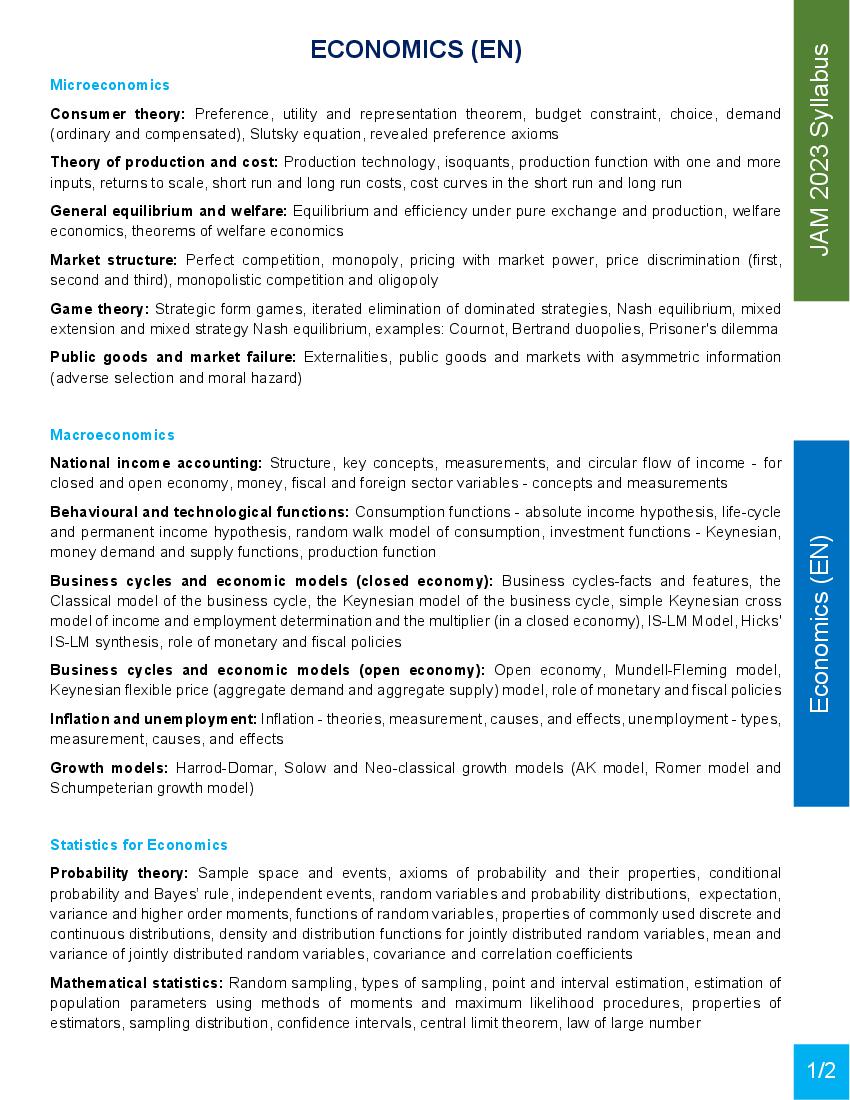
ECONOMICS (EN) JAM 2023 Syllabus Microeconomics Consumer theory: Preference, utility and representation theorem, budget constraint, choice, demand (ordinary and compensated), Slutsky equation, revealed preference axioms Theory of production and cost: Production technology, isoquants, production function with one and more inputs, returns to scale, short run and long run costs, cost curves in the short run and long run General equilibrium and welfare: Equilibrium and efficiency under pure exchange and production, welfare economics, theorems of welfare economics Market structure: Perfect competition, monopoly, pricing with market power, price discrimination (first, second and third), monopolistic competition and oligopoly Game theory: Strategic form games, iterated elimination of dominated strategies, Nash equilibrium, mixed extension and mixed strategy Nash equilibrium, examples: Cournot, Bertrand duopolies, Prisoner's dilemma Public goods and market failure: Externalities, public goods and markets with asymmetric information (adverse selection and moral hazard) Macroeconomics National income accounting: Structure, key concepts, measurements, and circular flow of income - for closed and open economy, money, fiscal and foreign sector variables - concepts and measurements Behavioural and technological functions: Consumption functions - absolute income hypothesis, life-cycle and permanent income hypothesis, random walk model of consumption, investment functions - Keynesian, Economics (EN) money demand and supply functions, production function Business cycles and economic models (closed economy): Business cycles-facts and features, the Classical model of the business cycle, the Keynesian model of the business cycle, simple Keynesian cross model of income and employment determination and the multiplier (in a closed economy), IS-LM Model, Hicks' IS-LM synthesis, role of monetary and fiscal policies Business cycles and economic models (open economy): Open economy, Mundell-Fleming model, Keynesian flexible price (aggregate demand and aggregate supply) model, role of monetary and fiscal policies Inflation and unemployment: Inflation - theories, measurement, causes, and effects, unemployment - types, measurement, causes, and effects Growth models: Harrod-Domar, Solow and Neo-classical growth models (AK model, Romer model and Schumpeterian growth model) Statistics for Economics Probability theory: Sample space and events, axioms of probability and their properties, conditional probability and Bayes’ rule, independent events, random variables and probability distributions, expectation, variance and higher order moments, functions of random variables, properties of commonly used discrete and continuous distributions, density and distribution functions for jointly distributed random variables, mean and variance of jointly distributed random variables, covariance and correlation coefficients Mathematical statistics: Random sampling, types of sampling, point and interval estimation, estimation of population parameters using methods of moments and maximum likelihood procedures, properties of estimators, sampling distribution, confidence intervals, central limit theorem, law of large number 1/2
Page 2
JAM 2023 Syllabus Hypothesis testing: distributions of test statistics, testing hypotheses related to population parameters, Type I and Type II errors, the power of a test, tests for comparing parameters from two samples Correlation and regression: Correlation and types of correlation, the nature of regression analysis, method of Ordinary Least Squares (OLS), CLRM assumptions, properties of OLS, goodness of fit, variance and covariance of OLS estimator Indian Economy Indian economy before 1950: Transfer of tribute, deindustrialization of India Planning and Indian development: Planning models, relation between agricultural and industrial growth, challenges faced by Indian planning Indian economy after 1991: Balance of payments crisis in 1991, major aspects of economic reforms in India after 1991, reforms in trade and foreign investment Banking, finance and macroeconomic policies: aspects of banking in India, CRR and SLR, financial sector reforms in India, fiscal and monetary policy, savings and investment rates in India Inequalities in social development: India’s achievements in health, education and other social sectors, disparities between Indian States in human development Poverty: Methodology of poverty estimation, Issues in poverty estimation in India India’s labour market: unemployment, labour force participation rates Economics (EN) Mathematics for Economics Preliminaries and functions: Set theory and number theory, elementary functions: quadratic, polynomial, power, exponential, logarithmic, functions of several variables, graphs and level curves, convex set, concavity and quasiconcavity of function, convexity and quasi-convexity of functions, sequences and series: convergence, algebraic properties and applications, complex numbers and its geometrical representation, De Moivre’s theorem and its application Differential calculus: Limits, continuity and differentiability, mean value theorems, Taylor’s theorem, partial differentiation, gradient, chain rule, second and higher order derivatives: properties and applications, implicit function theorem, and application to comparative statics problems, homogeneous and homothetic functions: characterisations and applications Integral calculus: Definite integrals, fundamental theorems, indefinite integrals and applications Differential equations, and difference equations: First order difference equations, first order differential equations and applications Linear algebra: Matrix representations and elementary operations, systems of linear equations: properties of their solution, linear independence and dependence, rank, determinants, eigenvectors and eigenvalues of square matrices, symmetric matrices and quadratic forms, definiteness and semidefiniteness of quadratic forms Optimization: Local and global optima: geometric and calculus-based characterisations, and applications, multivariate optimization, constrained optimization and method of Lagrange multiplier, second order condition of optima, definiteness and optimality, properties of value function: envelope theorem and applications, linear programming: graphical solution, matrix formulation, duality, economic interpretation 2/2