Class 11 Sample Paper 2022 Solution Accountancy Term 2
Finished viewing? Save it for later —
Download Class 11 Sample Paper 2022 Solution Accountancy Term 2 (PDF · 7 pages)About Class 11 Sample Paper 2022 Solution Accountancy Term 2
Class 11 Sample Paper 2022 Solution Accountancy Term 2 is available here for free download. Published by AglaSem for Class 11, this sample paper can be viewed online or downloaded as a PDF (7 pages). Candidates preparing for Class 11 can use Class 11 Sample Paper 2022 Solution Accountancy Term 2 to understand the exam pattern, the type of questions asked, and the overall difficulty level.
Frequently Asked Questions
How can I download Class 11 Sample Paper 2022 Solution Accountancy Term 2?
Open this page and click the Download button to save Class 11 Sample Paper 2022 Solution Accountancy Term 2 as a PDF. It is completely free on AglaSem Docs.
Is Class 11 Sample Paper 2022 Solution Accountancy Term 2 free to download?
Yes. Class 11 Sample Paper 2022 Solution Accountancy Term 2 can be viewed online and downloaded as a PDF free of cost on AglaSem Docs.
How many pages does Class 11 Sample Paper 2022 Solution Accountancy Term 2 have?
Class 11 Sample Paper 2022 Solution Accountancy Term 2 contains 7 pages, which you can read online or download together as a single PDF.
Where can I find more Class 11 study material?
You can find more Class 11 question papers, sample papers, syllabus, and answer keys on AglaSem Docs.
Class 11 Sample Paper 2022 Solution Accountancy Term 2 – Text
Read the full text of this sample paper below — useful to quickly search, copy and reference the content online without downloading the PDF.
📄 View text version (7 pages)
Page 1
Directorate of Education, GNCT of Delhi
Suggestive Answers of Practice Paper
कक्षा – XI
Class – XI
लेखाांकि(कोड: 055)
Accountancy (Code: 055)
TERM II (2021-22)
अधधकतम अांक: 40
Maximum Marks: 40
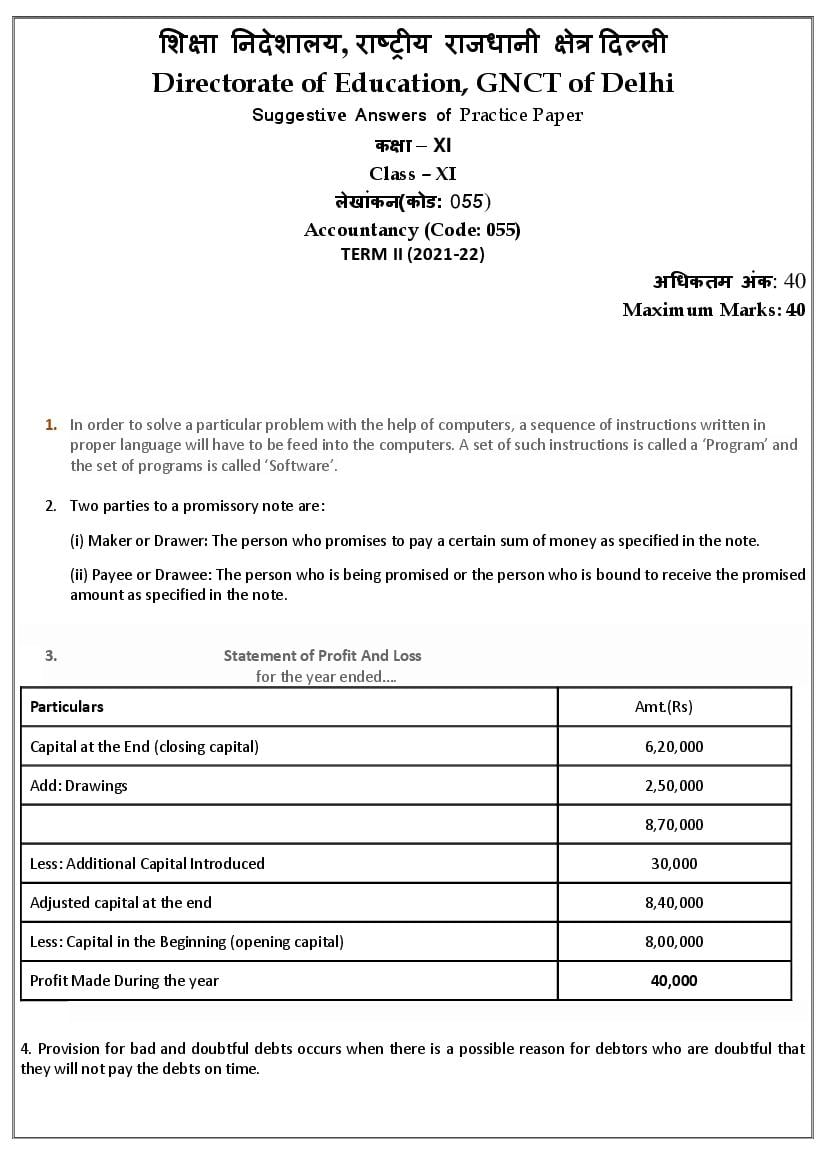
1. In order to solve a particular problem with the help of computers, a sequence of instructions written in
proper language will have to be feed into the computers. A set of such instructions is called a ‘Program’ and
the set of programs is called ‘Software’.
2. Two parties to a promissory note are:
(i) Maker or Drawer: The person who promises to pay a certain sum of money as specified in the note.
(ii) Payee or Drawee: The person who is being promised or the person who is bound to receive the promised
amount as specified in the note.
3. Statement of Profit And Loss
for the year ended….
Particulars Amt.(Rs)
Capital at the End (closing capital) 6,20,000
Add: Drawings 2,50,000
8,70,000
Less: Additional Capital Introduced 30,000
Adjusted capital at the end 8,40,000
Less: Capital in the Beginning (opening capital) 8,00,000
Profit Made During the year 40,000
4. Provision for bad and doubtful debts occurs when there is a possible reason for debtors who are doubtful that
they will not pay the debts on time.
Page 2
Profit and loss A/c Dr -
To provision for doubtful debts A/c -
5. A Central Processing Unit (CPU), also called a central processor or main processor, is the electronic
circuitry within a computer that carries out the instructions of a computer program by performing the basic
arithmetic, logic, controlling, and input/output (I/O) operations specified by the instructions. CPU has two
components:
i. Control Unit
ii. Arithmetic Logic Unit
6. The mentioned below are the various advantages of Computerised Accounting Systems.
a. Speed
b. Accuracy
c. Reliability
d. Up-to-Date Information
e. Real Time User Interface
f. Automated Document Production
g. Scalability
h. Legibility
OR
Limitations: Inspite of so many qualities, computers suffer from the following limitations.
(1) Lack of Common sense: Since computer work according to the stored programs, they simply lack of common
sense.
(2) Zero I.Q.: Computers are dumb devices with zero Intelligence Quotient (IQ). They can’t visualize and think what
exactly to do under a particular situation unless they are programmed to tackle that situation.
(3) Lack of Feeling: Computers lack feelings like human beings because they are machines. No computer passes the
equivalent of a human heart and soul.
(4) Lack of Decision-making: Decision making is a complex process involving information, knowledge, intelligence,
wisdom & ability to judge, Computers cannot make decisions of their own.
7. (1) Capital Expenditure: Paid to make an asset ready to use
(2) Capital Expenditure: Paid to make an asset ready to use
(3) Revenue Expenditure: Made for the maintenance of asset
OR
Gross = Sales + Closing Stock – (Opening Stock + Freight and Packing + Goods
Profit Purchased)
Page 3
= 2,20,000 – 1,75,000 = ₹45,000
8. Operating profit = Net profit - Rent received - Gain on sale of machines + Interest on loan – Donation
1,00,000 - 10,000 - 15,000 +20,000 - 2,000 = Rs. 93,000
OR
Marshaling of Balance Sheet can be made in two ways:
1. In order of Liquidity: According to this method, an asset which is most easily convertible into cash such as cash in
hand is written first and then will follow those assets which are comparatively less easily convertible, so that the
least liquid assets such as goodwill, is shown last.
In the same way, those liabilities which are to be paid at the earliest will be written first. In other words, current
liabilities are written, first of all, then fixed or long-term liabilities, and lastly, the proprietor’s capital. Proforma of a
Balance Sheet in the order of liquidity will be the same as shown in the topic Balance Sheet.
2. In order of Permanence: This method is just opposite to the first method. Assets that are most difficult to be
converted into cash such as Goodwill are written first and the assets which are most liquid such as cash in hand are
written last.
Those liabilities which are to be paid last will be written first. The proprietor’s capital is written, first of all, then
fixed or long-term liabilities, and lastly the current liabilities. The Performa of the Balance Sheet in the order of
Permanence will be just opposite to the above.
9.
Journal
Date Particulars L.F. Debit Amount (Rs) Credit Amount (Rs)
a) Suspense A/c Dr. 14,000
To Sales A/c 7,000
To Purchases A/c 7,000
(Goods sold to Mohan wrongly recorded in Purchases
Book)
b) Purchases A/c Dr. 9,000
Sales A/c Dr. 9,000
To Suspense A/c 18,000
(Credit purchases from Rohan recorded in Sales Book)
c) Suspense A/c Dr. 8,000
To Purchases Return A/c 4,000
To Sales Return A/c 4,000
(Goods returned to Rakesh recorded in Sales Return
Book)
d) Sales Return A/c Dr. 1,000
Purchases Return A/c Dr. 1,000
Page 4
(Goods returned from Mahesh recorded in Purchases
Return Book)
e) Suspense A/c Dr. 4,000
To Purchases Return A/c 2,000
To Purchases A/c 2,000
(Goods returned to Naresh recorded in Purchases
Book)
10.
(i) 30,000 X 18/100 X 2/12 = Rs. 900
(ii)
Books of B
Journal
Debit Credit
Date Particulars L.F. Amount Amount
(Rs) (Rs)
2017
Jan. 01 A Dr. 30,000
To Bills Payable A/c 30,000
( B accepted the bill)
(iii) No Entry
(iv) 4th April, 2017
Books of A
Journal
Debit Credit
Date Particulars L.F. Amount Amount
(Rs) (Rs)
2017
April. 04 B Dr. 30,200
To Bank A/c 30,200
(bill dishonoured and noting charges paid by
bank)
OR
(i) 15,000 X 10/100 X 3/12 = Rs. 375
(ii)
Page 5
Journal
Debit Credit
Date Particulars L.F. Amount Amount
(Rs) (Rs)
2016
March, 02 Bills Receivable A/c Dr. 15,000
To Nisha 15,000
(bill drawn)
(iii) No Entry
(iv) 5th June, 2016
Books of Nisha
Journal
Debit Credit
Date Particulars L.F. Amount Amount
(Rs) (Rs)
2016
June 05 Bills Payable A/c Dr. 15,000
Noting Charges A/c Dr. 30
To Asha 15,030
(bill dishonoured)
11.
Statement of Affairs
(Previous Year)
Amount Amount
Liabilities Assets
(Rs) (Rs)
Trade Creditors 6,270 Stock 12,350
Loan from Naresh 5,000 Cash in Hand 570
Capital (Balancing Figure) 18,170 Shop Fittings 7,250
Trade Debtors 5,280
Bank Balance 3,990
29,440 29,440
Statement of Affairs
(Current Year)
Page 6
Liabilities Assets
(Rs) (Rs)
Trade Creditors 5,890 Stock 11,980
Loan from Naresh 5,000 Cash in Hand 650
Add: Outstanding Interest
(5,000 × 5%) 250 5,250 Shop Fittings 7,800
Capital (Balancing Figure) 16,930 Less: Depreciation (780) 7,020
Trade Debtors 4,560
Less: Bad Debts (270) 4,290
Bank Balance 4,130
28,070 28,070
Statement of Profit or Loss
(Current Year)
Amount
Particulars
(Rs)
Capital of the Current Year 16,930
Add: Drawings (Rs 100 × 52) 5,200
22,130
Less: Capital of the Previous Year (18,170)
Profit made during the Current Year 3,960
12.
Trading and Profit and Loss Account for the
year ended March 31, 2017
Dr. Cr.
Particulars Amount Particulars Amount
` `
Opening stock 60,220 Sales 2,81,500
Purchase 1,99,080 Less :
Sales (1,870) 2,79,630
return
Less Purchases (1,450) 1,97,630
return Closing
stock 70,000
Carriage 5,170
Gross profit c/d 86,610
3,49,630 3,49,630
Discount allowed 3,960 Gross profit b/d 86,610
Bank charges 100 Discount received 2,980
Salaries 6,420
Rent and Taxes 7,680
Add Rent outstanding150 7,830
General expenses 3,630
Insurance 750
Page 7
Bad debts 1,250
Add New provision 8,274
for bad debts 9,524
Less Old provision (4,650)
for bad debts 4,874
Interest on loan outstanding 900
Net profit (transferred to 61,176
capital account)
89,590 89,590
Balance Sheet as at March 31, 2017
Liabilities Amount Assets Amount
` `
Creditors 18,670 Cash at bank 13,870
Loan 15,000
Add Interest on 900 15,900 Book 82,740
loan outstanding debts
Rent outstanding 150 Less: (8,274) 74,466
Reserve for bad debts
Capital 1,50,000 Bills receivable 1,860
Add Net profit 61,176 Land and Building 42,580
2,11,176 Furniture 5,130
Less Drawings (6,300) 2,04,876 Plant and Machinery 31,640
Insurance (prepaid) 50
Closing stock 70,000
2,39,596 2,39,596
Document Details
| Board / Org | Aglasem |
| Exam | Class 11 |
| Type | Solution |
| Pages | 7 |
| Updated | 22 Jul 2026 |