Class 11 Sample Paper 2022 Solution Physics Term 2
Finished viewing? Save it for later —
Download Class 11 Sample Paper 2022 Solution Physics Term 2 (PDF · 4 pages)About Class 11 Sample Paper 2022 Solution Physics Term 2
Class 11 Sample Paper 2022 Solution Physics Term 2 is available here for free download. Published by AglaSem for Class 11, this sample paper can be viewed online or downloaded as a PDF (4 pages). Candidates preparing for Class 11 can use Class 11 Sample Paper 2022 Solution Physics Term 2 to understand the exam pattern, the type of questions asked, and the overall difficulty level.
Frequently Asked Questions
How can I download Class 11 Sample Paper 2022 Solution Physics Term 2?
Open this page and click the Download button to save Class 11 Sample Paper 2022 Solution Physics Term 2 as a PDF. It is completely free on AglaSem Docs.
Is Class 11 Sample Paper 2022 Solution Physics Term 2 free to download?
Yes. Class 11 Sample Paper 2022 Solution Physics Term 2 can be viewed online and downloaded as a PDF free of cost on AglaSem Docs.
How many pages does Class 11 Sample Paper 2022 Solution Physics Term 2 have?
Class 11 Sample Paper 2022 Solution Physics Term 2 contains 4 pages, which you can read online or download together as a single PDF.
Where can I find more Class 11 study material?
You can find more Class 11 question papers, sample papers, syllabus, and answer keys on AglaSem Docs.
Class 11 Sample Paper 2022 Solution Physics Term 2 – Text
Read the full text of this sample paper below — useful to quickly search, copy and reference the content online without downloading the PDF.
📄 View text version (4 pages)
Page 1
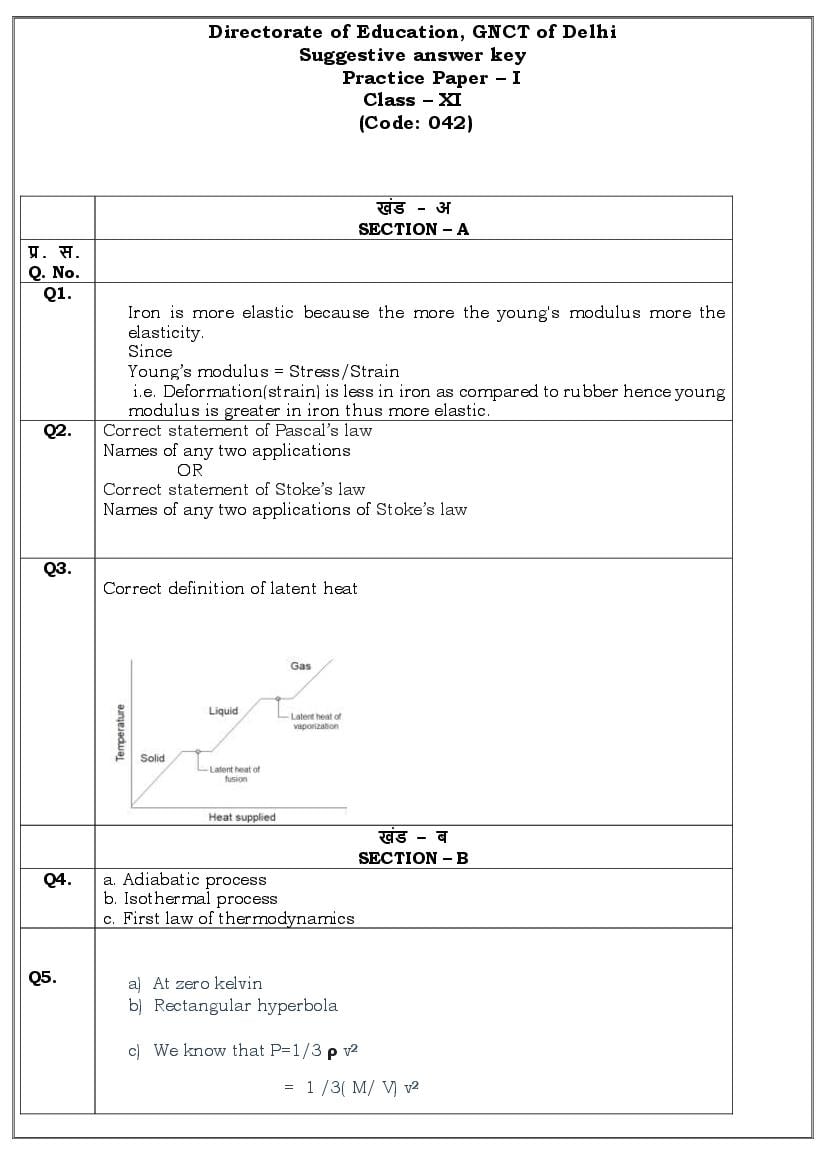
Suggestive answer key
Practice Paper – I
Class – XI
(Code: 042)
खंड - अ
SECTION – A
प्र. स.
Q. No.
Q1.
Iron is more elastic because the more the young's modulus more the
elasticity.
Since
Young’s modulus = Stress/Strain
i.e. Deformation(strain) is less in iron as compared to rubber hence young
modulus is greater in iron thus more elastic.
Q2. Correct statement of Pascal’s law
Names of any two applications
OR
Correct statement of Stoke’s law
Names of any two applications of Stoke’s law
Q3.
Correct definition of latent heat
खंड – ब
SECTION – B
Q4. a. Adiabatic process
b. Isothermal process
c. First law of thermodynamics
Q5. a) At zero kelvin
b) Rectangular hyperbola
c) We know that P=1/3 ρ v2
= 1 /3( M/ V) v2
Page 2
∴ P ∝ MT/V
As both T and V remain unchanged but mass M is doubled, so the pressure
of mixture gets doubled, i.e., it is equal to 2P.
So pressure of mixed gases get doubled.
Q6.
a) Derivation of formula with figure and steps.
b) The time period of a simple pendulum is
T=2π √(L /g)
where L is the length of the pendulum.
or L= gT2 /4π 2
The time period of the simple pendulum which ticks seconds is 2s.
∴T=2s
Substituting in (i), we get
L= (9.8)(2)2/ 4×(3.14)2 = 0.992m ≃1m
Q7.
a) Velocity of sound is directly proportional to square root of the temperature
of the air.
As temperature of warm air is more than temperature of cold air, velocity of
sound is more in warm air than cold air.
i) Frequency of the ultrasonic sound, f=100 kHz=105Hz
Speed of sound in air, Va=340m/s
The wavelength (λr) of the reflected sound is given by
λr =Va / f
=340/105
=3.4×10⁻³ m.
ii) Frequency of the ultrasonic sound, f= 100 kHz =105Hz
Speed of sound in water, Vw =1486 m/s
λt =Vw/ f
The wavelength of the transmitted sound is given by
λt=1486/105
=1.49×10⁻²m.
Q8 Correct statement
Labelled diagram with proof
Limitations
OR
As velocity increases viscous force (fv=6πηRv) also increases and a point
comes when viscous force become equal to gravitational force (mg) . At this
Page 3
two forces. Hence velocity of the object stops increasing. This highest velocity
which object has attained is called terminal velocity.
Derivation of an expression for terminal velocity.
Q9 Correct definition of triple point of water.
The triple point of water is a unique temperature and does not change with
pressure and other external factors. The melting point and boiling point of
water vary with pressure. That is, there is no fixed melting and boiling point
of water.
Q10 The frequency of external periodic force is different from the natural
frequency of the oscillator in case of forced oscillation but in resonance two
frequencies are equal.
2) Since x = A cos (ω t +θ)
Velcoity, v= dx/dt = −A ω sin(ωt+θ)
At t=0, x = x0
x0 = A cos θ ...(i)
and, dx/ dt = −v0 = A ω sin θ
A sin θ = v0/ω ...(ii)
Squaring and adding equations (i) and (ii), we get:
A2(cos2θ+sin2θ)=x02+(v02 / ω2)
∴ A=[ x02+( v02 / ω2)2]1/2
Q11. 1) Only (ii) represents S.H.M . For SHM, acceleration should be directly
proportional to displacement and sign should be negative. Hence, (ii)
represents SHM.
2) The amplitude is A=1/2 m= 0.5m.
maximum velocity is given by
Vmax = ωA =200×0.5=100 m/min
OR
Let original freq. of sitar string A be na and original freq. of sitar string B
be nb
As number of beats / sec. =6
∴nb=na ±6
Page 4
=330or318Hz
When tension in A is reduced, its frequency reduces (∵n∝√T)
As number of beats /sec decreases to 3 therefore, frequency
of B=324−6=318Hz
खंड – स
SECTION – C
Q12 a) ( i )
b) ( ii )
c) ( i )
d) ( ii )
e) ( i )
Document Details
| Board / Org | Aglasem |
| Exam | Class 11 |
| Type | Solution |
| Pages | 4 |
| Updated | 22 Jul 2026 |