IIT JAM 2019 Question Paper Mathematical Statistics (MS)
Finished viewing? Save it for later —
Download IIT JAM 2019 Question Paper Mathematical Statistics (MS) (PDF · 15 pages)About IIT JAM 2019 Question Paper Mathematical Statistics (MS)
IIT JAM 2019 Question Paper Mathematical Statistics (MS) is available here for free download. Published by IIT for Joint Admission Test for M.Sc, this question paper can be viewed online or downloaded as a PDF (15 pages). Candidates preparing for Joint Admission Test for M.Sc can use IIT JAM 2019 Question Paper Mathematical Statistics (MS) to understand the exam pattern, the type of questions asked, and the overall difficulty level.
Frequently Asked Questions
How can I download IIT JAM 2019 Question Paper Mathematical Statistics (MS)?
Open this page and click the Download button to save IIT JAM 2019 Question Paper Mathematical Statistics (MS) as a PDF. It is completely free on AglaSem Docs.
Is IIT JAM 2019 Question Paper Mathematical Statistics (MS) free to download?
Yes. IIT JAM 2019 Question Paper Mathematical Statistics (MS) can be viewed online and downloaded as a PDF free of cost on AglaSem Docs.
How many pages does IIT JAM 2019 Question Paper Mathematical Statistics (MS) have?
IIT JAM 2019 Question Paper Mathematical Statistics (MS) contains 15 pages, which you can read online or download together as a single PDF.
Where can I find more Joint Admission Test for M.Sc study material?
You can find more Joint Admission Test for M.Sc question papers, sample papers, syllabus, and answer keys on AglaSem Docs.
IIT JAM 2019 Question Paper Mathematical Statistics (MS) – Text
Read the full text of this question paper below — useful to quickly search, copy and reference the content online without downloading the PDF.
📄 View text version (15 pages)
Page 1
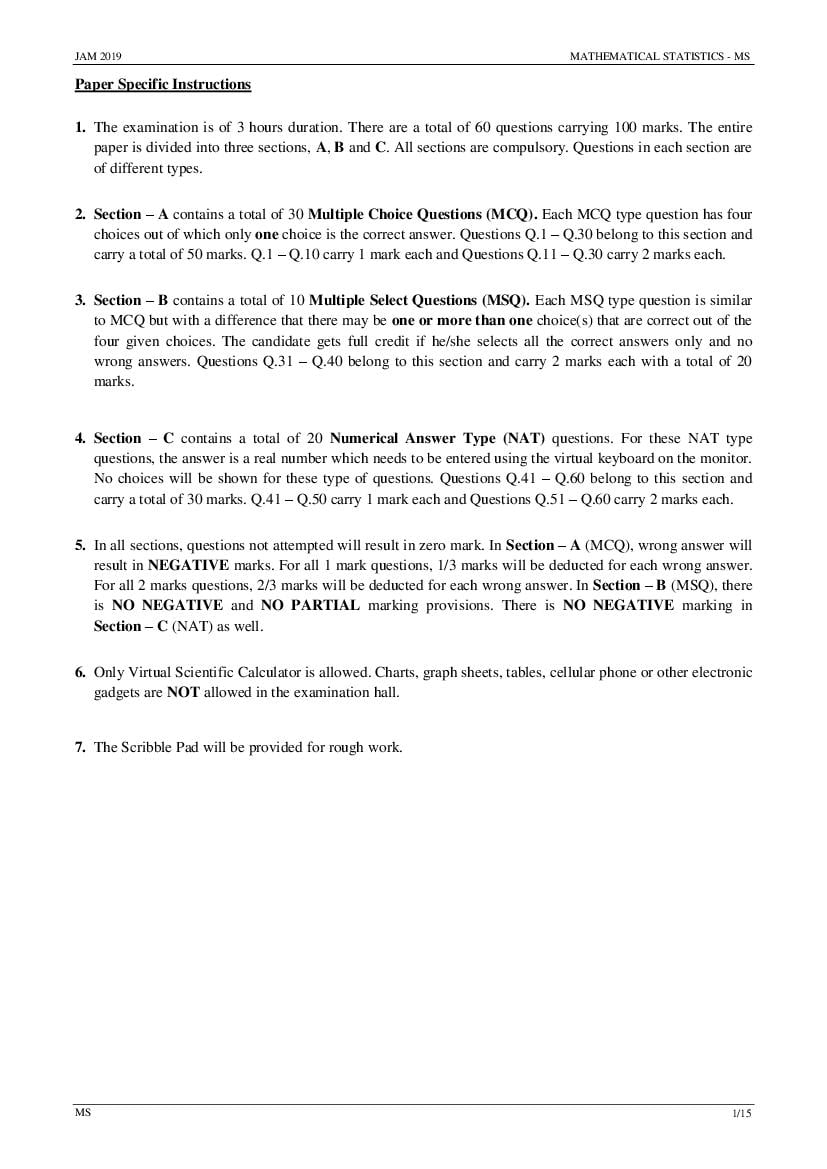
Paper Specific Instructions
1. The examination is of 3 hours duration. There are a total of 60 questions carrying 100 marks. The entire
paper is divided into three sections, A, B and C. All sections are compulsory. Questions in each section are
of different types.
2. Section – A contains a total of 30 Multiple Choice Questions (MCQ). Each MCQ type question has four
choices out of which only one choice is the correct answer. Questions Q.1 – Q.30 belong to this section and
carry a total of 50 marks. Q.1 – Q.10 carry 1 mark each and Questions Q.11 – Q.30 carry 2 marks each.
3. Section – B contains a total of 10 Multiple Select Questions (MSQ). Each MSQ type question is similar
to MCQ but with a difference that there may be one or more than one choice(s) that are correct out of the
four given choices. The candidate gets full credit if he/she selects all the correct answers only and no
wrong answers. Questions Q.31 – Q.40 belong to this section and carry 2 marks each with a total of 20
marks.
4. Section – C contains a total of 20 Numerical Answer Type (NAT) questions. For these NAT type
questions, the answer is a real number which needs to be entered using the virtual keyboard on the monitor.
No choices will be shown for these type of questions. Questions Q.41 – Q.60 belong to this section and
carry a total of 30 marks. Q.41 – Q.50 carry 1 mark each and Questions Q.51 – Q.60 carry 2 marks each.
5. In all sections, questions not attempted will result in zero mark. In Section – A (MCQ), wrong answer will
result in NEGATIVE marks. For all 1 mark questions, 1/3 marks will be deducted for each wrong answer.
For all 2 marks questions, 2/3 marks will be deducted for each wrong answer. In Section – B (MSQ), there
is NO NEGATIVE and NO PARTIAL marking provisions. There is NO NEGATIVE marking in
Section – C (NAT) as well.
6. Only Virtual Scientific Calculator is allowed. Charts, graph sheets, tables, cellular phone or other electronic
gadgets are NOT allowed in the examination hall.
7. The Scribble Pad will be provided for rough work.
MS 1/15
Page 2
Special Instructions / Useful Data
ℝ The set of all real numbers
𝑇 Transpose of the matrix 𝑃
𝑃
𝑥1
ℝ 𝑛
{ [ ⋮ ] ∶ 𝑥𝑖 ∈ ℝ, 𝑖 = 1, 2, … , 𝑛}
𝑥𝑛
𝑓′ Derivative of the differentiable function 𝑓
𝐼𝑛 𝑛 × 𝑛 identity matrix
𝑃(𝐸) Probability of the event 𝐸
𝐸(𝑋) Expectation of the random variable 𝑋
𝑉𝑎𝑟(𝑋) Variance of the random variable 𝑋
i.i.d. Independently and identically distributed
𝑈(𝑎, 𝑏) Continuous uniform distribution on (𝑎, 𝑏), −∞ < 𝑎 < 𝑏 < ∞
Exponential distribution with probability density function, for 𝜆 > 0,
𝐸𝑥𝑝(𝜆) −𝜆 𝑥
𝑓(𝑥) = {𝜆𝑒 , 𝑥 > 0,
0, otherwise
2 ) Normal distribution with mean 𝜇 and variance 𝜎 2
𝑁(𝜇, 𝜎
𝑎
1 𝑢2
Φ(𝑎) ∫ 𝑒 − 2 𝑑𝑢
√2𝜋
−∞
𝜒𝑛2 Central Chi-squared distribution with 𝑛 degrees of freedom
A constant such that 𝑃 (𝑋 > 𝑡𝑛, 𝛼 ) = 𝛼, where 𝑋 has Student’s
𝑡𝑛, 𝛼
𝑡-distribution with 𝑛 degrees of freedom
𝑛! 𝑛(𝑛 − 1) ⋯ 3 ⋅ 2 ⋅ 1 for 𝑛 = 1, 2, 3 …, and 0! = 1
Φ(1.65) = 0.950, Φ(1.96) = 0.975
𝑡4, 0.05 = 2.132, 𝑡4, 0.10 = 1.533
MS 2/15
Page 3
SECTION – A
MULTIPLE CHOICE QUESTIONS (MCQ)
Q. 1 – Q.10 carry one mark each.
Q.1 Let {𝑥𝑛 }𝑛≥1 be a sequence of positive real numbers. Which one of the following statements
is always TRUE?
(A) If {𝑥𝑛 }𝑛≥1 is a convergent sequence, then {𝑥𝑛 }𝑛≥1 is monotone
(B) If {𝑥𝑛2 }𝑛≥1 is a convergent sequence, then the sequence {𝑥𝑛 }𝑛≥1 does not converge
(C) If the sequence {|𝑥𝑛+1 − 𝑥𝑛 |}𝑛≥1 converges to 0, then the series ∑∞
𝑛=1 𝑥𝑛 is convergent
(D) If {𝑥𝑛 }𝑛≥1 is a convergent sequence, then {𝑒 𝑥𝑛 }𝑛≥1 is also a convergent sequence
Q.2 Consider the function 𝑓(𝑥, 𝑦) = 𝑥 3 − 3𝑥𝑦 2 , 𝑥, 𝑦 ∈ ℝ. Which one of the following
statements is TRUE?
(A) 𝑓 has a local minimum at (0, 0)
(B) 𝑓 has a local maximum at (0, 0)
(C) 𝑓 has global maximum at (0, 0)
(D) 𝑓 has a saddle point at (0, 0)
Q.3 4
If 𝐹(𝑥) = ∫𝑥 3 √4 + 𝑡 2 𝑑𝑡, for 𝑥 ∈ ℝ, then 𝐹 ′ (1) equals
(A) −3√5 (B) −2√5 (C) 2√5 (D) 3√5
Q.4 1 1 2 0
Let 𝑇: ℝ2 → ℝ2 be a linear transformation such that 𝑇 ([ ]) = [ ] and 𝑇 ([ ]) = [ ].
2 0 1 1
3 1 2 3 𝑎
Suppose that [ ] = 𝛼 [ ] + 𝛽 [ ] and 𝑇 ([ ]) = [ ]. Then 𝛼 + 𝛽 + 𝑎 + 𝑏 equals
−2 2 1 −2 𝑏
2 4 5 7
(A) (B) (C) (D)
3 3 3 3
Q.5 2 3
Two biased coins 𝐶1 and 𝐶2 have probabilities of getting heads and , respectively,
3 4
when tossed. If both coins are tossed independently two times each, then the probability of
getting exactly two heads out of these four tosses is
1 37 41 49
(A) (B) (C) (D)
4 144 144 144
MS 3/15
Page 4
Q.6 Let 𝑋 be a discrete random variable with the probability mass function
−2𝑐
, 𝑛 = −1, −2,
𝑛
𝑃 (𝑋 = 𝑛 ) = 𝑑, 𝑛 = 0,
𝑐 𝑛, 𝑛 = 1, 2,
{ 0, otherwise,
where 𝑐 and 𝑑 are positive real numbers. If 𝑃(|𝑋 | ≤ 1) = 3/4, then 𝐸(𝑋) equals
1 1 1 1
(A) (B) (C) (D)
12 6 3 2
Q.7 Let 𝑋 be a Poisson random variable and 𝑃(𝑋 = 1) + 2 𝑃(𝑋 = 0) = 12 𝑃(𝑋 = 2). Which
one of the following statements is TRUE?
(A) 0.40 < 𝑃(𝑋 = 0) ≤ 0.45 (B) 0.45 < 𝑃(𝑋 = 0) ≤ 0.50
(C) 0.50 < 𝑃(𝑋 = 0) ≤ 0.55 (D) 0.55 < 𝑃(𝑋 = 0) ≤ 0.60
Q.8 Let 𝑋1 , 𝑋2 , … be a sequence of i.i.d. discrete random variables with the probability mass
function
(log e 2)𝑚
, 𝑚 = 0,1,2, … ,
𝑃(𝑋1 = 𝑚) = { 2(𝑚!)
0, otherwise.
If 𝑆𝑛 = 𝑋1 + 𝑋2 + ⋯ + 𝑋𝑛 , then which one of the following sequences of random
variables converges to 0 in probability?
𝑆𝑛 𝑆𝑛 −𝑛 log𝑒 2 𝑆𝑛 −log𝑒 2 𝑆𝑛 −𝑛
(A) (B) (C) (D)
𝑛 log𝑒 2 𝑛 𝑛 log𝑒 2
Q.9 Let 𝑋1 , 𝑋2 , … , 𝑋𝑛 be a random sample from a continuous distribution with the probability
density function
1 1 2 1 2
𝑓 (𝑥 ) = [𝑒 − 2(𝑥−2𝜇) + 𝑒 − 2(𝑥−4𝜇) ] , − ∞ < 𝑥 < ∞.
2√2𝜋
If 𝑇 = 𝑋1 + 𝑋2 + ⋯ + 𝑋𝑛 , then which one of the following is an unbiased estimator of 𝜇?
𝑇 𝑇 𝑇 𝑇
(A) (B) (C) (D)
𝑛 2𝑛 3𝑛 4𝑛
MS 4/15
Page 5
Q.10 Let 𝑋1 , 𝑋2 , … , 𝑋𝑛 be a random sample from a 𝑁(𝜃, 1) distribution. Instead of observing
𝑋1 , 𝑋2 , … , 𝑋𝑛 , we observe 𝑌1 , 𝑌2 , … , 𝑌𝑛 , where 𝑌𝑖 = 𝑒 𝑋𝑖 , 𝑖 = 1, 2, … , 𝑛. To test the
hypothesis
𝐻0 : 𝜃 = 1 against 𝐻1 : 𝜃 ≠ 1
based on the random sample 𝑌1 , 𝑌2 , … , 𝑌𝑛 , the rejection region of the likelihood ratio test is
of the form, for some 𝑐1 < 𝑐2 ,
(A) ∑𝑛𝑖=1 𝑌𝑖 ≤ 𝑐1 or ∑𝑛𝑖=1 𝑌𝑖 ≥ 𝑐2 (B) 𝑐1 ≤ ∑𝑛𝑖=1 𝑌𝑖 ≤ 𝑐2
(C) 𝑐1 ≤ ∑𝑛𝑖=1 log 𝑒 𝑌𝑖 ≤ 𝑐2 (D) ∑𝑛𝑖=1 log 𝑒 𝑌𝑖 ≤ 𝑐1 or ∑𝑛𝑖=1 log 𝑒 𝑌𝑖 ≥ 𝑐2
Q. 11 – Q. 30 carry two marks each.
Q.11 6
∑∞
𝑛=4 equals
𝑛2 −4𝑛+3
5 7 9
(A) (B) 3 (C) (D)
2 2 2
Q.12 1 1
1+2+⋯+𝑛
lim equals
𝑛→∞ (𝜋𝑛 +𝑒 𝑛 )1/𝑛 log𝑒 𝑛
1 1 𝑒 𝜋
(A) (B) (C) (D)
𝜋 𝑒 𝜋 𝑒
Q.13 A possible value of 𝑏 ∈ ℝ for which the equation 𝑥 4 + 𝑏𝑥 3 + 1 = 0 has no real root is
− 11 −3 5
(A) (B) (C) 2 (D)
5 2 2
Q.14 1
Let the Taylor polynomial of degree 20 for at 𝑥 = 0 be ∑20 𝑛
𝑛=0 𝑎𝑛 𝑥 . Then
(1−𝑥)3
𝑎15 is
(A) 136 (B) 120 (C) 60 (D) 272
Q.15 The length of the curve 𝑦 = 3 𝑥 4/3 − 3 𝑥 2/3 + 7 from 𝑥 = 1 to 𝑥 = 8 equals
4 8
99 117 99 117
(A) (B) (C) (D)
8 8 4 4
MS 5/15
Page 6
Q.16 The volume of the solid generated by revolving the region bounded by the parabola
𝑥 = 2𝑦 2 + 4 and the line 𝑥 = 6 about the line 𝑥 = 6 is
78𝜋 91𝜋 64𝜋 117𝜋
(A) (B) (C) (D)
15 15 15 15
Q.17 Let 𝑃 be a 3 × 3 non-null real matrix. If there exist a 3 × 2 real matrix 𝑄 and
a 2 × 3 real matrix 𝑅 such that 𝑃 = 𝑄𝑅, then
(A) 𝑃𝒙 = 𝟎 has a unique solution, where 𝟎 ∈ ℝ3
(B) there exists 𝒃 ∈ ℝ3 such that 𝑃𝒙 = 𝒃 has no solution
(C) there exists a non-zero 𝒃 ∈ ℝ3 such that 𝑃𝒙 = 𝒃 has a unique solution
(D) there exists a non-zero 𝒃 ∈ ℝ3 such that 𝑃𝑇 𝒙 = 𝒃 has a unique solution
Q.18 1 0 1
If 𝑃 = [0 2 1] and 6𝑃−1 = 𝑎𝐼3 + 𝑏𝑃 − 𝑃2 , then the ordered pair (𝑎, 𝑏) is
2 0 −1
(A) (3, 2) (B) (2, 3) (C) (4, 5) (D) (5, 4)
Q.19 Let 𝐸, 𝐹 and 𝐺 be any three events with 𝑃(𝐸) = 0.3, 𝑃(𝐹|𝐸) = 0.2, 𝑃(𝐺|𝐸) = 0.1
and 𝑃(𝐹 ∩ 𝐺|𝐸) = 0.05. Then 𝑃(𝐸 − (𝐹 ∪ 𝐺)) equals
(A) 0.155 (B) 0.175 (C) 0.225 (D) 0.255
Q.20 Let 𝐸 and 𝐹 be any two independent events with 0 < 𝑃(𝐸) < 1 and 0 < 𝑃(𝐹) < 1.
Which one of the following statements is NOT TRUE?
(A) 𝑃(Neither 𝐸 nor 𝐹 occurs) = (𝑃(𝐸) − 1)(𝑃(𝐹) − 1)
(B) 𝑃(Exactly one of 𝐸 and 𝐹 occurs) = 𝑃(𝐸) + 𝑃(𝐹) − 𝑃(𝐸)𝑃(𝐹)
(C) 𝑃(𝐸 occurs but 𝐹 does not occur) = 𝑃(𝐸) − 𝑃(𝐸 ∩ 𝐹)
(D) 𝑃(𝐸 occurs given that 𝐹 does not occur) = 𝑃(𝐸)
Q.21 Let 𝑋 be a continuous random variable with the probability density function
1 7 −𝑥 2
𝑓(𝑥) = {3 𝑥 𝑒 , 𝑥 > 0,
0, otherwise.
Then the distribution of the random variable 𝑊 = 2𝑋 2 is
(A) 𝜒22 (B) 𝜒42 (C) 𝜒62 (D) 𝜒82
MS 6/15
Page 7
Q.22 Let 𝑋 be a continuous random variable with the probability density function
𝑒𝑥
𝑓(𝑥) = , − ∞ < 𝑥 < ∞.
(1 + 𝑒 𝑥 )2
Then 𝐸(𝑋) and 𝑃(𝑋 > 1), respectively, are
(A) 1 and (1 + 𝑒)−1 (B) 0 and 2(1 + 𝑒)−2
(C) 2 and (2 + 2𝑒)−1 (D) 0 and (1 + 𝑒)−1
Q.23 The lifetime (in years) of bulbs is distributed as an 𝐸𝑥𝑝(1) random variable. Using Poisson
approximation to the binomial distribution, the probability (round off to 2 decimal places)
that out of the fifty randomly chosen bulbs at most one fails within one month equals
(A) 0.05 (B) 0.07 (C) 0.09 (D) 0.11
Q.24 Let 𝑋 follow a beta distribution with parameters 𝑚 (> 0) and 2. If 𝑃 (𝑋 ≤ 1) = 1, then
2 2
𝑉𝑎𝑟(𝑋) equals
1 1 1 1
(A) (B) (C) (D)
10 20 25 40
Q.25 Let 𝑋1 , 𝑋2 and 𝑋3 be i.i.d. 𝑈(0,1) random variables. Then 𝑃(𝑋1 > 𝑋2 + 𝑋3 ) equals
1 1 1 1
(A) (B) (C) (D)
6 4 3 2
Q.26 Let 𝑋 and 𝑌 be i.i.d. 𝑈(0, 1) random variables. Then 𝐸(𝑋|𝑋 > 𝑌) equals
1 1 2 3
(A) (B) (C) (D)
3 2 3 4
Q.27 Let −1 and 1 be the observed values of a random sample of size two from 𝑁(𝜃, 𝜃)
distribution. The maximum likelihood estimate of 𝜃 is
− √5−1 √5−1
(A) 0 (B) 2 (C) (D)
2 2
MS 7/15
Page 8
Q.28 Let 𝑋1 and 𝑋2 be a random sample from a continuous distribution with the probability
density function
1 − 𝑥−𝜃
𝑓(𝑥) = {𝜃 𝑒
𝜃 , 𝑥 > 𝜃,
0, otherwise,
(𝑋1 +𝑋2 )
where 𝜃 > 0. If 𝑋(1) = min{𝑋1 , 𝑋2 } and 𝑋 = , then which one of the following
2
statements is TRUE?
(A) ( 𝑋, 𝑋(1) ) is sufficient and complete
(B) ( 𝑋, 𝑋(1) ) is sufficient but not complete
(C) ( 𝑋, 𝑋(1) ) is complete but not sufficient
(D) ( 𝑋, 𝑋(1) ) is neither sufficient nor complete
Q.29 Let 𝑋1 , 𝑋2 , … , 𝑋𝑛 be a random sample from a continuous distribution with the probability
density function 𝑓(𝑥). To test the hypothesis
1 2
𝐻0 : 𝑓(𝑥) = 𝑒 −𝑥 , −∞ < 𝑥 < ∞ against 𝐻1 : 𝑓(𝑥) = 𝑒 −2|𝑥| , −∞ < 𝑥 < ∞,
√𝜋
the rejection region of the most powerful size 𝛼 test is of the form, for some 𝑐 > 0,
(A) ∑𝑛𝑖=1(𝑋𝑖 − 1)2 ≥ 𝑐 (B) ∑𝑛𝑖=1(𝑋𝑖 − 1)2 ≤ 𝑐
(C) ∑𝑛𝑖=1(|𝑋𝑖 | − 1)2 ≥ 𝑐 (D) ∑𝑛𝑖=1(|𝑋𝑖 | − 1)2 ≤ 𝑐
Q.30 Let 𝑋1 , 𝑋2 , … , 𝑋𝑛 be a random sample from a 𝑁(𝜃, 1) distribution. To test 𝐻0 : 𝜃 = 0
1 3
against 𝐻1 : 𝜃 = 1, assume that the critical region is given by ∑𝑛𝑖=1 𝑋𝑖 > . Then the
𝑛 4
minimum sample size required so that 𝑃(Type I error) ≤ 0.05 is
(A) 3 (B) 4 (C) 5 (D) 6
MS 8/15
Page 9
SECTION - B
MULTIPLE SELECT QUESTIONS (MSQ)
Q. 31 – Q. 40 carry two marks each.
Q.31 Let {𝑥𝑛 }𝑛≥1 be a sequence of positive real numbers such that the series ∑∞
𝑛=1 𝑥𝑛
converges. Which of the following statements is (are) always TRUE?
(A) The series ∑∞
𝑛=1 √𝑥𝑛 𝑥𝑛+1 converges
(B) lim 𝑛 𝑥𝑛 = 0
𝑛→∞
(C) The series ∑∞ 2
𝑛=1 sin 𝑥𝑛 converges
√𝑥𝑛
(D) The series ∑∞
𝑛=1 converges
1+√𝑥𝑛
Q.32 Let 𝑓: ℝ → ℝ be continuous on ℝ and differentiable on (−∞, 0) ∪ (0, ∞). Which of the
following statements is (are) always TRUE?
(A) If 𝑓 is differentiable at 0 and 𝑓 ′ (0) = 0, then 𝑓 has a local maximum or a local
minimum at 0
(B) If 𝑓 has a local minimum at 0, then 𝑓 is differentiable at 0 and 𝑓 ′ (0) = 0
(C) If 𝑓 ′ (𝑥) < 0 for all 𝑥 < 0 and 𝑓 ′ (𝑥) > 0 for all 𝑥 > 0, then 𝑓 has a global
maximum at 0
(D) If 𝑓 ′ (𝑥) > 0 for all 𝑥 < 0 and 𝑓 ′ (𝑥) < 0 for all 𝑥 > 0, then 𝑓 has a global
maximum at 0
Q.33 Let 𝑃 be a 2 × 2 real matrix such that every non-zero vector in ℝ2 is an eigenvector of 𝑃.
2
Suppose that 𝜆1 and 𝜆2 denote the eigenvalues of 𝑃 and 𝑃 [√2] = [ ] for some
√3 𝑡
𝑡 ∈ ℝ. Which of the following statements is (are) TRUE?
(A) 𝜆1 ≠ 𝜆2
(B) 𝜆1 𝜆2 = 2
(C) √2 is an eigenvalue of 𝑃
(D) √3 is an eigenvalue of 𝑃
Q.34 Let 𝑃 be an 𝑛 × 𝑛 non-null real skew-symmetric matrix, where 𝑛 is even. Which of the
following statements is (are) always TRUE?
(A) 𝑃𝒙 = 𝟎 has infinitely many solutions, where 𝟎 ∈ ℝ𝒏
(B) 𝑃𝒙 = 𝜆𝒙 has a unique solution for every non-zero 𝜆 ∈ ℝ
(C) If 𝑄 = (𝐼𝑛 + 𝑃)(𝐼𝑛 − 𝑃)−1, then 𝑄 𝑇 𝑄 = 𝐼𝑛
(D) The sum of all the eigenvalues of 𝑃 is zero
MS 9/15
Page 10
Q.35 Let 𝑋 be a random variable with the cumulative distribution function
0, 𝑥 < 0,
1 + 𝑥2
, 0 ≤ 𝑥 < 1,
𝐹(𝑥) = 10
3 + 𝑥2
, 1 ≤ 𝑥 < 2,
10
{ 1, 𝑥 ≥ 2.
Which of the following statements is (are) TRUE?
3 3
(A) 𝑃 (1 < 𝑋 < 2) = (B) 𝑃 (1 < 𝑋 ≤ 2) =
10 5
1 4
(C) 𝑃 (1 ≤ 𝑋 < 2) = (D) 𝑃 (1 ≤ 𝑋 ≤ 2) =
2 5
Q.36 Let 𝑋 and 𝑌 be i.i.d. 𝐸𝑥𝑝(𝜆) random variables. If 𝑍 = max{𝑋 − 𝑌, 0}, then which of the
following statements is (are) TRUE?
1
(A) 𝑃 (𝑍 = 0) =
2
0, 𝑧 < 0,
(B) The cumulative distribution function of 𝑍 is 𝐹(𝑧) = { 1
1 − 2 𝑒 −𝜆𝑧 , 𝑧≥0
(C) 𝑃(𝑍 = 0) = 0
0, 𝑧 < 0,
(D) The cumulative distribution function of 𝑍 is 𝐹(𝑧) = { − 𝜆𝑧/2
1−𝑒 , 𝑧≥0
Q.37 Let the discrete random variables 𝑋 and 𝑌 have the joint probability mass function
𝑒 −2
𝑃(𝑋 = 𝑚, 𝑌 = 𝑛) = {𝑚! 𝑛! , 𝑚 = 0,1,2, … ; 𝑛 = 0,1,2, … ,
0, otherwise.
Which of the following statements is (are) TRUE?
(A) The marginal distribution of 𝑋 is Poisson with mean 2
(B) The random variables 𝑋 and 𝑌 are independent
(C) The covariance between 𝑋 and 𝑋 + √3 𝑌 is 1
(D) 𝑃(𝑌 = 𝑛) = (𝑛 + 1)𝑃(𝑌 = 𝑛 + 1) for 𝑛 = 0,1,2, …
MS 10/15
Page 11
Q.38 Let 𝑋1 , 𝑋2 , … be a sequence of i.i.d. continuous random variables with the probability
density function
1
−2(𝑥 − ) 1
𝑓(𝑥) = { 2𝑒 2 , 𝑥 ≥ ,
2
0, otherwise.
If 𝑆𝑛 = 𝑋1 + 𝑋2 + ⋯ + 𝑋𝑛 and 𝑋𝑛 = 𝑆𝑛 /𝑛, then the distributions of which of the
following sequences of random variables converge(s) to a normal distribution with mean 0
and a finite variance?
𝑆𝑛 −𝑛 𝑆𝑛 √𝑛 ( 𝑋𝑛 −1)
(A) (B) (C) √𝑛 ( 𝑋𝑛 − 1) (D)
√𝑛 √𝑛 2
Q.39 Let 𝑋1 , 𝑋2 , … , 𝑋𝑛 be a random sample from a 𝑈(𝜃, 0) distribution, where 𝜃 < 0.
If 𝑇𝑛 = min{𝑋1 , 𝑋2 , … , 𝑋𝑛 }, then which of the following sequences of estimators is (are)
consistent for 𝜃?
1 1
(A) 𝑇𝑛 (B) 𝑇𝑛 − 1 (C) 𝑇𝑛 + (D) 𝑇𝑛 − 1 −
𝑛 𝑛2
Q.40 Let 𝑋1 , 𝑋2 , … , 𝑋𝑛 be a random sample from a continuous distribution with the probability
density function, for 𝜆 > 0,
−𝜆𝑥 2
𝑓(𝑥) = {2𝜆𝑥𝑒 , 𝑥 > 0,
0, otherwise.
1 3
To test the hypothesis 𝐻0 : 𝜆 = 2 against 𝐻1 : 𝜆 = 4 at the level 𝛼 (0 < 𝛼 < 1), which of
the following statements is (are) TRUE?
(A) The most powerful test exists for each value of 𝛼
(B) The most powerful test does not exist for some values of 𝛼
(C) If the most powerful test exists, it is of the form: Reject 𝐻0 if 𝑋12 + 𝑋22 + ⋯ + 𝑋𝑛2 ≤ 𝑐
for some 𝑐 > 0
(D) If the most powerful test exists, it is of the form: Reject 𝐻0 if 𝑋12 + 𝑋22 + ⋯ + 𝑋𝑛2 ≥ 𝑐
for some 𝑐 > 0
MS 11/15
Page 12
SECTION – C
NUMERICAL ANSWER TYPE (NAT)
Q. 41 – Q. 50 carry one mark each.
Q.41 √𝑛+1+√𝑛+2+⋯+√𝑛+𝑛
lim (round off to 2 decimal places) equals __________
𝑛→∞ 𝑛 √𝑛
Q.42 Let 𝑓: [0, 2] → ℝ be such that |𝑓(𝑥) − 𝑓(𝑦)| ≤ |𝑥 − 𝑦|4/3 for all 𝑥, 𝑦 ∈ [0, 2].
2 2 1
If ∫0 𝑓(𝑥)𝑑𝑥 = , then ∑2019
𝑘=1 𝑓 ( ) equals __________
3 𝑘
Q.43 The value (round off to 2 decimal places) of the double integral
9 3
1
∫∫ 𝑑𝑦𝑑𝑥
1 + 𝑦3
0 √𝑥
equals __________
Q.44 √5 2
− 𝑐
3 3
If 2 √5 is a real orthogonal matrix, then 𝑎2 + 𝑏 2 + 𝑐 2 + 𝑑 2 equals ________
𝑑
3 3
[𝑎 𝑏 1]
Q.45 Two fair dice are tossed independently and it is found that one face is odd and the other one
is even. Then the probability (round off to 2 decimal places) that the sum is less than 6
equals __________
Q.46 Let 𝑋 be a random variable with the moment generating function
𝑡 𝑡 2
−
𝑒 +𝑒
2 2
𝑀𝑋 (𝑡) = ( ) , −∞ < 𝑡 < ∞.
2
2
Using Chebyshev’s inequality, the upper bound for 𝑃 (|𝑋| > √ ) equals __________
3
MS 12/15
Page 13
Q.47 In a production line of a factory, each packet contains four items. Past record shows that
20% of the produced items are defective. A quality manager inspects each item in a packet
and approves the packet for shipment if at most one item in the packet is found to be
defective. Then the probability (round off to 2 decimal places) that out of the three
randomly inspected packets at least two are approved for shipment equals __________
Q.48 Let 𝑋 be the number of heads obtained in a sequence of 10 independent tosses of a fair
coin. The fair coin is tossed again 𝑋 number of times independently, and let 𝑌 be the
number of heads obtained in these 𝑋 number of tosses. Then 𝐸(𝑋 + 2𝑌)
equals __________
Q.49 Let 0, 1, 0, 0, 1 be the observed values of a random sample of size five from a discrete
distribution with the probability mass function 𝑃 (𝑋 = 1) = 1 − 𝑃 (𝑋 = 0) = 1 − 𝑒 −𝜆 ,
where 𝜆 > 0. The method of moments estimate (round off to 2 decimal places) of 𝜆
equals __________
Q.50 Let 𝑋1 , 𝑋2 , 𝑋3 be a random sample from 𝑁(𝜇1 , 𝜎 2 ) distribution and 𝑌1 , 𝑌2 , 𝑌3 be a random
sample from 𝑁(𝜇2 , 𝜎 2 ) distribution. Also, assume that (𝑋1 , 𝑋2 , 𝑋3 ) and (𝑌1 , 𝑌2 , 𝑌3 ) are
1 2
independent. Let the observed values of ∑3𝑖=1 [𝑋𝑖 − (𝑋1 + 𝑋2 + 𝑋3 )] and
3
1 2
∑3𝑖=1 [𝑌𝑖 − (𝑌1 + 𝑌2 + 𝑌3 )] be 1 and 5, respectively. The length (round off to 2 decimal
3
places) of the shortest 90% confidence interval of 𝜇1 − 𝜇2 equals __________
Q. 51 – Q. 60 carry two marks each.
Q.51
𝑛 1 𝑛
lim [𝑛 − (1 + ) ] equals __________
𝑛→∞ 𝑒 𝑛
Q.52 For any real number 𝑦, let [𝑦] be the greatest integer less than or equal to 𝑦 and let
{𝑦} = 𝑦 − [𝑦]. For 𝑛 = 1, 2, …, and for 𝑥 ∈ ℝ, let
sin 𝑥 sin 𝑥
[ ], 𝑥 ≠ 0, { }, 𝑥 ≠ 0,
𝑓2𝑛 (𝑥) = { 𝑥 and 𝑓2𝑛−1 (𝑥) = { 𝑥
1, 𝑥 = 0, 1, 𝑥 = 0.
Then lim ∑100
𝑘=1 𝑓𝑘 (𝑥) equals __________
𝑥→0
MS 13/15
Page 14
Q.53 The volume (round off to 2 decimal places) of the region in the first octant
(𝑥 ≥ 0, 𝑦 ≥ 0, 𝑧 ≥ 0 ) bounded by the cylinder 𝑥 2 + 𝑦 2 = 4 and the planes 𝑧 = 2 and
𝑦 + 𝑧 = 4 equals __________
Q.54 0 0
𝑎 𝑏
2𝑝 𝑞
If 𝑎𝑑 − 𝑏𝑐 = 2 and 𝑝𝑠 − 𝑞𝑟 = 1, then the determinant of [3 10 ]
𝑐 𝑑 0 0
2 7 2𝑟 𝑠
equals _________
Q.55 In an ethnic group, 30% of the adult male population is known to have heart disease. A test
indicates high cholesterol level in 80% of adult males with heart disease. But the test also
indicates high cholesterol levels in 10% of the adult males with no heart disease. Then the
probability (round off to 2 decimal places), that a randomly selected adult male from this
population does not have heart disease given that the test indicates high cholesterol level,
equals __________
Q.56 Let 𝑋 be a continuous random variable with the probability density function
𝑎𝑥 2 , 0 < 𝑥 < 1,
𝑓(𝑥) = {𝑏𝑥 −4 , 𝑥 ≥ 1,
0, otherwise,
where 𝑎 and 𝑏 are positive real numbers. If 𝐸(𝑋) = 1, then 𝐸(𝑋 2 ) equals __________
Q.57 Let 𝑋 and 𝑌 be jointly distributed continuous random variables, where 𝑌 is positive valued
with 𝐸(𝑌 2 ) = 6. If the conditional distribution of 𝑋 given 𝑌 = 𝑦 is 𝑈(1 − 𝑦, 1 + 𝑦),
then 𝑉𝑎𝑟(𝑋) equals __________
Q.58 Let 𝑋1 , 𝑋2 , … , 𝑋10 be i.i.d. 𝑁(0, 1) random variables. If 𝑇 = 𝑋12 + 𝑋22 + ⋯ + 𝑋10
2
, then
1
E( ) equals __________
𝑇
Q.59 Let 𝑋1 , 𝑋2 , 𝑋3 be a random sample from a continuous distribution with the probability
density function
𝑒 −(𝑥−𝜇) , 𝑥 > 𝜇,
𝑓(𝑥) = {
0, otherwise.
Let 𝑋(1) = min{𝑋1 , 𝑋2 , 𝑋3 } and 𝑐 > 0 be a real number. Then (𝑋(1) − 𝑐, 𝑋(1) ) is a 97%
confidence interval for 𝜇, if 𝑐 (round off to 2-decimal places) equals __________
MS 14/15
Page 15
Q.60 Let 𝑋1 , 𝑋2 , 𝑋3 , 𝑋4 be a random sample from a discrete distribution with the probability mass
function 𝑃(𝑋 = 0) = 1 − 𝑃(𝑋 = 1) = 1 − 𝑝, for 0 < 𝑝 < 1. To test the hypothesis
3 4
𝐻0 : 𝑝 = against 𝐻1 : 𝑝 = ,
4 5
consider the test:
Reject 𝐻0 if 𝑋1 + 𝑋2 + 𝑋3 + 𝑋4 > 3.
Let the size and power of the test be denoted by 𝛼 and 𝛾, respectively. Then 𝛼 + 𝛾
(round off to 2 decimal places) equals __________
END OF THE QUESTION PAPER
MS 15/15
Document Details
| Board / Org | IIT |
| Exam | Joint Admission Test for M.Sc |
| Type | Question Paper |
| Pages | 15 |
| Updated | 30 Apr 2026 |