NCERT Class 12 Syllabus for Biology
Finished viewing? Save it for later —
Download NCERT Class 12 Syllabus for Biology (PDF · 3 pages)About NCERT Class 12 Syllabus for Biology
NCERT Class 12 Syllabus for Biology is available here for free download. Published by NCERT for Class 12, this syllabus can be viewed online or downloaded as a PDF (3 pages). Candidates preparing for Class 12 can use NCERT Class 12 Syllabus for Biology to understand the exam pattern, the type of questions asked, and the overall difficulty level.
Frequently Asked Questions
How can I download NCERT Class 12 Syllabus for Biology?
Open this page and click the Download button to save NCERT Class 12 Syllabus for Biology as a PDF. It is completely free on AglaSem Docs.
Is NCERT Class 12 Syllabus for Biology free to download?
Yes. NCERT Class 12 Syllabus for Biology can be viewed online and downloaded as a PDF free of cost on AglaSem Docs.
How many pages does NCERT Class 12 Syllabus for Biology have?
NCERT Class 12 Syllabus for Biology contains 3 pages, which you can read online or download together as a single PDF.
Where can I find more Class 12 study material?
You can find more Class 12 question papers, sample papers, syllabus, and answer keys on AglaSem Docs.
NCERT Class 12 Syllabus for Biology – Text
Read the full text of this syllabus below — useful to quickly search, copy and reference the content online without downloading the PDF.
📄 View text version (1 page)
Page 1
d. Suction due to transpiration
10. Study of human skeleton and different types of joints.
11. Study of external morphology of cockroach through models.
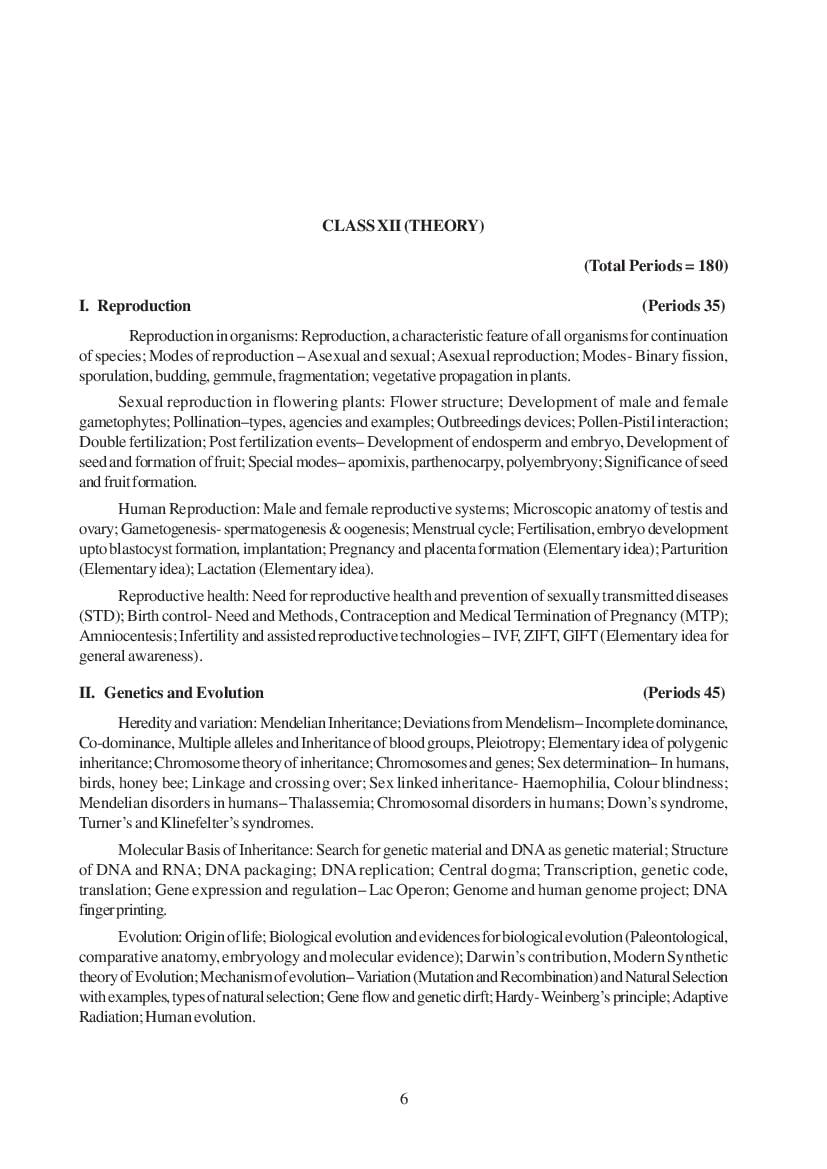
CLASS XII (THEORY)
(Total Periods = 180)
I. Reproduction (Periods 35)
Reproduction in organisms: Reproduction, a characteristic feature of all organisms for continuation
of species; Modes of reproduction – Asexual and sexual; Asexual reproduction; Modes- Binary fission,
sporulation, budding, gemmule, fragmentation; vegetative propagation in plants.
Sexual reproduction in flowering plants: Flower structure; Development of male and female
gametophytes; Pollination–types, agencies and examples; Outbreedings devices; Pollen-Pistil interaction;
Double fertilization; Post fertilization events– Development of endosperm and embryo, Development of
seed and formation of fruit; Special modes– apomixis, parthenocarpy, polyembryony; Significance of seed
and fruit formation.
Human Reproduction: Male and female reproductive systems; Microscopic anatomy of testis and
ovary; Gametogenesis- spermatogenesis & oogenesis; Menstrual cycle; Fertilisation, embryo development
upto blastocyst formation, implantation; Pregnancy and placenta formation (Elementary idea); Parturition
(Elementary idea); Lactation (Elementary idea).
Reproductive health: Need for reproductive health and prevention of sexually transmitted diseases
(STD); Birth control- Need and Methods, Contraception and Medical Termination of Pregnancy (MTP);
Amniocentesis; Infertility and assisted reproductive technologies – IVF, ZIFT, GIFT (Elementary idea for
general awareness).
II. Genetics and Evolution (Periods 45)
Heredity and variation: Mendelian Inheritance; Deviations from Mendelism– Incomplete dominance,
Co-dominance, Multiple alleles and Inheritance of blood groups, Pleiotropy; Elementary idea of polygenic
inheritance; Chromosome theory of inheritance; Chromosomes and genes; Sex determination– In humans,
birds, honey bee; Linkage and crossing over; Sex linked inheritance- Haemophilia, Colour blindness;
Mendelian disorders in humans– Thalassemia; Chromosomal disorders in humans; Down’s syndrome,
Turner’s and Klinefelter’s syndromes.
Molecular Basis of Inheritance: Search for genetic material and DNA as genetic material; Structure
of DNA and RNA; DNA packaging; DNA replication; Central dogma; Transcription, genetic code,
translation; Gene expression and regulation– Lac Operon; Genome and human genome project; DNA
finger printing.
Evolution: Origin of life; Biological evolution and evidences for biological evolution (Paleontological,
comparative anatomy, embryology and molecular evidence); Darwin’s contribution, Modern Synthetic
theory of Evolution; Mechanism of evolution– Variation (Mutation and Recombination) and Natural Selection
with examples, types of natural selection; Gene flow and genetic dirft; Hardy- Weinberg’s principle; Adaptive
Radiation; Human evolution.
6
Showing the first page only. Download the PDF above for the complete document.
Document Details
| Board / Org | NCERT |
| Exam | Class 12 |
| Type | Syllabus |
| Pages | 3 |
| Updated | 09 Jun 2026 |