TS PGECET 2023 Syllabus Biomedical Engineering (BM)
Finished viewing? Save it for later —
Download TS PGECET 2023 Syllabus Biomedical Engineering (BM) (PDF · 4 pages)About TS PGECET 2023 Syllabus Biomedical Engineering (BM)
TS PGECET 2023 Syllabus Biomedical Engineering (BM) is available here for free download. Published by TGCHE for Telangana Post Graduate Engineering Common Entrance Test, this syllabus can be viewed online or downloaded as a PDF (4 pages). Candidates preparing for Telangana Post Graduate Engineering Common Entrance Test can use TS PGECET 2023 Syllabus Biomedical Engineering (BM) to understand the exam pattern, the type of questions asked, and the overall difficulty level.
Frequently Asked Questions
How can I download TS PGECET 2023 Syllabus Biomedical Engineering (BM)?
Open this page and click the Download button to save TS PGECET 2023 Syllabus Biomedical Engineering (BM) as a PDF. It is completely free on AglaSem Docs.
Is TS PGECET 2023 Syllabus Biomedical Engineering (BM) free to download?
Yes. TS PGECET 2023 Syllabus Biomedical Engineering (BM) can be viewed online and downloaded as a PDF free of cost on AglaSem Docs.
How many pages does TS PGECET 2023 Syllabus Biomedical Engineering (BM) have?
TS PGECET 2023 Syllabus Biomedical Engineering (BM) contains 4 pages, which you can read online or download together as a single PDF.
Where can I find more Telangana Post Graduate Engineering Common Entrance Test study material?
You can find more Telangana Post Graduate Engineering Common Entrance Test question papers, sample papers, syllabus, and answer keys on AglaSem Docs.
TS PGECET 2023 Syllabus Biomedical Engineering (BM) – Text
Read the full text of this syllabus below — useful to quickly search, copy and reference the content online without downloading the PDF.
📄 View text version (4 pages)
Page 1
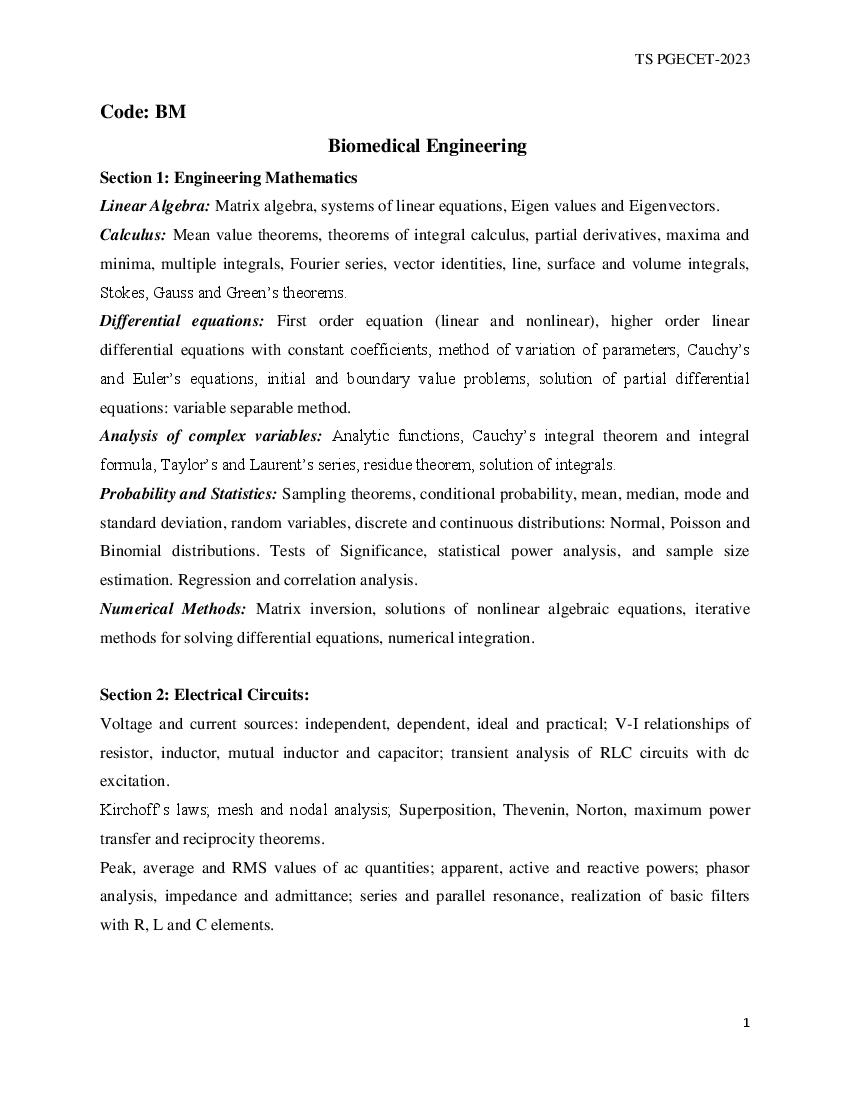
Biomedical Engineering
Section 1: Engineering Mathematics
Linear Algebra: Matrix algebra, systems of linear equations, Eigen values and Eigenvectors.
Calculus: Mean value theorems, theorems of integral calculus, partial derivatives, maxima and
minima, multiple integrals, Fourier series, vector identities, line, surface and volume integrals,
Stokes, Gauss and Green’s theorems.
Differential equations: First order equation (linear and nonlinear), higher order linear
differential equations with constant coefficients, method of variation of parameters, Cauchy’s
and Euler’s equations, initial and boundary value problems, solution of partial differential
equations: variable separable method.
Analysis of complex variables: Analytic functions, Cauchy’s integral theorem and integral
formula, Taylor’s and Laurent’s series, residue theorem, solution of integrals.
Probability and Statistics: Sampling theorems, conditional probability, mean, median, mode and
standard deviation, random variables, discrete and continuous distributions: Normal, Poisson and
Binomial distributions. Tests of Significance, statistical power analysis, and sample size
estimation. Regression and correlation analysis.
Numerical Methods: Matrix inversion, solutions of nonlinear algebraic equations, iterative
methods for solving differential equations, numerical integration.
Section 2: Electrical Circuits:
Voltage and current sources: independent, dependent, ideal and practical; V-I relationships of
resistor, inductor, mutual inductor and capacitor; transient analysis of RLC circuits with dc
excitation.
Kirchoff’s laws; mesh and nodal analysis; Superposition, Thevenin, Norton, maximum power
transfer and reciprocity theorems.
Peak, average and RMS values of ac quantities; apparent, active and reactive powers; phasor
analysis, impedance and admittance; series and parallel resonance, realization of basic filters
with R, L and C elements.
1
Page 2
Continuous and Discrete Signal and Systems: Periodic, aperiodic and impulse signals;
Sampling theorem; Laplace, Fourier and Z-transforms; transfer function, frequency response of
first and second order linear time invariant systems, impulse response of systems; convolution,
correlation. Discrete time system: impulse response, frequency response, DFT; basics of IIR and
FIR filters.
Biosignal Processing: pre-processing of Bio-signals, QRS detection methods, ECG Data
Compression Algorithms, EEG segmentation and Sleep EEG, Detection of resting rhythms.
Section 4: Analog and Digital Electronics
Characteristics and applications of diode, zener diode, BJT and MOSFET; feedback amplifiers.
Characteristics of operational amplifiers; applications of opamps: difference amplifier, adder,
subtractor, integrator, differentiator, Analog filters and wave form generators, instrumentation
amplifier, buffer.
Number Systems, Logic gates, Boolean algebra, Combinational logic circuits, Arithmetic
circuits, comparators, Schmitt trigger, multi-vibrators, sequential circuits, flipflops, shift
registers, timers and counters; sample-and-hold circuit, multiplexer. Principles and
characteristics of ADC and DAC (resolution, quantization, significant bits, conversion/settling
time)
Microprocessor and microcontroller: applications, memory and input- output interfacing;
elements of data acquisition systems.
Section 5: Measurements and Control Systems.
SI units, systematic and random errors in measurement, expression of uncertainty – accuracy and
precision index, propagation of errors; PMMC, MI and dynamometer type instruments; dc
potentiometer; bridges for measurement of R, L and C, Q-meter.
Basics of control engineering – modeling system: transfer function.
2
Page 3
Resistive, capacitive, inductive, piezoelectric, Hall Effect electro chemical and optical sensors
and their associated signal conditioning circuits.
Physiological signals and their characteristics. Biopotential Amplifiers, Generation, acquisition,
and signal conditioning of biosignals: ECG, EMG, EEG, EOG, ERG, PCG, GSR. Noise and
artifacts and their management, Electrical Isolation (optical and electrical) and patient safety
systems. Principles of measuring blood pressure, Body temperature, volume and flow in arteries.
Operating Principles of medical equipment-cardiac pacemaker, defibrillator, pulse oximeter,
hemodialyser, ventilator, anaesthesia machine, spirometer.
Section 7: Human Anatomy and Physiology
Basics of cell, types of tissues and organ systems; Homeostasis; Basics of organ systems-
musculoskeletal, respiratory, circulatory, endocrine, nervous and gastro-intestinal
Section 8: Biomechanics
Hard Tissues: Structure, functions, composition and mechanical properties of cortical and
cancellous bones.
Soft Tissues: Structure, functions, composition and mechanical properties of Soft Tissues:
Cartilage, Tendon, Ligament, Muscle. Viscoelasticity: Features and models.
Human Joints and Movements: Skeletal joints, types of joints, forces and stresses in human
joints, free body diagrams and equilibrium, biomechanical of analysis joints, Gait parameters and
their analysis.
Biofluid mechanics: Flow properties of blood, Blood flow in arteries, veins and micro vessels.
Section 9: Medical Imaging Systems
Basic physics, instrumentation and image formation techniques in medical imaging modalities-
X-Ray
CT
Ultrasound
MRI
PET
SPECT
3
Page 4
Basic properties of biomaterials, types of biomaterials-metals, ceramics, polymers and
composites.
Characteristics of implants-biocompatibility, bioactivity, biodegradability.
Biomaterial characterization techniques- Atomic Force Microscopy, Electron Microscopy,
Transmission Electron Microscopy, Infrared Spectroscopy.
4
Document Details
| Board / Org | TGCHE |
| Exam | Telangana Post Graduate Engineering Common Entrance Test |
| Type | Syllabus |
| Pages | 4 |
| Updated | 22 Jul 2026 |