Finished viewing? Save it for later —
Download ISC Class 12 Syllabus 2027 Home Science (PDF · 7 pages)About ISC Class 12 Syllabus 2027 Home Science
ISC Class 12 Syllabus 2027 Home Science is available here for free download. Published by CISCE for Class 12, this syllabus can be viewed online or downloaded as a PDF (7 pages). Candidates preparing for Class 12 can use ISC Class 12 Syllabus 2027 Home Science to understand the exam pattern, the type of questions asked, and the overall difficulty level.
Frequently Asked Questions
How can I download ISC Class 12 Syllabus 2027 Home Science?
Open this page and click the Download button to save ISC Class 12 Syllabus 2027 Home Science as a PDF. It is completely free on AglaSem Docs.
Is ISC Class 12 Syllabus 2027 Home Science free to download?
Yes. ISC Class 12 Syllabus 2027 Home Science can be viewed online and downloaded as a PDF free of cost on AglaSem Docs.
How many pages does ISC Class 12 Syllabus 2027 Home Science have?
ISC Class 12 Syllabus 2027 Home Science contains 7 pages, which you can read online or download together as a single PDF.
Where can I find more Class 12 study material?
You can find more Class 12 question papers, sample papers, syllabus, and answer keys on AglaSem Docs.
ISC Class 12 Syllabus 2027 Home Science – Text
Read the full text of this syllabus below — useful to quickly search, copy and reference the content online without downloading the PDF.
📄 View text version (7 pages)
Page 1
INDIAN SCHOOL CERTIFICATE
EXAMINATION
HOME SCIENCE
(864)
Page 2
____________________________________________________________________________________________
© Copyright, Council for the Indian School Certificate Examinations
All rights reserved. The copyright to this publication and any part thereof solely vests in the Council for the Indian
School Certificate Examinations. This publication and no part thereof may be reproduced, transmitted, distributed or
stored in any manner whatsoever, without the prior written approval of the Council for the Indian School Certificate
Examinations.
Page 3
MISSION STATEMENT
The Council for the Indian School Certificate
Examinations is committed to serving the nation's
children, through high quality educational
endeavours, empowering them to contribute towards
a humane, just and pluralistic society, promoting
introspective living, by creating exciting learning
opportunities, with a commitment to excellence.
ETHOS OF CISCE
Trust and fair play.
Minimum monitoring.
Allowing schools to evolve their own niche.
Catering to the needs of the children.
Giving freedom to experiment with new ideas
and practices.
Diversity and plurality - the basic strength for
evolution of ideas.
Schools to motivate pupils towards the
cultivation of:
Excellence - The Indian and Global
experience.
Values - Spiritual and cultural - to be the bedrock
of the educational experience.
Schools to have an 'Indian Ethos', strong roots in
the national psyche and be sensitive to national
aspirations.
Page 4
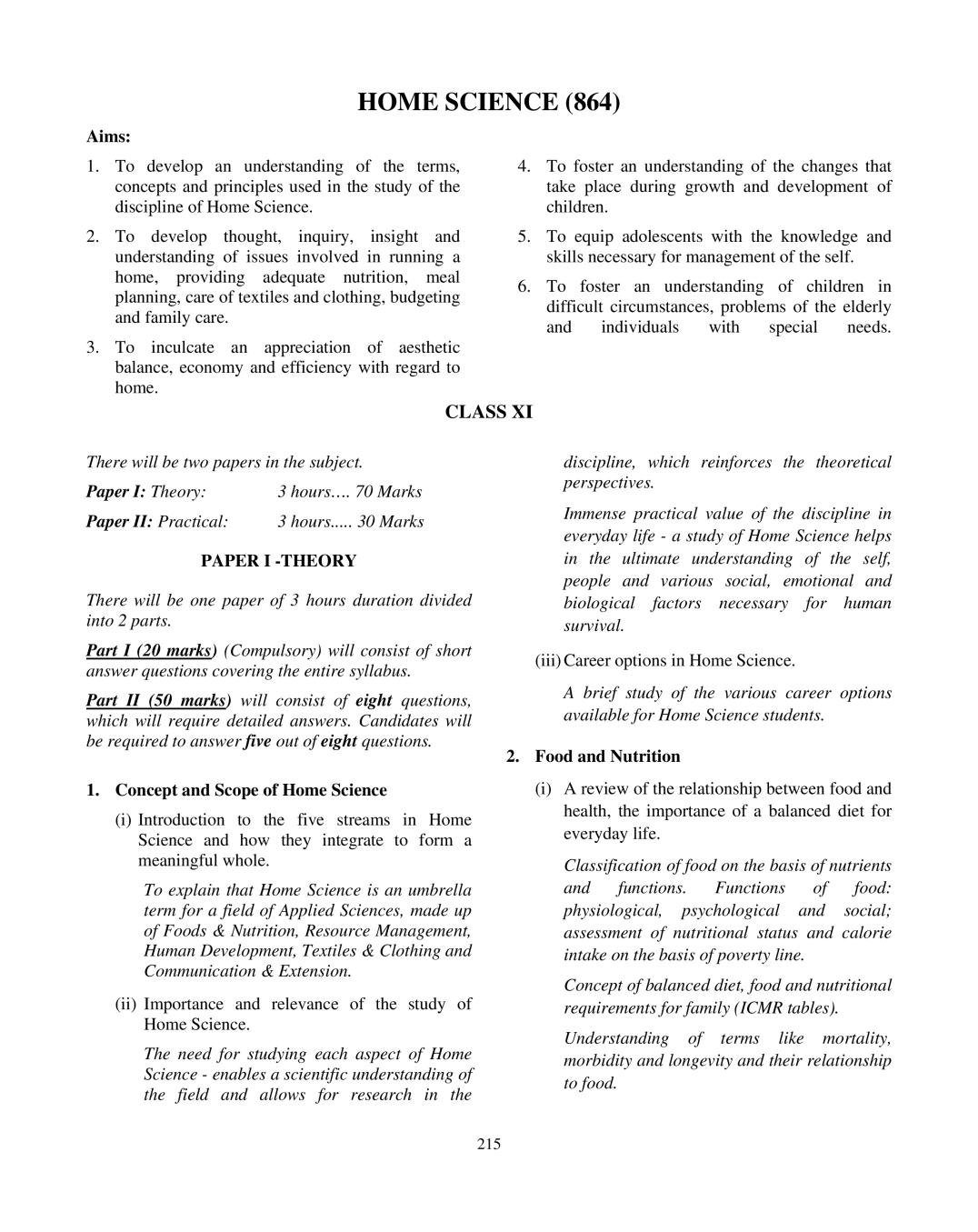
There will be two papers in the subject: flambé, meringue, glaze, poach, puree, roux,
Paper I: Theory: 3 hours ... 70 Marks pare, temper, prove, dredge.
Paper II: Practical: ... 20 Marks (iv) Effects of cooking on food components.
Planning Session: 1 hour Effect of cooking on Carbohydrates (starch,
Examination Session: 3 hours sugar, pectin, cellulose); Proteins; Oils and
Project Work … 7 marks Fats; Minerals and Vitamins. Internal and
external changes in food components. Do’s
Practical File … 3 marks
and don’ts in cooking to minimize loss of
nutrients.
(v) Methods of increasing nutritive value of
PAPER I -THEORY foods.
1. Food Preparation Sprouting/ germination, fermentation,
(i) Principles of cooking; Methods of cooking parboiling, combination of foods,
(dry and wet/moist methods of cooking) and supplementation, substitution.
reasons for cooking; advantages and Method and advantages of each of the above.
disadvantages of various methods employed
in cooking. Some technologies used in 2. Meal Planning for the family
cooking.
(i) Objectives of meal planning. Nutritional
Principles of cooking; adequacy.
Methods: Wet/moist methods: boiling, Self-explanatory.
simmering, steaming (direct and indirect),
stewing, braising, pressure cooking. (ii) Factors affecting food selection.
Frying: sautéing, shallow and deep frying. An understanding of how food consumption
Dry methods: baking, roasting, grilling/ varies from one family to another; how food
broiling. selected by families is affected by
various factors such as age, occupation,
Technologies used in cooking: microwave, gender, physiological conditions, personal
induction cooking, solar cooking. likes and dislikes, tradition, seasonal
Meaning, principle, advantages, availability, economic considerations,
disadvantages and examples of each of the religious beliefs, family size and composition.
above. (iii) Meal planning for various age groups.
(ii) Preliminary treatment of foods before An understanding of the nutritional needs of
cooking. pre-school children, school-age children,
Common pre-cooking procedures such as: adolescents, adults and the elderly. Making
Cleaning/ washing, peeling, cutting, sieving, meal plans for these age groups based on
grinding, beating / whipping, soaking, their nutritional requirements and the RDAs.
mixing, kneading, grating. (iv) Eating disorders; developing good food
habits.
Meaning and application of each of the
above. An understanding of the following:
(a) Anorexia nervosa (b) Bulimia (c) Binge
(iii) Culinary terms. eating disorder or obesity; ways to control the
Meaning and application of the following: above eating disorders.
garnish, season, blanch, marinate, braise, Developing good food habits: importance of
breakfast, following regular meal patterns,
ISC Examination Year 2027 4
Page 5
Food fads – meaning and examples. food items.
(v) Special diets. (c) Role of advertisements and their impact.
Meaning and types; factors to be kept in mind (iii) Problems faced by consumers.
while preparing special diets for: fever (of Price variation, hoarding and black
short duration), diarrhea, diabetes, obesity, marketing, unfair means of measurement,
hypertension. A day’s menu plan for each of misleading advertisements, deceptive
the above. packaging, sale of sub-standard goods.
3. Resource Management Food adulteration: Definition of food
adulteration as stated in Prevention of Food
(i) Savings and Investments.
Adulteration Act (PFA); common adulterants
Importance of savings and investments. present in food stores - stones, dust, dirt,
(ii) Avenues and schemes for savings and argemone seeds and oil, metanil yellow,
investments offered by different financial kesari dal, toxic colours, chicory powder and
institutions. starch and their effects.
Banks: 5. Human Development
Concept; function and types of accounts: Growth and development during adolescence.
savings, current, recurring and fixed deposit (i) Physical development.
accounts in Banks: features, limitations;
online banking: meaning, advantages and Physical Development during puberty and
disadvantages. A brief understanding of adolescence: role of the endocrine system -
NEFT. changes in body proportions and their
effects; early and late maturers; influence of
Opening and operating a bank account, types sports and exercise on physical fitness.
of cheques, filling a deposit slip, procedure
for making a demand draft, use of ATM, (ii) Cognitive development
debit, credit cards and availing educational Stages of cognitive development.
loans. (iii) Social and emotional development.
Post office: Influences on adolescents:
Concept; function and types of accounts: − Family: parents, grandparents, siblings;
savings, recurring and fixed deposit Family and socialization; patterns of
accounts: features, limitations. parenting; development of gender roles
Insurance (life and health); shares and and stereotypes.
debentures: concept only. − School and teachers: role of school and
4. Consumer Education teachers in the social and emotional
(i) Consumer Protection development of the adolescent.
Importance of consumer education; rights − Peers: development of peer relationships
and responsibilities of the consumer; (positive and negative influences).
advantages of consumer education. (iv) Issues and concerns of adolescents.
Consumer Protection Act (2019) - salient Peer pressure, substance abuse (meaning,
features. symptoms and treatment), sexual abuse;
(ii) Consumer aids anger management, depression and suicidal
(a) Standard Marks: Creating awareness tendencies. Preparation for career. Influence
about standard marks for consumer of social media.
protection: fssai, FPO, AGMARK, ISI,
Woolmark, Ecomark, Silkmark,
Hallmark, Handloom mark; vegetarian
and non-vegetarian food.
ISC Examination Year 2027 5
Page 6
Adulthood: meaning and dimensions; Stages: This practical paper will consist of two sessions:
• Early adulthood - understanding and (i) The Planning Session (1 hour)
managing new responsibilities, career,
marriage and family. (ii) The Examination Session (3 hours)
• Middle adulthood - physical and (i) The Planning Session: Candidates will be
psychological changes. required to plan a balanced menu during the
• Late adulthood/ old age - (a) Health and Planning Session, on any one from the two given
wellness: physical, social, emotional, options.
financial, recreational needs (b) Care for (ii) The Examination Session:
the elderly (at home and outside - old
age homes); modification in lifestyle; (a) Candidates will be required to cook any two
preparation for retirement. dishes from the menu planned during the
Planning Session.
Increasing life expectancy and
associated issues and concerns. (b) Candidates would also need to display the
Sensitising children towards the needs dishes prepared with a suitable table layout.
and care of the elderly. NOTE: Candidates will be required to exhibit
6. Traditional Textiles different methods of cooking during the
practical examination.
Traditional textiles: Classification - embroidered,
woven, dyed, printed and painted. (c) In addition, candidates will be required to
(a) Embroidered textiles: Chikankari, Phulkari, design and develop a suitable label for a food
Kashidakari, Kantha, Kasuti, Kutch- item on any one of the two given options.
Kathaiwar - origin, thread, colour, fabric, Candidates will be assessed on the design
stitches, motifs, products. and content of the label.
(b) Woven textiles: Baluchari, Chanderi, The label should include the following
Kanjeevaram, Banarasi, Jamdani, Kani information: nutritive content, net content,
shawls - origin, characteristics, care and use of additives and preservatives if any,
storage: origin, yarn, colours, motifs, manufacturing and expiry date /best before
products. dates, instructions of use, MRP,
(c) Dyed: Bandhini, Patola, Ikat - origin, fibre standardization marks, vegetarian/non-
or fabric, colours, motifs, products. vegetarian, name and address of the
(d) Printed and painted: Kalamkari, Madhubani, manufacturer (any six points to be included).
Bagh, Dabu (Sanganer-Baghru print) -
The Practical Work will be evaluated by a
origin, technique, fabric, colours, motifs,
Visiting Examiner appointed locally and
products.
approved by CISCE.
7. Communication and Extension
Distribution of Marks:
(i) Water safety
Importance of potable drinking water for Menu Planning 5 Marks
good health; simple methods of making water Cooking 10 Marks
safe for drinking: boiling, filtering
(traditional and modern technology), use of Table display 2 Marks
alum and chlorine.
Label Designing 3 Marks
(ii) Some National Programmes for Community
Development. TOTAL 20 MARKS
Scope and salient features of the Swachh
Bharat Abhiyan and the Integrated Child
Development Scheme (ICDS).
ISC Examination Year 2027 6
Page 7
following Practicals during the year:
FILE – 10 Marks
1. Plan a balanced menu keeping in mind the
specified age and sex variations for: Project Work – 7 Marks
- Special occasions (birthday party, marriage Evaluation Criteria: material, content,
anniversary, family get-togethers, promotion presentation and innovation
at work, success in examinations, etc.)
The project work is to be assessed by a Visiting
- Packed meals (picnic basket, short and long Examiner appointed locally and approved by CISCE.
journeys…)
The candidate is to creatively execute ONE
- Therapeutic diets (hypertension, diabetes, project/assignment on any one of the following:
obesity)
1. Study the height and weight of at least 20 people
Prepare any two dishes from the planned menu,
from the same age group. Compare the data
using different methods of cooking.
collected against the recommended norms to
Make an appropriate display to complement the identify variations. Analyse the data and present
prepared dishes. your findings graphically.
2. Design and develop suitable labels for food 2. Select any three States in India and study their
items. traditional weaves, prints and costumes. Prepare
3. Opening of a bank account, filling of cheques, a report on the same.
deposit slips, withdrawal slips and demand draft
3. Select any one National Programme for
forms.
community development in India and prepare a
report on the same. Also prepare two
communication aids to create awareness on this
Programme.
4. Compare the interest rates offered by five
different commercial banks on fixed deposits
under general and senior citizens categories and
the various time durations.
Also find out the procedure for: Opening a
savings account and a fixed deposit account.
Practical File – 3 Marks
The Visiting Examiner is required to assess
candidates on the basis of the Practical file
maintained by them during the academic year.
ISC Examination Year 2027 7
Document Details
| Board / Org | CISCE |
| Exam | Class 12 |
| Type | Syllabus |
| Pages | 7 |
| Updated | 04 Aug 2026 |