Finished viewing? Save it for later —
Download ISC Class 12 Syllabus 2027 Mathematics (PDF · 11 pages)About ISC Class 12 Syllabus 2027 Mathematics
ISC Class 12 Syllabus 2027 Mathematics is available here for free download. Published by CISCE for Class 12, this syllabus can be viewed online or downloaded as a PDF (11 pages). Candidates preparing for Class 12 can use ISC Class 12 Syllabus 2027 Mathematics to understand the exam pattern, the type of questions asked, and the overall difficulty level.
Frequently Asked Questions
How can I download ISC Class 12 Syllabus 2027 Mathematics?
Open this page and click the Download button to save ISC Class 12 Syllabus 2027 Mathematics as a PDF. It is completely free on AglaSem Docs.
Is ISC Class 12 Syllabus 2027 Mathematics free to download?
Yes. ISC Class 12 Syllabus 2027 Mathematics can be viewed online and downloaded as a PDF free of cost on AglaSem Docs.
How many pages does ISC Class 12 Syllabus 2027 Mathematics have?
ISC Class 12 Syllabus 2027 Mathematics contains 11 pages, which you can read online or download together as a single PDF.
Where can I find more Class 12 study material?
You can find more Class 12 question papers, sample papers, syllabus, and answer keys on AglaSem Docs.
ISC Class 12 Syllabus 2027 Mathematics – Text
Read the full text of this syllabus below — useful to quickly search, copy and reference the content online without downloading the PDF.
📄 View text version (11 pages)
Page 1
INDIAN SCHOOL CERTIFICATE
EXAMINATION
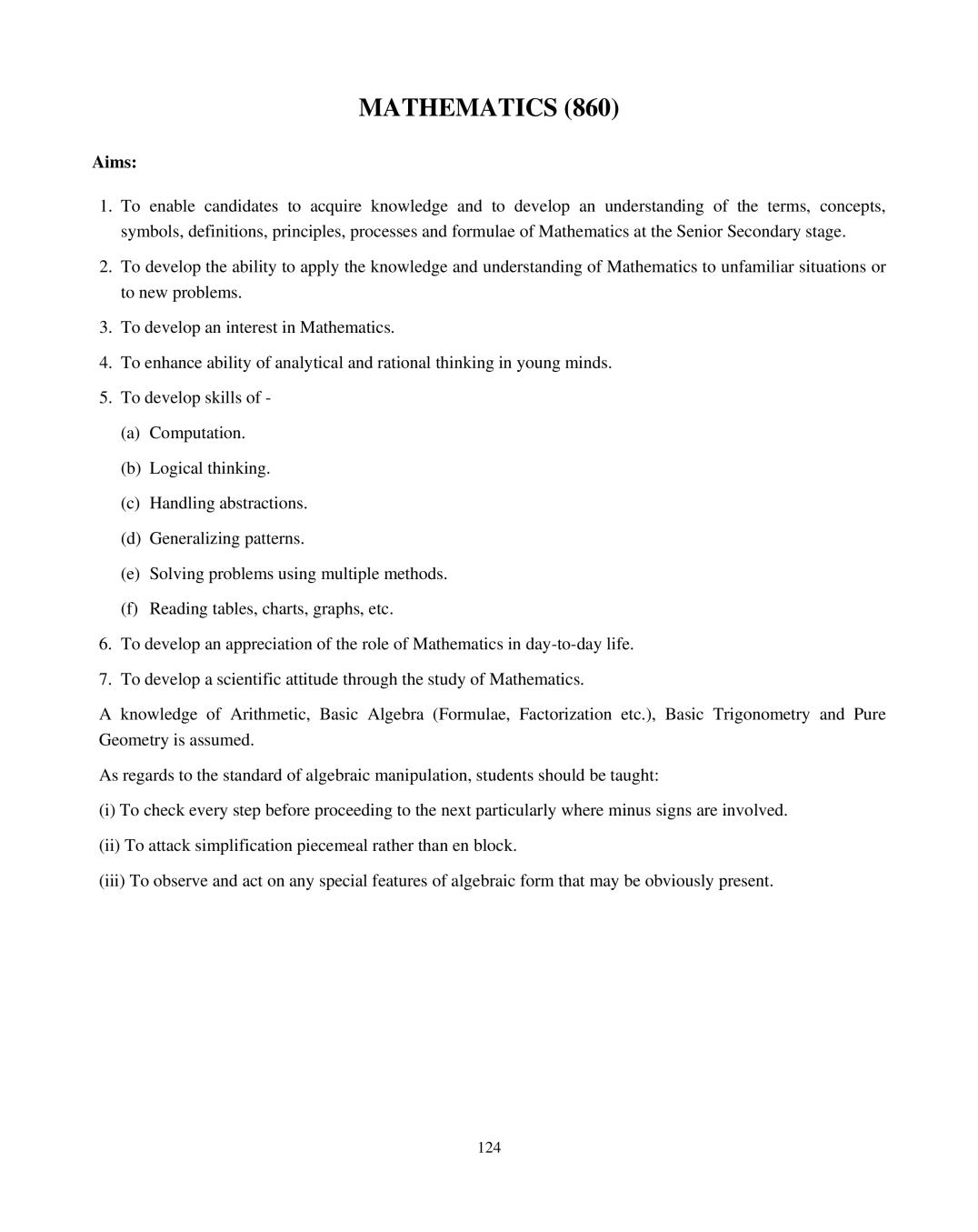
MATHEMATICS
(860)
Page 2
____________________________________________________________________________________________
© Copyright, Council for the Indian School Certificate Examinations
All rights reserved. The copyright to this publication and any part thereof solely vests in the Council for the Indian
School Certificate Examinations. This publication and no part thereof may be reproduced, transmitted, distributed or
stored in any manner whatsoever, without the prior written approval of the Council for the Indian School Certificate
Examinations.
Page 3
MISSION STATEMENT
The Council for the Indian School Certificate
Examinations is committed to serving the nation's
children, through high quality educational
endeavours, empowering them to contribute towards
a humane, just and pluralistic society, promoting
introspective living, by creating exciting learning
opportunities, with a commitment to excellence.
ETHOS OF CISCE
Trust and fair play.
Minimum monitoring.
Allowing schools to evolve their own niche.
Catering to the needs of the children.
Giving freedom to experiment with new ideas
and practices.
Diversity and plurality - the basic strength for
evolution of ideas.
Schools to motivate pupils towards the
cultivation of:
Excellence - The Indian and Global
experience.
Values - Spiritual and cultural - to be the bedrock
of the educational experience.
Schools to have an 'Indian Ethos', strong roots in
the national psyche and be sensitive to national
aspirations.
Page 4
There will be two papers in the subject:
Paper I : Theory (3 hours) ……80 marks
Paper II: Project Work ……20 marks
PAPER I - THEORY: 80 Marks
DISTRIBUTION OF MARKS FOR THE THEORY PAPER
S.No. UNIT TOTAL WEIGHTAGE
1. Relations and Functions 10 Marks
2. Algebra 10 Marks
3. Calculus 35 Marks
4 Vector Algebra 5 Marks
5 Three - Dimensional Geometry 6 Marks
6. Linear Programming 5 Marks
7. Probability 9 Marks
TOTAL 80 Marks
ISC Examination Year 2027 8
Page 5
3tan-1x etc. and application of these
(i) Types of relations: reflexive, symmetric,
formulae.
transitive and equivalence relations. One to
one and onto functions, composite function
2. Algebra
and inverse of a function.
Matrices and Determinants
• Relations as:
- Relation on a set A (i) Matrices
- Identity relation, empty relation, Concept, notation, order, equality, types of
universal relation. matrices, zero and identity matrix,
- Types of Relations: reflexive, transpose of a matrix, symmetric and skew
symmetric, transitive and symmetric matrices. Operation on matrices:
equivalence relation. Addition and multiplication and
multiplication with a scalar. Simple
• Functions: properties of addition, multiplication and
- As special relations, concept of scalar multiplication. Non- commutativity
writing “y is a function of x” as y of multiplication of matrices and existence
= f(x). of non-zero matrices whose product is the
- Types: one to one, many to one, zero matrix (restrict to square matrices of
into, onto. order upto 3). Invertible matrices and proof
- Real Valued function. of the uniqueness of inverse, if it exists (here
- Domain and range of a function. all matrices will have real entries).
- Conditions of inevitability.
(ii) Determinants
- Sketching of graph of a function and
its inverse. Determinant of a square matrix (up to 3 x
- Composite functions and Invertible 3 matrices), properties of determinants,
functions (algebraic functions minors, co-factors and applications of
only). determinants in finding the area of a
triangle. Adjoint and inverse of a square
(ii) Inverse Trigonometric Functions matrix. Consistency, inconsistency and
Definition, domain, range, principal value number of solutions of system of linear
branch. Graphs of inverse trigonometric equations by examples, solving system of
functions. Elementary properties of inverse linear equations in two or three variables
trigonometric functions. (having unique solution) using inverse of a
matrix.
- Principal values.
- Types of matrices (m × n; m, n ≤ 3),
- sin-1x, cos-1x, tan-1x etc order; Diagonal matrix, Scalar matrix,
x Identity matrix, Triangular matrix.
- sin-1x = cos −1 1 − x 2 =
tan −1 .
1 − x2 - Symmetric, Skew symmetric matrices.
Properties of Symmetric, Skew
1 π symmetric matrices.
- sin-1x= cosec −1 ; sin-1x+cos-1x=
x 2
- Operation – addition, subtraction,
and similar relations for cot-1x, tan-1x,
multiplication of a matrix with scalar,
etc.
multiplication of two matrices
sin-1 x ± = ( )
sin-1 y sin -1 x 1 − y 2 ± y 1 − x 2
(the compatibility).
1 1
-1
cos y cos ( xy 1 − y 1 − x )
cos x ± = -1 -1 2 2
E.g. 0 2
1 2 = AB( say ) but BA is
2 2
1 1
x+ y
similarly tan-1 x +=
tan-1 y tan-1 , xy < 1 not possible.
1 − xy
- Singular and non-singular matrices.
-1 -1 -1 x − y
tan
= x − tan y tan , xy > −1 - Existence of two non-zero matrices
1 + xy
whose product is a zero matrix.
ISC Examination Year 2027 9
Page 6
AdjA - Removable discontinuity. Types of
−1
- Inverse (2×2, 3×3) A = removable discontinuity.
A
• Differentiation
- Properties of inverse - Concept of continuity and
• Martin’s Rule (i.e. using matrices) differentiability of x , [x], etc.
a1x + b1y + c1z = d1 - Derivatives of trigonometric
a2x + b2y + c2z = d2 functions.
a3x + b3y + c3z = d3 - Derivatives of exponential
functions.
- Derivatives of logarithmic
a1 b1 c1 d1 x functions.
A = a 2 b2 c 2 B = d 2 X = y
- Derivatives of inverse
a 3 b3 c3 d 3 z trigonometric functions -
differentiation by means of
AX = B ⇒ X = A −1 B substitution.
- Derivatives of implicit functions
Problems based on above.
and chain rule.
NOTE: The conditions for consistency of - Derivatives of Parametric
equations in two and three variables, using functions.
matrices, are to be covered.
- Differentiation of a function with
• Determinants respect to another function e.g.
- Order. differentiation of sinx3 with respect
to x3.
- Minors.
- Logarithmic Differentiation -
- Cofactors. x
Finding dy/dx when y = x x .
- Expansion.
- Successive differentiation up to 2nd
- Applications of determinants in finding order.
the area of triangle and collinearity.
NOTE: Derivatives of composite functions
- Properties of determinants. Problems using chain rule.
based on properties of determinants.
(ii) Applications of Derivatives
3. Calculus Applications of derivatives: rate of change
of bodies, increasing/decreasing functions,
(i) Continuity, Differentiability and
tangent and normal, maxima and minima
Differentiation. Continuity and
(first derivative test motivated
differentiability, derivative of composite
geometrically and second derivative test
functions, chain rule, derivatives of
given as a provable tool). Problems that
inverse trigonometric functions, derivative
illustrate basic principles and understanding
of implicit functions. Concept of
exponential and logarithmic functions. of the subject as well as real-life situations.
• Equation of Tangent and Normal, Angle
Derivatives of logarithmic and exponential
between two curves
functions. Logarithmic differentiation,
derivative of functions expressed in • Rate measure.
parametric forms. Second order derivatives.
• Increasing and decreasing functions.
• Continuity
• Maxima and minima.
- Continuity of a function at a point
x = a. - Critical points, Stationary/turning
points, Extreme points.
- Continuity of a function in an - Absolute maxima/minima
interval.
ISC Examination Year 2027 10
Page 7
- First derivatives test and second ∫ 2 2 ,∫ 2 2 ,∫ 2 dx, ∫ dx
x ±a x ± a ax + bx + c ax 2 + bx + c
derivatives test
- Application problems based on and ∫ a 2 ± x 2 dx, ∫ x 2 − a 2 dx,
maxima and minima.
∫ ax + bx + c dx, ∫ ( px + q) ax + bx + c dx,
2 2
(iii) Integrals
Integration as inverse process of integrations reducible to the above
differentiation. Integration of a variety of forms.
functions by substitution, by partial dx
fractions and by parts, Evaluation of ∫ a cos x + b sin x ,
simple integrals of the following types and dx dx dx
problems based on them. ∫ a + b cos x , ∫ a + b sin x ∫ a cos x + b sin x + c ,
Fundamental Theorem of Calculus
(a cos x + b sin x)dx
(without proof). Basic properties of ∫ c cos x + d sin x ,
definite integrals and evaluation of
definite integrals. dx
∫ a cos x + b sin x + c
2 2
• Indefinite integral
- Integration as the inverse of 1 ± x2
differentiation.(anti-derivative). ∫ 1 + x 4 dx ,
- Anti-derivatives of polynomials and dx
functions (ax +b)n , sinx, cosx, ∫ 1 + x , ∫ tan x dx, ∫ cot x dx etc.
4
sec2x, cosec2x etc .
• Definite Integral
- Integrals of the type sin2x, sin3x,
sin4x, cos2x, cos3x, cos4x. - Fundamental theorem of calculus
(without proof)
- Integration of 1/x, ex.
- Integration by substitution. - Properties of definite integrals.
- Integrals of the type f ' (x)[f (x)]n, - Problems based on the following
f ′( x) properties of definite integrals are
. to be covered.
f ( x)
b b
- Integration of tanx, cotx, secx,
cosecx. ∫ f ( x)dx = ∫ f (t )dt
a a
- Integration by parts. b a
- Integration using partial fractions.
f ( x)
∫ f ( x)dx = − ∫ f ( x)dx
a b
Expressions of the form
g ( x) b c b
when degree of f(x) < degree of g(x) ∫ f ( x)dx = ∫ f ( x)dx + ∫ f ( x)dx
a a c
x+2 A B
E.g. = + where a < c < b
( x − 3)( x + 1) x − 3 x + 1
b b
x+2 A B C
( x − 2)( x − 1) 2
= +
x − 1 ( x − 1) 2
+
x−2
∫ f ( x)dx = ∫ f (a + b − x)dx
a a
x +1 Ax + B C a a
= 2 +
( x + 3)( x − 1) x + 3 x − 1
2
∫ f (=
0
x)dx ∫ f (a − x)dx
0
When degree of f (x) ≥ degree of g(x),
2a a
x +12
3x + 1 2 ∫ f ( x)dx, if f (2a − x) = f ( x)
e.g. 2
= 1− 2 ∫ f ( x)dx = 0
x + 3x + 2 x + 3x + 2 0 0, f (2a − x) =− f ( x)
• Integrals of the type:
ISC Examination Year 2027
11
Page 8
∫
a
2 f ( x)dx,if f is an even function multiplication of a vector by a scalar, position
∫
−a
f ( x)dx = 0
vector of a point dividing a line segment in a
0,if f is an odd function given ratio. Definition, Geometrical
Interpretation, properties and application of
(iv) Application of Integrals (Area under the scalar (dot) product of vectors, vector (cross)
curve) Application in finding the area product of vectors.
bounded b y simple curves and coordinate
axes. Area enclosed between two curves. - As directed line segments.
- Magnitude and direction of a vector.
- Application of definite integrals - area
- Types: equal vectors, unit vectors, zero
bounded by curves, lines and coordinate
axes is required to be covered. vector.
- Position vector.
- Simple curves: lines, circles/
parabolas/ ellipses, polynomial - Components of a vector.
functions, modulus function, - Vectors in two and three dimensions.
exponential function, logarithmic - iˆ, ˆj , kˆ as unit vectors along the x, y and
function.
the z axes; expressing a vector in terms of
(v) Differential Equations the unit vectors.
Definition, order and degree, general and - Operations: Sum and Difference of vectors;
particular solutions of a differential scalar multiplication of a vector.
equation. Solution of differential equations - Section formula.
by method of separation of variables - Scalar (dot) product of vectors and its
solutions of homogeneous differential
geometrical significance.
equations of first order and first degree.
Solutions of linear differential equation of - Scalar and vector projection.
dy - Cross product and its geometrical
the type: + py = q, where p and q are significance. Its properties - area of a
dx
dx triangle, area of parallelogram, collinear
functions of x or constants. + px = q, vectors.
dy
where p and q are functions of y or constants. NOTE: Proofs of geometrical theorems by
- Differential equations, order and degree. using Vector algebra are excluded.
- Formation of differential equation by 5. Three - dimensional Geometry
eliminating arbitrary constant(s).
- Solution of differential equations. Direction cosines and direction ratios of a line
joining two points. Cartesian equation and
- Variable separable. vector equation of a line, coplanar and skew
- Homogeneous equations. lines, shortest distance between two lines.
dy Cartesian and vector equation of a plane. Angle
- Linear form + Py = Q where P and Q between (i) two lines, (ii) two planes, (iii) a line
dx
are functions of x/constant. Similarly, for and a plane. Distance of a point from a plane.
dx/dy. - Equation of x-axis, y-axis, z axis and lines
NOTE 1: Equations reducible to variable parallel to them.
separable type are included. - Equation of xy - plane, yz – plane,
NOTE 2: The second order differential zx – plane.
equations are excluded. - Direction cosines, direction ratios.
- Angle between two lines in terms of
4. Vector Algebra direction cosines /direction ratios.
- Condition for lines to be perpendicular/
Vectors and scalars, magnitude and direction parallel.
of a vector. Direction cosines and direction
ratios of a vector. Types of vectors (equal, unit, • Lines
zero, parallel and collinear vectors), position - Cartesian and vector equations of a line
vector of a point, negative of a vector, through one and two points.
ISC Examination Year 2027 12
Page 9
- Conditions for intersection of two lines. - Theoretical probability distribution,
- Distance of a point from a line. probability distribution function; mean of
- Shortest distance between two lines. random variable.
• Planes
PAPER II
- Cartesian and vector equation of a
plane.
PROJECT WORK – 20 Marks
- Direction ratios of the normal to the
plane. Candidates will be expected to have completed two
- One point form. projects.
- Normal form. The project work will be assessed by the subject
- Intercept form. teacher and a Visiting Examiner appointed
- Distance of a point from a plane. locally and approved by the Council.
- Intersection of the line and plane.
Mark allocation for each Project [10 marks]:
- Angle between two planes, a line and a
plane. Overall format 1 mark
6. Linear Programming Content 4 marks
Introduction, related terminology such as Findings 2 marks
constraints, objective function, optimization, Viva-voce based on the Project 3 marks
different types of linear programming (L.P.)
problems, mathematical formulation of L.P. Total 10 marks
problems, graphical method of solution for
problems in two variables, feasible and
infeasible regions (bounded and unbounded), List of suggested assignments for Project Work:
feasible and infeasible solutions, optimal 1. Using a graph, demonstrate a function which is
feasible solutions (up to three non-trivial one-one but not onto.
constraints).
2. Using a graph demonstrate a function which is
Introduction, definition of related terminology invertible.
such as constraints, objective function, 3. Draw the graph of y = sin-1 x (or any other
optimization, advantages of linear inverse trigonometric function), using the graph
programming; limitations of linear of y = sin x (or any other relevant
programming; application areas of linear trigonometric function). Demonstrate the
programming; different types of linear concept of mirror line (about y = x) and find its
programming (L.P.) problems, mathematical domain and range.
formulation of L.P problems, graphical method
of solution for problems in two variables, 4. Explore the principal value of the function
feasible (bounded/ unbounded) and infeasible sin-1 x (or any other inverse trigonometric
regions, feasible and infeasible solutions, function) using a unit circle.
optimum feasible solution(may/may not exists). 5. Find the derivatives of a determinant of the order
of 3 x 3 and verify the same by other methods.
7. Probability 6. Verify the consistency of the system of three
Conditional probability, multiplication theorem linear equations of two variables and verify the
on probability, independent events, total same graphically. Give its geometrical
probability, Bayes’ theorem, Random variable interpretation.
and its probability distribution, mean of 7. For a dependent system (non-homogeneous) of
r a n d o m variable. three linear equations of three variables, identify
- Independent and dependent events infinite number of solutions.
conditional events. 8. Explain the concepts of increasing and
- Laws of Probability, addition theorem, decreasing functions, using geometrical
multiplication theorem, conditional significance of dy/dx. Illustrate with proper
probability. examples.
- Theorem of Total Probability.
ISC Examination Year 2027 13
Page 10
inflexion with examples and illustrate it using compound angles, e.g. sin (A + B) = Sin A Cos
graphs. B + Sin B Cos A, etc.
10. Explain and illustrate (with suitable examples) 21. Find the image of a line with respect to a given
the concept of local maxima and local minima plane.
using graph. 22. Find the distance of a point from a given plane
11. Explain and illustrate (with suitable examples) measured parallel to a given line.
the concept of absolute maxima and absolute 23. Find the distance of a point from a line measured
minima using graph. parallel to a given plane.
12. Explain the conditional probability, the theorem 24. Find the area bounded by a parabola and an
of total probability and the concept of Bayes’ oblique line.
theorem with suitable examples.
25. Find the area bounded by a circle and an oblique
13. Explain the types of probability distributions line.
and derive mean and variance of binomial
probability distribution for a given function. 26. Find the area bounded by an ellipse and an
oblique line.
14. Using any suitable data, find the minimum cost
by applying the concept of Transportation 27. Find the area bounded by a circle and a circle.
problem. 28. Find the area bounded by a parabola and a
15. Using any suitable data, find the minimum cost parabola.
and maximum nutritional value by applying the 29. Find the area bounded by a circle and a parabola.
concept of Diet problem. (Any other pair of curves which are specified
16. Using any suitable data, find the Optimum cost in the syllabus may also be taken.)
in the manufacturing problem by formulating a 30. Analyse - Three methods (proofs) to find the area
linear programming problem (LPP). under the curve.
17. Demonstrate application of differential 31. Tessellation:
equations to solve a given problem (example,
population increase or decrease, bacteria count Types of tessellations, Geometrical shape of
in a culture, etc.). tessellation, Tessellation in nature, Man made
tessellation, application in real life situation.
18. Using vector algebra, find the area of a 32. Scared Geometry and Euclid geometry
parallelogram/triangle. Also, derive the area comparison and different approach
analytically and verify the same.
(Mathematically)
19. Using Vector algebra, prove the formulae of
properties of triangles (sine/cosine rule, etc.) 33. Derivation of 𝑒𝑒 ∫ 𝑝𝑝𝑝𝑝𝑝𝑝 and its applications.
34. Differentiation – instantaneous rate of change of
displacement, why not rate of change of one
variable with reference to other variable.
35. Derivation of determinant.
NOTE: No question paper for Project Work will
be set by the CISCE.
ISC Examination Year 2027 14
Page 11
S. No. Unique PROJECT 1 PROJECT 2 TOTAL
Identification MARKS
Number A B C D E F G H I J
(Unique ID) of Teacher Visiting Average Viva- Total Teacher Visiting Average Viva- Total (E + J)
the candidate Examiner Marks Voce by Marks Examiner Marks Voce by Marks
(A + B ÷ Visiting (C + D) (F + G ÷ Visiting (H + I)
2) Examiner 2) Examiner
7 Marks* 7 Marks* 7 Marks 3 Marks 10 Marks 7 Marks* 7 Marks* 7 Marks 3 Marks 10 Marks 20
Marks
1
2
3
4
5
6
7
8
9
10
*Breakup of 7 Marks to be awarded separately by
Name of Teacher:
the Teacher and the Visiting Examiner is as follows:
Signature: Date
Overall Format 1 Mark
Content 4 Marks Name of Visiting Examiner
Findings 2 Marks
Signature: Date
NOTE: VIVA-VOCE (3 Marks) for each Project is to be conducted only by the Visiting Examiner, and should be based on the Project only
ISC Examination Year 2027
15
Document Details
| Board / Org | CISCE |
| Exam | Class 12 |
| Type | Syllabus |
| Pages | 11 |
| Updated | 04 Aug 2026 |