PSEB Syllabus 2020-21 for Class 9 English
Finished viewing? Save it for later —
Download PSEB Syllabus 2020-21 for Class 9 English (PDF · 10 pages)About PSEB Syllabus 2020-21 for Class 9 English
PSEB Syllabus 2020-21 for Class 9 English is available here for free download. Published by Punjab Board for Class 9, this syllabus can be viewed online or downloaded as a PDF (10 pages). Candidates preparing for Class 9 can use PSEB Syllabus 2020-21 for Class 9 English to understand the exam pattern, the type of questions asked, and the overall difficulty level.
Frequently Asked Questions
How can I download PSEB Syllabus 2020-21 for Class 9 English?
Open this page and click the Download button to save PSEB Syllabus 2020-21 for Class 9 English as a PDF. It is completely free on AglaSem Docs.
Is PSEB Syllabus 2020-21 for Class 9 English free to download?
Yes. PSEB Syllabus 2020-21 for Class 9 English can be viewed online and downloaded as a PDF free of cost on AglaSem Docs.
How many pages does PSEB Syllabus 2020-21 for Class 9 English have?
PSEB Syllabus 2020-21 for Class 9 English contains 10 pages, which you can read online or download together as a single PDF.
Where can I find more Class 9 study material?
You can find more Class 9 question papers, sample papers, syllabus, and answer keys on AglaSem Docs.
PSEB Syllabus 2020-21 for Class 9 English – Text
Read the full text of this syllabus below — useful to quickly search, copy and reference the content online without downloading the PDF.
📄 View text version (10 pages)
Page 1
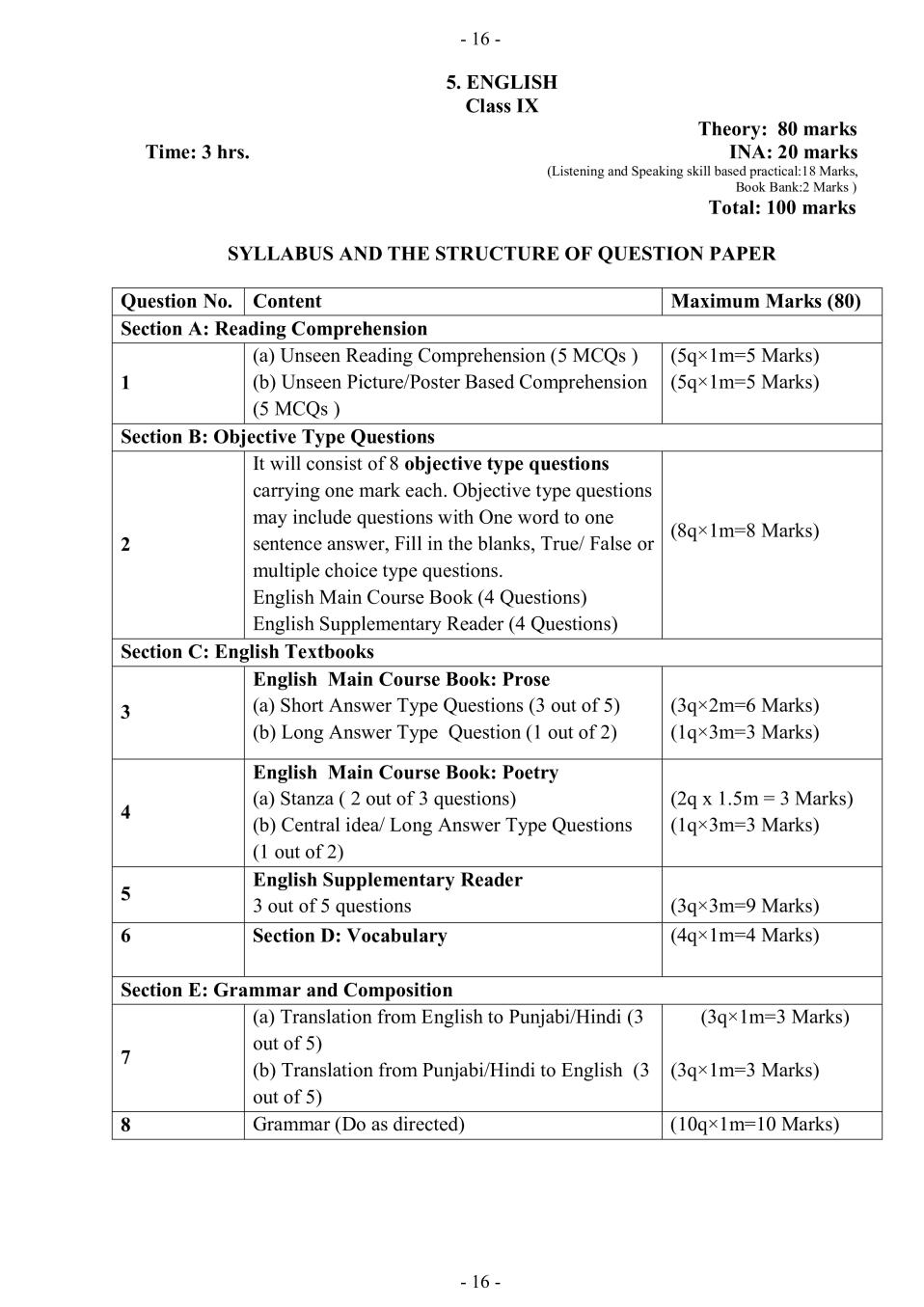
5. ENGLISH
Class IX
Theory: 80 marks
Time: 3 hrs. INA: 20 marks
(Listening and Speaking skill based practical:18 Marks,
Book Bank:2 Marks )
Total: 100 marks
SYLLABUS AND THE STRUCTURE OF QUESTION PAPER
Question No. Content Maximum Marks (80)
Section A: Reading Comprehension
(a) Unseen Reading Comprehension (5 MCQs ) (5q×1m=5 Marks)
1 (b) Unseen Picture/Poster Based Comprehension (5q×1m=5 Marks)
(5 MCQs )
Section B: Objective Type Questions
It will consist of 8 objective type questions
carrying one mark each. Objective type questions
may include questions with One word to one
(8q×1m=8 Marks)
2 sentence answer, Fill in the blanks, True/ False or
multiple choice type questions.
English Main Course Book (4 Questions)
English Supplementary Reader (4 Questions)
Section C: English Textbooks
English Main Course Book: Prose
3 (a) Short Answer Type Questions (3 out of 5) (3q×2m=6 Marks)
(b) Long Answer Type Question (1 out of 2) (1q×3m=3 Marks)
English Main Course Book: Poetry
(a) Stanza ( 2 out of 3 questions) (2q x 1.5m = 3 Marks)
4
(b) Central idea/ Long Answer Type Questions (1q×3m=3 Marks)
(1 out of 2)
English Supplementary Reader
5
3 out of 5 questions (3q×3m=9 Marks)
6 Section D: Vocabulary (4q×1m=4 Marks)
Section E: Grammar and Composition
(a) Translation from English to Punjabi/Hindi (3 (3q×1m=3 Marks)
out of 5)
7
(b) Translation from Punjabi/Hindi to English (3 (3q×1m=3 Marks)
out of 5)
8 Grammar (Do as directed) (10q×1m=10 Marks)
- 16 -
Page 2
(a) Note making/E-mail messages (with internal 3 marks
choice)
9
(b) Paragraph ( 1 out of 2) 4 Marks
(c) Letter writing ( 1 out of 2) 6 Marks
10 Marks for Good Handwriting 5 Marks
Note: abbreviations used: q-questions, m-marks
(1) In Main Course Book (including poetry) and Supplementary Reader Section,
questions will come from the given back exercises of lessons in the prescribed text
books.
(2) There will be four choices in multiple choice questions
(3) For letter writing any two kinds of letters (Personal, Official and Business) with
internal choice will be given.
(4) In Question 3(b), one question will be asked from the first four chapters (The
Grooming of a Boy, Plants also Breathea nd Feel, Budgeting your Time ,
Journey by Night).The other question will be asked from the next three chapters
(The Discovery of Moon, Three Great Indians, The Death of Abhimanyu).
Listening and Speaking skill based practical: 18 Marks
Listening-10 Marks
Speaking-08 Marks
For the listening test students will be given a practice sheet containing 10
questions. They will answer all the 10 questions on the basis of an audio clip.
Each question will carry 1 mark.
For the speaking test students will speak 8 correct sentences on the basis of
‘picture and cue words’ provided in the practice sheet. Each correct sentence will
carry 1 mark.
SYLLABUS
Unit-I Reading Skills
Reading Comprehension of unseen passage with five multiple choice questions
Unseen Picture/Poster based Comprehension with five multiple choice questions.
Unit-2 Text Books: English Main Course Book
1. Grooming of a Boy
2. Plants also Breathe and Feel
3. Budgeting Your Time
4. Journey by Night
5. The Discovery of Moon
6. Three Great Indians
7. The Death of Abhimanyu
Poetry
(ii) Open Thy Eyes and See Thy God (Rabindranath Tagore)
(iii) No Men Are Foreign (James Kirkup)
(iv) The Nightingale and the Glow-worm (William Cowper)
English Literature Book (Supplementary Reader)
1. The Magic Violin
2. Wishes Come True
- 17 -
Page 3
3. In the Flood
4. A letter to God
5. The Last Leaf
6. The Bewitched Jacket
7. The King Who Limped
Unit-3 Vocabulary
1. Nature of Words (Context-Meaning)
2. Words as different Parts of Speech
3. Synonyms
4. Antonyms
5. Homonyms
6. Formation of words
Unit-4 Grammar
1. Determiners
2. Modals
3. Prepositions
4. Conjunctions
5. Simple and Complex Sentences
6. Voice
7. Narration
8. Non-Finites
9. Tenses (Concord and Sequence)
Unit-5 Guided Creative Writing
1. Note-making
2. E-mail messages
3. Letter Writing
4. Paragraph Writing (not more than 100 words)
Translation from English to Punjabi/Hindi
1. GROOMING OF A BOY
1. Steer him away from envy.
2. All men are not true .
3. This is a big order.
4. All men are not just.
5. For every enemy there is a friend.
6. Treat him gently.
7. Beware of too much sweetness.
8. Teach him always to have sublime faith in himself.
9. He is such a fine little fellow, my son.
10. Teach him to listen to all men.
11. The test of fire makes fine steel.
12. Teach him how to laugh when he is sad.
2 PLANTS ALSO BREATHE AND FEEL
13. It was an event that surprised the scientific world.
14. Your instrument is a wonderful thing.
15. What do you call this instrument?
16. The reply caused greater surprise.
17. Bose was born in 1858 in a village of Bengal.
- 18 -
Page 4
18. Bose was by nature a rebel.
19. He refused to touch any part of his salary for three years.
20. In the end victory was his.
21. Bose knew he was right and he proved it.
22. It showed that plants have hearts and are capable of feeling.
3 BUDGETING YOUR TIME
23. Money makes the mare go.
24. Time and tide wait for none.
25. Every second in life is important.
26. Seconds add up to minutes, hours, days and months.
27. One must learn to be punctual in all one's activities.
28. It is no use crying over spilt milk.
29. Art is long and time is fleeting.
30. 'Now or Never' must be our guiding principle in life.
31. One must act in time before it is too late.
32. Never put off till tomorrow.
33. What is the best time for doing a thing?
4 JOURNEY BY NIGHT
34. She did not weep.
35. The steaming clothes did nothing.
36. Sher Singh's father was known far and wide as Sher Singh Bahadur.
37. Sher Singh saw death in his young brother's eyes.
38. There are no men in the village.
39. Kalaghat was 80 km away.
40. Night fell.
41. The sky blazed with stars.
42. Sher Singh chilled with fright.
43. Sher Singh breathed another prayer of thanks.
44. He looked for the bridge.
45. Sher Singh knew that his brother was dying.
5 THE DISCOVERY OF MOON
46. Armstrong and Edwin became the first men to set foot on the moon.
47. The discovery of moon formed an important part of space programme.
48. We know all the important facts about the moon.
49. We can see the full moon and no moon once in a month.
50. The moon is of the same age as the earth.
51. Some scientists feel that moon can be made inhabitable for men.
52. It is the Earth's only natural satellite.
53. The moon is not a self-luminous body.
54. The moon is lacking water and it has no atmosphere.
55. The moon is an absolutely desolate place where there is no water and air.
56. Its distance from the earth is 384,405 km.
6 THREE GREAT INDIANS
57. Laxmi Bai was born on 16th November, 1834.
58. The Punjabi word ‘Kuka’ stands for a ‘roar’.
59. The followers of this movement were named Namdharis.
60. Rani Laxmi Bai died fighting bravely for the sake of her country.
- 19 -
Page 5
61. Her childhood name was Manikarnika or Manu.
62. She breathed her last on the battlefield.
63. Thousands of men, women, children and old men died in the massacre.
64. Udham Singh was arrested and sentenced to death on 30 July.
65. In 1937, he reached England after travelling through Europe.
66. He strongly opposed child marriage.
67. Udham Singh's name is linked inseparably with Jallianwala Bagh.
7 THE DEATH OF ABHIMANYU
68. Abhimanyu knew only the art of entering the Chakravyuh.
69. Abhimanyu was fighting alone.
70. At last, the wheel was torn into pieces.
71. All the warriors returned to their camps.
72. Arjuna wept bitterly.
73. Duryodhana assured him all protection.
74. Arjuna fiercely attacked the Kauravas that day.
75. Arjuna advanced ahead.
76. Duryodhana was soon exhausted.
77. Krishna was watching everything carefully.
78. Arjuna shot his arrows with terrific speed.
79. They slashed the head of Jayadratha from his body.
80. Arjuna was aware of the time of truce.
Translation from Punjabi/Hindi to English.
1-10 Modal related
s +h बोल सकता हूँ|
1. ਮ ਅੰ ਗਰੇਜ਼ੀ ਬੋਲ ਸਕਦੀ ਹ |/म vaxzt
2. ਤੁਹਾਨੂੰ ਹਰ ਰੋਜ਼ ਕਸਰਤ ਕਰਨੀ ਚਾਹੀਦੀ ਹੈ |/आपको izfrfnu यायाम करना चा हए |
3. ਤੁਹਾਨੂੰ ਆਪਣਾ ਵਾਅਦਾ ਿਨਭਾਉਣਾ ਚਾਹੀਦਾ ਹੈ |/आपको अपना वादा fuHkkuk चा हए |
4. ਤੁਸ ਜਦ ਚਾਹੋ ਘਰ ਜਾ ਸਕਦੇ ਹੋ |/आप जब भी चाह घर जा सकते ह |
5. ਛੇਤੀ ਚੱ ਲੋ ਅਿਜਹਾ ਨਾ ਹੋਵੇ ਿਕ ਗੱ ਡੀ ਛੁੱ ਟ ਜਾਵੇ |/ज द चलो, ऐसा न हो क गाड़ी छूट जाए |
6. ਉਹ ਆਪਣੇ ਬਚਪਨ ਿਵੱ ਚ ਿਕਕੇਟ ਖੇਿਡਆ ਕਰਦਾ ਸੀ |/वह अपने बचपन म केट खेलता था
7. ਮ ਤੁਹਾਨੂੰ ਕੁਝ ਪੈਸੇ ਉਧਾਰ ਦੇ ਸਕਦਾ ਹ |/म आपको कुछ पैसे उधार दे सकता gw¡ |
8. ਸਾਨੂੰ ਆਪਣੇ ਦੇਸ਼ ਦੀ ਸੇਵਾ ਕਰਨੀ ਚਾਹੀਦੀ ਹੈ |/हम अपने दे श क सेवा करनी चा हए |
9. ਤੁਹਾਨੂੰ ਇਸ ਗੱ ਲ ਦੀ ਿਚੰ ਤਾ ਨਹ ਕਰਨੀ ਚਾਹੀਦੀ |/आपको इसके बारे म चंता नह ं करनी
चा हए |
10. ਕਾਸ਼ ! ਮ ਪਧਾਨ ਮੰ ਤਰੀ ਹੁੰ ਦਾ |/काश ! म धान मं ी होता |
11-50 Tense based sentences
11. ਸੂਰਜ ਪੁਰਬ ਿਵੱ ਚ ਿਨਕਲਦਾ ਹੈ | / सूय पूव ls नकलता है |
12. ਉਹ ਸਕੂਲ ਨਹ ਜ ਦਾ ਹੈ | / वह कूल नह ं जाता है |
13. ਕੀ ਉਹ ਗਾਣਾ ਗ ਦਾ ਹੈ ? / या वह गाना गाता है ?
- 20 -
Page 6
14. ਕੀ ਤੁਸ ਕਾਫ਼ੀ ਪਸੰ ਦ ਨਹ ਕਰਦੇ ਹੋ ? / या आप dkWQh पसंद नह ं करते हो?
15. ਿਨਸ਼ਾ ਪੱ ਤਰ ਿਲਖ ਰਹ ਹੈ | / नशा प लख रह है |
16. ਬੱ ਚੇ ਸ਼ੋਰ ਨਹ ਮਚਾ ਰਹੇ ਹਨ | / ब चे शोर नह ं मचा रहे ह |
17. ਕੀ ਚਪੜਾਸੀ ਘੰ ਟੀ ਵਜਾ ਿਰਹਾ ਹੈ ?/ या चपड़ासी घंट बजा रहा है ?
18. ਉਹ ਿਕੱ ਥੇ ਜਾ ਰਹ ਹੈ ?/ वह कहाँ जा रह है ?
19. ਅੰ ਜੂ ਨ ਆਪਣਾ ਕੰ ਮ ਕਰ ਿਲਆ ਹੈ | / vatw ने अपना काम कर लया है |
20. ਰਚਨਾ ਨ ਆਪਣਾ ਪਾਠ ਨਹ ਦੁਹਰਾਇਆ ਹੈ | / रचना ने अपना पाठ नह ं दोहराया है |
21. ਕੀ ਸ਼ਰਨ ਘਰ ਵਾਪਸ ਆ ਚੁੱ ਕਾ ਹੈ ? / या शरण ?kj वापस आ pqdk है ?
22. ਪਰਦੀਪ ਿਕੱ ਥੇ ਪਹੁੰ ਚ ਿਗਆ ਹੈ ? / iznhi कहाँ igq¡p गया है ?
23. ਸਵੇਰ ਤ ਵਰਖਾ ਹੋ ਰਹੀ ਹੈ | / सब
ु ह से वषा हो रह है |
24. ਚੰ ਦਰ ਦੋ ਘੰ ਟੇ ਤ ਨਹ ਸ ਿਰਹਾ ਹੈ | / च दो घंट से सो नह ं रहा है |
25. ਕੀ ਉਹ ਇਸ ਘਰ ਿਵੱ ਚ 2008 ਤ ਰਿਹ ਿਰਹਾ ਹੈ ?/ या वह 2008 से इस घर म रह रहा है ?
26. ਕੀ ਮਾਲੀ ਸਵੇਰ ਤ ਪੌਿਦਆਂ ਨੂੰ ਪਾਣੀ ਨਹ ਦੇ ਿਰਹਾ ਹੈ ?/ या माल सुबह से पौध को पानी
नह ं दे रहा है ?
27. ਉਸਨ ਚਾਹ ਪੀਤੀ | / उसने चाय पी |
28. ਅਸ ਮੈਚ ਵੇਖਣ ਨਹ ਗਏ | / हम मैच दे खने नह ं गए |
29. ਕੀ ਮ ਪਾਣੀ ਪੀਤਾ ?/ या मने पानी पया ?
30. ਮ ਬੱ ਚੇ ਨੂੰ ਕਦ ਕੁੱ ਿਟਆ ?/ मने ब चे को कब मारा ?
31. ਕਮਲ ਟੀ.ਵੀ.ਦੇਖ ਿਰਹਾ ਸੀ | / कमल ट . वी. दे ख रहा था |
32. ਮੁਨੀਸ਼ ਸ਼ੋਰ ਨਹ ਮਚਾ ਿਰਹਾ ਸੀ | / मनीष शोर नह ं मचा रहा था |
33. ਕੀ ਗੁਰਮੁਖ ਸ ਿਰਹਾ ਸੀ ?/ या गु मुख सो रहा था ?
34. ਕੁਲਿਵੰ ਦਰ ਕਦ ਹੱ ਸ ਿਰਹਾ ਸੀ ?/ कुल वंदर कब हँस रहा था ?
35. ਭਾਰਤ ਪਾਿਕਸਤਾਨ ਨੂੰ ਹਰਾ ਚੁੱ ਕਾ ਸੀ |/ भारत पा क तान को परािजत कर चुका था |
36. ਅਿਧਆਪਕ ਪਾਠ ਨਹ ਪੜਾ ਚੁੱ ਕਾ ਸੀ |/ श क पाठ नह ं पढ़ा चुका था |
37. ਕੀ ਉਹ ਆਪਣਾ ਘਰ ਵੇਚ ਚੁੱ ਕੇ ਸਨ ? / या वह अपना घर बेच चुके थे ?
38. ਕੀ ਉਹ ਚਾਹ ਨਹ ਪੀ ਚੁੱ ਕੇ ਸਨ ? / या वे चाय नह ं पी चुके थे ?
39. ਅਸ ਜਲੰਧਰ ਿਵੱ ਚ 1998 ਤ ਰਿਹ ਰਹੇ ਸੀ | / हम 1998 से जालंधर म रह रहे थे |
40. ਉਹ ਇੱ ਕ ਘੰ ਟੇ ਤ ਨਕਲ ਨਹ ਕਰ ਿਰਹਾ ਸੀ | / वह एक घंटे से नकल नह ं कर रहा था |
41. ਕੀ ਮੁੰ ਡੇ ਦਸ ਵਜੇ ਤ ਦੌੜ ਰਹੇ ਸਨ ? / या लड़के दस बजे से दौड़ रहे थे ?
- 21 -
Page 7
42. ਤੁਸ ਆਪਣਾ ਪਾਠ ਯਾਦ ਕਰੋਗੇ | / आप अपना पाठ याद करोaगे |
43. ਉਹ ਪਤੰ ਗ ਨਹ ਉਡਾਉਣਗੇ | / वे पतंग नह ं mM+k,¡xs |
44. ਤੁਸ ਮੇਰੀ ਮਦਦ ਕਦ ਕਰੋਗੇ ? / आप मेर मदद कब करोaगे?
ੇ ਾ | / वह प
45. ਉਹ ਪੱ ਤਰ ਿਲੱਖ ਿਰਹਾ ਹੋਵਗ लख रहा होगा |
46. ਪੰ ਕਜ ਸੋ ਨਹ ਿਰਹਾ ਹੋਵੇਗਾ | / पंकज सो नह ं रहा होगा |
47. ਕੀ ਮਲਕੀਤ ਮੈਚ ਖੇਡ ਿਰਹਾ ਹੋਵੇਗਾ ? / या मलक त मैच खेल रहा होगा ?
48. ਮ ਉਦ ਤੱ ਕ ਸੜਕ ਨੂੰ ਪਾਰ ਕਰ ਚੁੱ ਕਾ ਹੋਵ ਗਾ | / म तब तक सड़क पार कर चुका gksmaxk |
49. ਕੀ ਤੁਸ ਉਸਦੇ ਆਉਣ ਤ ਪਿਹਲ ਚਾਹ ਪੀ ਚੁੱ ਕੇ ਹੋਵੋਗੇ ?/ या तुम उसके आने से पहले
चाय पी चुके gksaxs ?
50. ਤੁਸ ਦੋ ਵਜੇ ਤ ਉਸਦੀ ਉਡੀਕ ਕਰ ਰਹੇ ਹੋਵੋਗੇ |/ आप दो बजे से mldh izrh{kk कर रहे ह गे|
51-60 Imperative Sentences
51. ਖੱ ਬੇ ਹੱ ਥ ਚੱ ਲੋ | / बा ओर चलो |
52. ਵੱ ਿਡਆਂ ਦਾ ਿਕਹਾ ਮੰ ਨ | / cM+ksa का कहा मानो |
53. ਿਕਸੇ ਨੂੰ ਧੋਖਾ ਨਾ ਿਦਓ | / कसी को धोखा मत दो |
54. ਆਪਣਾ ਸਮ ਿਵਅਰਥ ਨਾ ਗੰ ਵਾਓ | / अपना समय यथ मत xaokvksa |
55. ਆਪਣੀ ਿਸਹਤ ਦਾ ਿਧਆਨ ਰੱ ਖੋ | / अपने वा य का è;ku रखो |
56. ਮੁੰ ਿਡਆਂ ਨੂੰ ਅੰ ਦਰ ਆਉਣ ਿਦਓ | / लड़क को अंदर आने दो |
57. ਉਸਨੂੰ ਟੀ.ਵੀ. ਵੇਖਣ ਿਦਓ | / उसे ट .वी. दे खने दो |
58. ਆਓ, ਬਾਹਰ ਚੱ ਲੀਏ | / vkvks] बाहर चल |
59. ਉਸ ਨੂੰ ਉਸ ਦਾ ਫਰਜ਼ ਿਨਭਾਉਣ ਿਦਓ | / उसे mldk dÙkZO; पूरा करने दो |
60. ਹੁਣ ਮੈਨੰ ੂ ਜਾਣ ਿਦਓ | / अब मुझे जाने दो |
61-70 Helping Verb related Sentences
61. ਸਵਾ ਸੱ ਤ ਵੱ ਜੇ ਹਨ | / सवा सात बजे ह |
62. ਪੌਣੇ ਅੱ ਠ ਵੱ ਜੇ ਹਨ | / पौने आठ बजे ह |
63. ਉਸ ਕੋਲ ਇੱ ਕ ਵੱ ਡਾ ਘਰ ਹੈ | / उसके पास एक बड़ा घर है |
64. ਚਾਹ ਿਤਆਰ ਹੈ | / चाय तैयार है |
65. ਉਹ ਇੱ ਕ ਿਕਸਾਨ ਸੀ | / वह एक कसान था |
66. ਉਸ ਕੋਲ ਇੱ ਕ ਿਕਤਾਬ ਸੀ | / उसके पास एक कताब थी |
67. ਪੰ ਛੀ ਕੋਲ ਆਲਣਾ ਹੈ | / प ी के पास घ सला है |
68. ਇਹ ਕਹਾਣੀ ਬਹੁਤ ਲੰਬੀ ਹੈ | / यह कहानी बहुत लंबी है |
- 22 -
Page 8
69. ਉਸਦੀ ਘੜੀ ਬਹੁਤ ਕੀਮਤੀ ਹੈ | / उसक घड़ी बहुत क मती है |
70. ਇਹ ਖਬਰ ਬਹੁਤ ਿਦਲਚਸਪ ਹੈ | / यह समाचार बहुत euksjatd है |
71-80 Proverbs
71. ਘਮੰ ਡੀ ਦਾ ਿਸਰ ਨੀਵ | / घमंडी का सर uhpk ।
72. ਸੇਵਾ ਿਬਨ ਮੇਵਾ ਨਹ | / सेवा बना मेवा नह ं |
73. ਹਰ ਚਮਕਦੀ ਚੀਜ ਸੋਨਾ ਨਹ ਹੁੰ ਦੀ | / हर चमकती चीज़ सोना नह ं होती |
74. ਬੁਰੀ ਸੰ ਗਤ ਨਾਲ ਇਕੱ ਲਾ ਚੰ ਗਾ | / बरु संगत से अकेला भला |
75. ਜੋ ਗਰਜਦੇ ਹਨ ਉਹ ਵਰਦੇ ਨਹ | / जो xjtrs ह, oks बरसते नह ं |
76. ਅ ਲੇ ਦਾ ਬਦਲਾ | / अदले का बदला |
77. ਜੈਸਾ ਦੇਸ਼ ਵੈਸਾ ਭੇਸ | / जैसा दे श, वैसा Hks"k |
78. ਆਪਣਾ ਆਪਣਾ, ਪਰਾਇਆ ਪਰਾਇਆ | / अपना-अपना, पराया-पराया |
79. ਥੋਥਾ ਚਨਾ ਬਾਜੇ ਘਨਾ | / थोथा चना, ckts घना |
80. ਜੋ ਬੀਜੋਗੇ ,ਉਹੀ ਕੱ ਟੋਗੇ | / जो बोएंगे, वह काटगे |
81-90 Idiomatic Sentences
81. ਇਸ ਗੱ ਲ ਦੀ ਨਗਰ ਿਵੱ ਚ ਆਮ ਚਰਚਾ ਹੈ | / इस बात क शहर म आम चचा है |
82. ਮੌਤ ਦਾ ਕੋਈ ਸਮ ਨਹ ਹੁੰ ਦਾ | / म ृ यु dk कोई समय नह ं gksrk |
83. ਮੌਕੇ ਦਾ ਫਾਇਦਾ ਉਠਾਓ | / अवसर का लाभ उठाओ |
84. ਤੁਸ ਮੇਰੇ ਿਪੱ ਛੇ ਿਕ ਪਏ ਹੋ ? / तुम मेरे पीछे य पड़े हो?
85. ਤੁਸ ਮੇਰੇ ਨੱਕ ਿਵੱ ਚ ਦਮ ਕਰ ਿਦੱ ਤਾ ਹੈ | / vkius मेर नाक म दम कर fn;k है |
86. ਉਹ ਫੁੱ ਟ ਫੁੱ ਟ ਕੇ ਰੋ ਿਰਹਾ ਹੈ | / वह फूट&फूट कर रो रहा है |
87. ਇਹ ਪੁਸਤਕ ਹੱ ਥ ਹੱ ਥ ਿਵੱ ਕ ਰਹੀ ਹੈ | / यह पु तक हाथ &हाथ बक रह है |
88. ਉਸਨੂੰ ਘੱ ਟ ਸੁਣਦਾ ਹੈ | / उसे कम सुनता है |
89. ਕੰ ਮ ਤ ਜੀਅ ਨਾ ਚੁਰਾਓ | / काम से जी मत चुराओ |
90. ਕੰ ਧ ਦੇ ਵੀ ਕੰ ਨ ਹੁੰ ਦੇ ਹਨ | / द वार के भी कान होते ह |
91-95 Interrogative Sentences
91. ਉਹ ਕੁੜੀਆਂ ਿਕੱ ਥੇ ਜਾ ਰਹੀਆਂ ਹਨ ? / वे yM+fd;k¡ कहाँ जा रह ह ?
92. ਅੰ ਗੇਜੀ ਿਵੱ ਚ ਪਿਹਲੇ ਨੰਬਰ ਤੇ ਕੋਣ ਆਇਆ ਹੈ ? / vaxzt+h म पहले नंबर ij कौन आया है ?
93. ਤੁਹਾਡਾ ਇੱ ਥੇ ਕੀ ਕੰ ਮ ਹੈ ? / आपका यहाँ या काम है ?
94. ਤੁਸ ਿਕੰ ਨ ਪੈਸੇ ਚਾਹੁੰ ਦੇ ਹੋ ? / आप कतने पैसे चाहते gks ?
95. ਤੁਸ ਰਾਤ ਨੂੰ ਕਦ ਸਦੇ ਹੋ ? / आप रात म कब सोते हो ?
- 23 -
Page 9
96-100 Exclamatory
96. ਿਕੰ ਨ ਸੋਹਣਾ ਨਜ਼ਾਰਾ ਹੈ ! / कतना सुंदर n`'; है !
97. ਤੁਸ ਿਕੰ ਨ ਬੁਜਿਦਲ ਹੋ ! / आप कतने Mjiksd हो!
98. ਿਕੰ ਨ ਿਪਆਰਾ ਫੁੱ ਲ ਹੈ ! / कतना यारा फूल है !
99. ਉਹ ਿਕੰ ਨ ਬਹਾਦੁਰ ਹਨ ! / वे कतने बहादरु ह!
100. ਆਹਾ ! ਅਸ ਮੈਚ ਿਜੱ ਤ ਿਲਆ ਹੈ | / vgk ! हमने मैच जीत fy;k है |
FOLLOWING ARE TO BE DELETED (This portion will neither be taught nor
evaluated).
Sr. Book Name Lesson Lesson / Topic to be deleted
No. No.
1 Main Course 3 The Postmaster
Book 6&7 The Bishop's Candle Sticks I & II
8&9 God's sees The Truth But waits I & II
10 The Life Story of a Man Eater
Poem- 4 Excelsior
Poem- 6 The Ballad of Father Gilligan
2 Supplementary 4 My Father And I
Reader 5 I Became a Great Friends of Animals
10 The Diamond Maker
Informal Letters
Sr. No Page No. Letters to be deleted
1 198 Letter to accept the Invitation (Unsolved 2)
2 198 Letter to uncle (Unsolved 3)
3 198 Letter to Friend (Unsolved 4)
4 198 Letter to Rajni (Unsolved 7)
5 198 Letter to Amarjit (Unsolved 8)
6 198 Letter to Roshni (Unsolved 9)
Formal Letters
Sr. No Page No. Letters to be deleted
1 208 Letter to The Times of India (Unsolved a)
2 209 Applications in response of two Advertisement, (Unsolved b)
3 209 Application for the post of a cook (Unsolved c)
4 209 Letter on the behalf of Prabha (Unsolved d)
5 209 Letter to the editor of Danik Bhasker (Unsolved e)
6 210 Letter to Azad Hind Store (Unsolved f)
7 210 Letter of complaint against a nurse (Unsolved h)
8 210 Letter to Principal (Unsolved j )
9 210 Letter to S. D. M, Bhatinda (Unsolved k)
PRESCRIBED BOOKS
1) English Main Course Book for Class-IX (For Intensive Study) Published by
Punjab School Education Board.
- 24 -
Page 10
2) English Literature Book (Supplementary Reader) For Class-IX (for Extensive
Study), Published by Punjab School Education Board.
3) A Practice Book of English Grammar & Composition for Class IX, Published by
Punjab School Education Board.
- 25 -