MBOSE Class 12 Question Paper 2020 for Chemistry Old Course
Finished viewing? Save it for later —
Download MBOSE Class 12 Question Paper 2020 for Chemistry Old Course (PDF · 12 pages)About MBOSE Class 12 Question Paper 2020 for Chemistry Old Course
MBOSE Class 12 Question Paper 2020 for Chemistry Old Course is available here for free download. Published by Meghalaya Board for Class 12, this question paper can be viewed online or downloaded as a PDF (12 pages). Candidates preparing for Class 12 can use MBOSE Class 12 Question Paper 2020 for Chemistry Old Course to understand the exam pattern, the type of questions asked, and the overall difficulty level.
Frequently Asked Questions
How can I download MBOSE Class 12 Question Paper 2020 for Chemistry Old Course?
Open this page and click the Download button to save MBOSE Class 12 Question Paper 2020 for Chemistry Old Course as a PDF. It is completely free on AglaSem Docs.
Is MBOSE Class 12 Question Paper 2020 for Chemistry Old Course free to download?
Yes. MBOSE Class 12 Question Paper 2020 for Chemistry Old Course can be viewed online and downloaded as a PDF free of cost on AglaSem Docs.
How many pages does MBOSE Class 12 Question Paper 2020 for Chemistry Old Course have?
MBOSE Class 12 Question Paper 2020 for Chemistry Old Course contains 12 pages, which you can read online or download together as a single PDF.
Where can I find more Class 12 study material?
You can find more Class 12 question papers, sample papers, syllabus, and answer keys on AglaSem Docs.
MBOSE Class 12 Question Paper 2020 for Chemistry Old Course – Text
Read the full text of this question paper below — useful to quickly search, copy and reference the content online without downloading the PDF.
📄 View text version (12 pages)
Page 1
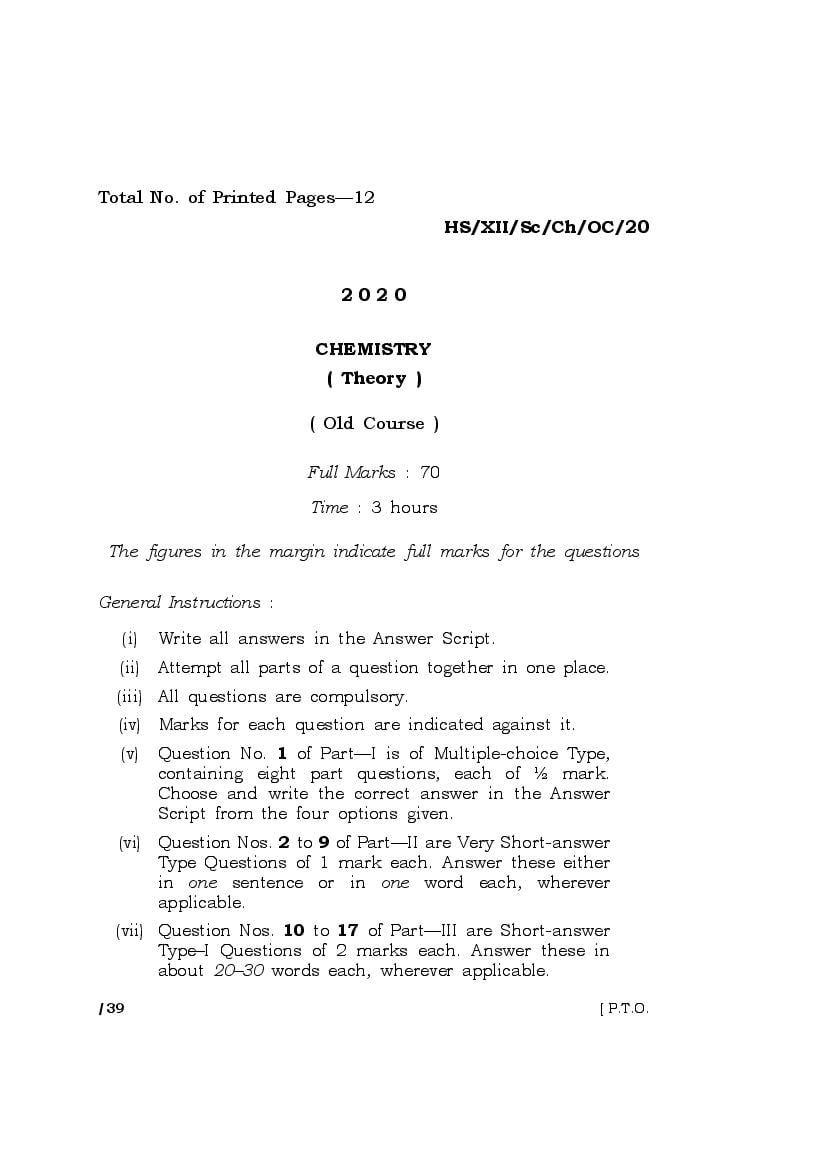
HS/XII/Sc/Ch/OC/20
2020
CHEMISTRY
( Theory )
( Old Course )
Full Marks : 70
Time : 3 hours
The figures in the margin indicate full marks for the questions
General Instructions :
(i) Write all answers in the Answer Script.
(ii) Attempt all parts of a question together in one place.
(iii) All questions are compulsory.
(iv) Marks for each question are indicated against it.
(v) Question No. 1 of Part—I is of Multiple-choice Type,
containing eight part questions, each of ½ mark.
Choose and write the correct answer in the Answer
Script from the four options given.
(vi) Question Nos. 2 to 9 of Part—II are Very Short-answer
Type Questions of 1 mark each. Answer these either
in one sentence or in one word each, wherever
applicable.
(vii) Question Nos. 10 to 17 of Part—III are Short-answer
Type–I Questions of 2 marks each. Answer these in
about 20–30 words each, wherever applicable.
/39 [ P.T.O.
Page 2
(viii) Question Nos. 18 to 26 of Part—IV are Short-answer
Type–II Questions of 3 marks each. Answer these in
about 40–50 words each, wherever applicable.
(ix) Question Nos. 27 to 29 of Part—V are Long-answer
Type Questions of 5 marks each. Answer these in
about 70–80 words each, wherever applicable.
(x) Use of non-programmable ordinary Scientific
Calculators and Log Tables is allowed.
(xi) Mobile Phones and Pagers are not allowed inside the
Examination Hall.
PART—I
1. Choose and write the correct answer for the following
in the Answer Script : ½×8=4
(a) Colligative properties depend on
(i) the nature of the solute particles dissolved in
the solution
(ii) the number of solute particles in the solution
(iii) the physical properties of the solute particles
dissolved in the solution
(iv) the nature of the solvent particles
(b) In case of the electrolyte which dissociates in
solution the van’t Hoff’s factor, i is
(i) >1
(ii) <1
(iii) =1
(iv) =0
HS/XII/Sc/Ch/OC/20/39 [ Contd.
Page 3
(c) The Tyndall effect associated with colloidal particles
is due to
(i) presence of electrical charge
(ii) scattering of light
(iii) absorption of light
(iv) reflection of light
(d) The electrical charge on a colloidal particle is
indicated by
(i) Brownian movement
(ii) electrophoresis
(iii) ultramicroscope
(iv) molecular sieves
(e) [Co(NH3)5Br]SO4 and [Co(NH3)5SO4]Br are related
to each other as
(i) ionization isomers
(ii) linkage isomers
(iii) coordination isomers
(iv) hydrate isomers
(f) The coordination number of Ni in [Ni(C2O4)3]–4 is
(i) 3
(ii) 6
(iii) 4
(iv) 5
HS/XII/Sc/Ch/OC/20/39 [ P.T.O.
Page 4
(g) Methyl bromide reacts with AgF to give methyl
fluoride and AgBr. This reaction is called
(i) Finkelstein reaction
(ii) Fittig reaction
(iii) Swarts reaction
(iv) Wurtz reaction
(h) Identify the compound Y in the following reaction :
PART—II
2. On heating a crystal of KCl in potassium vapour, the
crystal starts exhibiting a violet colour. What is the
colour due to? 1
3. A solid with cubic crystal is made of two elements
P and Q. Atoms of Q are at the corners of the cube
and P at the body-centre. What is the formula of
the compound? 1
HS/XII/Sc/Ch/OC/20/39 [ Contd.
Page 5
4. Convert benzene to p-chloronitrobenzene. 1
5. Which of the following isomers is steam volatile and why? 1
p-Nitrophenol and o-Nitrophenol
6. Arrange the following compounds in increasing order
of their reactivity in nucleophilic addition reactions : 1
Ethanal, Propanal, Propanone, Butanone
7. Give reason why C6H5NH2 is a weaker base than
CH3CH2NH2. 1
8. Write the equation of carbylamine reaction. 1
9. Write one difference between -helix and -pleated
structures of proteins. 1
PART—III
10. An element with density 2·8 g cm–3 forms an f.c.c. unit
cell with edge length 4 × 10⁻⁸ cm. Calculate the molar
mass of the element. Given, NA = 6·022 × 1023. 2
11. Either
(a) Define the following : 1+1=2
(i) Henry’s law about dissolution of a gas in a
liquid
(ii) Boiling point elevation constant for a solvent
Or
(b) Define the following terms : 1+1=2
(i) Ideal solution
(ii) Azeotrope
12. When 2·56 g of sulphur was dissolved in 100 g of CS2,
the freezing point lowered by 0·383 K. Calculate the
formula of sulphur. (Kf for CS2 = 3·83 K kg mol–1 and
atomic mass of sulphur = 32 g mol–1) 2
HS/XII/Sc/Ch/OC/20/39 [ P.T.O.
Page 6
13. Consider the following reaction :
h
H2 Cl2
2HCl
Rate = k
(a) Write the order and molecularity of this reaction. 1
(b) Write the unit of k. 1
14. Give reasons for the following features of transition
metals : 1+1=2
(a) The transition metals and their compounds are
usually paramagnetic.
(b) The transition metals exhibit variable oxidation
states.
15. Either
(a) Explain on the basis of VBT why [Ni(CN)4]–2 is
diamagnetic, while [NiCl4]–2 is paramagnetic.
(Atomic number of Ni is 28) 2
Or
(b) With the help of crystal field theory, predict the
number of unpaired electrons in [Fe(CN)6]–4 and
[Fe(H2O)6]+2 complexes and hence, its magnetic
character (Atomic number of Fe is 26) 2
16. Write the major products in the following reactions : 2
HS/XII/Sc/Ch/OC/20/39 [ Contd.
Page 7
17. How will you convert—
(a) nitrobenzene to aniline;
(b) ethanoic acid to methenamine? 2
PART—IV
18. (a) For a reaction R P , half-life (t1/2 ) is observed to
be independent of the initial concentrations of
reactants. What is the order of the reaction? 1
(b) A first-order reaction takes 20 minutes for 25%
decomposition. Calculate the time when 75% of the
reaction will be completed. 2
19. Either
(a) Define the following terms : 3
(i) Electrophoresis
(ii) Adsorption
(iii) Shape-selective catalysis
Or
(b) (i) Out of MgCl2 and AlCl3, which one is more
effective in causing coagulation of negatively
charged sol and why? 1
(ii) Out of sulphur sol and protein, which one
forms multimolecular colloids? 1
(iii) Differentiate between adsorption and absorption. 1
HS/XII/Sc/Ch/OC/20/39 [ P.T.O.
Page 8
20. Either
(a) Write the principle of vapour phase refining with the
help of an example. 2
(b) What is the role of limestone in the extraction of
iron from its oxides? 1
Or
(c) Name one chief ore each of copper and aluminium.
Name the method used for the concentration of
these two ores. 2
(d) What is the role of depressant in froth floatation
process? 1
21. Give reasons for the following : 1+1+1=3
(a) Nitric oxide becomes brown when released in air.
(b) PCl5 is ionic in nature in the solid state.
(c) Fluorine exhibits only –1 oxidation state, whereas
other halogens exhibit +1, +3, +5 and +7 oxidation
states also.
22. How would you account for the following? 3
(a) Sc+3 is colourless in aqueous solution, whereas
Ti+3 is coloured.
(b) Atomic radii of 4d and 5d series elements are nearly
same.
(c) Mn+2 is more resistant than Fe+2 towards oxidation.
HS/XII/Sc/Ch/OC/20/39 [ Contd.
Page 9
23. (a) Write the mechanism of acid dehydration of ethanol
to yield ether. 2
(b) How is toluene obtained from phenol? 1
24. What happens when D-glucose is treated with the
following reagents?
(a) HI
(b) Bromine water
(c) HNO3
Give chemical equations. 3
25. Write the names and structures of the monomers of
the following polymers : 3
(a) Bakelite
(b) Buna-S
(c) PVC
26. (a) Which one of the following is a food preservative? 1
Equanil, Morphine, Sodium benzoate
(b) Why is bithional added to soap? 1
(c) Which class of drug is used in sleeping pills? 1
PART—V
27. Either
(a) State Faraday’s first law of electrolysis. How much
charge in terms of faraday is required for the
reduction of 1 mol of Cu+2 to Cu? 1+1=2
HS/XII/Sc/Ch/OC/20/39 [ P.T.O.
Page 10
(b) Calculate the e.m.f. of the following cell at 298 K :
Mg (s)|Mg 2 (0·1 M )||Cu2 (0·01 M )|Cu(s)
(Given, E cell 1 F = 96500 C mol–1)
2·71 V , 2
(c) What are fuel cells? 1
Or
(d) State and explain Kohlrausch’s law of independent
migration of ions. Why does the conductivity of a
solution decrease with dilution? 2+1=3
(e) An aqueous solution of CuSO4 was electrolyzed
between platinum electrodes using a current of
0·1287 ampere for 50 minutes. (Atomic mass of
Cu = 63·5 g mol–1)
(i) Write the cathodic reaction.
(ii) Calculate—
(1) the electric charge passed during
electrolysis;
(2) the mass of copper deposited at the
cathode. 2
28. Either
(a) Account for the following : 3
(i) Interhalogens are more reactive than pure
halogens.
(ii) N2 is less reactive at room temperature.
(iii) Reducing character increases from NH3 to BiH3.
(b) Draw the structures of the following : 1+1=2
(i) H4P2O7 (Pyrophosphoric acid)
(ii) SF6
HS/XII/Sc/Ch/OC/20/39 [ Contd.
Page 11
Or
(c) Write the balanced chemical equations for the
following reactions : 2
(i) Chlorine reacts with dry slaked lime.
(ii) Carbon reacts with conc. H2SO4.
(d) Describe Ostwald’s process for manufacture of
nitric acid with special reference to the reaction
conditions, catalysts used and the yield in the
process. 3
29. Either
(a) Write the chemical equations to illustrate the
following name reactions : 2
(i) Rosenmund’s reduction
(ii) Cannizzaro’s reaction
(b) Out of
and
which will give iodoform test? 1
(c) Account for the following : 1+1=2
(i) is a stronger acid than .
(ii) Carboxylic acids do not give reactions of
carbonyl group.
HS/XII/Sc/Ch/OC/20/39 [ P.T.O.
Page 12
Or
(d) Write the products of the following reactions : 5
HS/XII/Sc/Ch/OC/20/39 20K—1130
Document Details
| Board / Org | Meghalaya Board |
| Exam | Class 12 |
| Type | Question Paper |
| Pages | 12 |
| Updated | 30 Apr 2026 |