TIFR GS 2023 Question Paper Science Education
Finished viewing? Save it for later —
Download TIFR GS 2023 Question Paper Science Education (PDF · 38 pages)About TIFR GS 2023 Question Paper Science Education
TIFR GS 2023 Question Paper Science Education is available here for free download. Published by Default for TIFR GS, this question paper can be viewed online or downloaded as a PDF (38 pages). Candidates preparing for TIFR GS can use TIFR GS 2023 Question Paper Science Education to understand the exam pattern, the type of questions asked, and the overall difficulty level.
Frequently Asked Questions
How can I download TIFR GS 2023 Question Paper Science Education?
Open this page and click the Download button to save TIFR GS 2023 Question Paper Science Education as a PDF. It is completely free on AglaSem Docs.
Is TIFR GS 2023 Question Paper Science Education free to download?
Yes. TIFR GS 2023 Question Paper Science Education can be viewed online and downloaded as a PDF free of cost on AglaSem Docs.
How many pages does TIFR GS 2023 Question Paper Science Education have?
TIFR GS 2023 Question Paper Science Education contains 38 pages, which you can read online or download together as a single PDF.
Where can I find more TIFR GS study material?
You can find more TIFR GS question papers, sample papers, syllabus, and answer keys on AglaSem Docs.
TIFR GS 2023 Question Paper Science Education – Text
Read the full text of this question paper below — useful to quickly search, copy and reference the content online without downloading the PDF.
📄 View text version (38 pages)
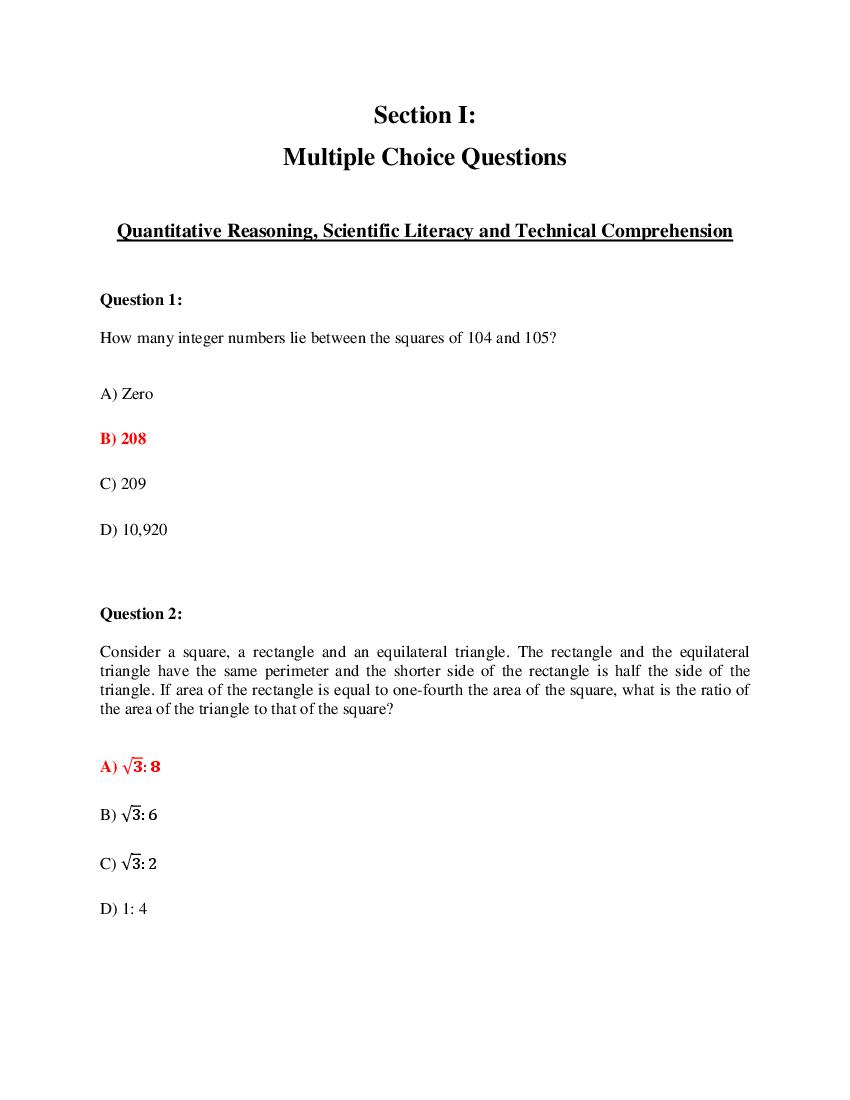
Page 1
Multiple Choice Questions
Quantitative Reasoning, Scientific Literacy and Technical Comprehension
Question 1:
How many integer numbers lie between the squares of 104 and 105?
A) Zero
B) 208
C) 209
D) 10,920
Question 2:
Consider a square, a rectangle and an equilateral triangle. The rectangle and the equilateral
triangle have the same perimeter and the shorter side of the rectangle is half the side of the
triangle. If area of the rectangle is equal to one-fourth the area of the square, what is the ratio of
the area of the triangle to that of the square?
A) 𝟑: 𝟖
B) 3: 6
C) 3: 2
D) 1: 4
Page 2
Fathima is sitting in a platform. She sees two trains of equal length moving in parallel tracks in
opposite direction. The first train, in which Gauri is sitting takes 10 s to cross the platform and
the second one in which Harsha sits take 5 s. If Gauri sees Fathima move at 40 km/h, what is the
speed with which Harsha is moving with respect to Gauri?
A) 20 km/h
B) 60 km/h
C) 80 km/h
D) 120 km/h
Question 4:
A housing colony has a square plot of land. The residents decide to build a circular garden of
area 11,304 meter square, that fits exactly within the square. They also decide to lay a turf that
costs Rs 80 per meter square in the area that is left out from the circular garden. How much will
it cost for the turf?
A) Rs 100000
B) Rs 157000
C) Rs 247680
D) Rs 314000
Question 5:
Rahul spends 16% of his salary in paying his house rent. He spends 1/6 th of the remaining
salary on food and sends 3/7 th to his home. After these spending if he has Rs 13,600 remaining,
what is his salary?
Page 3
B) Rs 40000
C) Rs 42600
D) Rs 43400
Question 6:
Sanjana is standing 100 m away from a building and sees a bird sitting at the top of it at an angle
of 45 degree with the ground. What is the shortest distance she should walk, so that she can see
the bird at 30 degree?
A) 33 m
B) 73 m
C) 100 m
D) 173 m
Question 7:
A solid circular cylinder made of iron is melted and recasted into identical hollow spheres whose
thickness is one tenth of their inner radius. The ratio of the radius of the cylinder to its height is
1:8. If the radius of the cylinder is ten times that of the inner radius of the sphere, how many
spheres are made in the process?
A) 900
This question has not been taken into account for the purpose of evaluation.
B) 1230
C) 1800
D) 1875
Page 4
A motor can pump in water in a tank at the rate of 5 L per minute. However, the tank has a
leakage and it gets emptied in 7 hours after being fully filled. If the motor pump is switched on
when the tank is full, the time taken by the leakage to empty the water is 15 hours. Around how
much volume of water can the tank hold?
A) 2100 L
B) 2365 L
C) 3937 L
D) 4800 L
Question 9:
A straight road connects Maria’s house to her school in the city of Goa. Walking along this road
on her way to the school at 8 am on a December morning, she notices that the shadow of a
straight coconut tree on the ground is 4 m long and perpendicular to the road. Which of the
following statements is true?
A) The school lies to the North-East of Maria’s house.
B) The school lies to the South-East of Maria’s house.
C) The school lies to the due North of Maria’s house.
D) The school lies to the due South of Maria’s house.
Question 10:
In a high school math classroom, the teacher wrote a quadratic equation on the blackboard for
the students to solve. Anna mistakenly wrote a different coefficient for the 𝑥 term in the equation
and got the roots as 2 and 3. Suresh made a mistake in writing the constant term and got the
roots as 3 and 4. What are the roots of the equation which the teacher wrote?
Page 5
B) 3, 4
C) 6, 1
D) None of the above
Question 11:
The third term of a geometric progression is 8, then the product of the first five terms is
A) 𝟖𝟓
B) 84
C) 83
D) not determinable with the given information.
Question 12:
The standard deviation of the scores of 30 students in a written test is 5. When the mark from a
home assignment is added, the total score of each student increases by 4. The standard deviation
and variance of the total scores are
A) 7 and 4 respectively.
B) 7 and 9 respectively.
C) 9 and 25 respectively.
D) 5 and 25 respectively.
Question 13:
Four years from now Amina’s age will be three times her daughter’s age. 3 years ago she was
five times her daughter’s age. Currently what is Amina’s age?
Page 6
B) 36
C) 38
D) 40
Question 14:
Which of the following statements is true regarding the relation between mean, median and
mode of a frequency distribution?
A) For a positively skewed frequency distribution, mean > median > mode.
B) For a negatively skewed frequency distribution, mean < median < mode.
C) For a symmetrical frequency distribution, mean = median = mode.
D) All of the above.
Question 15:
Three friends of different ages and heights stand in a line for a photograph. The youngest stands
to the right of Anu. The tallest stands on the extreme left. Mani does not stand in the centre, and
he is not the youngest. Charu is not in the centre too. Who is the shortest?
A) Anu
B) Charu
C) Mani
D) Cannot be determined
Page 7
Read the following passage carefully and answer questions 16 to 20.
%%%%%%%%%%%%%%%%%%%%%%%%%%%%%%%%%%
The rise of drug-resistant organisms poses a challenge for modern medicine. Antimicrobial
resistance is a natural phenomenon, but it is exaggerated with antibiotic exposure. In Germany,
about 75% of all antibiotics prescribed are used in outpatient services/care, most of them for
respiratory tract infections, which are caused predominantly by viruses, and for urinary tract
infections. In regions with higher consumption of antibiotics in outpatient care, there are higher
rates of resistant bacteria. Antibiotic use in primary care has remained relatively stable in recent
years, with a decrease in the use of the first-generation penicillin-like antibiotics and an increase
in the use of reserve/last resort antibiotics.
Many patients are not aware of the difference between a viral and bacterial infection. At times,
primary care physicians feel pressured by their patients to prescribe antibiotics for infections
which do not necessarily require antibiotics– i.e., common cold and sore throat of viral origin.
Knowledge of the mode of action of antibiotics in the general population is also insufficient. This
adversely affects intake routines of prescribed antibiotics. Furthermore, the benefits of
antimicrobial therapy are often inflated in comparison to their disadvantages for patients with an
acute infection. A typical patient response often heard by the health care professionals is -
“Antibiotics might not make me better, but I should take them just in case”.
Over the last years, health literacy has gained importance in the literature as a key factor in the
promotion of health and for coping with illness. Low health literacy has been shown to be
associated with inappropriate use of the health care system. It should be noted that health literacy
differs from knowledge. Health literacy describes the ability to understand and critically evaluate
health information and to make health-related decisions. Health literacy influences patient-
provider relationship, self-care and the use of the health care system. Moreover, research has
shown that knowledge alone might not be sufficient to change health-related behavior. Although,
competencies like health literacy may be crucial for efficiently managing health and illness by
patients, the studies related to public usage of antibiotics are scarce. In this context, both,
investigations about history of antibiotic use in general population and characterization of
antibiotic consumers in terms of health literacy as well as knowledge are important.
(Adapted from:Salm F, Ernsting C, Kuhlmey A, Kanzler M, Gastmeier P, Gellert P (2018)
Antibiotic use, knowledge and health literacy among the general population in Berlin, Germany
and its surrounding rural areas. PLoS ONE 13(2): e0193336, and data from CDDEP.org)
%%%%%%%%%%%%%%%%%%%%%%%%%%%%%%%%%%%%%%
Page 8
Which of the following places is/are more likely to harbour multi-drug resistant bacteria in
Germany?
A) Tap of a washroom in a common household
B) Seat cover of a public transport system in a crowded city
C) Out-patient care of a pulmonologist
D) A place where pediatric vaccination drive is operational
Question 17:
Which of the following statements is true?
A) Phenomenon of Antimicrobial resistance emerged after the discovery of penicillin.
B) Antibiotics can be effectively used against influenza viruses.
C) General population is not completely aware of mode of action of antibiotics.
D) Antibiotics are predominantly prescribed to the patients admitted in hospitals.
Question 18:
A researcher has plotted a graph depicting trend in antibiotic use over the years in
Germany. What do the light/green (1) and dark/red (2) trend lines most likely represent?
Page 9
B) Total antibiotics and penicillin like antibiotic respectively
C) Penicillin like antibiotic and reserve antibiotic respectively
D) Total antibiotics and reserve antibiotic respectively
Question 19:
Which of the following behaviours in citizens is likely to help in coping with drug resistant
microorganisms?
A) Inflating the benefits of antimicrobial therapy in comparison to their disadvantages for
patients with an acute infection
B) Better understanding of mode of action of antibiotics and antimicrobial resistance
C) Discontinuing prescribed routine of antibiotics once relieved from the symptoms of the illness
D) Taking precautionary doses in addition to the prescribed antibiotics
Question 20:
Which of the following best capture the meaning of this statement -“Antibiotics might not make
me better, but I should take them just in case”, in the context of this paragraph?
A) When people are ill, they tend to take risks, even if they are unsure of the outcomes of
taking antibiotics
B) People are convinced that antibiotics are not effective in treating certain viral illnesses like
common cold and flu
C) People are unaware of side effects of excessive use of antibiotics
D) People consume antibiotics because it makes them better
Page 10
Read the following passage carefully and answer questions 21 to 25.
%%%%%%%%%%%%%%%%%%%%%%%%%%%%%%%%%%
I don’t presume to grasp Aboriginal knowledge fully. It comes from a way of knowing the
earth—an epistemology—different from that of my own culture. It speaks of being attuned to the
blooming of the bitterroot, the running of the salmon, the cycles of the moon. Of knowing that
we are tied to the land—the trees and animals and soil and water—and to one another, and that
we have a responsibility to care for these connections and resources, ensuring the sustainability
of these ecosystems for future generations and to honor those who came before. Of treading
lightly, taking only what gifts we need, and giving back. Of showing humility toward and
tolerance for all we are connected to in this circle of life. But what my years in the forestry
profession have also shown me is that too many decision-makers dismiss this way of viewing
nature and rely only on select parts of science. The impact has become too devastating to ignore.
We can compare the condition of the land where it has been torn apart, each resource treated in
isolation from the rest, to where it has been cared for according to the Secwepemc principal
of k̓wseltktnews (translated as “we are all related”) or the Salish concept of nə́c̓aʔmat ct (“we are
one”).
We must heed the answers we’re being given.
I believe this kind of transformative thinking is what will save us. It is a philosophy of treating
the world’s creatures, its gifts, as of equal importance to us. This begins by recognizing that trees
and plants have agency. They perceive, relate, and communicate; they exercise various
behaviors. They cooperate, make decisions, learn, and remember—qualities we normally ascribe
to sentience, wisdom, intelligence. By noting how trees, animals, and even fungi—any and all
nonhuman species—have this agency, we can acknowledge that they deserve as much regard as
we accord ourselves. We can continue pushing our earth out of balance, with greenhouse gases
accelerating each year, or we can regain balance by acknowledging that if we harm one species,
one forest, one lake, this ripples through the entire complex web. Mistreatment of one species is
mistreatment of all.
The rest of the planet has been waiting patiently for us to figure that out.
Making this transformation requires that humans reconnect with nature—the forests, the prairie,
the oceans—instead of treating everything and everyone as objects for exploitation. It means
expanding our modern ways, our epistemology and scientific methodologies, so that they
complement, build on, and align with Aboriginal roots. Mowing down the forests and harvesting
the waters to fulfill our wildest dreams of material wealth just because we can has caught up to
us.
(The above passage is an excerpt from Finding the Mother Tree by Suzanne Simard)
%%%%%%%%%%%%%%%%%%%%%%%%%%%%%%%%%%
Page 11
21) The term ‘epistemology’ means:
A) The scientific approach to understanding the world
B) A way of understanding the world
C) The aboriginal approach to understanding the world
D) A transformative approach to engaging with the world
Question 22:
Suzanne Simard advocates (select the most appropriate answer):
A) A rejection of scientific epistemologies and acceptance of aboriginal epistemologies of the
earth
B) A broadening of the scientific epistemology to align with and supplement aboriginal
epistemologies
C) A rejection of aboriginal epistemologies and acceptance of scientific epistemologies
D) A broadening of the aboriginal epistemology to align with and supplement scientific
epistemologies
Question 23:
When Suzanne Simard argues that trees and plants have agency, she means all of the following
EXCEPT:
A) Trees and plants are as important as human beings
B) Trees and plants are resources to be exploited
C) Trees and plants as capable of communication
D) Trees and plants are capable of cooperation and decision making
Page 12
All of the following statements about aboriginal epistemology are true EXCEPT
A) It grants agency to all living beings
B) It advocates being in harmony with other living beings
C) It advocates that every living resource should be treated as separate
D) It advocates the interconnectedness of all species
Question 25:
Simard argues that “Mowing down the forests and harvesting the waters to fulfil our wildest
dreams of material wealth just because we can has caught up to us”. Choose the most appropriate
meaning of the sentence:
A) We can and should mow down forests and harvest waters merely because we have the power
to do so and it has been beneficial to our survival
B) Mowing down forests and harvesting waters to satisfy our greed, and merely because we
have the power to do so, has led to devastating ecological impacts
C) Mowing down forests and trees to satisfy our need to feel powerful has become our practice
and it is unethical
D) We can and should mow down forests, however, it will lead to ecological impacts.
Page 13
Question 26:
Many studies show that an enriched environment can enhance animals’ survival-related
behaviors and brain functions. In a recent study, mice were assigned to groups, to investigate the
effects of environmental novelty (novel vs. familiar) and environmental complexity (complex vs.
normal) on innovative problem solving, and its possible neural mechanisms.
Results showed that only the mice in the novel-environment group performed better at
innovative-problem-solving tasks, and showed greater numbers of novel explorations. They also
developed associated brain changes (dopaminergic projections from the ventral tegmental area to
the nucleus accumbens). These findings indicate that an enriched environment has the potential
to promote the innovative capability of mice, by enhancing their motivation to explore in novel
ways. This behavior depends on the novelty of the environment but not its complexity.
Based on this study, which of the following extrapolations to the human case is the most
plausible?
A) Children exposed to novel environments will explore more
B) Children exposed to complex environments will explore less
C) Children exposed to complex environments will innovate less
D) Children exposed to novel environments will innovate more
Question 27:
The social model of disability states that
A) Disabled people cannot make social gains because of their disabilities
B) Disabled people need more medical interventions so they can make social gains
C) Disabled people are hindered because of social discrimination, stigma, and systemic
barriers
D) Disabled people need to try harder to overcome their hardships
Page 14
In Parkinson's disease (PD), dopamine producing neurons are damaged, and this limits a patient's
action abilities. Typical symptoms include tremor, rigidity, slowness of movements, and
difficluty in walking.
A popular Youtube video shows a Parkinson's disease patient who is unable to walk, with a nurse
trying to push his feet forward. In the next scene, he is in the nursing home courtyard, and he is
given a bicycle. The patient smoothly takes off on the cycle, doing a few rounds of the courtyard.
He then brings the cycle to a stop and gets off. PD patients have also been reported to be able to
walk faster when hearing a fire alarm, or when strips of paper are placed on the floor in front of
them.
Which of the statements below provide the most cohesive account of these findings?
A) PD affects only self-directed movements.
B) Technologies and external cues activate new sensorimotor pathways.
C) Some actions require only low dopamine levels
D) PD changes the wiring of the brain
Question 29:
Feminism is all of the following EXCEPT
A) A political movement that seeks to establish the superiority of women over men
B) A political movement that is concerned with dismantling patriarchy
C) A theoretical framework that employs gender as an analytical category
D) A political movement that raises questions on the continued dominance of cis-heterosexual
men over other genders
Question 30:
Page 15
educational institutions. She thinks of ways to go about conducting the research. Which among
the following options reflect an appropriate way to conduct the research?
A) Conducting interviews with faculty belonging to reserved categories on the campus of an elite
institution
B) Examining the institutional rules and policies of elite educational institutions to understand
whether they are inclusive of people of marginalised caste groups
C) Conducting observations of classrooms to look at how students from reserved categories are
treated in elite educational spaces
D) All of the above
Question 31:
Which of the following statements best reflect a reasonable view of the history of science?
A) Modern Science emerged from the philosophy of Socrates.
B) Modern Science emerged after the scientific revolution in Europe
C) Modern Science is a knowledge system has contributions from both eastern and western
cultures
D) All of the above
Question 32:
Empathy, the ability to understand the feelings of other people, is critical for navigating the
social world and maintaining social connections. A recent study of the effect of stress on
empathy showed that acute psychosocial stress facilitated empathic accuracy for men, but had no
effect on empathic accuracy for women. Women also showed a smaller cortisol response to stress
than men. (Cortisol is a steroid hormone, released at higher levels during stress). Exploratory
analyses revealed that women taking oral contraceptives performed worse on the empathic-
accuracy task than regularly cycling women.
Which of the following statements follow from these results?
A. Men are more empathetic than women.
B. Women experience less stress than men.
Page 16
D. Oral contraceptives lower empathy.
Question 33:
The major concerns that feminists have raised of science over the years have been on the
question of
A) Inclusion of more women in science
B) Inclusion of all gender marginal groups in science
C) Gendered nature of scientific knowledge
D) All of the above
Question 34:
The Mandal Commission Report of 1980, concluded that 52% of the Indian population falls
under “other backward classes” or OBC (not counting Scheduled Castes and Scheduled Tribes)
but recommended allocating 27% reservation to OBCs in education and jobs because:
A) Reservation quota for any group can only be about half of their representation in the total
population.
B) Because only 50% of total seats can be reserved, and 22.5% seats were already reserved
for SC and ST
C) The report concluded that a higher reservation allocation could lead to political unrest
D) None of the above
Question 35:
In a classroom, teachers can support students in developing deep conceptual knowledge by:
A) Providing answers to questions given at the end of the textbook.
B) Providing group exercise sessions before individual work.
C) Giving more exams to students.
D) Providing students the option to not attend lessons.
Page 17
Emotional intelligence is important for students’ development. Positive emotional development
can be aided through
A) Helping students become aware of their own emotional needs and responses.
B) Helping students manage their emotions and value their own selves.
C) Helping students understand their own as well as others’ emotional states.
D) Helping students to do all of the above.
Question 37:
A researcher wants to understand how social status gets formed amongst the students in a school.
Which of the following would be the most suited for such an investigation?
A) Survey-based quantitative study of students
B) Ethnographic study of student-student interactions
C) Interviewing a few faculty teaching the students
D) Interviewing the principal of the school
Question 38:
A researcher is conducting a study on the effect of a novel pedagogy on students’ learning.
Which of the following would be a violation of research ethics?
A) The researcher takes the permission of only the instructor for administering a survey
B) The researcher includes in their research the conversations they happen to overhear between
friends as they were entering the classroom
C) The researcher reveals the names of the students who scored well on a survey to the instructor
D) All of the above
Page 18
The Right to Education Act (2009) specifies that:
A) Every child from age 6-14 has a responsibility to be educated
B) Every child from age 6-14 is barred from working for salary
C) Every child from age 6-14 is entitled to free and compulsory education
D) Every child from age 6-14 is entitled to free education in a school of their choice
Question 40:
Social pain is a common experience, but individuals differ in their sensitivity to social pain.
Recent evidence suggests that sensitivity to social pain varies according to (tonic) blood
pressure, a biological factor that also modulates sensitivity to physical pain. A set of pre-
registered studies extended this evidence, by testing: 1) whether blood pressure relates to
sensitivity to imagined and acute experiences of social pain, and 2) whether these associations
extended to general emotional responding.
Results showed that higher resting blood pressure was associated with lower sensitivity to social
pain. Moreover, associations regarding blood pressure and sensitivity to social pain did not
appear to be explained by individual differences in general emotional responding. These findings
is compatible with the view that social and physical pain share similar cardiovascular correlates,
and they may be modulated by convergent brain pathways involved in interoception (perception
of internal states).
Which of the following statements follow from these studies?
A) Engaging in contact sports, where high tolerance to physical pain is required, will help lower
social pain based on classroom experiences
B) Students with higher resting blood pressure have a higher chance of falling into depression
based on classroom experiences
C) Students with lower resting blood pressure are more likely to act in ways that hurt others
D) Resting blood pressure data could be informative during psychological counselling
sessions that seek to address social pain based on classroom experiences
Page 19
Question 41:
41) Which of the following are the biotic components of an ecosystem without which it cannot
exist/sustain?
A) Producers, primary carnivores and secondary carnivores.
B) Producers and herbivores.
C) Producers and decomposers.
D) Herbivores, primary carnivores and secondary carnivores.
Question 42:
Consider an evolving population of some individuals as shown below.
The processes X and Y underway respectively are:
A) Non-random survival and random mutation
B) Random survival and non-directed mutation
C) Non-random survival and mutation in response to need
D) Non-random survival and directed mutation
Page 20
43) Metabolic and locomotory rates of two marine predators (P and Q) are shown below.
P and Q respectively most likely are:
A) Surface dwelling and bottom dwelling fish.
B) Fish with large and small body size.
C) Cartilaginous fish and a mammal.
D) Whale and shark.
Question 44:
If the history of life on earth is depicted as a 30-day calendar, then match the following events
with the dates on which they would have occurred.
i. First birds appear
ii. First land animals appear
iii. Evolution of multicellular animals
iv. Evolution of photosynthesis
Events that might have occurred on days 14, 24, 28 and 30 respectively most likely be:
A) ii, i, iii, iv
B) iv, iii, ii, i
Page 21
D) iv, iii, i, ii
Question 45:
Coat colour in mice can be of different colours like black, albino, agouti and so on. In a cloning
experiment, an enucleated egg from a black mouse was fused with the nucleus from an agouti
mouse and transplanted into an albino surrogate mother. The progeny that she would give birth
to would be:
A) A mix of black and agouti mice.
B) Albino mice only
C) Agouti mice only
D) Mice with black, albino and agouti in the ratio of 1:2:1 respectively
Question 46:
The Drosophila mojavensis population from Baja, Mexico breeds entirely on rotting tissue of
agria cactus while the population from Sonora region lays eggs on organ pipe cactus. Both the
cacti are used as food by the growing larvae.
In an experiment, researchers grew D. mojavensis from both the regions on artificial medium.
They also grew both types of flies on agria cactus and organ pipe cactus. They then collected 15
males of each type from each of the media and placed them with a native population of Sonoran
females to observe their mating preferences towards the males. The results obtained are shown in
the following figure.
Page 22
Proportion of mating by
75
Sonoran females
50
25
0 Artificial Organ pipe Agria
medium cactus cactus
With Baja With Sonoran
males males
Which of the following can be deduced from the results obtained?
A) Sonoran males are always chosen by Sonoran females over Baja males irrespective of the
culture medium.
B) Sonoran females have a significantly higher preference for Baja males over Sonoran grown
on agria cactus.
C) Sonoran females do not recognize Baja males grown on artificial medium.
D) Sonoran females are not significantly selective between Baja and Sonoran males
growing on either of the cactus medium.
Question 47:
It is observed that birds of any species lay the same number of eggs every season. For e.g. The
clutch size of robin is 5-6 eggs while moorhens generally lay around 10 eggs.
In an experiment to check the egg-laying ability of moorhens, researchers found a nest where a
bird had started laying eggs. They removed four eggs when the clutch size reached to six. After
continuous observation for the next few days, the final clutch size was found to be eleven. It can
be deduced from this experiment that the moorhen:
A) can lay more eggs if the nest size is bigger.
B) can keep laying as many eggs as she can, till all the eggs formed in the body are laid.
C) has only 15 eggs formed in its body.
D) limits the clutch size though the body forms more eggs.
Page 23
Given below are some statements. Which of them suggest that the RNA world may have
preceded the DNA world?
i. RNA is usually formed from DNA by the process of transcription.
ii. Some RNA molecules can function as enzymes.
iii. RNA exists as the sole genetic material in some organisms.
iv. RNA is a single stranded molecule.
Options:
A) i and iii only
B) i and iv only
C) ii and iii only
D) i, ii, iii and iv
Question 49:
The relationship between plant water availability and the ratio of root weight (mg) to leaf area
(cm2) was studied for two species of peppermint. Eucalyptus saligna and E. dives were grown in
greenhouse conditions to maintain all the other physical parameters constant except water. The
amount of water given per day was varyied for different sets of each species. Root weight to leaf
area ratio was calculated and plotted as shown below.
100
E. dives
Root weight /Leaf area
75
ratio
50
25 E. saligna
0 100 200 300 400 500
Water (ml/day)
Page 24
A) Reduced water availability results in increase in both root weight and leaf area for E. dives
species only.
B) The leaf weight goes on increasing as the water supply is reduced in E. dives.
C) It is likely that the natural habitat of E. saligna is dry and arid.
D) In adequate water supply, E. dives show higher growth rate as compared to E. saligna.
Question 50:
A student in a zoology lab tested three samples labeled X, Y and Z in three separate test tubes.
The results obtained showed that X, Y and Z respectively contained urea, ammonia and uric acid.
X, Y and Z most likely are excretory products of which of the following animals respectively?
A) Fish, pigeon and lizard
B) Insect, marine invertebrate and frog
C) Dog, frog and fish
D) Cat, fish and snake
Chemistry
Question 51:
A 1 M aqueous solution of which of the following will turn blue litmus into red?
A) Potassium chloride
B) Sodium carbonate
C) Potassium sulphate
D) Zinc chloride
Page 25
Which of the following pictures is printed on the tankers which carries sulfuric acid?
A B C D
Question 53:
Three solid samples were titrated with 0.1 mol L–1 HCl giving the following results
(i) 2.3 g of pure Na2CO3 reacts completely with a volume, V1, of the HCl solution to give
sodium chloride, carbon dioxide and water.
(ii) 2.3 g of a sample containing Na2CO3 and some K2CO3, similarly reacts completely with a
volume, V2, of the HCl solution.
(iii) 2.3 g of a sample containing Na2CO3 but contaminated with some NaOH, similarly
reacts completely with a volume, V3, of the HCl solution.
The relationship between the volumes V1, V2 and V3 is
(A) V3>V1>V2
(B) V1>V2>V3
(C) V3>V2>V1
(D) V1>V3>V2
Page 26
For the following compound, a possible tautomer is:
(a) (b) (c) (d)
Question 55:
In the following transformation, the compound X undergoes ozonolysis to form compound Y
which is further converted to Z as follows. Identify Z.
i. O3, (1 eqvt) i. NaOH - I2
Y Z
ii. H2O, Zn ii. H3O+
X
(a) (b)
Page 27
Question 56:
trans- isomer of [Co(NH3)4Cl2] is green in colour while cis-isomer is violet. Regarding the
statement, which of the following statements is true?
A) trans-isomer absorbs green colour while cis-isomer absorbs violet
B) trans-isomers' d-orbital splitting energy is larger than that of cis-isomer
C) trans-isomer emits green colour while cis-isomer emit violet
D) trans-isomer absorbs red colour while cis-isomer absorbs yellow
Question 57:
For the given hydrides with general formula EHn, order of their H-E-H bond angle is
A) CH4 > NH3 > PH3 > BF3 > H2O
B) BH3 > CH4 > NH3 > H2O > PH3
C) PH3 > BH3 > NH3 > CH4 > H2O
D) CH4 > NH3 > PH3 > BF3 > H2O
Page 28
Isopropanol (CH3CH(OH)CH3) has higher boiling point compared to that of acetone
(CH3COCH3). The primary reason for the observation is
A) The O–H bond in isopropanol molecules is stronger than the C–H bonds in acetone
B) Isopropanol molecules experiences stronger hydrogen bonding than acetone
C) Isopropanol molecules experiences greater London dispersion forces than acetone
D) Some fraction of acetone molecules exits in their enol form
Question 59:
Which of these mixtures of compounds could be separated on the basis of their solubility in
toluene?
A) Benzaldehyde and phenol B) Sodium chloride and water
C) Octane and 1-octanol D) Benzoic acid and water
Question 60:
Considering air as a 4:1 mixture of nitrogen and oxygen, the mass of air in a hall with
dimensions 5 m × 5 m × 4 m at STP is approximately
A) 128 g (B) 128 kg (C) 12.8 g (D) 1.28 kg
Mathematics
Page 29
A) 12
B) 13
C) 25
D) cannot be determined from the data
Question 62:
A) 5
B) 20
C) 25
D) 30
Question 63:
A) 72
B) 108
Page 30
D) 216
Question 64:
4
A) 5
𝟓
B) 𝟒
5
C) 6
6
D) 5
Question 65:
A) does not exist
B) exists and lies strictly between 0 and 1
C) exists and is equal to 1
D) exists and is an irrational number
Page 31
A) is always equal to its perimeter.
B) is always less than its perimeter.
C) is always more than its perimeter.
D) need not always satisfy any of these relations.
Question 67:
Option B is correct answer
Question 68:
Option B is correct answer
Page 32
A) (I) and (II) are TRUE
B) (I), (II) and (III) are TRUE
C) (I), (III) and (IV) are TRUE
D) (I) and (IV) are TRUE.
Question 70:
A) the range of f is [1; ∞)
B) the range of f is (0;∞)
C) the range of f is a finite interval
D) f is injective.
Page 33
Question 71:
A new table was ordered in a school. The table was made from a teak wood with a thin metal
strip border fixed around the table for protecting the table from wear and tear. A student was
asked to measure the length and breadth of the table to check whether the order received is
according to the specifications given.
The student uses a measuring tape to measure the length and breadth of the wooden part of the
table and found them to be 120.6 cm and 90.4 cm respectively. Next, he uses a vernier calliper to
measure the thickness of the metal strip and found it to be 3.4 mm.
What is the total length and breadth of the table?
A) l = 121.28 cm and b = 91.08 cm
B) l = 120.94 cm and b = 90.74 cm
C) l = 127.4 cm and b = 97.2 cm
D) l = 121.3 cm and b = 91.1 cm
Question 72:
In a single cantilever experiment, a wooden meter scale is fixed at one end and loaded at its free
end by 200 g. For this scale, breadth, b = 2.62 cm and thickness, d = 0.542 cm. Later this scale is
rotated by 900 such that b = 0.542 cm and d = 2.62 cm.
Which of the following statements is true?
A) The moment of inertia would decrease and the extension of the scale will increase for the
same load.
B) The moment of inertia and the extension both would increase for the same load.
C) The moment of inertia would increase and the extension will decrease for the same load.
D) The moment of inertia would remain the same but the extension will decrease for the same
load
Page 34
In an experiment a wire is in contact with a thermal reservoir. A student observes the variation of
current in the wire with respect to the voltage. The expression is given by
𝑉 2
𝐼=
𝑅0 𝑉2 𝛼
1 + √1 + 4 ( 𝑅 )
[ 0 𝛽]
The value of the resistance at room temperature, R0 is 4.15 Ω and the coefficient of linear
thermal expansion, α = 0.00393 (C)-1. Which linear graph will you plot to obtain the value of
(called coefficient of thermal coupling) from the slope of the graph?
1 𝑽 2𝑉
A) I and V B) I and 𝑉 2 C) VI and 𝑰 D) 𝑉 2 and ( 𝑅 − 1)
0
Question 74:
When the compressed liquid in a can of hair spray is released as a mist (see below), the container
cools down. Select the most appropriate reason for this.
Page 35
will lead to a decrease in the temperature of the gas.
B) When the mist is released, work is done by the gas and according to the first law, the
work done causes a decrease of internal energy. This results in a drop in temperature.
C) When the mist is released, heat is given by the gas to the environment, which results in a drop
in temperature.
D) When the mist is released, the environment does work on the gas and this results in a drop in
temperature.
Question 75:
A girl is on a swing as shown in the figure. She drops a ball when she is at the lowest point.
Which path will the ball then follow?
Page 36
Question 76:
A crow sitting on a tree wants to pickup some breadcrumbs from the ground and fly to her nest
(see figure).
From which lettered point she should be picking up bread crumbs in order to cover the shortest
distance possible? The diagram is up to scale.
A) A
B) B
C) C
D) D
Question 77:
Page 37
spool such that in the first spool it is at the top and in the second one it is at the bottom of the
axle. Assume if there is any motion, it is without slipping.
When the strings are pulled forward, spools will move, respectively
A. forward, and backward.
B. forward, and forward.
C. backward, and forward.
D. backward, and backward
Question 78:
A planet completes one revolution around the Sun in a circular orbit with a period of 29.5 Earth
years. The closest and farthest the planet can be from Earth in Astronomical Units (AU), which
is the mean Earth-Sun distance) is -
A) 8.5 AU, 10.5 AU
B) 9.5 AU, 9.5 AU
C) 159.2 AU, 161.2 AU
D) 160.2 AU, 160.2 AU
Page 38
The kinetic energy gained by the electron after it is emitted from the surface of a material kept in
vacuum when a photon of wavelength 350nm is incident on the surface is 1.2 eV, the work
function of the material is - (the value of Planck’s constant is 6.63 10-34 J s)
A) 1.2 eV
B) 2.3 eV
C) −1.2 eV
D) −2.3 eV
Question 80:
Calculate the value of the shunt resistance to be connected for converting a galvanometer (8 Ω,
14 mA) to an ammeter which should read 2A.
A. 14 Ω
B. 0.056 Ω
C. 0.028 Ω
D. 7 Ω
Document Details
| Board / Org | Default |
| Exam | TIFR GS |
| Type | Question Paper |
| Pages | 38 |
| Updated | 22 Jul 2026 |