CBSE Class 10 Social Science Question Paper 2019 Set 1 Solutions
Finished viewing? Save it for later —
Download CBSE Class 10 Social Science Question Paper 2019 Set 1 Solutions (PDF · 9 pages)About CBSE Class 10 Social Science Question Paper 2019 Set 1 Solutions
CBSE Class 10 Social Science Question Paper 2019 Set 1 Solutions is available here for free download. Published by CBSE for Class 10, this solution can be viewed online or downloaded as a PDF (9 pages). Candidates preparing for Class 10 can use CBSE Class 10 Social Science Question Paper 2019 Set 1 Solutions to understand the exam pattern, the type of questions asked, and the overall difficulty level.
Frequently Asked Questions
How can I download CBSE Class 10 Social Science Question Paper 2019 Set 1 Solutions?
Open this page and click the Download button to save CBSE Class 10 Social Science Question Paper 2019 Set 1 Solutions as a PDF. It is completely free on AglaSem Docs.
Is CBSE Class 10 Social Science Question Paper 2019 Set 1 Solutions free to download?
Yes. CBSE Class 10 Social Science Question Paper 2019 Set 1 Solutions can be viewed online and downloaded as a PDF free of cost on AglaSem Docs.
How many pages does CBSE Class 10 Social Science Question Paper 2019 Set 1 Solutions have?
CBSE Class 10 Social Science Question Paper 2019 Set 1 Solutions contains 9 pages, which you can read online or download together as a single PDF.
Where can I find more Class 10 study material?
You can find more Class 10 question papers, sample papers, syllabus, and answer keys on AglaSem Docs.
CBSE Class 10 Social Science Question Paper 2019 Set 1 Solutions – Text
Read the full text of this solution below — useful to quickly search, copy and reference the content online without downloading the PDF.
📄 View text version (9 pages)
Page 1
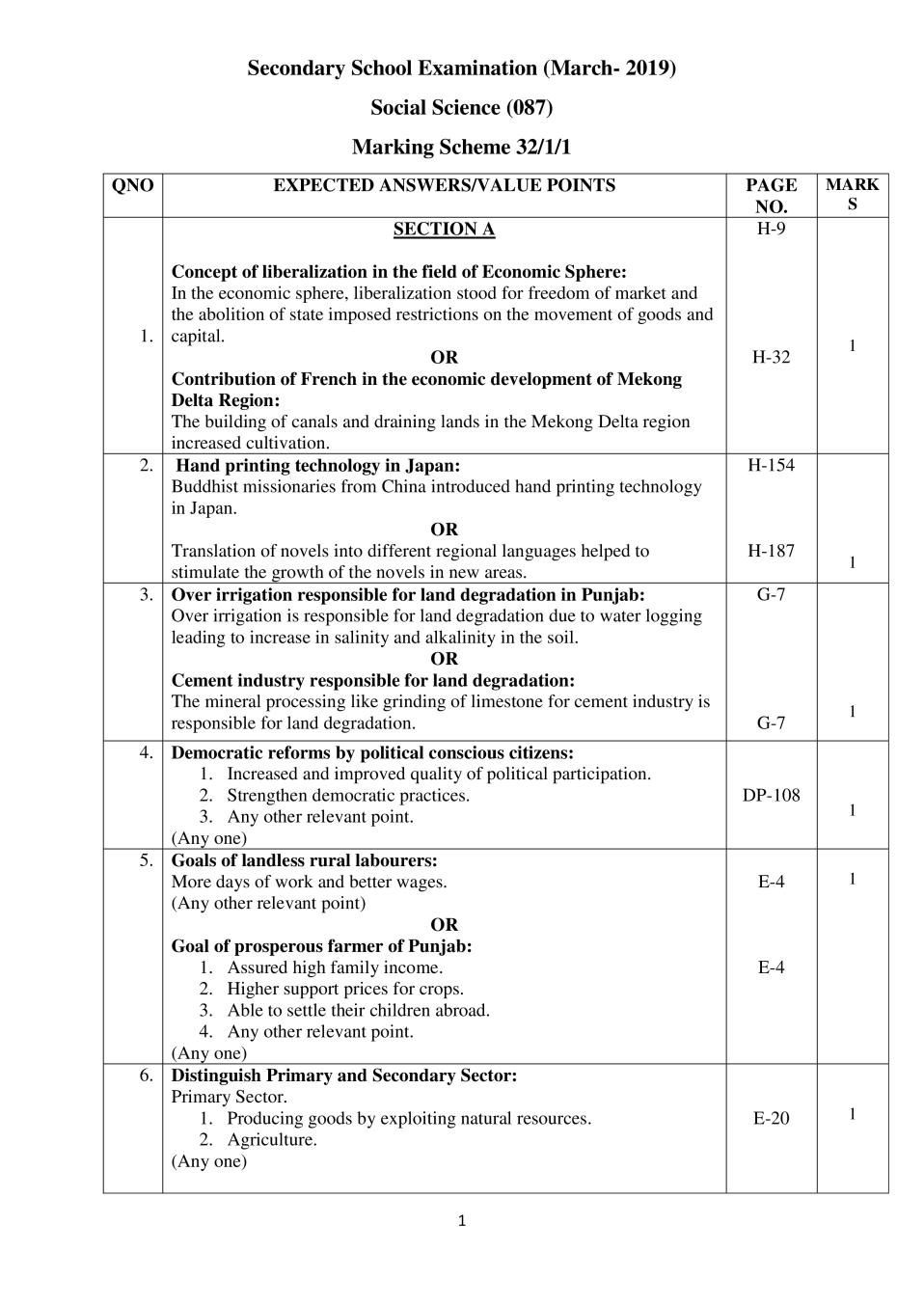
Social Science (087)
Marking Scheme 32/1/1
QNO EXPECTED ANSWERS/VALUE POINTS PAGE MARK
NO. S
SECTION A H-9
Concept of liberalization in the field of Economic Sphere:
In the economic sphere, liberalization stood for freedom of market and
the abolition of state imposed restrictions on the movement of goods and
1. capital.
1
OR H-32
Contribution of French in the economic development of Mekong
Delta Region:
The building of canals and draining lands in the Mekong Delta region
increased cultivation.
2. Hand printing technology in Japan: H-154
Buddhist missionaries from China introduced hand printing technology
in Japan.
OR
Translation of novels into different regional languages helped to H-187
1
stimulate the growth of the novels in new areas.
3. Over irrigation responsible for land degradation in Punjab: G-7
Over irrigation is responsible for land degradation due to water logging
leading to increase in salinity and alkalinity in the soil.
OR
Cement industry responsible for land degradation:
The mineral processing like grinding of limestone for cement industry is
1
responsible for land degradation. G-7
4. Democratic reforms by political conscious citizens:
1. Increased and improved quality of political participation.
2. Strengthen democratic practices. DP-108
3. Any other relevant point. 1
(Any one)
5. Goals of landless rural labourers:
More days of work and better wages. E-4 1
(Any other relevant point)
OR
Goal of prosperous farmer of Punjab:
1. Assured high family income. E-4
2. Higher support prices for crops.
3. Able to settle their children abroad.
4. Any other relevant point.
(Any one)
6. Distinguish Primary and Secondary Sector:
Primary Sector.
1. Producing goods by exploiting natural resources. E-20 1
2. Agriculture.
(Any one)
1
Page 2
1. Activities in which natural products are changed into other forms
through manufacturing.
2. Industries.
(Any one)
7. Banks or Lenders demand collateral against loans.
Bank or lenders demand collateral against loans as it is used as a E-44 1
guarantee to a lender until the loan is repaid.
SECTION – B
Nepoleonic code exported to the regions under French Control: H-6
1. Simplified administrative divisions.
2. Abolished feudal system.
3x1=3
3. Freed peasants from serfdom and manorial dues.
4. In towns, guild restrictions were removed.
5. Transport and communication system improved.
6. Any other relevant point.
8. (Any three points to be explained with examples.)
OR
Barriers responsible for economic growth in Vietnam: H-33
1. High population level.
2. Low agricultural productivity.
3. Extensive indebtness among the peasants.
4. Any other relevant point.
(Any three points to be explained with examples)
9. Imperial state in China as major producer of printed material:
1. Text books for examinations were printed in vast number.
2. The use of print was diversified and readership enhanced. H-154
3. Import of new western technology and mechanical presses.
4. Any other relevant point.
(Any three points to be explained with example)
OR
Novels easily available for the masses in Europe during nineteenth
century:
1. Introduction of circulating libraries. H-178 3x1=3
2. Technological improvements in printing.
3. Mass production at low cost.
4. Innovation in marketing led to expanded sales.
(Any three points to be explained.)
10. Main features of ‘Rabi Crop Season’:
1. Rabi crops are sown in Winter from October to December.
2. Harvested in Summer from April to June. G-36
3. Important Rabi crops are Wheat, Barley, Peas, Gram and
Mustard.
4. Availability of precipitation during winter months due to western
temperate cyclones helps in the success of these crops.
2
Page 3
OR
Features of ‘Kharif Crop Season’: G-36
3x1=3
1. Grown with the onset of monsoon in different parts of the
country.
2. Harvested in September-October.
3. Important Kharif crops are Paddy, Maize, Jowar, Bajra, Tur
(arhar) etc.
4. Any other relevant point.
(Any three points to be described.)
11. Water scarcity due to large and growing population in India:
1. Greater demand for water for domestic purposes.
2. Water resources over exploited to expand irrigated areas. G-25 3x1=3
3. Falling ground water levels.
4. Any other relevant point.
(Any three points to be analyzed.)
12. Assertion of social diversities in a democratic country:
1. This allows various disadvantaged and marginal social groups to
express their grievances.
2. This get the government to attend grievances of disadvantaged DP-37 3X1=3
groups.
3. Expression of various kinds of social divisions in politics results
in their cancelling one another out and thus reducing their
intensity.
4. Any other relevant point.
(Any three points to be justified.)
OR
Social divisions affect politics:
1. Social divisions competing with each other can lead to
disintegration of a country.
2. Social divisions turned to political divisions lead to conflicts and DP-34,36
violence.
3. Social divisions affects voting.
4. People from one community tend to prefer some party more than
others.
(Any three points to be examined.)
13. Women still lag much behind men in India despite some
improvements since independence:
A lot has been done to bring women at par with men but still women DP-42-44 3x1=3
face disadvantages, discriminations and oppression in various ways-
1. The literacy rate among women still less than men.
2. Lesser number of girl students go for higher studies.
3. Unequal wages in some areas of employment.
4. Less representation of women in elected bodies.
(Any three points to be analyzed.)
3
Page 4
The election commission gives regulation to the parties as regional and
national party on following basis. DP-79 1½+
1. REGIONAL PARTY: 1½ =3
a. A party to secure at least six percent of the total votes in
an election to the Legislative Assembly of a state and win at least
two seats.
b. Example : Trinmool Congress, Shiv Sena, DMK etc.
2. NATIONAL PARTY
a. A party that secures at least six percent of the total votes in
Lok Sabha election or Assembly in four states and wins at
least four seats in Lok Sabha.
b. For example: BJP, Indian National Congress, etc.
15. Consequences of Environmental degradation do not respect national
or State boundaries:
1. The increase in pollution of land water, air, noise and resulting in
degradation of environment cannot be overlooked. G-78 3x1=3
2. Pollution of river waters effects all as most of the rivers passes
through different states.
3. Air pollution caused by the presence of high proportion of
undesirable gases adversely affects human health and atmosphere
as a whole.
4. Thermal pollution of river water effect the aquatic life irrespective of
state and national boundaries.
(Any three points to be justified.)
16. Importance of tertiary sector in India:
1. Development of services such as transport, trade and storage
promote agriculture and industry.
2. Rise in income level. E-24,25
3. Development of information and communication technology.
4. It provide larger number of employment.
(Any three points to be explained.)
OR
Gross Domestic Production:
1. GDP is undertaken by central government ministry.
2. The value of all final goods and services produced within a
country during a particular year calculated. E-22,23 1x3=3
3. The value of final goods and services in the three sectors are
calculated by the different government departments.
4. Any other relevant point.
(Any three points to be explained with example.)
17. Importance of formal sources of credit in the Economic
Development:
1. Formal sources provide cheap credit. E-48,49
2. Credit at affordable rate is available through formal sources.
3. Terms and conditions of credit through formal sources are
regulated by government.
4
Page 5
(Any three points to be described.)
OR
Bad effects of informal sources of credit on borrowers:
1. Higher interest rate.
2. Higher cost of borrowing means a larger part of the earnings of E-49 3x1=3
the borrowers is used to repay the loan.
3. In certain cases, the high interest rate for borrowing can mean
that the amount to be repaid is greater than the income of the
borrower.
4. This could lead to increasing debt and debt trap.
(Any three points to be described.)
18. Right to seek redressal:
1. Under COPRA, a three tier quasi-judicial machining is set up for
redressal of grievances.
2. Consumer courts are set up at District, State and National level. DP-84 3x1=3
3. Consumer can file case in consumer courts depending upon
amount of claim involved.
4. Consumer can appeal in higher consumer court/ commission
against the decision of lower court/ commission.
(Any three points to be explained with example.)
19. SECTION C
Depressed Classes Association was organized by Dr. B. R. H-68
Ambedkar in 1930.
Achievements:
1. Dr. B. R. Ambedkar raised the demand of separate electorate for
Dalits.
2. British government conceded Ambedkar’s demand of separate
electorates for Dalits.
3. The Depressed classes got reservation of seats in provincial and
Central Legislative Councils.
4. Ambedkar accepted Gandhiji’s position and as the result Poona
Pact was signed.
(to be assessed as whole)
OR
Civil Disobedience Movement: to disobey the rules of the British H-65 1+4=5
Government:
Participation of rich and poor peasant.
1. In the countryside, rich peasant communities like patidars of
Gujarat and Jats of U.P. were active in movement.
2. Rich peasants participated in the movement as a struggle against
high revenue demand.
3. Rich peasants organized their community to support Civil
5
Page 6
4. The poor peasants participated as they wanted their unpaid rent to
be remitted.
(to be assessed as a whole)
20. Indian trade had played a crucial role in the late nineteenth century:
1. By helping Britain balance its deficits, India played a crucial role
in the late nineteenth century world economy.
2. Britain trade surplus in India also helped pay the so called ‘home H-91
charges’.
3. British manufacturers flooded the Indian market.
4. Increased food grain and raw material exports from India to
Britain.
5. The value of British exports to India was much higher than the
value of British import from India.
6. Any other relevant point.
(Any five points to be explained.)
OR
Series of changes affected the pattern:
1. As the Swadeshi Movement gathered, momentum nationalists H-121
mobilized people to bycott foreign cloth.
2. Industrial groups organized themselves to protect their collective
interest.
3. Pressurizing the government to increase tariff protection and
grant other concessions.
4. The export of Indian yarn to China declined.
5. Industrialists in India began shifting from yarn to cloth
production.
6. Cotton piece goods production in India doubled between 1900-
1912.
7. Any other relevant point.
(Any five points to be explained.)
OR
Industrialization had changed the form of urbanization:
1. The early industrial cities of Britain such as Leeds and
Manchester attracted large number of migrants to the textile
Mills.
2. Many migrants came from rural areas. H-128-
3. London became a colossal city. 129
1x5=5
4. London expanded and became a Powerful magnet for migrant
population.
5. It became a city of clerks, shopkeeper, skilled artisans, semi
skilled workers.
6. Apart from the London dockyards, five major types of industries
employed larger number of people from distinctive areas.
7. Any other relevant point.
(Any five points to be explained.)
6
Page 7
1. Pollution of land, water and air from industries caused
environmental degradation.
2. Burning of fossil fuels in big and small factories emit smoke in
the air. G-76,78 5x1=5
3. Organic and inorganic industrial wastes and effluents are
discharged into rivers.
4. Dumping of wastes from industries renders the soil useless.
5. Rain water carrying pollutants from wastes dumped by industries
percolates and contaminated the ground water.
6. Any other relevant point.
(Any five points to be explained with examples)
22. Roadways have edge over Railways in India:
1. Roads are easy to build and maintain as compare to railways.
2. Constructions cost of roads is much lower that of railway lines.
3. Roads as compare to railways lines can negotiate higher gradients G-82 5x1=5
of slopes easily and as such can traverse mountains like
Himalayas.
4. Road transport is economical in transportation for people and
goods for shorter distance.
5. Roads provide door-to-door service, which railways cannot do.
6. Road transport is also used as feeder to other modes of transport
and provide a link between air, sea ports and railway stations.
7. Any other relevant point.
(Any five points to be explained with examples)
23. Comparison of Belgium and Sri Lanka:
1. Belgium is located in Europe whereas Sri Lanka is located in
South Asia.
2. Belgium has a population of little over one crore whereas Sri
Lanka has population of two crores.
3. In Belgium 59 percent people living in Flemish region and DP-2 1+1+3=
speaking Dutch language, 40 percent people living in Wallonia 5
region speaking French and remaining 1 percent Belgian people
speaks German whereas in Sri Lanka 74 percent population are
Sinhalese speakers and 18 percent are Tamil speakers.
4. In Belgium, French-speaking community are relatively rich and
powerful and in Sri Lanka, Sinhalese-speaking people are
Buddhist and powerful.
5. In Belgium, Dutch speaking people are in numeric majority
whereas in Sri Lanka, Sinhalese speaking population are in
majority.
6. Any other relevant point.
(Any five points to be explained)
OR
Idea of Power Sharing Emerged:
1. The idea of power sharing has emerged in opposition to the
notions of undivided political power.
Different forms having common arrangements of Power sharing:
1. Power is shared among different organs of government such as
the Legislature, Executive and Judiciary. DP-8,9
1+4=5
7
Page 8
at National and Provincial or regional levels.
3. Power shared among different social groups such as religious and
linguistic groups.
4. Power sharing arrangements in the way political parties, pressure
groups and movements control or influence those in power.
(Any five points to be explained)
24. Importance of Democratic Government:
1. It produces a government that is accountable to citizens.
2. It responses to the needs and expectations of citizens. DP-91 1x5=5
3. It ensures that decision making will be based on norms and
procedures for transparency making it accountable.
4. It has great success in setting up regular and free elections.
5. Democracy’s ability to generate its own support is the most
positive feature.
6. Any other relevant point.
(Any five points to be discussed)
25. Offices and factories of MNC’s .
1. Availability of Raw material.
2. Availability of skilled and unskilled labor at low costs. ECO-57 1x5=5
3. Availability of other factors of production is assured like
electricity etc.
4. Smaller companies are available.
5. Where government policies are favorable to investors.
6. Any other relevant point.
(Any five points to be explained)
26. (A) See attached filled map.
(B) See attached filled map.
For visually impaired candidates only in lieu of Q.No. 26
1. Punjab 1x5=5
2. Gujarat
3. Uttar Pradesh (UP)
4. Odisha
5. Karnataka
6. Uttar Pradesh (UP)
7. Narmada
8
Page 9
Document Details
| Board / Org | CBSE |
| Exam | Class 10 |
| Type | Solution |
| Pages | 9 |
| Updated | 09 Jun 2026 |