Karnataka SSLC Preparatory Exam Model Question Paper 2023 Science
Finished viewing? Save it for later —
Download Karnataka SSLC Preparatory Exam Model Question Paper 2023 Science (PDF · 20 pages)About Karnataka SSLC Preparatory Exam Model Question Paper 2023 Science
Karnataka SSLC Preparatory Exam Model Question Paper 2023 Science is available here for free download. Published by Karnataka Board for Class 10, this sample paper can be viewed online or downloaded as a PDF (20 pages). Candidates preparing for Class 10 can use Karnataka SSLC Preparatory Exam Model Question Paper 2023 Science to understand the exam pattern, the type of questions asked, and the overall difficulty level.
Frequently Asked Questions
How can I download Karnataka SSLC Preparatory Exam Model Question Paper 2023 Science?
Open this page and click the Download button to save Karnataka SSLC Preparatory Exam Model Question Paper 2023 Science as a PDF. It is completely free on AglaSem Docs.
Is Karnataka SSLC Preparatory Exam Model Question Paper 2023 Science free to download?
Yes. Karnataka SSLC Preparatory Exam Model Question Paper 2023 Science can be viewed online and downloaded as a PDF free of cost on AglaSem Docs.
How many pages does Karnataka SSLC Preparatory Exam Model Question Paper 2023 Science have?
Karnataka SSLC Preparatory Exam Model Question Paper 2023 Science contains 20 pages, which you can read online or download together as a single PDF.
Where can I find more Class 10 study material?
You can find more Class 10 question papers, sample papers, syllabus, and answer keys on AglaSem Docs.
Karnataka SSLC Preparatory Exam Model Question Paper 2023 Science – Text
Read the full text of this sample paper below — useful to quickly search, copy and reference the content online without downloading the PDF.
📄 View text version (20 pages)
Page 1
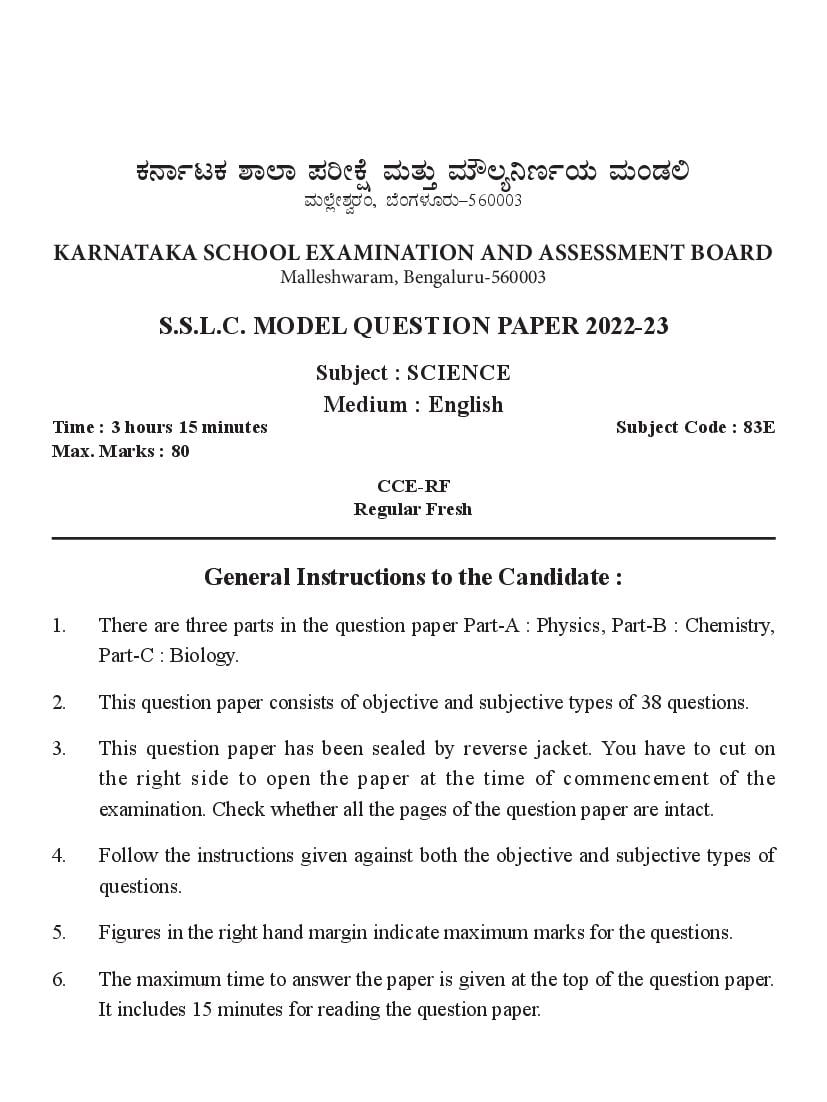
ªÀįÉèñÀégÀA, ¨ÉAUÀ¼ÀÆgÀÄ-560003
KARNATAKA SCHOOL EXAMINATION AND ASSESSMENT BOARD
Malleshwaram, Bengaluru-560003
S.S.L.C. MODEL QUESTION PAPER 2022-23
Subject : SCIENCE
Medium : English
Time : 3 hours 15 minutes Subject Code : 83E
Max. Marks : 80
CCE-RF
Regular Fresh
General Instructions to the Candidate :
1. There are three parts in the question paper Part-A : Physics, Part-B : Chemistry,
Part-C : Biology.
2. This question paper consists of objective and subjective types of 38 questions.
3. This question paper has been sealed by reverse jacket. You have to cut on
the right side to open the paper at the time of commencement of the
examination. Check whether all the pages of the question paper are intact.
4. Follow the instructions given against both the objective and subjective types of
questions.
5. Figures in the right hand margin indicate maximum marks for the questions.
6. The maximum time to answer the paper is given at the top of the question paper.
It includes 15 minutes for reading the question paper.
Page 2
PART-A
(PHYSICS)
I. Four alternatives are given for each of the following questions /
incomplete statements. Choose the correct alternative and write the
complete answer along with its letter of alphabet.
3x1=3
1. The device used to change the resistance at many times in the electric
circuit is
(A) Electric generator (B) Electric motor
(C) Galvanometer (D) Rheostat
2. The correct statement among the following related to the Concave lens is,
(A) Converges the light rays (B) forms inverted image
(C) forms real image (D) diverges the light rays
3. The resistivity (Ωm) of four materials A, B, C and D are
6.84x10⁻⁸, 1.62x10⁻⁸, 5.20x10⁻⁸ and 2.63×10⁻⁸ respectively. Which of
these materials has very less electric conductivity?
(A) Material B (B) Material C
(C) Material A (D) Material D
II. Answer the following questions. 2x1=2
4. Draw the symbol diagram of two electric cells that are connected in
series in an electric circuit.
5. What is 'Optic centre' of spherical lens?
Page 3
III. Answer the following questions. 3x2=6
6. What is solenoid? List the properties of the magnetic field due to the
flow of electric current in a solenoid.
7. How does rainbow form in nature? Explain.
8. Ray of light travelling in air enters obliquely into water. Does the light
ray bend towards the normal or away from the normal? Why?
OR
Convex mirror is commonly used as a rear-view mirror in vehicles.
Why? Write the relationship between the focal length and radius of
curvature of a convex mirror.
IV. Answer the following questions. 3x3=9
9. Explain the method of production of biogas in biogas plant and write
any two characteristics of biogas.
OR
How power is generated from nuclear energy? Explain. Write any two
hazards of nuclear power generation.
10. Draw the ray diagram of image formation when the object is kept at
'C' of the concave mirror. With the help of the ray diagram mention the
position and the nature of the image formed. (F: Principal focus of the
mirror, C: Centre of curvature of mirror)
11. Stars appear to be twinkling. Why? Explain. What are the reasons for
the appearance of the sun in red colour during sunrise?
OR
a) What is meant by power of accommodation of the eye ?
b) What is myopia (near sightedness)? What are the reasons that cause
this defect ?
[ Turn over
Page 4
V. Answer the following questions. 2x4=8
12. a) Two resistors of resistance 5Ω and 20Ω are connected in parallel
and connected to a 12V battery. Calculate the total resistance in the
electric circuit and the total current flowing in this circuit.
b) 200 J of heat is produced in two seconds in a 8 Ω resistance. Find
the potential difference across the resistor.
13. a) Coil-1 is connected to the battery and plug key and Coil-2 with a
galvanometer are kept close to each other as shown in the diagram.
Coil - 1 Coil - 2
G
Write your observation in the galvanometer. When
i) plug key K is closed and ii) plug key K is opened
Give reasons for your observations.
b) Write the functions of the following.
i) Earthing wire ii) Electric fuse
Page 5
PART-B
(CHEMISTRY)
VI. Four alternatives are given for each of the following statements /
incomplete statements. Choose the correct alternative and write the
complete answer along with its letter of alphabet.
3x1=3
14. The Chemical equation that represents neutralisation reaction among
the following is
(A) Sodium Hydroxide + Hydrochloric acid →
Sodium Chloride + Water
(B) Barium Chloride + Sulphuric acid →
Barium sulphate + Hydro Chloric acid
(C) Manganese dioxide + Hydrochloric acid →
Manganese chloride + Water + Chlorine
D) Silver nitrate + Hydrochloric acid →
Silver chloride + Nitric acid
15. "Properties of elements are periodic function of their atomic number".
This law was proposed by
(A) Dobereiner (B) Mendeleev
(C) Newlands (D) Henry Moseley
16. The substance that converts red litmus paper into blue colour is
(A) KOH Solution (B) distilled water
(C) dilute solution of HCl (D) concentrated solution of HNO3
[ Turn over
Page 6
VII. Answer the following questions. 3x1=3
17. Mention the number of single bonds and double bonds present in the
structure of C2H5COOH molecule.
18. Write the electron dot structure of methane.
19. Draw the diagram of the arrangement of apparatus to show electrolysis
of water.
VIII. Answer the following questions. 3x2=6
20. Calcium oxide reacts with water to form slaked lime. What type of
Chemical reaction is this? Write the balanced chemical equation for
this reaction.
21. What is the chemical name of bleaching powder ? Write any two uses
of it.
OR
What is concentrated acid? Name the acid present in the stinging hair
of nettle leaves.
22. Give reason.
i) Ionic compounds have high melting and boiling points.
ii) Ionic compounds in solid state do not conduct electricity.
IX. Answer the following questions. 3x3=9
23. Draw the diagram of the arrangement of apparatus to show the action
of steam on metals.
i) Metal piece ii) Delivery tube
Page 7
24. The electronic configuration of four elements are given in the below
table. Write the elements in the increasing order of their electropositivity
and give reason.
Elements Electronic Configuration
Na 2, 8, 1
S 2, 8, 6
Al 2, 8, 3
K 2, 8, 8, 1
25. Silver chloride exposed to the sunlight turns grey colour. Why? Write
the balanced chemical equation for this reaction and mention the type
of reaction.
OR
Why does the colour of copper sulphate solution change when an iron
nail is dipped into it? Write the balanced chemical equation for this
reaction.
X. Answer the following question. 1x4=4
26. a) The conversion of ethanol to ethanoic acid is an oxidation reaction.
Why?
b) What are structural isomers? Write the structural isomers of butane.
[ Turn over
Page 8
PART-C
(BIOLOGY)
XI. Four alternatives are given for each of the following questions /
incomplete statements. Choose the correct alternative and write the
complete answer along with its letter of alphabet.
2x1=2
27. AIDS : Virus : : Warts : ________________
(A) Bacteria (B) Fungus
(C) Protozoan (D) Virus
28. Algae Small insects Large insects Small fish
Large fish Human. The arrangement of trophic levels in this
food chain are in the
(A) increasing order of energy availability.
(B) increasing order of both energy availability and storage of
harmful chemicals.
(C) increasing order of storage of harmful chemicals.
(D) decreasing order of both energy availability and storage of
harmful chemicals.
XII. Answer the following questions. 3x1=3
29. Draw the diagram showing the structure of closed stomata.
30. What is the function of ozone layer?
31. Rejuvenating ancient water harvesting systems is being encouraged.
Why?
Page 9
XIII. Answer the following questions. 2x2=4
32. What needs of the local people are fulfilled by the forest?
33.
SPIROGYRA PLANARIA
The reproduction methods expressed in both of the above figures are similar
or different from each other? Write the justification to your answer.
XIV. Answer the following questions. 3x3=9
34. a) How is the vegetative propagation in plants useful to the field of
agriculture?
b) Consistency of the DNA copying is important during reproduction.
Why?
OR
a) How do germ cells receive half the amount of DNA? What is the
need of this process?
b) How does menstruation in women occur?
[ Turn over
Page 10
35. How phototropism, thigmotropism and chemotropism are co-ordinated
in the apparent movement of creepers (climbing-up plants) towards
particular direction?
36. Draw the diagram showing the structure of the human brain. Label the
following parts.
i) Cerebrum ii) Cerebellum
XV. Answer the following question. 1x4=4
37. a) What is the important function of 'villi' and 'alveoli' in our body?
b) Explain the structure and function of nephron.
OR
a) What is the importance of transpiration in plants?
b) How does translocation of materials take place by phloem tissue?
XVI. Answer the following question. 1x5=5
38. a) Tall pea plant (TT) is crossed with short pea plant (tt). What type of
the plants will obtain in F1 generation? Write the genetic make up
of this progeny.
b) Forelimbs of frog, wings of bird, wings of bat, forelimbs of lizard
pair them as analogous and homologous organs. Give reason for
your pairing.
Page 11
ªÀįÉèñÀégÀA, ¨ÉAUÀ¼ÀÆgÀÄ-560003
KARNATAKA SCHOOL EXAMINATION AND ASSESSMENT BOARD
Malleshwaram, Bengaluru-560003
J¸ï.J¸ï.J¯ï.¹. ªÀiÁzÀj ¥Àæ±ÉߥÀwæPÉ 2022-23
«µÀAiÀÄ : «eÁÕ£À
ªÀiÁzsÀåªÀÄ : PÀ£ÀßqÀ
¸ÀªÀÄAiÀÄ: 3 UÀAmÉ 15 ¤«ÄµÀUÀ¼ÀÄ «µÀAiÀÄ ¸ÀAPÉÃvÀ: 83K
UÀjµÀ× CAPÀUÀ¼ÀÄ : 80
CCE-RF
±Á¯Á C¨sÀåyðUÀ½UÉ
¥ÀjÃPÁëyðUÀ½UÁV ¸ÁªÀiÁ£Àå ¸ÀÆZÀ£ÉUÀ¼ÀÄ :
1. F ¥Àæ±ÉߥÀwæPÉAiÀÄ°è ¨sÁUÀ : A ¨sËvÀ«eÁÕ£À, ¨sÁUÀ : B gÁ¸ÁAiÀÄ£À«eÁÕ£À,
¨sÁUÀ : C fêÀ«eÁÕ£À JA§ ªÀÄÆgÀÄ ¨sÁUÀUÀ½ªÉ.
2. F ¥Àæ±ÉߥÀwæPÉAiÀÄÄ ªÀ¸ÀÄÛ¤µÀ× ªÀÄvÀÄÛ «µÀÀAiÀĤµÀ× ªÀiÁzÀjAiÀÄ MlÄÖ 38 ¥Àæ±ÉßUÀ¼À£ÀÄß ºÉÆA¢zÉ.
3. F ¥Àæ±ÉߥÀwæPÉAiÀÄ£ÀÄß »ªÀÄÄäR eÁPÉmï ªÀÄÆ®PÀ ªÉƺÀgÀÄ (¹Ã¯ï) ªÀiÁqÀ¯ÁVzÉ.
¥ÀjÃPÉë ¥ÁægÀA¨sÀªÁUÀĪÀ ¸ÀªÀÄAiÀÄPÉÌ ¤ªÀÄä ¥Àæ±ÉߥÀwæPÉAiÀÄ §®§¢ ¥Á±ÀéðªÀ£ÀÄß PÀvÀÛj¹,
¥Àæ±ÉߥÀwæPÉAiÀÄ°è J¯Áè ¥ÀÅlUÀ¼ÀÄ EªÉAiÉÄà JAzÀÄ ¥ÀjÃQë¹PÉƽî.
4. ªÀ¸ÀÄÛ¤µÀ× ªÀÄvÀÄÛ «µÀÀAiÀĤµÀ× ªÀiÁzÀjAiÀÄ ¥Àæ±ÉßUÀ½UÉ PÉÆnÖgÀĪÀ ¸ÀÆZÀ£ÉUÀ¼À£ÀÄß ¥Á°¹.
5. §® ¨sÁUÀzÀ°è PÉÆnÖgÀĪÀ CAQUÀ¼ÀÄ ¥Àæ±ÉßUÀ½VgÀĪÀ ¥ÀÇtð CAPÀUÀ¼À£ÀÄß vÉÆÃj¸ÀÄvÀÛªÉ.
6. ¥Àæ±ÉߥÀwæPÉAiÀÄ£ÀÄß N¢PÉƼÀî®Ä 15 ¤«ÄµÀUÀ¼À PÁ¯ÁªÀPÁ±ÀªÀÇ ¸ÉÃjzÀAvÉ, GvÀÛj¸À®Ä
¤UÀ¢¥Àr¸À¯ÁzÀ ¸ÀªÀÄAiÀĪÀ£ÀÄß ¥Àæ±ÉߥÀwæPÉAiÀÄ ªÉÄïÁãUÀzÀ°è ¤ÃqÀ¯ÁVzÉ.
Page 12
¨sÁUÀ - A
(¨sËvÀ«eÁÕ£À)
I. F PɼV
À £À ¥À±
æ ßÉ UÀ½UÉ CxÀªÁ C¥ÀÇtð ºÉýPÉU½
À UÉ £Á®ÄÌ ¥ÀAiÀiÁðAiÀÄ GvÀg
Û U
À ¼
À £
À ÄÀ ß
¤ÃqÀ¯ÁVzÉ. CªÀÅUÀ¼À°è ¸ÀÆPÀÛªÁzÀ GvÀÛgÀªÀ£ÀÄß Dj¹, CzÀgÀ PÀæªÀiÁPÀëgÀzÉÆqÀ£É
¥ÀÇtð GvÀÛgÀªÀ£ÀÄß §gɬÄj.
3x1=3
1. «zÀÄåvï ªÀÄAqÀ®zÀ°è C£ÉÃPÀ ¨Áj gÉÆÃzsÀªÀ£ÀÄß §zÀ¯Á¬Ä¸À®Ä §¼À¸ÀĪÀ
¸ÁzsÀ£À.
(A) «zÀÄåvï d£ÀPÀ (B) «zÀÄåvï ªÉÆÃmÁgï
(C) UÁå®é£ÉÆëÄÃlgï (D) jAiÉÆøÁÖmï
2. PɼÀV£ÀªÀÅUÀ¼À°è ¤ªÀÄß ªÀĸÀÆgÀPÉÌ ¸ÀA§A¢ü¹zÀAvÉ ¸ÀjAiÀiÁzÀ ºÉýPÉ.
(A) ¨É¼ÀQ£À QgÀtUÀ¼À£ÀÄß PÉÃA¢æÃPÀj¸ÀÄvÀÛzÉ.
(B) vÀ¯É PɼÀUÁzÀ ¥Àæw©A§ªÀ£ÀÄß GAlĪÀiÁqÀÄvÀÛzÉ.
(C) ¸ÀvÀå ¥Àæw©A§ªÀ£ÀÄß GAlĪÀiÁqÀÄvÀÛzÉ.
(D) ¨É¼ÀQ£À QgÀtUÀ¼À£ÀÄß «PÉÃA¢æPÀj¸ÀÄvÀÛzÉ.
3. A, B, C ªÀÄvÀÄÛ D JA§ £Á®ÄÌ ªÀ¸ÀÄÛUÀ¼À gÉÆÃzsÀ²Ã®vÉAiÀÄÄ (Ωm) PÀæªÀĪÁV
6.84x10⁻⁸, 1.62x10⁻⁸, 5.20x10⁻⁸ ªÀÄvÀÄÛ 2.63×10⁻⁸ DVzÉ. EªÀÅUÀ¼À°è AiÀiÁªÀ
ªÀ¸ÀÄÛ«£À «zÀÄåvï ªÁºÀPÀvÉAiÀÄÄ CvÀåAvÀ PÀrªÉĬÄzÉ?
(A) ªÀ¸ÀÄÛ B (B) ªÀ¸ÀÄÛ C
(C) ªÀ¸ÀÄÛ A (D) ªÀ¸ÀÄÛ D
II. PɼÀV£À ¥Àæ±ÉßUÀ½UÉ GvÀÛj¹. 2x1=2
4. MAzÀÄ «zÀÄåvï ªÀÄAqÀ®zÀ°è ¸ÀgÀtÂAiÀÄ°è eÉÆÃr¹zÀ JgÀqÀÄ «zÀÄåvï
PÉÆñÀUÀ¼À aºÉßAiÀÄ avÀæªÀ£ÀÄß §gɬÄj.
5. UÉÆýÃAiÀÄ ªÀĸÀÆgÀzÀ `zÀÈPïPÉÃAzÀæ' JAzÀgÉãÀÄ ?
Page 13
III. PɼÀV£À ¥Àæ±ÉßUÀ½UÉ GvÀÛj¹. 3x2=6
6. ¸ÉƯɣÁAiÀiïØ JAzÀgÉãÀÄ? «zÀÄåvï ¥ÀæªÁºÀ¢AzÀ ¸ÉƯɣÁAiÀiïØ£À°è
GAmÁzÀ PÁAvÀPÉëÃvÀæzÀ UÀÄt®PÀëtUÀ¼À£ÀÄß ¥ÀnÖªÀiÁr.
7. ¤¸ÀUÀðzÀ°è PÁªÀÄ£À©®Äè ºÉÃUÉ GAmÁUÀÄvÀÛzÉ? «ªÀj¹.
8. UÁ½AiÀÄ°è ZÀ°¸ÀÄwÛgÀĪÀ ¨É¼ÀQ£À QgÀtªÀÅ NgÉAiÀiÁV ¤ÃgÀ£ÀÄß ¥ÀæªÉò¸ÀÄvÀÛzÉ.
¨É¼ÀQ£À QgÀtªÀÅ ®A§zÀ PÀqÉUÉ ¨ÁUÀĪÀÅzÉÆà CxÀªÁ ®A§¢AzÀ zÀÆgÀ
¨ÁUÀĪÀÅzÉÆÃ? KPÉ?
CxÀªÁ
¦Ã£ÀzÀ¥ÀðtªÀ£ÀÄß ¸ÁªÀiÁ£ÀåªÁV ªÁºÀ£ÀUÀ¼À°è »£ÀÉÆßÃl zÀ¥ÀðtªÁV
§¼À¸ÀÄvÁÛgÉ. KPÉ? MAzÀÄ ¦Ã£À zÀ¥ÀðtzÀ ¸ÀAUÀªÀÄ zÀÆgÀ ªÀÄvÀÄÛ ªÀPÀævÁ
wædåUÀ½VgÀĪÀ ¸ÀA§AzsÀªÀ£ÀÄß §gɬÄj.
IV. PɼÀV£À ¥Àæ±ÉßUÀ½UÉ GvÀÛj¹. 3x3=9
9. eÉÊ«PÀ C¤® ¸ÁܪÀgÀzÀ°è eÉÊ«PÀ C¤®ªÀ£ÀÄß GvÁࢸÀĪÀ «zsÁ£ÀªÀ£ÀÄß
«ªÀj¹ ªÀÄvÀÄÛ eÉÊ«PÀ C¤®zÀ AiÀiÁªÀÅzÁzÀgÀÆ JgÀqÀÄ ®PÀëtUÀ¼À£ÀÄß
§gɬÄj.
CxÀªÁ
£ÀÆåQèÃAiÀÄ ±ÀQÛ¬ÄAzÀ «zÀÄåvÀÛ£ÀÄß ºÉÃUÉ GvÁࢸÀ¯ÁUÀÄvÀÛzÉ? «ªÀj¹.
¥ÀgÀªÀiÁtÄ «zÀÄåvï GvÁàzÀ£ÉAiÀÄ AiÀiÁªÀÅzÁzÀgÀÆ JgÀqÀÄ C¥ÁAiÀÄUÀ¼À£ÀÄß
§gɬÄj.
10. ¤ªÀÄß zÀ¥ÀðtzÀ 'C' £À°è ªÀ¸ÀÄÛªÀ¤ßmÁÖUÀ ¥Àæw©A§ GAmÁUÀÄ«PÉAiÀÄ£ÀÄß
vÉÆÃj¸ÀĪÀ gÉÃSÁavÀæªÀ£ÀÄß §gɬÄj. gÉÃSÁavÀæzÀ ¸ÀºÁAiÀÄ¢AzÀ
¥Àæw©A§zÀ ¸ÁÜ£À ªÀÄvÀÄÛ ¸Àé¨sÁªÀUÀ¼À£ÀÄß w½¹. (F: zÀ¥ÀðtzÀ ¥ÀæzsÁ£À
¸ÀAUÀªÀÄ, C: zÀ¥ÀðtzÀ ªÀPÀævÁ wædå)
[ Turn over
Page 14
11. £ÀPÀëvÀæUÀ¼ÀÄ «Ä£ÀÄVzÀAvÉ PÁtÄvÀÛªÉ. KPÉ? «ªÀj¹. ¸ÀÆAiÉÆÃðzÀAiÀÄzÀ
PÁ®zÀ°è ¸ÀÆAiÀÄð£ÀÄ PÉA¥ÁV PÁt®Ä PÁgÀtUÀ¼ÉãÀÄ?
CxÀªÁ
a) PÀtÂÚ£À ºÉÆAzÁtÂPÉAiÀÄ ¸ÁªÀÄxÀåð JAzÀgÉãÀÄ?
b) ¸À«ÄÃ¥À zÀ馅 zÉÆõÀ (ªÀÄAiÉÆæAiÀiÁ) JAzÀgÉãÀÄ ? F zÉÆõÀ
GAmÁUÀ®Ä PÁgÀtUÀ¼ÉãÀÄ ?
V. PɼÀV£À ¥Àæ±ÉßUÀ½UÉ GvÀÛj¹. 2x4=8
12. a) 5Ω ªÀÄvÀÄÛ 20Ω gÉÆÃzsÀªÀ£ÀÄß ºÉÆA¢gÀĪÀ JgÀqÀÄ gÉÆÃzsÀPÀUÀ¼À£ÀÄß
¸ÀªÀiÁAvÀgÀªÁV eÉÆÃr¹. 12V «¨sÀªÁAvÀgÀ«gÀĪÀ «zÀÄåvïPÉÆñÀPÉÌ
¸ÀA¥ÀQð¹zÉ. F «zÀÄå£ÀäAqÀ®zÀ°è£À MlÄÖ gÉÆÃzsÀªÀ£ÀÄß ªÀÄvÀÄÛ
ªÀÄAqÀ®zÀ°è£À MlÄÖ «zÀÄåvï ¥ÀæªÁºÀªÀ£ÀÄß ¯ÉPÀÌZÁgÀ ªÀiÁr.
b) 8 Ω gÉÆÃzsÀ¢AzÀ ¥Àæw JgÀqÀÄ ¸ÉPÉArUÉ 200 J GµÀÚ±ÀQÛ GvÀàwÛAiÀiÁUÀÄvÀÛzÉ.
gÉÆÃzsÀPÀzÀ £ÀqÀÄ«£À «¨sÀªÁAvÀgÀªÀ£ÀÄß PÀAqÀÄ»r¬Äj.
13. a) ¸ÀÄgÀĽ-1£ÀÄß ¨Áålj ªÀÄvÀÄÛ ¥ÀèUïQà eÉÆvÉUÉ ºÁUÀÆ ¸ÀÄgÀĽ-2£ÀÄß
UÁå®é£ÉÆëÄÃlgï eÉÆvÉUÉ ¸ÀA¥ÀQð¹ CªÀÅUÀ¼À£ÀÄß avÀæzÀ°è
vÉÆÃj¹gÀĪÀAvÉ ¥ÀgÀ¸ÀàgÀ ¸À«ÄÃ¥ÀzÀ°èj¹zÉ.
¸ÀÄgÀĽ-1 ¸ÀÄgÀĽ-2
G
i) ¥ÀèUïQà `K' AiÀÄ£ÀÄß ªÀÄÄaÑzÁUÀ ªÀÄvÀÄÛ
ii) ¥ÀèUïQà `K' AiÀÄ£ÀÄß vÉgÉzÁUÀ UÁå®é£ÉÆëÄÃlgï£À°è ¤ªÀÄä
«ÃPÀëuÉAiÀÄ£ÀÄß §gɬÄj. ¤ªÀÄä «ÃPÀëuÉUÉ PÁgÀtUÀ¼À£ÀÄß w½¹.
b) PɼÀV£ÀªÀÅUÀ¼À PÁAiÀÄðUÀ¼À£ÀÄß §gɬÄj.
i) ¨sÀƸÀA¥ÀPÀð vÀAw ii) «zÀÄåvï ¥sÀÇå¸ï
Page 15
¨sÁUÀ - B
(gÀ¸ÁAiÀÄ£À«eÁÕ£À)
VI. F PɼV
À £À ¥À±
æ ßÉ UÀ½UÉ CxÀªÁ C¥ÀÇtð ºÉýPÉU½
À UÉ £Á®ÄÌ ¥ÀAiÀiÁðAiÀÄ GvÀg
Û U
À ¼
À £
À ÄÀ ß
¤ÃqÀ¯ÁVzÉ. CªÀÅUÀ¼À°è ¸ÀÆPÀÛªÁzÀ GvÀÛgÀªÀ£ÀÄß Dj¹, CzÀgÀ PÀæªÀiÁPÀëgÀzÉÆqÀ£É
¥ÀÇtð GvÀÛgÀªÀ£ÀÄß §gɬÄj.
3x1=3
14. PɼÀV£ÀªÀÅUÀ¼À°è vÀl¹ÜÃPÀgÀt QæAiÉÄAiÀÄ£ÀÄß ¥Àæw¤¢ü¸ÀĪÀ ¸À«ÄÃPÀgÀt
(A) ¸ÉÆÃrAiÀÄA ºÉÊqÁæPÉìöÊqï + ºÉÊqÉÆæÃPÉÆèÃjPï DªÀÄè →
¸ÉÆÃrAiÀÄA PÉÆèÃgÉÊqï + ¤ÃgÀÄ
(B) ¨ÉÃjAiÀÄA PÉÆèÃgÉÊqï + ¸À®Æá÷åjPï DªÀÄè →
¨ÉÃjAiÀÄA ¸À¯ÉáÃmï + ºÉÊqÉÆæÃPÉÆèÃjPï DªÀÄè
(C) ªÀiÁåAUÀ¤Ã¸ï qÉÊDPÉìöÊqï + ºÉÊqÉÆæÃPÉÆèÃjPï DªÀÄè →
ªÀiÁåAUÀ¤Ã¸ï PÉÆèÃgÉÊqï + ¤ÃgÀÄ + PÉÆèÃj£ï
D) ¨É½îAiÀÄ £ÉÊmÉæÃmï + ºÉÊqÉÆæÃPÉÆèÃjPï DªÀÄè →
¨É½îAiÀÄ PÉÆèÃgÉÊqï + £ÉÊnæPï DªÀÄè
15. ``zsÁvÀÄUÀ¼À UÀÄtUÀ¼ÀÄ CªÀÅUÀ¼À ¥ÀgÀªÀiÁtÄ ¸ÀASÉåAiÀÄ DªÀvÀð¤ÃAiÀÄ
¥ÀÅ£ÀgÁªÀvÀð£ÉUÀ¼ÀÄ F ¤AiÀĪÀĪÀ£ÀÄß ¥Àæw¥Á¢¹zÀªÀgÀÄ'',
(A) qÉÆçgÉÊ£Àgï (B) ªÉÄAqÀ°Ãªï
(C) £ÀÆå¯ÁåAqïì (D) ºÉ¤æ ªÉÆøÉè
16. PÉA¥ÀÅ °lä¸ï PÁUÀzÀªÀ£ÀÄß ¤Ã° §tÚPÉÌ §zÀ¯Á¬Ä¸ÀĪÀ ªÀ¸ÀÄÛ.
(A) KOH zÁæªÀt (B) D¸À«vÀ¤ÃgÀÄ
(C) zÀħð® HCl zÁæªÀt (D) ¥À槮 HNO3 zÁæªÀt
[ Turn over
Page 16
VII. PɼÀV£À ¥Àæ±ÉßUÀ½UÉ GvÀÛj¹. 3x1=3
17. C2H5COOH £À CtÄ«£À gÀZÀ£ÉAiÀÄ°ègÀĪÀ KPÀ§AzsÀUÀ¼ÀÄ ªÀÄvÀÄÛ ¢é§AzsÀUÀ¼À
¸ÀASÉåAiÀÄ£ÀÄß w½¹.
18. «ÄxÉãï£À J¯ÉPÁÖç£ï ZÀÄQÌ gÀZÀ£ÉAiÀÄ£ÀÄß §gɬÄj.
19. ¤Ãj£À «zÀÄåvï «¨sÀd£ÉAiÀÄ£ÀÄß vÉÆÃj¸ÀĪÀ G¥ÀPÀgÀtUÀ¼À eÉÆÃqÀuÉAiÀÄ
avÀæªÀ£ÀÄß §gɬÄj.
VIII. PɼÀV£À ¥Àæ±ÉßUÀ½UÉ GvÀÛj¹. 3x2=6
20. PÁå°ìAiÀÄA DPÉìöÊqï ¤Ãj£ÉÆA¢UÉ ªÀwð¹zÁUÀ CgÀ½zÀ ¸ÀÄtÚ GAmÁUÀÄvÀÛzÉ.
F gÁ¸ÁAiÀĤPÀ QæAiÉÄAiÀÄ «zsÀ AiÀiÁªÀÅzÀÄ? F QæAiÉÄUÉ ¸ÀjzÀÆV¹zÀ
gÁ¸ÁAiÀĤPÀ ¸À«ÄÃPÀgÀtªÀ£ÀÄß §gɬÄj.
21. ZÀ®ÄªÉ¥ÀÅrAiÀÄ gÁ¸ÁAiÀĤPÀ ºÉ¸ÀgÉãÀÄ ? EzÀgÀ AiÀiÁªÀÅzÁzÀgÀÆ JgÀqÀÄ
G¥ÀAiÉÆÃUÀUÀ¼À£ÀÄß §gɬÄj.
CxÀªÁ
¥À槮 DªÀÄè JAzÀgÉãÀÄ? vÀÄjPÉ VqÀzÀ J¯ÉUÀ¼À ZÀÄZÀÄѪÀ PÀÆzÀ®ÄUÀ¼À°ègÀĪÀ
DªÀÄèªÀ£ÀÄß ºÉ¸Àj¹.
22. PÁgÀt PÉÆr.
i) CAiÀiÁ¤Pï ¸ÀAAiÀÄÄPÀÛUÀ¼ÀÄ ºÉaÑ£À PÀgÀUÀĪÀ ªÀÄvÀÄÛ PÀÄ¢AiÀÄĪÀ ©AzÀÄUÀ¼À£ÀÄß
ºÉÆA¢ªÉ.
ii) CAiÀiÁ¤Pï ¸ÀAAiÀÄÄPÀÛUÀ¼ÀÄ WÀ£À¹ÜwAiÀÄ°è «zÀÄåvï CªÁºÀPÀUÀ¼ÀÄ.
IX. PɼÀV£À ¥Àæ±ÉßUÀ½UÉ GvÀÛj¹. 3x3=9
23. ¯ÉÆúÀzÀ ªÉÄÃ¯É ºÀ¨ÉAiÀÄ ªÀvÀð£ÉAiÀÄ£ÀÄß vÉÆÃj¸À®Ä G¥ÀAiÉÆÃV¸ÀĪÀ
G¥ÀPÀgÀtUÀ¼À eÉÆÃqÀuÉAiÀÄ avÀæªÀ£ÀÄß §gɬÄj. PɼÀV£À ¨sÁUÀUÀ¼À£ÀÄß
UÀÄgÀÄw¹.
i) ¯ÉÆúÀzÀ ZÀÆgÀÄ ii) «vÀgÀuÁ £À½PÉ
Page 17
24. £Á®ÄÌ zsÁvÀÄUÀ¼À J¯ÉPÁÖç¤Pï «£Áå¸ÀªÀ£ÀÄß PɼÀV£À PÉÆõÀÖPÀzÀ°è ¤ÃqÀ¯ÁVzÉ.
F zsÁvÀÄUÀ¼À£ÀÄß CªÀÅUÀ¼À «zÀåvïzsÀ¤ÃAiÀÄvÉAiÀÄ KjPÉAiÀÄ PÀæªÀÄzÀ°è §gɬÄj
ªÀÄvÀÄÛ PÁgÀt PÉÆr.
zsÁvÀÄUÀ¼ÀÄ E¯ÉPÁÖç£ï «£Áå¸À
Na 2, 8, 1
S 2, 8, 6
Al 2, 8, 3
K 2, 8, 8, 1
25. ¨É½îAiÀÄPÉÆèÃgÉÊqï C£ÀÄß ¸ÀÆAiÀÄð£À ¨É¼ÀQUÉ vÉgÉ¢mÁÖUÀ §ÆzÀÄ §tÚPÉÌ
wgÀÄUÀÄvÀÛzÉ. KPÉ? F QæAiÉÄUÉ ¸ÀjzÀÆV¹zÀ gÁ¸ÁAiÀĤPÀ ¸À«ÄÃPÀgÀt
§gɬÄj ªÀÄvÀÄÛ QæAiÉÄAiÀÄ «zsÀªÀ£ÀÄß w½¹.
CxÀªÁ
PÀ©âtzÀ ªÉƼÉAiÀÄ£ÀÄß ªÀÄļÀÄV¹mÁÖUÀ vÁªÀÄæzÀ ¸À¯ÉáÃmï zÁæªÀtzÀ §tÚ
§zÀ¯ÁUÀÄvÀÛzÉ. KPÉ? F QæAiÉÄUÉ ¸ÀjzÀÆV¹zÀ gÁ¸ÁAiÀĤPÀ ¸À«ÄÃPÀgÀt
§gɬÄj.
X. PɼÀV£À ¥Àæ±ÉßUÉ GvÀÛj¹. 1x4=4
26. a) JxÀ£Á¯ï C£ÀÄß JxÀ£ÉƬÄPï DªÀÄèªÁV ¥ÀjªÀwð¸ÀĪÀÅzÀÄ GvÀ̵Àðt
QæAiÉÄAiÀiÁVzÉ. KPÉ?
b) gÀZÀ£Á ¸ÀªÀiÁAVUÀ¼ÀÄ JAzÀgÉãÀÄ? §ÆåmÉãï£À gÀZÀ£Á ¸ÀªÀiÁAVUÀ¼À£ÀÄß
§gɬÄj.
[ Turn over
Page 18
¨sÁUÀ - C
(fêÀ«eÁÕ£À)
XI. F PɼV
À £À ¥À±
æ ßÉ UÀ½UÉ CxÀªÁ C¥ÀÇtð ºÉýPÉU½
À UÉ £Á®ÄÌ ¥ÀAiÀiÁðAiÀÄ GvÀg
Û U
À ¼
À £
À ÄÀ ß
¤ÃqÀ¯ÁVzÉ. CªÀÅUÀ¼À°è ¸ÀÆPÀÛªÁzÀ GvÀÛgÀªÀ£ÀÄß Dj¹, CzÀgÀ PÀæªÀiÁPÀëgÀzÉÆqÀ£É
¥ÀÇtð GvÀÛgÀªÀ£ÀÄß §gɬÄj.
2x1=2
27. Kqïì : ªÉÊgÀ¸ï :: ¥Àæd£À£ÁAUÀzÀ UÀļÉîUÀ¼ÀÄ : ______________
(A) ¨ÁåQÖÃjAiÀiÁ (B) ²°ÃAzsÀæ
(C) KPÀPÉÆò fë (D) ªÉÊgÀ¸ï
28. ±ÉʪÀ®UÀ¼ÀÄ aPÀÌ QÃlUÀ¼ÀÄ zÉÆqÀØ QÃlUÀ¼ÀÄ aPÀÌ «ÄãÀÄUÀ¼ÀÄ
zÉÆqÀØ «ÄãÀÄUÀ¼ÀÄ ªÀiÁ£ÀªÀ. F DºÁgÀ ¸ÀgÀ¥À½AiÀÄ°è ¥ÉÇõÀuÁ
¸ÀÛgÀUÀ¼À eÉÆÃqÀuÉAiÀÄÄ
(A) ±ÀQÛ ®¨sÀåvÉAiÀÄ KjPÉ PÀæªÀÄzÀ°èzÉ.
(B) ±ÀQÛAiÀÄ ®¨sÀåvÉ ªÀÄvÀÄÛ ºÁ¤PÁgÀPÀ gÁ¸ÁAiÀĤPÀUÀ¼À ¸ÀAUÀæºÀ JgÀqÀgÀ
KjPÉ PÀæªÀÄzÀ°èzÉ.
C) ºÁ¤PÁgÀPÀ gÁ¸ÁAiÀĤPÀUÀ¼À ¸ÀAUÀæºÀzÀ KjPÉ PÀæªÀÄzÀ°èzÉ.
D) ±ÀQÛAiÀÄ ®¨sÀåvÉ ªÀÄvÀÄÛ ºÁ¤PÁgÀPÀ gÁ¸ÁAiÀĤPÀUÀ¼À ¸ÀAUÀæºÀ JgÀqÀgÀ
E½PÉ PÀæªÀÄzÀ°èzÉ.
XII. PɼÀV£À ¥Àæ±ÉßUÀ½UÉ GvÀÛj¹. 3x1=3
29. ªÀÄÄaÑzÀ ¥ÀvÀægÀAzsÀæzÀ gÀZÀ£ÉAiÀÄ£ÀÄß vÉÆÃj¸ÀĪÀ avÀæªÀ£ÀÄß §gɬÄj.
30. NgÉhÆÃ£ï ¥ÀzÀgÀzÀ PÁAiÀÄðªÉãÀÄ?
31. ¥ÀÅgÁvÀ£À ¤Ãj£À PÉÆAiÀÄÄè ªÀåªÀ¸ÉÜUÀ¼À ¥ÀÅ£À±ÉÑÃvÀ£ÀUÉƽ¸ÀÄ«PÉAiÀÄ£ÀÄß
GvÉÛÃf¸À¯ÁUÀÄwÛzÉ. KPÉ?
Page 19
XIII. PɼÀV£À ¥Àæ±ÉßUÀ½UÉ GvÀÛj¹. 2x2=4
32. ¸ÀܽÃAiÀÄ d£ÀgÀ AiÀiÁªÀ CUÀvÀåvÉUÀ¼ÀÄ PÁr¤AzÀ ¥ÀÇgÉÊPÉAiÀiÁUÀÄvÀÛªÉ.
33.
¸ÉàöÊgÉÆÃUÉÊgÁ ¥Àè£ÉÃjAiÀiÁ
F ªÉÄð£À JgÀqÀÄ avÀæUÀ¼À°è ªÀåPÀÛªÁVgÀĪÀ ¸ÀAvÁ£ÉÆÃvÀàwÛ «zsÁ£ÀUÀ¼ÀÄ
MAzÉà jÃwAiÀiÁV EzÉAiÉÆÃ? CxÀªÁ ¥ÀgÀ¸ÀàgÀ «©ü£ÀߪÁVzÉAiÉÆÃ? ¤ªÀÄä
GvÀÛgÀPÉÌ ¸ÀªÀÄxÀð£ÉAiÀÄ£ÀÄß §gɬÄj.
XIV. PɼÀV£À ¥Àæ±ÉßUÀ½UÉ GvÀÛj¹. 3x3=9
34. a) ¸À¸ÀåUÀ¼À°èAiÀÄ PÁAiÀÄd jÃwAiÀÄ ¸ÀAvÁ£ÉÆÃvÀàwÛAiÀÄÄ PÀȶ PÉëÃvÀæPÉÌ ºÉÃUÉ
G¥ÀAiÀÄÄPÀÛªÁVzÉ?
b) ¸ÀAvÁ£ÉÆÃvÀàwÛ ¸ÀªÀÄAiÀÄzÀ°è rJ£ïJ ¸Àé¥ÀæwÃPÀgÀtzÀ°è£À ¹ÜgÀvÉAiÀÄÄ
¥ÀæªÀÄÄRªÁVzÉ. KPÉ?
CxÀªÁ
a) °AUÁtÄPÉÆñÀUÀ¼ÀÄ CzsÀðzÀµÀÄÖ ¥ÀæªÀiÁtzÀ rJ£ïJAiÀÄ£ÀÄß ºÉÃUÉ
¥ÀqÉAiÀÄÄvÀÛªÉ? F ¥ÀæQæAiÉÄAiÀÄ CUÀvÀåªÉãÀÄ?
b) ¹ÛçÃAiÀÄgÀ°è IÄvÀÄZÀPÀæªÀÅ ºÉÃUÉ GAmÁUÀÄvÀÛzÉ?
[ Turn over
Page 20
35. §½î ¸À¸ÀåUÀ¼À ¤¢ðµÀÖ ¢QÌ£À PÀqÉV£À vÉÆÃjPÉAiÀÄ ZÀ®£ÉAiÀÄ°è zÀÄåw
C£ÀĪÀvÀð£É, ¸Àà±Áð£ÀĪÀvÀð£É ªÀÄvÀÄÛ gÁ¸ÁAiÀĤPÁ£ÀĪÀvÀð£ÉUÀ¼ÀÄ
ºÉÃUÉ ¸ÀªÀÄ£ÀéAiÀĪÁVªÉ?
36. ªÀiÁ£ÀªÀ£À ªÉÄzÀĽ£À gÀZÀ£ÉAiÀÄ£ÀÄß vÉÆÃj¸ÀĪÀ avÀæªÀ£ÀÄß §gɬÄj. PɼÀV£À
¨sÁUÀUÀ¼À£ÀÄß UÀÄgÀÄw¹.
i) ªÀĺÁªÀĹ۵ÀÌ ii) C£ÀĪÀĹ۵ÀÌ
XV. PɼÀV£À ¥Àæ±ÉßUÉ GvÀÛj¹. 1x4=4
37. a) £ÀªÀÄä zÉúÀzÀ°è "«¯ÉèöÊ" ºÁUÀÆ "D°éAiÉÆïÉèöÊ"UÀ¼À ¥ÀæªÀÄÄR
PÁAiÀÄðªÉãÀÄ?
b) £É¥sÁæ£ï£À gÀZÀ£É ªÀÄvÀÄÛ PÁAiÀÄðªÀ£ÀÄß «ªÀj¹.
CxÀªÁ
a) ¸À¸ÀåUÀ¼À°è ¨ÁµÀà «¸Àdð£ÉAiÀÄ ¥ÁæªÀÄÄRåvÉAiÉÄãÀÄ?
b) ¥sÉÇèÃAiÀÄA CAUÁA±À¢AzÀ ªÀ¸ÀÄÛ ¸ÁÜ£ÁAvÀgÀtªÀÅ ºÉÃUÉ dgÀÄUÀÄvÀÛzÉ?
XVI. PɼÀV£À ¥Àæ±ÉßUÉ GvÀÛj¹. 1x5=5
38. a) JvÀÛgÀzÀ §mÁt ¸À¸ÀåªÀ£ÀÄß (TT), VqÀØ §mÁt ¸À¸ÀåzÀ (tt) eÉÆvÉ
¸ÀAPÀtUÉƽ¹zÉ. F1 ¸ÀAvÀwAiÀÄ°è AiÀiÁªÀ «zsÀzÀ ¸À¸ÀåUÀ¼ÀÄ zÉÆgÉAiÀÄÄvÀÛªÉ?
F ¸ÀAvÀwAiÀÄ vÀ½UÀÄtªÀ£ÀÄß §gɬÄj.
b) PÀ¥ÉàAiÀÄ ªÀÄÄAUÁ®Ä, ¥ÀQëAiÀÄ gÉPÉÌ, ¨ÁªÀ°AiÀÄ gÉPÉÌ ªÀÄvÀÄÛ ºÀ°èAiÀÄ
ªÀÄÄAUÁ®Ä EªÀÅUÀ¼À£ÀÄß PÁAiÀiÁð£ÀÄgÀƦ ªÀÄvÀÄÛ gÀZÀ£Á£ÀÄgÀƦ
CAUÀUÀ¼ÁV eÉÆvÉ ªÀiÁr. ¤ªÀÄä eÉÆÃqÀuÉUÉ PÁgÀtªÀ£ÀÄß PÉÆr.
Document Details
| Board / Org | Karnataka Board |
| Exam | Class 10 |
| Type | Sample Paper |
| Pages | 20 |
| Updated | 22 Jul 2026 |