PU CET UG 2025 Question Paper Chemistry
Finished viewing? Save it for later —
Download PU CET UG 2025 Question Paper Chemistry (PDF · 8 pages)About PU CET UG 2025 Question Paper Chemistry
PU CET UG 2025 Question Paper Chemistry is available here for free download. Published by Punjab University for PUCET, this question paper can be viewed online or downloaded as a PDF (8 pages). Candidates preparing for PUCET can use PU CET UG 2025 Question Paper Chemistry to understand the exam pattern, the type of questions asked, and the overall difficulty level.
Frequently Asked Questions
How can I download PU CET UG 2025 Question Paper Chemistry?
Open this page and click the Download button to save PU CET UG 2025 Question Paper Chemistry as a PDF. It is completely free on AglaSem Docs.
Is PU CET UG 2025 Question Paper Chemistry free to download?
Yes. PU CET UG 2025 Question Paper Chemistry can be viewed online and downloaded as a PDF free of cost on AglaSem Docs.
How many pages does PU CET UG 2025 Question Paper Chemistry have?
PU CET UG 2025 Question Paper Chemistry contains 8 pages, which you can read online or download together as a single PDF.
Where can I find more PUCET study material?
You can find more PUCET question papers, sample papers, syllabus, and answer keys on AglaSem Docs.
PU CET UG 2025 Question Paper Chemistry – Text
Read the full text of this question paper below — useful to quickly search, copy and reference the content online without downloading the PDF.
📄 View text version (8 pages)
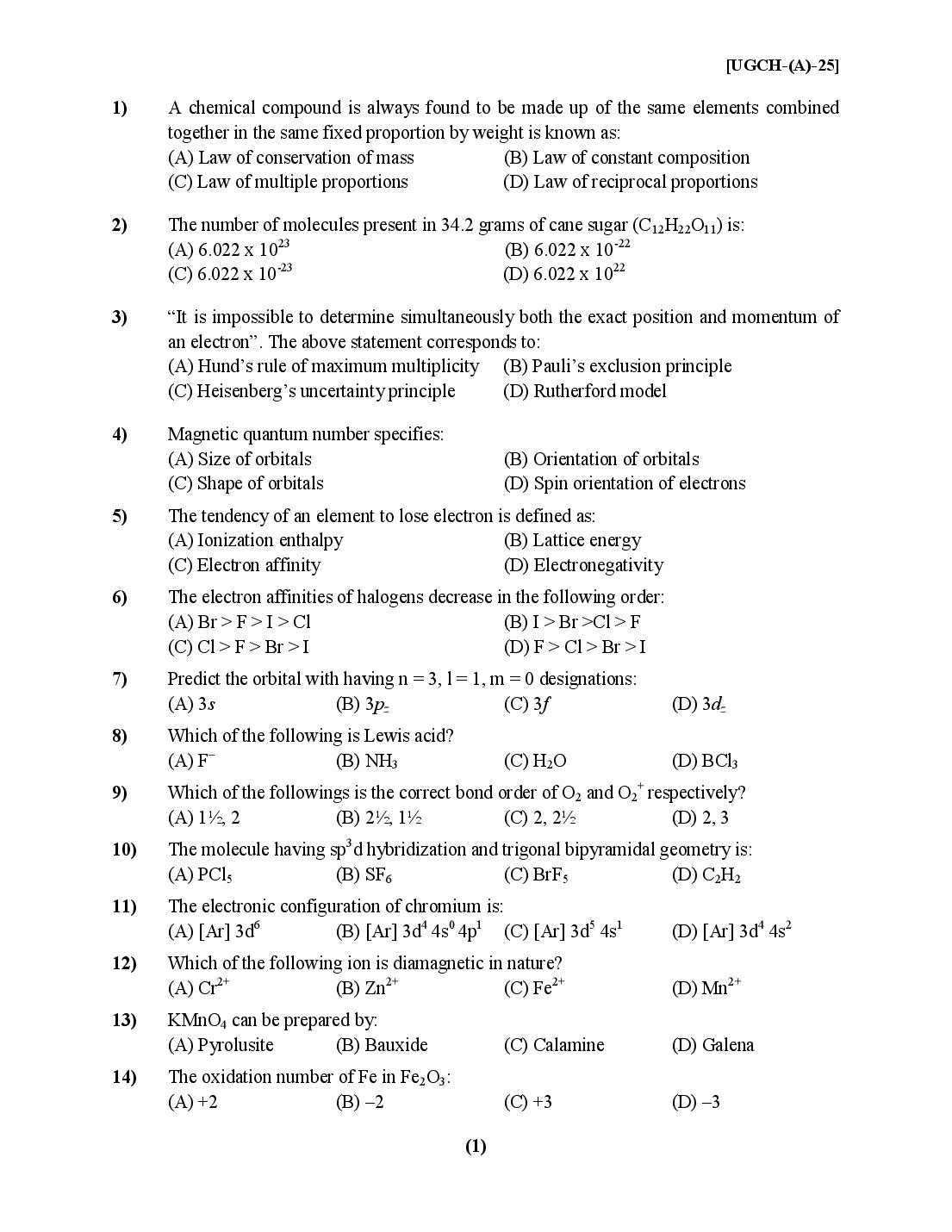
Page 1
together in the same fixed proportion by weight is known as:
(A) Law of conservation of mass (B) Law of constant composition
(C) Law of multiple proportions (D) Law of reciprocal proportions
2) The number of molecules present in 34.2 grams of cane sugar (C 12H22O11) is:
(A) 6.022 x 10²³ (B) 6.022 x 10⁻²²
(C) 6.022 x 10⁻²³ (D) 6.022 x 10²²
3) “It is impossible to determine simultaneously both the exact position and momentum of
an electron”. The above statement corresponds to:
(A) Hund’s rule of maximum multiplicity (B) Pauli’s exclusion principle
(C) Heisenberg’s uncertainty principle (D) Rutherford model
4) Magnetic quantum number specifies:
(A) Size of orbitals (B) Orientation of orbitals
(C) Shape of orbitals (D) Spin orientation of electrons
5) The tendency of an element to lose electron is defined as:
(A) Ionization enthalpy (B) Lattice energy
(C) Electron affinity (D) Electronegativity
6) The electron affinities of halogens decrease in the following order:
(A) Br ˃ F ˃ I ˃ Cl (B) I ˃ Br ˃Cl ˃ F
(C) Cl ˃ F ˃ Br ˃ I (D) F ˃ Cl ˃ Br ˃ I
7) Predict the orbital with having n = 3, l = 1, m = 0 designations:
(A) 3s (B) 3pz (C) 3f (D) 3dz
8) Which of the following is Lewis acid?
(A) F– (B) NH3 (C) H2O (D) BCl3
+
9) Which of the followings is the correct bond order of O2 and O2 respectively?
(A) 1½, 2 (B) 2½, 1½ (C) 2, 2½ (D) 2, 3
10) The molecule having sp3d hybridization and trigonal bipyramidal geometry is:
(A) PCl5 (B) SF6 (C) BrF5 (D) C2H2
11) The electronic configuration of chromium is:
(A) [Ar] 3d6 (B) [Ar] 3d4 4s0 4p1 (C) [Ar] 3d5 4s1 (D) [Ar] 3d4 4s2
12) Which of the following ion is diamagnetic in nature?
(A) Cr2+ (B) Zn2+ (C) Fe2+ (D) Mn2+
13) KMnO4 can be prepared by:
(A) Pyrolusite (B) Bauxide (C) Calamine (D) Galena
14) The oxidation number of Fe in Fe2O3:
(A) +2 (B) –2 (C) +3 (D) –3
(1)
Page 2
(A) Actinide contraction (B) Diagonal relationship
(C) Belongs to f-block of elements (D) Lanthanide contraction
16) Which of the following element belongs to actinoids?
(A) Ce (B) U (C) Tb (D) Au
17) Complex [Co(en)3] 3+ shows:
(A) Optical isomerism (B) Ionisation isomerism
(C) Linkage isomerism (D) Hydrate isomerism
18) According to crystal field theory, [CoF6]3+ has:
(A) Tetrahedral geometry and diamagnetic
(B) Tetrahedral geometry and paramagnetic
(C) Octahedral geometry and diamagnetic
(D) Octahedral geometry and paramagnetic
19) The IUPAC name of K[Cu(CN)2] is:
(A) Cyanocuperate(I)potassium (B) Potassium dicyanocuperate (I)
(C) Dicyanopotassium copper (II) (D) Potassium dicyanocopper (II)
20) Square planner geometry, dsp2 hybridisation and diamagnetic nature belong to:
(A) [NiCl4]2– (B) [Co(NH3)6]3+ (C) [Ni(CN)4]2– (D) [CoF6]3–
21) The flow of electrons from one part of conjugated π-system to other due to resonance is
called as:
(A) Inductive effect (B) Mesomeric effect (C) Electromeric effect (D) Field effect
22) Give IUPAC name of the following:
O
Cl
(A) 6-Chloro-2-methyl-3-hexanone (B) 1-Chloro-5-methyl-4-oxo-hexane
(C) 5-Chloro-1,1-dimethyl-2-pentanone (D) 1-Chloro-5-methyl-4-hexanone
23) Among the following, which one is the most stable carbanion:
(A) Ethyl Phenyl (B) Isobutyl (C) Phenyl (D) tert-Butyl
24) Reaction of alkyl halides with dialkyl copper reagents to afford alkanes is termed as:
(A) Wurtz reaction (B) Corey-House reaction
(C) Kolbe’s electrolytic method (D) Fittig reaction
25) Ozonolysis of CH3CH=CH2 followed by reduction with Zn-H2O gives:
(A) Methanal and water (B) Acetone and Ethanal
(C) Propan-2-one and methanal (D) Ethanal and methanal
(2)
Page 3
(A) 1, 1-Dibromoethane (B) 1, 2-Dibromoethane
(C) 2, 2-Dibromoacetaledyhde (D) 1, 1-Dibromopropane
27) According to Huckel’s rule, an aromatic compound must have a planar cyclic molecule
containing a delocalized:
(A) (4n + 2) electrons (B) (2n - 2) electrons
(C) (4n - 2) electrons (D) (2n + 2) electrons
28) Predict the product X in the following reaction:
Liquid NH3
C6H5Cl + NaNH2 X
(A) Benzene (B) Toluene (C) Aniline (D) Anisole
29) Freon is used as:
(A) Dry cleaning agent (B) Agricultural pesticide
(C) Fire extinguisher (D) Refrigerant and propellant
30) The primary, secondary and tertiary alcohols can be distinguished using:
(A) Tollen’s reagent test (B) Azo dye test
(C) Victor Meyer’s test (D) Baeyer’s test
31) Hydrolysis of cumene hydroperoxide with dil. H2SO4 gives:
(A) Anisole and benzene (B) Phenol and acetone
(C) Aniline and acetaldehyde (D) Toluene and hydrogen peroxide
32) Treatment of anisole with hydrogen iodide produces:
(A) Iodobenzene and phenol (B) Aniline and water
(C) Iodobenzene and methyl alcohol (D) Phenol and methyl iodide
33) Predict the final product Z in the following reaction:
CH3COONa -H2O
C6H5CHO + CH3CO.O.OCCH3 Y Z
453 K -CH3COOH
(A) Cinnamic Acid (B) Salicylic acid
(C) Phthalic acid (D) Benzoic acid
34) Propionic acid can be converted to α-bromopropionic acid using following reagent:
(A) PBr3 (B) Br2/CCl4 (C) Br2/aq KOH (D) Br2/P
35) Name the reaction which leads to following conversion:
conc. H2SO4
CH3COOH + HN3 CH3NH2 + CO2 + N2
(A) Schmidt rearrangement (B) Fries rearrangement
(C) Reimer Tiemann reaction (D) Sandmeyer’s reaction
36) Benzene diazonium chloride on treatment with H3PO2 in the presence of Cu2Cl2 gives:
(A) Aniline (B) Toluene (C) Chlorobenzene (D) Benzene
(3)
Page 4
(A) Glucose and fructose (B) Glucose and maltose
(C) Glucose and Galactose (D) Glucose and amylose
38) α-Helix belongs to which of the following structure of protein:
(A) Quaternary (B) Primary (C) Secondary (D) Tertiary
39) Deficiency of Vitamin C leads to:
(A) Night-blindness (B) Scurvy (C) Anaemia (D) Beri-beri
40) The process in which mRNA directs protein synthesis in the cytoplasm of cell with the
involvement of t-RNA is known as:
(A) Replication (B) Translation (C) Transcription (D) Extraction
41) The enthalpy change of a reaction does not depend upon:
(A) State of products and reactants
(B) Nature of products and reactants
(C) Initial and final enthalpy change in a reaction
(D) Different intermediate reaction
42) What is the work done when 1 mole of gas expands isothermally from 25 L to 250 L at a
constant pressure of 1 atm and a temperature of 300 K?
(A) -5744 J (B) -4679 J (C) -3890 J (D) -2358 J
43) The pH of 0.0001 M Ba(OH)2 solution will be:
(A) 2 (B) 7.4 (C) 10.3 (D) 11.3
44) The equilibrium constant for the following reaction will be:
P4 (s) + 5O2 (g) P4O10 (s)
(A) Kc = [P4][O2]5Ú [P4O10] (B) Kc = [P4O10] Ú [P4][O2]5
(C) Kc = 1Ú [P4O10] (D) Kc = 1Ú [O2]5
45) Which of the following condition is not satisfied by an ideal solution?
(A) Raoult’s law is obeyed (B) Formation of azeotropic mixture
(C) Hmix = 0 (D) Vmix = 0
46) Which of the following describes the criterion of spontaneity?
(A) STotal> 0 (B) G(T,P) > 0 (C) G(T,P) = 0 (D) H(T,P) > 0
47) Which of the following is a colligative property?
(A) Change in free energy (B) Dipole moment
(C) Osmotic pressure (D) Heat of vaporization
48) The rate constant of a reaction is 2.5 x 10⁻² s-1, then the order of the reaction is:
(A) Zero (B) One (C) Two (D) Three
49) The freezing point of 1% solution of lead nitrate in water will be:
(A) 2C (B) 1C (C) 0C (D) Below 0C
(4)
Page 5
0.1 N?
(A) 1000 ml (B) 1010 ml (C) 990 ml (D) 900 ml
51) Which of the following is not related to the chemical kinetics?
(A) Collision theory (B) VSEPR theory
(C) Activated complex theory (D) Arrhenius equation
52) Which of the following is not a strong electrolyte?
(A) NaCl (B) NH4OH (C) KCl (D) KOH
53) At 298 K, the electrolytic conductivity of 0.2 M KCl solution is 6.8 x 10 -3 ohm-1cm-1,
calculate its molar conductance
(A) 86.9 ohm-1cm2mol-1 (B) 78.3 ohm-1cm2mol-1
(C) 62.5 ohm-1cm2mol-1 (D) 34.0 ohm-1cm2mol-1
54) For a reaction M → Product, rate = -k [M], the negative sign used in the rate expression
indicate that:
(A) Concentration of reactant decreases with time
(B) Repulsive forces between reactants
(C) Concentration of reactant increase with time
(D) Explosion in reaction
55) The pOH of an aqueous solution is 9, the [H+] of the solution will be:
(A) 10-9 M (B) 10+9 M (C) 10-5 M (D) 10+5 M
56) The least random state of water system is:
(A) Liquid water (B) Ice
(C) Steam (D) Randomness is same in all
57) A solution which resists the change in its pH value on addition of same amount of acid or
base is called as:
(A) Buffer solution (B) Isotonic solution
(C) Isomorphic solution (D) Isochoric solution
58) The cell reaction of the galvanic cell:
Cu(s) │Cu2+(aq)║ Hg2+(aq) │Hg(l) is
(A) Hg(l) + Cu2+(aq) → Hg2+(aq) + Cu(s) (B) Hg(l) + Cu2+(aq) → Cu+(aq) + Hg+(aq)
(C) Hg(l) + Cu(s) → CuHg(s) (D) Cu(s) + Hg2+(aq) → Cu2+(aq) + Hg(l)
59) A plot of log (a-x) against t is a straight line. This indicates that the reaction is of
(A) Third order (B) Second order (C) First order (D) Zero order
60) The osmotic pressure of the solution can be increased by:
(A) Increasing the number of solute molecules
(B) Increasing the volume
(C) Removing the semi permeable membrane
(D) Decreasing the temperature
x-x-x
(5)
Page 6
(6)
Page 7
(7)
Page 8
(8)
Document Details
| Board / Org | Panjab University |
| Exam | PUCET |
| Type | Question Paper |
| Pages | 8 |
| Updated | 24 Sep 2026 |