PU CET UG 2025 Question Paper Maths
Finished viewing? Save it for later —
Download PU CET UG 2025 Question Paper Maths (PDF · 10 pages)About PU CET UG 2025 Question Paper Maths
PU CET UG 2025 Question Paper Maths is available here for free download. Published by Punjab University for PUCET, this question paper can be viewed online or downloaded as a PDF (10 pages). Candidates preparing for PUCET can use PU CET UG 2025 Question Paper Maths to understand the exam pattern, the type of questions asked, and the overall difficulty level.
Frequently Asked Questions
How can I download PU CET UG 2025 Question Paper Maths?
Open this page and click the Download button to save PU CET UG 2025 Question Paper Maths as a PDF. It is completely free on AglaSem Docs.
Is PU CET UG 2025 Question Paper Maths free to download?
Yes. PU CET UG 2025 Question Paper Maths can be viewed online and downloaded as a PDF free of cost on AglaSem Docs.
How many pages does PU CET UG 2025 Question Paper Maths have?
PU CET UG 2025 Question Paper Maths contains 10 pages, which you can read online or download together as a single PDF.
Where can I find more PUCET study material?
You can find more PUCET question papers, sample papers, syllabus, and answer keys on AglaSem Docs.
PU CET UG 2025 Question Paper Maths – Text
Read the full text of this question paper below — useful to quickly search, copy and reference the content online without downloading the PDF.
📄 View text version (10 pages)
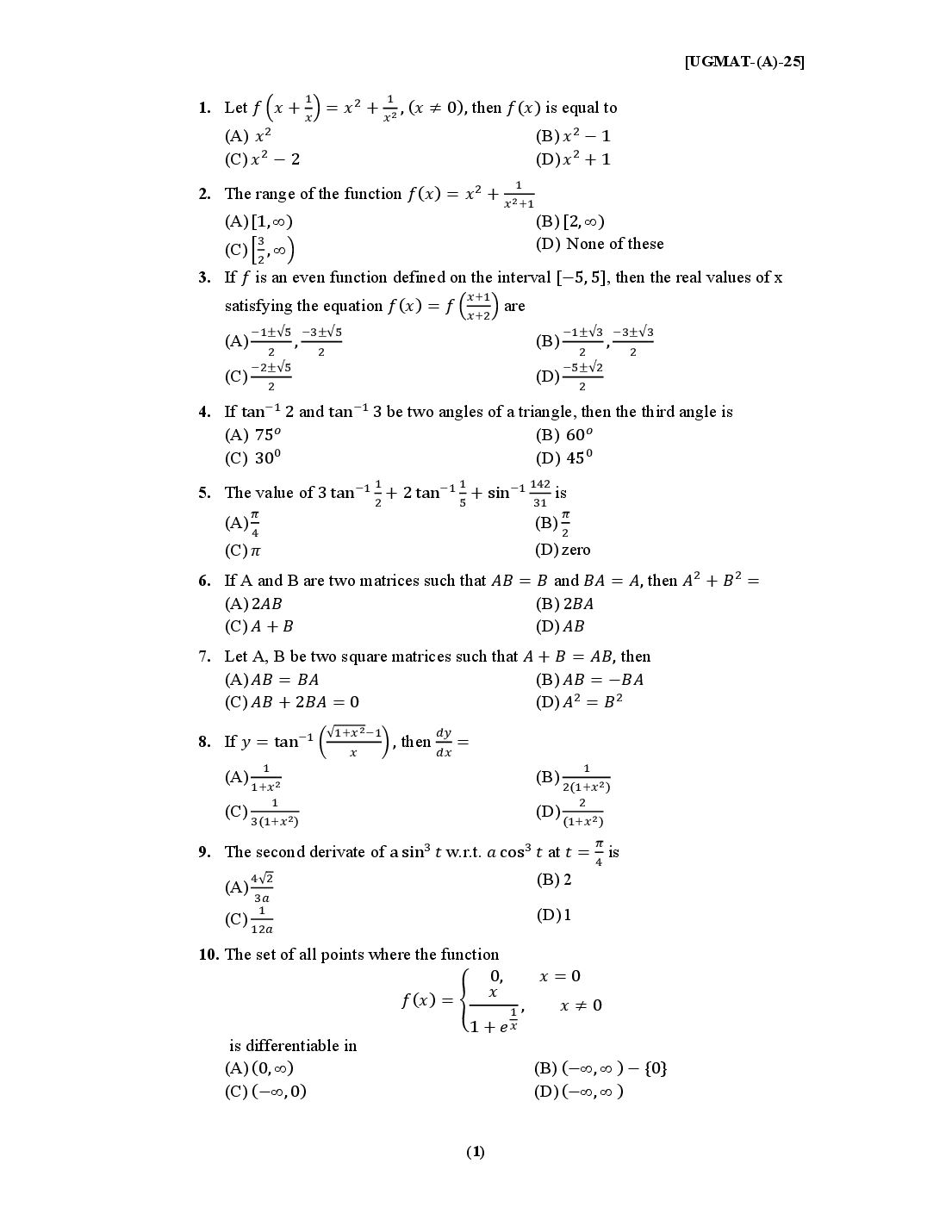
Page 1
(A) 𝑥 (B) 𝑥 − 1
(C) 𝑥 − 2 (D) 𝑥 + 1
2. The range of the function 𝑓(𝑥) = 𝑥 +
(A) [1, ∞) (B) [2, ∞)
(C) ,∞ (D) None of these
3. If 𝑓 is an even function defined on the interval [−5, 5], then the real values of x
satisfying the equation 𝑓 (𝑥 ) = 𝑓 are
±√ ±√ ±√ ±√
(A) , (B) ,
±√ ±√
(C) (D)
4. If tan 2 and tan 3 be two angles of a triangle, then the third angle is
(A) 75 (B) 60
(C) 30 (D) 45
5. The value of 3 tan + 2 tan + sin is
(A) (B)
(C) 𝜋 (D) zero
6. If A and B are two matrices such that 𝐴𝐵 = 𝐵 and 𝐵𝐴 = 𝐴, then 𝐴 + 𝐵 =
(A) 2𝐴𝐵 (B) 2𝐵𝐴
(C) 𝐴 + 𝐵 (D) 𝐴𝐵
7. Let A, B be two square matrices such that 𝐴 + 𝐵 = 𝐴𝐵, then
(A) 𝐴𝐵 = 𝐵𝐴 (B) 𝐴𝐵 = −𝐵𝐴
(C) 𝐴𝐵 + 2𝐵𝐴 = 0 (D) 𝐴 = 𝐵
√
8. If 𝑦 = tan , then =
(A) (B)
( )
(C) (D)
( ) ( )
9. The second derivate of a sin 𝑡 w.r.t. 𝑎 cos 𝑡 at 𝑡 = is
(A)
√ (B) 2
(C) (D) 1
10. The set of all points where the function
0, 𝑥=0
𝑓 (𝑥 ) = 𝑥
, 𝑥≠0
1+𝑒
is differentiable in
(A) (0, ∞) (B) (−∞, ∞ ) − {0}
(C) (−∞, 0) (D) (−∞, ∞ )
(1)
Page 2
(A) (B) tan √2
(C) tan 2√2 (D)
12. If 𝑎𝑥 + ≥ 𝑐 for all +ve x, where 𝑎, 𝑏 > 0, then
(A) 27𝑎𝑏 ≥ 4𝑐 (B) 27𝑎𝑏 < 4𝑐
(C) 4𝑎𝑏 ≥ 27𝑐 (D) 4𝑎𝑏 < 27𝑐
13. The two curves 𝑦 = 4𝑥 𝑎𝑛𝑑 𝑥 + 𝑦 − 6𝑥 + 1 = 0 at the point (1, 2)
(A) Intersect orthogonally (B) Intersect at angle
(C) Touch each other (D) None of these
14. ∫ =
(A) log 1 + cot +𝑐 (B) log 1 − cot +𝑐
(C) log 1 + tan +𝑐 (D) log 1 − tan +𝑐
15. ∫ =
(A) 1 (B) 2
(C) -1 (D) 0
16. The area of the region bounded by the curve 𝑦 = 2𝑦 − 𝑥 and the y-axis is
(A) sq. units (B) sq. units
(C) sq. units (D) sq. units
17. The area bounded by the curves 𝑦 = 𝑥 and 𝑦 = 𝑥 is
(A) 1 sq. units (B) sq. units
(C) 2 sq. units (D) 0 sq. units
18. The solution of = is
(A) 𝑦 = 𝐶𝑒 (B) 𝑦 = 𝐶𝑒
(D) None of these
(C) 𝑦 = 𝐶𝑒
19. Solution of 𝑥 = 𝑦 + 𝑥𝑦 + 𝑥 + 1 is
(A) 𝑦 + 1 = 𝐴𝑒 (B) 𝑦 + 1 = 𝐴𝑥𝑒
(C) 𝑥𝑒 = 𝐶 (D) 𝑦 + 𝑥𝑒 = 𝐶
20. The solution of (𝑦 log 𝑥 − 1)𝑦𝑑𝑥 = 𝑥 𝑑𝑦 is
(A) 𝑦(log(𝑒𝑥) + 𝑐𝑥) = 2 (B) 𝑦 = log(𝑒𝑥) + 𝑐𝑥
(C) 𝑦 = log(𝑒𝑥 ) − 𝑐𝑥 (D) None of these
21. If 𝑎⃗ + 𝑏⃗ = 𝑎⃗ − 𝑏⃗ , then angle between 𝑎⃗ and 𝑏⃗ is (𝑎⃗, 𝑏⃗ ≠ 0)
(A) (B)
(C) (D)
(2)
Page 3
(A) 0⃗ (B) 3𝐺𝐴⃗
(C) 3𝐺𝐵⃗ (D) 3𝐺𝐶⃗
23. If 𝜃 is the angle between 𝚤⃗ + 𝚥⃗ + 𝑘⃗ and 2𝚤⃗ − 𝚥⃗ + 2𝑘⃗ , then sin 𝜃 =
(A) (B)
√
√ √
(C) (D)
24. The equation of the plane containing the two lines
= = and = = is
(A) 8𝑥 + 𝑦 − 5𝑧 − 7 = 0 (B) 8𝑥 + 𝑦 + 5𝑧 − 7 = 0
(C) 8𝑥 − 𝑦 − 5𝑧 − 7 = 0 (D) 8𝑥 − 𝑦 − 5𝑧 + 7 = 0
25. The area of the triangle whose vertices are (1, 2, 3), (2, 5, −1) and (−1, 1, 2) is
(A) 150 sq. units (B) 145 sq. units
√ (D) sq. units
(C) sq. units
26. The projection of a line segment on the co-ordinate axes are 12, 4, 3 respectively.
The length of the line segment is
(A) 13 (B) 15
(C) 16 (D) 19
27. The objective function of a L.P.P. is
(A) A constraint (B) A function to be optimized
(C) A relation between the variables (D) None of these
28. The minimum value of 𝑃 = 3𝑥 + 𝑦 subject to 2𝑥 + 3𝑦 ≤ 6, 𝑥 + 𝑦 ≥ 1, 𝑥 ≥ 0,
𝑦 ≥ 0 is
(A) ½ (B) 0
(C) 1 (D) 2
29. Which of the following statements is correct?
(A) Every L.P.P admits an optimal (B) A L.P.P. admits a unique solution
solution
(C) If a L.P.P. admits two optimal (D) A L.P.P. admits two optimal
solutions, then it has an infinite solutions
number of optimal solutions
30. If A and B are two independent events such that
𝑃(𝐴̅ ∩ 𝐵 ) = 𝑎𝑛𝑑 𝑃(𝐴 ∩ 𝐵 ) = , then 𝑃(𝐵) =
(A) or (B) or
(C) ¼ or ¾ (D) or 1
31. In a binomial distribution, mean=5 and variance=4, then the number of trials is
(A) 4 (B) 5
(C) 16 (D) 25
(3)
Page 4
that the sum is divisible by 5 is
(A) 49/285 (B) 29/285
(C) 11/285 (D) 9/285
33. A card is drawn from a well shuffled pack of 52 cards. The probability that the
card is black or a club, is
(A) 1/3 (B) ¼
(C) ½ (D) 1/6
34. The number of values of k for which the linear equations
4𝑥 + 𝑘𝑦 + 2𝑧 = 0
𝑘𝑥 + 4𝑦 + 𝑧 = 0
2𝑥 + 2𝑦 + 𝑧 = 0
posses a non-zero solution is :
(A) 3 (B) 2
(C) 1 (D) 0
35. The coefficient of 𝑥 in the expression of (1 − 𝑥 − 𝑥 + 𝑥 ) is :
(A) 144 (B) -132
(C) -144 (D) 132
36. Let 𝑎 ≠ 𝑎 ≠ 0, 𝑓(𝑥 ) = 𝑎𝑥 + 𝑏𝑥 + 𝑐, 𝑔(𝑥 ) = 𝑎 𝑥 + 𝑏 𝑥 + 𝑐 and 𝑝(𝑥 ) =
𝑓 (𝑥 ) − 𝑔(𝑥). If 𝑝(𝑥) = 0 only for 𝑥 = −1 𝑎𝑛𝑑 𝑝(−2) = 2, then the value of
𝑝(2) is :
(A) 3 (B) 6
(C) 9 (D) 18
𝜔 0
37. If 𝜔 ≠ 1 is the complex cube root of unity and matrix 𝐻 = , then 𝐻 is
0 𝜔
equal to :
(A) H (B) 0
(C) –H (D) 𝐻
38. Let 𝛼, 𝛽 be the roots of 𝑥 − 6𝑥 − 2 = 0, with 𝛼 > 𝛽. If 𝑎 = 𝛼 − 𝛽 for 𝑛 ≥ 1,
then the value of is
(A) 1 (B) 2
(C) 3 (D) 4
39. The circle passing through the point (-1,0) and touching the y-axis at (0,2) also
passes through the point
(A) − , 0 (B) − , 2
(C) − , (D) (−4, 0)
40. A value of b for which the equations
𝑥 + 𝑏𝑥 − 1 = 0
𝑥 +𝑥+𝑏 =0
have one root in common is
(A) -√2 (B) – 𝑖√3
(C) 𝑖√5 (D) √2
(4)
Page 5
the greatest integer function, then f is :
(A) Discontinuous only at x=0. (B) Discontinuous only at non-zero
integral values of x.
(C) Continuous only at x=0. (D) Continuous for every real x.
42. If the line 2𝑥 + 𝑦 = 𝑘 passes through the point which divides the line segment
joining the points (1, 1) and (2, 4) in the ratio 3 : 2, then k equals :
(A) 5 (B) 6
(C) 11/5 (D) 29/5
43. Let P and Q be 3 × 3 matrices with 𝑃 ≠ 𝑄. If 𝑃 = 𝑄 𝑎𝑛𝑑 𝑃 𝑄 = 𝑄 𝑃, then the
determinant of (𝑃 + 𝑄 )is equal to :
(A) 1 (B) 0
(C) -1 (D) -2
44. The function 𝑓 ∶ [0, 3] → [1, 29], defined by 𝑓 (𝑥) = 2𝑥 − 15𝑥 + 36𝑥 + 1, is
(A) One-one and onto (B) Onto but not one-one
(C) One-one but not onto (D) Neither one-one nor onto
45. The slope of the normal to the curve 𝑦 = 2𝑥 + 3 sin 𝑥 𝑎𝑡 𝑥 = 0 is
(A) 3 (B) 1/3
(C) -3 (D) -1/3
46. The rectangle of maximum area that can be inscribed in a circle of radius 𝑎 is a
square of side :
(A) √2𝑎 (B)
√
(C) 2√2𝑎 (D)
√
47. For all real values of x, the minimum value of is
(A) 0 (B) 1
(C) 3 (D) 1/3
48. If 𝐴 = {1, 2, 3, 4, 5}, then the number of proper subsets of A is
(A) 120 (B) 30
(C) 31 (D) 32
49. If R is a relation on a finite set A having n elements, then the number of relations
on A is
(A) 2 (B) 2
(C) 𝑛 (D) 𝑛
50. The range of the function 𝑓(𝑥) = | | is
(A) 𝑅 − {0} (B) 𝑅— {−1, 1}
(C) {−1, 1} (D) 𝑅 − {1}
51. If tan 𝜃 + sec 𝜃 = 𝑒 , then cos 𝜃 equals
(A) (B)
(C) (D)
(5)
Page 6
2 sin 𝜃 + √3 cos 𝜃 + 1 = 0 is
(A) (B)
(C) (D)
53. The least positive integer n such that is a positive integer, is
(A) 16 (B) 8
(C) 4 (D) 2
54. The amplitude of is equal to
(A) 1 (B)
(C) − (D) 𝜋
55. In the expansion of 2𝑥 − , the term without x is
(A) 7920 (B) -7920
(C) 495 (D) -495
56. If the first, second and last term of an A.P. are a, b and 2a respectively, then its
sum is
(A) ( )
(B)
(C) (D)
( )
57. If second term of a G.P. is 2 and sum of its infinite terms is 8, then its first term is
(A) ¼ (B) ½
(C) 2 (D) 4
58. The centroid of a triangle is (2, 7) and two of its vertices are (4, 8) and (-2, 6). The
third vertex is
(A) (0, 0) (B) (4, 7)
(C) (7, 4) (D) (7, 7)
59. The circle 𝑥 + 𝑦 + 2𝑔𝑥 + 2𝑓𝑦 + 𝑐 = 0 does not intersect x-axis, if
(A) 𝑔 > 𝑐 (B) 𝑔 < 𝑐
(C) 𝑔 > 2𝑐 (D) 𝑔 < 𝑐
60. In a three dimensional space the equation 𝑥 − 5𝑥 + 6 = 0 represents
(A) Points (B) Planes
(C) curves (D) pair of straight lines
x-x-x
[ROUGH WORK]
(6)
Page 7
(7)
Page 8
(8)
Page 9
(9)
Page 10
(10)
Document Details
| Board / Org | Panjab University |
| Exam | PUCET |
| Type | Question Paper |
| Pages | 10 |
| Updated | 24 Sep 2026 |