Rajasthan Board Class 12 Question Paper 2020 Mathematics
Finished viewing? Save it for later —
Download Rajasthan Board Class 12 Question Paper 2020 Mathematics (PDF · 8 pages)About Rajasthan Board Class 12 Question Paper 2020 Mathematics
Rajasthan Board Class 12 Question Paper 2020 Mathematics is available here for free download. Published by Rajasthan Board for Class 12, this question paper can be viewed online or downloaded as a PDF (8 pages). Candidates preparing for Class 12 can use Rajasthan Board Class 12 Question Paper 2020 Mathematics to understand the exam pattern, the type of questions asked, and the overall difficulty level.
Frequently Asked Questions
How can I download Rajasthan Board Class 12 Question Paper 2020 Mathematics?
Open this page and click the Download button to save Rajasthan Board Class 12 Question Paper 2020 Mathematics as a PDF. It is completely free on AglaSem Docs.
Is Rajasthan Board Class 12 Question Paper 2020 Mathematics free to download?
Yes. Rajasthan Board Class 12 Question Paper 2020 Mathematics can be viewed online and downloaded as a PDF free of cost on AglaSem Docs.
How many pages does Rajasthan Board Class 12 Question Paper 2020 Mathematics have?
Rajasthan Board Class 12 Question Paper 2020 Mathematics contains 8 pages, which you can read online or download together as a single PDF.
Where can I find more Class 12 study material?
You can find more Class 12 question papers, sample papers, syllabus, and answer keys on AglaSem Docs.
Rajasthan Board Class 12 Question Paper 2020 Mathematics – Text
Read the full text of this question paper below — useful to quickly search, copy and reference the content online without downloading the PDF.
📄 View text version (8 pages)
Page 1
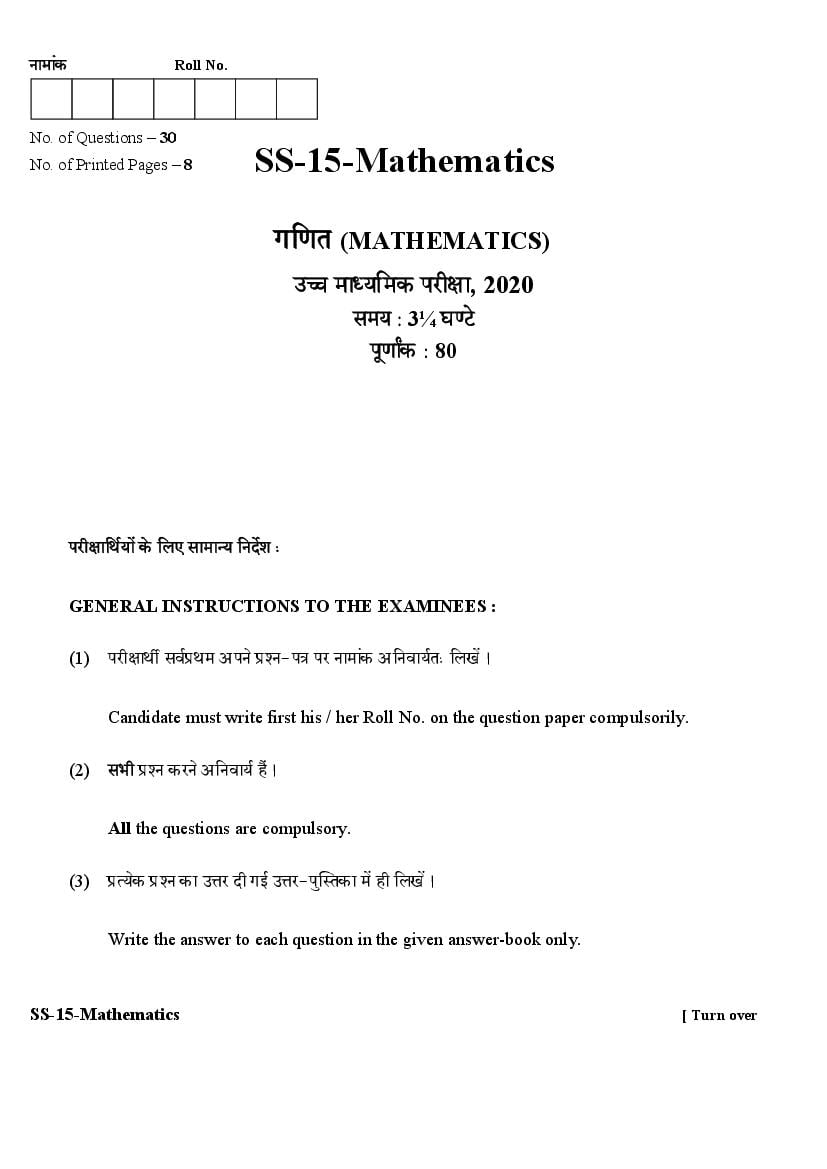
No. of Questions – 30
No. of Printed Pages – 8 SS-15-Mathematics
(MATHEMATICS)
, 2020
3¼
80
GENERAL INSTRUCTIONS TO THE EXAMINEES :
(1) -
Candidate must write first his / her Roll No. on the question paper compulsorily.
(2)
All the questions are compulsory.
(3) -
Write the answer to each question in the given answer-book only.
SS-15-Mathematics [ Turn over
Page 2
(4) ,
For questions having more than one part, the answers to those parts are to be written
together in continuity.
(5) -
//
If there is any error / difference / contradiction in Hindi & English versions of the
question paper, the question of Hindi version should be treated valid.
(6)
1 – 10 1
11 – 15 2
16 – 25 3
26 – 30 6
Section Q. Nos. Marks per question
A 1 – 10 1
B 11 – 15 2
C 16 – 25 3
D 26 – 30 6
(7) 25
Draw the graph of Q. No. 25 on the graph paper.
Page 3
–
SECTION – A
1. f : R R, f(x) = x2 + 5x + 9 , f –1 (8) f –1(9)
If f : R R, f(x) = x2 + 5x + 9, then find the value of f –1 (8) and f –1(9).
2. 2 tan (tan–1 x + tan–1 x3)
Find the value of 2 tan (tan–1 x + tan–1 x3 ).
k+4 –1 a –1
3.
=
, a
3 k–6 3 –4
k+4 –1 a –1
If
=
, then find the value of a.
3 k–6 3 –4
4.
Define singular and Non-singular matrix.
5. (–1, 1) f(x) = x2 – x + 1
Prove that in interval (–1, 1) function f(x) = x2 – x + 1 is neither increasing nor decreasing.
. 1
6. dx
. 1 + sin x
. 1
Find . dx.
1 + sin x
7. (2^i – 3^j + 4k^) (3^i + 4^j – 4k^)
Find the value of (2^i – 3^j + 4k^) (3^i + 4^j – 4k^).
SS-15-Mathematics [ Turn over
Page 4
8. A(2, 3, 4), B(–1, 2, –3) C(– 4, 1, –10)
Show that the points A(2, 3, 4), B(–1, 2, –3) and C (– 4, 1, –10) are Collinear.
9.
Define the feasible solution of the Linear programming problem.
6 5 7
10. P(A) = , P(B) = P(A B) = , P(A B)
11 11 11
If P(A) = 6/11, P(B) = 5/11 and P(A B) = 7/11, then find P(A B).
-
SECTION – B
11. f g (gof) (gof)–1
(gof)–1 = f –1og–1.
If f and g are one-one onto function such that composite function (gof) and (gof)–1 are
defined, then show that (gof)–1 = f –1og–1.
–1 –2 3
12. A – 2I = 2 1 –1 , AAT , I, 3 3
–3 1 0
–1 –2 3
If A – 2I = 2 1 –1 , then find AAT, where I is unit matrix of order 3 3.
–3 1 0
2x + 5
13. x
(x2 + 3x + 1)
2x + 5
Integrate with respect to x.
(x2 + 3x + 1)
Page 5
dy
14. y = log x + log x + log x + .... , dx
dy .
If y = log x + log x + log x + .... , then find
dx
15. 2x2 – y2 = 14 x + 3y = 6
Find the equation of the normals to the curve 2x2 – y2 = 14 which are parallel to the line
x + 3y = 6.
–
SECTION – C
16.
sin–1 x + sin–1 2x =
3
Solve the following trigonometrical equation :
sin–1 x + sin–1 2x = .
3
1+a 1 1
17.
1 1+b 1 = abc 1 + + +
1 1 1
a b c
1 1 1+c
1+a 1 1
Prove that
1 1+b 1 = abc 1 + + + .
1 1 1
a b c
1 1 1+c
18.
3 0 3 x 8 2y
2 1 0 y = 1 + z
4 0 2 z 4 3y
Solve the following system of equations :
3 0 3 x 8 2y
2 1 0 y = 1 + z
4 0 2 z 4 3y
SS-15-Mathematics [ Turn over
Page 6
x
19. cos– 1 x
a + x
x
Integrate cos– 1 with respect to x.
a + x
20. y2 = 4ax x2 = 4by
Find the area of the region enclosed between the two Parabolas y2 = 4ax and x2 = 4by.
21. x2 + y2 = 32 y = x x-
Find the area of the region in the First quadrant enclosed by the x-axis, the line y = x and
the circle x2 + y2 = 32.
dy
22. dx + (2x tan–1y – x3) (1 + y2) = 0
dy
Solve : + (2x tan–1y – x3) ( 1 + y2) = 0.
dx
dy
23. (1 + y2) + (x – etan–1 y) dx = 0.
–1 y dy
Solve : (1 + y2) + (x – etan ) = 0.
dx
24. tan–1 2
Show that the semi vertical angle of a cone of maximum volume and given slant height is
tan–1 2.
25.
z = 2x + 3y
4x + 6y 60
2x + y 20
x 0, y 0
Solve the following Linear Programming problem by graphical method :
Max z = 2x + 3y
Constraints 4x + 6y 60
2x + y 20
and x 0, y 0
Page 7
–
SECTION – D
26. f(x) = | x – 1 | + 2| x – 2 | + 3| x – 3 | x = 1, 2, 3
Examine the continuity and differentiability of the function f(x) = | x – 1 | + 2 | x – 2 | + 3 | x – 3 |
at point x = 1, 2, 3.
. 1
27. I =
log (1 + cos x) dx = loge
. 2
0
Prove that :
. 1
I = .log (1 + cos x) dx = loge .
2
0
28.
(i) [ a + b b + c c + a ] = 2[ a b c ]
(ii) [( a b ) ( b c ) ( c a )] = [ a b c ]2
Prove that :
(i) [ a + b b + c c + a ] = 2[ a b c ]
(ii) [( a b ) ( b c ) ( c a )] = [ a b c ]2
29. :
x–3 y–4 z+1 x–1 y–3 z–1
(i)
2
=
1
=
–3
–1
=
3
=
2
.
^
(ii) r = ^i + 2^j – 4k^ + (2^i + 3^j + 6k) r = 3^i + 3^j – 5k^ + (2^i + 3^j + 6k)
^
Find the shortest distance between the following pair of lines :
x–3 y–4 z+1 x–1 y–3 z–1
(i) = = and = = .
2 1 –3 –1 3 2
^ and
(ii) r = ^i + 2^j – 4k^ + (2^i + 3^j + 6k) r = 3^i + 3^j – 5k^ + (2^i + 3^j + 6k)
^
SS-15-Mathematics [ Turn over
Page 8
30. 5 3
1
1
A man is known to speak the truth 3 out of 5 times. He throw a die and reports that it is
‘1’. Find the probability that it is actually 1.
____________
Document Details
| Board / Org | Rajasthan Board |
| Exam | Class 12 |
| Type | Question Paper |
| Pages | 8 |
| Updated | 22 Jul 2026 |