Finished viewing? Save it for later —
Download MBOSE Class 9 Syllabus (PDF · 39 pages)About MBOSE Class 9 Syllabus
MBOSE Class 9 Syllabus is available here for free download. Published by Meghalaya Board for Class 9, this syllabus can be viewed online or downloaded as a PDF (39 pages). Candidates preparing for Class 9 can use MBOSE Class 9 Syllabus to understand the exam pattern, the type of questions asked, and the overall difficulty level.
Frequently Asked Questions
How can I download MBOSE Class 9 Syllabus?
Open this page and click the Download button to save MBOSE Class 9 Syllabus as a PDF. It is completely free on AglaSem Docs.
Is MBOSE Class 9 Syllabus free to download?
Yes. MBOSE Class 9 Syllabus can be viewed online and downloaded as a PDF free of cost on AglaSem Docs.
How many pages does MBOSE Class 9 Syllabus have?
MBOSE Class 9 Syllabus contains 39 pages, which you can read online or download together as a single PDF.
Where can I find more Class 9 study material?
You can find more Class 9 question papers, sample papers, syllabus, and answer keys on AglaSem Docs.
MBOSE Class 9 Syllabus – Text
Read the full text of this syllabus below — useful to quickly search, copy and reference the content online without downloading the PDF.
📄 View text version (39 pages)
Page 1
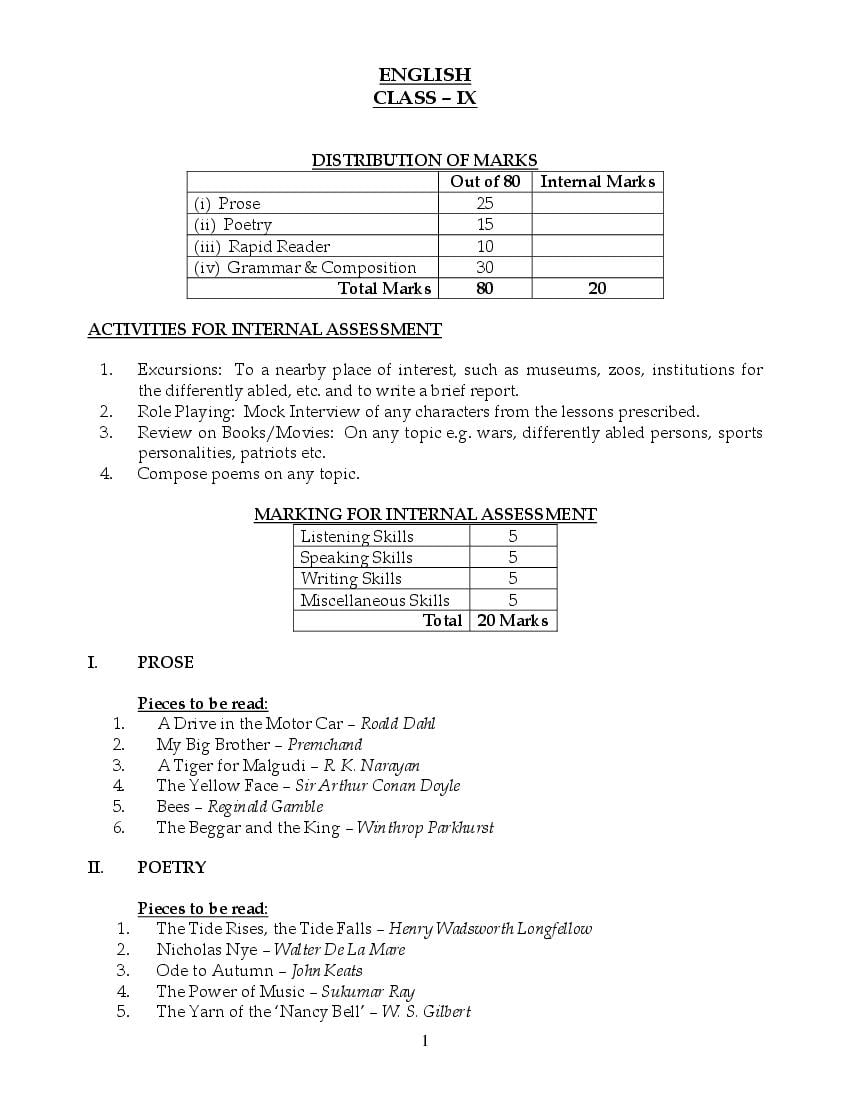
CLASS – IX
DISTRIBUTION OF MARKS
Out of 80 Internal Marks
(i) Prose 25
(ii) Poetry 15
(iii) Rapid Reader 10
(iv) Grammar & Composition 30
Total Marks 80 20
ACTIVITIES FOR INTERNAL ASSESSMENT
1. Excursions: To a nearby place of interest, such as museums, zoos, institutions for
the differently abled, etc. and to write a brief report.
2. Role Playing: Mock Interview of any characters from the lessons prescribed.
3. Review on Books/Movies: On any topic e.g. wars, differently abled persons, sports
personalities, patriots etc.
4. Compose poems on any topic.
MARKING FOR INTERNAL ASSESSMENT
Listening Skills 5
Speaking Skills 5
Writing Skills 5
Miscellaneous Skills 5
Total 20 Marks
I. PROSE
Pieces to be read:
1. A Drive in the Motor Car – Roald Dahl
2. My Big Brother – Premchand
3. A Tiger for Malgudi – R. K. Narayan
4. The Yellow Face – Sir Arthur Conan Doyle
5. Bees – Reginald Gamble
6. The Beggar and the King – Winthrop Parkhurst
II. POETRY
Pieces to be read:
1. The Tide Rises, the Tide Falls – Henry Wadsworth Longfellow
2. Nicholas Nye – Walter De La Mare
3. Ode to Autumn – John Keats
4. The Power of Music – Sukumar Ray
5. The Yarn of the ‘Nancy Bell’ – W. S. Gilbert
1
Page 2
- Adventures of Tom Sawyer
IV. GRAMMAR & COMPOSITION
Contents:
1. Subject – Verb Concord
2. Reported Speech
3. Transformation of Sentences (Easy Transformation)
i) Sentences with adverb ‘too’
ii) Interchange of degrees of comparison
iii) Interchange of affirmative and negative
iv) Interrogative into assertive and vice versa
v) Interchange of exclamatory and assertive sentences
4. Phrasal Idioms
5. Notice Writing
6. Newspaper report
7. Editing – Errors; Omissions; Short paragraphs
8. Comprehension
9. Essay/Letter Writing
PRESCRIBED TEXTBOOKS:
1. Prose & Poetry
- Reading Circle - IX
M/S Oxford University Press, Pragjyotish Apartment (1st Floor),
M. Tayabullah Road, Dighali Pukhuri (East), Guwahati – 781001.
2. Rapid Reader
- Adventures of Tom Sawyer
M/S Macmillan India Ltd., S. C. Goswami Road, Pan Bazar,
Guwahati – 781001.
3. Grammar & Composition
- Functional English Grammar & Composition
M/S Laxmi Publications Pvt. Ltd., Hemsen Complex, M. D. Shah, Paltan
Bazar, Guwahati – 781008.
*******
2
Page 3
CLASS – IX
DISTRIBUTION OF MARKS
Out of 80 Internal Marks
(i) Prose 22
(ii) Poetry 16
(iii) Play 15
(iv) Composition 19
(v) Essay 08
Total Marks 80 20
MARKING FOR INTERNAL ASSESSMENT
(i) Listening and Reading: 5 marks
Eg. Audio clips, newspaper reading, poetry reading and
review, vocabulary (spelling and pronunciation).
(ii) Writing: 10 marks
Eg. Story or picture composition, reports, dialogue
writing, autobiography, biography, note making, diary
writing, argumentative essays.
(iii) Creative Activities/Assignments: 5 marks
Eg. Advertisements, Quotable quotes, Mock Interview,
Slogan Writing, Book review, poster designing,
extempore speech, debate, enacting plays, designing
greeting cards, public speaking, autograph book, self
composed songs or poems.
I. PROSE
Pieces to be read:
1. The Liar – Mulk Raj Anand
2. The Night the Bed Fell – James Thurber
3. Jenny – Victor Hugo
4. The Umbrella Man – Roald Dahl
5. Self-made Men – Stephen Leacock
II. POETRY
Pieces to be read:
1. Our Casuarina Tree – Toru Dutt
2. From Auguries of Innocence – William Blake
3. Strange Meeting – Wilfred Owen
4. The Forsaken Merman – Mathew Arnold
5. A Satirical Elegy on the Death of a Late Famous General – Jonathan Swift
3
Page 4
- The Tempest
IV. COMPOSITION
Contents:
1. One Word Substitution
2. Amplification
3. Substance Writing
4. Paraphrasing
5. Advertisement
6. Picture Composition
PRESCRIBED TEXTBOOKS:
1. Prose
- A Miscellany of Short Stories
M/S Inter University Press Pvt. Ltd., Educational Publishers, 30/7, Shakti
Nagar, New Delhi - 110007.
2. Poetry
- Wings of Poesy
M/S Evergreen Publications, 4779/23, Ansari Road, Darya Ganj,
New Delhi - 110002.
3. Play
- The Tempest
M/s Macmillan India Ltd., S. C. Goswami Road, Pan Bazar,
Guwahati – 781001.
4. Composition
- Holy Faith Essential English Grammar & Composition
M/s Holy Faith International (P) Ltd., Hem Baruah Road, Pan Bazar,
Guwahati – 781001.
******
4
Page 5
CLASS – IX
DISTRIBUTION OF MARKS
Prose 20
Poetry 15
Rapid Reader 15
Grammar 10
Composition 10
Essay 10
Total Marks 80
MARKING FOR INTERNAL ASSESSMENT
1. Activities
a. Extempore speech/prepared speech
b. A Report on a few Harvest Festivals observed in 10 marks
Meghalaya
c. Write-up on experience of a journey
d. Critical review of any poem from the prescribed
lesson
2. Prepared Speech: (From Textbook) 5 marks
3. Recitation of Poem: Poem should be selected from the 5 marks
textbook.
Total 20 marks
I. PROSE
Pieces to be read:
1. Anyar prati byabohar – Satya Nath Borah
2. Mukti – Lakkhi Nath Bezbarua
3. Samay – Nilmoni Phukan
4. Bharatar baichitra majot aikya – Dr. Hemanta Kr. Sharma
II. POETRY
Pieces to be read:
1. Sisuleela – Srimanta Sankardeb
2. Manab Bandana – Chandra Kumar Agarwala
3. Prachanda dhulumai Prasna Korile mok – Dr. Bhupen Hazarika
4. Mor des – Hiren Bhattacharya
III. RAPID READER
- Mur Saisab, Mur Kaisor by Bhobendra Nath Saikia
5
Page 6
Pieces to be read:
Sandhi
Karok
Nattwa Bidhi, Shattwa Bidhi
Pad Prakaran
Nama Dhatu
Samasa (Danda Samasa, Tatpurus Samasa, Karmadharay Samasa)
V. COMPOSITION
Pieces to be read:
1. Make sentences with Phrases and Idioms
2. Opposite words
3. One word for a group of words
4. Similar words, having different meanings
5. Amplification
6. Letter writing
VI. ESSAY WRITING
Types of Essay:
Adarsha Mulak
Bhraman Mulak
Jibani Mulak
Barnana Mulak
PRESCRIBED TEXTBOOK:
1. Prose and Poetry
- Sahitya Subah for Class IX & X
- SEBA.
2. Composition
a) Rachana Bichitra – D. S. Deka
b) Prabeshika Rachana Shiksha – G. Sharma
c) Assamiya Rachna Shiksha – Dr. L. Gogoi, Dr. N. Sharma
3. Grammar
- Adhunik Assamiya Bhaskar Vyakaran by G. Sharma
Assam State Textbook Production & Publication.
*********
6
Page 7
CLASS – IX
DISTRIBUTION OF MARKS
Prose 16
Poetry 12
Rapid Reader 12
Grammar 24
Composition 16
Total Marks 80
MARKING FOR INTERNAL ASSESSMENT
1. A Project work or assignment 10 marks
2. A viva voce on the home assignment submitted 5 marks
3. A viva voce on any assigned topic 5 marks
Total 20 marks
I. PROSE
Pieces to be read:
1. Pitrisneha – by Dwijendralal Roy
2. Chhuti – by Rabindranath Tagore
3. Jagroto Devota – by Banaphool
II. POETRY
Pieces to be read:
1. Dhulamandir – by Rabindranath Tagore
2. Kabar – by Jasimuddin
3. Manasa Mangal – by Shaktipada Brahmachari
III. RAPID READER
- Ramer Sumati by Sharatchandra Chottopadhyay
IV. GRAMMAR
Pieces to be read:
1. Shabdo Bandar
2. Uposarga o Anusarga
3. Samas o tar chhoyti prokar bhed
4. Ek kothay prokash
5. Baagdhara
6. Ashuddhi Sansodhan
7
Page 8
Pieces to be read:
1. Bhaab Samprasaron
2. Prabandho Rachana
PRESCRIBED TEXTBOOKS:
1. Sahitya Sourav – IX
- M/S Assam State Textbook Production & Publication Corporation Ltd.,
Guwahati.
2. Bani Bichitra (Class VIII – XII) by Piyush Dey
********
8
Page 9
CLASS – IX
DISTRIBUTION OF MARKS
Prose 25
Poetry 18
Rapid Reader 10
Grammar 10
Composition 7
Essay/Comprehension 10
Total Marks 80
MARKING FOR INTERNAL ASSESSMENT
Writing skills: story writing, picture composition, Life of 10 marks
the poet or author
Listening & Reading: Reading, Spelling & Dictations, 5 marks
Phonetics
Creativity: Extempore, slogan writing, chart making base 5 marks
on the lesson, Group discussions
Total 20 marks
I. PROSE
Pieces to be read:
1. Capt. Williamson A. Sangma – Mary Celina A. Sangma
2. Ta∙sek Wari – John P. Marak
3. A∙chikrangni Kal∙susaanirang – Tharsush K. Sangma
4. Lindrid D. Shirani Janggi Tangani – Venibabe N. Sangma
5. A∙chikrangni Ganding Chinding aro Gipin Patanirang – Llewellyn R. Marak
II. POETRY
Pieces to be read:
1. A∙chik A∙song – Harendra W. Marak
2. A∙gilsak Dal∙begipa Alda Nok – Jarongpang Rongmuthu
3. Nokgipani Pattia – Phoebe W. Momin
4. A∙songtangna Sintea – Surendra S. Marak
5. Somoi aro Kam – Bemfield K. Sangma
III. RAPID READER
- Veniceni Badinggipa by Mackenson Rongmuthu
9
Page 10
Pieces to be read:
Sentence aro uni bakrang
1. Sentence
2. Subject aro Predicate
3. Noun, Pronoun, Verb
4. Subject Noun, Predicate Verb aro Object
5. Talatgipa Kattarang – Adjective, Adverb
6. Preposition, Conjunction aro Interjection
7. Sentenceni Ma∙arang
Bak – III
Kattarang (Ma∙arang aro Bimungrang)
1. Kattarangni Ma∙arang
2. Noun: Ma∙arang, Person, Number, Gender aro Case
3. Sentenceo Caserangni Kam
4. Pronoun - Ma∙arang, Person, Number, Gender aro Case
Bak – IV
Punctuation aro Punctuation Ka∙ani Niamrang
Recommended Textbook:
- A·chik Grammar – E. G. Philips
V. A∙CHIK COMPOSITION
- A∙chik Composition – K. M. Momin
PRESCRIBED TEXTBOOKS:
1. Prose & Poetry
- Poraiani Ki·tap IX
- Tura Book Room, Tura, Meghalaya.
********
10
Page 11
CLASS – IX
DISTRIBUTION OF MARKS
Prose 20 marks
Poetry 20 marks
Rapid Reader 15 marks
Grammar 17 marks
Composition
(a) Essay 08 marks
Total 80 marks
MARKING FOR INTERNAL ASSESSMENT
1. Home assignment (Life history of any writer) in own 07 marks
handwriting
2. Dictation 04 marks
3. Reading 04 marks
4. Spelling 05 marks
Total 20 marks
I. PROSE
Pieces to be read:
1. Mantra-Tantra – by Hajari Prasad Dwebedi
2. Pashchatap – by Premchand
3. Dr. Bhim Rao Ambedkar – by Niranjan Kr. Singh
4. Kitna Badla Mera Gaon – by Mansingh Verma
5. Jeeta Kaun – by Satyaprakash Agarwal “Umang”
6. Ganitagya Jyotishi Aryabhatt - by Gunakar Mule
II. POETRY
Pieces to be read:
1. Hamen Sirjan Ki Shakti Dena – by Mansingh Verma
2. Dekho Kitni Pyari Maa – by Ram Gopal Bharatiya
3. Jhansi Ki Rani – by Ramdhari Singh Dinkar
4. Doha-Ekadash – by Kabir Rahim
5. Muktee Ki Aakansha – by Sarweshwar Dayal Saxena
III. RAPID READER
- Sanchayan (NCERT) Part-I
11
Page 12
Pieces to be read:
1. Varna-Vichar
2. Vartani
3. Sandhi-Swar Sandhiya
4. Sabdo Ke Bhed
5. Padh Vichar Aur Un Palo Ke Bhed (A)
6. Ling Aur Bachan
7. Karak Aur Ruprachana
8. Samas (A)
9. Upasarga; Pratyay
10. Sabdh Rachana
11. Vakya, Upvakya Aur Unke Bhed
12. Vakya-Parivartan
13. Viramchinha
14. Lokoktiya
Composition
1. Patra Lekhan (letter-writing)
2. Nibandh Lekhan (essay) (Hamare Gaon – Sainik Ki Atma Katha)
PRESCRIBED TEXTBOOKS:
1. Deepshika Hindi – Class IX
– M/S Arya Publishing Company, 1002-1003, Faiz Road, Karol Bagh, New Delhi –
110005.
2. Bhasha Vyakaran IX & X
– M/S Neeta Prakashan, A-4, Ring Road, South Extension-1, New Delhi – 110049.
3. (i) Learn Hindi – Learn Khasi (Dictionary)
(ii) Learn Hindi – Learn Garo (Dictionary)
– M/S Gewali Publication, Upper Mawprem, Shillong – 2.
4. Rapid Reader – Sanchayan (NCERT) Part-I.
12
Page 13
CLASS – IX
DISTRIBUTION OF MARKS
Prose 24 marks
Poetry 14 marks
Rapid Reader 14 marks
Grammar & Composition 28 marks
Total 80 marks
MARKING FOR INTERNAL ASSESSMENT
1. Poetry- Text- Ka Duitara Ksiar - U Soso Tham 6 marks
Recitation Individual, poetry writing.
2. Prose-Text- (i) Ki Dienjat Jong Ki Longshuwa – Fr. J. Bacchiarello 10 marks
(ii) Ki Phawer U Aesop - Soso Tham
(iii) Ki Jingsneng Tymmen-Part I - Radhon Sing Berry
Poster Designing, Story writing, Extempore, Elocution, Study Tour,
Social Activities on any related topics, One act play.
3. Rapid Reader – Text- Na Mihngi Sepngi - Fr. H Elias 2 marks
Take photographs related to topics, Study Tour, Designing Greeting Cards on
related topics.
4. Grammar And Composition- Text- Hints On The Study Of Khasi Language 2 marks
- D. Nissor Sing Wahlang
Paste collection of pictures depicting the different kinds of Pronoun.
N.B.: Scrap book on any activities done and cover will add to the weightage of marks.
TOTAL 20 marks
I. PROSE
Pieces to be read:
1. Ka Jingiasiatthong
2. Ka Mei Ramew Bad Ki Laiphew Jingthaw
3. Ki Samla Bad Ki Drok
II. POETRY
Pieces to be read:
1. U Khlur
2. Ki Khun Ka Mariang
3. Ki Saw Aiom
4. U Lok Shisha
III. KI PHAWER U AESOP
Lynnong: 31-40
IV. KI JINGSNENG TYMMEN (PART-I)
13
Page 14
V. RAPID READER
Pieces to be read:
1. Ka Jingrep Slasha
2. Ka Unibersiti Barim Ka Ri India
3. Ka Jingsngewtynnad Ka Jingpulekot
VI. GRAMMAR, COMPOSITION & ESSAY
1. The Pronouns
a. The Personal Pronoun
b. The Reflexive Pronoun
c. The Relative Pronoun
The Compound Relative Pronoun
d. The Interrogative Pronoun
e. The Demonstrative Pronoun
f. The Indefinite Pronoun
g. The Distributive Pronoun
Syntactical Rules on the Pronouns of Different persons
2. Adverbs and words with which they are used.
From Alphabet ‘A’ to ‘L’ – Page 70 to 76
3. Essay
4. Precis Writing
PRESCRIBED TEXTBOOKS:
1. Prose
- Ki Dienjat Jong Ki Longshuwa – J. Bacchiarello
- Ki Phawer U Aesop – Soso Tham
- Ki Jingsneng Tymmen (Part-I) – Radhon Sing Berry
2. Poetry
- Ka Duitara Ksiar – Soso Tham
3. Rapid Reader
- Na Mihngi Sepngi – H. Elias
4. Grammar & Composition
- Hints on the Study of Khasi Language – Ri Khasi Publication, Mawkhar,
Shillong – 793001.
********
14
Page 15
CLASS – IX
DISTRIBUTION OF MARKS
Hla (Poetry) 20 marks
Thu (Prose) 25 marks
Mizo Grammar 15 marks
Lemchan (Drama) 10 marks
Thawnthu tawi (Rapid Reader) 10 marks
Total 80 marks
MARKING FOR INTERNAL ASSESSMENT
1. Writing skill – Project work, home assignment, 10 marks
composition, amplification, story writing.
2. Listening and Reading skill – Dictation, Recitation, 10 marks
News reading, extempore debating.
Total 20 marks
I. THU (PROSE)
Pieces to be read:
1. A lem leh a tak – Vanneihtluanga
2. Mihring dikna leh chanvo – Lalhmunmawia
3. Tlawmngaihna leh aia upa zah – R. Lalrawna
4. Huaina – R. H. Rokunga
5. Rilru puitling – H. Ngurthansanga
6. Incheina – P. L. Liandinga
7. Mahni inhneh – Lalzuia Colney
8. Sumdawnna – Lalrochuanga Pachuau
9. Chhiatni thatni – Thanpuii pa
10. Nungchate leh zofate – B. Lalthangliana
11. Lungawina – James Dokhuma
II. HLA (POETRY)
Pieces to be read:
1. A saw raltiang tlangah – Lalmama
2. Hrinhniang an liamna thlafam khua chu e – Saihnuna
3. Ka pian ka seilenna ram – Rokunga
4. Kan zoram nuam – Hranghnuna
5. Lam ang ka lo let leh ta e – F. Rokima
6. Min then lul suh – Lalzova
7. Buannel – R. L. Thanmawia
8. Sem sem dam dam – B. Bawlkhuma
9. Luah loh run – Zirsangzela Hnamte
15
Page 16
III. MIZO GRAMMAR
1. Noun
2. Pronoun
3. Chhinchhiahna (Punctuation)
4. Mizo tawng ziah dan (Ziah zawm tur chi te)
5. Tawng Upa
IV. LEMCHAN (DRAMA)
Lungrem a chim – Liansailova
V. THAWNTHU TAWI (RAPID READER)
Pathian Samsuih – Rev. Zokima
PRESCRIBED TEXTBOOK:
- Mizo (Pawl Kaw Zirlai Bu) – MBSE Publication
*********
16
Page 17
CLASS – IX
DISTRIBUTION OF MARKS
Prose 30 marks
Poetry 18 marks
Rapid Reader 10 marks
Grammar & Composition 22 marks
Total 80 marks
MARKING FOR INTERNAL ASSESSMENT
1. Reading Recitation, Dictation, Extempore speech, 05 marks
Elocution
2. Home assignment – self composed poem or to write 10 marks
the life story of any poet or author
3. Project Work -
a) To develop the story from the given picture (visual
clue) 05 marks
b) Slogan writing
c) Chart making on the basis of Lessons (Paste Pictures
and Drawings)
Total 20 marks
I. PROSE
Pieces to be read:
1. Bhavishya Nirman
2. Nisha
3. Kartavya
4. Upahaar
5. Hargovind Khurana
6. Gandhi.
II. POETRY
Pieces to be read:
1. Timi Ujyalo Parkhirahu
2. Aama
3. Jeevan: Ek Drishti
4. Shraddhanjali
5. Kaviprati
6. Mrityu: Kamana Kehi Mera
17
Page 18
- ‘Mane’ by Subhash Darjeeling
IV. GRAMMAR & COMPOSITION
Pieces to be read:
Part I Descriptive Grammar
1. Essay Writing (Nibandha Lekhan)
2. Letter Writing (Patra Lekhan)
3. Paragraph Writing (Anuchhed Lekhan)
4. Comprehension (Bodh Pranali)
5. Amplification (Vistritikaran)
6. Precis Writing (Saransa Lekhan or Sanchhepikaran)
Part II Objective Grammar - 15 marks
1. Linga, Sangya, Sarvanam, Sandhi, Visheshan
2. Kriya, Kaal, Dhatu Ra Pratyay, Vachya
3. Ukhan, Tukka Ra Vakyansha
4. Viparitarthak Shabda, Sammocharit Shabda, Prayayvachi Shabda, Sar Shabda
(one word for many), Chinha Prayog (Punctuation)
PRESCRIBED TEXTBOOKS:
1. Prose & Poetry:
- Madhyamik Nepali Sahitya Bhag V
edited by Dr. Tek Narayan Upadhaya
2. Rapid Reader
- ‘Mane’ by Subhash, Darjeeling
3. Grammar & Composition
(i) Madhhyamik Nepali Vyakaran Ra Rachana
Written & Compiled By the Expert Academicians
Published by Shri Raaj Prakashan, Darjeeling
OR
(ii) Vyakaran Saurabh (Chautho Bhaag) (PART – IV)
Written by Vishnu Sharma Adhikari
Published by Puspa Prakashan, Siliguri.
********
18
Page 19
CLASS – IX
DISTRIBUTION OF MARKS
Prose 25 marks
Poetry 15 marks
Grammar 15 marks
Composition
(a) Essay 10 marks
(b) Letter/Application/ 10 marks
Paragraph Writing
(c) Substance Writing 05 marks
Total 80 marks
MARKING FOR INTERNAL ASSESSMENT
1. Reading/Recitation: Reading or reciting passages or verses 04 marks
in Urdu from seen or unseen prose or poetry.
2. Writing: Writing paragraphs or verses in Urdu on the topics 04 marks
related to literature or science or environment.
3. Comprehension: Understanding passages or verses in Urdu 04 marks
from seen or unseen prose or poetry.
4. Life-Sketch: Representing a brief Life-Sketch of authors or
poets in Urdu on a chart paper whose writings are included in 04 marks
the academic syllabus.
5. Extempore Speech/Group Discussion: A short extempore
speech or Group discussion on the topics related to literature or 04 marks
science or environment in Urdu.
Total 20 marks
I. PROSE
Pieces to be read:
a. Guzra Hua Zamana – Sir Syed Ahmed Khan.
b. Haj-E-Akbar – Munshi Premchand.
c. Magar Woh Tut Gai – Saleha Aabid Hussian.
d. Dehat Ki Zindagi – Abdul Halim Sharar.
e. Jeene ka Saliqua – Khuwaja gulam-Us-Sayadeen.
f. Information Technology – Adara
II. POETRY
Pieces to be read:
a. Muflasi Sab Bahar Khoti Hai – Wali Mohammad Wali
b. Ashk Aankhon Mein Kab Nahin Aata – Mir Taqui Mir.
c. Dard Mannat Kish Dawa Na Hua – Mirza Ghalib.
19
Page 20
e. Taalim Se Be Tawajahi Ka Nateeja – Altaf Hassain Haali.
f. Ek Arzoo – Mohammad Iqbal.
g. Dawat-e-Inqualab – Wahidduddin Salim
h. Arzoo, Shab-e-pur Bahar – Akhatar Ansari.
i. Dastan Shahzade ke Gayeb Hone Ki – Mir Hasan.
III. GRAMMAR & COMPOSITION
Pieces to be read:
a. Reading /Recitation
b. Words vocabulary
c. Objective type questions from each lesson. (Refer Text book)
(Fill in the blanks/True and False Statement/Choose the correct
answer/Matching the column)
d. Paragraph writing on selected topics such as computer, madri jaban urdu,
Hamdardi, Baron ka Ehtaram, Majhab-E-Islam
e. Kind of Nazm
f. Substance writing
g. Grammar and compositions
(i) Huroof and kinds of huroof
(ii) Zamana ki kismein
(iii) Synonyms (Muta radif Alfaz)
(iv) Antonyms (Mutazad Alfaz)
(v) Opposite numbers and genders
(vi) Idioms and phrases
(vii) Ism Zarf
(viii) Letter writing/Application writing/Essay writing
IV. PROJECT WORK (Any two of the following topics may be selected)
(i) Tourism and Tourists spots in our State
(ii) Natural Disaster
(iii) Biography of some prominent Urdu Writer and Poet
(iv) Air and Water Pollution
PRESCRIBED TEXTBOOKS:
1. Prose & Poetry
- Naway Urdu for Class IX (NCERT)
2. Grammar & Composition
- Urdu Grammar Book by NCERT
*********
20
Page 21
CLASS – IX
DISTRIBUTION OF MARKS
1. Number System 08 marks
2. Algebra 20 marks
3. Co-ordinate Geometry 06 marks
4. Geometry and Construction 20 marks
5. Mensuration 16 marks
6. Statistics and Probability 10 marks
Total 80 marks
WEIGHTAGE OF MARKS FOR INTERNAL ASSESSMENT
The Internal Assessment of 20 marks is to be awarded on the basis of the
performance of a student in the activity work, project work and continuous assessment as
per the following scheme.
- Assessment through test – 10 marks
- Assessment of Project Work – 5 marks
- Assessment of 2 skills – 5 marks.
For its effective implementation, the following aspects of the scheme should
be kept in view:
a. Internal examination is to be conducted at the school level to assess the activity
work and project work done by every student during the year.
b. Each student must perform at least two activities for assessment of any two skills
like numerical ability, observation, ability to see patterns, analytical thinking,
understanding logic, skills of comparing, interpreting, problem solving, decision
making and skills of games.
c. The assessment may be carried out by a team of two Mathematics teachers
including the teacher teaching the particular class
The break-up of 5 marks for assessment of activity/skills could be as:-
- Statement of the objective of activity - 01 mark
- Design of approach to activity - 01 mark
- Actual conduct of activity - 01 mark
- Procedure explanation - 01 mark
- Result and conclusion - 01 mark
The marks for assessment of two activities (5 + 5) may be added and the
average should be calculated out of 5.
21
Page 22
- Identification and statement of the project - 01 mark
- Design of the project - 01 mark
- Procedure adopted - 01 mark
- Write-up of the project - 01 mark
- Interpretation of the result - 01 mark
UNIT I : NUMBER SYSTEMS
1. Real Numbers
Review of representation of natural numbers, integers, rational numbers on the
number line. Representation of terminating/non-terminating recurring decimals, on the
number line through successive magnification. Rational numbers as recurring/terminating
decimals. Operations on real numbers. Examples of non-recurring/non-terminating
decimals. Existence of non-rational numbers (irrational numbers) such as √2, √3 and their
representation on the number line, and conversely, viz. every point on the number line
represents a unique real number.
Existence of √x for a given positive real number x and its representation on the number line
with geometric proof. Definition of nth root of a real number. Recall of laws of exponents
with integral powers. Rational exponents with positive real bases (to be done by particular
cases, allowing learner to arrive at the general laws). Rationalization (with precise
1 1
meaning) of real numbers of the type and (and their combinations) where
ab x x y
x and y are natural numbers and a, b are integers.
UNIT II : ALGEBRA
1. Polynomials
Definition of a polynomial in one variable, its coefficients, with examples and
counter examples, its terms, zero polynomial. Degree of a polynomial; constant, linear,
quadratic, cubic polynomials; monomials, binomials, trinomials. Factors and multiples.
Zeros of a polynomial/equation. State and motivate the Remainder Theorem with
examples and analogy to integers. Statement and proof of the Factor Theorem.
Factorization of ax² + bx + c, a ≠ 0 where a, b, c are real numbers and of cubic polynomials
using the Factor Theorem.
Recall of algebraic expressions and identities. Further identities of the type (x + y + z)² = x²
+ y² + z² + 2xy +2yz + 2zx; (x ± y)³= x³ ± y³± 3xy (x ± y), x³ + y³ + z³ – 3xyz = (x + y + z) (x² + y²
+ z² – xy – yz – zx) and their use in factorization of polynomials.
2. Linear Equations In Two Variables
Recall of linear equations in one variable. Introduction to equations in two
variables. Focus on linear equations of the type ax + by + c = 0. Prove that a linear equation
in two variables has infinitely many solutions, and justify their being written as ordered
pairs of real numbers. Plotting them and showing that they seem to lie on a line. Graph of
22
Page 23
on Ratio and Proportion and with algebraic and graphical solutions being done
simultaneously.
UNIT III : COORDINATE GEOMETRY
Coordinate Geometry
The Cartesian plane, coordinates of a point, names and terms associated with the
coordinate plane, notations, plotting points in the plane.
UNIT IV : GEOMETRY
1. Lines And Angles
i) (Motivate) If a ray stands on a line, then the sum of the two adjacent angles so
formed is 180º and the converse.
ii) (Prove) If two lines intersect, the vertically opposite angles are equal.
iii) (Motivate) Results on corresponding angles, alternate angles, interior angles
when a transversal intersects two parallel lines.
iv) (Motivate) Lines, which are parallel to a given line, are parallel.
v) (Prove) The sum of the angles of a triangle is 180º.
vi) (Motivate) If a side of a triangle is produced, the exterior angle so formed is
equal to the sum of the two interiors opposite angles.
2. Triangles
i) (Motivate) Two triangles are congruent if any two sides and the included angle
of one triangle is equal to any two sides and the included angle of the other
triangle (SAS Congruence).
ii) (Prove) Two triangles are congruent if any two angles and the included side of
one triangle is equal to any two angles and the included side of the other triangle
(ASA Congruence).
iii) (Motivate) Two triangles are congruent if the three sides of one triangle are equal
to three sides of the other triangle (SSS Congruence).
iv) (Motivate) Two right triangles are congruent if the hypotenuse and a side of one
triangle are equal (respectively) to the hypotenuse and a side of the other triangle
(RHS Congruence).
v) (Prove) The angles opposite to equal sides of a triangle are equal.
vi) (Motivate) The sides opposite to equal angles of a triangle are equal.
vii) (Motivate) Triangle inequalities and relation between ‘angle and facing side’
inequalities in triangles.
3. Quadrilaterals
i) (Prove) The diagonal divides a parallelogram into two congruent triangles.
ii) (Motivate) In a parallelogram, opposite sides are equal and conversely.
iii) (Motivate) In a parallelogram, opposite angles are equal and conversely.
iv) (Motivate) A quadrilateral is a parallelogram if a pair of its opposite sides is
parallel and equal.
23
Page 24
vi) (Motivate) In a triangle, the line segment joining the mid points of any two sides
is parallel to the third side and (motivate) its converse.
4. Area
Review concepts of area. Recall area of a triangle.
i) (Prove) Parallelograms on the same base and between the same parallels have
the same area.
ii) (Motivate) Triangles on the same base and between the same parallels are equal
in area.
5. Circles
Through examples, arrive at definitions of circle related concepts, radius,
circumference, diameter, chord, arc, subtended angle.
i) (Prove) Equal chords of a circle subtend equal angles at the centre and (motivate)
its converse.
ii) (Motivate) The perpendicular from the centre of a circle to a chord bisects the
chord and conversely, the line drawn through the centre of a circle to bisect a
chord is perpendicular to the chord.
iii) (Motivate) There is one and only one circle passing through three given non-
collinear points.
iv) (Motivate) Equal chords of a circle (or of congruent circles) are equivalent from
the centre and conversely.
v) (Prove) The angle subtended by an arc at the centre is double the angle
subtended by it at any point on the remaining part of the circle.
vi) (Motivate) Angles in the same segment of a circle are equal.
vii) (Motivate) If a line segment joining two points subtends equal angles at two
other points lying on the same side of the line containing the segment, the four
points lie on a circle.
viii) (Motivate) The sum of either pair of opposite angles of a cyclic quadrilateral is
180° and its converse.
6. Constructions
i) Construction of bisectors of line segments. Construction of angles of 60°, 90°, 45º
angles etc, equilateral triangles.
ii) Construction of a triangle given its base, sum/difference of the other two sides
and one base angle.
iii) Construction of a triangle with a given perimeter and base angles.
UNIT V : MENSURATION
1. Areas
Area of a triangle using Heron’s formula (without proof) and its application in
finding the area of a quadrilateral.
24
Page 25
Surface areas and volumes of cubes, cuboids, spheres (including hemispheres) and
right circular cylinders/cones.
UNIT VI : STATISTICS & PROBABILITY
1. Statistics
Introduction to Statistics: Collection of Data, presentation of tabular form,
Ungrouped/grouped data, bar graphs, histograms (with varying base lengths), frequency
polygons, qualitative analysis of data to choose the correct form of presentation of the
collected data. Mean, median, mode of ungrouped data.
2. Probability
History, repeated experiments and observed frequency approach to probability.
Focus is on empirical probability (A large amount of time to be devoted to group and to
individual activities to motivate the concept; the experiments to be drawn from real-life
situations, and from examples used in the chapter on statistics).
PRESCRIBED TEXTBOOK:
- Modern’s abc of Mathematics – IX
M/S Modern Publishers Chancellor Commercial, H. B. Road,
Panbazar, Guwahati – 781001.
*********
25
Page 26
CLASS – IX
DISTRIBUTION OF MARKS
Physics 26 marks
Chemistry 26 marks
Biology 28 marks
Total 80 marks
PHYSICS
1. MOTION
Introduction How to Describe the Motion of a Body Scalar and Vector Quantities
Meaning of the Terms Distance and Displacement Uniform and Non-Uniform Motion
Speed [Measuring Rate of Change of Motion] Velocity [Speed with Direction]
Acceleration Equations of Uniformly Accelerated Motion Distance-Time Graphs
Velocity-Time Graphs To Prove Graphically Uniform Circular Motion Differences
between Circular Motion and Linear Motion
2. FORCE
Introduction Force in Our Life Effects of Force Balanced and Unbalanced Forces
Newton’s Laws of Motion Newton’s First Law of Motion Inertia Momentum
Newton’s Second Law of Motion Units of Force Applications of Newton’s Second Law
or Impulse of Force Newton’s Third Law of Motion Law of Conservation of Momentum
3. GRAVITATION
Introduction Gravitation Newton’s Universal Law of Gravitation Motion of
Falling Objects Force of Gravity Mass and Weight Equations of Motion for Freely
Falling Bodies Thrust and Pressure Upthrust or Buoyant Force Floating and Sinking
Archimedes’ Principle Density Relative Density
4. WORK AND ENERGY
Introduction Work Mathematical Expression for Work Mathematical Expression
for Work Against Acceleration Due to Gravity Unit of Work Positive, Negative and
Zero Work Energy Units of Energy Mechanical Energy Potential Energy
Mathematical Expression for Potential Energy Kinetic Energy Mathematical
Expression for Kinetic Energy Law of Conservation of Energy and Energy
Transformations Law of Conservation of Energy A Theoretical Example to Illustrate
the Law of Conservation of Energy Examples of Transformation of Energy Power
Unit of Power Commercial Units of Energy
26
Page 27
Introduction Sound is Produced by Vibrating Bodies Propagation of Sound
Common Terms Associated with Wave Motion Characteristics of Sound Speed of
Sound in Different Media Reflection of Sound Human Ear
CHEMISTRY
1. THE MATTER IN OUR SURROUNDINGS
Introduction Particulate Nature of Matter Theory of Molecular Structure of Matter
or Characteristics of Particulate Nature of Matter Physical Classification of Matter
States of Matter Inter-Conversion of States of Matter Evaporation
2. IS MATTER AROUND US PURE?
Introduction Pure Substances Mixtures Solutions Saturated and Unsaturated
Solutions Suspensions Colloidal Solutions or Colloids Separating the Components of
a Mixture Physical and Chemical Changes Elements Compounds
3. ATOMS AND MOLECULES
Atomic Theory of Matter Atom Molecule Molecular Formula How to Write
Chemical Formula from the Knowledge of Valency Molecular Mass and Formula Unit
Mass Mass Percentage Composition of an Element in a Compound Mole
4. STRUCTURE OF ATOM
Introduction Electrical Nature of Matter History of Discovery of Modern Structure
of Atom Thomson’s Atomic Model Discovery of Nucleus Assumption and
Discovery of Neutron Bohr’s Model of Atom Study of Nucleus Study of Extra-
Nuclear Electrons Geometric Representation of Atomic Structure of the First 20 Elements
Valency Isotopes Isobars
BIOLOGY
1. CELL – THE FUNDAMENTAL UNIT OF LIFE
Cell Discovery of the Cell Unicellular and Multicellular Organisms Cell-shape
and Size Cell Structure (Structural Organisation of a Cell) Cell Organelles Diffusion
and Osmosis Endocytosis Exocytosis
2. TISSUES
Introduction Plant Tissues Animal Tissues
3. DIVERSITY IN LIVING ORGANISMS
Classification Classification and Evolution Nomenclature Classification of
Organisms Kingdom Animalia
27
Page 28
Health Disease Types of Diseases Manifestations of Disease Acute and Chronic
Diseases Causes of Diseases Transmission of Diseases — Means of Spread Principles
of Treatment Principles of Prevention
5. NATURAL RESOURCES
Natural Resources Types of Natural Resources Air : The Breath of Life Water : A
Wonder Liquid Soil Biogeochemical Cycles
6. IMPROVEMENT IN FOOD RESOURCES
Development of Agriculture Crop Production Crop Variety Improvement – Higher
Yield Through Genetic Manipulation Animal Husbandry Poultry Farming Fish
Farming Bee Keeping
PRACTICAL
Total – 20 marks
Every student will perform at least fifteen experiments (at least five
experiments from each unit) during the academic year.
PHYSICS
1. To determine the density of a solid (denser than water) by using a spring balance
and a measuring cylinder.
2. To study the variation in time period of a simple pendulum with length and to plot
L - T graph.
3. To determine the value of acceleration due to gravity by simple pendulum.
4. To verify Archimedes’ Principle.
5. To determine the boiling point of water and melting point of Ice.
6. To measure the temperature of hot water as it cools and plot a temperature-time
graph.
7. To determine the velocity of a pulse propagated through a stretched string/slinky.
BIOLOGY
1. To study the main parts of compound microscope.
2. To make a temporary stained mount of onion peel under a microscope.
3. To study major groups of plants (Thallophyta, Bryophyta, Pteridophyta,
Gymnosperms and Angiosperms) and their salient features.
4. Study of major groups of animals (non-chordates and chordates) and their salient
features.
5. To study the life cycle of mosquito.
6. Collect articles in the local newspaper regarding health information.
CHEMISTRY
1. To prepare a solution of common salt/sugar of a given percentage composition of
mass.
2. To prepare a colloidal solution of sulphur and differentiate it from
(i) true solution and
28
Page 29
3. To differentiate between a mixture (containing two components) and pure
compounds.
4. To carry out the following chemical reactions and record the observations
(i) Iron nail with copper sulphate solution in water.
(ii) Zinc with sulphuric acid.
(iii) sodium sulphate with barium chloride in the form of their aqueous solutions.
5. To distinguish between saturated and un-saturated organic compounds.
6. To prepare carbon dioxide gas and study its two physical and two chemical
properties.
7. To study the sublimation of iodine or camphor or NH4Cl or Naphthalene.
8. To study the interconversion of three different states of water and to show that they
are the three states of the same substance.
9. To separate the constituents of mixture of two substances (anyone):
(i) Iron and sand
(ii) Iodine and sand
(iii) Sand and salt or sugar
(iv) Salt and water
(v) Sugar and water
10. To prepare one homogeneous and one heterogeneous mixture (preferably one
liquid) and distinguish them on the basis of atleast one common property of such
solution like
(i) Colour
(ii) Filtration
(iii) Settling
PRESCRIBED TEXTBOOKS:
1. Core Science – IX
- M/S Goyal Brothers Prakashan, D-231-232, Sector-63, Noida – 201301 (UP).
2. Practical Science – IX
- M/S Laxmi Publications Pvt. Ltd., Hemsen Complex, M. D. Shah Road,
Paltan Bazar, Guwahati – 781008.
*********
29
Page 30
CLASS – IX
THE SCHEME OF ASSESSMENT FOR THEORY EXAMINATION.
One Paper Theory Examination = 80 marks Pass marks = 24
Internal Assessment = 20 marks Pass marks = 6
(for regular candidates)
DISTRIBUTION OF MARKS
Unit Parts/Sections Theory
Section I History 23
Section II Civics 17
Section III Economics 17
Section IV Geography (Including map 23
works and Disaster
Management)
Total 80
WEIGHTAGE OF MARKS FOR INTERNAL ASSESSMENT
Each subject segment carries the following weightage of marks for Internal Assessment:
i) History 5 marks
ii) Civics 5 marks
iii) Economics 5 marks
iv) Geography + Disaster Management 5 marks
Total 20 marks
These marks can be internally assessed through any one of the following:
i. Project Work
ii. Written Tests
iii. Assignments (Class or Home Work)
Different types of Project Work:
- Class/Interclass discussions and debates
- Preparations of a report based on newspapers/magazines clippings
- Conducting a survey in the locality (activity to be accompanied by a brief
report)
- Posters
- Mock drills to deal with fire mishaps, earthquakes, flood and landslides to be
practiced for the topic, ‘Disaster Management.’
30
Page 31
Unit I: Events and Processes
1. The French Revolution (1789-1799)
2. Socialism in Europe and the Russian Revolution
Unit II: Livelihoods, Economies and Societies
3. Forest Society and Colonialism
4. Peasants and Farmers
Unit III: Freedom Fighters of Meghalaya
5. Freedom Fighters and Prominent Personalities of Meghalaya
6. Part I: Investment only for classroom transaction
Part II: Financial Sector Reforms and Insurance and Internal Assessment.
7. Source of Funds
SECTION II: GEOGRAPHY
1. Major Relief Features of the Earth
2. Tides and Ocean Currents
3. India – Size and Location
4. Physical Features of India
5. Drainage
6. Climate
7. Natural Vegetation and Wildlife
8. Natural Disasters
9. Survival Skills
SECTION III: CIVICS
1. Democracy in the Contemporary World
2. Democracy in India
3. Electoral Politics in India
4. Institutions of Parliamentary Democracy
5. Citizens’ Rights in Democracy
6. The Rights of Persons with Disabilities Act, 2016
7. Swachh Bharat Abhiyan
8. PAN Card and Aadhaar Card
9. Part I: Grievance Redressal Mechanism in Insurance only for classroom
Part II: Credit Cards and Debit Cards transaction and Internal
Assessment
SECTION IV: ECONOMICS
1. Factors of Production
2. People as a Resource
3. Poverty as a Challenge
4. Food Security in India
5. Demonetization of Currency
6. Part I: RBI – Central Bank
31
Page 32
7. Part I: Banks and Loans Internal Assessment
Part II: Inflation
PRESCRIBED TEXTBOOKS:
Core Social Science – IX
- M/S Goyal Brothers Prakashan, D-231-232, Sector-63,
Noida – 201301 (UP)
Note: Schools may choose their own topics for Internal Assessment.
*****
32
Page 33
CLASS – IX
Theory - 80 Marks
Internal Assessment - 20 Marks
Total = 100 Marks
WEIGHTAGE OF MARKS FOR INTERNAL ASSESSMENT
The Internal Assessment will be done through tests, assignments and project
work. The breakup of 20 marks for the Internal Assessment may be as follows:
Part - 1 - Written tests - 10 marks
Part - 2 - Assignments - 5 marks
Part - 3 - Project Works - 5 marks
The Internal Assessment of 20 marks is to be awarded on the basis of the
performance of a student in the activity work, project work and assessment on the
assignments given at the end of each lesson of the textbook.
The break-up of 5 marks for Assignments could be as:-
- Statement of the skills/activity - 01 mark
- Elaboration of the skills/activity - 01 mark
- Procedure of explanation - 01 mark
- Actual conduct of activity - 01 mark
- Conclusion - 01 mark
The marks for assessment of two activities (5+5) may be added and the
average should be calculated out of 5
The break-up of 5 marks for assessment of project could be as:-
- Identification and statement of the project - 01 mark
- Design of the project - 01 mark
- Procedure adopted - 01 mark
- Write-up of the project - 01 mark
- Interpretation of the result - 01 mark
To implement them successfully, the following aspects of the scheme should
be kept in view:-
(a) Internal Examination is to be conducted at the school level to assess the activity
and project work done by each student.
33
Page 34
(c) Assessment may be carried out by a team of two teachers including the teacher
teaching this particular subject.
NOTE: Schools may choose their own topics for Internal Assessment.
Units to be read
Unit I Health Hazards of Modern Age
1. Health Hazards of Modern Age
Unit II Growth and Development
1. Nature and General Principles of Growth and Development
2. Characteristics of Boys and Girls during Adolescence
Unit III Food and Nutrition
1. Factors Affecting Nutritional Status of an Individual
2. Nutritional Status
3. Balanced Diet for Adolescent Boys and Girls
4. Malnutrition and its Effects
Unit IV Communicable Diseases
1. General Knowledge about Communicable Diseases and Diseases Spread
through Air
2. Diseases Spread Through Water and Food
3. Diseases Spread Through Insects and Animals
4. Diseases Spread by Close Contacts and (spread) by Soil
Unit V Safety
1. Safety
2. First Aid
3. Care of the Sick at Home
PRESCRIBED TEXTBOOK:
- Health (A Textbook for Secondary School Class IX)
M/S Frank Brothers & Co. Ltd., 136, Moti Lal Nehru Road, Opp. Pan Bazar
Girls’ Hr. Sec. School, Guwahati – 781001.
******
34
Page 35
CLASS – IX
DISTRIBUTION OF MARKS
Sl. Chapter Theory Practical
No. Mark Mark
1 Computer System 8 –
2 Computer Software 8 –
3 Operating System and Windows 10 4
4 Communication Technology 10 –
5 Content Technology 8 –
6 Programming in C 14 8
7 Visual Basic 14 8
8 Societal Impacts of IT – I 8 –
Total Mark 80 20
PIECES TO BE READ:
1. Computer System
Characteristics of a computer
Functional components of a computer
Input unit
Central Processing Unit
Memory unit
Storage devices
Output unit
Types of computer
Applications of computer
2. Computer Software
Types of software
System software
Operating system
Language translators
Utilities
Application software
3. Operating System and Windows
Basic concepts of OS
Functions of OS
Popular Operating Systems
Basic Commands in Operating Systems
Desktop
35
Page 36
Files and Folders
Windows Accessories
Paint
Notepad
WordPad
Mobile operating system
4. Communication Technology
Advantages of a Network
Topology
Linear Bus Topology
Star Topology
Ring Topology
Tree Topology
Types of Network
Networking Technology
Wired Technology
Wireless Technology
Internet
World Wide Web
5. Content Technology
Data
Information Multimedia
Animation
File Types
Conclusion
6. Programming in C
Algorithm
Flowchart
Introduction to C
Structure of a C program
C Variable
C Constant
C Keyword
Data types
Declaring a Variable
Input and Output Functions
Operators
Control Structures
Loop Structures
36
Page 37
Starting Visual Basic 6.0
Components of Visual Basic Window
Creating a New Project in Visual Basic
Basic Controls involved in Building an Interface
Creating a Simple Visual Basic Project
Executing Visual Basic Program
Saving a Project and a Form
Data Types
Operators in Visual Basic
Built-in Functions in VB
Control Statements
Looping Statements
8. Societal Impacts of IT – I
Plagiarism
Intellectual Property Rights
Privacy
Computer Security and Integrity of Information
Careers in IT
PRESCRIBED TEXTBOOK:
- Click Start –
Computer Science for Schools – 9
M/S Cambridge University Press, 10 Raja Subodh Mallick Square Second
Floor, Kolkata – 700013.
*****
37
Page 38
CLASS – IX
PIECES TO BE READ:
UNIT I: UNDERSTANDING ECOSYSTEM
1. Ecosystem and its Types
2. Interaction Between Biotic and Abiotic Components
3. Energy Flow and Nutrient Cycle
4. Destruction of an Ecosystem
5. Impact of Ecosystem Destruction
6. Conservation of an Ecosystem
7. Role of Environmental Impact Assessment (EIA)
UNIT II: DEPLETION OF RESOURCES
1. Natural Resources
2. Depletion of Recourses
3. Practices for Conservation of Resources
UNIT III: WASTE GENERATION AND MANAGEMENT
1. Sources and Classification of Waste
2. Impact of Waste Accumulation
3. Need for Management of Waste
4. Waste Management
UNIT IV: ENVIRONMENTAL VALUES AND ETHICS
1. Fundamental Values and Ethics
2. Women and Child Welfare.
PRESCRIBED TEXTBOOK:
- A Textbook of Environmental Education – IX
M/S Goyal Brothers Prakashan, D-231-232, Sector-63, Noida – 201301 (UP).
Note: Evaluation on subject Environmental Education shall be school based grading.
*******
38
Page 39
CLASS – IX
- The whole book is to be completed -
PRESCRIBED TEXTBOOK:
- WOW! ART & CRAFT – IX
M/S Allied Publishers, 1/13-14, Asaf Ali Road, New Delhi – 110002.
Note: Evaluation on subject Creative Expression shall be school based grading.
********
WORK EDUCATION
CLASS – IX
PIECES TO BE READ:
1. Health and Hygiene
2. Prevention and Control of Diseases
3. Field Work: Awareness on Diseases
4. Community Service
5. Photography
6. Commercial Art
7. Interior Decoration
8. Dyeing and Printing
9. Book Keeping
10. Plumbing
11. Woodwork
12. Meal Planning
13. Designing and Stitching
14. Computer: Using MS Office
PRESCRIBED TEXTBOOK:
- Work Education – IX
M/S Allied Publishers, 1/13-14, Asaf Ali Road, New Delhi – 110002.
Note: Evaluation on subject Work Education shall be school based grading.
39
Document Details
| Board / Org | Meghalaya Board |
| Exam | Class 9 |
| Type | Syllabus |
| Pages | 39 |
| Updated | 09 Jun 2026 |