MBOSE Class 9 Syllabus 2027 Social Science (End-Term, revised)
Finished viewing? Save it for later —
Download MBOSE Class 9 Syllabus 2027 Social Science (End-Term, revised) (PDF · 5 pages)About MBOSE Class 9 Syllabus 2027 Social Science (End-Term, revised)
MBOSE Class 9 Syllabus 2027 Social Science (End-Term, revised) is available here for free download. Published by Meghalaya Board for Class 9, this syllabus can be viewed online or downloaded as a PDF (5 pages). Candidates preparing for Class 9 can use MBOSE Class 9 Syllabus 2027 Social Science (End-Term, revised) to understand the exam pattern, the type of questions asked, and the overall difficulty level.
Frequently Asked Questions
How can I download MBOSE Class 9 Syllabus 2027 Social Science (End-Term, revised)?
Open this page and click the Download button to save MBOSE Class 9 Syllabus 2027 Social Science (End-Term, revised) as a PDF. It is completely free on AglaSem Docs.
Is MBOSE Class 9 Syllabus 2027 Social Science (End-Term, revised) free to download?
Yes. MBOSE Class 9 Syllabus 2027 Social Science (End-Term, revised) can be viewed online and downloaded as a PDF free of cost on AglaSem Docs.
How many pages does MBOSE Class 9 Syllabus 2027 Social Science (End-Term, revised) have?
MBOSE Class 9 Syllabus 2027 Social Science (End-Term, revised) contains 5 pages, which you can read online or download together as a single PDF.
Where can I find more Class 9 study material?
You can find more Class 9 question papers, sample papers, syllabus, and answer keys on AglaSem Docs.
MBOSE Class 9 Syllabus 2027 Social Science (End-Term, revised) – Text
Read the full text of this syllabus below — useful to quickly search, copy and reference the content online without downloading the PDF.
📄 View text version (6 pages)
Page 1
MBOSE Class 9
Syllabus 2027 Social
Science (End-Term,
revised)
EXAM YEAR TYPE SUBJECT
Meghalaya Class 9 2027 Syllabus Science
Notes · Sample Papers · Previous Year Papers · Mock Tests
Page 2
.co s e m
s em l a
a ag
MEGHALAYA BO ARD OE S CHO OL EDUCATION
HEADQUARTERS :: TURA.
N9IIErcATIQN-NO.9g"
m
om
Datedror@zozo.
. co
. c e m
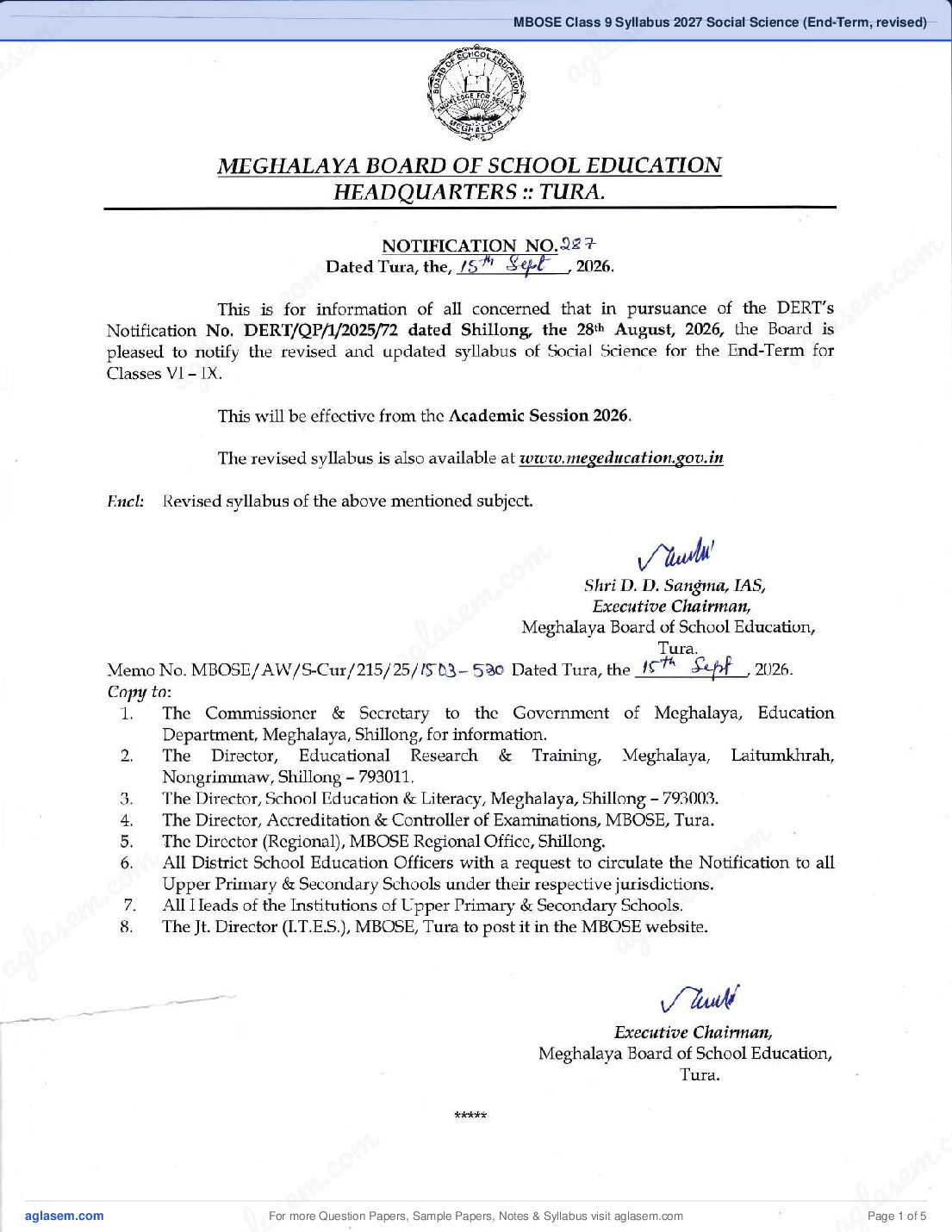
This is for information of all concerned that in pursuance of the DERT's
e m l as
l as
Notification No. DERT/QP/L/2025/72 dated Shillong, the 28th August, 2026, fhe Board is
pleased to notify the revised and updated syllabus of Social Science for the End-Term for
ag
ag
Classes VI - IX.
This will be effective from the Academic Session 2026.
The revised syllabus is also available atwww.megeducation goo.ilr
Encl: Revised syllabus of the above mentioned subject.
m
c. o
,/w,ln,
ShriD.D. SanSma,IAS,
s em MeghalayaExecutiae Chairman,
l a Board of School Educatioru
ag 5Bc Dated Trra,t6u tr"t^ '4>P
Tura.
Memo No. MBOSE/ AW/S-Cur/21.5/25//t03* ,ZOZO.
Copy to:
1,. The Commissioner & Secretarv to the Covernment of Meghalaya, Education
Department Meghalaya, Shillong, for information.
2. The Director, Educational Research & Training, Meghalaya Laitumkhrah,
Nongrimmaw, Shillong - 793011,.
J. The Director, School Education & Literacy, Meghalaya Shillong -793003.
4. The Director, Accreditation & Conkoller of Examinations, MBOSE, Tura.
m
.co
5. The Director (Regional), MBOSE Regional Office, Shitlong.
m A11 District School Education Officers with a request to circulate the Notification to all
.co
6.
Upper Primary & Secondary Schools under their respective jurisdictions.
e m
e m 7. All Heads of the Lrstitutions of Upper Primary & Secondary Schools.
las
las 8. The Jt. Director (I.T.E.S.), MBOSE, Tura to post it in the MBOSE website.
ag
ag
Executiae Chairman,
Meghalaya Board of School Educatioru
Tura.
m . c
c. o s e m
s em
For more Question Papers, Sample Papers, Notes & Syllabus visit
gl a
Page 1 of 5
Page 3
Directorate of Educational Research & Training
Nongrimmaw, Laitumkhrah, Shillong - 793011
SOCIAL SCIENCE REVISED SYLLABUS
CLASSES VI- IX
For End-term of Academic Year 2026
For more Question Papers, Sample Papers, Notes & Syllabus visit Page 2 of 5
Page 4
m .co
m .co s e m
se SOCIAL SCIENCE
g l a
CLASS IX a
(Internal - 20 marks; External - 80 marks)
Course Structure
Sl. No. Sections Internal Assessment External Assessment
1 History 5 marks 20 marks
2 Civics 5 marks 20 marks
m
.co
3 Geography 5 marks 20 marks
m
.co
4 Economics 5 marks 20 marks
e m
Total
em
20 marks 80 marks
l as
las Section – A: History ag
g
a 1: Events and Processes: The French Revolution (1789-1799) - France before the
Chapter
Revolution; Causes of the Revolution, Impact of the American Revolution; Beginning of the
Revolution; Course of the Revolution; Role of Women in the Revolution; Abolition of Slavery in
France; Legacy of the Revolution.
Chapter 2: Livelihoods, Economies and Societies (For internal assessment only): - Forest
Society and Colonialism; Why Deforestation? Colonial Times- Forests and Colonial
m
Development; Rise of Commercial Forestry; Forest Rules and Effects on Cultivation; Rebellion
in the Forest.
m .co
s e
Peasants and Farmers - Modern Agriculture in England; Enclosures and the New Demands;
g la
Bread Basket and Dust Bowl; Agrarian Expansion in U.S.A; Indian Farmers and Opium
production. a
Chapter 3: Meghalaya’s Resistance to British Dominion: Khasi Uprising, Jaiñtia Uprising,
A·Chik Uprising.
Chapter 4: Financial Education (For internal assessment only): Part I: Investment – Types of
Investment; Part II: Financial Sector Reform and Insurance
Chapter 5: Source of Funds (For internal assessment only): Classification of Source of Funds;
m
.co
Loan from Financial Institution; Raising Fund from Customers and Suppliers.
m
.co e m
Section - B: Geography
s
s em Chapter 1: Major Relief Features of the Earth: Formation of LandgForms
l a - Forces; Mountains-
g la a and Importance; Land
Types and Importance; Plateaus-Types and Importance; Plains-Types
a Forms and People.
Chapter 2: India - Size and Location: Location and Size; India and the World; Indian Sub-
Continent.
Chapter 3: Physical Features of India (For internal assessment only): Earth’s Processes; Major
Physiographic Divisions.
Chapter 4: Drainage (For internal assessment only): Rivers; Drainage Systems; Lakes and Island
m .
.co m
Drainage; Rivers: Lifeline of Human Civilization; Rivers’ Pollution.
s e
s em l a
g la ag
a For more Question Papers, Sample Papers, Notes & Syllabus visit Page 3 of 5
Page 5
Indian Monsoon; Annual Cycle of Seasons; Distribution of Precipitation; Monsoons- A Unifying Bond.
Chapter 6: Natural Vegetation and Wildlife: Ecosystem; Biomes; Vegetation Types; Wildlife;
Conserving Biodiversity.
Section - C: Civics
Chapter 1: Democracy in the Contemporary World (For internal assessment only):
Introduction; Democracy in the Contemporary World; Is the World Moving Towards Democracy?
Chapter 2: Democracy in India: Making of a Constitution; Road to Democracy; Framing of the
Constitution; How The Indian Constitution Was, Framed? Guiding Values of the Indian
Constitution; Philosophy of the Constitution; Salient Features of the Indian Constitution; How
Democracy Is Being Redesigned In India?
Chapter 3: Electoral Politics in India (For internal assessment only): Why Elections? How
Elections Are Held? Are Elections in India Free and Fair? Candidates In Fray for Lok Sabha
Elections; Representation of Women in Lok Sabha.
Chapter 4: Institutions of Parliamentary Democracy: Why We Need Political Institutions?
Parliament (The Legislature); Functions of the Parliament; Relations between the Lok Sabha and
the Rajya Sabha; How Laws Are Made? Political Executive- The President; The Vice President;
Prime Minister; The Council of Ministers (Powers and Functions); Judiciary: Role of the Supreme
Court, Jurisdiction of the Supreme Court; Power of Judicial Review; Judiciary’s Independence
Chapter 5: Citizens’ Rights in Democracy: Definition of Rights; Why Do We need Rights?
Classification of Rights; Fundamental Rights; Scope of Fundamental Rights.
Chapter 6: Financial Education: PAN Card and Aadhaar Card (For internal assessment
only): PAN Card, Aadhaar- Benefits of Aadhaar
Chapter 7: Grievance Redressal Mechanism in Insurance (For internal assessment only):
Policy holder protection, Grievance Redressal
Chapter 8: Credit Cards and Debit Cards (For internal assessment only): Steps in making
payment by credit card for online purchase, Advantages and Disadvantages, Debit Card
Section - D: Economics
Chapter 1: Factors of Production: Economic and Non- Economic Activities, Meaning of
Economics; Important terms in Economics; Factors of production; Case Study.
Chapter 2: People as A Resource (For internal assessment only): How People Become A
Resource? Role of Health in an Individual’s working life; Education in India; Health in India;
Economic Activities by Men and Women; Unemployment in India.
For more Question Papers, Sample Papers, Notes & Syllabus visit Page 4 of 5
Page 6
m Chapter 3: Poverty as a Challenge: Introduction; Meaning of Poverty; .co
m .co s e m Social Indicators of
se l a
Poverty; Absolute and Relative Poverty; Magnitude of Poverty; Causes of Poverty; International
g by the Government for Poverty
a
Comparisons of Poverty and Inequality of Incomes; Steps Taking
Alleviation: Two Case Studies of Poverty.
Chapter 4: Food Security in India: Introduction; Meaning of Food Security; Need for Food
Security; Food Insecurity Concerns- People, Regions and Hunger; Food Security in India; Public
Distribution System (PDS); Defects of India’s Food Security System; Role of Cooperatives in
Food Security.
Chapter 5: Financial Education (For internal assessment only): Demonetisation of Currency;
m
.co
Merits and Demerits of Demonetisation.
m
.co
Chapter 6: Part-I: RBI-Central Bank (For internal assessment only): Meaning; Functions of
s e m
em
RBI; Case study; Part-II: Budgeting (For internal assessment only): Preparation; Case study
s l a
g la ag
a 7: Part-I: Banks and Loans (For internal assessment only): Types of Loans;
Chapter
Part-II: Inflation (For Internal Assessment only): Causes and Effects.
Following are important instructions to be followed by schools and teachers:
All Chapters are equally important.
Suggestive Formative Assessment strategies besides written tests\class tests for internal
assessment across grades are field trips, project work, group discussions, written assignments,
m
.co
quizzes, timelines, concept maps, mind-maps, map skills, case studies, experiential learning
m
activities, role play, drawing, painting, model making, artefacts, journaling, think, pair and
s e
share, debate, portfolios, anecdotal records and others.
g la
Teachers can make assessments on individual and group presentations of students’ projects
a
and other activities for formative or internal assessment.
Formative Assessment activities conducted individually and group can be done by developing
assessment tools such as checklists, rubrics on a 3 - point scale.
Records of assessments of students should serve as evidence-based data which will be the
basis for reporting of each student holistically.
Allotment of marks class- wise and section wise have been given in the prescribed syllabus.
The Questions for the Final External Assessment (Summative Assessment) at the end of the
academic year will cover the entire syllabus of 80 marks. 20 marks is allotted for internal
m
m assessment of the whole curricular session.
.co
.co Question papers for the Final External Assessment will be externally set.
s e m
s em g l a
g la Textbook as prescribed by MBOSE: a
a - Core Social Science - IX
M/s Goyal Brothers Prakashan, D-231 – 232, Sector – 63, Noida – 201301 (U.P)
m .
.co s e m
s em l a
g la ag
a For more Question Papers, Sample Papers, Notes & Syllabus visit Page 5 of 5
Document Details
| Board / Org | Meghalaya Board |
| Exam | Class 9 |
| Type | Syllabus |
| Pages | 5 |
| Updated | 04 Nov 2026 |