Finished viewing? Save it for later —
Download MBOSE Class 10 Syllabus (PDF · 38 pages)About MBOSE Class 10 Syllabus
MBOSE Class 10 Syllabus is available here for free download. Published by Meghalaya Board for Class 10, this syllabus can be viewed online or downloaded as a PDF (38 pages). Candidates preparing for Class 10 can use MBOSE Class 10 Syllabus to understand the exam pattern, the type of questions asked, and the overall difficulty level.
Frequently Asked Questions
How can I download MBOSE Class 10 Syllabus?
Open this page and click the Download button to save MBOSE Class 10 Syllabus as a PDF. It is completely free on AglaSem Docs.
Is MBOSE Class 10 Syllabus free to download?
Yes. MBOSE Class 10 Syllabus can be viewed online and downloaded as a PDF free of cost on AglaSem Docs.
How many pages does MBOSE Class 10 Syllabus have?
MBOSE Class 10 Syllabus contains 38 pages, which you can read online or download together as a single PDF.
Where can I find more Class 10 study material?
You can find more Class 10 question papers, sample papers, syllabus, and answer keys on AglaSem Docs.
MBOSE Class 10 Syllabus – Text
Read the full text of this syllabus below — useful to quickly search, copy and reference the content online without downloading the PDF.
📄 View text version (38 pages)
Page 1
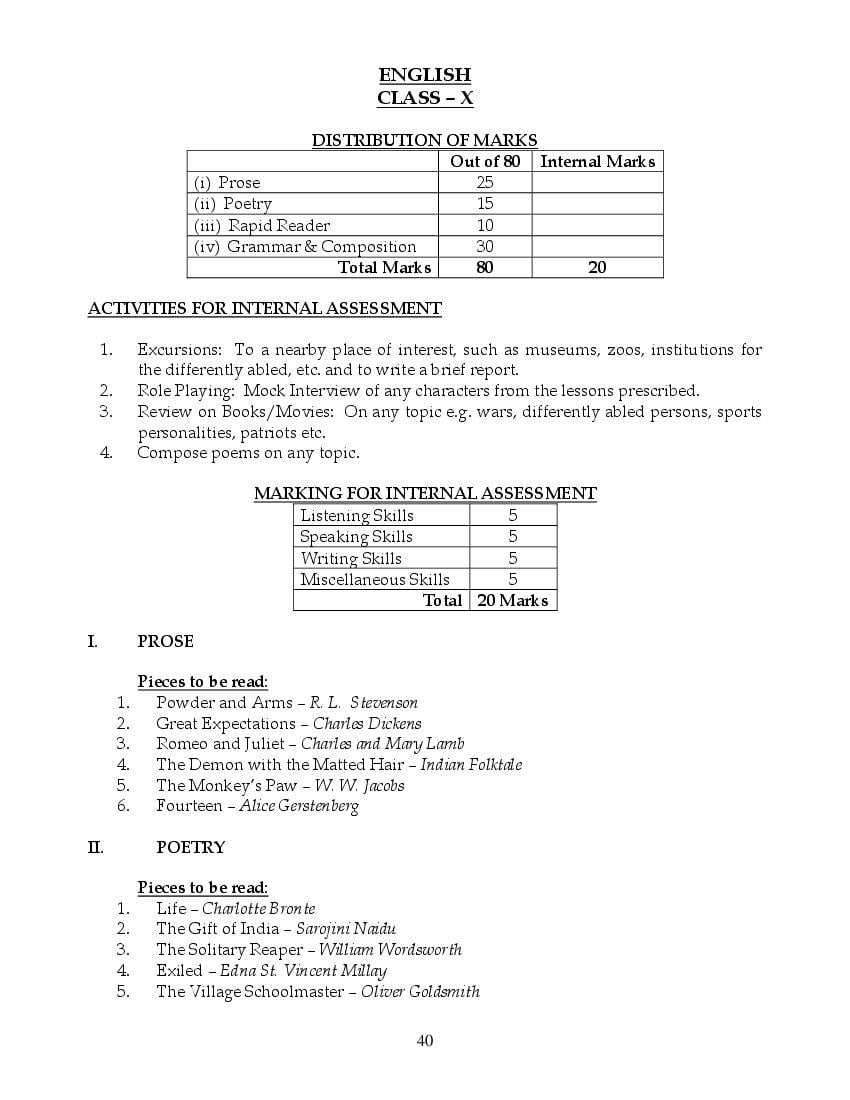
CLASS – X
DISTRIBUTION OF MARKS
Out of 80 Internal Marks
(i) Prose 25
(ii) Poetry 15
(iii) Rapid Reader 10
(iv) Grammar & Composition 30
Total Marks 80 20
ACTIVITIES FOR INTERNAL ASSESSMENT
1. Excursions: To a nearby place of interest, such as museums, zoos, institutions for
the differently abled, etc. and to write a brief report.
2. Role Playing: Mock Interview of any characters from the lessons prescribed.
3. Review on Books/Movies: On any topic e.g. wars, differently abled persons, sports
personalities, patriots etc.
4. Compose poems on any topic.
MARKING FOR INTERNAL ASSESSMENT
Listening Skills 5
Speaking Skills 5
Writing Skills 5
Miscellaneous Skills 5
Total 20 Marks
I. PROSE
Pieces to be read:
1. Powder and Arms – R. L. Stevenson
2. Great Expectations – Charles Dickens
3. Romeo and Juliet – Charles and Mary Lamb
4. The Demon with the Matted Hair – Indian Folktale
5. The Monkey’s Paw – W. W. Jacobs
6. Fourteen – Alice Gerstenberg
II. POETRY
Pieces to be read:
1. Life – Charlotte Bronte
2. The Gift of India – Sarojini Naidu
3. The Solitary Reaper – William Wordsworth
4. Exiled – Edna St. Vincent Millay
5. The Village Schoolmaster – Oliver Goldsmith
40
Page 2
- Oliver Twist
IV. GRAMMAR & COMPOSITION
Contents:
1. Tenses
2. Active and Passive Voice
3. Reported Speech
4. The Preposition
5. Miscellaneous Idioms
6. Comprehension
7. Letter-Writing (Formal)/Essay
8. E-mail Writing
9. Article Writing
10. Story Writing
PRESCRIBED TEXTBOOKS:
1. Prose & Poetry
- Reading Circle - X
M/S Oxford University Press, Pragjyotish Apartment (1st Floor),
M. Tayabullah Road, Dighali Pukhuri (East), Guwahati – 781001.
2. Rapid Reader
- Oliver Twist
M/S Macmillan India Ltd., S. C. Goswami Road, Pan Bazar,
Guwahati – 781001.
3. Grammar & Composition
- Functional English Grammar & Composition
M/S Laxmi Publications Pvt. Ltd., Hemsen Complex, M. D. Shah, Paltan
Bazar, Guwahati – 781008.
*******
41
Page 3
CLASS – X
DISTRIBUTION OF MARKS
Out of 80 Internal Marks
(i) Prose 22
(ii) Poetry 16
(iii) Play 15
(iv) Composition 19
(v) Essay 08
Total Marks 80 20
MARKING FOR INTERNAL ASSESSMENT
(i) Listening and Reading: 5 marks
Eg. Audio clips, newspaper reading, poetry reading and
review, vocabulary (spelling and pronunciation).
(ii) Writing: 10 marks
Eg. Story or picture composition, reports, dialogue
writing, autobiography, biography, note making, diary
writing, argumentative essays.
(iii) Creative Activities/Assignments: 5 marks
Eg. Advertisements, Quotable quotes, Mock Interview,
Slogan Writing, Book review, poster designing,
extempore speech, debate, enacting plays, designing
greeting cards, public speaking, autograph book, self
composed songs or poems.
I. PROSE
Pieces to be read:
1. A High Drive – L. P. Hartley
2. War – Luigi Pirandello
3. Out of Business – R. K. Narayan
4. The Postmaster – R. Tagore
5. The Lady or the Tiger? – Frank R. Stockton
II. POETRY
Pieces to be read:
1. The Education of Nature – William Wordsworth
2. Swimmers – Louis Untermeyer
3. The Man with the Hoe – Edwin Markham
4. If – Rudyard Kipling
5. A River – A. K. Ramanujan
42
Page 4
- A Midsummer Night’s Dream (Macmillan)
IV. COMPOSITION
Contents:
1. One Word Substitution
2. Amplification
3. Substance Writing
4. Paraphrasing from the Play
5. Advertisement
6. Picture Composition
PRESCRIBED TEXTBOOKS:
1. Prose
- A Miscellany of Short Stories
Published by Inter University Press Pvt. Ltd., Educational Publishers,
30/7, Shakti Nagar, New Delhi – 110007.
2. Poetry
- Wings of Poesy
M/S Evergreen Publications, 4779/23 Ansari Road, Darya Ganj,
New Delhi – 110002.
3. Play
- A Midsummer Night’s Dream
M/s Macmillan India Ltd., S. C. Goswami Road, Pan Bazar,
Guwahati – 781001.
4. Composition
- HolyFaith Essential English Grammar & Composition
M/S Holy Faith International (P) Ltd., Hem Baruah Road, Pan Bazar,
Guwahati – 781001.
*******
43
Page 5
CLASS – X
DISTRIBUTION OF MARKS
Prose 20
Poetry 15
Rapid Reader 15
Grammar 10
Composition 10
Essay 10
Total Marks 80
MARKING FOR INTERNAL ASSESSMENT
1. Activities:
a. Extempore speech/prepared speech
b. A Report on a few Harvest Festivals observed in 10 marks
Meghalaya
c. Write-up on experience of a journey
d. Critical review of any poem from the prescribed
lesson
2. Prepared Speech: (From Textbook) 5 marks
3. Recitation of Poem: Poem should be selected from the 5 marks
textbook.
Total 20 marks
I. PROSE
Pieces to be read:
1. Chatra jibon aru smaj sewa – Deinswar Neog
2. Bharatiya Sanskriti – Hem Baruah
3. Asomor jonogosthir gathoni aru sanskrity – Abdus Sattar
4. Nuton arn saptados satikar bouddhik biplob – Dr. Kulendu Pathak
II. POETRY
Pieces to be read:
1. Bor geet – Sri Sri Madhadev
2. Zikir – Ajain Fakir
3. Mor desh manuhor desh – Debakanta Baruah
4. Drisyantor – Harekrishna Deka
III. RAPID READER
44
Page 6
IV. GRAMMAR
Pieces to be read:
Sandhi
Nattwa Aru Shattwa Bidhi
Samasa (Digu Samasa, Bahubrihi Samasa, Abyaieebhab Samasa)
Pratyaya (Tadhit Pratyaya, Stri Pratayaya)
Pad Prakaran
Karak
V. COMPOSITION
Pieces to be read:
1. Make sentences with Phrases and Idioms
2. Opposite words
3. One word for a group of words
4. Similar words, having different meanings
5. Amplification
6. Letter writing
VI. ESSAY WRITING
Types of Essay:
Adarsha Mulak
Bhraman Mulak
Jibani Mulak
Barnana Mulak
PRESCRIBED TEXTBOOK:
1. Prose and Poetry
- Sahitya Subah for Class IX & X
- SEBA.
2. Composition
a) Rachana Bichitra – D. S. Deka
b) Prabeshika Rachana Shiksha – G. Sharma
c) Assamiya Rachna Shiksha – Dr. L. Gogoi, Dr. N. Sharma
3. Grammar
- Adhunik Assamiya Bhaskar Vyakaran by G. Sharma
Assam State Textbook Production & Publication.
********
45
Page 7
CLASS – X
DISTRIBUTION OF MARKS
Prose 16
Poetry 12
Rapid Reader 12
Grammar 22
Composition 18
Total Marks 80
MARKING FOR INTERNAL ASSESSMENT
1. A Project work or assignment 10 marks
2. A viva voce on the home assignment submitted 5 marks
3. A viva voce on any assigned topic 5 marks
Total 20 marks
I. PROSE
Pieces to be read:
1. Guptadhan – by Rabindranath Tagore
2. Adorini – by Prabathkumar Mukhopadhyay
3. Tota Kahini – by Sayad Mujtaba Ali
II. POETRY
Pieces to be read:
1. Gramyachhabi – by Girindramohini Dasi
2. Abar Asibo Phire – by Jiibananda Das
3. Rabindranath – by Achintyakumar Sen
III. RAPID READER
- Shrikanta O Indranath by Sharatchandra Chottopadhyay
IV. GRAMMAR
Pieces to be read:
1. Definition – apinihiti, abhishruti, swaraagam, borno biparjay, samas
2. Samas o tar chhoyti prokar (samas nirnoy)
3. Bagdhara
4. Ek kothay prokash
5. Somochaarito bhinnarthak shobdo
46
Page 8
Pieces to be read:
1. Comprehension
2. Prabandha Rachana or picture composition/story writing (for blind students)
PRESCRIBED TEXTBOOKS:
1. Sahitya Sourav – X
- M/S Assam State Textbook Production & Publication Corporation Ltd.,
Guwahati.
2. Bani Bichitra (Class VIII – XII) by Piyush Dey
********
47
Page 9
CLASS – X
DISTRIBUTION OF MARKS
Prose 25
Poetry 18
Rapid Reader 10
Grammar 10
Composition 7
Essay/Comprehension 10
Total Marks 80
MARKING FOR INTERNAL ASSESSMENT
Writing skills: story writing, picture composition, Life of 10 marks
the poet or author
Listening & Reading: Reading, Spelling & Dictations, 5 marks
Phonetics
Creativity: Extempore, slogan writing, chart making base 5 marks
on the lesson, Group discussions
Total 20 marks
I. PROSE & POETRY
Pieces to be read:
1. Rev. Thangkan K. Sangma – Lindrid D. Shira
2. Jatni Nisan, Git aro Chin – Brucellish K. Sangma
3. Meghalayani Sam Bolrang aro Do∙o Matrang – T. T. C. Marak
4. Sonaram R. Sangma – Dr. Milton S. Sangma
5. Chadambeni Salrang – Lindrid D. Shira
II. POETRY
Pieces to be read:
1. Ang’ Chakki – Evelyn R. Marak
2. Saljong Tasin Me∙chik – Monensing R. Sangma
3. Pring – Surendra S. Marak
4. Basako – Jonmoni D. Shira
5. Da∙al – Rev. Gilbert K. Marak
III. RAPID READER
- Skul Master (Dakmesokani) – L. D. Shira
48
Page 10
Pieces to be read:
Bak - I
Phrase
Clause
Bak – III
1. Verb – Ma∙arang, Predicateko Chu∙sokatgiparang, Mood, Participle, Verbal Noun,
Verbal Adjective aro Tense.
2. Adjective - Ma∙arang aro Tosusaani
3. Adverb - Ma∙arang aro Tosusaani, Napsikgipa Adverbrang
Recommended textbook:
- A∙chik Grammar – E. G. Phillips
V. COMPOSITION
i) A∙chik Composition – K. M. Momin
ii) A∙chik Kattarang – W. K. Sangma
VI. ESSAY/COMPREHENSION
PRESCRIBED TEXTBOOKS:
1. Prose & Poetry
- Poraiani Ki·tap X
- Tura Book Room, Tura, Meghalaya.
********
49
Page 11
CLASS – X
DISTRIBUTION OF MARKS
Prose 20 marks
Poetry 20 marks
Rapid Reader 15 marks
Grammar 17 marks
Composition
(a) Essay 08 marks
Total 80 marks
MARKING FOR INTERNAL ASSESSMENT
1. Home assignment (Life history of any writer) in own 07 marks
handwriting
2. Dictation 04 marks
3. Reading 04 marks
4. Spelling 05 marks
Total 20 marks
I. PROSE
Pieces to be read:
1. Shahid Bakri – by Ayodhya Prasad Goyellia
2. Bade Sapne Dekhe – by A. P. J. Abdul Kalam
3. Har Ki Jeet – by Sudarshan
4. Tiruwalluwar – by Mansingh Verma
5. Neelkanth – by Mahadevi Varma
6. Ped Ki Baat - by Jagaddish Chandra Basu
II. POETRY
Pieces to be read:
1. Is Matti Ko Naman Karen – by Mansingh Verma
2. Vishwa Nagrik Bane – by Vidhichandra Patwari
3. Teen Kundaliya – by Giridhar
4. Baal Leela – by Surdas
5. Uddyami Nar – by Ramdhari Singh Dinkar
6. Satpura Ke Ghane Jungle – by Bhawani Prasad Mishra
III. RAPID READER
- Sanchayan (NCERT) Part-II
50
Page 12
Pieces to be read:
1. Sandhiyan-Vyanjan, Visarga, Tatha Hindi Ki Sandhiyan
2. Padhvichar Aur Unpadho Ke Bhed (B)
3. Kriya Ka Roob Parivartan Kalo Aur Vidhiyomein
4. Kriya Ke Vachaya Aur Prayog
5. Samas (B)
6. Sabdh – Vivek
7. Padhbandhan
8. Vakya, Upvakaya Aur Unke Bhed
9. Vakya Parivartan
10. Vakya Visleshan
11. Muhabare
12. Lokoktiya
13. Alangkar
Composition
1. Nibandh Lekhan (essay)
Paropkar – Madhyapanduwara Vinash (Avyasbhi)
PRESCRIBED TEXTBOOKS:
1. Deepshika Hindi – Class X
– M/S Arya Publishing Company, 1002-1003, Faiz Road, Karol Bagh, New Delhi –
110005.
2. Bhasha Vyakaran IX & X
– M/S Neeta Prakashan, A-4, Ring Road, South Extension-1, New Delhi – 110049.
3. (i) Learn Hindi – Learn Khasi (Dictionary)
(ii) Learn Hindi – Learn Garo (Dictionary)
– M/S Gewali Publication, Upper Mawprem, Shillong – 2.
4. Rapid Reader – Sanchayan (NCERT) Part-II.
********
51
Page 13
CLASS – X
DISTRIBUTION OF MARKS
Prose 24 marks
Poetry 14 marks
Rapid Reader 14 marks
Grammar & Composition 28 marks
Total 80 marks 20 marks
(Internal)
MARKING FOR INTERNAL ASSESSMENT
1. Poetry- Text- Ka Duitara Ksiar- U Soso Tham 6 marks
Recitation Individual, poetry writing.
2. Prose-Text- (I) Ki Dienjat Jong Ki Longshuwa – Fr. J. Bacchiarello 10 marks
(ii) Ki Phawer U Aesop- Soso Tham
(iii) Ki Jingsneng Tymmen-Part I- Radhon Sing Berry
Poster Designing, Story writing, Extempore, Elocution, Study Tour,
Social Activities on any related topics, One act play.
3. Rapid Reader – Text- Na Mihngi Sepngi - Fr. H Elias 2 marks
Snap pictures related to topics, Study Tour, Designing Greeting Cards
on related topics.
4. Grammer And Composition- Text- Hints On The Study 2 marks
Of Khasi Language- D. Nissor Sing Wahlang
Paste collection of pictures depicting the different kinds of Adverb.
N.B.:- Scrap book on any activities done and cover will add to the weightage of marks.
TOTAL 20 marks
I. PROSE
Pieces to be read:
1. Ka Dorbar U Khasi Hyndai
2. Ki Mawbynna, Mawniam Bad Ki Kor
II. POETRY
Pieces to be read:
1. U Dieng Bilat
2. Ki Sngi Ba La Leit Noh
3. Ka Mynsiem Bashynrang
4. U Ingkhong Shyllangmat
III. KI PHAWER U AESOP
Lynnong: 41-50
52
Page 14
Lynnong: 31-40
III. RAPID READER
Pieces to be read:
1. Ka Nobel Prize
2. Ka Kheiñkur Kheiñkha
3. Ka Trei Ka Ktah Ha Ri Khasi Jaiñtia
IV. GRAMMAR, COMPOSITION & ESSAY
1. The Adverb
2. Adverb and words with which they are used
From Alphabet ‘M’ to ‘W’ Page – 76 to 81
3. Comprehension
4. Essay
PRESCRIBED TEXTBOOKS:
1. Prose
- Ki Dienjat Jong Ki Longshuwa – J. Bacchiarello
- Ki Phawer U Aesop – Soso Tham
- Ki Jingsneng Tymmen (Part-I) – Radhon Sing Berry
2. Poetry
- Ka Duitara Ksiar – Soso Tham
3. Rapid Reader
- Na Mihngi Sepngi – H. Elias
4. Grammar & Composition
- Hints on the Study of Khasi Language – Ri Khasi Publication, Mawkhar,
Shillong – 793001.
********
53
Page 15
CLASS – X
DISTRIBUTION OF MARKS
Hla (Poetry) 20 marks
Thu (Prose) 30 marks
Mizo Grammar 20 marks
Thawnthu tawi (Rapid Reader) 10 marks
Total 80 marks
MARKING FOR INTERNAL ASSESSMENT
1. Writing skill – Project work, home assignment, 10 marks
composition, amplification, story writing.
2. Listening and Reading skill – Dictation, Recitation, 10 marks
News reading, extempore debating.
Total 20 marks
I. THU (PROSE)
Pieces to be read:
1. Nun kawng – R. L. Thanmawia
2. Thalaite Khawvel – Siamhnuna Khawlhring
3. Mizo Thufing
4. Zawlbuk – C. Lianhmingthanga
5. Peihna – Sangzuala
6. Nihna – Darchhawna
7. Mizote leh an nihna – B. Lalthangliana
8. Tihdan tha
9. Tlemte ka chhiar a, ka Pass tho – Zikpuii pa
II. HLA (POETRY)
Pieces to be read:
1. Aw Lalpa, Davida leh a thlah arsi – Patea
2. Kum sul liam hnu – C. Lalkhawliana
3. Chhul khat kual – C. Durthanga
4. Zofate inpumkhatna – C. Chhuanvawra
5. Zo bawmtu chhawkhlei par – H. Lalringa
6. Zirtu kawng – Selet Thanga
7. Mahriak ten a rang ka vai e Parte – Lalzova
8. Chhingkhual len mawi – P. S. Chawngthu
54
Page 16
1. Parts of Speech thenkhat – Verb, Adjective, Adverd
2. Mizo tawng hman dik loh thinte
3. Tawng Upa
IV. THAWNTHU TAWI (RAPID READER)
Tualte Vanglai – Pastor Nikhama
PRESCRIBED TEXTBOOK:
- Class X Mizo – MBSE Publication
*********
55
Page 17
CLASS – X
DISTRIBUTION OF MARKS
Prose 30 marks
Poetry 18 marks
Rapid Reader 10 marks
Grammar & Composition 22 marks
Total 80 marks
MARKING FOR INTERNAL ASSESSMENT
1. Reading Recitation, Dictation, Extempore speech, 05 marks
Elocution
2. Home assignment – self composed poem or to write 10 marks
the life story of any poet or author
3. Project Work -
a) To develop the story from the given picture (visual
clue) 05 marks
b) Slogan writing
c) Chart making on the basis of Lessons (Paste Pictures
and Drawings)
Total 20 marks
I. PROSE
Pieces to be read:
1. Shikchhachha ko Udheshya
2. Alijheko Ichchha
3. Paras Mani Pradhan
4. Chitthi
5. Paribanda
6. Saya Rupriyanko note
7. Charlicheplin: Ek Asaadharan Vyaktittyo
II. POETRY
Pieces to be read:
1. Gaunthaliko Chiribiri
2. Garib
3. Sweet Falls
4. Sirja Auta Kagajko Itihas
5. Bhanubhakta Prati
6. Adhikar Ra Kartavya
56
Page 18
- ‘Maita Ghara’ by Shri Lain Singh Bangdel
IV. GRAMMAR & COMPOSITION
Pieces to be read:
1. Essay Writing (Nibandha Lekhan)
2. Comprehension (Bodh Pranali)
3. Letter Writing (Patra Lekhan)
4. Amplification (Vistritikaran)
5. Paragraph Writing (Anuchhed Lekhan)
6. Linga, Sangya, Visheshan, Sandhi, Kriya Rayasko Prakar
7. Dhatu Ra Pratyay, Upasarga, Vachya, Vakyansha, Ukhan Ra Tukka
8. Viparitarthak Shabda, Sammocharit Shabda, Prayayvachi Shabda, Shar Shabda
ESTIMATED NUMBER OF PERIODS PER WEEK = 5 (FIVE)
Note: - Teachers may take the help of any other Grammar Book available in the market for
their reference.
PRESCRIBED TEXTBOOKS:
1. Prose & Poetry
- Madhyamik Nepali Sahitya Bhag V
Edited by Dr. Tek Narayan Upadhaya
Published by Text Book Committee (Nepali) Shillong, Meghalaya
2. Rapid Reader
- ‘Maita - Ghara’ by Shri Lain Singh Bangdel
Saajha Prakashan, Kathmandu, Nepal.
3. Grammar & Composition
(i) Madhhyamik Nepali Vyakaran Ra Rachana
Written & Compiled By the Expert Academicians
Shri Raaj Prakashan, Darjeeling
OR
(ii) Vyakaran Saurabh (Chautho Bhaag) (Part – IV)
Written by Vishnu Sharma Adhikari
Puspa Prakashan, Siliguri.
*********
57
Page 19
CLASS – X
DISTRIBUTION OF MARKS
Prose 25 marks
Poetry 15 marks
Grammar 20 marks
Life History 10 marks
Essay 10 marks
Total 80 marks
MARKING FOR INTERNAL ASSESSMENT
1. Reading/Recitation: Reading or reciting passages or verses 04 marks
in Urdu from seen or unseen prose or poetry.
2. Writing: Writing paragraphs or verses in Urdu on the topics 04 marks
related to literature or science or environment.
3. Comprehension: Understanding passages or verses in Urdu 04 marks
from seen or unseen prose or poetry.
4. Life-Sketch: Representing a brief Life-Sketch of authors or
poets in Urdu on a chart paper whose writings are included in 04 marks
the academic syllabus.
5. Extempore Speech/Group Discussion: A short extempore
speech or Group discussion on the topics related to literature or 04 marks
science or environment in Urdu.
Total 20 marks
I. PROSE
Pieces to be read:
Afsana Writer
1. Naya Guanoon Sadat Hassan Mantoo
2. Bheek Hayat-u-Ilah Ansari
Sawaneh (life history)
3. Sirsyed Ka Bachapan Altaf Hussain Hali
Darama
4. Aazmaish Mohammad Mujeeb
Aapbiti
5. Chori our Uska Kaffarah Syed Abid Hussain
Mazmoon
6. Auraton Ke Haquoque Sir Syed Ahmad Khan
7. Makhaloot Zuban Maulavi Abdul Haque
58
Page 20
9. Chakabast Lakhnavi Aal Ahmed Sarvar
II. POETRY
Pieces to be read:
Ghazal Poets
1. Bahar Besapre jam Guzre hai Mirza Mohammad Rafi Sauda
2. Lai Heyat Sekh Mohammad Ibrahim Zoque
3. Dhondage agar Mulkon Mulkon Shad Aazimabadi
4. Aalam-e-Razagar Asgar Goudave
Nazam Poets
5. Jalwae Darbar-e-Dehli Akbar Illahabadi
6. Haquiquat-e-Husn Mohammad Iqubal
7. Aandhi Kaifi Azami
8. O-Des-Se A’anewale Bata Akhtar Shiravi
Rubai
9. (i) Gulshan mein Phiron ke Saire Sehra Dekhon Anis
(ii) Rutba jise dunia mein khuda deta hai Anis
(iii) Fitrat ki dihoi musarrat kho kar Tilok Chand Mahroom
(iv) Mazhab ki zuban Tilok Chand Mahroom
(v) Har aib se mana ke juda hojai Firaque Gorakhpuri
PRESCRIBED TEXTBOOKS:
1. Prose & Poetry
- Nawa-e-Urdu (NCERT)
2. Urdu Grammar Book
- NCERT
*********
59
Page 21
CLASS – X
DISTRIBUTION OF MARKS
1. Number Systems 04 marks
2. Algebra 20 marks
3. Co-ordinate Geometry 08 marks
4. Trigonometry 12 marks
4. Geometry and Construction 16 marks
5. Mensuration 10 marks
6. Statistics and Probability 10 marks
Total 80 marks
WEIGHTAGE OF MARKS FOR INTERNAL ASSESSMENT
The Internal Assessment of 20 marks is to be awarded on the basis of the
performance of a student in the activity work, project work and continuous assessment as
per the following scheme.
- Assessment through test – 10 marks
- Assessment of Project Work – 5 marks
- Assessment of 2 skills – 5 marks.
For its effective implementation, the following aspects of the scheme should
be kept in view:
a. Internal examination is to be conducted at the school level to assess the activity
work and project work done by every student during the year.
b. Each student must perform at least two activities for assessment of any two skills
like numerical ability, observation, ability to see patterns, analytical thinking,
understanding logic, skills of comparing, interpreting, problem solving, decision
making and skills of games.
c. The assessment may be carried out by a team of two Mathematics teachers
including the teacher teaching the particular class
The break-up of 5 marks for assessment of activity/skills could be as:-
- Statement of the objective of activity - 01 mark
- Design of approach to activity - 01 mark
- Actual conduct of activity - 01 mark
- Procedure explanation - 01 mark
- Result and conclusion - 01 mark
The marks for assessment of two activities (5 + 5) may be added and the
average should be calculated out of 5.
60
Page 22
- Identification and statement of the project - 01 mark
- Design of the project - 01 mark
- Procedure adopted - 01 mark
- Write-up of the project - 01 mark
- Interpretation of the result - 01 mark
UNIT I : NUMBER SYSTEMS
1. Real Numbers
Euclid’s division lemma, Fundamental Theorem of Arithmetic – Statements after reviewing
work done earlier and after illustrating and motivating through examples. Proofs of results
– irrationality. Decimal representation of rational numbers in terms of terminating/non –
terminating recurring decimals.
UNIT II : ALGEBRA
1. Polynomials
Zeros of a polynomial. Relationship between zeros and coefficients of a polynomial.
Statement and simple problems on division algorithm for polynomials with real
coefficients.
2. Pair Of Linear Equations In Two Variables
Pair of linear equations in two variables and graphical method of their solution,
consistency/inconsistency. Algebraic conditions for number of solutions. Solution of pair
of linear equations in two variables algebraically – by substitution, by elimination and by
cross – multiplication method. Simple situational problems must be included. Simple
problems on equations reducible to linear equations.
3. Quadratic Equations
Standard from of a quadratic equation ax² + bx + c = 0, (a ≠ 0). Solution of a quadratic
equation (only real roots) by factorization and completing the squares, by using quadratic
formula. Relationship between the discriminant and nature of roots.
Situational problems based on quadratic equations related to day to day activities to
be incorporated.
4. Arithmetic Progressions
Motivation for studying Arithmetic Progression. Derivation of standard results of finding
the nth term and sum of the first n terms of Arithmetic Progression and their application in
solving daily life problems.
61
Page 23
1. Introduction to Trigonometry
Trigonometric ratios of an acute angle of a right – angled triangle. Proof of their existence
(well defined); motivate the ratios, whichever are defined at 0° and 90°. Values (with
proofs) of the trigonometric ratios of 30°, 45° and 60°. Relationships between the ratios.
2. Trigonometric Identities
Proof and applications of the identity sin² A + cos² A = 1. Only simple identities to be
given. Trigonometric ratios of complementary angles.
3. Heights And Distances: Angle of elevation, Angle of depression
Simple and believable problems on heights and distances. Problems should not involve
more than two right triangles. Angles of elevation/depression should be only 30°, 45°, 60°.
UNIT IV : COORDINATE GEOMETRY
1. Lines (In two-dimensions)
Review the concepts of coordinates geometry, graphs of linear equations. Distance
formula. Section formula (internal division), Area of a triangle.
UNIT V : GEOMETRY
1. Triangles
Definitions, examples, counter examples of similar triangles.
i) (Prove) If a line is drawn parallel to one side of a triangle to intersect the other
two sides in distinct points, the other two sides are divided in the same ratio.
ii) (Motivate) If a line divides two sides of a triangle in the same ratio, the line is
parallel to the third side.
iii) (Motivate) If in two triangles, the corresponding angles are equal, their
corresponding sides are proportional and the triangles are similar.
iv) (Motivate) If the corresponding sides of two triangles are proportional, their
corresponding angles are equal and the two triangles are similar.
v) (Motivate) If one angle of a triangle is equal to one angle of another triangle and
the sides including these angles are proportional, the two triangles are similar.
vi) (Motivate) If a perpendicular is drawn from the vertex of the right angle of a
right triangle to the hypotenuse; the triangles on each side of the perpendicular
are similar to the whole triangle and to each other.
vii) (Prove) The ratio of the areas of two similar triangles is equal to the ratio of the
squares on their corresponding sides.
viii) (Prove) In a right triangle, the square on the hypotenuse is equal to the sum of
the squares of the other two sides.
ix) (Prove) In a triangle, if the square on one side is equal to the sum of the squares
of the other two sides, the angle opposite to the first side is a right angle.
62
Page 24
Tangents to a circle at a point of contact.
i) (Prove) The tangent at any point of a circle is a perpendicular to the radius
through the point of contact.
ii) (Prove) The lengths of tangents drawn from an external point to a circle are
equal.
3. Constructions
i) Division of a line segment in a given ratio (internally).
ii) Tangent to a circle from a point outside it.
iii) Construction of a triangle similar to a given triangle.
UNIT VI : MENSURATION
1. Areas Related to Circles
Motivate the area of a circle; area of sectors and segments of a circle. Problems based on
area and perimeter/circumference of the above said plane figures. (In calculating area of
segment of a circle, problem should be restricted to central angles of 60°, 90°, and 120° only.
Plane figures involving triangles, simple quadrilaterals and circles should be taken).
2. Surface Areas And Volumes
i) Surface areas and volumes of combinations of any two of the following: cubes,
cuboids, spheres, hemispheres and right circular cylinders/cones. Frustum of a
cone.
ii) Problems involving converting one type of metallic solid into another and other
mixed problems. (Problems with combination of not more than two different
solids may be taken).
UNIT VII : STATISTICS AND PROBABILITY
1. Statistics
Mean, median and mode of grouped data (bimodal situation to be avoided) Cumulative
frequency graph.
2. Probability
Classical definition of Probability. Simple problems on single events (not using set
notation).
PRESCRIBED TEXTBOOK:
- Modern’s abc of Mathematics – X
M/S Modern Publishers Chancellor Commercial, H. B. Road,
Panbazar, Guwahati – 781001.
******
63
Page 25
CLASS – X
DISTRIBUTION OF MARKS
Physics 26 marks
Chemistry 26 marks
Biology 28 marks
Total 80 marks
PHYSICS
1. REFLECTION AND REFRACTION OF LIGHT
Light as Invisible Energy Nature of Light Reflection of Light Position of the Image
formed by a Plane Mirror Spherical Mirrors and Their Technology Sign Conventions
for Reflection by Spherical Mirrors Refraction of Light Refraction by Spherical Lenses
Power of a Lens New Cartesian Sign Convention for Lenses
2. THE HUMAN EYE AND THE COLOURFUL WORLD
Human Eye Accommodation of the Eye Defects of Vision and Their Correction
Advantages of having two eyes in Humans Refraction of Light Through an Equilateral
Prism Dispersion of White Light by a Glass Prism Atmospheric Refraction Scattering
of Light
3. ELECTRICITY
Electric Charges and its Properties Conductors and Insulators Flow of Electric
Charges Electric Current Electric Potential Electric Circuit Resistance of a Conductor
or Electric Resistance Series and Parallel Circuits Ohm’s Law Expression for
Resistances in Series Expression for Resistances in Parallel Heating Effects of Electric
Current
4. MAGNETIC EFFECTS OF ELECTRIC CURRENT
Magnetic Field and Field Lines Solenoid Force on a Current Carrying Conductor in a
Magnetic Field Electromagnetic Induction Domestic Electric Circuits
CHEMISTRY
1. CHEMICAL REACTIONS
Introduction Chemical Equation Types of Chemical Reactions Effects of Oxidation
Reactions in Everyday Life
2. ACIDS, BASES AND SALTS
Introduction Understanding the Chemical Properties of Acids and Bases What Do
All Acids and All Bases have in Common How strong are Acid or Base Solutions More
about salts
64
Page 26
Physical Properties of Metals and Non-metals Formation of Ionic Compounds
Chemical Properties of Metals Specimen Problems Occurrence of Metals Corrosion
of Metals
4. CLASSIFICATION OF ELEMENTS
Necessity for Classification of Elements Early Attempts for Classification of Elements
Mendeleev’s Periodic Table Mendeleev’s Periodic Law Modern version of
Mendeleev’s Periodic Table of Elements Defects (Limitations) in Modern Version of
Mendeleev’s Periodic Table of Elements Modern Periodic Law Long form of Periodic
Table Position of Hydrogen in the Periodic Table Study of Normal Elements of the
Periodic Table Characteristics of Periods in Long form of Periodic Table Characteristics
of Groups in Long form of Periodic Table Merits of the Long form of Periodic Table
Defects of the Long form of the Periodic Table Advantages of the Long form of the
Periodic Table in Learning Chemistry Sample Problems
5. CARBON AND ITS COMPOUNDS
Introduction The Covalent Bond–Bonding in Carbon and other Non-metals Versatile
Nature of Element Carbon Chemical Properties of Carbon Compounds Important
Carbon Compounds–Ethanol and Ethanoic Acid Soaps And Detergents
BIOLOGY
1. LIFE PROCESSES
What are life processes? Nutrition Autotrophic Nutrition Heterotrophic Nutrition
How do organisms obtain their Nutrition? Respiration Transportation
Transportation in Human beings Transportation in Plants Excretion Excretion in
Human beings
2. CONTROL AND COORDINATION
Animals — Nervous system Structure of Neuron How does an impulse travel in the
Body? Types of Nervous Actions What happens in Reflex Actions? Human Nervous
System How are these tissues protected How does the Nervous Tissue cause Action?
Coordination in Plants Immediate response to stimulus Movement due to Growth
Plant Hormones Hormones in Animals Endocrine Glands in Humans
3. REPRODUCTION IN PLANTS AND ANIMALS
Do organisms create exact copies of themselves? The importance of variations
Modes of reproduction used by single organisms Fission Fragmentation
Regeneration Budding Vegetative propagation Spore formation Sexual
reproduction Why the Sexual mode of Reproduction? Sexual Reproduction in
Flowering Plants Reproduction in Human Beings Male Reproductive System Female
Reproductive System What happens when the egg is not fertilised? Reproductive
health
65
Page 27
Accumulation of variation during reproduction Heredity Inherited traits
Rules for the Inheritance of traits — Mendel’s contribution How do these traits get
expressed? Evolution Acquired and inherited traits Speciation Evolution and
classification Evolution by stages Evolution should not be equated with ‘progress’
Human Evolution.
PRACTICAL
Total – 20 marks
Every student will perform at least fifteen experiments (at least five
experiments from each unit) during the academic year.
PHYSICS
1. To verify the laws of reflection of light using plane mirror.
2. To determine the focal length of a concave mirror by obtaining image of a distant
object.
3. To trace the path of a ray of light passing through a rectangular glass slab for
different angle of incidence. Measure the angle of incidence, angle of refraction,
angle of emergence and interpret the result.
4. To determine the focal length of a convex lens by obtaining the image of a distant
object.
5. To trace the path of a ray of light passing through a glass prism and measure the
angle of deviation.
6. To study the dependence of potential difference (v) across a resistor, determine its
resistance.
7. (a) To determine the equivalent resistance of two resistors when connected in series
parallel.
(b) To determine the equivalent resistance of two resistors when connected in
parallel.
BIOLOGY
1. To study land food chain from the given chart.
2. Construction of food web using models.
3. To study the different parts of a Hibiscus flower.
4. To study germination of grams/pea seeds.
5. To test the presence of starch in a given food sample.
6. To study various things around and classify them into living and non-living.
7. To identify bio-degradable and non-biodegradable materials (wastes) in the
environment.
8. Collection of newspaper reports on HIV/AIDS.
CHEMISTRY
1. To measure the change in temperature during chemical reaction (at least four) and
conclude whether the reaction is exothermic or not.
66
Page 28
To identify bleaching powder from the given samples of chemicals (four samples).
3.
To identify baking soda from samples of chemicals (four samples).
4.
(a) To study on precipitation reaction and isolation of the precipitate, Na2SO4 with
BaCl2
(b) To study on precipitation reaction and isolation of precipitate, NaCl with
AgNO3.
5. To prepare Sulphur dioxide gas and study its two physical and two chemical
properties.
6. Carry out the reactions for an acid (HCl) with:
(i) Litmus solution (blue/red),
(ii) Zinc metal,
(iii) Solid Sodium carbonate
(iv) Sodium hydroxide.
7. To prepare ammonia gas and study its two physical and two chemical properties.
8. To study properties of acetic acid (ethanoic acid).
(i) odour
(ii) solubility in water
(iii) effect on litmus
(iv) reaction with sodium bicarbonate
9. To identify whether a given solution is acidic or basic, performing following test is
required:
(i) Litmus test,
(ii) Reaction with NaHCO3 or Na2CO3
(iii) Reaction with NH4OH or (NH4)2 CO3
10. To study the decomposition of CaCO3 and prove that CO2 is evolved during the
reaction (lime water test)
11. To perform the reaction of 1: 1 molar acetic acid and ethanol (elhyl alcohol) in the
presence of sulphuric acid.
12. To examine the heating effect on sugar and common salt, observe the change and
find the nature of bonding in the two compounds.
13. To determine the pH value of equimolar concentration of four acids and arrange
them in order of their increasing acidity.
PRESCRIBED TEXTBOOKS:
1. Core Science – X
- M/S Goyal Brothers Prakashan, D-231-232, Sector-63, Noida – 201301 (UP).
2. Practical Science – X
- M/S Laxmi Publications Pvt. Ltd., Hemsen Complex, M. D. Shah Road,
Paltan Bazar, Guwahati – 781008.
*********
67
Page 29
CLASS – X
THE SCHEME OF ASSESSMENT FOR THEORY EXAMINATION.
One Paper Theory Examination = 80 marks Pass marks = 24
Internal Assessment = 20 marks Pass marks = 6
(for regular candidates)
DISTRIBUTION OF MARKS
Unit Parts/Sections Theory
Section I History 23
Section II Civics 17
Section III Economics 17
Section IV Geography (Including map 23
works and Disaster
Management)
Total 80
WEIGHTAGE OF MARKS FOR INTERNAL ASSESSMENT
Each subject segment carries the following weightage of marks for Internal Assessment:
i) History 5 marks
ii) Civics 5 marks
iii) Economics 5 marks
iv) Geography 5 marks
Total 20 marks
These marks can be internally assessed through any one of the following:
i. Project Work
ii. Written Tests
iii. Assignments (Class or Home Work)
Different types of Project Work:
- Class/Interclass discussions and debates
- Preparations of a report based on newspapers/magazines clippings
- Conducting a survey in the locality (activity to be accompanied by a brief
report)
- Posters
- Mock drills to deal with fire mishaps, earthquakes, flood and landslides to be
practiced for the topic, ‘Disaster Management.’
68
Page 30
Unit I: Events and Processes
1. The Rise of Nationalism in Europe
2. Non-Cooperation and Civil Disobedience Movements
Unit II: Livelihoods, Economies and Societies
3. Industrialisation (1850s-1950s)
4. Urbanisation and Urban Lives
Unit III: Culture, Identity and Society
5. Print Culture and Nationalism
6. Financial Education
Part I: Electronic Commerce (e-commerce) only for classroom
Part II: E-Commerce and Financial Regulatory Bodies transaction and Internal
of Country Assessment.
7. Part I: Information Technology in Insurance Sector
Part II: Insurance Ombudsman
SECTION II: GEOGRAPHY
1. Resources
2. Water Resources
3. Forest Resources
4. Minerals and Energy Resources
5. Agriculture
6. Manufacturing Industries
7. Lifelines of National Economy
8. Meghalaya: An Overview
9. Planning Ahead: by the People, for the People
SECTION III: CIVICS
1. Unit I: Role of Caste in Indian Politics and Communalism
2. Unit II: Nature of Indian Federal Structure
3. Unit III: Popular Struggles and Movements
4. Political Parties
5. Challenges to Democracy
6. Voters’ Awareness and its Importance
7. Women’s Rights in India
8. Supreme Court’s Ruling on Child Abuse
9. The Rights of Persons with Disabilities Act, 2016
10. Financial Education
Commodity Futures Market only for classroom transaction and
11. Part I: Economic Depression Internal Assessment.
Part II: Investing in Shares
Part III: Initial Public Offering (IPO)
SECTION IV: ECONOMICS
69
Page 31
2. The Story of Development
3. Money and Financial System
4. Globalisation and the Indian Economy
5. Consumer Rights
6. Financial Education
Benefits of Insurance only for classroom transaction
7. Part I: Learning to Trade and Internal Assessment
Part II: Stock Exchange and Economy
PRESCRIBED TEXTBOOKS:
Core Social Science – X
- M/S Goyal Brothers Prakashan, D-231-232, Sector-63,
Noida – 201301 (UP)
*****
70
Page 32
CLASS – X
Theory - 80 Marks
Internal Assessment - 20 Marks
Total = 100 Marks
WEIGHTAGE OF MARKS FOR INTERNAL ASSESSMENT
The Internal Assessment will be done through tests, assignments and project
work. The breakup of 20 marks for the Internal Assessment may be as follows:
Part - 1 - Written tests - 10 marks
Part - 2 - Assignments - 5 marks
Part - 3 - Project Works - 5 marks
The Internal Assessment of 20 marks is to be awarded on the basis of the
performance of a student in the activity work, project work and assessment on the
assignments given at the end of each lesson of the textbook.
The break-up of 5 marks for Assignments could be as:-
- Statement of the skills/activity - 01 mark
- Elaboration of the skills/activity - 01 mark
- Procedure of explanation - 01 mark
- Actual conduct of activity - 01 mark
- Conclusion - 01 mark
The marks for assessment of two activities (5+5) may be added and the
average should be calculated out of 5
The break-up of 5 marks for assessment of project could be as:-
- Identification and statement of the project - 01 mark
- Design of the project - 01 mark
- Procedure adopted - 01 mark
- Write-up of the project - 01 mark
- Interpretation of the result - 01 mark
To implement them successfully, the following aspects of the scheme should
be kept in view:-
(a) Internal Examination is to be conducted at the school level to assess the activity
and project work done by each student.
71
Page 33
(c) Assessment may be carried out by a team of two teachers including the teacher
teaching this particular subject.
NOTE: Schools may choose their own topics for Internal Assessment.
Units to be read
Unit I Growth and Development
1. How Mature Are You?
2. You and Your Family
3. Marriage and Family Life
Unit II Diseases
1. Some Defence Measures Against Diseases (Immunity and Immunization)
2. National Health Programme
3. Importance of Pupil’s and People’s Participation in the Implementation of
These Programmes
4. Primary Health Care, Meaning and Scope, Health Care Set Up in Rural and
Urban Areas
Unit III Consumer Education
1. Consumer Education - Consumer Rights, Making Correct Choices While
Buying Different Items, Food Adulteration
2. Systems of Medicine and Quackery
3. Drugs, Medicines and Self-Medication
Unit IV International Health
1. Importance of International Health .............................
Unit V Life Skills Education
1. Teenage Pregnancy
2. Sexually Transmitted Infections
3. Basic Facts About HIV/AIDS
4. Prevention Against HIV/AIDS
PRESCRIBED TEXTBOOK:
- Health (A Textbook for Secondary School Class X)
M/S Frank Brothers & Co. Ltd., 136, Moti Lal Nehru Road, Opp. Pan Bazar
Girls’ Hr. Sec. School, Guwahati – 781001.
********
72
Page 34
CLASS – X
DISTRIBUTION OF MARKS
Sl. Chapter Theory Practical
No. Mark Mark
1 Computer Fundamentals 20 5
2 Internet Basics 18 5
3 Object Oriented Programming I – C++ 18 5
4 Object Oriented Programming II – Java 16 5
5 Societal Impacts of IT – II 8 –
Total Mark 80 20
PIECES TO BE READ:
1. Computer Fundamentals
Types of Software
System Software
Operating System
Language Translators
Utilities
Application Software
Basic Commands in Operating Systems
What is Data?
How to Measure Computer Data?
Number System
Conversion
Logic Gates
Logic Circuits of Primary and Secondary Gates
2. Internet Basics
Internet
How Does the Internet Work?
Wired and Wireless connection
Protocols
World Wide Web (WWW)
Web Browser
Web Server
Website
Web Page
73
Page 35
IP Address
Uniform Resource Locator (URL)
Intranet
HTML
HTML Editor
Creating and Viewing HTML Documents
HTML Tag
HTML Element
Structure of an HTML Document
HTML Heading Tag
HTML Paragraph tag
Line Break tag
Horizontal Rule tag
Text Formatting Tags
Comment Tag
List Tags
Images In HTML Tables In HTML
Linking In HTML
Frames In HTML
3. Object Oriented Programming I – C++
What is OOPs?
Introduction to C++
Structure of a C++ program
Data types
Variables in C++
Escape Sequences
Input / Output in C++
Operators
Precedence of operators
Control Structure
Loop Structure
Bug and Debug
4. Object Oriented Programming II – Java
Characteristics of Java
Different Forms of Java
Java Program
Variables
Data Types
74
Page 36
Programming Structure in Java
Some Examples of Java Programs
5. Societal Impacts of IT – II
Virus
Worm
Malware
Spyware
Scareware
Adware
Spam
Internet Hacking
Protect the Computer
Backup and Recovery Tools
Information Security Provisions in E-commerce
Ways for safety computing
PRESCRIBED TEXTBOOK:
- Click Start –
Computer Science for Schools – 10
M/S Cambridge University Press, 10 Raja Subodh Mallick Square Second
Floor, Kolkata – 700013.
********
75
Page 37
CLASS – X
PIECES TO BE READ:
UNIT I: RESTORING BALANCE IN ECOSYSTEM
1. Need for Conservation and Management of Water
2. Conservation and Management of Forests, Grasslands and Semi-Arid Ecosystems
3. Conservation and Management of Soil
4. Conservation and Management of Wildlife
5. Relevance of Indigenous Practices
UNIT II: POLLUTION
1. Sources of Pollution and Major Pollutants
2. Effects of Pollution on Environment, Human Health and Other Organisms
3. Abatement of Pollution
UNIT III: ISSUES OF THE ENVIRONMENT
1. Decline in Productivity; Resettlement and Rehabilitation of People
2. Energy Crisis – Urban and Rural Sectors
3. Greenhouse Effect, Climatic Changes and Global Warming
4. Acid Rain and Ozone Layer Depletion
UNIT IV: STRIVING FOR A BETTER ENVIRONMENT
1. Use of Efficient and Eco-friendly Technology
2. Ecological Restoration and Conservation
PRESCRIBED TEXTBOOK:
- A Textbook of Environmental Education – X
M/S. Goyal Brothers Prakashan, D-231-232, Sector-63, Noida – 201301 (UP).
Note: Evaluation on subject Creative Expression shall be school based grading.
******
76
Page 38
CLASS – X
- The whole book is to be completed -
PRESCRIBED TEXTBOOK:
- WOW! ART & CRAFT – X
M/S. Allied Publishers, 1/13-14, Asaf Ali Road, New Delhi – 110002.
Note: Evaluation on subject Creative Expression shall be school based grading.
********
WORK EDUCATION
CLASS – X
PIECES TO BE READ:
1. Photography
2. Commercial Art
3. Tie & Dye
4. Interior Decoration
5. Gardening
6. Woodwork
7. Puppet Making
8. Papercraft
9. Working with Leather
10. Chemical Technology
11. Designing and Stitching
12. Community Service: Adult Literacy Program
13. Food Preservation
14. Electrical Gadget
15. Computer: Making a Web Page
PRESCRIBED TEXTBOOK:
- Work Education – X
M/S. Allied Publishers, 1/13-14, Asaf Ali Road, New Delhi – 110002.
Note: Evaluation on subject Work Education shall be school based grading.
77
Document Details
| Board / Org | Meghalaya Board |
| Exam | Class 10 |
| Type | Syllabus |
| Pages | 38 |
| Updated | 09 Jun 2026 |