Finished viewing? Save it for later —
Download NEET Sample Paper Chemistry (PDF · 13 pages)About NEET Sample Paper Chemistry
NEET Sample Paper Chemistry is available here for free download. Published by NTA for NEET UG, this sample paper can be viewed online or downloaded as a PDF (13 pages). Candidates preparing for NEET UG can use NEET Sample Paper Chemistry to understand the exam pattern, the type of questions asked, and the overall difficulty level.
Frequently Asked Questions
How can I download NEET Sample Paper Chemistry?
Open this page and click the Download button to save NEET Sample Paper Chemistry as a PDF. It is completely free on AglaSem Docs.
Is NEET Sample Paper Chemistry free to download?
Yes. NEET Sample Paper Chemistry can be viewed online and downloaded as a PDF free of cost on AglaSem Docs.
How many pages does NEET Sample Paper Chemistry have?
NEET Sample Paper Chemistry contains 13 pages, which you can read online or download together as a single PDF.
Where can I find more NEET UG study material?
You can find more NEET UG question papers, sample papers, syllabus, and answer keys on AglaSem Docs.
NEET Sample Paper Chemistry – Text
Read the full text of this sample paper below — useful to quickly search, copy and reference the content online without downloading the PDF.
📄 View text version (13 pages)
Page 1
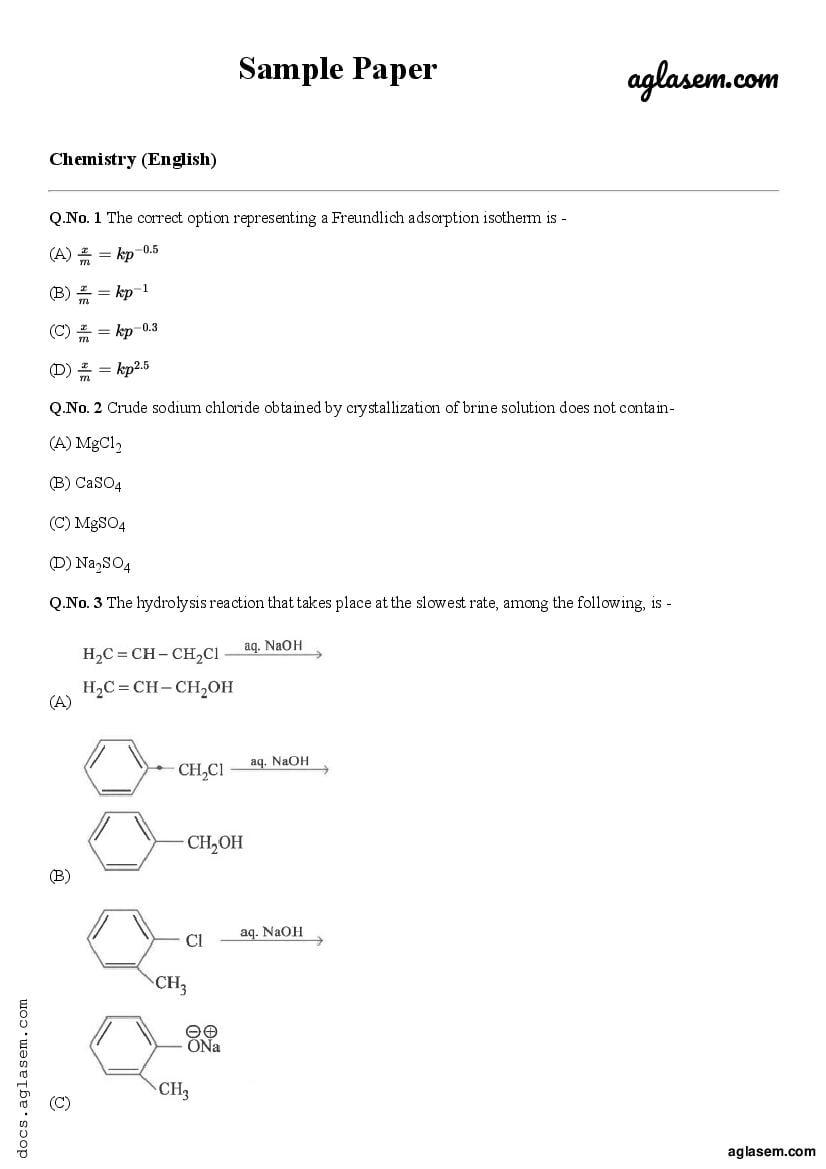
Chemistry (English)
Q.No. 1 The correct option representing a Freundlich adsorption isotherm is -
(A) x
m
= kp
−0.5
(B) x
m
= kp
−1
(C) x
m
= kp
−0.3
(D) x
m
= kp
2.5
Q.No. 2 Crude sodium chloride obtained by crystallization of brine solution does not contain-
(A) MgCl2
(B) CaSO4
(C) MgSO4
(D) Na2SO4
Q.No. 3 The hydrolysis reaction that takes place at the slowest rate, among the following, is -
(A)
(B)
(C)
Page 2
Q.No. 4 Match the catalyst with the process
(A) (i)- a, (ii)-c, (iii)-b, (iv)-d
(B) (i)- c, (ii)-a, (iii)-d, (iv)-b
(C) (i)- c, (ii)-d, (iii)-a, (iv)-b
(D) (i)- a, (ii)-b, (iii)-c, (iv)-d
Q.No. 5 The method used to remove temporary hardness of water is:
(A) Calgon’s method
(B) Clark’s method
(C) Ion-exchange method
(D) Synthetic resins method
Q.No. 6 The Crystal Field Stabilisation Energy (CFSE) For [Cocl6]4- is 18000 cm-1 . The CFSE for [Cocl4]2-
will be
(A) 1800 cm-1
(B) 8000 cm-1
(C) 6000 cm-1
(D) 16000 cm-1
Q.No. 7 Which of the following reactions are disproportionation reaction ? [a] 2Cu+ → Cu2+ + Cu0 [b]
3MnO2-4 + 4H+ --> 2MnO4 +MnO2 +2H2O [c] 2KMnO4 ----> K2MnO4 + MnO4 + O2 [d] 2MnO4 + 3Mn2+
+2H2O > 5MnO2 + 4H+ Select the correct option from the following :
(A) [a] and [b] only
(B) [a], [b] and [c]
(C) [a], [b] and [d]
Page 3
Q.No. 8 A gas at 350 K and 15 bar has molar volume 20 percent smaller than that for an ideal gas under the
same conditions. The correct option about the gas and its compressibility factor (Z) is:
(A) Z > 1 and attractive forces are dominant
(B) Z > 1 and repulsive forces are dominant
(C) Z < 1 and attractive forces are dominant
(D) Z < 1 and repulsive forces are dominant
Q.No. 9
The structure of intermediate A in the following reaction, is:
(A)
(B)
(C)
Page 4
Q.No. 10 The compound that is most difficult to protonate is:
(A)
(B)
(C)
(D)
Q.No. 11 The artificial sweetener stable at cooking temperature and does not provide calories is -
(A) sucralose
(B) alitame
(C) saccharin
(D) aspartame
Q.No. 12 Which mixture of the solutions will lead to the formation of negatively charged colloidal sol ?
(A) 50 mL of 1 M AgNO3 + 50 mb of 1.5M KI
(B) 50 mL of 1 M AgNO3 + 50 mL of 2M KI
(C) 50mL of 2 M AgNO3 + 50 mL of 1.5 M KI
(D) 50mL of 0.1 M AgNO3 + 50 mL of 0.1 M KI
Q.No. 13 A first order reaction has a rate constant of 2.303 X 10⁻³s-1. The time required for 40g of this
reactant to reduce to 10g will be- [Given that log102 = 0.3010 J
(A) 2000 s
Page 5
(C) 230.3 s
(D) 301 s
Q.No. 14 The major products C and D formed in the following reaction respectively are
H 3 C − CH 2 − CH 2 − O − C(CH 3 )
3
excess HI
,C + D
Δ
H 3 C − CH 2 − CH 2 − I
(A)
and HO − C(CH 3 ) 3
H 3 C − CH 2 − CH 2 − I
(B)
and I − C(CH 3 )
3
H 3 C − CH 3 − CH 2 − I
(C)
and I − C(CH 3 )
3
H 3 C − CH 2 − CH 2 − OH
(D)
and I − C(CH 3 ) 3
Q.No. 15 Under isothermal condition, a gas at 300 K expands from 0.1 L to 0.25 L against a constant
external pressure of 2 bar. The work done by the gas is: . [Given that 1 Lbar = 100 J]
(A) -30 J
(B) 5 kJ
(C) 25 J
(D) 30 J
Q.No. 16 The polymer that is used as a substitute for wool in making commercial fibres is -
(A) polyacrylonitrile
(B) Buna - N
(C) melamine
(D) nylon -6,6
Q.No. 17 The density of 2M aqueous solution of NaoH is 1.28 g/cm3.The molality of the solution is [Given
that molecular mass of of NaOh = 40 g mol-1
(A) 1.67 m
(B) 1.32 m
(C) 1.20 m
(D) 1.56 m
Q.No. 18 Aluminium chloride in acidified aqueous solution a complex ‘A’ in Which hybridisation state of A1
is B ‘. What are 'A' and ‘B’ respectively ?
Page 6
2 4
3+
(B) [Al(H O) ] , d2sp3
2 6
3+
(C) [Al(H O) ] , sp3d2
2 6
3+
(D) [Al(H O) ] , sp3
2 4
3+
Q.No. 19 Which of the following species is not stable ?
(A) [SiF6]2-
(B) [GeCl6]2-
(C) [Sn(OH)6]2-
(D) [SiCl6]2-
Q.No. 20 Orbital having 3 angular nodes and 3 total nodes is -
(A) 4 f
(B) 6 d
(C) 5 p
(D) 2 d
Q.No. 21 The number of moles of hydrogen molecules required to produce 20 moles of ammonia through
Haber’s process is :
(A) 10
(B) 20
(C) 30
(D) 40
Q.No. 22 Among the following, the reaction that proceeds through an electrophilic substitution, is :
(A)
(B)
Page 7
(D)
Q.No. 23 Which will make the basic buffer ?
(A) 50 mL of 0.1 M NaOH +25 mL of 0.1 M CH3COOH
(B) 100 mL of 0.1M CH3COOH + 100 mL of 0.1 M NaOH
(C) 100 mL of 0.1 M HCl + 200 mL of 0.1 M NH4OH
(D) 100 mL of 0.1 M HCl + 100 mL of 0.1M NaOH
Q.No. 24 Which of the following compounds is used in cosmetic surgery ?
(A) Silicones
(B) Zeolites
(C) Silica
(D) Silicates
Q.No. 25 The molar solubility of CaF2 (Ksp=5.3 x 10⁻¹¹) in 0.1 M solution of NaF will be -
(A) 5.3 x 10⁻⁹ mol L-1
(B) 5.3 x 10⁻¹⁰ mol L-1
(C) 5.3 x 10⁻¹¹ mol L-1
(D) 5.3 x 10⁻⁸ mol L-1
Q.No. 26 For the cell reaction 2Fe3+ (aq) + 2I- (aq) --> 2Fe2+ (aq) + I2(aq) Ecell = 0.24 V at 298 K.
The.standard Gibbs energy (ΔrG°) of the cell reaction is : [Given that Faraday constant F = 96500 C mol-1]
(A) -46.32kd mol-1
(B) -23.16kJ mol-1
(C) 46.32k3 mol-1
(D) 23.16kJ mol-1
Q.No. 27 Following limiting molar conductivities are given as λ o
m(H 2 SO 4 )
2
= xScm mol
−1
λ
o
m(K 2 SO 4 )
2
= xScm mol
−1 ∘ 2
λ m (CH 3 COOK) = zScm mol
−1 ∘
λ m ( in Scm mol
2 −1
)f or CH 3 COOH Will be
Page 8
(B)
(x−y)
+ z
2
(C) x - y + 2z
(D) x + y + z
Q.No. 28 Identify the correct formula of ‘oleum’ from the following.
(A) H2SO4
(B) H2S2O8
(C) H2S2O7
(D) H2SO3
Q.No. 29 For the second. period elements the correct increasing order of first ionisation enthalpy is:
(A) Li < Be < B < C < N < O < F < Ne
(B) Li < B < Be < C < O < N < F < Ne
(C) Li < B < Be < C < N < O < F < Ne
(D) Li < Be < B < C < O < N < F < Ne
Q.No. 30 An ideal gas expands isothermally from 10-3m3 to 10-2m3 at 300k against a constant pressure of
105 Nm-2. The work done on the gas is -
(A) + 900 Kj
(B) - 900 Kj
(C) + 270KJ
(D) - 900 J
Q.No. 31 Among the following, the narrow spectrum antibiotic is :
(A) penicillin G.
(B) ampicillin
(C) amoxicillin
(D) chloramphenicol
Q.No. 32 The most suitable reagent for the following conversion, is :
(A) Na/liquid NH3
Page 9
(C) Zn/HCl
(D) Hg2+/H-, H2O
Q.No. 33 The standard electrode potential (E) values of Al3+Al, Ag+/Ag, K+/K and Cr3+/Cr are -1.66V, 0.80
V, -2.93 V and -0.74V, respectively. The correct decreasing order of reducing power of the metal is-
(A) K > Al > Ag > Cr
(B) Al > K > Ag > Cr
(C) Ag > Cr > Al > K
(D) K > Al > Cr > Ag
Q.No. 34 Which of the following diatomic molecular species has only π bonds according to Molecular
Orbital Theory ?
(A) O2
(B) N2
(C) C2
(D) Be2
Q.No. 35 In which case change in entropy is negative ?
(A) Evaporation of water
(B) Expansion of a gas at constant temperature
(C) Sublimation of solid to gas
(D) 2H(g) --> HC2(g)
Q.No. 36 For a cell involving one electron Egjy= 0.59 V at 298 K, the equilibrium constant for the cell
reaction is: [Given that a = 2.303/F =0.059 V at T = 298 K]
(A) 1.0 x 10²
(B) 1.0 x 10²
(C) 1.0 x 10¹⁰
(D) 1.0 x 1030
Q.No. 37 For the chemical reaction N2(g) + 3H2(g) ⇌ 2NH3(g) The correct option is
(A)
Page 10
(C)
(D)
Q.No. 38 Which of the following is the correct order of dipole moment ?
(A) BF3 < NH3 < NF3 < H2O
(B) H2O < NF3 < NH3 < BF3
(C) NH3 < BF3 < NF3 < H2O
(D) BF3 < NF3 < NH3 < H2O
Q.No. 39 The volume occupied by 1.8g of water vapour at 374°C and 1 bar pressure will be - [Use R = 0.083
bar LK-1 mol-1]
(A) 3.10 L
(B) 5.37 L
(C) 96.66 L
(D) 55.87 L
Q.No. 40 Which of the following series of transitions in the spectrum of hydrogen atom falls in visible
region ?
(A) Lyman series
(B) Balmer series
(C) Paschen series .
(D) Brackétt series -
Q.No. 41 Which of the following is an amphoteric hydroxide ?
(A) Sr(OH)2
(B) Ca(OH)2
(C) MgOH2
(D) Be(OH)2
Page 11
M is:
(A) Be
(B) Mg
(C) Ca
(D) Sr
Q.No. 43 The pH of 0.01 M NaOH (aq) solution will be
(A) 12
(B) 9
(C) 7.01
(D) 2
Q.No. 44 What is the correct electronic configuration of the central atom in K4[Fe(CN)6] based on crystal
field theory ?
(A)
(B)
(C)
(D)
Q.No. 45 Reversible expansion of an gas under isothermal and adiabatic conditions are as shown in the
figure; AB --> Isothermal Expansion AC --> Adiabatic
expansion Which of the following options is not correct ?
(A) wisothermal > wadiabatic
(B) TC > TA
Page 12
(D) TA > TB
Answer Sheet
Q.No Answer
Q.No. 1 (C)
Q.No. 2 (B)
Q.No. 3 (C)
Q.No. 4 (C)
Q.No. 5 (B)
Q.No. 6 (A)
Q.No. 7 (A)
Q.No. 8 (C)
Q.No. 9 (B)
Q.No. 10 (D)
Q.No. 11 (A)
Q.No. 12 (A)
Q.No. 13 (B)
Q.No. 14 (C)
Q.No. 15 (D)
Q.No. 16 (A)
Q.No. 17 (D)
Q.No. 18 (C)
Q.No. 19 (D)
Q.No. 20 (C)
Q.No. 21 (C)
Q.No. 22 (B)
Q.No. 23 (C)
Q.No. 24 (B)
Q.No. 25 (A)
Q.No. 26 (A)
Q.No. 27 (B)
Q.No. 28 (A)
Q.No. 29 (B)
Q.No. 30 (D)
Q.No. 31 (A)
Q.No. 32 (B)
Page 13
Q.No. 34 (C)
Q.No. 35 (D)
Q.No. 36 (C)
Q.No. 37 (C)
Q.No. 38 (B)
Q.No. 39 (A)
Q.No. 40 (B)
Q.No. 41 (D)
Q.No. 42 (B)
Q.No. 43 (A)
Q.No. 44 (B)
Q.No. 45 (B)
Document Details
| Board / Org | NTA |
| Exam | NEET UG |
| Type | Sample Paper |
| Pages | 13 |
| Updated | 29 Aug 2026 |