Finished viewing? Save it for later —
Download NEET Sample Paper Physics (PDF · 14 pages)About NEET Sample Paper Physics
NEET Sample Paper Physics is available here for free download. Published by NTA for NEET UG, this sample paper can be viewed online or downloaded as a PDF (14 pages). Candidates preparing for NEET UG can use NEET Sample Paper Physics to understand the exam pattern, the type of questions asked, and the overall difficulty level.
Frequently Asked Questions
How can I download NEET Sample Paper Physics?
Open this page and click the Download button to save NEET Sample Paper Physics as a PDF. It is completely free on AglaSem Docs.
Is NEET Sample Paper Physics free to download?
Yes. NEET Sample Paper Physics can be viewed online and downloaded as a PDF free of cost on AglaSem Docs.
How many pages does NEET Sample Paper Physics have?
NEET Sample Paper Physics contains 14 pages, which you can read online or download together as a single PDF.
Where can I find more NEET UG study material?
You can find more NEET UG question papers, sample papers, syllabus, and answer keys on AglaSem Docs.
NEET Sample Paper Physics – Text
Read the full text of this sample paper below — useful to quickly search, copy and reference the content online without downloading the PDF.
📄 View text version (14 pages)
Page 1
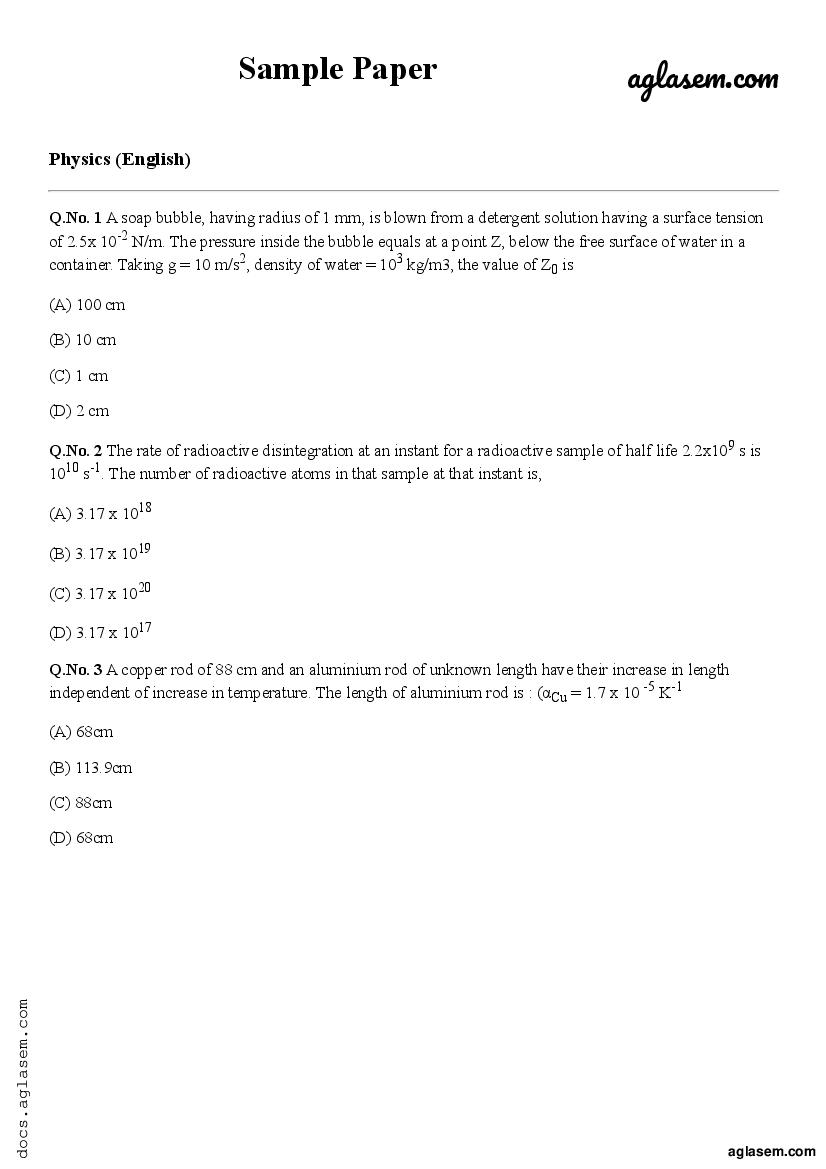
Physics (English)
Q.No. 1 A soap bubble, having radius of 1 mm, is blown from a detergent solution having a surface tension
of 2.5x 10⁻² N/m. The pressure inside the bubble equals at a point Z, below the free surface of water in a
container. Taking g = 10 m/s2, density of water = 103 kg/m3, the value of Z0 is
(A) 100 cm
(B) 10 cm
(C) 1 cm
(D) 2 cm
Q.No. 2 The rate of radioactive disintegration at an instant for a radioactive sample of half life 2.2x10⁹ s is
1010 s-1. The number of radioactive atoms in that sample at that instant is,
(A) 3.17 x 10¹⁸
(B) 3.17 x 10¹⁹
(C) 3.17 x 10²⁰
(D) 3.17 x 10¹⁷
Q.No. 3 A copper rod of 88 cm and an aluminium rod of unknown length have their increase in length
independent of increase in temperature. The length of aluminium rod is : (αCu = 1.7 x 10 -5 K-1
(A) 68cm
(B) 113.9cm
(C) 88cm
(D) 68cm
Page 2
loop is R. The total magnetic fields along the two loops is,
(A) 3μ0i/32 R, inward
(B) μ0i
2R
(C) zero
(D) 3μ0i/32 R, outward
Q.No. 5 In a u-tube as shown in the fig. water and oil are in the len side and right side of the tube
respectively. The heights from the bottom for water and oil columns are 15 cm and 20 cm respectively. The
density of the oil is [take-ρwater = 1000 kg/m3
(A) 1000 kg/m3
(B) 1333 kg/m3
(C) 1200 kg/m3
(D) 750 kg/m3
Q.No. 6 In a Young's double slit experiment, if there is no initial phase difference between the light from the
two slits. A point on the screen corresponding to the fifth minimum has path difference.
(A) 5 λ
2
(B) 9 λ
2
(C) 10 λ
2
(D) 11 λ
2
Page 3
distance of 2R in free space. What is the electric field mid - way between the two line charges ?
(A) zero
(B) 2λ
πϵ0R
N/C
(C) λ
πϵ0R
N/C
(D) λ
2πϵ0R
N /C
Q.No. 8 In total internal reflection when the. angle of incidence is equal to the critical angle for the pair of
media in contact, what will. be angle of refraction ?
(A) 180°
(B) 0°
(C) equal to angle of incidence.
(D) 90°
Q.No. 9 The relations amongst the three elements of earth'S magnetic field, namely horizontal component H,
vertical component V and dip 𝛿 are, (BE = total magnetic field)
(A) V = BEcos 𝛿 , H = BE𝛿
(B) V = BE H = BE tan
(C) V = BE tan 𝛿 H = BE
(D) V = BE sin 𝛿, H= BE cos 𝛿
Q.No. 10 The unit of thermal conductivity is :
(A) J m K -1
(B) Jm-1K-1
(C) Wm-1
(D) W-1K-1
Q.No. 11 When a block of mass M is suspended by a long wire of length L, the length of the wire becomes
(L+l). The elastic potential energy stored in the extended wire is:
(A) Mgl
(B) MgL
(C) 1/2 Mgl
(D) 1/2 MgL
Q.No. 12 Angular Width of the central maxima in the Fraufifer diffraction for λ = 6000 Å is θ0. When the
same Slit is illuminated by another monochromatic light, the angular width decreases by 30%. wavelength of
this light is,
Page 4
(B) 420 Å
(C) 1800 Å
(D) 4200 Å
Q.No. 13 The value of γ (= c /c ) , for hydrogen, helium and another ideal diatomic gas X (whose
p v
molecules are not rigid but have an additional vibrational mode), are respectively equal to,
(A) 5/3, 7/5, 7/5
(B) 7/5, 5/3, 7/5
(C) 7/5, 5/3, 9/7
(D) 5/3, 7/5, 9/7
Q.No. 14 The work function of a photosensitive material is 4.0 eV, longest wavelength of light that can cause
photon emission from the is (approximately)
(A) 31 nm
(B) 310 nm
(C) 3100
(D) 966 nm
Q.No. 15 An LED is constructed from a p-n junction diode using GaAsP. The energy gap is 1.9 eV. The
wavelength of the light emitted will equal to
(A) 654 Å
(B) 654 x 10-11m
(C) 10.4 x 10⁻²⁶m
(D) 654 nm
Q.No. 16 An equiconvex lens has power P. It is cut into two symmetrical halves by a plane principal axis.
The power of one part will be,
(A) P/4
(B) P
(C) 0
(D) P/2
Q.No. 17 A force F = 20 + 10y acts on a particle in y-direction where F is in newton and yin meter. Work
done by this force to move the particle from y = 0 to y = 1m is:
(A) 30 J
(B) 5 J
(C) 25 J
Page 5
Q.No. 18 A hollow metal sphere-of radius R is uniformly charged. The electric field due to the sphere at a
distance r from the centre
(A) increases as r increases for r < R and for r > R
(B) zero as r increases for r < R, ‘decreases as r increases for r > R
(C) zero as r increases for r' < R, increases as r increases for r > R
(D) decreases as r increases for r < R and for r > R
Q.No. 19 The metre bridge shown is in balance position with P
=
Q
. If we now interchange the positions
l1
l2
of galvanometer and cell ,will the bridge work ? If yes, what will be the balance condition ?
(A) yes, P
Q
=
l2
l1
(B) yes, P
Q
=
l1
l2
(C) yes, P
Q
=
l2−l1
l2+l1
(D) no, no null point
Q.No. 20 Average velocity of a particle executing SHM in one complete vibration is :
(A) Aω/2
(B) Aω
2
(C) Aω
2
(D) zero
Page 6
Q.No. 21 A particle moving with velocity V is acted by three forces shown by the vector triangle PQR. The
velocity of the particle will:
(A) increase
(B) decrease
(C) remain constant
−→
(D) change according to the smallest force QR
Q.No. 22 Two bullets are fired horizontally and simultaneously towards each other from roof tops of two
buildings 100m apart and of same height of 200 m. with the same velocity of 25 m/s. When and where will
the two bullets collide? (g =10 m/s2)
(A) after 4s at a height of 120 m
(B) they will not collide
(C) after 2s at a height of 180 m
(D) after 2s at a height of 20 m
Q.No. 23 When an object is shot from the bottom of a long smooth inclined plane kept at an angle 60° with
horizontal, it can travel a distance x1, along the plane. But when the inclination is decreased to 30° and the
same object is shot with the same velocity, it can travel x2, distance. Then x1 : x2 will be:
(A) 1 : √2
(B) √2 : 1
(C) 1 : √3
(D) 1 : 2√3
Q.No. 24 ‘Two particles A and B are moving in uniform circular motion in concentric circles of radii rA and
rB with speed vA, and vB respectively. Their “time period of rotation is the same. The ratio of angular speed
of A to that of B will be
(A) rA : rB
(B) vA : vB
(C) rB : rA
(D) 1 : 1
Page 7
(A) OR
(B) NAND
(C) NOR
(D) AND
Q.No. 26 Two identical capacitors C1 and C2 of equal capacitance are connected as shown in the circuit.
Terminals a and b of the key k are connected to charge capacitor C1 using a battery of emf V volt. Now
disconnecting a and b the terminals b and c are connected. Due to this, what will be the percentage loss of
energy ?
(A) 50 %
(B) 25 %
(C) 75 %
(D) 0 %
Q.No. 27 The speed of a swimmer in still water is 20 m/s. The speed of river water is 10 m/s and is flowing
due east. If he is standing on the south bank and wishes to cross the river along the shortest path, the angle at
which he should make his strokes w.r.t. north is given by :
(A) 30° west
(B) 0° west
(C) 60° west
(D) 45° west
Q.No. 28 A cylindrical conductor of radius R is carrying a constant current. The plot of the magnitude of the
magnetic field, B with the distance, d, from the centre of the conductor, is correctly represented by the figure
Page 8
(A)
(B)
(C)
(D)
Q.No. 29 A disc of radius 2 m and mass 100 kg rolls on a horizontal floor. Its centre of mass has speed of 20
cm/s. How much work is needed to stop it ?
(A) 3 J
(B) 30 kJ
(C) 2 J
(D) 1 J
Q.No. 30 Two metal spheres, one of radius R and the other of radius 2R respectively have the same surface
charge density σ. They are brought in contact and separated. What will be the new surface charge densities
on them ?
(A) σ =
1
5
2
σ, σ2 =
5
3
σ
Page 9
1
5
3
σ, σ2 =
5
6
σ
(C) σ =
1
5
6
σ, σ2 =
5
2
σ
(D) σ =1
5
2
σ, σ2 =
5
6
σ
Q.No. 31 The main scale of a vernier callipers has n divisions/cm. n divisions of the vernier scale coincide
with (n -1) divisions of main scale. The least count of the vernier callipers is,
(A) 1
n
2 cm
(B) n(n+1)
1
cm
(C) (n+1)(n−1)
1
cm
(D) 1/n cm
Q.No. 32 The reading of an ideal voltmeter in the circuit shown is.
(A) 0.5 V
(B) 0.4 V
(C) 0.6 V
(D) 0 V
Q.No. 33 A truck is stationary and has a bob suspended by a light string, in a frame attached to the truck. The
truck suddenly moves to the right with an acceleration of a . The pendulum will tilt
(A) to the left and angle of inclination of the pendulum with the vertical is sin −1
(
a
g
)
(B) to the left and angle of inclination of the pendulum with the vertical is tan −1
(
g
a
)
(C) to the left and angle of inclination of the pendulum with the vertical is sin
−1
(
g
a
)
(D) to the left and angle of inclination of the pendulum with the vertical is sin −1
(
a
g
)
Q.No. 34 An electron is accelerated through a potential difference of 10,000 V. Its de Broglie wavelength is,
Nearly : (me= 9 x 10-31 kg)
(A) 12.2 x 10⁻¹³
(B) 12.2 x 10⁻¹²
Page 10
(D) 12.2 nm
Q.No. 35 Ionized hydrogen atoms and «-particles with same momenta enters perpendicular to a constant
magnetic field, B. The ratio of their radii of their paths rH: rα, will be :
(A) 2:1
(B) 1:2
(C) 4:1
(D) 1:4
Q.No. 36 A body of mass m is kept on a rough horizontal surface (coefficient of friction=μ ) = A horizontal
force is applied on the body ,but it does not move. The resultant of normal reaction and the frictional force
acting on the object is given by F, where F is ,
(A) |F→| ≤ mg√1 + μ 2
(B) |F→| = mg
(C) |r→| = mg + μmg
(D) |r→| = μmg
Q.No. 37 1 g of water, of volume 1 cm3 at 100°C, is converted into steam at the same temperature under
normal atmospheric pressure (≃ 1 × 10 P a) . The volume of steam formed equals 1671 crn3. If the specific
5
latent heat of vaporisation of water is 2256 J/g, the change in internal energy is ,
(A) 167 J
(B) 2256 J
(C) 2423 J
(D) 2089 J
Q.No. 38 A proton and an α- particle are accelerated from rest to the same energy. The de Broglie
wavelengths λp and λα in the ratio,
(A) √2 : 1
(B) 4 : 1
(C) 2 : 1
(D) 1 : 1
Q.No. 39 The total energy of an electron in an atom in an orbit is - 3.4 eV. Its kinetic and potential energies
are, respectively
(A) -3.4 eV, -3.4 eV
(B) -3.4 eV, -6.8 eV
(C) 3.4 eV, -6.8 eV
Page 11
Q.No. 40 The time period of a geostationary satellite is 24 h, at a height 6RE is radius of earth) from the
surface of earth. The time period of another satellite whose height is 2.5 RE from surface will be.
(A) 24
2.5
h
(B) 12
2.5
h
(C) 6 √2 h
(D) 12 √2 h
Q.No. 41 Two small spherical metal balls, having equal masses, are made from materials of densities ρ1 and
ρ2 (ρ1 = 8ρ2) and have radii of 1 mm and 2 mm, respectively, They are made to fall vertically (from rest) in
a viscous medium whose coefficient of viscosity equals and whose density is 0.1 ρ2. The ratio of their
terminal velocities would be,
(A) 39/72
(B) 79/36
(C) 79/72
(D) 19/36
Q.No. 42 The correct Boolean operation represented by the circuit diagram drawn is:
(A) AND
(B) OR
(C) NAND
(D) NOR
Q.No. 43 An object of mass 500g initially at rest, is acted upon by a variable force whose X-component
varies with X in the manner shown. The velocities of the object at the points X= 8 m and X = 12 m , would
Page 12
(A) 23 m/s and 20.6 m/s
(B) 18 m/s and 20.6 m/s
(C) 18 m/s and 24.4 m/s
(D) 23 m/s and 24.4 m/s
Q.No. 44 A 800 turn coil of effective area 0.05 m2 is kept perpendicular to a magnetic field 5x 1075 T. When
the plane of the coil is rotated by 90° around any of its coplanar axis in 0.1 s, the emf induced in the coil will
be :
(A) 2 V
(B) 0.2 V
(C) 2 x 10⁻³ V
(D) 0.02 V
Q.No. 45 A mass m is attached to a thin wire and whirled in a vertical circle. The wire is most likely to break
when:
(A) ‘the mass is at the highest point
(B) the wire is horizontal
(C) the mass is at the lowest point
(D) inclined at an angle of 60° from vertical
Answer Sheet
Q.No Answer
Q.No. 1 (C)
Q.No. 2 (C)
Q.No. 3 (D)
Q.No. 4 (D)
Q.No. 5 (C)
Page 13
Q.No. 7 (C)
Q.No. 8 (D)
Q.No. 9 (B)
Q.No. 10 (D)
Q.No. 11 (C)
Q.No. 12 (D)
Q.No. 13 (D)
Q.No. 14 (A)
Q.No. 15 (D)
Q.No. 16 (B)
Q.No. 17 (C)
Q.No. 18 (B)
Q.No. 19 (A)
Q.No. 20 (D)
Q.No. 21 (C)
Q.No. 22 (A)
Q.No. 23 (C)
Q.No. 24 (D)
Q.No. 25 (A)
Q.No. 26 (C)
Q.No. 27 (A)
Q.No. 28 (C)
Q.No. 29 (A)
Q.No. 30 (B)
Q.No. 31 (D)
Q.No. 32 (C)
Q.No. 33 (B)
Q.No. 34 (B)
Q.No. 35 (A)
Q.No. 36 (A)
Q.No. 37 (C)
Q.No. 38 (D)
Q.No. 39 (C)
(C)
Q.No. 40
Q.No. 41 (A)
Q.No. 42 (C)
Q.No. 43 (C)
Page 14
Q.No. 45 (C)
Document Details
| Board / Org | NTA |
| Exam | NEET UG |
| Type | Sample Paper |
| Pages | 14 |
| Updated | 29 Aug 2026 |