PSEB Syllabus 2020-21 for Class 8 English
Finished viewing? Save it for later —
Download PSEB Syllabus 2020-21 for Class 8 English (PDF · 10 pages)About PSEB Syllabus 2020-21 for Class 8 English
PSEB Syllabus 2020-21 for Class 8 English is available here for free download. Published by Punjab Board for Class 8, this syllabus can be viewed online or downloaded as a PDF (10 pages). Candidates preparing for Class 8 can use PSEB Syllabus 2020-21 for Class 8 English to understand the exam pattern, the type of questions asked, and the overall difficulty level.
Frequently Asked Questions
How can I download PSEB Syllabus 2020-21 for Class 8 English?
Open this page and click the Download button to save PSEB Syllabus 2020-21 for Class 8 English as a PDF. It is completely free on AglaSem Docs.
Is PSEB Syllabus 2020-21 for Class 8 English free to download?
Yes. PSEB Syllabus 2020-21 for Class 8 English can be viewed online and downloaded as a PDF free of cost on AglaSem Docs.
How many pages does PSEB Syllabus 2020-21 for Class 8 English have?
PSEB Syllabus 2020-21 for Class 8 English contains 10 pages, which you can read online or download together as a single PDF.
Where can I find more Class 8 study material?
You can find more Class 8 question papers, sample papers, syllabus, and answer keys on AglaSem Docs.
PSEB Syllabus 2020-21 for Class 8 English – Text
Read the full text of this syllabus below — useful to quickly search, copy and reference the content online without downloading the PDF.
📄 View text version (10 pages)
Page 1
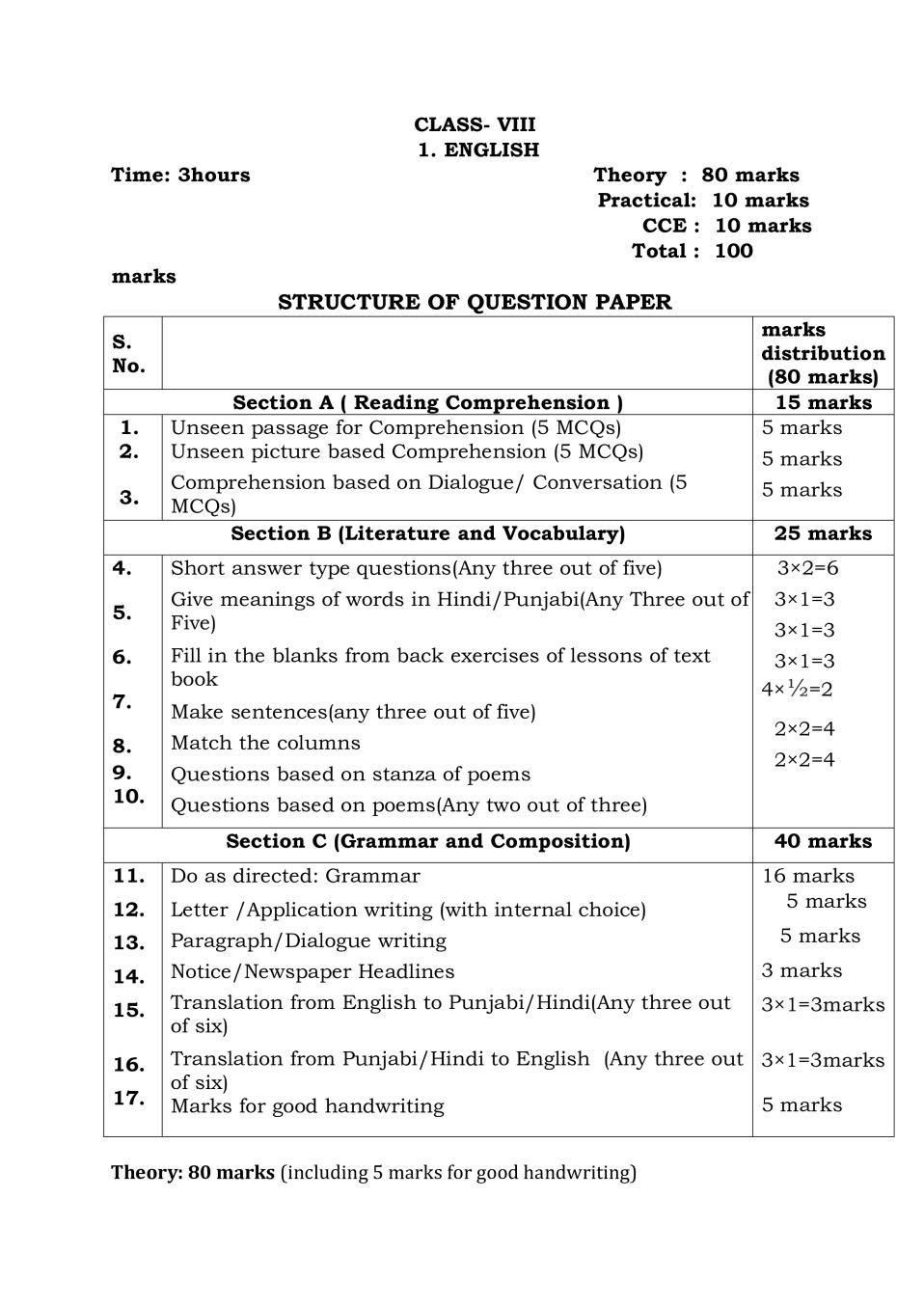
1. ENGLISH
Time: 3hours Theory : 80 marks
Practical: 10 marks
CCE : 10 marks
Total : 100
marks
STRUCTURE OF QUESTION PAPER
marks
S.
distribution
No.
(80 marks)
Section A ( Reading Comprehension ) 15 marks
1. Unseen passage for Comprehension (5 MCQs) 5 marks
2. Unseen picture based Comprehension (5 MCQs) 5 marks
Comprehension based on Dialogue/ Conversation (5 5 marks
3. MCQs)
Section B (Literature and Vocabulary) 25 marks
4. Short answer type questions(Any three out of five) 3×2=6
Give meanings of words in Hindi/Punjabi(Any Three out of 3×1=3
5.
Five) 3×1=3
6. Fill in the blanks from back exercises of lessons of text 3×1=3
book
4×½=2
7. Make sentences(any three out of five)
2×2=4
8. Match the columns
2×2=4
9. Questions based on stanza of poems
10. Questions based on poems(Any two out of three)
Section C (Grammar and Composition) 40 marks
11. Do as directed: Grammar 16 marks
12. Letter /Application writing (with internal choice) 5 marks
13. Paragraph/Dialogue writing 5 marks
14. Notice/Newspaper Headlines 3 marks
15. Translation from English to Punjabi/Hindi(Any three out 3×1=3marks
of six)
16. Translation from Punjabi/Hindi to English (Any three out 3×1=3marks
of six)
17. Marks for good handwriting 5 marks
Theory: 80 marks (including 5 marks for good handwriting)
Page 2
English’ Activities.)
Practical: 10 marks (Listening test =6 marks, Speaking test =4 marks)
Total marks: 100
Note: abbreviations used: q-questions, m-marks
Unit I Reading Skills
1. Unseen Passage for Comprehension
2. Unseen picture based Comprehension (with five multiple choice
questions)
3. Comprehension based on Dialogue/Conversation
Unit II (Textbook)
Lessons
1. Abdul Hamid
2. Say ‘No’ !
3. How Daddy Decided What He Wanted to be
4. Three Questions
5. Our National Symbols
6. The Punjab-A Glimpse
7. Childhood
8. Two Memorable Speeches
9. Saint Ravidas
10. How Daddy Decided What He Wanted to be
11. Three Questions
12. Our National Symbols
13. The Punjab-A Glimpse
14. Childhood
15. Two Memorable Speeches
16. Saint Ravidas
Poems
1. True Growth
2. Abou Ben Adhem
3. This is My Prayer To Thee
4. Sympathy
5. He That Is Down Needs Fear No Fall
Unit-III (GRAMMAR)
I. GRAMMAR
1. Parts of Speech
2. Nouns
3. The Pronoun
4. Adjectives
5. The Verb
6. The Tenses
Page 3
8. The Adverb
9. Non-Finite
10. The Determiners
11. The Sentence
Unit-IV COMPOSITION
1. Letter/Application Writing
2. Notices, Explaining Newspaper Headlines
3. Guided Creative Writing
4. Dialogue Writing
5. Complete an Incomplete Paragraph
Translation from English to Punjabi/Hindi
Lesson- 1 (Abdul Hamid)
1. He was a very brave soldier.
2. This village is on the border.
3. Hamid is sitting in a jeep.
4. The tank catches fire.
5. They are coming nearer.
6. He sees a Pakistani tank.
7. He is their biggest enemy.
8. He is badly wounded.
Lesson – 2 ( Say ‘No’)
9. He was the king’s favourite now.
10. The King trusted Gopal completely.
11. He is very clever and witty.
12. Gopal arrived at the court.
13. Gopal was shocked.
14. They were all very happy.
15. The king looked at Gopal.
16. We are really very sorry.
17. Please forgive us.
Lesson-3 (How Daddy Decided What He Wanted To Be)
18. He wanted to be a night watchman.
19. Who’s that man?
20. He’s a car mechanic.
Page 4
22. It made him angry.
23. He changed his mind.
24. He wanted to be an actor.
25. What are you doing?
26. No one laughed.
Lesson4- (Three Questions)
27. Many wise men came to the king.
28. The hermit was old and weak. 29. He gave his spade to the king.
30. He stood up.
31. I will go back home.
32. The man felt better.
33. You have saved my life.
34. You did not return.
35. He forgave him.
36. The king went out of the hut.
Lesson-5 (Our National Symbols)
37. The saffron is at the top.
38. We call it the Ashoka Chakra.
39. It fills us with pride.
40. We salute our national flag.
41. He was a great poet.
42. Our National Animal is the Tiger.
43. It has three colours.
44. They encourage us.
Lesson-6 (The Punjab- A Glimpse)
45. This dance is full of energy.
46. The country was partitioned.
47. About 1000 people were killed.
48. Punjab suffered a lot.
49. You are right.
50. It is the holiest shrine of the Sikhs.
51. This temple is surrounded by water.
52. It has number of gardens.
53. The temple is double storeyed.
Page 5
55. It is a small town.
Lesson-7 (Childhood)
56. I was only a mediocre student.
57. That was my daily habit.
58. I had misspelt it.
59. I read it with deep interest.
60. To err is human.
61. I could never be tired of seeing it.
62. I used to be very shy.
63. I was put into a primary school.
Lesson-8 (Two Memorable Speeches)
64. The appointed day has come.
65. A new star rises.
66. The future beckons to us.
67. May the star never set!
68. We have hard work ahead.
69. I pity him.
70. We are citizens of a great country.
71. He made this speech in 1893.
Lesson-9 (Saint Ravidas)
72. They sent him to school.
73. Ravidas was the son of a cobbler.
74. The seed was sown.
75. The field was ready.
76. He is our loving father.
77. Saint Ravidas was very humble.
78. He had a charming personality.
79. His end was peaceful.
80. All forms of life are sacred.
Page 6
1. ਆਪਣਾ ਬਸਤਾ ਖੋਲੋ |/ 51. s[;hA feZE/ ofjzd/ j'</
2. ਆਪਣਾ ਨਾਮ ਦਸੋ | /
52. s[;hA M{Zm feT[A p'fbnk</
3. ਗਲ ਨਾ ਕਰੋ | /
4. ਬੁਰੀ ਸੰ ਗਤ ਤੋ ਬਚੋ | /
53. s[;hA nkgDh S[ZNh feZE/ fpskJh</
5. ਵਿਡਆ ਦਾ ਕਿਹਨਾ ਮੰ ਨ /
54. iwks ftZu e"D ;h</
6. e{VQk Bk ybQko'. /
7. ngDk jZE T[Zs/ u[Ze'| / 55. s[jkvk gZek fwZso e'D j?< /
8. ed/ M{m Bk p'b'./
56. nfXnkge B/ eh gVQfJnk< /
9. ਆਪਣਾ ਕੰ ਮ ਪੂਰਾ ਕਰੋ|/
10. rbshnK ;[Xko'./
57. T[;B/ itkp feT[A BjhA fdZsk</
11. w?A EdhnK j'fJnK jK./
12. T[j w{oy BjhA j?./
58. s[;hA feZE/ ik oj/ j'< /
13. w/o/ wksk fgsk ih nfXnkge jB. /
59. s[;hA o'bQk feT[A gk oj/ j'< /
14. n;hA Gkostk;h jK. /
15. wT[;dh G?D pj[s nebwzd j?./
60. s[;hA ed'A nk oj/ j'< /
16. w?B{z s[jkv/ s/ wkD j?. /
61. s[;hA feskp ed'A gVQ oj/ ;h< /
17. ਪਾਣੀ ਸਾਫ਼ ਹੈ| /
18. ਉਹ ਬਹੁਤ ਮਤਲਬੀ ਹੈ|/
62. s[;hA eZbQ eh eo oj/ ;h< /
19. ਘਾਹ ਹਰੀ-ਭਰੀ ਹੈ| /
63. s[;hA ezw ed'A eo'r/< /
20. w?A nZi mhe wfj;{; BjhN eo fojk jK. /
64. T[j ;tkb feZdk jZb eo/rh< /
21. w? o'ia ;e{b iKdk jK. /
Page 7
23. ;G B/ gkm :kd eo fbnk j?. / 66. T[j gkoNh s/ feT[A BjhA nkt/rh< /
24. w?A ngDk iBwfdB wBkfJnk. / 67. eh s[;hA itkp fby fbnk j?< /
68. eh T[;B/ gkm :kd eo fbnk j?< /
25. w/o/ fgsk ih piako ikDr/./
69. T[;B/ ngDk xo feT[A p/u fdZsk< /
26. oZp w/oh wdd eo/rk. /
70. eh T[jBK B/ w?u fiZs fbnk ;h< /
27. T[j s/ia d'V fojk j?./
28. ugVk;h xzNh BjhA pik fojk j?./ 71. T[j gohfynk ftZu fe; soQK gk; j' frnk<
/
29. ftfdnkoEh gVQ oj/ j'Dr/. /
30. fe;kB nokw BjhA eo oj/ j'Dr/. / 72. eh w?A nzdo nk iktK< /
31. ;[;ahbk B/ nkgDk ezw eo fbnk j?. /
73. eh T[jBK B/ w?u fiZs fbnk ;h< /
32. w/o/ nfXnkge B/ ekgh u?Ze eo bJh j?. /
74. T[j gohfynk ftZu fe; soQK gk; j' frnk<
/
33. w[zfvnK B/ e[o;ah BjhA s'VQh j?. /
।
75. eh w?A nzdo nk iktK< /
34. w?B{z fJZe B"eoh fwb rJh j?. /
76. eh w?A pkjo uZbk iktK< /
35. fe;/ B/ w?B{z p[bkfJnk j?./
77. eh T[j s?o ;edh j?< /
36. w'jB B/ fJZe rhs rkfJnk j?. /
Page 8
38. g[fb; B/ u"o BjhA cfVnk j?./
79. ;kB{z nkgD/ jZE G'iB s'A gfjbK E'B/ ukjhd/
jB</
39. T[j fJ; ;kb gk; BjhA j'fJnk j?./
80. w?B{z j[D ;'Dk ukjhdk j?< /
40. w/o/ nzeb B/ w?B{z s'jca/ ftZu xVh fdZsh./
41. T[;B/ ;Zu BjhA p'fbnk./ 81. o'jB ebQ iao{o nkt/rk. /
42. w?B T[; fdB{z p[yko ;h./ 82. nkU y/vhJ/. /
83. nkU ukj gh bU. /
84. w?B{z fJZe ;tkb g[SD fdU. /
43. n;hA vkeNo B{z p[bQk fbnk ;h./
85. gowkswk s[jkv/ T[Zs/ fwjo eo/. /
44. p[ZY/ nkdwh B/ fJZe xo pDkfJnk./
86. gqwkswk s[jkvh T[Zwo bzph eo/ |/
45. n;hA pj[s wiak eo u[Ze/ ;h./
87. i?;/ e' s?;k | /
46. ;[Xk B/ y/v y/vh ;h./
88. eo GbQk, j' Gbk | /
47. w/oh ;j/bh B/ wdd ehsh ;h./
89. p[oh ;zrs Bkb'A fJZebk Gbk | /
48. fpZbh B/ d[ZX BjhA ghsk ;h./
90. p[oh ;zrs Bkb'A fJZebk Gbk | /
49. ;'B{z B/ s?B{z XZek BjhA wkfonk ;h |/
91. i' roid/ jB T[j po;d/ BjhA | /
50. dkdh B/ uzrh ejkDh ;[DkJh ;h |/
92. feBQK ;'jDk Biakok j?. /
Page 9
94. jkJ/! w?A popkd j' frnk. /
95. ;akp;ak! s[;hA pj[s tZXhnk ehsk. /
!
96. fwjBs eo' BjhA s/ s[;hA c/b j' ikt'r/./
97. oZp dk ;a[eo j?./
98. feogk eoe/ g/ia gbN'./
99. ;kca ;kca fby'. /
100. ;w/A f;o oj'. /
PRESCRIBED BOOKS
1. Textbook for Class VIII, prescribed by Punjab School
Education Board.
2. Grammar and Composition for Class VIII, prescribed by
Punjab School Education Board.
FOLLOWING ARE TO BE DELETED (This portion will neither be taught nor
evaluated).
Sr No. Book/ Topic Lesson No. Lesson / Topic to be
deleted
1. Reader 6 A Robot called Makito
2. Reader 11, 12 Our civilization I and II
3. Reader (Poem) 4 Lucy Gray
1. Paragraphs:
1. An Indian Farmer (Page No. 161)
2. The Police Man (Page No. 162)
3. A Visit to a Hospital (Page No. 162)
4. A Volley Ball Match (Page No. 162)
Page 10
6. Visit of Political Leader (page No. 173)
7. A Day after the examination (page No. 173)
8. An Indian Beggar (page No. 173)
9. My Aim in Life (page No. 173)
10. The Baisakshi Fair (page No. 173)
2. Letter and Applications:
1. Application to the Head Master for Sick Leave. (page No.
152)
2. Application to the Head Master to grant full fee
concession (page No. 152) 3. Application to the Head
Master to remit the fine (page No. 152).
4. Application to the Principal to issue school leaving
certificate (page No. 152)
5. Application to the Head Mistress to exempt you from the
examination (page No. 152)
6. Letter to the elder brother to send money for fees and
books (page No. 153)
7. Letter to the uncle requesting to buy a new bicycle (page
No. 153)
8. Letter to the friend for invitation on sister’s wedding.
(page No. 153)
9. Letter to your elder sister giving details of the celebration
of the Diwali festival (page No. 153)
10. Letter to your younger brother advising him to take part
in games. (page No. 153)
11. Letter to your friend telling him how you celebrated your
birthday (page No. 153)
12. Letter to your friend inquiring about his health (page No.
153) 13. Letter to your friend congratulating him on his
success (page No. 153) 3. Dialogues:
1. Exercise No. 4 (page No. 167)
2. Exercise No. 5 (Page No. 168)
3. Exercise No. 6 (Page No. 168)