Teaching Material Class 7, Class 8, Class 9, Class 10 History First War of Independence - Text
Finished viewing? Save it for later —
Download Teaching Material Class 7, Class 8, Class 9, Class 10 History First War of Independence - Text (PDF · 4 pages)About Teaching Material Class 7, Class 8, Class 9, Class 10 History First War of Independence - Text
Teaching Material Class 7, Class 8, Class 9, Class 10 History First War of Independence - Text is available here for free download. Published by NCERT for Class 7, this teaching material can be viewed online or downloaded as a PDF (4 pages). Candidates preparing for Class 7 can use Teaching Material Class 7, Class 8, Class 9, Class 10 History First War of Independence - Text to understand the exam pattern, the type of questions asked, and the overall difficulty level.
Frequently Asked Questions
How can I download Teaching Material Class 7, Class 8, Class 9, Class 10 History First War of Independence - Text?
Open this page and click the Download button to save Teaching Material Class 7, Class 8, Class 9, Class 10 History First War of Independence - Text as a PDF. It is completely free on AglaSem Docs.
Is Teaching Material Class 7, Class 8, Class 9, Class 10 History First War of Independence - Text free to download?
Yes. Teaching Material Class 7, Class 8, Class 9, Class 10 History First War of Independence - Text can be viewed online and downloaded as a PDF free of cost on AglaSem Docs.
How many pages does Teaching Material Class 7, Class 8, Class 9, Class 10 History First War of Independence - Text have?
Teaching Material Class 7, Class 8, Class 9, Class 10 History First War of Independence - Text contains 4 pages, which you can read online or download together as a single PDF.
Where can I find more Class 7 study material?
You can find more Class 7 question papers, sample papers, syllabus, and answer keys on AglaSem Docs.
Teaching Material Class 7, Class 8, Class 9, Class 10 History First War of Independence - Text – Text
Read the full text of this teaching material below — useful to quickly search, copy and reference the content online without downloading the PDF.
📄 View text version (1 page)
Page 1
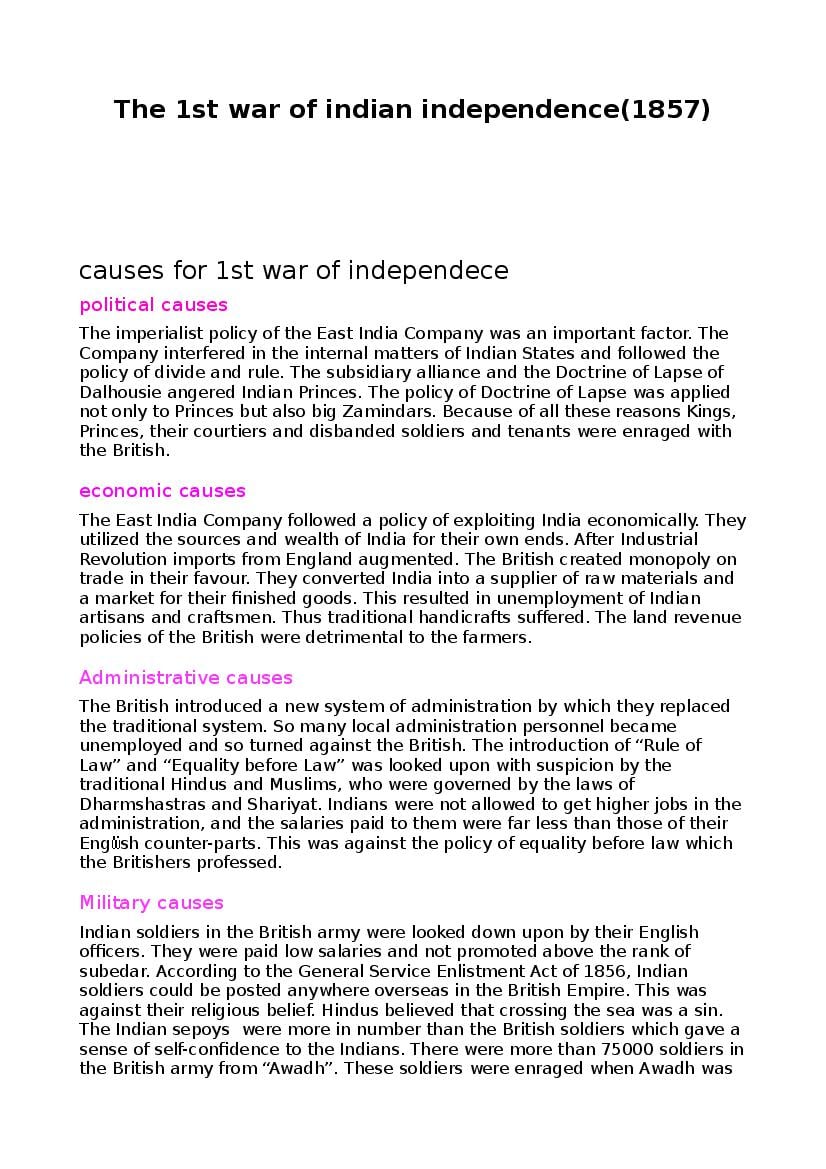
causes for 1st war of independece
political causes
The imperialist policy of the East India Company was an important factor. The
Company interfered in the internal matters of Indian States and followed the
policy of divide and rule. The subsidiary alliance and the Doctrine of Lapse of
Dalhousie angered Indian Princes. The policy of Doctrine of Lapse was applied
not only to Princes but also big Zamindars. Because of all these reasons Kings,
Princes, their courtiers and disbanded soldiers and tenants were enraged with
the British.
economic causes
The East India Company followed a policy of exploiting India economically. They
utilized the sources and wealth of India for their own ends. After Industrial
Revolution imports from England augmented. The British created monopoly on
trade in their favour. They converted India into a supplier of raw materials and
a market for their finished goods. This resulted in unemployment of Indian
artisans and craftsmen. Thus traditional handicrafts suffered. The land revenue
policies of the British were detrimental to the farmers.
Administrative causes
The British introduced a new system of administration by which they replaced
the traditional system. So many local administration personnel became
unemployed and so turned against the British. The introduction of “Rule of
Law” and “Equality before Law” was looked upon with suspicion by the
traditional Hindus and Muslims, who were governed by the laws of
Dharmshastras and Shariyat. Indians were not allowed to get higher jobs in the
administration, and the salaries paid to them were far less than those of their
English counter-parts. This was against the policy of equality before law which
the Britishers professed.
Military causes
Indian soldiers in the British army were looked down upon by their English
officers. They were paid low salaries and not promoted above the rank of
subedar. According to the General Service Enlistment Act of 1856, Indian
soldiers could be posted anywhere overseas in the British Empire. This was
against their religious belief. Hindus believed that crossing the sea was a sin.
The Indian sepoys were more in number than the British soldiers which gave a
sense of self-confidence to the Indians. There were more than 75000 soldiers in
the British army from “Awadh”. These soldiers were enraged when Awadh was
Showing the first page only. Download the PDF above for the complete document.
Document Details
| Board / Org | NCERT |
| Exam | Class 7 |
| Type | Teaching Material |
| Pages | 4 |
| Updated | 30 Apr 2026 |