MBOSE Class 12 Question Paper 2019 for Anthroplogy
Finished viewing? Save it for later —
Download MBOSE Class 12 Question Paper 2019 for Anthroplogy (PDF · 7 pages)About MBOSE Class 12 Question Paper 2019 for Anthroplogy
MBOSE Class 12 Question Paper 2019 for Anthroplogy is available here for free download. Published by Meghalaya Board for Class 12, this question paper can be viewed online or downloaded as a PDF (7 pages). Candidates preparing for Class 12 can use MBOSE Class 12 Question Paper 2019 for Anthroplogy to understand the exam pattern, the type of questions asked, and the overall difficulty level.
Frequently Asked Questions
How can I download MBOSE Class 12 Question Paper 2019 for Anthroplogy?
Open this page and click the Download button to save MBOSE Class 12 Question Paper 2019 for Anthroplogy as a PDF. It is completely free on AglaSem Docs.
Is MBOSE Class 12 Question Paper 2019 for Anthroplogy free to download?
Yes. MBOSE Class 12 Question Paper 2019 for Anthroplogy can be viewed online and downloaded as a PDF free of cost on AglaSem Docs.
How many pages does MBOSE Class 12 Question Paper 2019 for Anthroplogy have?
MBOSE Class 12 Question Paper 2019 for Anthroplogy contains 7 pages, which you can read online or download together as a single PDF.
Where can I find more Class 12 study material?
You can find more Class 12 question papers, sample papers, syllabus, and answer keys on AglaSem Docs.
MBOSE Class 12 Question Paper 2019 for Anthroplogy – Text
Read the full text of this question paper below — useful to quickly search, copy and reference the content online without downloading the PDF.
📄 View text version (7 pages)
Page 1
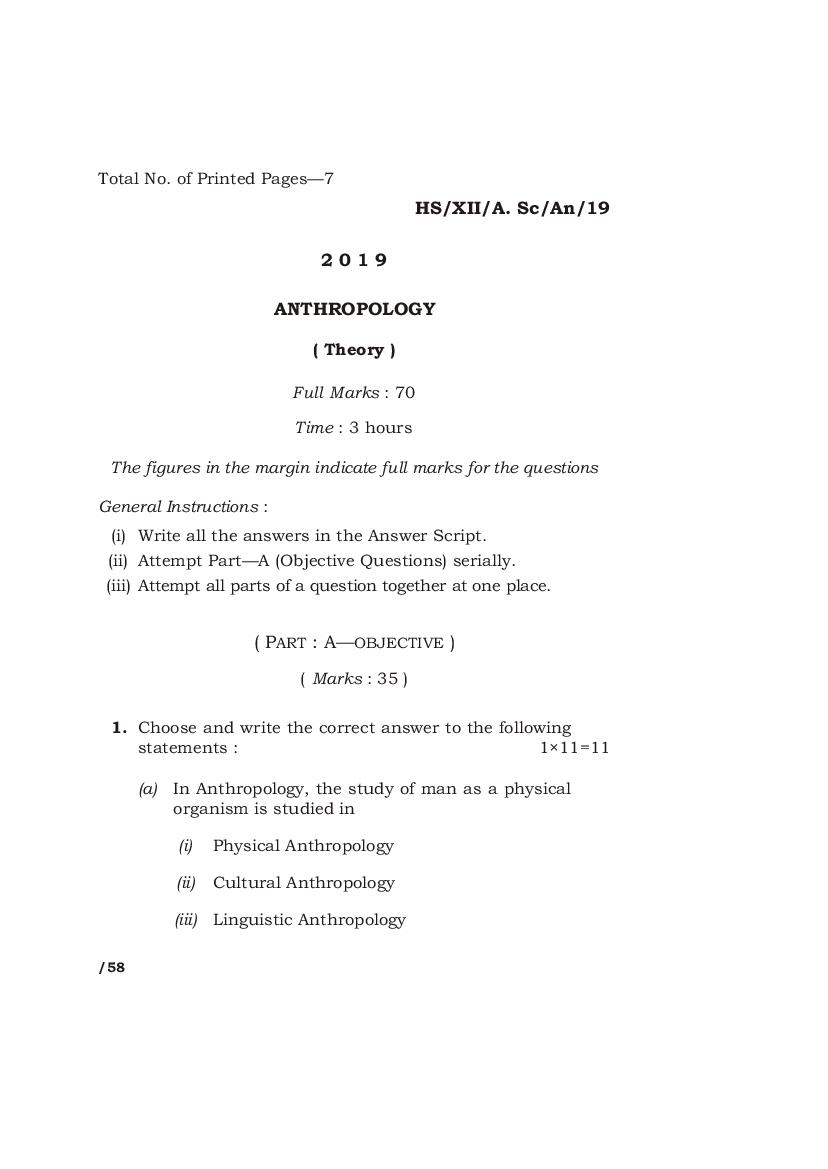
HS/XII/A. Sc/An/19
2019
ANTHROPOLOGY
( Theory )
Full Marks : 70
Time : 3 hours
The figures in the margin indicate full marks for the questions
General Instructions :
(i) Write all the answers in the Answer Script.
(ii) Attempt Part—A (Objective Questions) serially.
(iii) Attempt all parts of a question together at one place.
( PART : A—OBJECTIVE )
( Marks : 35 )
1. Choose and write the correct answer to the following
statements : 1×11=11
(a) In Anthropology, the study of man as a physical
organism is studied in
(i) Physical Anthropology
(ii) Cultural Anthropology
(iii) Linguistic Anthropology
/58
Page 2
(b) The fossil evidence of Homo erectus was
discovered from Java in the year
(i) 1891
(ii) 1924
(iii) 1962
(c) The Neanderthal stage is an intermediate stage
between
(i) Australopithecus and Homo erectus
(ii) Homo erectus and Modern man
(iii) None of the above
(d) —— is a sudden change in a particular gene
producing a new form of an old one.
(i) Natural selection
(ii) Mutation
(iii) Hybridization
Page 3
(e) Levalloisian refers to the
(i) hand axe tradition
(ii) flake tool tradition
(iii) blade tool tradition
(f) Exposure to sunlight helps to produce
(i) vitamin A
(ii) vitamin C
(iii) vitamin D
(g) —— termed the Neolithic period as ‘Neolithic
Revolution’.
(i) Charles Darwin
(ii) V. Gordon Childe
(iii) E. A. Hoebel
Page 4
(h) —— enjoys a special authority in the Khasi
society.
(i) Father’s brother
(ii) Mother’s brother
(iii) Mother’s sister
(i) The Pleistocene is a period remarkable for
(i) glaciation
(ii) pluviation
(iii) Both (i) and (ii)
(j) —— are topographic platforms, benches or steps
in the river valley.
(i) River terraces
(ii) Moraine
(iii) Loess
(k) Other Backward Classes comprise —— of the
total Indian population according to 2011 Census.
(i) 15·6%
(ii) 7·5%
(iii) 41%
Page 5
2. State whether the following statements are True or
False : 1×10=10
(a) A fossil skull of the first Australopithecine group
was discovered by Eugene Dubois.
(b) Hormones are organic substances produced by
the body that affect physiological activity.
(c) Invention of pottery took place in the Mesolithic
period.
(d) The uplifting of the earth due to melting of the
ice-mass is known as Eustatic Movement.
(e) The fluting technique was used for making blade
tools.
(f) Microliths are the characteristic tools of the
Neolithic period.
(g) In the primitive law, sanctions which are based
on approved mode of behaviour is known as
positive sanction.
(h) The Scythio-Dravidian was classified by H. H.
Risley.
(i) The first Backward Class Commission was
appointed on 29th November, 1953.
(j) Patrilocal is the characteristic feature of the
Garo society.
Page 6
3. Answer in brief any seven of the following : 2×7=14
(a) Define adaptation.
(b) List (in order) the four glacial periods of Europe.
(c) List (in order) the prehistoric stages of cultural
development.
(d) What is ‘home art’?
(e) What is Taboo?
(f) Name any two tools found in the Lower
Palaeolithic period.
(g) What is hypoxia?
(h) Define socialization.
(i) What is ‘Statutory Law’?
(j) Who discovered the remains of Pithecanthropus
erectus and when?
(k) What is culture contact?
Page 7
( PART : B—DESCRIPTIVE )
( Marks : 35 )
Answer Question No. 4 and any two from the rest
4. Write short notes on any three of the following : 5×3=15
(a) Sanskritization
(b) Human adaptation in the mountain
(c) Grinding and polishing techniques
(d) Sanctions
(e) Justice and punishment in tribal society
5. Define growth. Describe the different stages of
human growth. 2+8=10
6. Define race. Describe the important physical
characteristics of the major races of man. 2+8=10
7. Define evolution. Describe the biocultural
mechanism behind the evolution of man. 2+8=10
8. What is caste? Describe the important characteristics
of the caste system in India. 2+8=10
9. Write an essay on Neolithic cultures. 10
10. Define tribe. What are the major identified problems
of tribes in India? 2+8=10
HHH
HS/XII/A. Sc/An/19/58 K9—390
Document Details
| Board / Org | Meghalaya Board |
| Exam | Class 12 |
| Type | Question Paper |
| Pages | 7 |
| Updated | 15 Jul 2026 |