CG B.Sc Nursing 2027 Sample Paper
Finished viewing? Save it for later —
Download CG B.Sc Nursing 2027 Sample Paper (PDF · 9 pages)About CG B.Sc Nursing 2027 Sample Paper
CG B.Sc Nursing 2027 Sample Paper is available here for free download. Published by CG Vyapam for CG B.Sc Nursing, this sample paper can be viewed online or downloaded as a PDF (9 pages). Candidates preparing for CG B.Sc Nursing can use CG B.Sc Nursing 2027 Sample Paper to understand the exam pattern, the type of questions asked, and the overall difficulty level.
Frequently Asked Questions
How can I download CG B.Sc Nursing 2027 Sample Paper?
Open this page and click the Download button to save CG B.Sc Nursing 2027 Sample Paper as a PDF. It is completely free on AglaSem Docs.
Is CG B.Sc Nursing 2027 Sample Paper free to download?
Yes. CG B.Sc Nursing 2027 Sample Paper can be viewed online and downloaded as a PDF free of cost on AglaSem Docs.
How many pages does CG B.Sc Nursing 2027 Sample Paper have?
CG B.Sc Nursing 2027 Sample Paper contains 9 pages, which you can read online or download together as a single PDF.
Where can I find more CG B.Sc Nursing study material?
You can find more CG B.Sc Nursing question papers, sample papers, syllabus, and answer keys on AglaSem Docs.
CG B.Sc Nursing 2027 Sample Paper – Text
Read the full text of this sample paper below — useful to quickly search, copy and reference the content online without downloading the PDF.
📄 View text version (9 pages)
Page 1
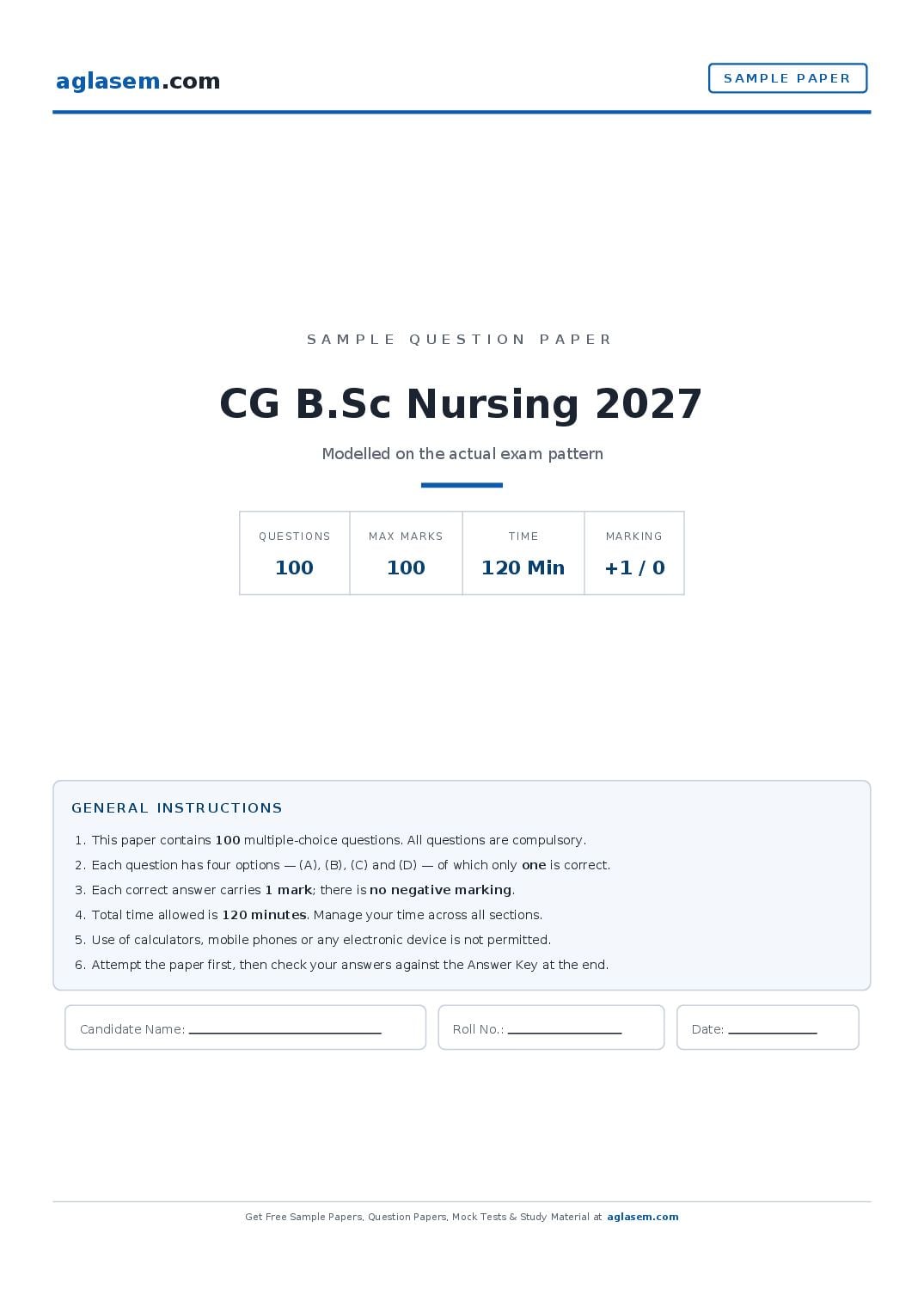
S A M P L E Q U E S T I O N P A P E R
CG B.Sc Nursing 2027
Modelled on the actual exam pattern
.
QUESTIONS MAX MARKS TIME MARKING
100 100 120 Min +1 / 0
GENERAL INSTRUCTIONS
1. This paper contains 100 multiple-choice questions. All questions are compulsory.
2. Each question has four options — (A), (B), (C) and (D) — of which only one is correct.
3. Each correct answer carries 1 mark; there is no negative marking.
4. Total time allowed is 120 minutes. Manage your time across all sections.
5. Use of calculators, mobile phones or any electronic device is not permitted.
6. Attempt the paper first, then check your answers against the Answer Key at the end.
Candidate Name: Roll No.: Date:
Page 2
CG B.Sc Nursing 2027
SAMPLE QUESTION PAPER
Questions 100 Max Marks 100 Time 120 Min Marking +1 / 0
Attempt all questions. Choose the one correct option for each.
PHYSICS
1. The SI unit of force is: 2. Which of the following is a good insulator of
electricity?
(A) Newton
(B) Joule (A) Copper
(C) Pascal (B) Iron
(D) Watt (C) Aluminium
(D) Rubber
3. Potential difference (voltage) is measured using a: 4. The acceleration due to gravity on Earth is
approximately:
(A) Ammeter
(B) Barometer (A) 9.8 m/s2
(C) Voltmeter (B) 19.6 m/s2
(D) Thermometer (C) 4.9 m/s2
(D) 1.6 m/s2
5. The energy possessed by a body due to its motion is 6. The frequency of AC mains supply in India is:
called:
(A) 50 Hz
(A) Potential energy (B) 60 Hz
(B) Chemical energy (C) 100 Hz
(C) Nuclear energy (D) 220 Hz
(D) Kinetic energy
7. Which mirror is used as a reflector in torches and 8. Which of the following is a good conductor of
vehicle headlights? electricity?
(A) Convex mirror (A) Rubber
(B) Plane mirror (B) Wood
(C) Cylindrical mirror (C) Copper
(D) Concave mirror (D) Plastic
9. Earthquakes are recorded using a: 10. Electric power P is given by (V = voltage, I = current):
(A) Seismograph (A) V / I
(B) Barometer (B) V x I
(C) Telescope (C) I / V
(D) Hygrometer (D) V + I
Page 3
(A) Viscosity (A) Reflection
(B) Osmosis (B) Atmospheric refraction
(C) Capillarity (C) Dispersion
(D) Diffusion (D) Total absorption
13. According to Ohm's law, voltage V equals: 14. The nearest star to the Earth is:
(A) I / R (A) The Moon
(B) I x R (B) The Sun
(C) R / I (C) Polaris
(D) I x I x R (D) Sirius
15. The SI unit of electric charge is: 16. The SI unit of time is the:
(A) Coulomb (A) Hour
(B) Ampere (B) Second
(C) Volt (C) Minute
(D) Ohm (D) Day
17. The loudness of sound is measured in: 18. A fuse is used in an electric circuit to protect it from:
(A) Decibel (A) Low voltage
(B) Hertz (B) Static charge
(C) Watt (C) Excessive current
(D) Newton (D) Magnetism
19. The SI unit of temperature is: 20. The SI unit of pressure is:
(A) Celsius (A) Pascal
(B) Fahrenheit (B) Newton
(C) Joule (C) Joule
(D) Kelvin (D) Watt
21. The coloured part of the human eye is the: 22. Electric current is the flow of electric:
(A) Pupil (A) Mass
(B) Iris (B) Pressure
(C) Retina (C) Heat
(D) Cornea (D) Charge
23. A freely suspended magnetic compass needle points 24. The splitting of white light into its seven colours is
towards: called:
(A) East-West (A) Reflection
(B) North-South (B) Refraction
(C) Upwards (C) Absorption
(D) Downwards (D) Dispersion
Page 4
(A) Virtual and erect (A) Barometer
(B) Virtual and inverted (B) Thermometer
(C) Real and inverted (C) Ammeter
(D) Real and erect (D) Hygrometer
27. Newton's first law of motion is also called the law of: 28. The SI unit of work (energy) is:
(A) Inertia (A) Newton
(B) Gravitation (B) Watt
(C) Conservation (C) Ampere
(D) Reflection (D) Joule
29. What is the SI unit of electric current? 30. The commercial unit of electrical energy is the:
(A) Ampere (A) Watt
(B) Volt (B) Joule
(C) Ohm (C) Kilowatt-hour
(D) Watt (D) Volt
CHEMISTRY
31. The atomic number of carbon is: 32. Rusting of iron is an example of:
(A) 4 (A) Reduction
(B) 6 (B) Neutralisation
(C) 8 (C) Oxidation
(D) 12 (D) Sublimation
33. A base turns red litmus paper: 34. The gas that humans breathe out in large amounts is:
(A) Red (A) Oxygen
(B) Blue (B) Nitrogen
(C) Green (C) Carbon dioxide
(D) Colourless (D) Hydrogen
35. The chemical symbol of helium is: 36. Common salt is commercially obtained mainly from:
(A) H (A) Sea water
(B) He (B) River water
(C) Hg (C) Rain water
(D) Ho (D) Mineral water
37. The chemical formula of ammonia is: 38. LPG (cooking gas) mainly contains:
(A) NO2 (A) Methane
(B) N2O (B) Hydrogen
(C) NH4 (C) Chlorine
(D) NH3 (D) Butane
Page 5
dilute acid is:
(A) Ag
(A) Oxygen (B) Si
(B) Carbon dioxide (C) Au
(C) Hydrogen (D) Sr
(D) Chlorine
41. The chemical formula of common salt is: 42. The most abundant element in the Earth's crust is:
(A) NaCl (A) Silicon
(B) KCl (B) Oxygen
(C) CaCl2 (C) Iron
(D) NaOH (D) Aluminium
43. The chemical symbol of nitrogen is: 44. The common name of sodium bicarbonate is:
(A) Ni (A) Washing soda
(B) Na (B) Bleaching powder
(C) N (C) Baking soda
(D) Ne (D) Lime
45. The main constituent of natural gas is: 46. The chemical symbol of potassium is:
(A) Ethane (A) P
(B) Methane (B) Po
(C) Propane (C) K
(D) Butane (D) Pt
47. The atomic number of hydrogen is: 48. The pH of a neutral solution at 25 C is:
(A) 2 (A) 0
(B) 0 (B) 14
(C) 1 (C) 1
(D) 3 (D) 7
49. The lightest gas is: 50. The central part (core) of an atom is called the:
(A) Hydrogen (A) Nucleus
(B) Helium (B) Electron
(C) Oxygen (C) Proton
(D) Nitrogen (D) Shell
51. The chemical formula of water is: 52. The common name of calcium carbonate (marble,
limestone) is:
(A) H2O2
(B) CO2 (A) Baking soda
(C) O2 (B) Common salt
(D) H2O (C) Limestone
(D) Gypsum
Page 6
(A) Only oxygen (A) Blue
(B) Oxygen and water (B) Red
(C) Only water (C) Green
(D) Nitrogen (D) Colourless
55. The chemical symbol of gold is: 56. The smallest particle of an element that retains its
properties is a(n):
(A) Au
(B) Ag (A) Atom
(C) Gd (B) Molecule
(D) Go (C) Ion
(D) Electron
57. The hardest natural substance is: 58. Dry ice is the solid form of:
(A) Graphite (A) Water
(B) Diamond (B) Carbon dioxide
(C) Iron (C) Ammonia
(D) Quartz (D) Oxygen
59. The chemical formula of carbon dioxide is: 60. Which gas is commonly used to disinfect drinking
water?
(A) CO
(B) CO2 (A) Oxygen
(C) C2O (B) Hydrogen
(D) O2 (C) Chlorine
(D) Helium
BIOLOGY
61. The largest gland in the human body is the: 62. The hormone insulin is secreted by the:
(A) Liver (A) Pancreas
(B) Pancreas (B) Liver
(C) Thyroid (C) Thyroid gland
(D) Salivary gland (D) Kidney
63. Most absorption of digested food takes place in the: 64. The vitamin also known as ascorbic acid is:
(A) Stomach (A) Vitamin A
(B) Large intestine (B) Vitamin D
(C) Small intestine (C) Vitamin K
(D) Oesophagus (D) Vitamin C
65. The structural and functional unit of the kidney is the: 66. The largest artery in the human body is the:
(A) Neuron (A) Aorta
(B) Nephron (B) Vena cava
(C) Alveolus (C) Pulmonary vein
(D) Villus (D) Capillary
Page 7
(A) Carbon dioxide (A) Cerebrum
(B) Nitrogen (B) Cerebellum
(C) Oxygen (C) Medulla oblongata
(D) Hydrogen (D) Hypothalamus
69. The branch of medicine dealing with the treatment of 70. The 'master gland' of the human body is the:
children is:
(A) Thyroid gland
(A) Cardiology (B) Adrenal gland
(B) Paediatrics (C) Pituitary gland
(C) Gynaecology (D) Pancreas
(D) Neurology
71. The process by which green plants prepare their own 72. The universal recipient blood group is:
food is called:
(A) AB positive
(A) Respiration (B) O negative
(B) Transpiration (C) A positive
(C) Photosynthesis (D) B negative
(D) Digestion
73. Which blood group is called the universal donor? 74. Which cell organelle is known as the 'powerhouse of
the cell'?
(A) AB positive
(B) A positive (A) Nucleus
(C) B negative (B) Ribosome
(D) O negative (C) Mitochondria
(D) Golgi apparatus
75. The largest cell in the human body is the: 76. The exchange of gases in the lungs takes place in the:
(A) Ovum (egg cell) (A) Bronchi
(B) Nerve cell (B) Alveoli
(C) Red blood cell (C) Trachea
(D) Liver cell (D) Pharynx
77. The largest organ of the human body is the: 78. Which blood component is mainly responsible for
clotting?
(A) Skin
(B) Liver (A) Red blood cells
(C) Brain (B) Platelets
(D) Lungs (C) White blood cells
(D) Plasma
79. White blood cells are also called: 80. The number of lungs in the human body is:
(A) Erythrocytes (A) 1
(B) Thrombocytes (B) 2
(C) Platelets (C) 3
(D) Leucocytes (D) 4
Page 8
cell is:
(A) Kidney
(A) 21 (B) Liver
(B) 22 (C) Lung
(C) 23 (D) Heart
(D) 24
83. Deficiency of vitamin D causes: 84. The number of teeth in a normal adult human is:
(A) Scurvy (A) 28
(B) Rickets (B) 30
(C) Goitre (C) 32
(D) Anaemia (D) 36
85. The total number of bones in an adult human body is: 86. Which blood cells mainly fight infection?
(A) 200 (A) Red blood cells
(B) 206 (B) Platelets
(C) 212 (C) Plasma
(D) 300 (D) White blood cells
87. Deficiency of vitamin A causes: 88. Which part of the brain controls breathing and
heartbeat?
(A) Scurvy
(B) Rickets (A) Cerebrum
(C) Night blindness (B) Cerebellum
(D) Goitre (C) Thalamus
(D) Medulla oblongata
89. Deficiency of vitamin C causes: 90. The liquid (fluid) part of blood is called:
(A) Scurvy (A) Serum
(B) Rickets (B) Lymph
(C) Night blindness (C) Platelet
(D) Beriberi (D) Plasma
GENERAL KNOWLEDGE
91. Who is regarded as the 'Father of Medicine'? 92. In a hospital, 'ICU' stands for:
(A) Aristotle (A) Internal Care Unit
(B) Hippocrates (B) Intensive Care Unit
(C) Charaka (C) Immediate Care Unit
(D) Louis Pasteur (D) Intensive Cure Unit
93. World AIDS Day is observed every year on: 94. In medicine, 'ECG' stands for:
(A) 7 April (A) Electro Cardiac Graph
(B) 12 May (B) Electric Cell Gauge
(C) 1 December (C) Electro Chemical Graph
(D) 14 June (D) Electrocardiogram
Page 9
(A) Human Infection Virus (A) Louis Pasteur
(B) Human Immunodeficiency Virus (B) Alexander Fleming
(C) Highly Infectious Virus (C) Jonas Salk
(D) Human Immune Vaccine (D) Edward Jenner
97. Penicillin was discovered by: 98. 'WHO' stands for:
(A) Louis Pasteur (A) World Heart Organization
(B) Edward Jenner (B) World Health Organization
(C) Alexander Fleming (C) World Hygiene Organization
(D) Robert Koch (D) Women Health Organization
99. 'DNA' stands for: 100. World Health Day is observed every year on:
(A) Dinucleic Acid (A) 7 April
(B) Deoxyribose Nuclear Acid (B) 1 December
(C) Deoxyribonucleic Acid (C) 12 May
(D) Dextro Nucleic Acid (D) 2 October
ANSWER KEY
1. (A) 2. (D) 3. (C) 4. (A) 5. (D) 6. (A) 7. (D)
8. (C) 9. (A) 10. (B) 11. (C) 12. (B) 13. (B) 14. (B)
15. (A) 16. (B) 17. (A) 18. (C) 19. (D) 20. (A) 21. (B)
22. (D) 23. (B) 24. (D) 25. (C) 26. (D) 27. (A) 28. (D)
29. (A) 30. (C) 31. (B) 32. (C) 33. (B) 34. (C) 35. (B)
36. (A) 37. (D) 38. (D) 39. (C) 40. (A) 41. (A) 42. (B)
43. (C) 44. (C) 45. (B) 46. (C) 47. (C) 48. (D) 49. (A)
50. (A) 51. (D) 52. (C) 53. (B) 54. (B) 55. (A) 56. (A)
57. (B) 58. (B) 59. (B) 60. (C) 61. (A) 62. (A) 63. (C)
64. (D) 65. (B) 66. (A) 67. (C) 68. (B) 69. (B) 70. (C)
71. (C) 72. (A) 73. (D) 74. (C) 75. (A) 76. (B) 77. (A)
78. (B) 79. (D) 80. (B) 81. (C) 82. (B) 83. (B) 84. (C)
85. (B) 86. (D) 87. (C) 88. (D) 89. (A) 90. (D) 91. (B)
92. (B) 93. (C) 94. (D) 95. (B) 96. (D) 97. (C) 98. (B)
99. (C) 100. (A)
Document Details
| Board / Org | CG Vyapam |
| Exam | CG B.Sc Nursing |
| Type | Sample Paper |
| Pages | 9 |
| Language | english |
| Updated | 24 Sep 2026 |