Karnataka 2nd PUC Model Question Paper 2027 for Physics (Paper 2)
Finished viewing? Save it for later —
Download Karnataka 2nd PUC Model Question Paper 2027 for Physics (Paper 2) (PDF · 4 pages)About Karnataka 2nd PUC Model Question Paper 2027 for Physics (Paper 2)
Karnataka 2nd PUC Model Question Paper 2027 for Physics (Paper 2) is available here for free download. Published by Karnataka Board for Class 12, this sample paper can be viewed online or downloaded as a PDF (4 pages). Candidates preparing for Class 12 can use Karnataka 2nd PUC Model Question Paper 2027 for Physics (Paper 2) to understand the exam pattern, the type of questions asked, and the overall difficulty level.
Frequently Asked Questions
How can I download Karnataka 2nd PUC Model Question Paper 2027 for Physics (Paper 2)?
Open this page and click the Download button to save Karnataka 2nd PUC Model Question Paper 2027 for Physics (Paper 2) as a PDF. It is completely free on AglaSem Docs.
Is Karnataka 2nd PUC Model Question Paper 2027 for Physics (Paper 2) free to download?
Yes. Karnataka 2nd PUC Model Question Paper 2027 for Physics (Paper 2) can be viewed online and downloaded as a PDF free of cost on AglaSem Docs.
How many pages does Karnataka 2nd PUC Model Question Paper 2027 for Physics (Paper 2) have?
Karnataka 2nd PUC Model Question Paper 2027 for Physics (Paper 2) contains 4 pages, which you can read online or download together as a single PDF.
Where can I find more Class 12 study material?
You can find more Class 12 question papers, sample papers, syllabus, and answer keys on AglaSem Docs.
Karnataka 2nd PUC Model Question Paper 2027 for Physics (Paper 2) – Text
Read the full text of this sample paper below — useful to quickly search, copy and reference the content online without downloading the PDF.
📄 View text version (5 pages)
Page 1
Karnataka 2nd PUC
Model Question Paper
2027 for Physics
(Paper 2)
EXAM YEAR TYPE SUBJECT
Karnataka Class 12 2027 Sample Paper Physics
Notes · Sample Papers · Previous Year Papers · Mock Tests
Page 2
m .co
m .co s em
se g la
a
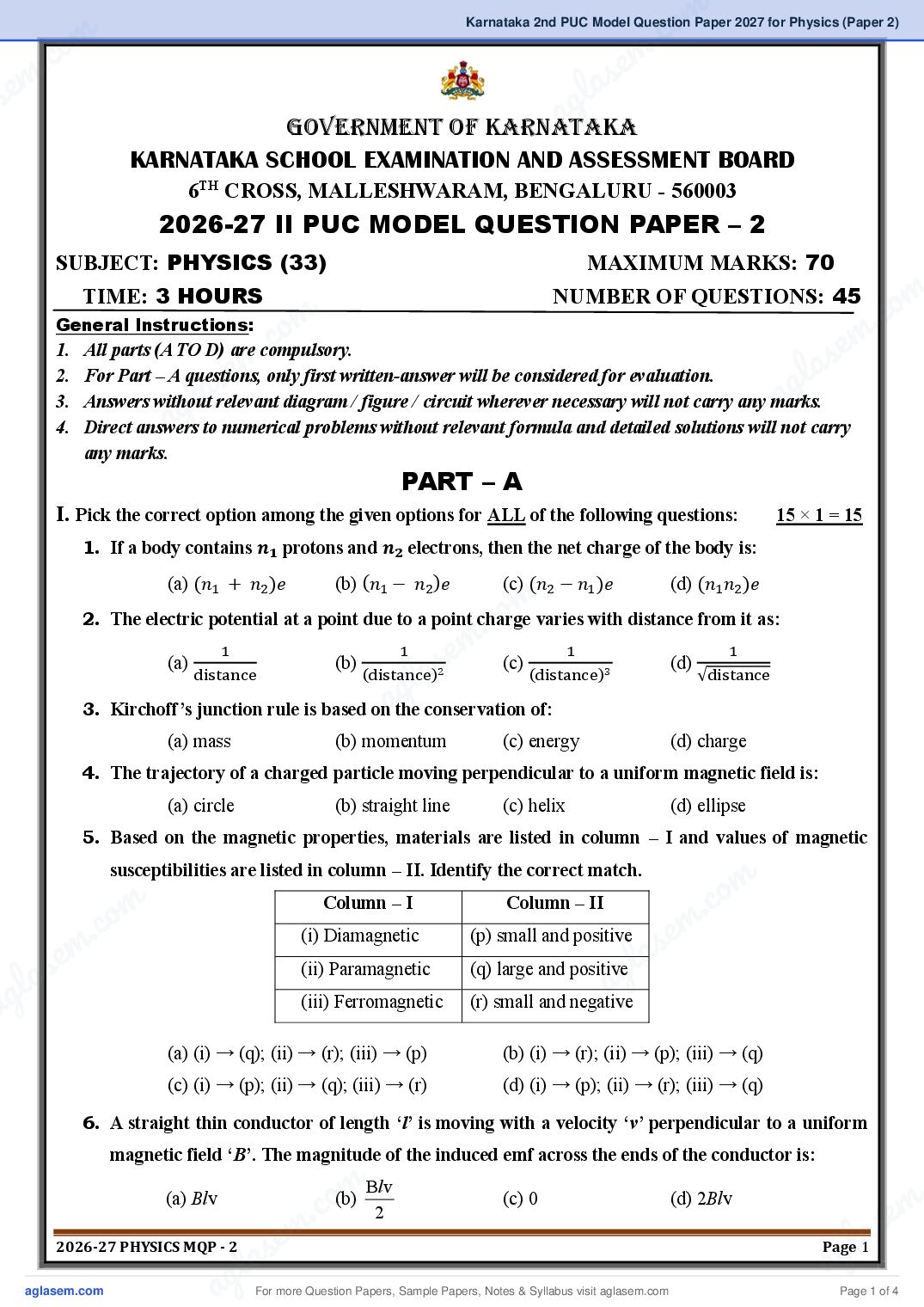
GOVERNMENT OF KARNATAKA
KARNATAKA SCHOOL EXAMINATION AND ASSESSMENT BOARD
6TH CROSS, MALLESHWARAM, BENGALURU - 560003
2026-27 II PUC MODEL QUESTION PAPER – 2
SUBJECT: PHYSICS (33) MAXIMUM MARKS: 70
m
.co
TIME: 3 HOURS NUMBER OF QUESTIONS: 45
o m m
General Instructions:
. c s e
em only first written-answer will be considered for evaluation. a
1. All parts (A TO D) are compulsory.
s
2. For Part – A questions,
a g l
l a
ag to numerical problems without relevant formula and detailed solutions will not carry
3. Answers without relevant diagram / figure / circuit wherever necessary will not carry any marks.
4. Direct answers
any marks.
PART – A
I. Pick the correct option among the given options for ALL of the following questions: 15 × 1 = 15
1. If a body contains 𝒏𝟏 protons and 𝒏𝟐 electrons, then the net charge of the body is:
(a) (𝑛1 + 𝑛2 )𝑒 (b) (𝑛1 − 𝑛2 )𝑒 (c) (𝑛2 − 𝑛1 )𝑒 (d) (𝑛1 𝑛2 )𝑒
m
.co
2. The electric potential at a point due to a point charge varies with distance from it as:
m (c) 1
1
s e 1 1
la
(a) (b) (d)
distance (distance)2
(distance) 3 √distance
g
3. Kirchoff’s junction rule is based onathe conservation of:
(a) mass (b) momentum (c) energy (d) charge
4. The trajectory of a charged particle moving perpendicular to a uniform magnetic field is:
(a) circle (b) straight line (c) helix (d) ellipse
5. Based on the magnetic properties, materials are listed in column – I and values of magnetic
susceptibilities are listed in column – II. Identify the correct match.
m
m Column – I Column – II .co
m .co (i) Diamagnetic (p) small and positive
s e m
s e (q) large and positivegl
a
la a
(ii) Paramagnetic
ag (iii) Ferromagnetic (r) small and negative
(a) (i) → (q); (ii) → (r); (iii) → (p) (b) (i) → (r); (ii) → (p); (iii) → (q)
(c) (i) → (p); (ii) → (q); (iii) → (r) (d) (i) → (p); (ii) → (r); (iii) → (q)
6. A straight thin conductor of length ‘l’ is moving with a velocity ‘v’ perpendicular to a uniform
magnetic field ‘B’. The magnitude of the induced emf across the ends of the conductor is:
o mBlv m .
.c 2 e
(a) Blv (b) (c) 0 (d) 2Blv
em l as
2026-27 PHYSICS MQP - 2
las ag
Page 1
ag For more Question Papers, Sample Papers, Notes & Syllabus visit Page 1 of 4
Page 3
(a) The average current over a complete cycle is zero.
(b) The average voltage over a complete cycle is zero.
(c) The average power dissipated by the resistor over a complete cycle is zero.
(d) The phase difference between the voltage and current is zero.
8. Which of the following electromagnetic waves are used to kill germs in water purifiers?
(a) Microwaves (b) Infrared waves (c) Ultraviolet rays (d) Gamma rays
9. The angle of minimum deviation of a prism depends on
(i) refractive index of the material of the prism
(ii) refractive index of surrounding medium
(iii) refracting angle of the prism
(a) only option (i) (b) only option (ii)
(c) only option (iii) (d) all (i), (ii) and (iii)
10. Image of a real object formed by a simple microscope when the object is placed at a distance
less than one focal length is:
(a) real, inverted and magnified (b) virtual, erect and magnified
(c) virtual, erect and diminished (d) virtual, inverted and magnified
11. Consider the following two statements regarding diffraction of light.
Statement – I: We do not easily encounter diffraction effects of light in everyday observation.
Statement – II: The wavelength of light is much smaller than the dimensions of most of the
obstacles.
Choose the correct option from the following:
(a) Both the statements are correct and statement–II is the correct explanation for statement–I.
(b) Both the statements are correct and statement–II is not the correct explanation of statement–I.
(c) Statement–I is correct and statement–II is wrong
(d) Both the statements are wrong.
12. The process of emission of electrons from a metal surface by applying high electric field is called:
(a) thermionic emission (b) photoelectric emission
(c) field emission (d) secondary emission
13. Let K be the kinetic energy, U be the potential energy and E be the total energy of electron
revolving around the nucleus in a hydrogen atom, then which of the following is correct?
(a) K > 0, U > 0, E > 0 (b) K > 0, U < 0, E < 0
(c) K > 0, U > 0, E < 0 (d) K < 0, U < 0, E < 0
14. Among the following, which set of nuclei are isotones?
(a) 126𝐶, 136𝐶 (b) 21𝐻, 32𝐻𝑒 (c) 146𝐶, 147𝑁 (d) 31𝐻, 32𝐻𝑒
2026-27 PHYSICS MQP - 2 Page 2
For more Question Papers, Sample Papers, Notes & Syllabus visit Page 2 of 4
Page 4
m .co
c. o 15. Carbon, silicon and germanium have four valence electrons each.
s e mThese are characterised by
m la equal to (E ) , (E ) and (E )
se valence and conduction bands separated by energy bandggap
a
g C g Si g Ge
respectively. Which of the following comparison of energy band gaps is correct?
(a) (Eg)Si < (Eg)Ge < (Eg)C (b) (Eg)C < (Eg)Ge > (Eg)Si
(c) (Eg)C > (Eg)Si > (Eg)Ge (d) (Eg)C = (Eg)Si = (Eg)Ge
II. Fill in the blanks by choosing appropriate answer given in the bracket for ALL of
the following questions: 5×1=5
m
[transformer, polarization, intensity, interference, solenoid, AC generator]
m .co
16. A current carrying ___________ is equivalent to a bar magnet.
.co
17. A/an ____________ converts mechanical energy into electrical energy.
s e m
s em
18. Alternating voltages can be varied using a/an ___________.
l a
g la of ______________ confirms the transverse nature of light waves.
19. The phenomenon ag
20. Duringa photoelectric emission, the number of photoelectrons emitted per second is directly
proportional to ______________of the incident light.
PART – B
III. Answer the FIVE of the following questions: 5 × 2 = 10
21. Sketch the electric field lines for (a) a positive point charge and (b) an electric dipole.
22. What are polar molecules? Give an example.
m
23. State and explain Ohm’s law.
.co
s em
24. A current loop of magnetic dipole moment 10 A m2 is suspended freely in a uniform magnetic field
of magnitude 5 10 T. The plane of thelacoil is present in the direction of magnetic field. Calculate
–3
the torque on the current loop. ag
25. Mention two factors on which self-inductance of a solenoid depends.
26. What is displacement current? Write the mathematical form of Ampere-Maxwell law.
27. Define impact parameter. What is the value of angle of scattering for minimum impact parameter?
28. Give any two differences between intrinsic and extrinsic semiconductors.
PART – C
o m 5 × 3 = 15
m
IV. Answer any FIVE of the following questions:
c
. of charge using
c. oGive Coulomb’s law in vector form and explain the terms. DefineseSImunit
29.
s em Coulomb’s law. g l a
g la 30. Mention any three important results regarding electrostatics of conductors.
a
a 31. What is Lorentz force? Write the expression representing this force and explain the terms.
32. State and explain Gauss’s law in magnetism. Give its significance.
33. Derive the expression for the magnetic energy stored in a coil, U = ½ LI 2.
34. Give the Cartesian sign convention used to measure distances and heights in spherical mirrors.
35. Write three properties of photon.
m
36. Calculate the binding energy of an alpha () particle in MeV from the following data.
.
.co
Mass of -particle = 4. 002603 u; mass of neutron = 1.008665 u; Mass of proton = 1.007825 u.
s e m
s em l a
la ag
2026-27 PHYSICS MQP - 2 Page 3
ag For more Question Papers, Sample Papers, Notes & Syllabus visit Page 3 of 4
Page 5
V. Answer any THREE of the following questions: 3 × 5 = 15
37. Using Gauss’s law, arrive at the expression for electric field at a point outside a uniformly charged
spherical shell. Also write the expression for the electric field at a point on the surface of the
charged spherical shell.
38. Obtain the expressions for equivalent emf and equivalent internal resistance of two cells of
different emfs and different internal resistances connected in series.
39. Derive the expression for force per unit length on two infinitely long straight parallel conductors
carrying currents. Hence define ‘ampere’.
40. (i) Two coherent waves of same amplitude and constant phase difference undergo interference.
Obtain an expression for resultant displacement. (3)
(ii) Mention two uses of polaroids. (2)
41. What is meant by rectification? Explain the working of a p - n junction diode as a full-wave
rectifier, with the help of relevant circuit diagram and input-output waveforms.
VI. Answer any TWO of the following questions: 2 × 5 = 10
42. A parallel plate capacitor has air between the plates. The area of the plates is 4 cm2 and the
distance between the them is of 2 mm.
(a) Calculate the capacitance of the capacitor.
(b) If this capacitor is connected to a 100 V supply, find the magnitude of the charge on each plate
and the energy stored in the capacitor. Given: o = 8.854 × 10⁻¹² F m–1.
43. A copper wire of length 50 cm and diameter 1.0 mm carries a current of 3.0 A. The number
density of free electrons in copper is 8.5 × 1028 m–3. Calculate
(a) the current density,
(b) the drift velocity of free electrons and
(c) the time taken by the electrons to drift from one end of the wire to the other end.
[Given: e = 1.6 × 10⁻¹⁹ C]
44. A resistor, an inductor and a capacitor are connected in series with a 110 V, 100 Hz AC source. In
the circuit, the voltage leads the current by 35°. If the resistance of the resistor is 10 and the
sum of inductive reactance and capacitive reactance is 17 , calculate the self-inductance of the
inductor.
45. Find the effective focal length and effective power of combination of a convex lens of focal length
25 cm in contact with a concave lens of focal length 20 cm. Does the combination act like a
converging lens or a diverging lens? Ignore the thickness of the lenses.
****
2026-27 PHYSICS MQP - 2 Page 4
For more Question Papers, Sample Papers, Notes & Syllabus visit Page 4 of 4
Document Details
| Board / Org | Karnataka Board |
| Exam | Class 12 |
| Type | Sample Paper |
| Pages | 4 |
| Language | english |
| Updated | 03 Nov 2026 |