MBOSE Class 12 Question Paper 2019 for History
Finished viewing? Save it for later —
Download MBOSE Class 12 Question Paper 2019 for History (PDF · 12 pages)About MBOSE Class 12 Question Paper 2019 for History
MBOSE Class 12 Question Paper 2019 for History is available here for free download. Published by Meghalaya Board for Class 12, this question paper can be viewed online or downloaded as a PDF (12 pages). Candidates preparing for Class 12 can use MBOSE Class 12 Question Paper 2019 for History to understand the exam pattern, the type of questions asked, and the overall difficulty level.
Frequently Asked Questions
How can I download MBOSE Class 12 Question Paper 2019 for History?
Open this page and click the Download button to save MBOSE Class 12 Question Paper 2019 for History as a PDF. It is completely free on AglaSem Docs.
Is MBOSE Class 12 Question Paper 2019 for History free to download?
Yes. MBOSE Class 12 Question Paper 2019 for History can be viewed online and downloaded as a PDF free of cost on AglaSem Docs.
How many pages does MBOSE Class 12 Question Paper 2019 for History have?
MBOSE Class 12 Question Paper 2019 for History contains 12 pages, which you can read online or download together as a single PDF.
Where can I find more Class 12 study material?
You can find more Class 12 question papers, sample papers, syllabus, and answer keys on AglaSem Docs.
MBOSE Class 12 Question Paper 2019 for History – Text
Read the full text of this question paper below — useful to quickly search, copy and reference the content online without downloading the PDF.
📄 View text version (12 pages)
Page 1
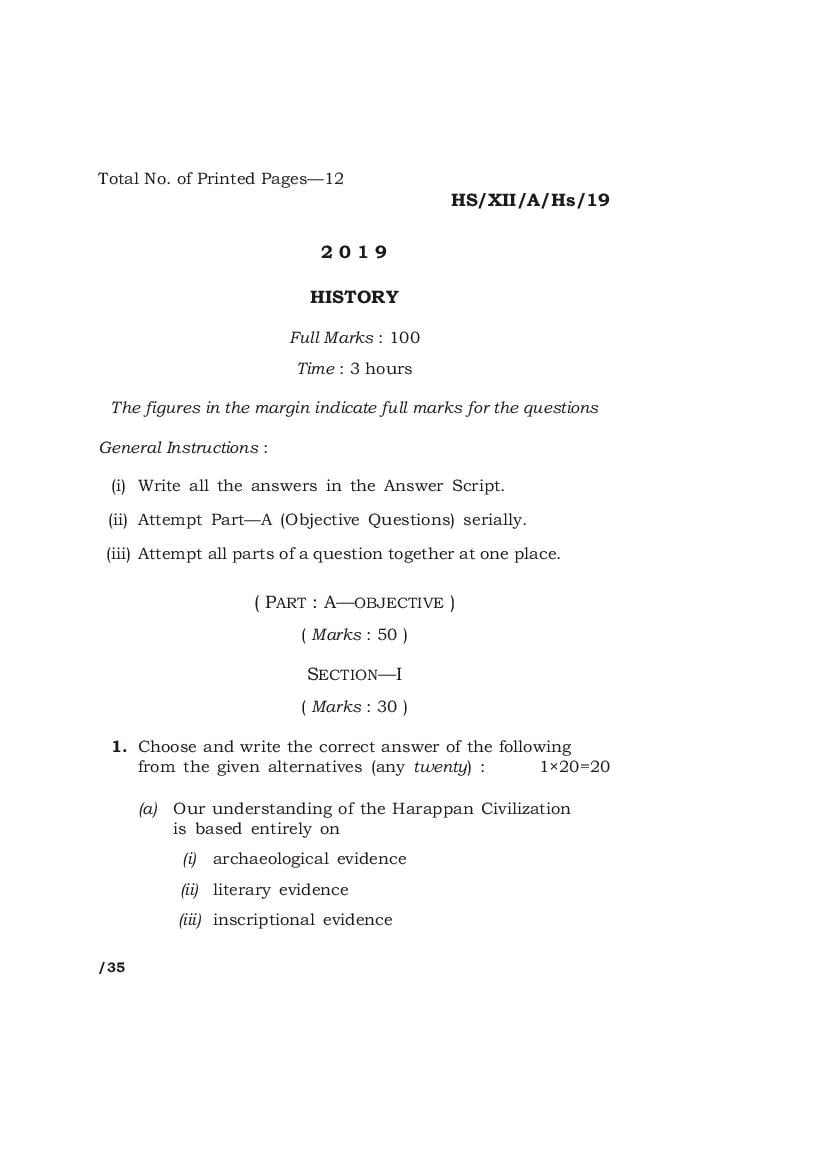
HS/XII/A/Hs/19
2019
HISTORY
Full Marks : 100
Time : 3 hours
The figures in the margin indicate full marks for the questions
General Instructions :
(i) Write all the answers in the Answer Script.
(ii) Attempt Part—A (Objective Questions) serially.
(iii) Attempt all parts of a question together at one place.
( PART : A—OBJECTIVE )
( Marks : 50 )
SECTION—I
( Marks : 30 )
1. Choose and write the correct answer of the following
from the given alternatives (any twenty) : 1×20=20
(a) Our understanding of the Harappan Civilization
is based entirely on
(i) archaeological evidence
(ii) literary evidence
(iii) inscriptional evidence
/35
Page 2
(b) Harappan culture was originated in the
(i) Northwestern part of the Indian
subcontinent
(ii) Southern part of the Indian subcontinent
(iii) Western part of the Indian subcontinent
(c) What language is used in Ashokan inscriptions?
(i) Prakrit
(ii) Pali
(iii) Sanskrit
(d) The Rigveda was translated into English by
(i) Ralph T. H. Griffith
(ii) Max Müller
(iii) Weber
(e) Dipavamsa and Mahavamsa were written in
(i) India
(ii) Sri Lanka
(iii) China
Page 3
(f) Which among the following is not associated
with the life of Buddha?
(i) Bodh-Gaya
(ii) Sarnath
(iii) Mathura
(g) The Gopurams are the
(i) pyramidal roof of the main temple
(ii) gate pyramids
(iii) pillared halls
(h) Which of the following can be found at
Mahabalipuram?
(i) Stupas
(ii) Five rathas
(iii) Gopuram
(i) In the Mughal period, a headman was known as
(i) muqaddam
(ii) patwari
(iii) mollazadas
Page 4
(j) The third volume of the Akbarnama is the
(i) Ain-i-Akbari
(ii) Tuzuk-i-Baburi
(iii) Badshahnama
(k) Babur, the first Mughal ruler was related to
Genghis Khan, a Mongol from his
(i) mother’s side
(ii) father’s side
(iii) uncle’s side
(l) Calligraphy is the art of
(i) carving
(ii) painting
(iii) handwriting
(m) The Lingayats questioned the theory of
(i) death
(ii) salvation
(iii) rebirth
Page 5
(n) Dargah means
(i) tomb
(ii) temple
(iii) palace
(o) Ibn Batuta was from
(i) Uzbekistan
(ii) Morocco
(iii) France
(p) Travels in the Mogul Empire was written by
(i) Francois Bernier
(ii) Ibn Batuta
(iii) Al-Biruni
(q) In 1793, the Permanent Settlement was
introduced by
(i) Warren Hastings
(ii) Robert Clive
(iii) Lord Cornwallis
Page 6
(r) The jotedars were the class of
(i) businessmen
(ii) rich peasants
(iii) zamindars
(s) Who were the first to establish their settlements
in India?
(i) English
(ii) French
(iii) Portuguese
(t) The part of the settlement occupied by the
Europeans was termed as
(i) black town
(ii) white town
(iii) red town
(u) The Jaintia Kingdom was annexed by the British
in
(i) 1835
(ii) 1838
(iii) 1861
Page 7
(v) The British Government replaced which
language in schools and courts in Assam in
1873?
(i) Bengali
(ii) Assamese
(iii) English
(w) The leader of the Revolt in 1857 in Lucknow was
(i) Begum Hazrat Mahal
(ii) Kunwar Singh
(iii) Nana Sahib
(x) The first mass movement organized by Mahatma
Gandhi was the
(i) Civil Disobedience Movement
(ii) Non-Cooperation Movement
(iii) Quit India Movement
(y) Gandhiji was characterized as a ‘one man army’
because
(i) he was a firm believer in the non-violence
(ii) he visited riot-torn areas to restore peace in
a bid to vindicate his lifelong principle of
non-violence
(iii) he succeeded in ousting the British from
India
Page 8
2. Write whether the following statements are True or
False (any ten) : 1×10=10
(a) The longest Harappan Inscription contains only
about 26 signs.
(b) Suvarnagiri, meaning ‘the golden mountain’, was
significant because of the gold mines located in
Karnataka.
(c) The practice of marrying girls outside the kin
group is called endogamy.
(d) ‘Hagiography’ is a biography of a saint or a
religious leader.
(e) Rock-cut caves in Badami have four significant
features.
(f) The Panchayat acted as a watchdog of the castle
hierarchy.
(g) The Akbarnama was written by Mulla Abdul
Hamid Lahori.
(h) Ziyarat means the death anniversary of Sufi
saints.
(i) Kitab al-Hind (Chronicles of India) was written by
Ibn Batuta.
Page 9
(j) ‘Damin-i-koh’, the government estate was
declared to be the land of the Santhals.
(k) The Writers’ Building was the British East India
Company’s headquarters.
(l) Slavery existed in North-East India before the
coming of the British.
(m) Nana Sahib led the Revolt in Bihar.
(n) The Civil Disobedience Movement, 12th March,
1930, was started with the Dandi March.
(o) The Hindustani was accepted as the national
language by the Congress as early as 1960’s.
SECTION—II
( Marks : 20 )
3. Answer any ten of the following questions in 2 or 3
sentences each : 2×10=20
(a) What was the Great Bath of Mohenjo-daro?
(b) What is transplantation?
(c) What are the Vedas?
Page 10
(d) What are the Tripitaka?
(e) Mention two Chalukyan style of Monuments.
(f) Who were the Mughals?
(g) What are the five ‘pillars’ or five fundamental
principles of Islam?
(h) Who was Francois Bernier?
(i) Who were the Santhals and Paharias?
(j) What were the civil lines in colonial towns?
(k) Why did the people not favour women education
in colonial Assam?
(l) Who was Rani Lakshmi Bai?
(m) What was the Jallianwala Bagh Massacre?
(n) What was the Khilafat Movement?
(o) Name the Congress trio who played a crucial role
in the making of the Indian Constitution.
Page 11
( PART : B—DESCRIPTIVE )
( Marks : 50 )
4. Answer Question No. (j) and any three from the rest :
(a) Discuss the causes that led to the disappearance
of the Harappan Civilization. 12
(b) Describe the Pallava or the Chola style of
architecture. 12
(c) Who was the author of the Akbarnama? How did
the Akbarnama describe the history of Akbar’s
reign? 2+10=12
(d) Describe the life and teachings of Guru Nanak. 12
(e) Why were many zamindaris auctioned after the
Permanent Settlement? How did the zamindars
continue to hold their zamindaris even after the
auction? 6+6=12
(f) Why did the British develop hill stations? Briefly
describe Shillong as a hill station in the East.
6+6=12
(g) Describe the emergence of new social groups in
Assam. 12
Page 12
(h) What were the storm centres of the Revolt of
1857? What steps did the British take to put
down the Uprising? 2+10=12
(i) Give an account of the Civil Disobedience
Movement. Mention the notable feature of the
Movement. 10+2=12
(j) Write short notes on any two of the following :
7×2=14
(i) Rise of Magadha
(ii) Teachings of Mahavira or Buddha
(iii) Ibn Batuta
(iv) Kolkata (Calcutta) : Town Planning
(v) Modern Education in Colonial Assam
(vi) Swadeshi Movement
(vii) Cabinet Mission Plan, 1946
HHH
HS/XII/A/Hs/19/35 K9—16460
Document Details
| Board / Org | Meghalaya Board |
| Exam | Class 12 |
| Type | Question Paper |
| Pages | 12 |
| Updated | 15 Jul 2026 |