MBOSE Class 12 Question Paper 2019 for Political Science
Finished viewing? Save it for later —
Download MBOSE Class 12 Question Paper 2019 for Political Science (PDF · 11 pages)About MBOSE Class 12 Question Paper 2019 for Political Science
MBOSE Class 12 Question Paper 2019 for Political Science is available here for free download. Published by Meghalaya Board for Class 12, this question paper can be viewed online or downloaded as a PDF (11 pages). Candidates preparing for Class 12 can use MBOSE Class 12 Question Paper 2019 for Political Science to understand the exam pattern, the type of questions asked, and the overall difficulty level.
Frequently Asked Questions
How can I download MBOSE Class 12 Question Paper 2019 for Political Science?
Open this page and click the Download button to save MBOSE Class 12 Question Paper 2019 for Political Science as a PDF. It is completely free on AglaSem Docs.
Is MBOSE Class 12 Question Paper 2019 for Political Science free to download?
Yes. MBOSE Class 12 Question Paper 2019 for Political Science can be viewed online and downloaded as a PDF free of cost on AglaSem Docs.
How many pages does MBOSE Class 12 Question Paper 2019 for Political Science have?
MBOSE Class 12 Question Paper 2019 for Political Science contains 11 pages, which you can read online or download together as a single PDF.
Where can I find more Class 12 study material?
You can find more Class 12 question papers, sample papers, syllabus, and answer keys on AglaSem Docs.
MBOSE Class 12 Question Paper 2019 for Political Science – Text
Read the full text of this question paper below — useful to quickly search, copy and reference the content online without downloading the PDF.
📄 View text version (11 pages)
Page 1
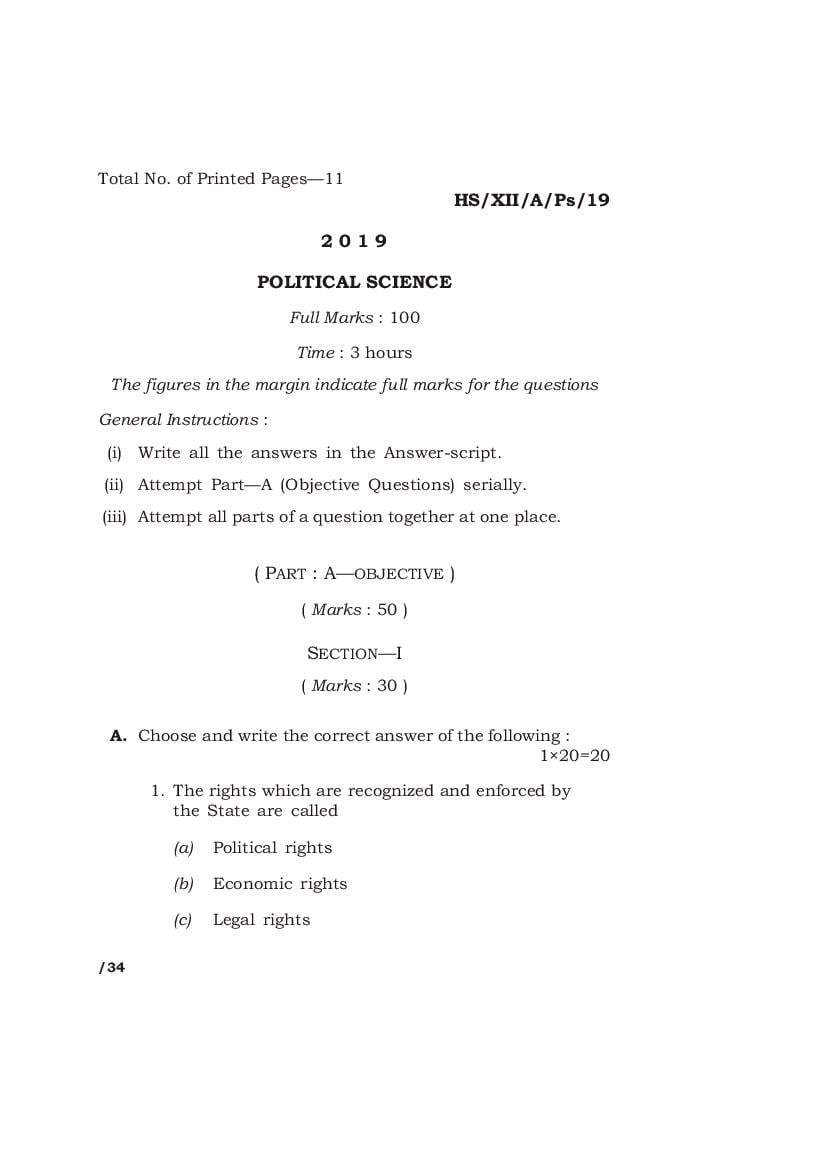
HS/XII/A/Ps/19
2019
POLITICAL SCIENCE
Full Marks : 100
Time : 3 hours
The figures in the margin indicate full marks for the questions
General Instructions :
(i) Write all the answers in the Answer-script.
(ii) Attempt Part—A (Objective Questions) serially.
(iii) Attempt all parts of a question together at one place.
( PART : A—OBJECTIVE )
( Marks : 50 )
SECTION—I
( Marks : 30 )
A. Choose and write the correct answer of the following :
1×20=20
1. The rights which are recognized and enforced by
the State are called
(a) Political rights
(b) Economic rights
(c) Legal rights
/34
Page 2
2. “Man is born free but everywhere he is in chains”
was said by
(a) Locke
(b) Rousseau
(c) Hobbes
3. True equality implies
(a) identical salaries
(b) the provision of adequate opportunities for
all
(c) absence of special privileges
4. “Where there is no law, there is no freedom” was
said by
(a) Hobbes
(b) Locke
(c) Laski
5. Social justice aims at creating
(a) a just and fair society
(b) a prosperous society
(c) a stable society
Page 3
6. A national may turn into a citizen if he enjoys
(a) natural right
(b) human right
(c) right to vote
7. The right to vote in India was subsequently
reduced to 18 years from 21 years in the year
(a) 1983
(b) 1988
(c) 1993
8. Which of the following types of representation is
not conducive to national unity and integrity?
(a) Proportional representation
(b) Communal representation
(c) Territorial representation
9. What is the formula of quota in proportional
representation?
Total number of votes polled
(a) +1
Number of seats in the Constituency
Total number of votes polled (valid vote)
(b) +1
Number of seats in the Constituency +1
Total number of votes polled +1
(c) +1
Number of seats in the Constituency
Page 4
10. Liberalism puts emphasis on
(a) liberty
(b) equality
(c) justice
11. According to Marx, State is
(a) an instrument of exploitation
(b) a necessary evil
(c) a divine institution
12. The non-permanent members of the Security
Council are elected for a period of
(a) 5 years
(b) 4 years
(c) 2 years
13. The Right to Property was deleted by the 44th
Amendment Act, 1978. It was substituted with
new Article
(a) 226
(b) 300A
(c) 50
Page 5
14. The idea of Directive Principles of State Policy
was influenced by the
(a) Irish Constitution
(b) Canadian Constitution
(c) American Constitution
15. To be qualified for election as President, a person
must complete the age of
(a) 35 years
(b) 30 years
(c) 25 years
16. The Union Council of Ministers is collectively
responsible to the
(a) Parliament
(b) Lok Sabha
(c) President of India
17. The Prime Minister of India exercises
(a) nominal powers
(b) real powers
(c) absolute powers
Page 6
18. The ex officio Chairman of the Rajya Sabha is
(a) the Speaker of the Lok Sabha
(b) the Prime Minister
(c) the Vice President
19. The advice tendered by the Supreme Court to the
President of India is
(a) binding on him
(b) not binding on him
(c) binding on him sometimes
20. India is a founding member of the
(a) UNESCO
(b) NAM
(c) ICJ
Page 7
B. Write whether the following statements are True or
False : 1×10=10
1. The President can be removed from his office by
the method of impeachment.
2. The term of the Lok Sabha cannot be extended at
all.
3. According to Gandhi, the history of all societies
is the history of class struggle.
4. Classical liberals consider individuals to be their
own masters.
5. A law passed by the legislature of a State is
known as statutory law.
6. All who are staying in a State are its citizens.
7. An ordinance is an order issued by the Judiciary
for administrative purposes.
8. The SAARC was established on the 8th
December, 1985.
Page 8
9. The idea of NAM was first given shape by Nasser
of Egypt.
10. The United Nations is a World State.
SECTION—II
( Marks : 20 )
Answer the following questions in about 2 or 3 sentences
each : 2×10=20
1. Distinguish between moral and legal aspects of
citizenship.
2. What is the meaning of Universal Adult Franchise?
3. What are the two characteristics of Rights?
4. Distinguish between Law and Morality.
5. Give the full forms of UNESCO and UNICEF.
Page 9
6. How is the President of India elected?
7. Mention any two powers of the Speaker of the Lok
Sabha.
8. Write any two Fundamental Duties of the citizens of
India.
9. What are the two objectives of the Directive
Principles of State Policy?
10. How is the Prime Minister of India appointed?
( PART : B—DESCRIPTIVE )
( Marks : 50 )
GROUP—A
( Political Theory )
Answer any three of the following questions : 10×3=30
1. Define Rights. Explain the various kinds of Rights.
2+8=10
2. Explain the negative and positive meaning of
equality. Explain the relationship between liberty
and equality. 4+6=10
Page 10
3. What is Justice? Explain the different kinds of
Justice. 2+8=10
4. What is territorial representation? What are its
merits and demerits? 2+8=10
5. Describe the main tenets of Marxism. 10
6. What is the composition, powers and functions of the
UN Security Council? 2+8=10
7. Write short notes on any two of the following : 5×2=10
(a) Duties of the citizens
(b) Kinds of law
(c) Methods of acquiring citizenship
(d) Negative and positive liberty
(e) Aims of the UNO
GROUP—B
( The Indian Constitution and Political
System in Operation )
Answer any two of the following questions : 10×2=20
8. Enumerate the Fundamental Rights of the Indian
citizens. 10
Page 11
9. Explain the composition, powers and functions of
either the Lok Sabha or the Rajya Sabha. 2+8=10
10. What is the composition of the Supreme Court?
Describe its powers and functions. 2+8=10
11. Give an assessment of India’s relation with the
United Nations. 10
12. Write short notes on any two of the following : 5×2=10
(a) Emergency powers of the President
(b) Formation of the Union Council of Ministers
(c) Gandhian Principles
(d) National Human Rights Commission
(e) Relationship of the Prime Minister to the
Parliament
HHH
HS/XII/A/Ps/19/34 K9—27400
Document Details
| Board / Org | Meghalaya Board |
| Exam | Class 12 |
| Type | Question Paper |
| Pages | 11 |
| Updated | 15 Jul 2026 |