TIFR GS 2024 Question Paper Science Education
Finished viewing? Save it for later —
Download TIFR GS 2024 Question Paper Science Education (PDF · 41 pages)About TIFR GS 2024 Question Paper Science Education
TIFR GS 2024 Question Paper Science Education is available here for free download. Published by TIFR for TIFR GS, this question paper can be viewed online or downloaded as a PDF (41 pages). Candidates preparing for TIFR GS can use TIFR GS 2024 Question Paper Science Education to understand the exam pattern, the type of questions asked, and the overall difficulty level.
Frequently Asked Questions
How can I download TIFR GS 2024 Question Paper Science Education?
Open this page and click the Download button to save TIFR GS 2024 Question Paper Science Education as a PDF. It is completely free on AglaSem Docs.
Is TIFR GS 2024 Question Paper Science Education free to download?
Yes. TIFR GS 2024 Question Paper Science Education can be viewed online and downloaded as a PDF free of cost on AglaSem Docs.
How many pages does TIFR GS 2024 Question Paper Science Education have?
TIFR GS 2024 Question Paper Science Education contains 41 pages, which you can read online or download together as a single PDF.
Where can I find more TIFR GS study material?
You can find more TIFR GS question papers, sample papers, syllabus, and answer keys on AglaSem Docs.
TIFR GS 2024 Question Paper Science Education – Text
Read the full text of this question paper below — useful to quickly search, copy and reference the content online without downloading the PDF.
📄 View text version (41 pages)
Page 1
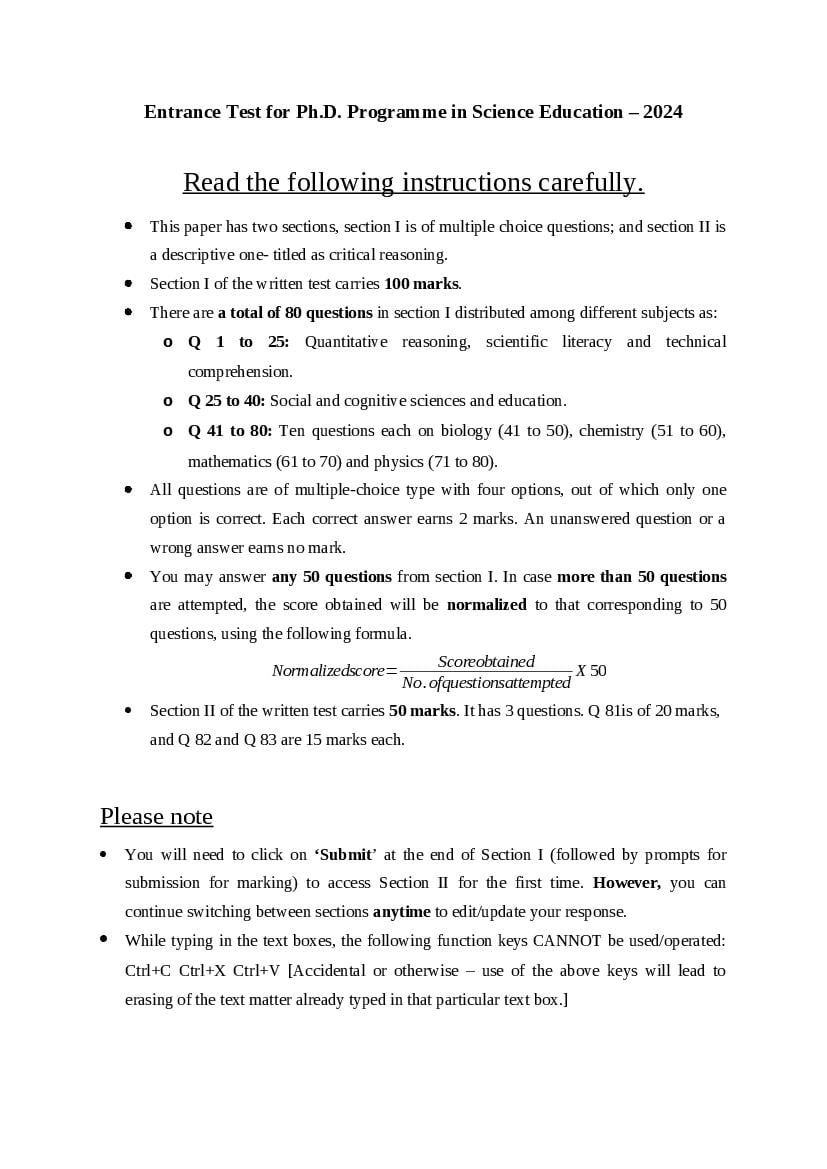
Read the following instructions carefully.
This paper has two sections, section I is of multiple choice questions; and section II is
a descriptive one- titled as critical reasoning.
Section I of the written test carries 100 marks.
There are a total of 80 questions in section I distributed among different subjects as:
o Q 1 to 25: Quantitative reasoning, scientific literacy and technical
comprehension.
o Q 25 to 40: Social and cognitive sciences and education.
o Q 41 to 80: Ten questions each on biology (41 to 50), chemistry (51 to 60),
mathematics (61 to 70) and physics (71 to 80).
All questions are of multiple-choice type with four options, out of which only one
option is correct. Each correct answer earns 2 marks. An unanswered question or a
wrong answer earns no mark.
You may answer any 50 questions from section I. In case more than 50 questions
are attempted, the score obtained will be normalized to that corresponding to 50
questions, using the following formula.
Scoreobtained
Normalizedscore= X 50
No. ofquestionsattempted
Section II of the written test carries 50 marks. It has 3 questions. Q 81is of 20 marks,
and Q 82 and Q 83 are 15 marks each.
Please note
You will need to click on ‘Submit’ at the end of Section I (followed by prompts for
submission for marking) to access Section II for the first time. However, you can
continue switching between sections anytime to edit/update your response.
While typing in the text boxes, the following function keys CANNOT be used/operated:
Ctrl+C Ctrl+X Ctrl+V [Accidental or otherwise – use of the above keys will lead to
erasing of the text matter already typed in that particular text box.]
Page 2
Multiple Choice Questions
Quantitative Reasoning, Scientific Literacy and Technical Comprehension
Question 1:
A) B)
C) D)
Page 3
A) 11 B) 10 C) 9 D) 8
Question 3:
A) B) C) D)
Question 4:
A) Only I and IV are true B) Only II and IV are true
C) Only III is true D) Only IV is true
Page 4
A) Rs. 10,00,000 B) Rs. 10,60,000
C) Rs. 10,60,800 D) Rs. 10,62,500
Question 6:
A wall clock with a minute hand and an hour hand but with no digit markings is facing a
mirror (say X) directly opposite to it. There is another mirror (say Y) on the ceiling of the
room just above the clock. An observer observes reflection of the clock on both mirrors for a
full day (24 hours). How many times in a day will either reflections show the correct time?
A) X twice and Y twice. B) X four times and Y twice.
C) X four times and Y four times. D) X four times and Y six times.
Question 7:
A) B)
C) D)
Page 5
A) 39 B) 43 C) 47 D) 51
Question 9:
A) 2012 B) 2013 C) 2014 D) 2015
Question 10:
A) ZKQTKR B) XKQPKR
C) ZKQPKR D) XKQSKR
Question 11:
There were 63 piles of fruits and 7 single fruits. All the fruits were divided equally between
23 travelers. Which of the following cannot be the number of fruits that each traveler got?
A) 14 B) 54
C) 77 D) 266
Page 6
A) Between 10000 and 15000
B) Between 15000 and 30000
C) Between 30000 and 60000
D) More than 60000
Question 13:
A) 302 B) 303
C) 304 D) 305
Page 7
A) P > Q > R B) P > R > Q
C) Q > P > R D) R > P > Q
Question 15:
A) 50 B) 47 C) 57 D) 67
Page 8
Read the passage carefully and answer questions 16 to 20.
PASSAGE:
Polls consistently show a high level of environmental awareness in the U.S. However,
awareness frequently does not translate into action. Use of mass transit has shown almost no
per capita growth despite substantial investment in light rail and other transit improvements.
Carpooling has declined. The use of environmentally friendly technologies such as solar and
wind power has grown in a limited manner, except where subsidized or mandated. In part,
this is because they have been more expensive than their fossil fuel using counterparts.
However, even as those costs approach parity, growth rates drop significantly when subsidies
are removed.
There was once, and to some extent continues to be, a belief in the simple model that says:
knowledge of the environment leads to a positive environmental attitude, which results in
pro-environmental action. This has not happened consistently, either in the U.S. or Europe. In
a European study, Ortega-Egea et al. say “Over the past two decades, increased media
coverage – coupled with economic incentives, subsidies, and related interventions – has
substantially raised citizens' awareness and concern about climate change, but has typically
failed to induce persistent behavioral changes.”
The root cause of the problem is that protecting the environment is not the only goal that
people have. Individuals choose actions based upon priority between conflicting goals. In
addition, there are multiple sources of influence affecting environmental choices. The
influences are often subconscious. A large number of theories have been proposed to explain
what motivates environmental behavior. An entire journal, the Journal of Environmental
Psychology, is devoted to the topic. A model described by Steg and Vlek includes five
categories, namely 1) Perceived costs and benefits (including non-monetary costs and
benefits); 2) Moral and normative concerns (what you think you should be doing); 3)
Emotion; 4) Contextual factors (primarily available means to execute specific
actions/behaviour); 5) Habits.
In addition to these factors, political orientation, age, gender, education and other individual
characteristics influence environmental behaviour. There are also numerous psychological
factors influencing whether a person will take individual environmentally friendly actions or
support collective and governmental actions. These can be influenced, vary over time and
interact. They will have strong influence on the pace of adoption of electric vehicles, ride
sharing services, and other lifestyle changes that are expected to reduce CO 2 emissions and
fossil fuel use.
Adapted from: Ritchie, E. J. (2017). Good Intentions. Forbes.
Page 9
Awareness and knowledge about the environment:
A) always leads to pro-environmental actions.
B) may at times lead to pro-environmental actions.
C) never leads to pro- environmental actions.
D) is not related to green behaviour.
Question 17
Which of the following is NOT mentioned in the article?
A) Psychological factors, emotional factors, economic factors and contextual factors may
influence green behaviour.
B) Rail infrastructure has improved in the US, but the number of people using the rail
services continue to be less.
C) Solar and wind power tend to be more expensive than their fossil fuel counterparts.
D) Levels of environmental awareness has consistently been poor in the US.
Question 18
A) (iii) and (iv) B) (ii) and (iii) C) (i) and (ii) D) (i) and (iv)
Page 10
A) unity
B) equivalence
C) agreement
D) affinity
Question 20
According to the article:
A) Europe and US show different trends when it comes to pro-environmental behaviours.
B) Very few theories actually try to explain what motivates environmental behavior.
C) Adoption of electric vehicles, ride sharing services, and other lifestyle changes are barely
affected by social and psychological factors.
D) A reason for lack of green behaviour could be because people have to choose actions
based on priority between conflicting goals.
Page 11
PASSAGE:
Globally, 2 in 3 children aged 6–23 months do not receive the recommended minimum
diverse diet they need in early childhood to grow healthy. Undernutrition early in life can
lead to an increased risk of overweight and obesity later in life, especially when children and
their families are confronted with a rapid shift to an obesogenic food environment that
promotes high energy intake and sedentary behaviour. Children in Asia and Africa bear the
greatest share of all forms of malnutrition. While the proportion of children affected by
undernutrition has been declining, albeit far too slowly to meet globally agreed targets, the
proportion of children who are overweight is rising rapidly, including in regions that are still
struggling with a high burden of undernutrition. Globally, almost 200 million children under
5 suffer from stunting, wasting or both, and at least 340 million suffer from hidden hunger of
vitamin and mineral deficiencies. At the same time, 40 million children under 5 are
overweight and toll of overweight and obesity keeps rising, including in lower-income
countries.
Widespread changes in food environments – including the increased availability, affordability
and marketing of ultra-processed, unhealthy foods high in fats, salt and sugars – are the major
driver of escalating overweight and obesity prevalence during the past 30 to 40 years. Poverty
and inequality, which undermine access to and affordability of adequate nutritious and
healthy food, are drivers of both obesity and vitamin and nutrient deficiencies, in addition to
undernutrition. At a rapidly increasing rate, people are moving towards commercialized diets
that rely heavily on unhealthy foods, high in saturated fats, salt and sugars, and inadequate in
fruits, vegetables and whole grains. Consequently, many children’s diets do not satisfy their
nutritional needs, even if the amount of food being consumed may meet – or exceed – their
basic energy needs. To address childhood and adolescent obesity, the environmental context
needs to be considered during three critical time periods: preconception and pregnancy;
infancy and early childhood; and older childhood and adolescence.
While there are many barriers to protecting children’s rights in modern food environments,
particularly important is the cost of healthy food. Low income families are especially
vulnerable to economic barriers to food accessibility; these families may not be able to afford
sufficient nutritious food for a healthy diet without having to forgo or compromise other basic
needs, such as education, health care and housing. In addition, when parents work full-time,
commute to work, or require more than one job to support their families, they may also be
constrained by ‘time poverty’, making it difficult or impossible to find time to buy the
ingredients and prepare healthy meals. Additionally, manufacturers focus on increasing
production and maximizing efficiency at the lowest possible economic cost, meaning that
many ultra-processed packaged foods have excessive amounts of low-cost fats, salt and
sugars. Reflecting their affordability, availability and aggressive marketing strategies, 77 per
cent of processed food sales worldwide are controlled by just 100 large firms.
In a recent study, London’s Child Obesity Taskforce spoke with children and families in the
city’s poorest neighbourhoods to better understand how they viewed their food environments.
Children who have only experienced unhealthy foods, due to their affordability and
accessibility, have entrenched food habits and are reluctant to eat healthy foods even when
they are available.
Ref.https://www.unicef.org/media/96101/file/Protecting-Childrens-Right-Healthy-Food-Environment.pdf
Page 12
According to the passage, a food environment:
A) determines the range of food choices available to a person in a particular geographical and
socioeconomic context
B) is a place where unhealthy food is consumed such as fast food joints and restaurants
C) includes places where food is cultivated, such as agricultural farms, poultry farms
D) includes places where food is prepared, such as kitchens and restaurants
Question 22
A) (ii), (iii), (iv) B) (i), (ii), (iii)
C) (i), (iii), (iv) D) (i), (ii), (iv)
Question 23
State true or false
1. Ultra-processed low-cost fats, salt and sugar in the food may lead to malnutrition
2. Consumption of fruits, vegetables and whole grains and sedentary behaviour may lead to
obesity
3. Poverty and inequality can come in the way of children’s right to healthy food environment
4. Children will always prefer healthy food if it is made available to them
A) TTFT B) TFTF C) TTTF D) FFTT
Page 13
Children in Asia and Africa bear the greatest share of all forms of malnutrition. As per the
arguments in the paragraph, the reason could be:
A) Because of poverty and inequality in these subcontinents
B) Because of lack of hygiene in these subcontinents
C) Because of more aggressive marketing by food industries in these subcontinents
D) Because of inadequate food production in these subcontinents
Question 25
A) All the above
B) (i) and (ii)
C) (ii), (iii), (iv), (v)
D) (i), (ii), (iii), (iv)
Page 14
Question 26:
Which among the following statements regarding Scheduled Tribes (adivasis) in India is
FALSE:
A) Barring the North Eastern states, there are no states in India largely inhabited by adivasi
people, there are only areas of adivasi concentration.
B) Where they are concentrated, the socio-economic conditions of adivasi people are far
worse than others
C) The Indian constitution recognises that the adivasi groups are marked by poverty and
social stigma.
D) In terms of absolute population size, the Scheduled Tribes outnumber other groups.
Question 27:
Which among the following statements regarding reservations in India is FALSE:
A) These include reservation of seats in the State and Central legislatures; reservation of jobs
in government service across all departments and public sector companies; and reservation
of seats in educational institutions.
B) The proportion of reserved seats for a particular caste/tribe group is equal to the
percentage share of the particular caste/tribe group’s population in the total population
C) It is a government initiative that attempts to combat past and present caste discrimination
D) Reservations were extended to the Other Backward Classes in the 1990s
Question 28:
Based on the Census of India 2011, what was the percentage of the Indian population living
in rural areas in 2011? (pick the nearest answer)
A) 80% B) 70% C) 60% D) 50%
Page 15
All of the following is true about Malthus’s theory of population growth EXCEPT:
A) While the population rises in geometric progression, agricultural production can only grow in
arithmetic progression
B) Nature deals with increased population through positive checks (through famines and diseases)
C) Humans can deal with increased population through preventive checks (through celibacy, sexual
abstinence)
D) Malthus’s theory and predictions have proven to be true.
Question 30:
Consider the statements below on how Other Backward Classes (OBCs) are described in the
Indian Constitution?
(I) Extremely socially and educationally backward classes who are oppressed by
‘untouchability’ practices
(ii) Socially and educationally backward classes
(iii) Socially and educationally backward tribes
Which of these are correct?
A) Only (i) is correct.
B) Only (ii) is correct
C) Only (ii) and iii) are correct
D) All (i-iii) statements are correct
Question 31:
The rank of tenured professors in STEM in India are dominated by men, as compared to
other genders. Which of the following statements explains the reason for this:
A) Obvious biological and physical differences across genders
B) Prejudice and negative stereotypical assumptions made against some genders
C) Scientific evidence of the intellectual differences between genders
D) None of the above
Page 16
An education researcher is conducting a research study with undergraduate students of
biology. The researcher knew completing the study would benefit students’ biology
understanding, so they did not mention that students could quit being part of the study
anytime they wanted.
Which of the following statements is true?
A) The researcher is following research ethics, since this action would benefit the study
participants.
B) The researcher is violating research ethics by not following the norms of informed consent.
C) The researcher is acting ethically because if students quit the study, that could negatively
impact research findings.
D) All of the above.
Question 33:
“Sanskritisation” as defined by M. N. Srinivas refers to (pick the choice that best describes
this construct):
A) Translating texts into Sanskrit
B) Finding Sanskrit origins of the Hindi words
C) A process by which members of a (usually middle or lower) caste attempt to raise their
own social status by adopting the customs and practices of higher castes.
D) The demand to mandate Sanskrit language instruction in all schools.
Question 34:
A researcher is studying youths’ attitudes towards youth employment. She through a study
compared the attitudes of 160 fifteen year old students, 170 eighteen year old students,
and 180 twenty two year old students. This research design may be best classified as -
(A) Longitudinal
(B) Case Study
(C) Controlled Experiment
(D) Cross-sectional
Page 17
Which of the following is NOT a correct interpretation of the Cultural and Educational Rights
guaranteed in the Constitution of India?
A) The right of the minorities to maintain and conserve their language, script, and culture
B) The right of the minorities to set up their own educational institutions
C) The right of the minorities to administer their own educational institutions
D) The right of the minorities to have guaranteed admission in any educational institution
maintained by the state
Question 36:
“We are disabled by buildings that are not designed to admit us, and this in turn leads to a
range of further disablements regarding our education, our chances of gaining employment,
our social lives and so on. The disablement lies in the construction of society, not in the
physical condition of the individual (Brisenden 1986 :176).”
All of the following convey the meaning of the quote EXCEPT:
A) Disability is biologically given
B) Disability is not biologically given
C) Disability is constructed by society
D) Architectural design can be discriminatory to disabled people
Question 37:
Which of the following is NOT a metacognitive performance?
(A) Assessing response of a question on our own
(B) Finding ways to remember passage highlights
(C) Reading a text for others
(D) Setting goals for learning
Page 18
Which of the following statements accurately describes the provisions in the Right of
Children to Free and Compulsory Education Act, 2009 (RTE)?
(i) RTE protects the right of children to free and compulsory education in a neighbourhood
school till completion of elementary education
(ii) RTE includes provisions for a non-admitted child to be admitted to a school in vicinity.
(iii) RTE prohibits schools and teachers from subjecting children to physical punishment or
mental harassment
(A) (ii) and (iii)
(B) (i) and (ii)
(C) (i) and (iii)
(D) Only (ii)
Question 39:
The child sex ratio between the (0-6) years age in India has been declining in India, from 976
in 1961 to 919 in 2011. Which of the following is a factor that may be held responsible for
the decline in the child sex ratio in India?
A) Severe neglect of girl babies in infancy, leading to higher death rates
B) Sex-specific abortions that prevent girl babies from being born
C) Female infanticide (or the killing of girl babies due to religious or cultural beliefs)
D) All of the above
Question 40:
Which of the following statements is true for Panchayat Raj
A) The system has a pyramid structure, and Gram Sabha is at the base
B) They have elections every three years
C) There is 63% reservation for women in leadership
D) It was regularised through Indian Constitution
Page 19
Question 41:
A) Biomass of fruits, squirrels, snakes and hawks on a mango tree.
B) Number of trees, birds, lice and bacteria in a forest.
C) Number of phytoplanktons, zooplanktons, mackerels and sharks in an ocean.
D) Biomass of grass, grasshoppers, mice and snakes in a grassland.
Question 42:
A) 0 B) 0.25 C) 0.5 D) 1
Page 20
A)
B)
C)
D)
Question 44:
Page 21
B)
C)
D)
Question 45:
A) Hair; mammary glands and carnivorous teeth.
B) Carnivorous teeth; retractable claws and mammary glands.
Page 22
D) Hooves; mammary glands and carnivorous teeth.
Question 46:
A) (i) or (iv) only
B) (ii) only
C) (i), (ii) or (iii)
D) (ii) or (iii) only
Page 23
A) The primary structure only
B) The secondary structure only
C) Quaternary structure only
D) Secondary, tertiary and quaternary structures only
Page 24
A) Nervous control, mechanical control and hormonal control.
B) Hormonal control, nervous control and mechanical control.
C) Nervous control, hormonal control and mechanical control.
D) Mechanical control, nervous control and hormonal control.
Page 25
A) Velocity of blood flow
B) Total cross-sectional area of vessels
C) Average blood pressure
D) Vessel diameter
Page 26
A student dissolved 5 grams of sugar in 100 mL of distilled water in beaker X. She dissolved
100 grams of sugar in 100 mL of distilled water in beaker Y. Then she dropped a few raisins
of equal weight in each beaker. After two hours, she found the raisins in X swollen and those
in Y shrunken.
The inference drawn is that:
A) Sugar concentration of raisins is lower than that of solution in beaker X and higher than
that of solution in beaker Y.
B) Sugar concentration of raisins is higher than that of solution in beaker X and lower than
that of solution in beaker Y.
C) The cell membrane of raisins in beaker Y was damaged resulting in leaching.
D) in beaker X, the permeability of the cell membrane of raisins to water was enhanced.
Page 27
Question 51:
A)
B)
C)
D)
Question 52:
A) 3.5 L
B) 0.45 L
C) 1.75 L
D) 0.86 L
Page 28
A) i, ii, iii, iv
B) i, iii
C) ii, iii, iv
D) iii, iv
Question 54:
The natural oil or crude oil is separated into group of compounds by a process called as
refining of oil and it is done by fractional distillation. Petrol obtained from this process is
unlikely to contain
A) octadecane.
B) iso-hexane.
C) octane.
D) decane.
Question 55:
Benzoic acid was mixed with ethanol and refluxed along with concentrated sulfuric acid in
order to form X. After 1 hour of reflux, the reaction mixture was washed with saturated
solution of Y to separate X from unreacted acid. The product X and the most suitable reagent
Y respectively are:
Page 29
B)
C)
D)
Question 56:
A chemist has to open a new bottle of concentrated ammonia in a lab. The safest way to open
the new bottle is
A) Keep the bottle on the floor and open it.
B) Keep the bottle on a warm water bath, allow it to warm up and open it.
C) Keep the bottle in refrigerator, cool it and open it.
D) First keep the bottle in refrigerator to cool it, then take it out and allow it to come to room
temperature and then open it.
Question 57:
A)
B)
Page 30
D)
Question 58:
The structure of a sedative, Ethchlorvynol (1-chloro-3-ethylpent-1-en-4-yn-3-ol) is shown
below. Based on the structure, we can predict that the compound would:
(A) be strongly coloured
(B) be white/colourless
(C) be highly water soluble
(D) not react with aqueous glucose solutions
Question 59:
A)
Page 31
C)
D)
Question 60:
A)
B)
C)
D)
Page 32
Question 61:
A)
B)
C)
D)
Question 62:
A)
B)
C)
D)
Question 63:
Page 33
B) only (II), (III) and (IV) are true;
C) only (I), (III) and (IV) are true;
D) all four statements are true.
Question 64:
Which of these will have a different digit at the unit’s place?
A)
B)
C)
D)
Question 65:
A) 2
B) 9
C) 4
D) 81
Page 34
A) Three lines forming a triangle.
B) Three parallel lines.
C) Two parallel line intersected by the third line.
D) Three concurrent lines.
Question 67:
A)
B)
C)
D)
Question 68:
A) 8 and 19
B) -8 and 19
Page 35
D) -8 and -19
Question 69:
A)
B)
C)
D)
Question 70:
A) Only I.
B) Both II and III.
C) Only II.
D) Only III.
Page 36
Question 71:
A) 4
B) 5
C) 6
D) 7
Question 72:
A) I, II, and III only B) I, and III only
C) I and II only D) II, and III only
Page 37
A) Only (a) and (b).
B) Only (c) and (d).
C) Only (b), (c), and (d).
D) In all the cases, flux is non zero.
Question 74:
A satellite, in an elliptical orbit around Earth, experiences an increase in velocity due to an
instantaneous thrust near the apogee (farthest distance from Earth). Choose the correct
statement about its perigee (nearest distance from Earth):
A) the perigee distance decreases
B) the apogee distance decreases
C) the orbit remains the same
D) the perigee distance increases
Page 38
Which of the following statements is correct about the Moon –
A) Moon completes one rotation around itself in the same time it takes to revolve around the
Earth.
B) Moon completes one rotation around itself in same time that the Earth takes to rotate
around itself.
C) Moon doesn‘t rotate around itself, as we see only one side of Moon.
D) Moon completes one rotation around itself in the same time it takes for the Earth to
revolve around Sun.
Question 76:
Assume that the Venus and Earth revolve around Sun in circular co-planar orbits. Now if the
revolution period of Venus around the Sun is 0.615 Earth years (or 224.7 days). In two Earth
years atleast how many times will Sun-Venus-Earth align in this order?
A) Once B) Twice C) Thrice D) Four times
Question 77:
A)
B)
C)
D)
Page 39
A)
B)
C)
D)
Question 79:
A) 10 m B) 20 m
C) 50 m D) 100m
Page 40
A) Option I only
B) Option II only
C) Option III only.
D) Both options II and III
Page 41
Critical reasoning
81) Describe briefly any research topic of your interest in science education, OR mathematics
education, OR technology education.
Provide arguments for why that research is important, and outline the possible educational
outcomes of the research you have described.
Please stick to a word limit of approximately 300 words.
82) Write a short essay (approximately 250 words each) on any ONE of the following three
themes/issues in science education. Mention your essay serial number (for example, Essay
No. 2) at the start.
1. Do we need to teach Darwinian evolution in school science?
2. In the era of computers and calculators, is it still necessary to teach procedures for
arithmetic calculations in schools?
3. Enquiry based learning approach in undergraduate (BSC)
physics/chemistry/mathematics/biology class
83) Write a short essay (approximately 250 words each) on any ONE of the following three
themes/issues in science education. Mention your essay serial number (for example, Essay
No. 2) at the start.
1. Are mass-scale public examinations a fair tool to assess ability of students?
2. Many educators argue that there is a need to make the Science Technology
Engineering and Mathematics (STEM) curriculum responsive to social, historical
and political realities. What could that mean? Discuss with example/s.
3. The mathematics curriculum seems to strike ‘fear for math’ into a lot of students
on the one hand, while others at the same time experience ‘pleasure of engaging
with math’. Why do you think people experience the same mathematics
classroom in such radically different ways? Discuss focusing on your own
experiences, and of those around you.
Document Details
| Board / Org | TIFR |
| Exam | TIFR GS |
| Type | Question Paper |
| Pages | 41 |
| Updated | 23 Oct 2026 |