TIFR GS 2024 Question Paper Wildlife Biology & Conservation
Finished viewing? Save it for later —
Download TIFR GS 2024 Question Paper Wildlife Biology & Conservation (PDF · 30 pages)About TIFR GS 2024 Question Paper Wildlife Biology & Conservation
TIFR GS 2024 Question Paper Wildlife Biology & Conservation is available here for free download. Published by TIFR for TIFR GS, this question paper can be viewed online or downloaded as a PDF (30 pages). Candidates preparing for TIFR GS can use TIFR GS 2024 Question Paper Wildlife Biology & Conservation to understand the exam pattern, the type of questions asked, and the overall difficulty level.
Frequently Asked Questions
How can I download TIFR GS 2024 Question Paper Wildlife Biology & Conservation?
Open this page and click the Download button to save TIFR GS 2024 Question Paper Wildlife Biology & Conservation as a PDF. It is completely free on AglaSem Docs.
Is TIFR GS 2024 Question Paper Wildlife Biology & Conservation free to download?
Yes. TIFR GS 2024 Question Paper Wildlife Biology & Conservation can be viewed online and downloaded as a PDF free of cost on AglaSem Docs.
How many pages does TIFR GS 2024 Question Paper Wildlife Biology & Conservation have?
TIFR GS 2024 Question Paper Wildlife Biology & Conservation contains 30 pages, which you can read online or download together as a single PDF.
Where can I find more TIFR GS study material?
You can find more TIFR GS question papers, sample papers, syllabus, and answer keys on AglaSem Docs.
TIFR GS 2024 Question Paper Wildlife Biology & Conservation – Text
Read the full text of this question paper below — useful to quickly search, copy and reference the content online without downloading the PDF.
📄 View text version (30 pages)
Page 1
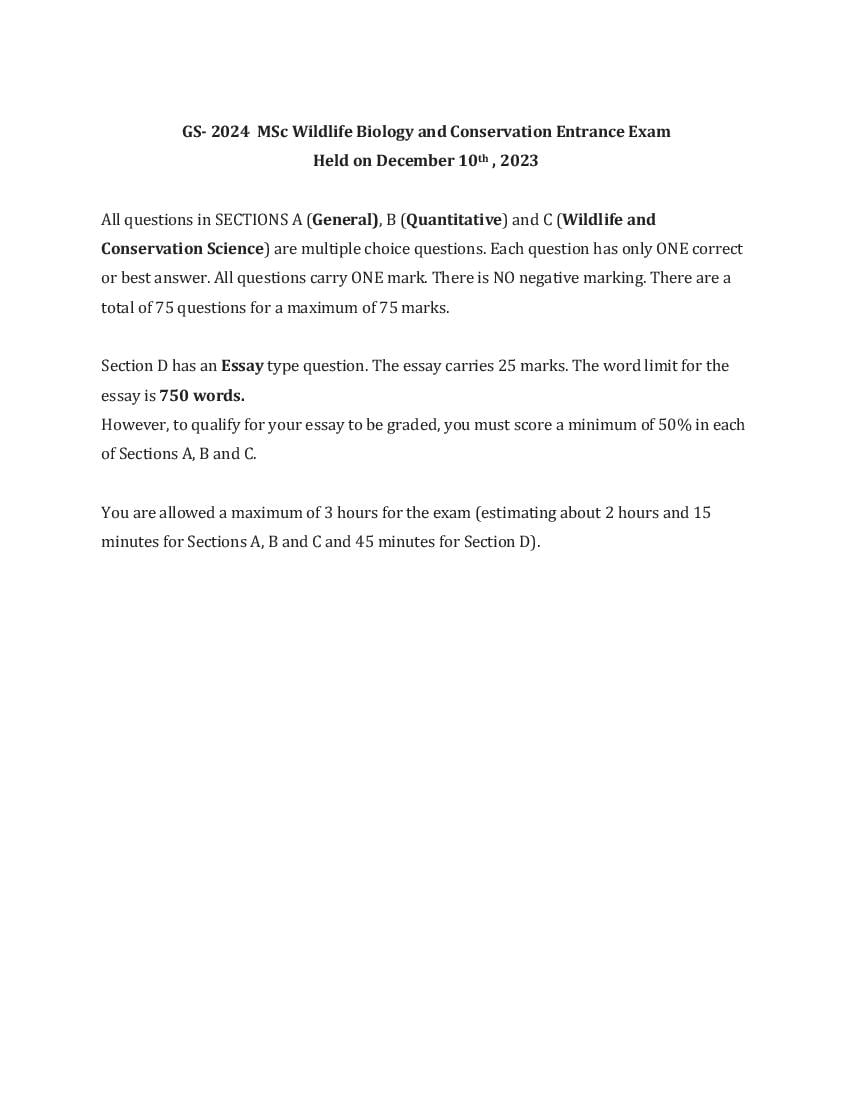
Held on December 10th , 2023
All questions in SECTIONS A (General), B (Quantitative) and C (Wildlife and
Conservation Science) are multiple choice questions. Each question has only ONE correct
or best answer. All questions carry ONE mark. There is NO negative marking. There are a
total of 75 questions for a maximum of 75 marks.
Section D has an Essay type question. The essay carries 25 marks. The word limit for the
essay is 750 words.
However, to qualify for your essay to be graded, you must score a minimum of 50% in each
of Sections A, B and C.
You are allowed a maximum of 3 hours for the exam (estimating about 2 hours and 15
minutes for Sections A, B and C and 45 minutes for Section D).
Page 2
1. Which of the following was the reason for the breach of the Teesta III dam in Sikkim in
2023?
a) Glacial lake outburst flood
b) Earthquake
c) Rock-ice avalanche
d) Landslide
2. According to the data released by the National Tiger Conservation Authority in April
2022, India has about 3700 tigers. Which set of the states shown below has the largest
populations of tigers, according to this report?
a) Madhya Pradesh, Rajasthan, Uttarakhand and Maharashtra
b) Madhya Pradesh, Karnataka, Uttarakhand and Maharashtra
c) Karnataka, Tamil Nadu, Madhya Pradesh and Uttar Pradesh
d) Karnataka, Uttarakhand, Odisha and Maharashtra
3. Virat Kohli recently scored his 50th century to become the batsman with the most One-
Day International (ODI) centuries. Who previously held the record for the most ODI
centuries?
a) Ricky Ponting
b) Rohit Sharma
c) Sachin Tendulkar
d) Kumara Sangakkara
4. Global warming is predicted to lead to more frequent extreme rainfall events (i.e
unusually large amounts of rain falling during a single rainfall episode) in the future. Which
one of the following is a plausible explanation for this?
a) Warmer air rises higher
b) Warmer air holds more water
c) Warmer air results in greater wind speeds
d) Warmer air is more dense
5. Which dimensions are considered in the calculation of the Multidimensional Poverty
Index (MPI) for Indian states?
a) Income and education
b) Health, education, and living standards
c) Agricultural productivity and employment
d) Urbanization and infrastructure
6. Which of the following is not a greenhouse gas?
Page 3
b) Sulphur di-oxide
c) Water vapour
d) Methane
7. Three friends Priya, Sanjay and Mihir are sitting in a row. In how many ways can they be
seated if Sanjay must be to the left of Mihir?
a) 2
b) 3
c) 6
d) 12
8. Ngwame, who lives in the Serengeti, travels south-east a distance of 7 km, then she
travels 14 km west. Then she turns towards the north-west and travels a distance of 7 km,
and finally she moves a distance of 4 km east. How far is she from the starting point?
a) 10 km
b) 20 km
c) 30 km
d) 40 km
9.Five people ran a race. A finished before C, but behind B. E finished before D and A. Which
one of these is a possible finishing order (from first to last)?
a) A, B, C, D, E
b) B, A, C, E, D
c) E, B, A, D, C
d) B, C, D, A, E
10.Thirty years ago, Umesh was half as old as he would be 10 years from now. Umesh’s
current age is:
a) 30
b) 50
c) 60
d) 70
11. Anand visited two different protected areas – A & B - in India, both of similar area. He
noticed that the densities of sambar deer in protected area A were twice those of protected
area B. Which one of the following inferences can he conclusively draw based on this
observation?
Page 4
b) Poaching incidents are twice as high in B compared to A.
c) A is twice as fertile as B.
d) None of the above.
12. Which of the following is not a UNESCO world heritage site?
a) Ranthambore National Park
b) Great Himalayan National Park
c) Kaziranga National Park
d) Keoladeo National Park
13. A job advertisement for a college lecturer stated that “applicants must be fluent in
Sanskrit and know how to dance Kathak”. Therefore, being fluent in Sanskrit and knowing
how to dance Kathak are:
a) necessary to get this job
b) sufficient to get this job
c) necessary and sufficient to get this job
d) neither necessary nor sufficient to get this job
Page 5
them and a light drizzle began, four hikers glimpsed twinkling lights from a village ahead.
In another ten minutes they were walking on the main street of the village. Relieved, Nitin
turned to his friends and said “Whew….Let’s get a bite to eat!” to which his friends replied
as below:
Shashi said: I don’t really like bites.
Menon said: Lets do that, I am starving.
Nina said: I have never understood how anyone can eat a bite.
Nair said: No, I just want to sleep, I’m not hungry.
Which of his friends correctly understood Nitin?
a) Shashi and Nina
b) Nina and Menon
c) Menon and Nair
d) Nair and Shashi
15. The following paragraph (adapted from Sapiens by Yuval Noah Harari) is missing a
sentence. Which of the options given below the paragraph is the most logical sentence to
fill in the blank?
The healthy and diverse diet, the relatively short working week, the low densities in which
they lived and the rarity of infectious diseases in pre-agricultural forager societies have
caused many experts to define these as “the original affluent societies”._______________________.
Though they lived better lives than most people in agricultural and industrial societies,
their world could still be harsh. Periods of want and hardship were not uncommon, child
mortality was high, and an illness which would be minor today could be a death sentence.
Further, being able to keep up with the movement of fellow foraging group members was a
necessity for individual survival and well-being.
a) Theirs was a Utopian world that we no longer experience in the modern day.
b) It would be a mistake, however, to idealise the lives of these ancients.
c) Since they were not sedentary societies, they always experienced good climatic
conditions.
d) People in these societies were always in the warm company of their foraging band.
16. The following sentence contains a missing word. Which of the options given below the
sentence is the most appropriate word to fill in the blank?
“The wooden hut appeared ----------- in the midst of the stone cottages that surrounded it.”
a) incredulous
b) incongruous
c) intrepid
d) introspective
Page 6
always doing his work on time, writing unusually creative essays and doing extra research
on any topic that was assigned for study. Which of the following expressions most correctly
describes Rajan's work relative to his classmates?
a) Rajan jumped out from the rest of the class
b) Rajan leapt out from the rest of the class
c) Rajan stood out from the rest of the class
d) Rajan reached out from the rest of the class
18. Choose the most correct combination of words to fill in the blanks in the sentence
below:
The coach scolded his team, saying, “You ______ when your defence becomes_______”.
a) loose/loose
b) loose/lose
c) lose/loose
d) lose/lose
19. Choose the Odd one out of the following:
a) Babies in a crèche
b) Eggs in a clutch
c) Puppies in a litter
d) Seeds in a pod
20. Which instrument has captured an infrared image of the Herbig-Haro 46/47 stars?
a) Chandra X-Ray Observation Telescope
b) Hubble Space Telescope
c) James Webb Space Telescope
d) Rover of Chandrayaan 3
END OF SECTION A
Page 7
21. Pressure increases by one atmosphere (also called 1 bar) with every 10 metres of depth
in the sea. Hence, pressure at the depth of 10 metres is 2 bars, at 20 metres is 3 bars, and so
on. A marine biologist carries an inflated balloon of volume 6000 millilitres with her. What
will be the volume of the balloon when she reaches the depth of 10 metres and 30 metres,
respectively?
a) 3000 and 1500 millilitres
b) 4000 and 1000 millilitres
c) 3000 and 2000 millilitres
d) 6000 and 6000 millilitres
22. A bag contains 5 white balls and 5 black balls. The probability of drawing two balls of
the same color from the bag is:
a) 2/5
b) 2/10
c) 4/9
d) 2/8
23. While estimating the distribution of income of all people in Mumbai city, Pradyumna
realized that he had left out the income for members of the three wealthiest families in the
city, known for its billionaires. Adding this information will likely change his estimates of
the mean, median and mode of the income of people in Mumbai. Which of the following
statements represents possible outcomes of this change?
a) Mean showed a large increase, Median a small increase, while mode did not change
b) Mean showed a large increase, Median did not change, and mode showed a large increase
c) Mean showed a small increase, Median a large increase, while mode did not change
d) Mean showed a small increase, Median did not change, and mode showed a large increase
24. A research team studies body colour and ectoparasite prevalence in a fish species. They
catch all 100 fish in a pond, measure the colour (red, not red), note down the parasitism
status (parasitized, not parasitised), and then release the fish back into the pond. The
diagram below displays these data (circle R = set of Red, circle P = set of Parasitised).
If I catch a red fish at random from this pond, what is the probability that it is parasitised?
Page 8
b) 1/8
c) 1/6
d) 1/4
25. A researcher wants to perform a study on spatial memory of urban male and female
dogs. There are 5 males and 6 females available for the study. In how many ways, can the
researcher select 3 males and 3 females from those available?
a) 11
b) 30
c) 200
d) 270
Page 9
measurements shown in the figure below: the distance from the tree top (A) to the
observer top (B) is 15ft; the height of the observer is 6 ft; the distance from the observer
(C) to the base of the tree (D) is 9 ft; the angle of tree trunk to the ground, Angle ADC is 900.
Given these measurements, the height of the tree (length AD) is:
a) 12 ft
b) 18 ft
c) 22 ft
d) 33 ft
27. Which one of the following options lists measures of central tendency?
a) Median and mode
b) Mean and variance
c) Standard deviation and standard error
d) Median and interquartile range
Page 10
expectation is that leaf galls are distributed non-randomly across leaves of a tree. I measure
the number of galls on a sample of 300 leaves from a tree. I calculate the mean and variance
in the number of galls per leaf. Which one of the results below indicates that galls are
distributed evenly/uniformly across leaves in the tree?
a) Variance/Mean = 1
b) Variance/Mean < 1
c) Variance/Mean > 1
d) Variance/Mean = 2
29. In a population of tigers, the probability of being photographed by a camera trap is 0.6.
The probability of a tiger surviving to the next year is 0.9. Given that a tiger in this
population is photographed in a given year, what is the probability that it is photographed
again in the following year?
a) 0.54
b) 0.90
c) 0.60
d) 0.66
Page 11
larger than females. They then measure the body weights of 50 males and 50 females in the
population. To test whether this hypothesis is true, which is the most appropriate of the
following statistical tests?
A. Linear regression
B. Chi-squared test
C. Spearman's rank correlation
D. t-test
31. If a population is growing at 5% per year, and the population size in year t is denoted as
Nt, then which of the following statements is true?
A. N(t+1) = 5
B. N(t+2)/N(t+1) = 5/100
C. N(t+3)/N(t+2) is equal to N(t+2)/N(t+1)
D. N(t+3)-N(t+2) is equal to N(t+2)-N(t+1)
32. If x and y are positive integers such that x + y = 10, what is the maximum possible value
of the product x*y?
a) 20
b) 25
c) 30
d) 36
Page 12
triangle BCD is 1/3 that of triangle ABC. The length BC is 10cm and the height of triangle
ABC is 15cm.
The area of the shaded part of the figure is:
a) 25 cm2
b) 50 cm2
c) 75 cm2
d) 100 cm2
Page 13
individuals were grazed and not grazed. The figure below plots the number of seeds produced by
these plants as a function of their height. The open circles and filled black circles represent plants
that were grazed and not grazed, respectively. The dashed and solid lines represent the best fit
lines for plants that were grazed and not grazed, respectively. The slopes of these lines are not
statistically different from one another. Which of the following conclusions can be drawn from this
figure?
a) Grazed plants are on average taller than plants that were not grazed.
b) The rate of increase in seed production with plant height differs between grazed plants and
plants that were not grazed.
c) For a given height, grazed plants produce more seeds than plants that were not grazed.
d) Seed production is only dependent on plant height.
Page 14
predators as a function of water temperature. This suggests that marine ecotherms like
sharks would perform relatively better (as measured by their metabolic rates) at lower
latitudes, while endotherms like orcas would perform better at higher latitudes. Further,
there appears to be a crossover point, a latitude at which the relative performances of
endotherms and ectotherms flip. How would global warming and increasing sea
temperatures affect this crossover point ?
a) The crossover point will move to higher latitudes, towards the poles
b) The crossover point will move to lower latitudes, towards the equator
c) The crossover point will move to lower latitudes, in the southern hemisphere only
d) The crossover point will not change
Page 15
Protected Area (km2) Number of Number of Density of Density of large
Area ungulate large carnivore ungulates carnivores
species species (individuals/km ) (individuals/km2)
2
A 80 7 4 40.0 3.30
B 200 10 6 12.0 2.01
C 350 11 7 24.2 3.10
D 1250 15 13 18.0 2.45
E 4000 18 13 15.5 2.72
Given the above data, examine the following statements:
1) Density of large carnivores is correlated with ungulate species richness
2) Larger protected areas have more species of ungulates and large carnivores
3) Ungulate and large carnivore species richness are correlated
4) Large carnivore density is correlated with protected area size
Which of the above statements are true?
a) 1 & 4
b) 2 & 3
c) 1 & 2
d) only 4
37. A researcher measures the foraging rate of sandpipers under different competitor
densities and estimates the relationship to be 𝑙𝑜𝑔! (𝑌) = 2.3 − 0.5𝑙𝑜𝑔! (𝑋)where Y is
foraging rate in number of prey items consumed per minute and X is number of
competitors (ranging from 1 to 100). According to this equation, the foraging rate (rounded
to the nearest integer) of a sandpiper in the presence of 1 competitor is:
a) 2 items per minute
b) 5 items per minute
c) 10 items per minute
d) 20 items per minute
Page 16
relationship with group size, as follows: 𝑌 = 18 − 0.23𝑋 + 0.0011𝑋 " , where Y is vigilance,
X is group size and X ranges from 1 to 200. Which one of the options below best represents
this relationship?
a) P
b) Q
c) R
d) S
39. A grocer has 400 kg of coffee in stock, 20% of which is decaffeinated. If the grocer buys
another 100 kg of coffee of which 60% is decaf, what percent, by weight, of the grocers’
stock of coffee is decaffeinated?
a) 28%
b) 30%
c) 32%
d) 40%
Page 17
the length of the other, what is the length of the longer piece of rope?
a) 7.5 m
b) 11.7 m
c) 9.9 m
d) 10.3 m
41 If a rectangle of area 24 cm2 is divided into exactly 3 non-overlapping squares of equal
area, what is the length of the longer side of the rectangle (rounded to two decimal places)?
a) 2.82
b) 5.64
c) 8.48
d) 11.28
42. In statistical hypothesis testing, alpha is the probability of falsely rejecting a true null
hypothesis, also called Type I error. Alpha is usually set at 0.05. If we reduce alpha to 0.01,
the probability of falsely rejecting a true null hypothesis:
a) decreases
b) increases
c) remains the same
d) saturates
Page 18
1: The age of a snake and its body length
2. The cross-sectional diameter of a snake and its body volume
3. The mass of a snake and its body volume
a) 1 = B; 2 = C; 3 = A
b) 1 = C; 2 = B; 3 = A
c) 1 = A; 2 = B; 3 = C
d) 1 = A; 2 = C; 3 = B
Page 19
richness in areas with different rainfall levels. The researcher hypothesizes that plant
species richness peaks at intermediate rainfall levels because water stress reduces species
richness at low rainfall and competition reduces species richness at high rainfall levels. She
also hypothesizes that grazing negatively impacts plant species richness at lower than
average rainfall by adding to the water stress; whereas grazing enhances plant species
richness at higher than average rainfall by reducing the impact of competition. Which of the
following graphs best depicts her hypothesis?
a) P
b) Q
c) R
d) S
Page 20
distribution of clutch sizes (the number of eggs laid at a time by a female) in a population of
birds, while the dotted line shows the number of young fledged per clutch. Using only these
data, which of the following conclusions are valid for this population of birds?
a) The largest clutch sizes in the population result in the maximum number of young fledged per
clutch
b) The most frequent clutch size in the population is greater than the clutch size that maximizes
the number of young fledged per clutch
c) The most frequent clutch size in the population is smaller than the clutch size that
maximizes the number of young fledged per clutch
d) The most frequent clutch size in this population is the one that maximizes the number of young
fledged per clutch.
END OF SECTION B
Page 21
46. The relationship between coral polyps and zooxanthellae is an example of which type of
interaction?
a) Commensalism
b) Mutualism
c) Parasitism
d) Predation
47. Which of these ecosystems typically hold the most amount of soil carbon per unit area?
a) Agricultural lands
b) Grasslands
c) Wet evergreen forests
d) Wetlands
48. Which of the following species is not known to be invasive in India:
a) Chromolaena odorata
b) Eucalyptus globulus
c) Lantana camara
d) Parthenium hysterophorus
49. Which of the following taxa of trees are not gymnosperms?
a) Cycads
b) Junipers
c) Oaks
d) Pines
50. As we move away from the equator to the poles, the elevation at which we encounter
the treeline on mountains is expected to:
a) decrease
b) increase
c) first increase and then decrease
d) remain unchanged
Page 22
a) crustaceans
b) marine fish
c) sea grasses
d) seaweed
52. Panel P below shows the population sizes of two insect species m and n when occurring
alone and when occurring together, and Panel Q shows the population sizes of two insect
species x and y when occurring alone and when occurring together. Which one of the
following descriptions of their interaction is most likely?
a) P: Mutualism, Q: Commensalism
b) P: Commensalism, Q: Parasitism
c) P: Commensalism, Q: Mutualism
d) P: Parasitism, Q: Commensalism
53. Heterozygosity at a locus H with two alleles p and q under Hardy-Weinberg equilibrium
is maximised when
a) p = 0.1 and q = 0.9
b) p = 0.2 and q = 0.8
c) p = 0.4 and q = 0.6
d) p = 0.5 and q = 0.5
54. Relatedness, which is the probability of two individuals sharing an allele by descent, for
a diploid sexually reproducing animal, is:
a) 0.75 for parent and offspring, 0.5 for siblings and 0.25 for grandparent-grandoffspring
b) 0.5 for parent and offspring, 0.25 for siblings and 0.25 for grandparent-grandoffspring
c) 0.5 for parent and offspring, 0.5 for siblings and 0.5 for grandparent-grandoffspring
Page 23
Typographic error. No correct answer. All candidates will be given a mark for this question
55. According to island biogeography theory of MacArthur and Wilson, the number of
species on an island is a balance between:
a) colonisation and extinction
b) competition and predation
c) instantaneous growth rate r and carrying capacity K
d) resource acquisition and predation
56. Match the following books with their authors
1. Indira Gandhi: A Life in Nature A. K.UllasKaranth
2. Among Tigers B. Prerna Singh Bindra
3. The Wild Heart of India C. Jairam Ramesh
4. The Vanishing: India’s Wildlife Crisis D. T.R.Shankar Raman
a) 1:A, 2:D, 3:B, 4:C
b) 1:B, 2:A, 3:C, 4:D
c) 1:C, 2:D, 3:B, 4:D
d) 1:C, 2:A, 3:D, 4:B
Page 24
been asked to select the least number of protected areas which would give protection to all
the 8 endangered species.
Endangered species: Elephant, tiger, rhino, lion-tailed macaque, swamp deer, Great Indian
Bustard, Bengal Florican and clouded leopard.
Protected areas: Kanha National Park, Ranthambore Tiger Reserve, Corbett National Park,
Kaziranga National Park, Silent Valley National Park, Jailsalmer Desert National Park,
Panna Tiger Reserve, Eaglenest Wildlife Sanctuary
Which are the protected areas that you would select?
a) Corbett National Park, Silent Valley National Park, Eaglenest Wildlife Sanctuary,
Kaziranga National Park
b) Kaziranga National Park, Silent Valley National Park, Panna Tiger Reserve
c) Kaziranga National Park, Jaisalmer Desert National Park, Silent Valley National
Park
d) All the protected areas.
58.Arrange amphibians, mammals and birds in increasing order of species richness in
India.
a) Mammals<Birds<Amphibians
b) Amphibians<Birds<Mammals
c) Amphibians<Mammals<Birds
d) Birds<Amphibians<Mammals
59. The Forest (Conservation) Amendment Bill 2023, was passed by the Parliament in July
2023. This amendment will:
a) Simplify procedures for diversion of forest land for strategic and development projects in
border areas.
b) Override several provisions in the Forest Rights Act (2006) which recognizes the rights of the
forest dwelling tribal communities and other traditional forest dwellers to forest resources.
c) Remove the “dictionary” definition of forests which the Supreme Court of India applied in the
Godavarman case, 1996, while banning clear felling in all ecological forests, regardless of
ownership.
d) Do all of the above
60. Name a non-native tree species much favoured by frugivorous bats in India?
a) Mango
Page 25
c) Cashew
d) Jamun
61. Carbon stocks in two forest ecosystems A and B are measured every year for a few
decades. The carbon stock in ecosystem A increases linearly with time. In ecosystem B, it
increases, becomes flat for a while and then decreases. Carbon sequestration is the rate at
which carbon stock changes with time. Which of the following is true:
a) Both ecosystems have a constant rate of carbon sequestration
b) The rate of carbon sequestration is non-zero in both ecosystems at all times
c) Ecosystem B has a zero rate of carbon sequestration at some point in time
d) Ecosystem B has a positive rate of sequestration throughout
62. Which region in India is likely to experience the highest rate of warming due to global
climate change?
a) Central India
b) Eastern Himalaya
c) Gangetic plains
d) Western Ghats
63. Bats are potential reservoirs of zoonoses because:
a) There are many bat species that are phylogenetically close to humans
b) There are bat species phylogenetically close to humans that fly long distances
c) They carry many RNA viruses and often live close to humans
d) They fly short distances and carry many bacterial pathogens
64. Which of the following is a set of extinct species?
a) Tasmanian tiger, Passenger pigeon, White rhino
b) Northern white rhino, South China tiger, Amur tiger
c) Tasmanian tiger, Passenger pigeon, Asian cheetah
d) Tasmanian tiger, Passenger pigeon, Quagga
65. Which one of the statements below correctly describes the relationship between
instantaneous birth rate (b) and population size (N) in a population showing logistic
population growth?
a) b decreases linearly with N
b) b increases linearly with N
Page 26
d) b shows a unimodal relationship with N
66. A study sampled butterfly communities at three different grassland sites. The table
below shows the species and their abundances quantified at the three sites. Which one of
the options given below represents the sites correctly ordered according to their species
diversity (as quantified by the Shannon-Weiner index which includes both species richness
and relative abundances)?
Species identity Site R Site S Site T
E 50 25 22
F 10 10 24
G 15 20 20
H 5 5 22
I 12 19
J 10 23
K 6 19
L 6 20
a) R > S > T
b) S = T > R
c) S > R > T
d) T > S > R
67. Aggressive ants live in the swollen thorns of a small tropical tree and feed on oil-rich
bodies that the tree produces at the tip of its leaflets. Of the following experiments, which
best tests the hypothesis that ants defend the plant by either killing or chasing away leaf-
feeding insects?
a) Remove ants and measure subsequent leaf damage
b) Remove oil-rich bodies and measure subsequent ant density.
c) Remove the thorns and measure subsequent ant density.
d) Remove leaf-feeding insects and measure subsequent plant growth.
68. Which of the following accurately depicts the correct sequence, in decreasing order, of
the distribution of biomass across the major kingdoms?
a) Animals > fungi > plants > bacteria >protists
b) Bacteria > plants > fungi > animals >protists
Page 27
d) Plants > bacteria > fungi >protists> animals
69. Plants with C4 photosynthetic pathways have specialized adaptations that help them
avoid photorespiration. This allows C4 plants to limit how much they open their stomates
relative to C3 plants. This gives C4 plants a relative advantage over C3 plants in:
a) cool environments
b) dry environments
c) nutrient rich environments
d) shaded environments
70. In which of the river systems does theGangetic river dolphin occur:
a) Ganga, Godavari, Krishna
b) Ganga, Yamuna, Godavari
c)Ganga, Brahmaputra, Mahanadi
d) Ganga, Yamuna, Narmada
71. Which of the following species is not endemic to the Indian peninsula?
a) Bonnet macaque
b) Yellow throated bulbul
c) Indian Peafowl
d) Jerdon’s courser
72. Which of the following choices gives the geologic eras in the correct sequence, from the
oldest to the most recent?
A. Cenozoic—Mesozoic—Paleozoic—Precambrian
B. Precambrian—Paleozoic—Mesozoic—Cenozoic
C. Paleozoic—Precambrian—Cenozoic—Mesozoic
D. Paleozoic—Cenozoic—Precambrian—Mesozoic
73. Charles Darwin’s proposed conditions for natural selection encompass all of the
following with regard to a given population EXCEPT
A. Differential survival of individuals
B. Differential production of offspring
C. Competition for limited resources
D. Changing environmental conditions
Page 28
Given the above, which vegetation forms would most likely be found in a location with an
average annual temperature below 10°C and average annual precipitation above 100 cm?
a) Coniferous trees, fungi, mosses, lichens
b) Shrubs, grasses, herbs, palms
c) Mosses, heath, lichens, algae
d) Cacti, succulents, grasses
75. The shola-grassland ecosystem of the high elevation regions of the Southern western
Ghats is a mosaic system. Here patches of stunted evergreen forests (known as sholas) and
large stretches of montane grassland occur together in a patchwork pattern. The
boundaries between these two ecosystem states- shola and grassland- are very abrupt and
sharply defined. It is thought that frosts and fires are important in determining these
boundaries. Fires and frosts occur frequently in the grasslands, and while grasses are
adapted to them, shola trees cannot establish under these conditions. In contrast, the dense
canopies of sholas do not allow frosts and fires to penetrate, and while shola trees do well
under these conditions, grasses are shaded out. Thus, the conditions in each ecosystem
state promote its persistence. This is an example of a:
Page 29
b) Neutral feedback loop
c) Positive feedback loop
d) None of the above
END OF SECTION C
Page 30
Write an essay on ONE of the following topics. You are allowed a maximum of 750 words.
You will be scored on the content of the essay, clarity of thought, logic of arguments, flow of
text and writing clarity.
TOPIC 1
The United Nations has declared 2021-2030 as the Decade of Ecosystem Restoration in
recognition of the urgent need to prevent, halt and reverse the loss of earth's natural
ecosystems to combat climate change and prevent the breaching of planetary boundaries.
Restoration of habitats is critical to bring back biodiversity and ecosystem function to areas
that have been degraded. However, although well-intentioned, we (administrators, funders,
citizens) have come to equate restoration with tree planting. Newspaper headlines
claiming a record number of trees being planted are a common occurrence. Often non-
native species are used to make up the numbers; endangered habitats such as grasslands
are planted over by trees; compensatory tree planting is done to make up loss of old
growth forests; overall this often does more harm than good. Imagine that you are in
charge of drafting India’s guidelines on restoration. Write an essay about the salient points
that you would include in this policy document, how would you suggest that decisions
about restoration be made and implemented, and what would you recommend as the goals
for restoration, bolstering your suggestions with evidence where you can.
TOPIC 2
The Indian subcontinent stands out in the conservation world as being home to the last
viable populations of charismatic megafauna such as Asian elephants and gaur, and large
carnivores like tigers, leopards and lions, alongside some of the most dense human
populations on earth. The cheetah is the only species of large mammal to have gone extinct
on the Indian subcontinent. Recently, cheetahs were brought in from Namibia and South
Africa with the intent to create a population of wild cheetahs after an absence of nearly 75
years. Is it important to recover locally extinct species for conservation? Will this project
result in a successful establishment of this species in India? Could the resources spent on
this project have been used instead for the conservation of other species that are currently
threatened with extinction (e.g. Great Indian Bustard)? Or does the project demonstrate
India’s unwavering commitment to wildlife conservation? Write an essay outlining your
views on this project, bolstering your case with evidence where you can.
END OF SECTION D
Document Details
| Board / Org | TIFR |
| Exam | TIFR GS |
| Type | Question Paper |
| Pages | 30 |
| Updated | 23 Oct 2026 |