MBOSE Class 12 Question Paper 2018 for Geology
Finished viewing? Save it for later —
Download MBOSE Class 12 Question Paper 2018 for Geology (PDF · 8 pages)About MBOSE Class 12 Question Paper 2018 for Geology
MBOSE Class 12 Question Paper 2018 for Geology is available here for free download. Published by Meghalaya Board for Class 12, this question paper can be viewed online or downloaded as a PDF (8 pages). Candidates preparing for Class 12 can use MBOSE Class 12 Question Paper 2018 for Geology to understand the exam pattern, the type of questions asked, and the overall difficulty level.
Frequently Asked Questions
How can I download MBOSE Class 12 Question Paper 2018 for Geology?
Open this page and click the Download button to save MBOSE Class 12 Question Paper 2018 for Geology as a PDF. It is completely free on AglaSem Docs.
Is MBOSE Class 12 Question Paper 2018 for Geology free to download?
Yes. MBOSE Class 12 Question Paper 2018 for Geology can be viewed online and downloaded as a PDF free of cost on AglaSem Docs.
How many pages does MBOSE Class 12 Question Paper 2018 for Geology have?
MBOSE Class 12 Question Paper 2018 for Geology contains 8 pages, which you can read online or download together as a single PDF.
Where can I find more Class 12 study material?
You can find more Class 12 question papers, sample papers, syllabus, and answer keys on AglaSem Docs.
MBOSE Class 12 Question Paper 2018 for Geology – Text
Read the full text of this question paper below — useful to quickly search, copy and reference the content online without downloading the PDF.
📄 View text version (8 pages)
Page 1
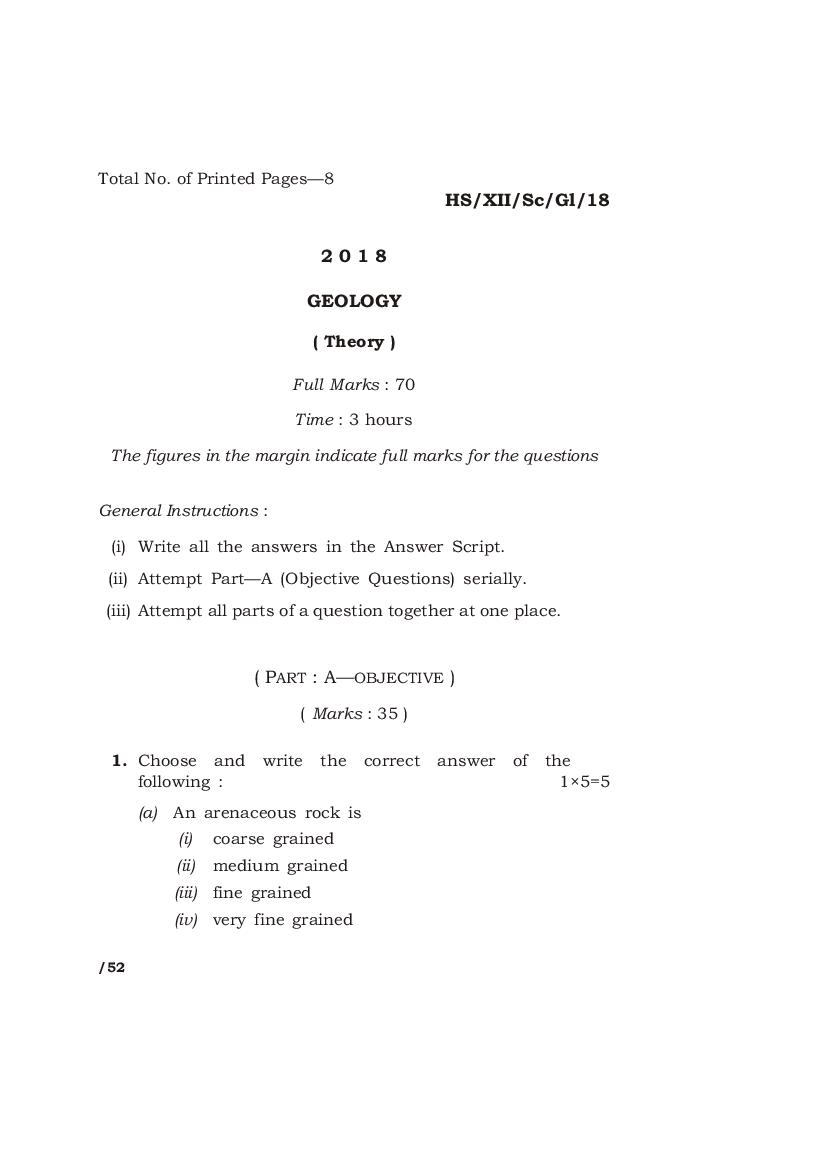
HS/XII/Sc/Gl/18
2018
GEOLOGY
( Theory )
Full Marks : 70
Time : 3 hours
The figures in the margin indicate full marks for the questions
General Instructions :
(i) Write all the answers in the Answer Script.
(ii) Attempt Part—A (Objective Questions) serially.
(iii) Attempt all parts of a question together at one place.
( PART : A—OBJECTIVE )
( Marks : 35 )
1. Choose and write the correct answer of the
following : 1×5=5
(a) An arenaceous rock is
(i) coarse grained
(ii) medium grained
(iii) fine grained
(iv) very fine grained
/52
Page 2
(b) Silicified wood is an example of
(i) petrification
(ii) carbonization
(iii) mould
(iv) cast
(c) The proper rock sequence from older to younger
in the stratigraphy of upper Assam is
(i) Barail, Tipam, Surma, Dupitila
(ii) Dihing, Dupitila, Tipam, Surma
(iii) Barail, Dupitila, Surma, Tipam
(iv) Barail, Surma, Tipam, Dupitila
(d) Choose the odd one :
(i) Magmatic concentration deposit
(ii) Pegmatitic deposit
(iii) Fissure vein
(iv) Placer deposit
(e) The component(s) of environment is/are
(i) lithosphere
(ii) lithosphere and biosphere
(iii) lithosphere, biosphere and atmosphere
(iv) lithosphere, biosphere, atmosphere and
hydrosphere
Page 3
2. State whether the following statements are True or
False : 1×5=5
(a) The direct effect of underground mining is
ground subsidence.
(b) Graded bedding is associated with decrease in
stream power.
(c) The ammonite suture is the most developed
suture type.
(d) The Muth quartzites occur between Haimanta
and Kanawar groups.
(e) Deposits that form later than the enclosing rocks
are syngenetic mineral deposits.
3. Fill in the blanks : 1×10=10
(a) Next to the continental shelf seaward is the _____
environment.
(b) Very thin beds are called _____.
(c) Benthonic organisms are _____ organisms.
(d) Coal is an example of _____ mode of preservation
of fossils.
Page 4
(e) An example of an igneous intrusion into the
Dharwars is _____.
(f) The Lakadong limestones belong to the _____
group.
(g) Petroleum originates from _____.
(h) Low temperature mineral deposits are called
_____ deposits.
(i) The uppermost level of groundwater is defined
by the _____.
(j) Rocks dipping upstream are _____ in the
construction of dams.
4. Express each of the following in 1 (one) word : 1×3=3
(a) A geomorphological unit in which sediments
are laid down
(b) Establishment of relationship between rocks of
two different areas
(c) The action of reducing the severity of a natural
event
Page 5
5. Match Column—A with Column—B and write the
corresponding numbers : 1×6=6
Column—A Column—B
(a) Argillaceous (i) Ultrabasic rock
(b) Suture (ii) Hypersthene
(c) Palial sinus (iii) Sandstone
(d) Petroleum reservoir (iv) Cephalopod
(e) Chromite (v) Lamellibranch
(f) Charnockite (vi) Shale
(vii) Conglomerate
6. Write 1 (one) or 2 (two) line(s) on any six of the
following : 1×6=6
(a) Bed
(b) Habitat
(c) Correlation
(d) Secondary mineral deposit
(e) Dams
(f) Conglomerate
(g) Gangue and tenor
Page 6
( PART : B—DESCRIPTIVE )
( Marks : 35 )
Answer five questions, selecting one from each Group
GROUP—A
( Sedimentology )
7. List eight sedimentary structures. Write on any three
of them. Draw sketches. 2+5=7
8. Write notes on any two of the following : 3½×2=7
(a) Diagenesis
(b) Non-clastic sedimentary rocks
(c) Environment of deposition
GROUP—B
( Paleontology )
9. Outline the morphology of a typical cephalopod shell.
Draw a neat labelled sketch. 6+1=7
10. Write notes on any two of the following : 3½×2=7
(a) Gondwana flora
(b) Differences between brachiopod and
lamellibranch shells
(c) Paleontology and paleo environment
Page 7
GROUP—C
( Stratigraphy )
11. Write the stratigraphy of the Dharwar supergroup
(after Rama Rao) in tabular form with very brief
petrographic note. 7
12. Write notes on any two of the following : 3½×2=7
(a) Khasi group
(b) Lithostratigraphy
(c) Lithostratigraphy of the Vindhyan supergroup
GROUP—D
( Mineral and Energy Resources )
13. Write brief notes on the origin, mode of occurrence
and distribution of hematite deposits in India. 7
14. Write notes on any two of the following : 3½×2=7
(a) Origin of coal
(b) Placer deposits
(c) Accumulation of petroleum
Page 8
GROUP—E
( Engineering Geology, Groundwater, Environment
and Disaster Studies )
15. How does structure of rocks affect the stability of
dams? Supplement your answer with neat sketches. 7
16. Write notes on any two of the following : 3½×2=7
(a) Causes of landslides
(b) Hydrologic cycle
(c) Impact of open-cast mining on the environment
HHH
8K—70/52 HS/XII/Sc/Gl/18
Document Details
| Board / Org | Meghalaya Board |
| Exam | Class 12 |
| Type | Question Paper |
| Pages | 8 |
| Updated | 15 Jul 2026 |