PUBDET 2023 Question Paper History
Finished viewing? Save it for later —
Download PUBDET 2023 Question Paper History (PDF · 16 pages)About PUBDET 2023 Question Paper History
PUBDET 2023 Question Paper History is available here for free download. Published by WBJEEB for PUBDET, this question paper can be viewed online or downloaded as a PDF (16 pages). Candidates preparing for PUBDET can use PUBDET 2023 Question Paper History to understand the exam pattern, the type of questions asked, and the overall difficulty level.
Frequently Asked Questions
How can I download PUBDET 2023 Question Paper History?
Open this page and click the Download button to save PUBDET 2023 Question Paper History as a PDF. It is completely free on AglaSem Docs.
Is PUBDET 2023 Question Paper History free to download?
Yes. PUBDET 2023 Question Paper History can be viewed online and downloaded as a PDF free of cost on AglaSem Docs.
How many pages does PUBDET 2023 Question Paper History have?
PUBDET 2023 Question Paper History contains 16 pages, which you can read online or download together as a single PDF.
Where can I find more PUBDET study material?
You can find more PUBDET question papers, sample papers, syllabus, and answer keys on AglaSem Docs.
PUBDET 2023 Question Paper History – Text
Read the full text of this question paper below — useful to quickly search, copy and reference the content online without downloading the PDF.
📄 View text version (16 pages)
Page 1
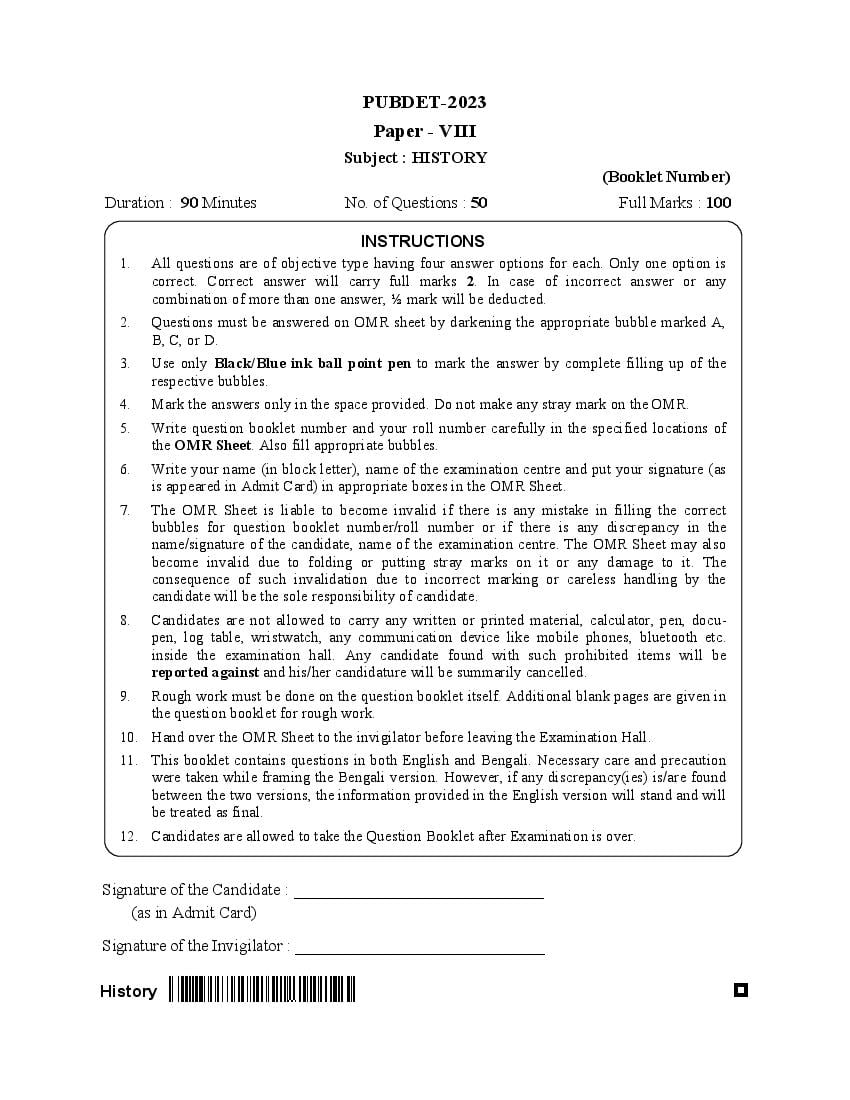
Subject : HISTORY
(Booklet Number)
Duration : 90 Minutes No. of Questions : 50 Full Marks : 100
INSTRUCTIONS
1. All questions are of objective type having four answer options for each. Only one option is
correct. Correct answer will carry full marks 2. In case of incorrect answer or any
combination of more than one answer, ½ mark will be deducted.
2. Questions must be answered on OMR sheet by darkening the appropriate bubble marked A,
B, C, or D.
3. Use only Black/Blue ink ball point pen to mark the answer by complete filling up of the
respective bubbles.
4. Mark the answers only in the space provided. Do not make any stray mark on the OMR.
5. Write question booklet number and your roll number carefully in the specified locations of
the OMR Sheet. Also fill appropriate bubbles.
6. Write your name (in block letter), name of the examination centre and put your signature (as
is appeared in Admit Card) in appropriate boxes in the OMR Sheet.
7. The OMR Sheet is liable to become invalid if there is any mistake in filling the correct
bubbles for question booklet number/roll number or if there is any discrepancy in the
name/signature of the candidate, name of the examination centre. The OMR Sheet may also
become invalid due to folding or putting stray marks on it or any damage to it. The
consequence of such invalidation due to incorrect marking or careless handling by the
candidate will be the sole responsibility of candidate.
8. Candidates are not allowed to carry any written or printed material, calculator, pen, docu-
pen, log table, wristwatch, any communication device like mobile phones, bluetooth etc.
inside the examination hall. Any candidate found with such prohibited items will be
reported against and his/her candidature will be summarily cancelled.
9. Rough work must be done on the question booklet itself. Additional blank pages are given in
the question booklet for rough work.
10. Hand over the OMR Sheet to the invigilator before leaving the Examination Hall.
11. This booklet contains questions in both English and Bengali. Necessary care and precaution
were taken while framing the Bengali version. However, if any discrepancy(ies) is/are found
between the two versions, the information provided in the English version will stand and will
be treated as final.
12. Candidates are allowed to take the Question Booklet after Examination is over.
Signature of the Candidate : ______________________________
(as in Admit Card)
Signature of the Invigilator : ______________________________
History
Page 2
History 2
Page 3
1. Which of the following is not associated with Mesolithic Culture ?
(A) Hunting-gathering (B) Domestication of animals
(C) Microlith (D) Horticulture
¢ejÀ¢m¢Ma L¡eÚ¢V jdÉfËÙ¹l pwú«¢al p‰ k¤š² eu ?
(A) ¢nL¡l J M¡cÉpwNËq (B) Nªq föf¡me
(C) j¡Cœ²¡¢mb (D) EcÉ¡e f¡me
2. Which of the following statements is correct ?
(A) Harappan civilization was a rural one.
(B) Harappan civilization was chalcolithic.
(C) Harappan civilization was of iron-age.
(D) Harappan civilization belonged to stone age.
¢ejÀ¢m¢Ma L¡eÚ hš²hÉ¢V p¢WL ?
(A) qlè¡ piÉa¡ ¢Rm HL¢V NË¡j£Z piÉa¡ z
(B) qlè¡ piÉa¡ ¢Rm a¡jË¡ ীu z
(C) qlè¡ piÉa¡ ¢Rm m±q-k¤Nl z
(D) qlè¡ piÉa¡ ¢Rm fËÙ¹l-k¤Nl z
3. Which of the following is not a Harappan Culture Site ?
(A) Kalibangan (B) Dholavira
(C) Chanhudaro (D) Taxila
¢eQl L¡eÚ¢V qlè¡ pwú«¢al ÙÛ¡e eu ?
(A) L¡¢mh‰¡e (B) d¡m¡¢il¡
(C) Q¡eýc¡l¡ (D) arn£m¡
4. Which of the following pairs is not correctly matched ?
Mahajanapada Chief City
(A) Anga Champa
(B) Asmaka Vaisali
(C) Matsya Viratanagara
(D) Surasena Mathura
¢ej¢À m¢Ma L¡eÚ S¡s¡¢V p¢WL eu ?
jq¡Se fc fËd¡e eNl
(A) A‰ QÇf¡
(B) A L °hn¡m£
(C) jvpÉ ¢hl¡VeNl
(D) n§lpe jb¤l¡
History 3
Page 4
ruling families ?
(A) Kanvas (B) Mitras
(C) Satavahanas (D) Chedis
e¡e¡O¡V, e¡¢pL Hhw py¡¢Q ¢m¢fa ¢ej¢À m¢Ma L¡eÚ f¢lh¡ll n¡pe-L¡¢q¢e h¢ZÑa quR ?
(A) L¡eÄcl (B) ¢jœcl
(C) p¡ah¡qecl (D) Q¢ccl
6. Put in the chronological order
(i) Sisunaga dynasty
(ii) Alexander’s invasion
(iii) Kalinga war
(iv) Megasthenes’ visit to India
(A) (i), (ii), (iii), (iv) (B) (i), (ii), (iv), (iii)
(C) (ii), (iii), (iv), (i) (D) (iv), (iii), (ii), (i)
L¡m¡e¤œ²j p¡S¡J
(i) ¢nöe¡N hwn
(ii) BmLS¡ä¡ll A¢ik¡e
(iii) L¢m‰ k¤Ü
(iv) jN¡¢ÙÛ¢epl i¡la ïjZ
(A) (i), (ii), (iii), (iv) (B) (i), (ii), (iv), (iii)
(C) (ii), (iii), (iv), (i) (D) (iv), (iii), (ii), (i)
7. Which of the following rulers controlled the ‘silk route’ and also benefited the most from
the revenue it brought ?
(A) Sakas (B) Indo-Greeks
(C) Kushanas (D) Satavahanas
¢ejÀ¢m¢Ma L¡eÚ n¡pLhNÑ ‘¢pó l¦V’/ ‘lnj fb’ -Hl Jfl ¢eu¿»Z fË¢aù¡ Ll Hhw pM¡e bL
Bc¡u£L«a l¡Sü m¡ih¡e qu¢Rm ?
(A) nL (B) C¾c¡-NË£L
(C) L¥o¡Z (D) p¡ah¡qe
History 4
Page 5
(A) Lichchhavi Dauhitrah (B) Sarvarajochchhetta
(C) Aswamedha Parakrami (D) Vikramaditya
¢ejÀ¢m¢Ma L¡eÚ A¢id¡¢V pj¤â…çl p‰ pw¢nÔø eu ?
(A) ¢mµR¢h c±¢qœ (B) phÑl¡SµRš¡
(C) AnÄjd fl¡œ²j£ (D) ¢hœ²j¡¢caÉ
9. Who wrote ‘Kitab-ul-Hind’ ?
(A) Utbi (B) Al-Biruni
(C) Al-Masudi (D) None of the above
‘¢La¡h-Em-¢q¾cÚ’ L ¢mM¢Rme ?
(A) Ev¢h (B) Bm-¢hl¦e£
(C) Bm-j¡p¤¤¢c (D) Efll ®LEC ee
10. Who received a robe of honour from the Caliph ?
(A) Iltutmish (B) Qutub-ud-din-Aibak
(C) Giasuddin Balban (D) Ala-ud-din-Khalji
L M¢mg¡l L¡R bL pÇj¡ep§QL f¡n¡L m¡i Lle ?
(A) Cma¥v¢jp (B) L¥a¥h-Ec-¢ce-BChL
(C) ¢Nu¡p¤¤¢Ÿe hmhe (D) Bm¡-Ec-¢ce Mm¢S
11. What was ‘Kharaj’ ?
(A) Property Tax (B) Booty
(C) Land Tax (D) Gift
‘Ml¡S’ L£ ¢Rm ?
(A) pÇf¢š Ll (B) m¤¢ãa âhÉ
(C) i¨¢j l¡Sü (D) Efq¡l
12. Who among the following Englishmen was given the title of ‘Khan’ by Jahangir ?
(A) Hawkins (B) Thomas Roe
(C) Ralph Fitch (D) Newbery
¢ejÀ¢m¢Ma L¡eÚ CwlS S¡q¡‰£ll L¡R bL ‘M¡e’ Ef¡¢d m¡i Ll¢Rme ?
(A) q¢L¾p (B) Vj¡p l¡
(C) lÉ¡mg ¢gQ (D) ¢eEh¢l
History 5
Page 6
(A) Abul Fazal (B) Badauni
(C) Munim Khan (D) Nizam-ud-din Ahmed
‘ah¡LaÚ-C-BLhl£’ L ¢mM¢Rme ?
(A) Bh¤m gSm (B) hc¡E¢e
(C) j¤¢ej M¡e (D) ¢eS¡j-Ec-¢ce Bqjc
14. Which one of these is not the work of Amir Khusrau ?
(A) Qiran-us-sadain (B) Miftah-ul-Futuh
(C) Ashiqa (D) Tahkik-i-Hind
L¡eÚ¢V B¢jl Mpl¦-l lQe¡ eu ?
(A) ¢Ll¡e-Ep-p¡c¡C (B) ¢jga¡q-Em-g¥a¥q
(C) B¢nL¡ (D) a¡qL£L-C-¢q¾c
15. Which of the following was not a ruling dynasty of the Vijaynagar Kingdom ?
(A) Sangama (B) Hayasala
(C) Saluva (D) Aravidu
¢eQl L¡eÚ¢V ¢hSueNl l¡SÉl n¡pL l¡Shwn ¢Rm e¡ ?
(A) p‰j (B) q¡up¡m¡
(C) p¡m¤i (D) Bl¢hX¥
16. Kabir, the great monotheist was, by profession
(A) Weaver (B) Carpenter
(C) Mason (D) Field Labourer
Lh£l, jq¡e HLnÄlh¡c£ fn¡u ¢Rme
(A) ay¡¢a (B) R¥a¡l
(C) l¡S¢jÙ»£ (D) rajS¥l
17. Which historian is famous for his research on Mughal history ?
(A) Sumit Sarkar (B) Jadunath Sarkar
(C) Susobhan Sarkar (D) Ranabir Chakravarty
L¡eÚ I¢aq¡¢pL j¤Om C¢aq¡p ¢eu NhoZ¡l SeÉ ¢hMÉ¡a ?
(A) p¤¤¢ja plL¡l (B) kc¤e¡b plL¡l
(C) p¤¤n¡ie plL¡l (D) lZh£l Qœ²haÑ£
History 6
Page 7
(i) Death of Mir Jafar
(ii) Battle of Buxar
(iii) Black Hole Tragedy
(iv) Treaty of Allahabad
(A) (iii), (ii), (i), (iv) (B) (i), (ii), (iii), (iv)
(C) (iv), (iii), (ii), (i) (D) (iii), (i), (iv), (ii)
¢ejÀ¢m¢Ma OVe¡hm£ L¡m¡e¤œ²j p¡S¡J
(i) j£lS¡gll jªa¥É
(ii) h„¡ll k¤Ü
(iii) AåL¨f qaÉ¡
(iv) Hm¡q¡h¡cl p¢å
(A) (iii), (ii), (i), (iv) (B) (i), (ii), (iii), (iv)
(C) (iv), (iii), (ii), (i) (D) (iii), (i), (iv), (ii)
19. Who was popularly known as ‘Nana Saheb’ ?
(A) Baji Rao I (B) Balaji Baji Rao
(C) Balaji Viswanath (D) Madhav Rao
‘e¡e¡ p¡qh’ e¡j L Se¢fËu ¢Rme ?
(A) fËbj h¡S£l¡J (B) h¡m¡S£ h¡S£l¡J
(C) h¡m¡S£ ¢hnÄe¡b (D) j¡dh l¡J
20. The Ryotwari settlement was first introduced in which of the following regions ?
(A) Bengal (B) United Provinces
(C) Bihar and Orissa (D) Madras and Bombay
¢ejÀ¢m¢Ma L¡eÚ A’m l¡uaJu¡¢l h¾c¡hÙ¹ fËbj Q¡m¤ qu ?
(A) h¡wm¡ (B) k¤š²fËcn
(C) ¢hq¡l J J¢sn¡u (D) j¡â¡S J h¡ð¡Ca
21. Jonathan Duncun founded the Sanskrit College in 1792 at
(A) Calcutta (B) Allahabad
(C) Bombay (D) Varanasi
1792 p¡m S¡e¡b¡e X¡eL¡e pwú«a LmS fË¢aù¡ Lle
(A) LmL¡a¡-u (B) Hm¡q¡h¡c-H
(C) h¡ð¡C-a (D) h¡l¡Zp£-a
History 7
Page 8
abolished ?
L¡eÚ hRl i¡lal h¡¢ZSÉ CwlS CØV C¢äu¡ L¡Çf¡¢el HLQ¢Vu¡ B¢dfaÉ ¢hm¤ç qu ?
(A) 1793 (B) 1803
(C) 1813 (D) 1833
23. Who propunded the theory of ‘Drain of Wealth’ ?
(A) Bipan Chandra (B) Dadabhai Naoroji
(C) R.P. Dutt (D) Mahatma Gandhi
‘pÇfc ¢eNÑje’ ašÄl Eá¡hL L ¢Rme ?
(A) ¢hf¡e Q¾cÊ (B) c¡c¡i¡C eJl¡¢S
(C) Bl. ¢f. cš (D) jq¡ ¡ N¡å£
24. Who headed the Famine Commission of 1880 ?
(A) Antony MacDonnel (B) John Russell
(C) Richard Strachey (D) Fredrick Nicholson
1880 p¡ml c¤¢iÑr L¢jnel fËd¡e L ¢Rme ?
(A) AÉ¡¾V¢e jÉ¡LX¡em (B) Se l¡pm
(C) ¢lQ¡XÑ ØVÊ¡¢Q (D) éX¢lL ¢eLmpe
25. Who was not associated with the Young Bengal Movement ?
(A) Pyarichand Mitra (B) Dakshinaranjan Mukhopadhyay
(C) Keshab Chandra Sen (D) Radhanath Sikdar
ehÉ h‰ B¾c¡mel p¡b L pwk¤š² ¢Rme e¡ ?
(A) fÉ¡l£Qy¡c ¢jœ (B) c¢rZ¡l”e j¤M¡f¡dÉ¡u
(C) Lnh Q¾cÊ pe (D) l¡d¡e¡b ¢nLc¡l
History 8
Page 9
(A) Meeting between Rammohan Roy and Vidyasagar
(B) Meeting between Rammohan Roy and Rabindranath
(C) Meeting between Vidyasagar and Rabindranath
(D) Meeting between Rabindranath and Prafulla Chandra Roy
¢eQl p¡r¡v…m¡l jdÉ L¡eÚ¢V Ae¤¢ùa qJu¡ pñhfl eu ?
(A) l¡jj¡qe l¡u Hhw ¢hcÉ¡p¡Nll p¡r¡v
(B) l¡jj¡qe l¡u Hhw lh£¾cÊe¡bl p¡r¡v
(C) ¢hcÉ¡p¡Nl Hhw lh£¾cÊe¡bl p¡r¡v
(D) lh£¾cÊe¡b Hhw fËg¥õQ¾cÊ l¡ul p¡r¡v
27. Arrange the following associations in chronological order and select the correct option :
(i) Arya Samaj
(ii) Prarthana Samaj
(iii) Ramakrishna Mission
(iv) Deccan Education Society
(A) (ii), (i), (iv), (iii) (B) (i), (ii), (iii), (iv)
(C) (i), (ii), (iv), (iii) (D) (iv), (ii), (iii), (i)
¢ej¢À m¢Ma fË¢aù¡e…¢mL L¡m¡e¤œ²j p¡S¡J Hhw p¢WL ¢hLÒf¢V ¢ehÑ¡Qe Ll
(i) BkÑ pj¡S
(ii) fË¡bÑe¡ pj¡S
(iii) l¡jL«o· ¢jne
(iv) XL¡e HX¥Lne p¡p¡C¢V
(A) (ii), (i), (iv), (iii) (B) (i), (ii), (iii), (iv)
(C) (i), (ii), (iv), (iii) (D) (iv), (ii), (iii), (i)
28. The tribal rebellion of Birsa Munda was known as
(A) Diku Movement (B) Sardari Movement
(C) Ulgulan (D) Tana Bhagat Movement
¢hlp¡ j¤ä¡l EfS¡¢a ¢hâ¡q k e¡j f¢l¢Qa ¢Rm a¡ qm
(A) ¢cL¥ B¾c¡me (B) plc¡l£ B¾c¡me
(C) Em…m¡e (D) a¡e¡ iNa B¾c¡me
History 9
Page 10
Congress ?
(A) Swarajya Party (B) Forward Bloc
(C) Muslim League (D) Poona Sarvojonik Sabha
¢eQl p¢j¢a…m¡l L¡eÚ¢V i¡la£u S¡a£u LwNËpl S l BN fË¢a¢ùa qu¢Rm ?
(A) ül¡SÉ f¡¢VÑ (B) gl¡u¡XÑ hÔL
(C) j¤p¢mj m£N (D) f¤e¡ p¡hÑS¢eL pi¡
30. Which of the following books was written by M. K. Gandhi ?
(A) Hind Swaraj (B) India Today
(C) A Nation in Making (D) Discovery of India
¢eQl hC…¢ml jdÉ L¡eÚ¢V Hj. L. N¡å£l mM¡ ?
(A) ¢q¾c ül¡S (B) C¢äu¡ V¥X
(C) H ene Ce j¢Lw (D) ¢XpLi¡¢l Ag C¢äu¡
31. Who was the leader of Bardoli Satyagraha (1928) ?
(A) Sardar Vallabhbhai Patel (B) Mahatma Gandhi
(C) Vithalbhai J. Patel (D) Mahadev Desai
h¡lc¡¢m paÉ¡NËql (1928) ea¡ L ¢Rme ?
(A) pcÑ¡l hõii¡C fÉ¡Vm (B) jq¡ ¡ N¡å£
(C) ¢hWmi¡C S. fÉ¡Vm (D) jq¡ch cn¡C
32. Who among the following was not associated with revolutionary secret societies ?
(A) Kalpana Dutta (B) Jatindramohan Sengupta
(C) Hemchandra Kanungo (D) Bina Das
¢ej¢À m¢Ma L ¢hfÔh£ …ç p¢j¢al p‰ k¤š² ¢Rme e¡ ?
(A) LÒfe¡ cš (B) ka£¾cÊj¡qe pe…ç
(C) qjQ¾cÊ L¡e¤eN¡ (D) h£Z¡ c¡p
33. Who founded the ‘Satyashodhak Samaj’ ?
(A) Jyotiba Phule (B) B.R. Ambedkar
(C) Narayan Guru (D) M.K. Gandhi
‘paÉn¡dL pj¡S’ L fË¢aù¡ Lle ?
(A) SÉ¡¢ah¡ g¥m (B) ¢h. Bl. BðcLl
(C) e¡l¡uZ …l¦ (D) Hj. L. N¡å£
History 10
Page 11
(A) Maulana Abul Kalam Azad (B) Jawaharlal Nehru
(C) Dr. Rajendra Prasad (D) J.B. Kripalni
L i¡lal ü¡d£ea¡ fË¡¢çl pju S¡a£u LwNËpl pi¡f¢a ¢Rme ?
(A) j±m¡e¡ Bh¤m L¡m¡j BS¡c (B) SJqlm¡m eql¦
(C) Xx l¡S¾cÊ fËp¡c (D) S. ¢h. L«f¡me£
35. Who was the author of the book entitled, ‘Pakistan or the Partition of India’ ?
(A) Muhammad Ali Jinnah (B) B.R. Ambedkar
(C) Liaqat Ali (D) Tej Bahadur Sapru
‘Pakistan or the Partition of India’ n£oÑL hC¢Vl mML L ¢Rme ?
(A) jqÇjc Bm£ ¢Sæ¡q (B) ¢h. Bl. BðcLl
(C) ¢mu¡La Bm£ (D) aS h¡q¡c¤l p¡fˤ
36. Who served as India’s first ambassador to the Soviet Union ?
(A) V.P. Krishna Menon (B) K.M. Panikkar
(C) Vijayalakshmi Pandit (D) P.C. Mahalanobis
L p¡¢iua CE¢eue i¡lal fËbj l¡øÊc§a l©f L¡S Ll¢Rme ?
(A) ¢i. ¢f. L«o·jee (B) L. Hj. f¡¢e‚l
(C) ¢hSumrÈ£ f¢™a (D) ¢f. ¢p. jqm¡e¢hn
37. Who wrote ‘India wins Freedom’ ?
(A) Jawaharlal Nehru (B) Subhas Chandra Bose
(C) Maulana Abul Kalam Azad (D) Rajendra Prasad
‘C¢äu¡ ECepÚ ¢éXj’ L ¢mM¢Rme ?
(A) SJqlm¡m eql¦ (B) p¤¤i¡oQ¾cÊ hp¤¤
(C) j±m¡e¡ Bh¤m L¡m¡j BS¡c (D) l¡S¾cÊ fËp¡c
History 11
Page 12
(A) Louis Dumont (B) Antonio Gramsci
(C) Karl Marx (D) Quentin Skinner
‘p¡hAmV¡eÑ’ në¢Vl p‰ pwk¤š²
(A) m¤C X¥j¡y (B) B¿¹¢eJ NË¡j¢n
(C) L¡mÑ j¡LÑp (D) L¥C¢¾Ve ¢úe¡l
39. Who told “History is a science, no less and no more” ?
(A) J.B. Bury (B) R.G. Collingwood
(C) E.H. Carr (D) Leopold von Ranke
L hm¢Rme “C¢aq¡p qm ¢h‘¡e, Hl LjJ eu Hhw h¢nJ eu” ?
(A) S. ¢h. ¢hE¢l (B) Bl. ¢S. L¢mwEX
(C) C. HCQ. L¡l (D) ¢mJf¡ô ie lÉ¡ˆ
40. The book entitled ‘What is History’ was written by
(A) R.G. Collingwood (B) V. Gordon Childe
(C) Richard Evans (D) E.H. Carr
‘q¡u¡V CS ¢q¢ØVÊ’ hC¢V ¢mM¢Rme
(A) Bl. ¢S. L¢mwEX (B) ¢i. NXÑe Q¡Cô
(C) ¢lQ¡XÑ Ci¡¾p (D) C. HCQ. L¡l
41. Who among the following was not connected with the Reformation Movement ?
(A) John Wycliffe (B) John Calvin
(C) Zwingli (D) Chaucer
¢ejÀ¢m¢Ma L djÑpwú¡l B¾c¡mel p‰ k¤š² ¢Rme e¡ ?
(A) Se Ju¡C¢LÓg (B) Se LÉ¡m¢ie
(C) S¥Cw¢m (D) Qp¡l
History 12
Page 13
(A) Ptolemy (B) Aristotle
(C) Copernicus (D) Galileo
p±lL¢¾cÊL jq¡¢hnÄl ašÄ fËbj EfÙÛ¡¢fa Lle
(A) Vm¢j (B) AÉ¡¢lØVVm
(C) L¡f¡l¢eL¡p (D) NÉ¡¢m¢mJ
43. Who among the following thinkers did not make any contribution to the ideological
preparation of the French Revolution of 1789 ?
(A) Voltaire (B) Montesquieu
(C) Rousseau (D) Karl Marx
¢ej¢À m¢Ma ¢Q¿¹¡¢hccl jdÉ L 1789 p¡ml gl¡p£ ¢hfÔhl BcnÑNa fËÙ¹¥¢aa L¡e¡ Ahc¡e
l¡Me¢e ?
(A) imau¡l (B) j¿¹ú¥
(C) l¦n¡ (D) L¡mÑ j¡LÑpÚ
44. Select the correct chronological order of the following events :
(A) Fall of the Bastille – July Revolution – Battle of Sedan – Vienna Congress
(B) Vienna Congress – July Revolution – Fall of the Bastille – Battle of Sedan
(C) Fall of the Bastille – Vienna Congress – July Revolution – Battle of Sedan
(D) July Revolution – Fall of the Bastille – Battle of Sedan – Vienna Congress
¢ejÀ¢m¢Ma OVe¡l p¢WL L¡m¡e¤œ²j¢V ¢ehÑ¡Qe Ll z
(A) h¡¢Ù¹ml fae – S¥m¡C ¢hfÔh – pX¡el k¤Ü – ¢iue¡ LwNËp
(B) ¢iue¡ LwNËp - S¥m¡C ¢hfÔh - h¡¢Ù¹ml fae – pX¡el k¤Ü
(C) h¡¢Ù¹ml fae – ¢iue¡ LwNËp - S¥m¡C ¢hfÔh - pX¡el k¤Ü
(D) S¥m¡C ¢hfÔh - h¡¢Ù¹ml fae – pX¡el k¤Ü - ¢iue¡ LwNËp
45. Who called Turkey the ‘Sickman of Europe’ ?
(A) Nepoleon-III (B) Tsar Nicholas-I
(C) Metternich (D) Bismarck
L a¥lúL ‘CEl¡fl l¦NÀ j¡e¤o’ hm¢Rme ?
(A) a«a£u ef¡¢mue (B) S¡l fËbj ¢eL¡m¡p
(C) jV¡l¢eM (D) ¢hpj¡LÑ
History 13
Page 14
(A) Karl Marx (B) J.A. Hobson
(C) E.J. Hobsbawm (D) Vladimir Lenin
L p¡jË¡SÉh¡cL ‘fy¤¢Sh¡cl ph¡ÑµQ Ù¹l’ hm A¢i¢qa Ll¢Rme ?
(A) L¡mÑ j¡LÑpÚ (B) S. H. qhpÚe
(C) C. S. qhpÚj (D) iÓ¡¢c¢jl m¢ee
47. Which of the following countries followed the policy of appeasement before World War-II ?
(A) Germany and France (B) Italy and Germany
(C) Italy and Britain (D) Britain and France
¢àa£u ¢hnÄk¤Ül BN ¢eQl L¡eÚ cn…¢m a¡oZ e£¢a Ae¤plZ Ll¢Rm ?
(A) S¡jÑ¡¢e J 顾p (B) Ca¡¢m J S¡jÑ¡¢e
(C) Ca¡¢m J ¢hËVe (D) ¢hËVe J 顾p
48. Who among the following did not support non-alignment after the World War-II ?
(A) Jawaharlal Nehru (B) Josip Tito
(C) Abdel Nasser (D) Joseph Stalin
¢ej¢À m¢Ma hÉ¢š²cl jdÉ L ¢àa£u ¢hnÄk¤Ül fl S¡V ¢elfra¡L pjbÑe Lle¢e ?
(A) SJqlm¡m eql¦ (B) k¡¢pf ¢VV¡
(C) Bhcm e¡pl (D) k¡pg ØVÉ¡¢me
49. Which of the following was not a part of America’s Cold War Policy ?
(A) Truman Doctrine (B) Warsaw Pact
(C) Marshall Plan (D) NATO
¢ejÀ¢m¢Ma L¡eÚ¢V Bj¢lL¡l W¡™¡ ms¡C e£¢al Awn ¢Rm e¡ ?
(A) VÊ¥jÉ¡e e£¢a (B) Ju¡ln Q¥¢š²
(C) j¡nÑ¡m f¢lLÒfe¡ (D) eÉ¡V¡
50. Which of the following countries is not a part of South-East Asia ?
(A) Indonesia (B) Vietnam
(C) China (D) Thailand
¢eQl L¡eÚ cn¢V c¢rZ-f§hÑ H¢nu¡l Awn eu ?
(A) C¾c¡e¢nu¡ (B) ¢iuae¡j
(C) Q£e (D) b¡CmÉ¡ä
_______________
History 14
Page 15
History 15
Page 16
Subject : HISTORY
pju: 90 ¢j¢eV ®j¡V fËnÀ : 50 ¢V f§ ZÑj¡e : 100
1. HC fËnÀfœl ph fËnÀC AhS¢ƒi fËnÀ Hhw fË¢a¢V fËnÀl Q¡l¢V pñ¡hÉ Ešl cJu¡ BR
k¡l HL¢V j¡œ p¢WL z p¢WL Ešl ¢Q¢q²a Llm 2 eðl f¡h z i¥m Ešl ¢Q¢q²a Llm
Abh¡ HL¡¢dL Ešl ¢Q¢q²a Llm ½ eðl L¡V¡ k¡h z
2. OMR fœ A, B, C, D ¢Q¢q²a p¢WL Ol¢V il¡V Ll Ešl ¢ca qh z
3. OMR fœ Ešl ¢ca öd¤j¡œ L¡m¡ h¡ e£m L¡¢ml hm fu¾V fe hÉhq¡l Llh z
4. OMR fœ ¢e¢cÑø ÙÛ¡e R¡s¡ AeÉ L¡b¡J L¡e¡ c¡N ch e¡ z
5. OMR fœ ¢e¢cÑø ÙÛ¡e fËnÀfœl eðl Hhw ¢eSl l¡m eðl A¢a p¡hd¡ea¡l p¡b ¢mMa
qh Hhw fËu¡Se£u Ol…¢m f§lZ Lla qh z
6. OMR fœ ¢e¢cÑø ÙÛ¡e ¢eSl e¡j J fl£r¡L¾cÊl e¡j ¢mMa qh Hhw ¢eSl (Admit
Card H Eõ¢Ma) ü¡rl Lla qh z
7. fËnÀfœl eðl h¡ l¡m eðl i¥m ¢mMm Abh¡ i¥m Ol il¡V Llm, fl£r¡bÑ£l e¡j,
fl£r¡L¾cÊl e¡j h¡ ü¡rl L¡e¡ i¥m b¡Lm Ešlfœ h¡¢am qu ka f¡l z OMR
fœ¢V i¡yS qm h¡ a¡a Ae¡hnÉL c¡N fsmJ h¡¢am qu ka f¡l z fl£r¡bÑ£l HC
dlel i¥m h¡ ApaÑLa¡l SeÉ Ešlfœ h¡¢am qm HLj¡œ fl£r¡bÑ£ ¢eSC a¡l SeÉ
c¡u£ b¡Lh z
8. j¡h¡Cm g¡e h¡ ®k ®L¡e dl®el C®mLVÌ¢eL NÉ¡®SV, LÉ¡mL¥mVl, pÔ¡CXl¦m, mNVhm,
q¡aO¢s, lM¡¢Qœ, NË¡g h¡ L¡e¡ dlel a¡¢mL¡ , Lmj CaÉ¡¢c fl£r¡Lr Be¡ k¡h e¡ z
Bem p¢V h¡Su¡ç qh Hhw fl£r¡bÑ£l JC fl£r¡ h¡¢am Ll¡ qh z
9. fËnÀfœ l¡g L¡S Ll¡l SeÉ gy¡L¡ S¡uN¡ cJu¡ BR z AeÉ L¡e¡ L¡NS HC L¡S
hÉhq¡l Llh e¡ z
10. fl£r¡Lr R¡s¡l BN OMR fœ AhnÉC f¢lcnÑLL ¢cu k¡h z
11. HC fËnÀfœ Cwl¡S£ J h¡wm¡ Eiu i¡o¡aC fËnÀ cJu¡ BR z h¡wm¡ j¡dÉj fËnÀ °al£l
pju fËu¡Se£u p¡hd¡ea¡ J paLÑa¡ Ahmðe Ll¡ quR z a¡ pšÄJ k¢c L¡e Ap‰¢a
mrÉ Ll¡ k¡u, prœ Cwl¡S£ j¡dÉj cJu¡ fËnÀ ¢WL J Q¨s¡¿¹ hm ¢hh¢Qa qh z
12. fl£r¡no fl£r¡b£Ñl¡ fËnÀfœ¢V ¢eu k¡h z
History 16
Document Details
| Board / Org | WBJEEB |
| Exam | PUBDET |
| Type | Question Paper |
| Pages | 16 |
| Updated | 22 Jul 2026 |