PUBDET 2023 Question Paper Political Science
Finished viewing? Save it for later —
Download PUBDET 2023 Question Paper Political Science (PDF · 16 pages)About PUBDET 2023 Question Paper Political Science
PUBDET 2023 Question Paper Political Science is available here for free download. Published by WBJEEB for PUBDET, this question paper can be viewed online or downloaded as a PDF (16 pages). Candidates preparing for PUBDET can use PUBDET 2023 Question Paper Political Science to understand the exam pattern, the type of questions asked, and the overall difficulty level.
Frequently Asked Questions
How can I download PUBDET 2023 Question Paper Political Science?
Open this page and click the Download button to save PUBDET 2023 Question Paper Political Science as a PDF. It is completely free on AglaSem Docs.
Is PUBDET 2023 Question Paper Political Science free to download?
Yes. PUBDET 2023 Question Paper Political Science can be viewed online and downloaded as a PDF free of cost on AglaSem Docs.
How many pages does PUBDET 2023 Question Paper Political Science have?
PUBDET 2023 Question Paper Political Science contains 16 pages, which you can read online or download together as a single PDF.
Where can I find more PUBDET study material?
You can find more PUBDET question papers, sample papers, syllabus, and answer keys on AglaSem Docs.
PUBDET 2023 Question Paper Political Science – Text
Read the full text of this question paper below — useful to quickly search, copy and reference the content online without downloading the PDF.
📄 View text version (16 pages)
Page 1
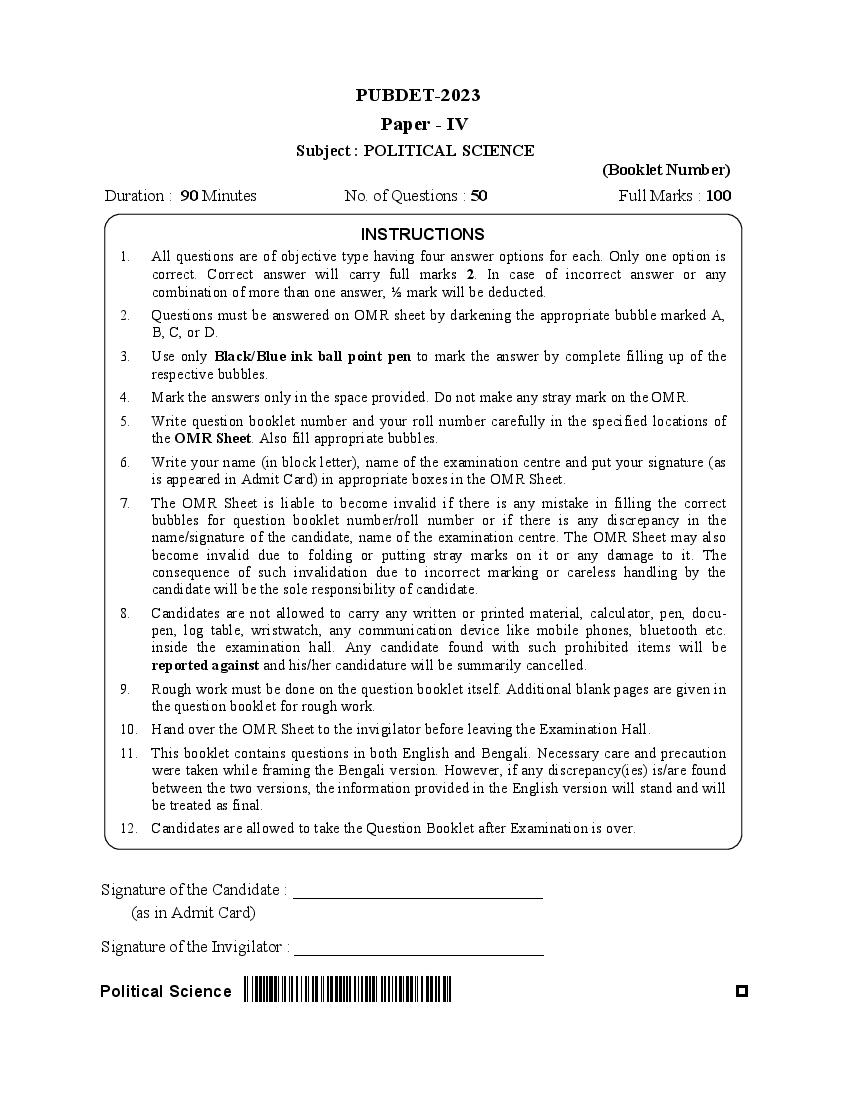
Subject : POLITICAL SCIENCE
(Booklet Number)
Duration : 90 Minutes No. of Questions : 50 Full Marks : 100
INSTRUCTIONS
1. All questions are of objective type having four answer options for each. Only one option is
correct. Correct answer will carry full marks 2. In case of incorrect answer or any
combination of more than one answer, ½ mark will be deducted.
2. Questions must be answered on OMR sheet by darkening the appropriate bubble marked A,
B, C, or D.
3. Use only Black/Blue ink ball point pen to mark the answer by complete filling up of the
respective bubbles.
4. Mark the answers only in the space provided. Do not make any stray mark on the OMR.
5. Write question booklet number and your roll number carefully in the specified locations of
the OMR Sheet. Also fill appropriate bubbles.
6. Write your name (in block letter), name of the examination centre and put your signature (as
is appeared in Admit Card) in appropriate boxes in the OMR Sheet.
7. The OMR Sheet is liable to become invalid if there is any mistake in filling the correct
bubbles for question booklet number/roll number or if there is any discrepancy in the
name/signature of the candidate, name of the examination centre. The OMR Sheet may also
become invalid due to folding or putting stray marks on it or any damage to it. The
consequence of such invalidation due to incorrect marking or careless handling by the
candidate will be the sole responsibility of candidate.
8. Candidates are not allowed to carry any written or printed material, calculator, pen, docu-
pen, log table, wristwatch, any communication device like mobile phones, bluetooth etc.
inside the examination hall. Any candidate found with such prohibited items will be
reported against and his/her candidature will be summarily cancelled.
9. Rough work must be done on the question booklet itself. Additional blank pages are given in
the question booklet for rough work.
10. Hand over the OMR Sheet to the invigilator before leaving the Examination Hall.
11. This booklet contains questions in both English and Bengali. Necessary care and precaution
were taken while framing the Bengali version. However, if any discrepancy(ies) is/are found
between the two versions, the information provided in the English version will stand and will
be treated as final.
12. Candidates are allowed to take the Question Booklet after Examination is over.
Signature of the Candidate : ______________________________
(as in Admit Card)
Signature of the Invigilator : ______________________________
Political Science
Page 2
Political Science 2
Page 3
POLITICAL SCIENCE
1. Under ___________, the Parliament is empowered to make laws on any item included in
the state list.
(A) Article 250 (B) Article 252
(C) Article 249 (D) Article 253
pw¢hd¡el ___________, Ae¤µRc Ae¤k¡u£ l¡SÉa¡¢mL¡l k L¡e¡ ¢houl Jfl f¡mÑ¡j¾V BCe
fËhaÑe Lla f¡l z
(A) Ae¤µRc 250 (B) Ae¤µRc 252
(C) Ae¤µRc 249 (D) Ae¤µRc 253
2. The origin of International relations can be traced to the writings of
(A) Chanakya in Arthasastra (B) Kalhan in Rajtarangini
(C) Asvaghosa in Budha Charita (D) Megasthenese in Indica
B¿¹ÑS¡¢aL pÇfLÑl fË¡lñ ¢ejÀ¢m¢Ma L¡l mM¡u f¡Ju¡ k¡u
(A) Q¡ZLÉl AbÑn¡Ù» (B) Lmqel l¡Sal¢‰e£
(C) AnÄO¡ol h¤ÜQ¢la (D) jN¡¢ÙÛ¢epl C¢äL¡
3. John Austin defined law as the ________________ of the Sovereign.
(A) Right (B) Command
(C) Wish (D) Dictates
Se A¢ØVe BCeL p¡hÑi±¢jL rja¡l ____________ ¢qp¡h hZÑe¡ LlRe ?
(A) A¢dL¡l (B) Bcn
(C) CµR¡ (D) ýL¥j Ll¡
4. The International Covenant on Economic, Social and Cultural Rights was formed in the
year
AbÑ°e¢aL, p¡j¡¢SL Hhw p¡wú¢ª aL A¢dL¡l pwœ²¡¿¹ ‘C¾V¡leÉ¡ne¡m Li¡e¾V’ -Hl NWe qu
(A) 1950 (B) 1945
(C) 1966 (D) 1969
5. The most prominent non-political humanitarian organization based in London is
(A) Red Cross (B) Amnesty International
(C) Green peace (D) People’s Union for Civic Liberties
mäe Ah¢ÙÛa phQu fËMÉ¡a Al¡S°e¢aL Seph¡ j§mL pwNWe qm
(A) lXœ²n (B) AÉ¡je¢ØV C¾V¡leÉ¡ne¡m
(C) NË£e ¢fp (D) ¢ffmpÚ CE¢eue gl ¢p¢im ¢mh¡¢VÑp
Political Science 3
Page 4
(A) Hans Morgenthau (B) Kenneth Waltz
(C) Immanuel Wallerstein (D) Andre Gunder Frank
“B¿¹ÑS¡¢aL l¡S°e¢aL ašÄ” L ¢mM¢Rme ?
(A) qÉ¡epÚ jlNeb¡ (B) Leb Ju¡mpÚ
(C) Cj¡e¤um Ju¡m¡lØV¡Ce (D) B¾cÊ …ecl 顈
7. The ‘Marshall Plan’ was reinforced on
(A) 5th June 1947 (B) 6th June 1947
(C) 10th June 1947 (D) 11th June 1947
‘j¡pÑm fÔÉ¡e’ Ae¤¢ùa qu :
(A) 5 C S¥e 1947 (B) 6 C S¥e 1947
(C) 10 C S¥e 1947 (D) 11 C S¥e 1947
8. ‘Glassnost’ and ‘Perestroika’ are credited to
(A) Woodrow Wilson (B) MaoTse Tung
(C) Mikhail Gorbachev (D) Jawaharlal Nehru
‘NÔ¡peØV’ Hhw ‘fÉ¡lÙ»¡¢uL¡’ d¡lZ¡…¢m L fËÙ¹¡h Ll¢Rme ?
(A) EXÊ¡ECmpe (B) j¡Epa¥w
(C) ¢jM¡Cm Nlh¡Qi (D) SJqlm¡m eql¦
9. General Assembly Resolution 377 is better known as the
(A) World Peace Resolution (B) Anti-Nuclear Weapons Resolution
(C) Anti-Trafficking Resolution (D) Uniting for Peace Resolution
l¡øÌpwOl p¡d¡lZ pi¡l fËÙ¹¡h 377 Hl BlL¢V e¡j qm
(A) ¢hnÄn¡¢¿¹ fËÙ¹¡h (B) BZ¢hL AÙ» ¢hl¡d£ fËÙ¹¡h
(C) e¡l£f¡Q¡l ¢hl¡d£ fËÙ¹¡h (D) n¡¢¿¹l EŸnÉ HL¢œa qJu¡l fËÙ¹¡h
10. Gandhi’s idea behind ‘Sarvodaya’ was inspired by
(A) John Ruskin (B) Henry David Thorean
(C) Leo Tolstoy (D) Jesus Christ
N¡¢åS£l ‘ph¡Ñcu’ d¡lZ¡ L¡l à¡l¡ Ae¤fË¡¢Za qu¢Rm ?
(A) Se l¡¢úe (B) qe¢l X¢iX blCe
(C) ¢mJ VmØVu (D) Sp¡p œ²¡CØV
Political Science 4
Page 5
of Record.
(A) Article 126 (B) Article 127
(C) Article 128 (D) Article 129
pw¢hd¡el ________________ Ae¤µRc Ae¤k¡u£ p¤¤¢fËjL¡VÑL ‘L¡VÑ Ag lLXÑp (mM Bc¡ma)’
¢qp¡h hZÑe¡ Ll¡ k¡u
(A) Ae¤µRc 126 (B) Ae¤µRc 127
(C) Ae¤µRc 128 (D) Ae¤µRc 129
12. Where was the first Municipal Corporation in India set up ?
(A) Kolkata (B) Delhi
(C) Bombay (D) Madras
i¡lal fËbj f±lpwÙÛ¡ L¡b¡u fË¢a¢ùa qu ?
(A) LmL¡a¡ (B) ¢cõ£
(C) h¡ð (D) j¡â¡S
13. The 74th Amendment Act was passed in the year
74aj p¡w¢hd¡¢eL pwn¡de BCe f¡n qu¢Rm L¡eÚ hRl ?
(A) 1990 (B) 1991
(C) 1992 (D) 1993
14. Who coined the phrase “global village” in his book “The Gutenberg Galaxy” ?
(A) Amartya Sen (B) Anthony Giddens
(C) Marshall McLuhan (D) David Held
“NÔ¡h¡m ¢imS (¢hnÄNË¡j) ” në¢V L hÉhq¡l Ll¢Rme ¢eSl hC “…Veh¡NÑ NÉ¡m¡¢„ ”a
(A) AjaÑÉ pe (B) AÉ¡¾V¢e ¢NX¾p
(C) j¡pÑm jÉ¡Lm¤q¡e (D) ®X¢iX qô
15. The term ‘Cold War’ was popularized by the columnist
(A) Andre Gunder Frank (B) Immanuel Wallerstein
(C) Walter Lippman (D) Peter Calvocoressi
‘W¡ä¡ ms¡C’ në¢V m¡L¢fËu qu L¡l à¡l¡
(A) B¾cÊ …¾cl 顈 (B) Cj¡e¤um Ju¡m¡lØV¡Ce
(C) Ju¡mV¡l ¢mfjÉ¡e (D) ¢fV¡l LÉ¡mi¡L¡l¢p
Political Science 5
Page 6
(A) Chicken Pox and Measles (B) Measles and Small Pox
(C) Measles and Rubella (D) Rubella and Small Pox
pÇfË¢aL¡m ¢nöcl SeÉ k iÉ¡L¢ne ¢halZl EŸÉ¡N ¢h¢iæ ú¥m eJu¡ quR a¡ qm :
(A) ¢QLe f„ J ¢jpmpÚ (B) ¢jpmpÚ J pÇmf„
(C) ¢jpmpÚ J l¦hm¡ (D) l¦hm¡ J pÇmf„
17. Globalisation signifies,
(A) Opening up of national economies to foreign capital, foreign direct investment and
foreign technologies.
(B) Free trade
(C) Information and technological revolution
(D) All of the above
¢hnÄ¡uel AbÑ
(A) S¡a£u AbÑ hÉhÙÛ¡ °hc¢nL j¤â¡l EŸnÉ উ ু LlZ, °hc¢nL fËaÉr ¢h¢eu¡N Hhw °hc¢nL
fËk¤¢š²
(B) উ ু hÉhp¡ h¡¢ZSÉ
(C) abÉ J fËk¤¢š² pwœ²¡¿¹ ¢hfÔh
(D) Efl E¢õ¢Ma phLV¡C
18. By which Amendment Act the terms “Socialist” and “Secular” were added to the Preamble
to the Constitution of India ?
(A) 42nd (B) 43rd
(C) 44th (D) 45th
L¡eÚ pwn¡de BCel j¡dÉj i¡lal pw¢hd¡el fËÙ¹¡he¡u ""pj¡Sa¡¢¿»L ” J ""djÑ¢elfr” në
c¤¢V k¡N Ll¡ qu ?
(A) 42 aj (B) 43 aj
(C) 44 aj (D) 45 aj
19. Which of the following Acts has influenced the making of the Constitution of India the
most ?
(A) Government of India Act, 1858 (B) Government of India Act, 1909
(C) Government of India Act, 1919 (D) Government of India Act, 1935
¢ejÀ¢m¢Ma BCe…¢ml jdÉ L¡eÚ¢V i¡lal pw¢hd¡e ¢ejÑ¡Z phÑ¡fr¡ h¢n fËi¡h gmR ?
(A) i¡la plL¡l BCe, 1858 (B) i¡la plL¡l BCe, 1909
(C) i¡la plL¡l BCe, 1919 (D) i¡la plL¡l BCe, 1935
Political Science 6
Page 7
(A) Renau (B) Russel
(C) Rabindranath (D) Karl Marx
L hmRe, “S¡a£ua¡h¡c piÉa¡l ¢hfc XL Be” ?
(A) le¡ (B) l¡pm
(C) lh£¾cÊe¡b (D) L¡mÑ j¡LÑpÚ
21. Who signed the Panchasheel Agreement ?
(A) India and Bangladesh (B) India and Russia
(C) India and China (D) India and U. S. A.
f’n£m Q¥¢š² L¡eÚ c¤C cnl jdÉ Ll¡ qu¢Rm ?
(A) i¡lahoÑ Bl h¡wm¡cn (B) i¡lahoÑ Bl l¡¢nu¡
(C) i¡lahoÑ Bl Q£e (D) i¡lahoÑ Bl j¡¢LÑe k¤š²l¡øÌ
22. “The Spirit of the Laws” was written by:
(A) John Locke (B) John S. Mill
(C) Edmond Burke (D) Montesquieu
“The Spirit of the Laws” L lQe¡ Lle ?
(A) Se mL (B) Se Hp. ¢jm
(C) HXjä h¡LÑ (D) j¿¹ú¥
23. Who among the following was a ‘moderate’ leader ?
(A) Bal Gangadhar Tilak (B) Bhagat Singh
(C) Gopal Krishna Gokhale (D) Bipin Chandra Pal
Hycl jdÉ L ‘eljf¿Û£’ ea¡ ¢Rme ?
(A) h¡m N‰¡dl ¢amL (B) iNv ¢pw
(C) N¡f¡m L«o· N¡Mm (D) ¢h¢fe Q¾cÊ f¡m
24. Which thinker propagated Utilitarianism ?
(A) Tocqueville (B) Bentham
(C) Proudhon (D) None of them
L¡eÚ a¡¢šÄL Efk¡Nh¡c fËhaÑe Lle ?
(A) aLÚ¢im (B) heb¡j
(C) fˤ dy¡ (D) L¡e¡¢VC eu
Political Science 7
Page 8
(A) Alderman (B) Mayor
(C) Councillor (D) Commissioner
LmL¡a¡ f¤lpi¡l ¢ehÑ¡¢Qa fË¢a¢e¢dL ¢L hm ?
(A) Hô¡ljÉ¡e (B) jul
(C) L¡E¢¾pml (D) L¢jne¡l
26. In which year, NAFTA took place ?
L¡eÚ hRl e¡gV¡ (NAFTA) qu¢Rm ?
(A) 1996 (B) 1994
(C) 1997 (D) 1998
27. What is Question Hour ?
(A) The first hour of every sitting is called the question Hour.
(B) It is zero hour.
(C) It is part of no-confidence motion.
(D) None of the above
fËnÀL¡m L¡L hm ?
(A) fË¢ah¡l A¢dhnel fËbj O¾V¡L fËnÀL¡m hm
(B) HV¡ qm n§ZÉL¡m
(C) HV¡ Ae¡ÙÛ¡ fËÙÛ¡hl HL¢V Awn
(D) Efll L¡e¡¢VC eu
28. Which articles of Indian Constitution guarantee Right to Equality ?
(A) Article 14 to 18
(B) Article 25 and 26
(C) Article 32 and 33
(D) Article 55 and 56
i¡la£u pw¢hd¡e p¡jÉl A¢dL¡l L¡eÚ d¡l¡ bL J L¡eÚ d¡l¡ fkÑ¿¹ ü£L«a BR ?
(A) d¡l¡ 14 bL 18
(B) d¡l¡ 25 J 26
(C) d¡l¡ 32 J 33
(D) d¡l¡ 55 J 56
Political Science 8
Page 9
(A) Article 132 (B) Article 131
(C) Article 136 (D) Article 140
L¡eÚ d¡l¡ p¤¤fË£j L¡VÑ j§m H¢š²u¡l¢V hÉ¡MÉ¡ Ll ?
(A) d¡l¡ 132 (B) d¡l¡ 131
(C) d¡l¡ 136 (D) d¡l¡ 140
30. The main argument of Divine theory is
(A) The state was created by GOD and the King was the representative of God on earth.
(B) Force is the source of the state.
(C) The state is the product of Social Contracts.
(D) The state is the result of an evolutionary process.
InÄ¢lL ašÄ¢Vl fËd¡e k¤¢š² qm
(A) l¡øÌ pª¢ø qu¢Rm DnÄl à¡l¡ J l¡S¡ qme fª¢bh£a DnÄll fË¢a¢e¢d
(B) l¡øÌl Evp qm hm
(C) l¡øÌ p¡j¡¢SL Q¥¢š²l gm
(D) l¡øÌ qm ¢hhaÑel gm
31. What is the main difference between Nationalism and Internationalism ?
(i) Nationalism is related to national identity.
(ii) Internationalism is universal brotherhood.
(iii) Nationalism is greater than Internationalism.
(iv) Nationalism is based on the negation of Internationalism.
(A) (i) and (iii) (B) (i) and (iv)
(C) (i) and (ii) (D) None
S¡a£ua¡h¡c J B¿¹SÑ¡¢aLa¡h¡cl jdÉ fËd¡e f¡bÑLÉ L¡b¡u ?
(i) S¡a£ua¡h¡c S¡a£l f¢l¢Q¢al p¡b S¢sa
(ii) B¿¹SÑ¡¢aLa¡h¡c S¢sa p¡hÑSe£e ï¡aªaÄl p¡b
(iii) S¡a£ua¡h¡c B¿¹SÑ¡¢aLa¡h¡cl bL hªqv
(iv) S¡a£ua¡h¡c Ns EWR B¿¹SÑ¡¢aLa¡h¡cL Aü£L¡l Ll
(A) (i) Hhw (iii) (B) (i) Hhw (iv)
(C) (i) Hhw (ii) (D) L¡e¡¢VC eu
32. Law is the command of the Sovereign and it has to be enforced by the State. The following
is a -
(A) Legal view of Law (B) Cultural view of Law
(C) Religious view of Law (D) Moral view of Law
BCe qm p¡hÑi±jl Bcn Hhw H¢V l¡øÌ à¡l¡ hmhvk¡NÉ z
(A) HC d¡lZ¡¢V qm BC¢e d¡lZ¡
(B) BCe pÇfLÑ p¡wú«¢aL d¡lZ¡
(C) BCe pÇfLÑ djÑ£u d¡lZ¡
(D) BCe pÇfLÑ °e¢aL d¡lZ¡
Political Science 9
Page 10
(A) Secularism and Democracy
(B) Fundamental Rights and Duties
(C) Unitary System with Unwritten Constitution
(D) Commitment to Rights, Liberty and Justice
¢ejÀ¡š² L¡eÚ ¢hhª¢a¢V i¡la£u pw¢hd¡el °h¢nøÉ eu ?
(A) djÑ¢elfra¡ J NZa¿»
(B) j±¢mL A¢dL¡l J LaÑhÉ
(C) HLL¢¾cÊL hÉhÙÛ¡ J A¢m¢Ma pw¢hd¡e
(D) A¢dL¡l, ü¡d£ea¡ J eÉ¡ul fË¢a A‰£L¡l
34. Who wrote “Two concepts of Liberty” ?
(A) J.S. Mill (B) Isaiah Berlin
(C) Robert Nozick (D) T.H. Green
“Two concepts of Liberty” hC¢V L ¢mMRe ?
(A) S. Hp. ¢jm (B) Cn¡Cu¡ h¡¢mÑe
(C) lhÑ¡V e¡¢SL (D) ¢V. HCQ. NË£e
35. Which statements are correct about the preamble of Indian Constitution ?
(i) It explains the fundamental values of Indian Constitution.
(ii) It can be amended.
(iii) It does not contain laws enforceable in a court.
(iv) It has tremendous political significance.
(A) (i) and (ii) (B) (ii), (iii) and (iv)
(C) (ii) and (iii) (D) (i), (iii) and (iv)
i¡la£u pw¢hd¡el fËÙ¹¡he¡ pÇfLÑ L¡eÚ ¢hhª¢a…¢m p¢WL ?
(i) H¢V i¡la£u pw¢hd¡el fËd¡e j§mÉh¡d…¢m Bm¡Qe¡ Ll
(ii) H¢V pwn¡¢da qa f¡l
(iii) H…¢m L¡VÑ hmhvk¡NÉ BCe eu
(iv) Hl Ap¡d¡lZ l¡S°e¢aL a¡vfkÑ BR
(A) (i) J (ii) (B) (ii), (iii) J (iv)
(C) (ii) J (iii) (D) (i), (iii) J (iv)
Political Science 10
Page 11
(A) 40th Amendment (B) 42nd Amendment
(C) 73rd Amendment (D) 74th Amendment
j±¢mL LaÑhÉ ¢hd¡e¢V L¡eÚ pw¢hd¡e pwn¡de pwk¡Se Ll ?
(A) 40 aj pwn¡de (B) 42 aj pwn¡de
(C) 73 aj pwn¡de (D) 74 aj pwn¡de
37. A _____________ does not participate directly in the acquisition of power or its exercise.
(A) political party (B) regional party
(C) pressure group (D) N. G. O.
HL¢V ______________ fËaÉr BL¡l rja¡l ASÑe Abh¡ a¡l fËu¡N AwnNËqZ Ll e¡ z
(A) l¡S°e¢aL cm (B) B’¢mL cm
(C) Q¡f pª¢øL¡l£ N¡ù£ (D) He. ¢S. J
38. What is the origin of the term democracy ?
(A) Roman (B) Greek
(C) Indian (D) Western
NZa¿» në¢Vl Evp ¢L ?
(A) l¡j¡e (B) NË£L
(C) i¡la£u (D) f¢ÕQj£
39. In which year, Telegu Desam party was founded ?
Lh am… cnj f¡¢VÑ¢V N¢Wa qu¢Rm ?
(A) 1985 (B) 1990
(C) 2000 (D) 1982
40. The Indian president’s Veto power is a Combination of :
(i) Pocket Veto (ii) Absolute Veto
(iii) Suspensive Veto (iv) Qualified Veto
(A) (ii) and (iii) (B) (i), (iii) and (iv)
(C) (ii), (iii) and (iv) (D) (i), (ii) and (iii)
i¡la£u l¡ØVÊf¢al ¢iV¡ rja¡ qm ¢ejÀ¡š²…¢ml pw¢jnËZ
(i) fLV ¢iV¡ (ii) AÉ¡hp¡¢mEV ¢iV¡
(iii) p¡pfe¢pi ¢iV¡ (iv) L¡u¡¢mg¡uX ¢iV¡
(A) (ii) J (iii) (B) (i), (iii) J (iv)
(C) (ii), (iii) J (iv) (D) (i), (ii) J (iii)
Political Science 11
Page 12
(i) Possesses executive, legislative and judicial powers analogous to the president.
(ii) He has to act according to the advice, of the Council of Ministers always.
(iii) He has the power to appoint and remove the members of the state public
commission.
(iv) Has the power to distribute portfolios.
(A) (i) and (ii) (B) (ii), (iii) and (iv)
(C) (i) and (iii) (D) (i), (iii) and (iv)
HL¢V l¡SÉl l¡SÉf¡ml rja¡…¢m ¢L ¢L ?
(i) Ee¡l l¡ØVÊf¢al Ae¤l©f n¡pe j§mL, BCe j§mL J ¢hQ¡l ¢hi¡N£u rja¡ b¡L
(ii) E¢e j¿»£ f¢locl Efcn Ae¤k¡u£ ph pju L¡S Lle
(iii) ¢a¢e l¡SÉ f¡h¢mL L¢jnel pcpÉcl ¢ehÑ¡Qe J Afp¡lZ Lla f¡le
(iv) E¢e cçl h¾Ve Lla f¡le
(A) (i) J (ii) (B) (ii),(iii) J (iv)
(C) (i) J (iii) (D) (i),(iii) J (iv)
42. Nagar Palika is for
(A) a larger area (B) a smaller area
(C) transitional area (D) township
eNlf¡¢mL¡ qm
(A) HL¢V hªqšl Hm¡L¡l SeÉ (B) HL¢V R¡V¡ Hm¡L¡l SeÉ
(C) HL¢V f¢lhaÑen£m Hm¡L¡l SeÉ (D) HL¢V Sefcl SeÉ
43. Which one of the following statements is incorrect ?
(A) High courts cannot issue writs
(B) High courts within its jurisdiction have the powers of superintence over all
subordinate courts and administrative tribunals.
(C) It is a court of record
(D) Article 214 states that there shall be a High Court for each state.
¢ej¡À š² L¡eÚ ¢hhª¢a¢V i¥m ?
(A) q¡CL¡VÑ…¢m mM S¡¢l Lla f¡l e¡
(B) q¡CL¡VÑ…¢m a¡l H¢š²u¡ll jdÉ Ad£eÙÛ L¡VÑ…¢ml Jfl ašÄ¡hd¡e Lla f¡l J fËn¡p¢eL
VÊ¡Ch¤e¡m …¢ml Jfl ašÄ¡hd¡e Lla f¡l
(C) H¢V HL¢V abÉ e¢bi¥š² Ll¡l Bc¡ma
(D) d¡l¡ 214 hm k fË¢a¢V l¡SÉ HL¢V q¡CL¡VÑ b¡Lh
Political Science 12
Page 13
(i) The concept of Judicial review serves the purpose of social justice.
(ii) Judicial review can lead to judicial activism.
(iii) It is against the ethos of the Constitution.
(iv) Article 13 and 32 help to protect the spirit of judicial review.
(A) (i) ,(ii) and (iv) (B) (iii) and (iv)
(C) (ii),(iii) and (iv) (D) (ii) and (iv)
¢ejÀ¡š² L¡eÚ ¢hhª¢a…¢m p¢WL ?
(i) ¢hQ¡l ¢hi¡N£u pj£r¡l d¡lZ¡¢V p¡j¡¢SL eÉ¡ul p¡b k¤š²
(ii) ¢hQ¡l ¢hi¡N£u pj£r¡ k¤š² BR ¢hQ¡l ¢hi¡N£u p¢œ²ua¡l p‰
(iii) H¢V pw¢hd¡el j§mÉh¡dl ¢hl¦Ü
(iv) d¡l¡ 13 J 32 ¢hQ¡l ¢hi¡N£u pj£r¡l d¡lZ¡ J j§mÉh¡dL lr¡ Ll
(A) (i), (ii) J (iv) (B) (iii) J (iv)
(C) (ii), (iii) J (iv) (D) (ii) J (iv)
45. “Politics among Nations: The struggle for Power and Peace” is written by
(A) Hans J. Morgenthan (B) Kaplan
(C) Martin Wright (D) David Thompson
“Politics among Nations: The struggle for Power and Peace” -l mML qme
(A) qÉ¡epÚ S jlNÉ¡ebÚ (B) LÉ¡fm¡e
(C) j¡¢VÑe l¡CV (D) X¢iX bÇfpe
46. Cold war was
(A) an ideological Conflict
(B) a war of strained relations between the East and the West
(C) a war that divided World Politics
(D) All mentioned above
W¡ä¡ k¤Ü ¢Rm
(A) HL¢V ja¡cnÑNa ms¡C
(B) f§hÑ J f¢ÕQjl jdÉ Q¡fl ms¡C
(C) H¢V ¢Rm Hje k¤Ü k¡ ¢hnÄl¡Se£¢aL ¢hiš² Ll ¢cu¢Rm
(D) Eš² phL¢VC fËk¡SÉ
Political Science 13
Page 14
(A) The Cairo Summit (B) The Belgrade Summit
(C) The Colombo Summit (D) The Lusaka Summit
fËbj ¢eS¡ÑV pÇjme qm
(A) L¡ul¡ pÇjme (B) hmNËX pÇjme
(C) Lmð¡ pÇjme (D) m¤p¡L¡ pÇjme
48. Politics is an instrument of class domination and history of all hithero existing societies is
the history of class struggle. This view relates to
(A) Marxian View of Politics (B) Liberal View of Politics
(C) Feminist View of Politics (D) Legal View of Politics
l¡Se£¢a qm nËZ£ B¢dfaÉl HL¢V k¿» Hhw ph haÑj¡e pj¡Sl C¢aq¡p qm nËZ£ pwNË¡jl
C¢aq¡p z HC cª¢øi¢‰¢V S¢sa qm
(A) j¡„Ñh¡c£ d¡lZ¡l p¡b (B) Ec¡le£¢a d¡lZ¡l p¡b
(C) e¡l£h¡c£ d¡lZ¡l p¡b (D) BC¢e d¡lZ¡l p¡b
49. The definition of politics centres around
(i) Struggle for power
(ii) Resource distribution and conflict resolution
(iii) Morality and Spiritualism
(iv) Public Institutions and State
(A) (i), (ii) and (iv) (B) (i), (ii) and (iii)
(C) (iii) and (iv) (D) (ii) and (iii)
l¡Se£¢al pw‘¡¢V ¢ej¡À š² L¡eÚ d¡lZ¡…¢mL L¾cÊ Ll ?
(i) H¢V rja¡l ms¡C
(ii) H¢V pÇfcl h¾Ve J ¢hh¡cl j£j¡wp¡
(iii) H¢V °e¢aLa¡ J BdÉ¡¢aÈLa¡l p¡b S¢sa
(iv) H¢V SefË¢aù¡e J l¡ØVÊL S¢su BR
(A) (i), (ii) J (iv) (B) (i), (ii) J (iii)
(C) (iii) J (iv) (D) (ii) J (iii)
50. In which year, Yalta Conference took place ?
L¡eÚ hRl Cu¡ÒV¡ pÇjme qu ?
(A) 1945 (B) 1950
(C) 1952 (D) 1955
_______________
Political Science 14
Page 15
Political Science 15
Page 16
Subject : POLITICAL SCIENCE
pju: 90 ¢j¢eV ®j¡V fËnÀ : 50 ¢V f§ ZÑj¡e : 100
1. HC fËnÀfœl ph fËnÀC AhS¢ƒi fËnÀ Hhw fË¢a¢V fËnÀl Q¡l¢V pñ¡hÉ Ešl cJu¡ BR
k¡l HL¢V j¡œ p¢WL z p¢WL Ešl ¢Q¢q²a Llm 2 eðl f¡h z i¥m Ešl ¢Q¢q²a Llm
Abh¡ HL¡¢dL Ešl ¢Q¢q²a Llm ½ eðl L¡V¡ k¡h z
2. OMR fœ A, B, C, D ¢Q¢q²a p¢WL Ol¢V il¡V Ll Ešl ¢ca qh z
3. OMR fœ Ešl ¢ca öd¤j¡œ L¡m¡ h¡ e£m L¡¢ml hm fu¾V fe hÉhq¡l Llh z
4. OMR fœ ¢e¢cÑø ÙÛ¡e R¡s¡ AeÉ L¡b¡J L¡e¡ c¡N ch e¡ z
5. OMR fœ ¢e¢cÑø ÙÛ¡e fËnÀfœl eðl Hhw ¢eSl l¡m eðl A¢a p¡hd¡ea¡l p¡b ¢mMa
qh Hhw fËu¡Se£u Ol…¢m f§lZ Lla qh z
6. OMR fœ ¢e¢cÑø ÙÛ¡e ¢eSl e¡j J fl£r¡L¾cÊl e¡j ¢mMa qh Hhw ¢eSl (Admit
Card H Eõ¢Ma) ü¡rl Lla qh z
7. fËnÀfœl eðl h¡ l¡m eðl i¥m ¢mMm Abh¡ i¥m Ol il¡V Llm, fl£r¡bÑ£l e¡j,
fl£r¡L¾cÊl e¡j h¡ ü¡rl L¡e¡ i¥m b¡Lm Ešlfœ h¡¢am qu ka f¡l z OMR
fœ¢V i¡yS qm h¡ a¡a Ae¡hnÉL c¡N fsmJ h¡¢am qu ka f¡l z fl£r¡bÑ£l HC
dlel i¥m h¡ ApaÑLa¡l SeÉ Ešlfœ h¡¢am qm HLj¡œ fl£r¡bÑ£ ¢eSC a¡l SeÉ
c¡u£ b¡Lh z
8. j¡h¡Cm g¡e h¡ ®k ®L¡e dl®el C®mLVÌ¢eL NÉ¡®SV, LÉ¡mL¥mVl, pÔ¡CXl¦m, mNVhm,
q¡aO¢s, lM¡¢Qœ, NË¡g h¡ L¡e¡ dlel a¡¢mL¡ , Lmj CaÉ¡¢c fl£r¡Lr Be¡ k¡h e¡ z
Bem p¢V h¡Su¡ç qh Hhw fl£r¡bÑ£l JC fl£r¡ h¡¢am Ll¡ qh z
9. fËnÀfœ l¡g L¡S Ll¡l SeÉ gy¡L¡ S¡uN¡ cJu¡ BR z AeÉ L¡e¡ L¡NS HC L¡S
hÉhq¡l Llh e¡ z
10. fl£r¡Lr R¡s¡l BN OMR fœ AhnÉC f¢lcnÑLL ¢cu k¡h z
11. HC fËnÀfœ Cwl¡S£ J h¡wm¡ Eiu i¡o¡aC fËnÀ cJu¡ BR z h¡wm¡ j¡dÉj fËnÀ °al£l
pju fËu¡Se£u p¡hd¡ea¡ J paLÑa¡ Ahmðe Ll¡ quR z a¡ pšÄJ k¢c L¡e Ap‰¢a
mrÉ Ll¡ k¡u, prœ Cwl¡S£ j¡dÉj cJu¡ fËnÀ ¢WL J Q¨s¡¿¹ hm ¢hh¢Qa qh z
12. fl£r¡no fl£r¡b£Ñl¡ fËnÀfœ¢V ¢eu k¡h z
Political Science 16
Document Details
| Board / Org | WBJEEB |
| Exam | PUBDET |
| Type | Question Paper |
| Pages | 16 |
| Updated | 22 Jul 2026 |