WBCHSE Class 12 Syllabus 2024 Economics
Finished viewing? Save it for later —
Download WBCHSE Class 12 Syllabus 2024 Economics (PDF · 15 pages)About WBCHSE Class 12 Syllabus 2024 Economics
WBCHSE Class 12 Syllabus 2024 Economics is available here for free download. Published by West Bengal Board for Class 12, this syllabus can be viewed online or downloaded as a PDF (15 pages). Candidates preparing for Class 12 can use WBCHSE Class 12 Syllabus 2024 Economics to understand the exam pattern, the type of questions asked, and the overall difficulty level.
Frequently Asked Questions
How can I download WBCHSE Class 12 Syllabus 2024 Economics?
Open this page and click the Download button to save WBCHSE Class 12 Syllabus 2024 Economics as a PDF. It is completely free on AglaSem Docs.
Is WBCHSE Class 12 Syllabus 2024 Economics free to download?
Yes. WBCHSE Class 12 Syllabus 2024 Economics can be viewed online and downloaded as a PDF free of cost on AglaSem Docs.
How many pages does WBCHSE Class 12 Syllabus 2024 Economics have?
WBCHSE Class 12 Syllabus 2024 Economics contains 15 pages, which you can read online or download together as a single PDF.
Where can I find more Class 12 study material?
You can find more Class 12 question papers, sample papers, syllabus, and answer keys on AglaSem Docs.
WBCHSE Class 12 Syllabus 2024 Economics – Text
Read the full text of this syllabus below — useful to quickly search, copy and reference the content online without downloading the PDF.
📄 View text version (15 pages)
Page 1
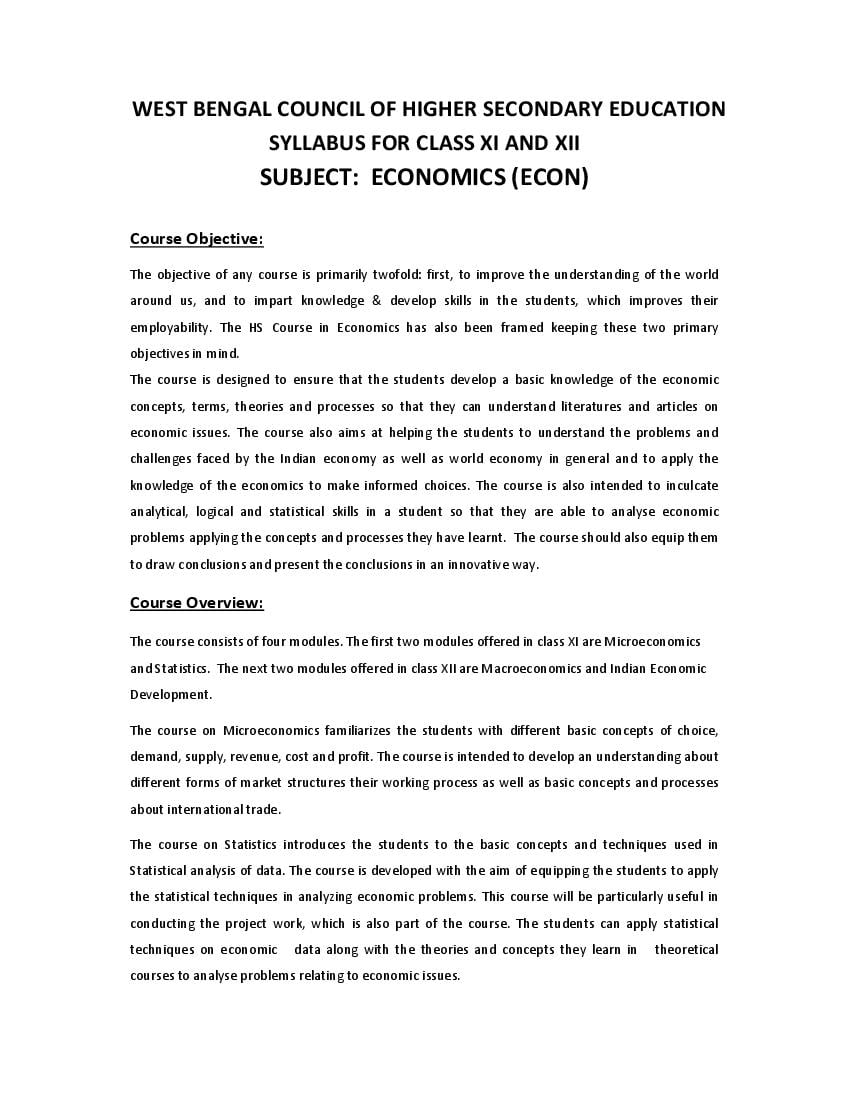
SYLLABUS FOR CLASS XI AND XII
SUBJECT: ECONOMICS (ECON)
Course Objective:
The objective of any course is primarily twofold: first, to improve the understanding of the world
around us, and to impart knowledge & develop skills in the students, which improves their
employability. The HS Course in Economics has also been framed keeping these two primary
objectives in mind.
The course is designed to ensure that the students develop a basic knowledge of the economic
concepts, terms, theories and processes so that they can understand literatures and articles on
economic issues. The course also aims at helping the students to understand the problems and
challenges faced by the Indian economy as well as world economy in general and to apply the
knowledge of the economics to make informed choices. The course is also intended to inculcate
analytical, logical and statistical skills in a student so that they are able to analyse economic
problems applying the concepts and processes they have learnt. The course should also equip them
to draw conclusions and present the conclusions in an innovative way.
Course Overview:
The course consists of four modules. The first two modules offered in class XI are Microeconomics
and Statistics. The next two modules offered in class XII are Macroeconomics and Indian Economic
Development.
The course on Microeconomics familiarizes the students with different basic concepts of choice,
demand, supply, revenue, cost and profit. The course is intended to develop an understanding about
different forms of market structures their working process as well as basic concepts and processes
about international trade.
The course on Statistics introduces the students to the basic concepts and techniques used in
Statistical analysis of data. The course is developed with the aim of equipping the students to apply
the statistical techniques in analyzing economic problems. This course will be particularly useful in
conducting the project work, which is also part of the course. The students can apply statistical
techniques on economic data along with the theories and concepts they learn in theoretical
courses to analyse problems relating to economic issues.
Page 2
accounting and simple Keynesian Economic system to the students. The course also includes topics
on Balance of payments, money & banking, government budget and taxation. All these topics are
introduced at a basic level with the aim of enabling the students to understand and analyse
Macroeconomic issues in an integrated framework.
Finally, the course on Indian Economic Development attempts to provide the students with an
overall view of Indian Economy, the nature and path of development that the Economy has
experienced and the factors that have contributed to the process of development. The topics include
sectoral distribution of income and occupation, evolution of the structure of Agricultural sector,
Industrial sector and Services sectorand the topical issue of inclusive growth. The necessary concepts
like poverty, inequality, unemployment, human development have been introduced to provide the
necessary perspective for understanding and analysing Indian Economic problems.
All the courses are structured in such a way that the student can understand, remember and apply
the different concepts, processes and theories. The ultimate aim is to develop the students’
analytical skills and ability to develop innovative ways to address the economic problems.
Page 3
SUBJECT: ECONOMICS (ECON)
COURSE CODE: THEORY
FULL MARKS: 40 CONTACT HOURS: 100 HOURS
SEMESTER – I
Sub Topics
Microeconomics & Statistics
UNIT No. TOPICS CONTACT MARKS
HOURS
1. Microeconomics
Unit – 1:
Microeconomics Unit 1: Introduction
a. Problems addressed in Economics (both Micro & Macro): 10 4
Basic Problems: for whom to produce, How to Produce,
what to produce; Problems of Economic Growth,
Economic Development and Problems of Sustainable
Development.
b. How the Problems are addressed: Free Market Economy;
Government Intervention; Socialist Economic system;
Mixed Economic system; Broad Social Goals: Efficiency,
Equity, Freedom of Choice, Economic Growth,
Sustainable Development.
c. Indicators
- Indicators of Economic Growth (Only definition)
a. Income, per capita income
b. Savings
c. Investment
i. Physical Capital
ii. Human Capital
d. Development Indicators (Concepts & Definitions)
a. Inequality
b. Poverty
c. Unemployment
d. Gender Inequality
e. Environment
Unit – 2 Consumer Behaviour
Microeconomics a. Demand & Supply-Concept of Equilibrium Price-Invisible 20 8
Hand –laissez faire
b. Concept of Elasticity of Demand – Price Elasticity of
Demand; Income Elasticity of Demand; Cross Price
Elasticity of Demand; Elasticity of Supply (Numerical
Page 4
HOURS
Problems can be Introduced); Comparative Statistics-
Price Ceiling& Price Floor.
c. Basics of Theory of Consumer Behaviour, Cardinal Utility,
Ordinal Utility; Budget Constraint, Indifference Curve &
Its Properties, Utility Maximization Using Indifference
Curve; Derivation of Demand Function.
Unit – 3 Producer Behaviour
Microeconomics a. Short Run and Long Run Production Function, Law of 20 8
Variable Proportions ,Returns to Scale, Economies of
Scale
b. Basic Concepts of Cost: STC, SAC, SMC, LTC, LAC, LMC,
Implicit Cost, Opportunity Cost
c. Concepts of Revenue and Profit: TR, AR, MR, Profit
Unit – 4 Introduction to Data
Statistics a. Scope of Statistics 10 4
b. Introduction to Different Types of Data: Primary vs
Secondary, Time Series vs Cross-Section, Qualitative vs
Quantitative; Features of a Good Questionnaire
c. Data Sources for the Indian Economy
Unit – 5 Organization & Representation of Data
Statistics a. Classification of Data: Continuous & Discrete Variables 20 8
b. Textual Presentation of Data
c. Tabular form Presentation of Data
d. Graphical Representation of Data:-Bar
Chart,Histogram,Frequency Curve, Pie Chart,Ogive,
Arithmetic Line Graph
Unit- 6 Measures of Central Tendency
Statistics a. Mean: Arithmetic Mean, Geometric Mean 20 8
b. Quartile &Median, Percentile (definition only)
c. Mode
Page 5
SUBJECT: ECONOMICS (ECON)
COURSE CODE: THEORY
FULL MARKS: 40 CONTACT HOURS: 80 HOURS
SEMESTER – II
Sub Topics
Microeconomics & Statistics
UNIT No. TOPICS CONTACT MARKS
HOURS
Unit – 1 Introduction to Concepts of Market Structure 20 10
Microeconomics a. Basic Concepts of Forms of Markets: Perfect
Competition, Monopoly, Natural Monopoly,
Monopolistic Competition, Oligopoly. (Definition &
Features)
b. TR, AR &MR under Fixed Price & Variable Price,
Equilibrium Condition under Perfect Competition &
Monopoly
c. Financing through Debt & Equity: Basics of Financial
Instruments (Stocks & Bonds)(Definitions & Differences)
d. Problems of Externality: Social Cost & Private Cost,
Problems of Market Failure, with special reference to
Environmental Problems
e. Public Goods & Private Goods
Unit – 2 Basics of International Trade 20 10
Microeconomics a. Difference Between Internal Trade & International Trade
b. Concept of Absolute Advantage &Concept of
Comparative Advantage
c. Gains from Trade
d. Concepts of Tariff & Quota (Only Definition)
e. Basic Ideas about Trade Liberalization, Bilateral Trade
Agreements, Regional Trade Agreements.
Unit – 3 Measures of Dispersion 17 8
Statistics a. Absolute Measures of Dispersion
Range, Standard Deviation and Variance
Quartile Deviation
b. Relative Measure of Dispersion: Coefficient of Variation
Page 6
HOURS
Unit – 4 Correlation 17 8
Statistics a. Concept
b. Scatter Diagram
c. Spearman’s Rank Correlation
d. Pearson’s Correlation Coefficient
Unit – 5 Index Numbers: 6 4
a. Concept & Use
Statistics
b. CPI & WPI
Page 7
SUBJECT: ECONOMICS ECON)
COURSE CODE: THEORY
FULL MARKS: 40 CONTACT HOURS: 100 HOURS
SEMESTER – III
Sub Topics
Macroeconomics & Indian Economic Development
UNIT No. TOPICS CONTACT MARKS
HOURS
Unit – 1 National Income Accounting: 20 8
Macroeconomics a. Concept of Stocks & Flows, Concept of Transfer
Payments, Concept of Closed Economy & Open
Economy, Concepts of GDP, GNP, NDP, NNP, NI at
Market Price, NI at Factor Cost, Real Income vs Nominal
Income
b. Methods of Measuring NI: Product Census Method,
Value Added Method-Concept of Intermediate Goods &
Final Goods, Income Method, Expenditure Method
(Simple Numerical )
Unit – 2 Simple Keynesian system (Closed Economy Model with 20 8
Government)
Macroeconomics
a. Consumption Function & Savings Function
b. Cross-Diagonal Model, Introduction to Government
Budget & Taxation
c. Alternative Forms of Multiplier: Investment Multiplier,
Government Expenditure Multiplier, Tax Multiplier
Unit–3 Balance of Payments & Exchange Rate 10 4
Macroeconomics a. Concepts of BOP: Balance of Trade, Balance of Current
Account, Balance of Capital Account, Causes & Solutions
of BOP Disequilibrium, Autonomous & Accommodating
Transactions.
b. Basic Concepts and Types of Exchange Rates
Page 8
HOURS
Unit – 4 Brief Reference to Colonial Past: Advantages and Disadvantages 10 4
Indian Economic
Development
Unit – 5 Evolving Features of Indian Economy : 20 8
Indian Economic a. Sectoral Composition of NI and changes over time
Development during Pre-Liberalization and Post Liberalization Period
b. Occupation Distribution of NI during Pre-Liberalization
and Post-Liberalization Period, Post-Independence
Period & Changes thereof
c. Types of Unemployment –Changes in Occupational
Patterns during Pre-Liberalization & Post-Liberalization
Period – Problem of Unemployment in India – Different
Employment Generating Programs in the Post-
Liberalization Period –Jobless Growth.
d. India & Its Neighbours – a Comparison of Economic
Growth, Population & Sectoral Development & other
Human Development Indicators
(Comparison with China)
Unit-6 Agriculture : 20 8
Indian Economic a. Problems in Agricultural in the Post-Independence Era-
Development 1st Plan and Green Revolution
b. Institutional Reforms: Land Reforms & Operation Barga
–Reforms in Rural Credit.
c. Agricultural Reforms in the Post-Liberalization Era –
Impact of Globalization in Indian Agriculture
d. Food Security & Public Distribution System
Page 9
SUBJECT: ECONOMICS (ECON)
COURSE CODE: THEORY
FULL MARKS: 40 CONTACT HOURS: 80 HOURS
SEMESTER – IV
Sub Topics
Macroeconomics & Indian Economic Development
CONTACT MARKS
UNIT No. TOPICS
HOURS
Unit – 1 Money, Banking & Inflation : 20 10
Macroeconomics a. Concept & Functions of Money
b. Basics of Supply of Money, Central Bank Money, Process
of Credit Creation & Role of Commercial Banks, Concept
of Money Multiplier
c. Concept of Inflation, Demand Pull Inflation, Cost Push
Inflation, Stagflation.
d. Functions of Central Bank & Methods of Credit Control:
Direct Control vs Indirect Control; Control Rates: CRR,
SLR, Repo Rate, Bank Rate, Prime Lending Rate
Unit – 2 Financing of Government Budget: 20 10
Macroeconomics a. Public Finance vs Private Finance
b. Sources of Government Revenue: Tax & Non-Tax
Revenue, Alternative Forms of Taxes – Progressive&
Proportional Taxes, Direct and Indirect Taxes,
Concept of GST, Sources of Non-Tax revenue
c. Concept of Government Budget & Budget Deficit:
Revenue Deficit, Fiscal Deficit, Primary Deficit,
Monetization of Fiscal Deficit & Inflation, Balanced
Budget Multiplier
d. Public Debt: Internal vs External Debt; Short Term vs
Long Term Debt
Unit – 3 Industry : 10 4
Indian Economic a. 2nd 5-year Plan, Maholanobish Model & Industrial
Problems Growth
b. Industrial Liberalization in 1991 – Its Impact on
Industrial Growth
c. Trade Policy & Impact of Globalization on Indian
Industry – Shift in Trade Policy Regime from Import
Page 10
UNIT No. TOPICS
HOURS
Substitution to Export Promotion – India as a
member of WTO
d. Importance of Small Scale and Village Industries
Unit – 4 Service Sector : 15 8
Indian Economic a. Growth in Service Sector in India
Problems b. Growth in Trade of Services (Financial Sector,
Information Technology Sector, Outsourcing)
c. Impact of Economic Liberalization & Globalization on
Service Sector Growth
Unit – 5 Inclusive Growth : 15 8
Indian Economic a. Inclusive Growth –Definition & Measurement of
Problems Inclusive Growth
b. Sustainable Development: 17 SDGs of UNDP
c. Inequality & Poverty: Basic Measurements – Head Count
Ratio, Poverty Gap, Lorenz Curve; Changes in Indian
Scenario during 1950-1990, 1991-2019; Special
Programs & Policies Adopted in India to Eradicate
Poverty with special reference to West Bengal
d. Environmental Problems of Economic Growth with
special reference to India
e. Human Development: Concept of HDI, Indian Scenario
Page 11
SUBJECT: ECONOMICS (ECON)
COURSE CODE: PROJECT WORK
FULL MARKS: 20 For Classes XI and XII Separately
MARKS DIVISION: 12 [PROJECT REPORT] + 8 [VIVA]
A project work in economics is defined as a sequence of tasks that must be conducted and
completed to attain a certain outcome either based on primary data or on secondary data. Learners
will undertake only one project in each academic session and that project should be within 3,500-
4,000 words (excluding diagrams, tables and graphs). Own observations and conclusions, depending
on self-understanding of the selected topic should be incorporated while conducting and writing the
project.
The Objectives of the Project Work are to enable students to:
explore and elucidate theoretical concepts learnt in class XI and XII.
analyse and evaluate empirically and theoretically real-world economic scenarios using
theoretical constructs and arguments.
nurture critical thinking skills.
develop better communication skills while collecting primary data to focus on the problems
of the local economy either individually or collectively.
help to improve cognitive abilities with a view to making them sharper and more profound
over time.
follow up different aspects of economics in which learners have interest.
Topics for Secondary Data based Project Work for Class XI
1. Study of growth of GDP/ Per capita income in India for a specific period
2. Study of changing pattern of employment in India during plan period / post-liberalization
period
3. Changing pattern of export/ Import during pre-liberalization &post-liberalization period
4. Study of government expenditure on education during post-liberalization period
5. Any other relevant topic from the topics covered
Topics for Secondary Data based Project Work for Class XII
1. Study of supply of credit to the Agricultural Sector/ Industrial Growth
2. Study of poverty in India
3. Study of changing pattern of inequality in India
4. Comparison of Human Development Index between India & a neighbouring country
5. Any other relevant topic from the topics covered
Data Sources for Secondary Data based Project
Page 12
2. Handbook of Statistics on Indian Economy:
https://rbi.org.in/Scripts/AnnualPublications.aspx
3. Hand book of Statistics on Indian States
4. RBI Bulletin
5. Annual Survey of Industries
6. Human Development Reports
Flow Chart for Projects Based on Secondary Data
Formulation of the problem
Brief survey of relevant
literature
Identification of data sources
Collection of data
Draw the relevant conclusion
Presentation of results/
report writing
Page 13
1. Study of consumption pattern of different households
2. Study of savings pattern of different households
3. Study of local vegetable market to identify the extent of completion
4. Provision of public goods by local Gram Panchayat/ Local government
5. Any other relevant topic discussed in the syllabus
Topics for Primary Survey based Project Work for Class XII
1. Study of agricultural land holding pattern in the local area
2. Study of cropping pattern in the local area
3. Study of digitization of transactions among the local population
4. Study of relation between education & income / education & employment based on a local
survey
5. Impact of Kanyasree Prakalpa on educational attainment of girl child
6. Any other relevant topic discussed in the syllabus
Flow Chart for Projects Based on Primary Data
Formulation of the problem
Brief survey on the relevant topic
Identification of Survey Units
Formulation of Questionnaire
Collection of data
Analysis of Data
Draw the relevant conclusion
Presentation of results and report writing
Page 14
1. Introduction of the issue
2. Description of data (description of data sources in case of secondary data based project,
description of how the survey was conducted in case of projects based on primary survey)
3. Analysis of data using the knowledge of Statistics, Graphs & Tables & Interpretation of
results
4. Conclusion from the analysis and interpretation
5. Bibliography
Distribution of Contact Hours
Total contact hours available per year 200 hrs
Contact hours for home assignments, tutorials, 20 hrs
remedial classes per year
Contact hours available for classes per year 180 hrs
Contact hours for Semester I of Class XI 100 hrs
Contact hours for Semester II of Class XI 80 hrs
Contact hours for Semester III of Class XII 100 hrs
Contact hours for Semester IV of Class XII 80 hrs
Class XI Hours Class XII Hours
Semester I 100 hrs Semester III 100 hrs
Subject :Microeconomics 50hrs Subject : Macroeconomics 50 hrs
Unit 1 10 hrs Unit 1 20 hrs
Unit 2 20hrs Unit 2 20 hrs
Unit 3 20hrs Unit 3 10 hrs
Subject :Statistics 50 hrs Subject : Indian Economic Development 50 hrs
Unit 4 10 hrs Unit 4 10 hrs
Unit 5 20 hrs Unit 5 20 hrs
Unit 6 20 hrs Unit 6 20 hrs
Page 15
Subject :Microeconomics 40 hrs Subject : Macroeconomics 40 hrs
Unit 1 20 hrs Unit 1 20 hrs
Unit 2 20 hrs Unit 2 20 hrs
Subject : Statistics 40 hrs Subject : Indian Economic Development 40 hrs
Unit 3 17hrs Unit 3 10 hrs
Unit 4 17 hrs Unit 4 15 hrs
Unit 5 6 hrs Unit 5 15hrs
Document Details
| Board / Org | West Bengal Board |
| Exam | Class 12 |
| Type | Syllabus |
| Pages | 15 |
| Updated | 22 Jul 2026 |