PUBDET 2023 Question Paper Life Sciences
Finished viewing? Save it for later —
Download PUBDET 2023 Question Paper Life Sciences (PDF · 16 pages)About PUBDET 2023 Question Paper Life Sciences
PUBDET 2023 Question Paper Life Sciences is available here for free download. Published by WBJEEB for PUBDET, this question paper can be viewed online or downloaded as a PDF (16 pages). Candidates preparing for PUBDET can use PUBDET 2023 Question Paper Life Sciences to understand the exam pattern, the type of questions asked, and the overall difficulty level.
Frequently Asked Questions
How can I download PUBDET 2023 Question Paper Life Sciences?
Open this page and click the Download button to save PUBDET 2023 Question Paper Life Sciences as a PDF. It is completely free on AglaSem Docs.
Is PUBDET 2023 Question Paper Life Sciences free to download?
Yes. PUBDET 2023 Question Paper Life Sciences can be viewed online and downloaded as a PDF free of cost on AglaSem Docs.
How many pages does PUBDET 2023 Question Paper Life Sciences have?
PUBDET 2023 Question Paper Life Sciences contains 16 pages, which you can read online or download together as a single PDF.
Where can I find more PUBDET study material?
You can find more PUBDET question papers, sample papers, syllabus, and answer keys on AglaSem Docs.
PUBDET 2023 Question Paper Life Sciences – Text
Read the full text of this question paper below — useful to quickly search, copy and reference the content online without downloading the PDF.
📄 View text version (16 pages)
Page 1
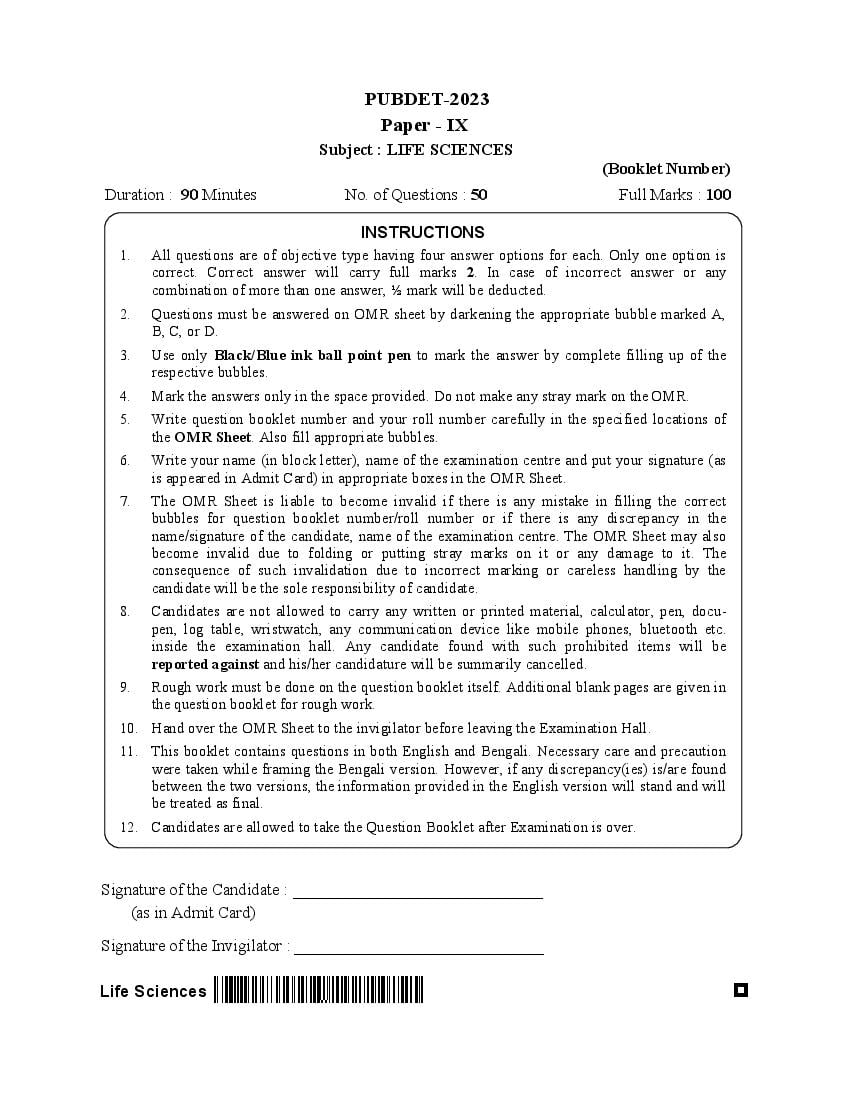
Subject : LIFE SCIENCES
(Booklet Number)
Duration : 90 Minutes No. of Questions : 50 Full Marks : 100
INSTRUCTIONS
1. All questions are of objective type having four answer options for each. Only one option is
correct. Correct answer will carry full marks 2. In case of incorrect answer or any
combination of more than one answer, ½ mark will be deducted.
2. Questions must be answered on OMR sheet by darkening the appropriate bubble marked A,
B, C, or D.
3. Use only Black/Blue ink ball point pen to mark the answer by complete filling up of the
respective bubbles.
4. Mark the answers only in the space provided. Do not make any stray mark on the OMR.
5. Write question booklet number and your roll number carefully in the specified locations of
the OMR Sheet. Also fill appropriate bubbles.
6. Write your name (in block letter), name of the examination centre and put your signature (as
is appeared in Admit Card) in appropriate boxes in the OMR Sheet.
7. The OMR Sheet is liable to become invalid if there is any mistake in filling the correct
bubbles for question booklet number/roll number or if there is any discrepancy in the
name/signature of the candidate, name of the examination centre. The OMR Sheet may also
become invalid due to folding or putting stray marks on it or any damage to it. The
consequence of such invalidation due to incorrect marking or careless handling by the
candidate will be the sole responsibility of candidate.
8. Candidates are not allowed to carry any written or printed material, calculator, pen, docu-
pen, log table, wristwatch, any communication device like mobile phones, bluetooth etc.
inside the examination hall. Any candidate found with such prohibited items will be
reported against and his/her candidature will be summarily cancelled.
9. Rough work must be done on the question booklet itself. Additional blank pages are given in
the question booklet for rough work.
10. Hand over the OMR Sheet to the invigilator before leaving the Examination Hall.
11. This booklet contains questions in both English and Bengali. Necessary care and precaution
were taken while framing the Bengali version. However, if any discrepancy(ies) is/are found
between the two versions, the information provided in the English version will stand and will
be treated as final.
12. Candidates are allowed to take the Question Booklet after Examination is over.
Signature of the Candidate : ______________________________
(as in Admit Card)
Signature of the Invigilator : ______________________________
Life Sciences
Page 2
Life Sciences 2
Page 3
1. In wheat, which of the following combinations is correct ?
(A) Genus-Triticum, Family-Poaceae, Order-Poales, Class-Monocotyledonae
(B) Genus- Triticum, Family-Gramineae, Order-Poales, Class- Dicotyledonae
(C) Genus- Triticum, Family- Poaceae, Order- Sapindales, Class- Dicotyledonae
(D) Genus- Triticum, Family-Cyperaceae, Order-Poales, Class-Monocotyledonae
Njl rœ, ¢ejÀ¢m¢Ma L¡eÚ pj¡q¡l¢V paÉ ?
(A) NZ- Triticum N¡œ-f¡u¢p, hNÑ-f¡ump, nËZ£-je¡L¢VmX¢e z
(B) NZ-Triticum N¡œ-NË¡¢j¢e, hNÑ-f¡ump, nËZ£-X¡CL¢VmX¢e z
(C) NZ-Triticum N¡œ-f¡u¢p, hNÑ-pÉ¡¢feXmp, nËZ£-X¡CL¢VmX¢e z
(D) NZ-Triticum N¡œ-p¡Cf¡l¢p, hNÑ-f¡ump, nËZ£-je¡L¢VmX¢e z
2. Pneumatophores are modified branches of roots usually found in
(A) Xerophytes (B) Halophytes
(C) Pteridophytes (D) Epiphytes
nÄ¡pj§m h¡ ¢eEjÉ¡V¡g¡l (l©f¡¿¹¢la j§m) ¢ejÀ¢m¢Ma k dlel E¢ác p¡d¡lZa cM¡ k¡u
(A) Sl¡g¡CVp (B) qÉ¡m¡g¡CVp
(C) V¢lX¡g¡CVp (D) H¢fg¡CVp
3. Ochreate stipule is the characteristic feature of which family ?
(A) Rubiaceae (B) Rosaceae
(C) Polygonaceae (D) Acanthaceae
L¡ähøL Effœ L¡eÚ N¡œl Q¡¢l¢œL °h¢nøÉ ?
(A) l¦¢hu¢p (B) l¡S¢p
(C) f¢mN¡eÉ¡¢p (D) HÉ¡L¡¿Û¢p
4. Which one of the following structures is of gametophytic origin in Bryophytes ?
(A) Capsule (B) Calyptra
(C) Seta (D) Sporogenous tissue
¢ej¢À m¢Ma hË¡u¡g¡CV¡l Awn…¢ml jdÉ L¡eÚ¢Vl Evp NÉ¡jV¡g¡CV bL ?
(A) LÉ¡fp¤¤m (B) LÉ¡¢mÃVÊ¡
(C) ¢pV¡ (D) Øf¡l¡Se¡p Lm¡
Life Sciences 3
Page 4
(A) Seeds having no storage food
(B) Seeds with storage food in endosperm only
(C) Seeds with storage food in cotyledons only
(D) Seeds with storage food in embryo only
AppÉm h¡ H„AÉ¡mh¤¢je¡p h£S hma h¡T¡u
(A) h£S L¡e¡ p¢’a M¡cÉ eC
(B) h£Sl p¢’a M¡cÉ öd¤ Hä¡Øf¡jÑ Ef¢ÙÛa
(C) h£Sl p¢’a M¡cÉ öd¤ h£Sfœ Ef¢ÙÛa
(D) h£Sl p¢’a M¡cÉ öd¤ ï¨Z Ef¢ÙÛa
6. Which one of the following plant is correctly matched with its three characteristics ?
(A) Pea: C3 pathway, endospermic seeds, vexillary aestivation
(B) Tomato: twisted aestivation, axile placentation, berry
(C) Onion: Bulb, imbricate aestivation, axile placentation
(D) Maize: C3 pathway, closed vascular bundles, Scutellum
¢ejÀ¢m¢Ma L¡eÚ E¢ác¢V a¡l ¢eSü ¢ae¢V °h¢nøÉl p¡b p¢WL i¡h pjL¡¢rL ?
(A) jVlö¢V : C3 fb , Hä¡Øf¡¢jÑL h£S, dÄSL f¤×ffœ¢heÉ¡p
(B) VjV¡ : f¡L¡e¡ f¤×ffœ¢heÉ¡p, Ar£u Ajl¡¢heÉ¡p, hl£
(C) fyu¡S : L¾c, Cj¢hËLV f¤×ffœ¢heÉ¡p, Ar£u Ajl¡¢heÉ¡p
(D) i¥–¡ : C3 fb, hÜ e¡m£L¡h¡¢äm, ú¥Vm¡jÚ
7. The process of photo-respiration occurs in which organelle/organelles ?
(A) Chloroplasts only
(B) Peroxisomes only
(C) Chloroplasts and peroxisomes
(D) Chloroplasts, peroxisomes and mitochondria
¢ejÀ¢m¢Ma L¡eÚ L¡o£u A‰¡Z¤a gV¡lp¢flne qu ?
(A) öd¤ LÓ¡l¡fÔ¡ØV
(B) öd¤ f¡lA¢„S¡j
(C) LÓ¡l¡fÔ¡ØV J f¡lA¢„S¡j
(D) LÓ¡l¡fÔ¡ØV, f¡lA¢„S¡j J j¡CV¡LeÚ¢XÊu¡a
Life Sciences 4
Page 5
(A) PS- II→ Plastoquinone → Cytochrome → PS-I → Ferredoxin
(B) PS -I→ Plastoquinone → Cytochrome → PS-II → Ferredoxin
(C) PS -I→ Cytochrome → Plastoquinone → PS-II → Ferredoxin
(D) PS- II→ Plastocyanin → Cytochrome → PS -I → Ferredoxin
Bm¡L ¢h¢œ²u¡u CmLVÊe fËh¡ql p¢WL œ²j qm:
(A) ¢fHp- II→ fÔ¡ØV¡L¥Ce¡e → p¡CV¡œ²¡j → ¢fHp -I →glX¢„e
(B) ¢fHp -I→ fÔ¡ØV¡L¥Ce¡e → p¡CV¡œ²¡j → ¢fHp -II → glX¢„e
(C) ¢fHp -I→ p¡CV¡œ²¡j → fÔ¡ØV¡L¥Ce¡e → ¢fHp -II → glX¢„e
(D) ¢fHp- II→ fÔ¡ØV¡p¡u¡¢ee → p¡CV¡œ²¡j → ¢fHp -I → glX¢„e
9. In angiosperms, endosperm development starts from a triploid (3n) nucleus that
results from fusion of which of the following ones ?
(A) Two synergids and one male gamete
(B) Three antipodal cells
(C) Two polar nuclei and one male gamete
(D) Two polar nuclei and one tube nucleus
…çh£S£ E¢ác pjÉ h¡ Hä¡Øf¡jÑ NWe k ¢VÊfÔuX (3n) ¢eE¢LÓu¡p bL öl¦ qu, p¢V ¢ej¢À m¢Ma
L¡eÚ…¢ml ¢jmel j¡dÉj Evfæ qu ?
(A) c¤¢V p¡Ce¡l¢SX J HL¢V f¤wNÉ¡jV
(B) ¢ae¢V AÉ¡¢¾Vf¡X¡m L¡o
(C) c¤¢V jl¦ ¢eE¢LÓu¡p J HL¢V f¤wNÉ¡jV
(D) c¤¢V jl¦ ¢eE¢LÓu¡p J HL¢V e¡¢m ¢eE¢LÓu¡p
10. Apomixis is a process that involves
(A) Formation of seeds by fusion of gametes
(B) Formation of seeds without syngamy and meiosis
(C) Formation of seeds with syngamy but no meiosis
(D) Formation of seeds without syngamy but with meiosis
AÉ¡f¡¢j¢„p qm HL¢V fÜ¢a kM¡e
(A) c¤¢V ¢iæ See L¡ol ¢jme h£S Evfæ qu
(B) k pLm h£S ¢peNÉ¡j£ Hhw ¢ju¡¢ppl j¡dÉj Evfæ qu e¡
(C) k pLm h£S ¢peNÉ¡j£l j¡dÉj Evfæ qu ¢L¿¹¥ ¢ju¡¢pp qu e¡
(D) k pLm h£S ¢peNÉ¡j£ qu e¡ ¢L¿¹¥ ¢ju¡¢pp qu
Life Sciences 5
Page 6
(A) Monera (B) Protista
(C) Animalia (D) Fungi
fË¡V¡S¡u¡ Efl¡SÉ k cmi¥š² Ll¡ qu a¡ qm
(A) j¡el¡ (B) fË¡¢VØV¡
(C) HÉ¡¢ej¢mu¡ (D) Rœ¡L
12. Where do we find alary muscle ?
(A) Surrounding the trachea of cockroach
(B) At the opening of the book lung
(C) In two sides of the heart chamber of cockroach
(D) In the locomotory organs of annelida
AÉ¡m¡l£ fn£ L¡b¡u cM¡ k¡u ?
(A) Bln¡m¡l VÊ¡¢Lu¡l Q¡l¢cL
(B) hr g¥pg¥pl à¡l
(C) Bln¡m¡l q©cfËL¡ùl c¤ ¢cL
(D) A‰¥l£j¡m fË¡Z£l Qme A‰
13. Which protein is involved in the formation of spindle fibres during cell division ?
(A) tubulin (B) histone
(C) calmodulin (D) cyclin
L¡o ¢hi¡Sel pju ¢Øfäm a¿¹¥ NWel SeÉ L¡eÚ fË¡¢Ve c¡u£ ?
(A) ¢VEh¤¢me (B) ¢qØV¡e
(C) LÉ¡mj¡¢XE¢me (D) p¡C¢LÓeÚ
14. Which of the following cell organelle is continuous with the outer membrane of nuclear
envelop ?
(A) Golgi apparatus (B) mitochondria
(C) endoplasmic reticulum (D) peroxisome
¢ejÀ¢m¢Ma L¡o A‰¡Z¤…¢ml jdÉ L¡eÚ¢Vl NWe ¢eE¢LÓu¡pl h¢qÑfcÑ¡l p¡b k¤š² ?
(A) Nm¢N hÙ¹¥ (B) j¡CV¡Le¢XÌu¡
(C) Hä¡fÔ¡S¢jL l¢V¢LEm¡j (D) f¡l¢„S¡j
Life Sciences 6
Page 7
(A) Ascaris (B) Pheretima
(C) Sycon (D) Taenia
¢ejÀ¢m¢Ma L¡eÚ NZ-Hl A¿¹NÑa fË¡Z£cl fËL«a ¢pm¡j cM¡ k¡u ?
(A) AÉ¡pL¡¢lp (B) g¢l¢Vj¡
(C) p¡CLe (D) ¢V¢eu¡
16. Which one of the following can convert ammonia or ammonium into nitrite ?
(A) Nitrosomonas (B) Nitrobactor
(C) Azatobactor (D) Mycobacterium
¢ejlÀ L¡eÚ¢V AÉ¡j¡¢eu¡ h¡ AÉ¡j¡¢eu¡j L e¡CVÊ¡CV f¢lh¢aÑa Lla f¡l ?
(A) e¡CVÊ¡p¡j¡e¡p (B) e¡CVÊ¡hÉ¡LVl
(C) AÉ¡S¡V¡hÉ¡LVl (D) j¡CL¡hÉ¡LV¢lu¡j
17. An area of transition between two contrasting ecosystems is termed as
(A) Ecotone (B) Ecotype
(C) Ecesis (D) Ecad
c¤¢V ¢hfl£a h¡Ù¹¥a¿»l A¿¹hÑa£ pwL£ZÑ ÙÛ¡eL hm¡ qu
(A) CL¡V¡e (B) CL¡V¡Cf
(C) CL¢pp (D) CLÉ¡X
18. The pioneer species found in primary succession on rock is
(A) Protozoa (B) Lichen
(C) Pteridophytes (D) Gymnosperms
f¡bll Jfl S£h fkÑ¡uœ²j fË¡b¢jL fËS¡¢a ¢qp¡h cM¡ k¡u
(A) fË¡V¡S¡u¡ (B) m¡CLe
(C) V¢lX¡g¡CV¡ (D) hÉš²h£S£ E¢ác
19. The least productive ecosystem is-
(A) Estuary (B) Open Ocean
(C) Marshes (D) Tropical Rainforest
¢ejÀ¡š² h¡Ù¹¥a¿»…¢ml jdÉ ph bL Lj Evf¡cen£m qm
(A) j¡qe¡ (B) EeÈ ¤š² pj¤â
(C) Sm¡i¨¢j (D) NË£×jjäm£u hª¢ø-AlZÉ
Life Sciences 7
Page 8
(A) alpha diversity (B) beta diversity
(C) gamma diversity (D) delta diversity
HLC h¡pÙÛ¡e h¡ pÇfËc¡ui¥š² S£hl °h¢QœÉL hm¡ qu
(A) Bmg¡ °h¢QœÉ (B) ¢hV¡ °h¢QœÉ
(C) N¡j¡ °h¢QœÉ (D) XÒV¡ °h¢QœÉ
21. Antibodies in our body are complex
(A) lipoproteins (B) steroids
(C) prostaglandins (D) glycoproteins
Bj¡cl nl£ll AÉ¡¢¾Vh¢Xpj§q qm S¢Vm
(A) m¡Cf¡fË¡¢Vep (B) ØVluXp
(C) fË¡ØV¡NÔÉ¡eÚ¢Xep (D) NÔ¡CL¡fË¡¢Vep
22. Select the correct events that occur during inspiration :
(i) Contraction of diaphragm
(ii) Contraction of external intercostal muscles
(iii) Decrease of pulmonary volume
(iv) Increase of intrapulmonary pressure
(A) (iii) and (iv) (B) (i), (ii) and (iv)
(C) only (iv) (D) (i) and (ii)
fËnÄ¡p eJu¡l pju k p¢WL OVe¡…¢m OV
(i) jdɵRc¡l pwL¡Qe
(ii) h¢qxÙÛ C¾V¡lLØV¡m fn£l pwL¡Qe
(iii) g¥pg¥pl Buae qÊÊ¡p
(iv) B¿¹x g¥pg¥p£u Q¡fl hª¢Ü
(A) (iii) Hhw (iv) (B) (i), (ii) Hhw (iv)
(C) öd¤ (iv) (D) (i) Hhw (ii)
Life Sciences 8
Page 9
(A) Schwann cells and oligodendrocytes
(B) Astrocytes and Schwann cells
(C) Oligodendrocytes and osteoclasts
(D) Osteoclasts and astrocytes
j¡u¡¢me p£c °a¢l qu
(A) ü¡u¡e L¡o J A¢mN¡XeXÊ¡p¡CV à¡l¡
(B) AÉ¡ØVÊ¡p¡CV J ü¡u¡e L¡o à¡l¡
(C) A¢mN¡XeXÊ¡p¡CV J A¢ØVJLÓ¡ØV à¡l¡
(D) A¢ØVJLÓ¡ØV J AÉ¡ØVÊ¡p¡CV à¡l¡
24. Which cells of ‘Crypts of Lieberkuhn’ secrete antibacterial lysozyme ?
(A) Argentaffin cells (B) Paneth cells
(C) Zymogen cells (D) Kupffer cells
‘¢œ²ÃVp Ag m¡Ch¡lM¤e’ Hl L¡eÚ L¡o…¢m S£h¡Z¤ ¢hdÄwp£ m¡Cp¡S¡Cj rlZ Ll ?
(A) BlS¾V¡¢ge L¡o (B) f¡eb L¡o
(C) S¡Cj¡Se L¡o (D) L¥fg¡l L¡o
25. Which layer of the eye is maximally rich in melanin ?
(A) Iris (B) Pupil
(C) Retina (D) Choroid
A¢rN¡mLl L¡eÚ Ù¹l¢V phQu h¢n jm¡¢ee pjªÜ ?
(A) Le£¢ZL¡ (B) a¡l¡låÊ
(C) A¢rfV (D) L«o·jäm
26. Growth hormone belongs to
(A) Glycoprotein (B) Steroid
(C) Protein (D) Polypeptide
hª¢Ü qlj¡e qm HL¢V
(A) NÔ¡CL¡fË¡¢Ve (B) ØVluX
(C) fË¡¢Ve (D) f¢mffV¡CX
Life Sciences 9
Page 10
(A) Henle’s Loop (B) Proximal Convoluted Tubule
(C) Distal Convoluted Tubule (D) Vasa Recta
¢eQl L¡eÚ¢V eéel Awn eu ?
(A) qe¢ml m¤f (B) fË¢„j¡m Leim¤VX ¢VE¢hEm
(C) ¢XpV¡m Leim¤VX ¢VE¢hEm (D) i¡p¡ lƒ¡
28. Which chemical compound is used in blood bank to inhibit coagulation of donor’s blood ?
(A) Heparin (B) Sodium glycocholate
(C) Sodium citrate (D) Sodium taurocholate
hÔ¡X-hÉ¡ˆ L¡eÚ l¡p¡u¢eL k±N¢V c¡a¡l lš²Sj¡V hy¡d¡L fË¢aqa Ll ?
(A) qf¡¢le (B) p¡¢Xu¡j NÔ¡CL¡L¡mV
(C) p¡¢Xu¡j-p¡CVÊV (D) p¡¢Xu¡j Vl¡L¡mV
29. The primary function of cerebellum is
(A) Memory (B) Vision
(C) Hearing and body balance (D) Body balance
p¢lhm¡j (mO¤j¢Ù¹×L) -Hl fËd¡e n¡l£lhªš£u L¡S qm
(A) Øj«¢a (B) cnÑe
(C) nËhZ J cql i¡lp¡jÉ (D) cql i¡lp¡jÉ
30. The hormone that stimulates milk secretion is
(A) FSH (B) LH
(C) ADH (D) Prolactin
c¤‡rlZ EŸ£¢fa Ll Hje qlj¡e¢V qm
(A) FSH (B) LH
(C) ADH (D) fË¡mÉ¡¢ƒe
31. The species of Bacillus used as bioinsecticide is
(A) Bacillus licheniformis (B) Bacillus subtilis
(C) Bacillus thuringiensis (D) Bacillus megaterium
Bacillus -Hl k fËS¡¢a¢V °Sh-fa‰e¡nL ¢qp¡h hÉhq¡l qu p¢V qm
(A) Bacillus licheniformis (B) Bacillus subtilis
(C) Bacillus thuringiensis (D) Bacillus megaterium
Life Sciences 10
Page 11
(A) RNA Polymerase (B) Transcription factor complex
(C) Repressors (D) DNA binding domains
¢Se ¢eu¿»Z fË¢œ²u¡u, A¢dL¡wn AÉ¡L¢ViVll ¢eu¿»L Awn…m¡ pwk¡N Ll
(A) Bl He H f¢mj¡lS (B) VÊ¡¾p¢œ²ÃVe gÉ¡ƒl LjfÔ„
(C) ¢lfËpl (D) ¢X He H h¡C¢äw X¡jCe
33. In the beads on a string model, the bead is made up of _______________
(A) 6 histone protein (B) 8 histone protein
(C) 8 histone protein and DNA (D) 6 histone protein and DNA
¢hXp Ae ¢ØVÊw jXm ¢hXp…m¡ °al£ qu ____________ ¢cu
(A) 6 ¢qØV¡e fË¡¢Ve (B) 8 ¢qØV¡e fË¡¢Ve
(C) 8 ¢qØV¡e fË¡¢Ve J ¢X He H (D) 6 ¢qØV¡e fË¡¢Ve J ¢X He H
34. Sickle cell anaemia results from
(A) Point Mutation (B) Chromosomal aberration
(C) Non-disjunction of autosome (D) Blood transfusion reaction
¢pLmÚ pm lš²¡Òfa¡l SeÉ c¡u£
(A) fu¾V ¢jEVneÚ (B) œ²¡j¡S¡j AÉ¡h¡lne
(C) AV¡S¡jl ee-¢XpÚS¡ˆneÚ (D) lš²c¡el pjpÉ¡
35. Where does anti-codon reside ?
(A) m-RNA (B) t-RNA
(C) r-RNA (D) mt-RNA
AÉ¡¢¾V-L¡Xe L¡b¡u AhÙÛ¡e Ll ?
(A) m-RNA (B) t-RNA
(C) r-RNA (D) mt-RNA
36. Edible vaccine in banana is available in market against-
(A) Hepatitis- B (B) Influenza
(C) Tetanus (D) AIDS
Lm¡l jdÉ Ah¢ÙÛa i¡Sek¡NÉ V£L¡ L¡eÚ l¡N fË¢al¡d Ll¡l SeÉ h¡S¡l f¡Ju¡ k¡u ?
(A) qf¡V¡C¢Vp-B (B) Ceg¥Óu”¡
(C) ¢VVe¡p (D) HCXpÚ
Life Sciences 11
Page 12
(A) Lysozyme (B) Ribozyme
(C) Carbozyme (D) Lipozyme
Ae¤S£h fË¢al¡¢d k EvpQL Q¡Ml Sm Ef¢ÙÛa b¡L :
(A) m¡Cp¡S¡Cj (B) l¡Ch¡S¡Cj
(C) L¡h¡ÑS¡Cj (D) m¡Cf¡S¡Cj
38. IgG antibodies are produced in human body by :
(A) T- cells (B) Plasma Cells
(C) RBCs (D) Platelets
j¡ehcq IgG fË¢a¢ho…¢m k dlZl L¡o fËÙ¹¥a qu :
(A) T- L¡o (B) fÔ¡Sj¡ L¡o
(C) m¡¢qa L¢ZL¡ (D) Ae¤Q¢œ²L¡
39. Which of the following bacteria is used in microbial fuel cell for the generation of
electricity ?
(A) Bacillus licheniformis (B) Aspergillus niger
(C) Leuconostoc mesenteroides (D) Shewanella putrefaciens
¢ej¢À m¢Ma L¡eÚ hÉ¡ƒ¢lu¡¢V j¡Cœ²¡¢hu¡m g¥um pm (Ae¤S£¢hu SÆ¡m¡e£ L¡o) H ¢hc¤Év Evf¡cel
SeÉ hÉhq©a qu ?
(A) Bacillus licheniformis (B) Aspergillus niger
(C) Leuconostoc mesenteroides (D) Shewanella putrefaciens
40. Conditions of a karyotype ‘2n + 1’ and ‘2n + 2’ are called :
(A) aneuploidy (B) polyploidy
(C) alloploidy (D) monosomy
‘2n + 1’ Hhw ‘2n + 2’ HC c¤C LÉ¡¢lJV¡Cf Hl AhÙÛ¡eL hm¡ qu :
(A) AÉ¡¢eEfÔu¢X (B) f¢mfÔu¢X
(C) AÉ¡m¡fÔu¢X (D) je¡p¢j
41. Thalassemia is an autosomal recessive disorder. In case, both parents are carriers, then
what are the chances of occurrence of the disease in their offsprings ?
(A) 25% (B) 100%
(C) No chance (D) 50%
bÉ¡m¡p¢ju¡ qm HL¢V AV¡p¡j¡m ¢lp¢pi-¢XpAXÑ¡l z k¢c h¡h¡-j¡ EiuC bÉ¡m¡p¢ju¡l h¡qL qe,
a¡qm a¡cl p¿¹¡ecl jdÉ bÉ¡m¡p¢ju¡ qh¡l pñ¡he¡ LaV¡ ?
(A) 25% (B) 100%
(C) pñ¡he¡ eC (D) 50%
Life Sciences 12
Page 13
together and are called as
(A) allelomorphs (B) identical genes
(C) linked genes (D) recessive genes
HLC œ²¡j¡S¡jl HL Afll M¤h L¡R¡L¡¢R Ah¢ÙÛa ¢Se…¢ml HLp¡b flhaÑ£ fËSeÈ k¡Ju¡l
pñ¡he¡ b¡L Hhw a¡cl hm¡ qu
(A) AÉ¡mm¡jgÑ (B) A¢iæ (identical) ¢Se
(C) pwk¤š² (linked) ¢Se (D) f˵Ræ (recessive) ¢Se
43. Which one is required for transformation of recombinant plasmid ?
(A) iodine (B) magnesium
(C) calcium (D) ferrous
L¡eÚ¢V ¢lL¢ðe¡¾V fÔ¡p¢jXl VÊ¡¾pgjÑnel SeÉ fËu¡Se ?
(A) Bu¡¢Xe (B) jÉ¡Ne¢nu¡j
(C) LÉ¡m¢pu¡j (D) gl¡p
44. Which of the following cells of the immune system do not perform phagocytosis ?
(A) macrophage (B) basophil
(C) eosinophil (D) neutrophil
C¢jEe ¢pØVj L¡eÚ L¡o gÉ¡N¡p¡CV¡¢pp ¢œ²u¡ Ll e¡ ?
(A) jÉ¡œ²¡g¡S (B) hp¡¢gm
(C) Cu¡¢pe¡¢gm (D) ¢eEVÊ¡¢gm
45. Anammox bactetia are used in sewage treatment plant to remove
(A) organic carbon compound (B) nitrogenous compounds
(C) heavy metals (D) fatty substances
AÉ¡e¡j„ hÉ¡ƒ¢lu¡ sewage treatment plant H hÉhq©a qu ¢ejÀ¢m¢Ma L¡eÚ dlel k±N Afp¡¢la
Ll¡l SeÉ ?
(A) °Sh-L¡hÑe k±N (B) e¡CVÊ¡Se O¢Va k±N
(C) i¡l£ d¡a¥ (D) Q¢hÑS¡a£u fc¡bÑ
46. Which one is used as vector in gene cloning ?
(A) Plasmid (B) Intron
(C) Exon (D) Transposon
Hl jdÉ L¡eÚ¢V ¢Se LÓ¡¢ew Hl SeÉ iƒl ¢qp¡h hÉhq©a qu ?
(A) fÔ¡p¢jX (B) CeVÊe
(C) H„e (D) VÊ¡¾pf¡pe
Life Sciences 13
Page 14
(A) Monosomic (B) Trisomic
(C) Nullisomic (D) Double monosomic
X¡Ee ¢peXÌ¡j p¡d¡lZa œ²¡j¡S¡j-21 Hl _______ AhÙÛ¡
(A) Monosomic (je¡p¢jL) (B) Trisomic (VÊ¡Cp¢jL)
(C) Nullisomic (e¡¢mp¢jL) (D) Double monosomic (X¡hm je¡p¢jL)
48. Callus can be triggered to form shoot by changing from which hormonal ratio ?
(A) auxin to gibberellin (B) gibberellin to auxin
(C) auxin to cytokinin (D) auxin to ethylene
LÉ¡m¡p bL L¡ä NWe ¢ejÀ¢m¢Ma L¡eÚ qlj¡e Ae¤f¡a f¢lhaÑe qu ?
(A) A¢„e bL ¢Sîl¢me (B) ¢Sîl¢me bL A¢„e
(C) A¢„e bL p¡CV¡L¡C¢ee (D) A¢„e bL C¢b¢me
49. _______ was considered as missing link between reptiles and birds.
(A) Archaeopteryx (B) Pteranodon
(C) Avimimus (D) Caudipteryx
_______ L pl£pªf J f¡¢Ml jdÉ ¢j¢pw ¢mˆ (missing link) hm¡ qu z
(A) B¢LÑJfÚV¢l„ (B) Vl¡e¡Xe
(C) AÉ¡¢i¢jj¡p (D) L¢XfÚV¢l„
50. In the ABO system, blood group ‘O’ is characterised by the
(A) Presence of antigen A and absence of antigen B
(B) Presence of both antigen A and antigen B
(C) Absence of both antigen A and antigen B
(D) Presence of antigen O
ABO system -H ‘O’ lš²-NÌf
¤ -Hl °h¢nøÉ
(A) A AÉ¡¢¾VSe haÑj¡e J B AÉ¡¢¾VSe AhaÑj¡e
(B) A J B AÉ¡¢¾VSe c¤C-C haÑj¡e
(C) A J B AÉ¡¢¾VSe c¤C-C AhaÑj¡e
(D) O AÉ¡¢¾VSe haÑj¡e
_______________
Life Sciences 14
Page 15
Life Sciences 15
Page 16
Subject : LIFE SCIENCES
pju: 90 ¢j¢eV ®j¡V fËnÀ : 50 ¢V f§ ZÑj¡e : 100
1. HC fËnÀfœl ph fËnÀC AhS¢ƒi fËnÀ Hhw fË¢a¢V fËnÀl Q¡l¢V pñ¡hÉ Ešl cJu¡ BR
k¡l HL¢V j¡œ p¢WL z p¢WL Ešl ¢Q¢q²a Llm 2 eðl f¡h z i¥m Ešl ¢Q¢q²a Llm
Abh¡ HL¡¢dL Ešl ¢Q¢q²a Llm ½ eðl L¡V¡ k¡h z
2. OMR fœ A, B, C, D ¢Q¢q²a p¢WL Ol¢V il¡V Ll Ešl ¢ca qh z
3. OMR fœ Ešl ¢ca öd¤j¡œ L¡m¡ h¡ e£m L¡¢ml hm fu¾V fe hÉhq¡l Llh z
4. OMR fœ ¢e¢cÑø ÙÛ¡e R¡s¡ AeÉ L¡b¡J L¡e¡ c¡N ch e¡ z
5. OMR fœ ¢e¢cÑø ÙÛ¡e fËnÀfœl eðl Hhw ¢eSl l¡m eðl A¢a p¡hd¡ea¡l p¡b ¢mMa
qh Hhw fËu¡Se£u Ol…¢m f§lZ Lla qh z
6. OMR fœ ¢e¢cÑø ÙÛ¡e ¢eSl e¡j J fl£r¡L¾cÊl e¡j ¢mMa qh Hhw ¢eSl (Admit
Card H Eõ¢Ma) ü¡rl Lla qh z
7. fËnÀfœl eðl h¡ l¡m eðl i¥m ¢mMm Abh¡ i¥m Ol il¡V Llm, fl£r¡bÑ£l e¡j,
fl£r¡L¾cÊl e¡j h¡ ü¡rl L¡e¡ i¥m b¡Lm Ešlfœ h¡¢am qu ka f¡l z OMR
fœ¢V i¡yS qm h¡ a¡a Ae¡hnÉL c¡N fsmJ h¡¢am qu ka f¡l z fl£r¡bÑ£l HC
dlel i¥m h¡ ApaÑLa¡l SeÉ Ešlfœ h¡¢am qm HLj¡œ fl£r¡bÑ£ ¢eSC a¡l SeÉ
c¡u£ b¡Lh z
8. j¡h¡Cm g¡e h¡ ®k ®L¡e dl®el C®mLVÌ¢eL NÉ¡®SV, LÉ¡mL¥mVl, pÔ¡CXl¦m, mNVhm,
q¡aO¢s, lM¡¢Qœ, NË¡g h¡ L¡e¡ dlel a¡¢mL¡ , Lmj CaÉ¡¢c fl£r¡Lr Be¡ k¡h e¡ z
Bem p¢V h¡Su¡ç qh Hhw fl£r¡bÑ£l JC fl£r¡ h¡¢am Ll¡ qh z
9. fËnÀfœ l¡g L¡S Ll¡l SeÉ gy¡L¡ S¡uN¡ cJu¡ BR z AeÉ L¡e¡ L¡NS HC L¡S
hÉhq¡l Llh e¡ z
10. fl£r¡Lr R¡s¡l BN OMR fœ AhnÉC f¢lcnÑLL ¢cu k¡h z
11. HC fËnÀfœ Cwl¡S£ J h¡wm¡ Eiu i¡o¡aC fËnÀ cJu¡ BR z h¡wm¡ j¡dÉj fËnÀ °al£l
pju fËu¡Se£u p¡hd¡ea¡ J paLÑa¡ Ahmðe Ll¡ quR z a¡ pšJ Ä k¢c L¡e Ap‰¢a
mrÉ Ll¡ k¡u, prœ Cwl¡S£ j¡dÉj cJu¡ fËnÀ ¢WL J Q¨s¡¿¹ hm ¢hh¢Qa qh z
12. fl£r¡no fl£r¡b£Ñl¡ fËnÀfœ¢V ¢eu k¡h z
Life Sciences 16
Document Details
| Board / Org | WBJEEB |
| Exam | PUBDET |
| Type | Question Paper |
| Pages | 16 |
| Updated | 22 Jul 2026 |