NEST Exam 2023 Question Paper Chemistry Shift I
Finished viewing? Save it for later —
Download NEST Exam 2023 Question Paper Chemistry Shift I (PDF · 8 pages)About NEST Exam 2023 Question Paper Chemistry Shift I
NEST Exam 2023 Question Paper Chemistry Shift I is available here for free download. Published by Default for National Entrance Screening Test, this question paper can be viewed online or downloaded as a PDF (8 pages). Candidates preparing for National Entrance Screening Test can use NEST Exam 2023 Question Paper Chemistry Shift I to understand the exam pattern, the type of questions asked, and the overall difficulty level.
Frequently Asked Questions
How can I download NEST Exam 2023 Question Paper Chemistry Shift I?
Open this page and click the Download button to save NEST Exam 2023 Question Paper Chemistry Shift I as a PDF. It is completely free on AglaSem Docs.
Is NEST Exam 2023 Question Paper Chemistry Shift I free to download?
Yes. NEST Exam 2023 Question Paper Chemistry Shift I can be viewed online and downloaded as a PDF free of cost on AglaSem Docs.
How many pages does NEST Exam 2023 Question Paper Chemistry Shift I have?
NEST Exam 2023 Question Paper Chemistry Shift I contains 8 pages, which you can read online or download together as a single PDF.
Where can I find more National Entrance Screening Test study material?
You can find more National Entrance Screening Test question papers, sample papers, syllabus, and answer keys on AglaSem Docs.
NEST Exam 2023 Question Paper Chemistry Shift I – Text
Read the full text of this question paper below — useful to quickly search, copy and reference the content online without downloading the PDF.
📄 View text version (8 pages)
Page 1
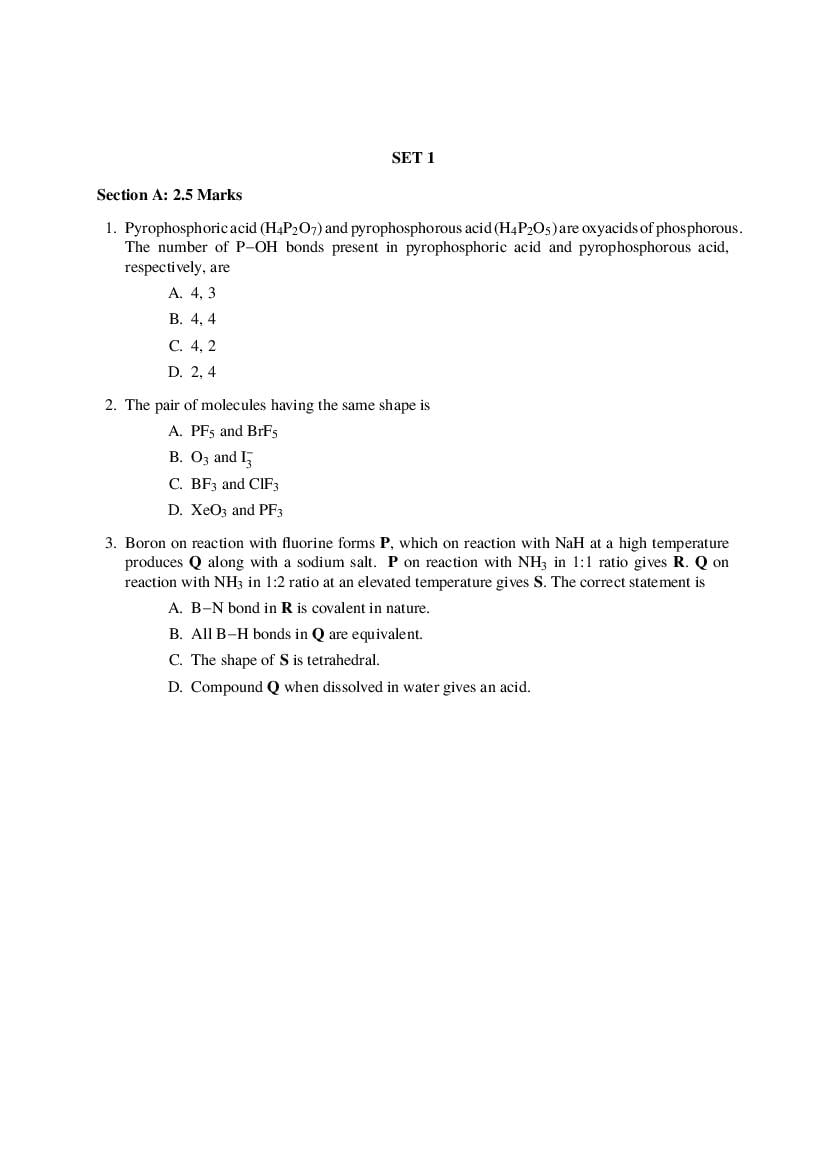
Section A: 2.5 Marks
1. Pyrophosphoric acid (H4 P2 O7 ) and pyrophosphorous acid (H4 P2 O5 ) are oxyacids of phosphorous.
The number of P−OH bonds present in pyrophosphoric acid and pyrophosphorous acid,
respectively, are
A. 4, 3
B. 4, 4
C. 4, 2
D. 2, 4
2. The pair of molecules having the same shape is
A. PF5 and BrF5
B. O3 and I−3
C. BF3 and ClF3
D. XeO3 and PF3
3. Boron on reaction with fluorine forms P, which on reaction with NaH at a high temperature
produces Q along with a sodium salt. P on reaction with NH3 in 1:1 ratio gives R. Q on
reaction with NH3 in 1:2 ratio at an elevated temperature gives S. The correct statement is
A. B−N bond in R is covalent in nature.
B. All B−H bonds in Q are equivalent.
C. The shape of S is tetrahedral.
D. Compound Q when dissolved in water gives an acid.
Page 2
energy of lanthanum and the lanthanoids is
A.
B.
C.
Page 2
Page 3
5. The ground state electronic energy of He atom (𝐸 He ) can be expressed in terms of the ground
state energy of the hydrogen atom (𝐸 H ) and the electron-electron interaction energy (𝐸 ee ) in
the He atom. If 𝐸 ee is equal to 𝑥 times the magnitude of 𝐸 H , then 𝐸 He is given by
A. 𝐸 He = 4𝐸 H + 𝑥𝐸 H
B. 𝐸 He = 2(4𝐸 H + 𝑥𝐸 H )
C. 𝐸 He = 8𝐸 H − 𝑥𝐸 H
D. 𝐸 He = 8𝐸 H + 𝑥𝐸 H
6. Consider a metal crystal with simple cubic, fcc, and bcc structures. Assume that the nearest
neighbour atoms (spheres) touch each other in the unit cells. The correct statement is
A. The percentage of the void space in different crystal structures follow the order:
fcc < bcc < simple cubic.
B. The number of atoms in the unit cell are 14, 9 and 8 for fcc, bcc and simple cubic
structures, respectively.
C. The lowest percentage of the void space among the three crystal structures is
approximately 48%.
D. The percentage of the void space in any of the above crystal structures will depend
on the lattice parameter and hence cannot be predicted without the knowledge of the
lattice parameter.
Page 3
Page 4
to a final state Y (𝑃2 ,𝑉2 ,𝑇2 ). Let Δ𝑈, Δ𝐻, and Δ𝑆 represent the changes in internal energy,
enthalpy, and entropy, respectively in this process. The correct expression is
A. Δ𝐻 = Δ𝑈 + 𝑃2 (𝑉2 −𝑉1 ).
B. Δ𝐻 = Δ𝑈 + 𝑃2 (𝑉2 −𝑉1 ) +𝑉2 (𝑃2 − 𝑃1 )
C. Δ𝑆 = 𝐶𝑣 ln(𝑇2 /𝑇1 ) + 𝑛𝑅ln(𝑉2 /𝑉1 )
D. Δ𝑆 = (3/2)(𝑃1𝑉1 /𝑇1 )ln(𝑇2 /𝑇1 ) + (𝑃2𝑉2 /𝑇2 )ln(𝑉2 /𝑉1 )
8. A mixture of 0.1 mol of a weak acid HX and 0.2 mol of another weak acid HY is dissolved
in 1 kg of water. The degrees of ionization of the two acids HX and HY in the final solution
are 0.1 and 0.2, respectively. Assuming Rault’s law to be valid, the elevation of boiling point
(Δ𝑇𝑏 ), in terms of the boiling point elevation constant (𝐾 𝑏 ), is given by
A. Δ𝑇𝑏 = 0.25𝐾 𝑏
B. Δ𝑇𝑏 = 0.35𝐾 𝑏
C. Δ𝑇𝑏 = 0.30𝐾 𝑏
D. Δ𝑇𝑏 = 0.32𝐾 𝑏
9. When levorotatory 2-methylbutan-1-ol (P) is heated with concentrated HCl, dextrorotatory
1-chloro-2-methylbutane (Q) is formed. The correct statement is
A. P and Q have identical absolute configuration.
B. The reaction takes place at the asymmetric centre.
C. The reaction involves a carbocationic intermediate.
D. If the concentration of P is doubled, keeping the concentration of HCl unchanged,
the rate of the reaction does not change.
Page 4
Page 5
the major hydrocarbon product is
A.
B.
C.
D.
11. Among the following pairs,
the pairs that represent resonance structures are
A. P, Q and R
B. Q, R and S
C. Q and S
D. R and S
Page 5
Page 6
the product P is
A.
B.
C.
D.
Page 6
Page 7
13. The reaction of the alkali metals with oxygen results in the formation of different alkali
metal oxides, monoxides, peroxides and superoxides. These oxides have interesting chemical
properties and applications. The ease of formation and stability of these oxides depend mainly
on the charge and size of the alkali metals in relation to the size of the anions. In an application
like in a space suit, a chemical may be used which gives oxygen and also absorbs carbon
dioxide from exhalation. In this context, the correct statement(s) is(are):
A. The order of the stability of alkali metal monoxides is Li2 O < Na2 O < K2 O.
B. Superoxide formation decreases down the group.
C. Na2 O2 on reaction with CO2 gives Na2 CO3 and itself gets oxidized to oxygen.
D. Potassium superoxide can be used in a space suit.
14. Negatively charged monodentate strong field ligand (X− ) and weak field ligand (Y− ) form
complexes [MnX6 ]4− and [MnY6 ]4− , respectively, under certain reaction conditions. Let the
crystal field splitting energy for [MnX6 ]4− and [MnY6 ]4− be (Δo )1 and (Δo )2 , respectively. The
correct statement(s) is(are):
A. Electron pairing energy in [MnX6 ]4− is smaller than (Δo )1 .
B. [MnY6 ]4− is more stabilized than [MnX6 ]4− .
C. The 𝑡2𝑔 orbitals in [MnX6 ]4− are stabilized by 2(Δo )1 as compared to degenerate 𝑑
orbitals.
D. [MnY6 ]4− is intense in colour as compared to [MnX6 ]4− .
15. The bonding in the species HeH can be studied in a way similar to that of the H2 . The correct
statement(s) is(are):
A. The dipole moment of HeH is larger than that of H+2 .
B. Among HeH, HeH+ , and HeH2+ , the species that is most stable is HeH2+ .
C. Among HeH, HeH− , and HeH+ , the system with the smallest bond length is HeH+ .
D. HeH+ has symmetrical distribution of electrons about the bond axis.
Page 7
Page 8
D-glucose and D-fructose. Since, sucrose, D-glucose, and D-fructose are optically active
compounds, the progress of the reaction can be monitored by measuring the angle of rotation
of the polarized light in a polarimeter at different times. In a certain experiment, 1 L of 0.1 M
sucrose solution is hydrolyzed and the angle of rotation (𝑅𝑡 ) is measured at different times (𝑡).
Let 𝑅0 = 25°, 𝑅∞ = −15°, and 𝑅30 = 5° be the angles of rotation at times 𝑡 = 0 min, 𝑡 = ∞, and
𝑡 = 30 min respectively. The concentration of sucrose at time 𝑡 is proportional to the change
in the angle of rotation (𝑅𝑡 − 𝑅∞ ). Molecular mass of sucrose is 342.3 g/mol. The correct
statement(s) is(are):
A. The half-life of the reaction is 15 min.
B. The rate constant (𝑘) is 3.85 ×10⁻⁴ s−1 .
C. The mass of sucrose hydrolysed in 60 min is 25.6 g.
D. The rate of the reaction at 30 min is 1.925 ×10⁻⁵ Ms−1 .
17. Consider the following mechanism of a reaction.
The correct statement(s) is(are):
A. The same mechanism will operate, if compound P does not have one of the methyl
groups.
B. The reaction involves both oxidation and reduction of P.
C. The equilibrium is favoured towards products T and W because T and W are weaker
conjugate base and acid as compared to R and S respectively.
D. Hydride is a nucleophile in the reaction of Q with P .
Page 8
Document Details
| Board / Org | Default |
| Exam | National Entrance Screening Test |
| Type | Question Paper |
| Pages | 8 |
| Updated | 30 Apr 2026 |