NEST Exam 2023 Question Paper Chemistry Shift II
Finished viewing? Save it for later —
Download NEST Exam 2023 Question Paper Chemistry Shift II (PDF · 10 pages)About NEST Exam 2023 Question Paper Chemistry Shift II
NEST Exam 2023 Question Paper Chemistry Shift II is available here for free download. Published by Default for National Entrance Screening Test, this question paper can be viewed online or downloaded as a PDF (10 pages). Candidates preparing for National Entrance Screening Test can use NEST Exam 2023 Question Paper Chemistry Shift II to understand the exam pattern, the type of questions asked, and the overall difficulty level.
Frequently Asked Questions
How can I download NEST Exam 2023 Question Paper Chemistry Shift II?
Open this page and click the Download button to save NEST Exam 2023 Question Paper Chemistry Shift II as a PDF. It is completely free on AglaSem Docs.
Is NEST Exam 2023 Question Paper Chemistry Shift II free to download?
Yes. NEST Exam 2023 Question Paper Chemistry Shift II can be viewed online and downloaded as a PDF free of cost on AglaSem Docs.
How many pages does NEST Exam 2023 Question Paper Chemistry Shift II have?
NEST Exam 2023 Question Paper Chemistry Shift II contains 10 pages, which you can read online or download together as a single PDF.
Where can I find more National Entrance Screening Test study material?
You can find more National Entrance Screening Test question papers, sample papers, syllabus, and answer keys on AglaSem Docs.
NEST Exam 2023 Question Paper Chemistry Shift II – Text
Read the full text of this question paper below — useful to quickly search, copy and reference the content online without downloading the PDF.
📄 View text version (10 pages)
Page 1
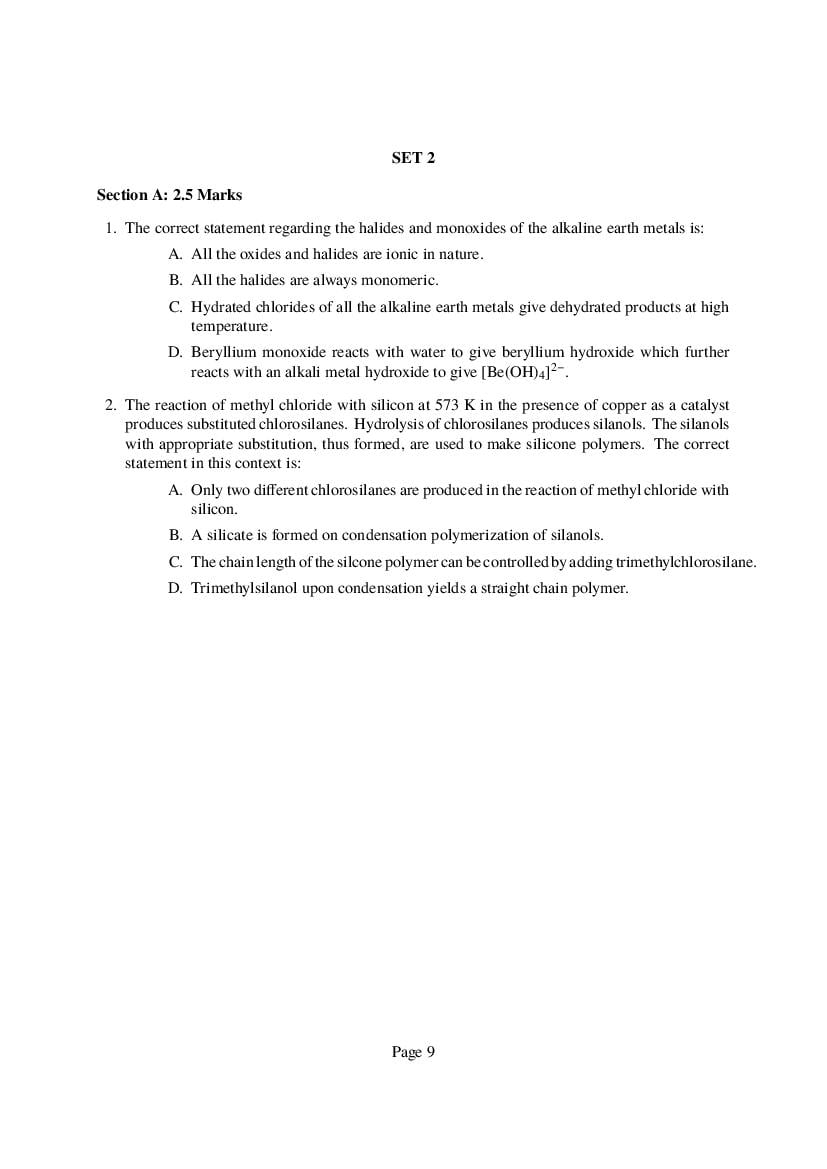
Section A: 2.5 Marks
1. The correct statement regarding the halides and monoxides of the alkaline earth metals is:
A. All the oxides and halides are ionic in nature.
B. All the halides are always monomeric.
C. Hydrated chlorides of all the alkaline earth metals give dehydrated products at high
temperature.
D. Beryllium monoxide reacts with water to give beryllium hydroxide which further
reacts with an alkali metal hydroxide to give [Be(OH)4 ]2− .
2. The reaction of methyl chloride with silicon at 573 K in the presence of copper as a catalyst
produces substituted chlorosilanes. Hydrolysis of chlorosilanes produces silanols. The silanols
with appropriate substitution, thus formed, are used to make silicone polymers. The correct
statement in this context is:
A. Only two different chlorosilanes are produced in the reaction of methyl chloride with
silicon.
B. A silicate is formed on condensation polymerization of silanols.
C. The chain length of the silcone polymer can be controlled by adding trimethylchlorosilane.
D. Trimethylsilanol upon condensation yields a straight chain polymer.
Page 9
Page 2
A.
B.
C.
D.
Page 10
Page 3
A. [Cr(H2 O)6 ]3+
B. [Ti(H2 O)6 ]3+
C. [V(H2 O)6 ]3+
D. [Fe(H2 O)6 ]3+
5. The equation appropriate for the exact calculation of pH of an aqueous solution of HCl at a
concentration (𝑐 HCl ), close to 10−6 M, is given by
A. [H+ ] = 𝑐 HCl
B. [H+ ] = 𝑐 HCl + 𝐾𝑤 /[H+ ]
√
C. [H+ ] = 𝑐 HCl + 𝐾𝑤
D. [H+ ] = 𝑐 HCl + 𝐾𝑤 /(2𝑐 HCl )
6. Consider a hypothetical one-electron atom, where the nucleus and the electron interact with
a force 𝐹 = −𝑘𝑟. Here, 𝑟 is the distance between the electron and the nucleus, and 𝑘 is a
constant. If this atom is studied using the Bohr model, the electron is assumed to move around
the nucleus in selected stable orbits of fixed radii, characterized by quantum number 𝑛. The
radius of the orbiting electron (of mass 𝑚 e ) is
� 2 2 � 1/4
𝑛 ℎ
A.
4𝜋 2 𝑘𝑚 e
� 2 2 �
𝑛 ℎ
B.
4𝜋 2 𝑘𝑚 e
� 2 2 � 1/3
𝑛 ℎ
C.
4𝜋 2 𝑘𝑚 e
� 2 2 � 1/2
𝑛 ℎ
D.
4𝜋 2 𝑘𝑚 e
7. Biological standard potential (𝐸 ∗ ) is defined as the potential measured at pH = 7.0. The species
nicotinamide adenine dinucleotide (NADH) and its oxidised form NAD+ play an important
role in respiratory process. Given, the standard potential 𝐸 0 = −0.099 V for the reaction NAD+
(aq) + H+ (aq) + 2e− → NADH (aq), the value of 𝐸 ∗ for the conversion of NAD+ (aq) to NADH
(aq) in 1.0 M NAD+ solution, at room temperature (25° C), is
A. −0.31 V
B. −0.99 V
C. −0.51 V
D. −0.41 V
Page 11
Page 4
in terms of Arrhenius equation, which contains the corresponding activation energy (𝐸 a ) term.
The correct plot of the ratio of the rate constants (not drawn to scale) of different chemical
reactions, at two temperatures 300 K and 400 K, as a function of their 𝐸 a values (in kJ mol−1 ) is
A.
B.
C.
Page 12
Page 5
9. In the reaction shown below,
the major product X is
A.
Page 13
Page 6
C.
D.
Page 14
Page 7
below. Glucose solution does not give positive Schiff test.
The correct statement is:
A. 𝛼-D(+)-glucose and 𝛽-D(+)-glucose are enantiomers.
B. 𝛼-D(+)-glucose and 𝛽-D(+)-glucose are anomers.
C. In solution, the open-chain form predominates over the cyclic forms.
D. Glucose reacts with sodium bisulphite to form an addition product.
11. One mole of toluene on reaction with 2 moles of Cl2 in the presence of light gives X, which
on hydrolysis at 100° C gives Y. Y on reaction with conc.HNO3 /H2 SO4 at 0-10° C provides Z
as the major product. The compound Z is
A.
B.
C.
D.
Page 15
Page 8
The correct reagents (P, Q, R and S) required are:
A. P = Br2 /red phosphorous; Q = H2 O; R = SOCl2 ; S = H2 , Pd-BaSO4
B. P = Br2 /red phosphorous; Q = H3 O+ ; R = SOCl2 ; S = LiAlH4
C. P = Br2 /NaOH; Q = H2 O; R = PCl3 ; S = DIBAL-H
D. P = PBr3 ; Q = H3 O+ ; R =Cl2 /FeCl3 ; S = Pd-BaSO4
Section B: 4 Marks
13. Ammonium sulfate on reaction with sodium hydroxide produces compounds Q and R along
with water. Catalytic oxidation of Q by atmospheric oxygen yields T (an oxide of nitrogen)
and water. T reacts with oxygen to produce compound X, which dissolves in water giving Y
and T. The correct statement(s) is(are):
A. The geometry of compound X is bent.
B. Compound T on reaction with hexaaqua iron(II) complex gives brown color.
C. The conversion of X to Y is a reduction process.
D. Compound Y on reaction with carbon yields compound X, CO2 and water.
Page 16
Page 9
of NaCl. The aqueous solutions of glucose and NaCl are of the same molal concentrations.
The vapour pressures (𝑝) of the three liquids are plotted (not drawn to scale) as a function of
temperature (𝑇) in the figure below.
The three values of pressure, 𝑝 1 (= 1 atm), 𝑝 2 and 𝑝 3 and three temperatures 𝑇1 , 𝑇2 and 𝑇3 are
indicated in the figure. The correct statement(s) is (are):
A. Curves X , Y and Z correspond to pure water, glucose solution and NaCl solution
respectively.
B. The temperatures 𝑇1 , 𝑇2 and 𝑇3 represent the boiling points of the solutions corresponding
to the curves X, Y and Z, respectively.
C. The pressures, 𝑝 1 , 𝑝 2 and 𝑝 3 are related as 2𝑝 2 = 𝑝 1 + 𝑝 3 .
D. The temperatures, 𝑇1 , 𝑇2 and 𝑇3 are related as 3𝑇2 = 2𝑇1 + 𝑇3 .
15. Consider the three electrodes Fe/Fe2+ , Fe/Fe3+ , and Fe2+ /Fe3+ , for which the standard electrode
(oxidation) potentials are: 𝐸 10 , 𝐸 20 , and 𝐸 30 , respectively. The standard EMF of the cell,
Fe/Fe2+ ||Fe3+ /Fe, is 𝐸 40 . The correct expression(s) is (are):
A. 𝐸 30 = (3𝐸 20 − 2𝐸 10 )
B. 𝐸 30 = (𝐸 20 − 𝐸 10 )
C. 𝐸 40 = (2𝐸 10 − 3𝐸 20 )
D. 𝐸 40 = (𝐸 10 − 𝐸 20 )
Page 17
Page 10
Consider the compounds P and Q that can undergo such reactions with different reagents.
With reference to the above reactions, the correct statement(s) is(are):
A. In the HBr addition, the rate of the reaction is faster for Q than for P.
B. HBr addition to P gives an equal mixture of enantiomers as a major product.
C. P reacts with diborane followed by oxidation with H2 O2 /NaOH gives racemic alcohol
as a major product.
D. Reaction of P with O3 followed by treatment with Zn/H2 O gives methyl formate and
formaldehyde.
17. Consider the following acid hydrolysis of esters.
The correct statement(s) about X and Y is(are):
A. Both X and Y on reaction with Lucas reagent (ZnCl2 + conc. HCl) give turbid
solutions.
B. Y on reaction with Br2 /NaOH gives sodium salt of phenyl acetic acid.
C. X forms silver mirror with ammonical silver nitrate solution.
D. The reaction of Y with NH2 NH2 followed by heating with KOH in ethylene glycol
gives n-propylbenzene.
Page 18
Document Details
| Board / Org | Default |
| Exam | National Entrance Screening Test |
| Type | Question Paper |
| Pages | 10 |
| Updated | 30 Apr 2026 |