WBCHSE Class 12 Syllabus 2024 History
Finished viewing? Save it for later —
Download WBCHSE Class 12 Syllabus 2024 History (PDF · 7 pages)About WBCHSE Class 12 Syllabus 2024 History
WBCHSE Class 12 Syllabus 2024 History is available here for free download. Published by West Bengal Board for Class 12, this syllabus can be viewed online or downloaded as a PDF (7 pages). Candidates preparing for Class 12 can use WBCHSE Class 12 Syllabus 2024 History to understand the exam pattern, the type of questions asked, and the overall difficulty level.
Frequently Asked Questions
How can I download WBCHSE Class 12 Syllabus 2024 History?
Open this page and click the Download button to save WBCHSE Class 12 Syllabus 2024 History as a PDF. It is completely free on AglaSem Docs.
Is WBCHSE Class 12 Syllabus 2024 History free to download?
Yes. WBCHSE Class 12 Syllabus 2024 History can be viewed online and downloaded as a PDF free of cost on AglaSem Docs.
How many pages does WBCHSE Class 12 Syllabus 2024 History have?
WBCHSE Class 12 Syllabus 2024 History contains 7 pages, which you can read online or download together as a single PDF.
Where can I find more Class 12 study material?
You can find more Class 12 question papers, sample papers, syllabus, and answer keys on AglaSem Docs.
WBCHSE Class 12 Syllabus 2024 History – Text
Read the full text of this syllabus below — useful to quickly search, copy and reference the content online without downloading the PDF.
📄 View text version (7 pages)
Page 1
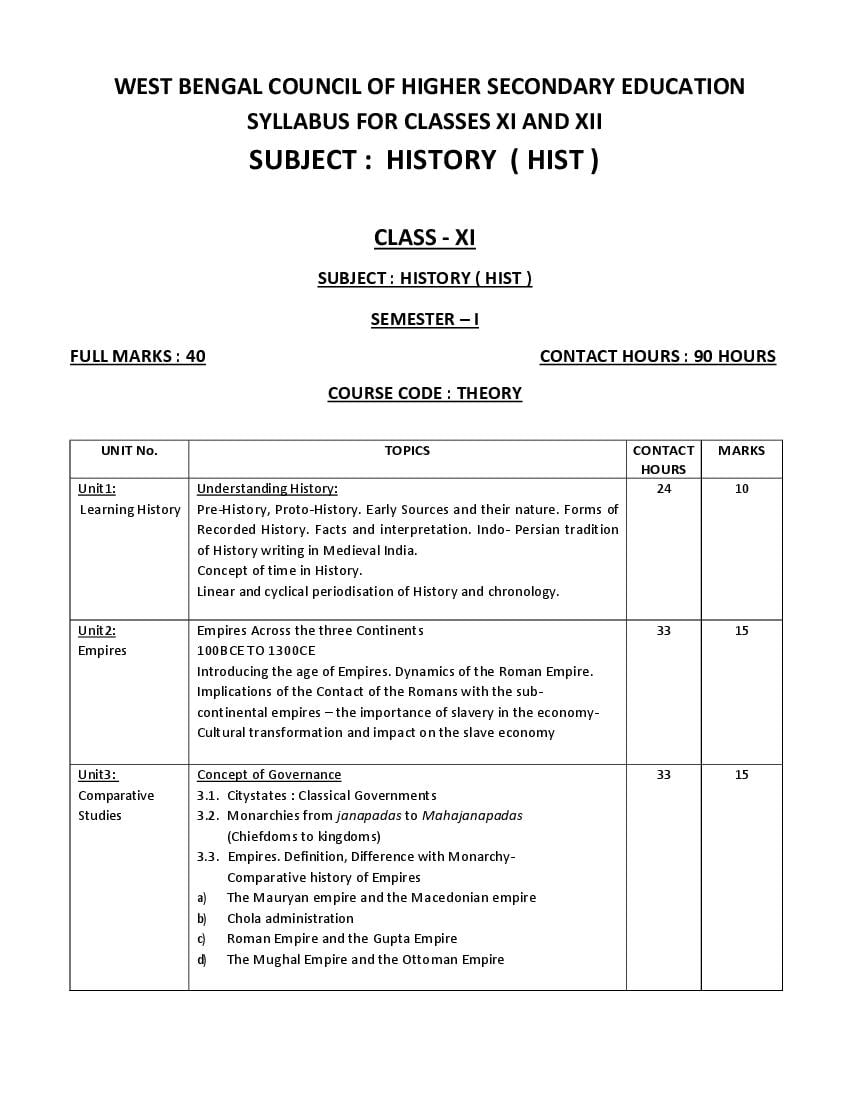
SYLLABUS FOR CLASSES XI AND XII
CLASS - XI
SEMESTER – I
FULL MARKS : 40 CONTACT HOURS : 90 HOURS
UNIT No. TOPICS CONTACT MARKS
Unit1: Understanding History: 24 10
Learning History Pre-History, Proto-History. Early Sources and their nature. Forms of
Recorded History. Facts and interpretation. Indo- Persian tradition
of History writing in Medieval India.
Concept of time in History.
Linear and cyclical periodisation of History and chronology.
Unit2: Empires Across the three Continents 33 15
Empires 100BCE TO 1300CE
Introducing the age of Empires. Dynamics of the Roman Empire.
Implications of the Contact of the Romans with the sub-
continental empires – the importance of slavery in the economy-
Cultural transformation and impact on the slave economy
Unit3: Concept of Governance 33 15
Comparative 3.1. Citystates : Classical Governments
Studies 3.2. Monarchies from janapadas to Mahajanapadas
(Chiefdoms to kingdoms)
3.3. Empires. Definition, Difference with Monarchy-
Comparative history of Empires
a) The Mauryan empire and the Macedonian empire
b) Chola administration
c) Roman Empire and the Gupta Empire
d) The Mughal Empire and the Ottoman Empire
Page 2
SEMESTER – II
FULL MARKS : 40 CONTACT HOURS : 70 HOURS
UNIT No. TOPICS CONTACT MARKS
Unit4: State and its apparatus: 25 15
Nature of State 4.1. Nature of state, The ideal prototype
a) The Indian context -Kautilya, the Arthasastra
and the state craft ;
Ziauddin Barani : Fatwa-i-Jahandari and the
nature of the state under the Delhi sultans
b) The European context : Greek and the
Roman world. Thomas Cromwell and the
new Monarchy: intellectual basis of the early
modern state.
4.2. Apparatus of Governance
a. Persian Satraps
b. Chinese Mandarins
c. Delhi Sultans : Iqtadars
d. Mughal Mansabdars
Unit 5: The Crusades - Changing Cultural Traditions - 20 10
Changing To appreciate the history of Cultural
Traditions transformations with reference to paintings, art &
architecture of the period. Renaissance periods.
Debate on Renaissance – positive and negative
impact.
Roman Catholic Church & Protestant movements.
Bhakti, Sufi, Confucious, Tao, Shinto etc.
Unit 6 : Origins of Modern Science -From Witchcraft to Social 25 15
Expanding emancipation- Astrology to Astronomy, Towards a
Horizons solar centric universe. Geographical Explorations and
new geographical knowledge -
Technological advancements.
Agricultural, Military and Shipbuilding technology-
Printing Revolution in Western Europe (With
reference to the contributions of China, Japan and the
Arab World to the art of Printing )
Page 3
COURSE CODE : PROJECT
FULL MARKS : 20
1. Prepare a time chart of Evolution
2. a. Map work : On a world map point out the places which were under the Roman Empire
b. Slavery and its impact on the contemporary world
3. Mapwork
a. On an outline map of Europe locate
i) Athens
ii) Sparta
b. On an outline map of India locate and name the sixteen mahajanapadas
c. Trade relation in the ancient times between Europe and India during 500BCE -500CE
4. Contributions of
a. Kautilya
b. Zia-ud-din Barani
c. Thomas Cromwell
5. Renaissance and its impact on the Human Life
6. Printing Revolution and its impact on the spread of education
[Note: 40 Hours reserved for Project , Remedial classes, Tutorials and Home Assignments.]
Page 4
SEMESTER – III
FULL MARKS : 40 CONTACT HOURS : 90 HOURS
UNIT No. TOPICS CONTACT MARKS
Unit1: 1. Society and Polity of India (Between 10th and 40 20
th
1) Through the eyes 17 Centuries) with reference to travelers’
of the travelers. accounts : Administrative Structure – Economic
2) Cultural Life – Social and Religious Life–Literature, Art and
amalgamation Architecture
3) Imperial capital 2. Bhakti, Sufi, Nath, Yogi, Vaishnava, etc:
The Bhakti Cult–
Shaivism–Vaishnavism
-Bhakti Saints – Impact of Bhakti Ideology –
Origins of Sufism–Sufi Orders in India–
Impact of Sufism etc
3. Vijaynagara, Bahamani and others :
Origins– Administrative Structure– Society and
Economy–Religion and Culture – Art and Architecture –
Literature– The Bahamani Successor States
Unit2: 1. Brief overview of 17th and 18th Century 50 20
1) Colonialism and Colonialisation in Asia and the New World :
Imperialism in Brief overview of Colonisation in Asia & the New
the19th and 20th World-Economic Dynamics of Imperialism and
Centuries Colonialism; from Mercantile Capital to Industrial &
2) Political basis of Finance Capital
Colonialism 2. Terminology of Imperialism, Colonialism, Neo-
3) The levers of Imperialism : The Political Basis of Colonialism-
Colonial Political and Economic Domination and
Control Subordination of the
Colonies–Racism and Its Impact on Colonial Societies–
Neo-imperialism
3. The Levers of Colonial Control :
India- as a ‘colonised’ state –
The instruments of control : Law/ Legislature /
Bureaucracy/Police/Army -
The subordination of the colonial economy
Page 5
SEMESTER – IV
FULL MARKS : 40 CONTACT HOURS : 70 HOURS
UNIT No. TOPICS CONTACT MARKS
Unit3: 1. Revolt of 1857 and its representations : 70 07
1) Rebels and Raj Causes of the Revolt – Character – Causes of Failure –
The impact of the Revolt
2) Nationalism 1. Aligarh Movement, Birth of Muslim League, Hindu 19
and Separatism Mahasabha:
The Aligarh Movement – Sayyid Ahmed Khan – The
‘two nation theory’-
Birth of the Muslim League – The Hindu Mahasabha
– Politics of Separatism and the Pathway to Pakistan
2. Pre-1917 and post-1917, till independence :
The early Congress and the Moderate phase – Rise of
Gandhi – Concept of Satyagraha – Gandhi in South
Africa – Gandhi’s popular appeal – Khadi, Charka,
Village Reconstruction - Harijan Sampradaya
Upliftment – Gandhian Philosophy of Non-Violence
and its impact – The Quit India Movement (1942)- An
Assessment of Gandhi in Indian and International
Affairs.
Contemporary Major Indian Freedom Movements –
Advent of Netaji Subhas Chandra Bose . Formation of
Azad Hind Movement . Formation of INA and its
background and impacts . Naval Mutiny. Other forms
of revolutionary movements in Bengal , Punjab ,
Maharashtra. Transfer of Power and the related
issues.
Page 6
3) Framing of the The beginning of a New Era, India after 75 years of 07
Constitution Independence :
Making of the Indian Constitution – Salient Features of
the Constitution with emphasis on social and economic
empowerment and women empowerment – Five Year
Plans – Liberalisation and the Opening up of the Indian
Economy in the 1990s – Changing Foreign Policy with
reference to the USA, Russia, China and Pakistan –
Assessment of 75 years of Indian Independence
4) Partition , The 1971 Indo-Pak War 07
Nation Formation of Bangladesh and its impact on India.
Formation and
related aspects
Page 7
COURSE CODE : PROJECT
FULL MARKS : 20
Globalization
Women’s Right Movement
Recent Political Crisis(International)
New Social Movement
Anti-Apartheid Movement
Environment And The World
Anti-Corruption Movement
Environmental Movement
World Peace Movement
[Note: 40 Hours reserved for Project , Remedial classes, Tutorials and Home Assignments.]
Document Details
| Board / Org | West Bengal Board |
| Exam | Class 12 |
| Type | Syllabus |
| Pages | 7 |
| Updated | 22 Jul 2026 |