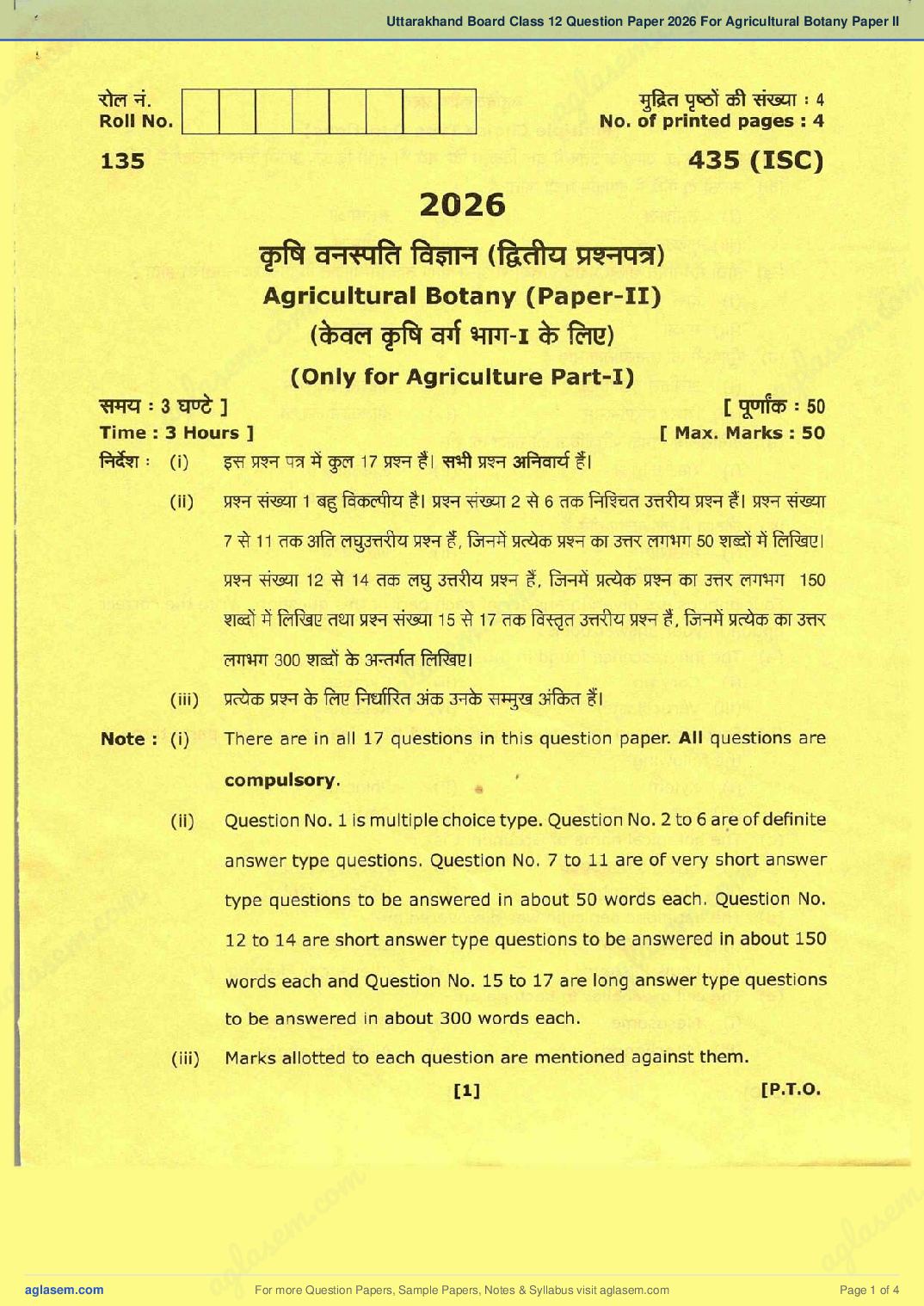
Uttarakhand Board Class 12 Question Paper 2026 For Agricultural Botany Paper II
Finished viewing? Save it for later —
Download Uttarakhand Board Class 12 Question Paper 2026 For Agricultural Botany Paper II (PDF · 4 pages)About Uttarakhand Board Class 12 Question Paper 2026 For Agricultural Botany Paper II
Uttarakhand Board Class 12 Question Paper 2026 For Agricultural Botany Paper II is available here for free download. Published by Uttarakhand Board for Class 12, this question paper can be viewed online or downloaded as a PDF (4 pages). Candidates preparing for Class 12 can use Uttarakhand Board Class 12 Question Paper 2026 For Agricultural Botany Paper II to understand the exam pattern, the type of questions asked, and the overall difficulty level.
Frequently Asked Questions
How can I download Uttarakhand Board Class 12 Question Paper 2026 For Agricultural Botany Paper II?
Open this page and click the Download button to save Uttarakhand Board Class 12 Question Paper 2026 For Agricultural Botany Paper II as a PDF. It is completely free on AglaSem Docs.
Is Uttarakhand Board Class 12 Question Paper 2026 For Agricultural Botany Paper II free to download?
Yes. Uttarakhand Board Class 12 Question Paper 2026 For Agricultural Botany Paper II can be viewed online and downloaded as a PDF free of cost on AglaSem Docs.
How many pages does Uttarakhand Board Class 12 Question Paper 2026 For Agricultural Botany Paper II have?
Uttarakhand Board Class 12 Question Paper 2026 For Agricultural Botany Paper II contains 4 pages, which you can read online or download together as a single PDF.
Where can I find more Class 12 study material?
You can find more Class 12 question papers, sample papers, syllabus, and answer keys on AglaSem Docs.
Uttarakhand Board Class 12 Question Paper 2026 For Agricultural Botany Paper II – Text
Read the full text of this question paper below — useful to quickly search, copy and reference the content online without downloading the PDF.
📄 View text version (5 pages)
Page 1
Uttarakhand Board Class
12 Question Paper 2026
For Agricultural Botany
Paper II
EXAM YEAR TYPE SUBJECT
Uttarakhand Class 12 2026 Question Paper Agriculture
Notes · Sample Papers · Previous Year Papers · Mock Tests
Page 2
m .co
m .co s em
se On+ g la lfaaqo dtdwr :
Roll No a No. of printed pages : 4 4
135 435 (ISC)
2026
pfB HTWfa faRm (fadt=1WqH)
Agricultural Botany (Paper-II) m
m
c. o (baa 9fB af wi-i & fRI!) m .co
s e
s em (Only for Agriculture Part-1) g l a
g
tI'Iq : 3 tMla ] [ gaIna :
a
Time : 3 Hours ] [ Max. Marks : 50
50
fUn : (i) 6nwq q3+ Ta 17 wg?I wIt wg afqaTdgl
(ii) wg+wrla€fa©8jtqgl wg+wr2+6a©fRf9m3v€tq wqgl gW+WT
7+11a©3rfaaq3urtawqg,fmdqa©wq©r38rmrwr50 gTa+fafinl
wg +wr12+14a©ag3vihl gw g, fm+ gM wg ar38taqln150
m
.co
VTd+fafiW aw wg+wr15+17a©fa@381hI wg g. fm+qMar 381
s em
mrvTr 300 ?Ta b 3Fafa fafjgtII
g l a
a 3tasibalsa 3+faa gI
(iii) qaa wg&fwMta
Note : (i) There are in all 17 questions in this question paper. All questions are
compulsory .
(ii) Question No. 1 is multiple choice type. Question No. 2 to 6 are of definite
answer type questions. Question No. 7 to 11 are of very short answer
m
m type questions to be answered in about 50 words each. Question No. .co
m .co s em
12 to 14 are short answer type questions to be answered in about 150
s e g l a
g la a answer type questions
words each and Question No. 15 to 17 are long
a to be answered in about 300 words each.
(iii) Marks allotted to each question are mentioned against them.
[1] [P.T.0.
m .
.co s e m
s em l a
g la ag
a For more Question Papers, Sample Papers, Notes & Syllabus visit Page 1 of 4
Page 3
(Multiple Choice Type Questions)
1. $nwq#qa©wg#38{+vNfB©mfhTT+glwtfi©®wM3m-!fm©l+fafiIt!-
(a) qHHt b1tel+!qnqwaxmg-
(i) WTf9® (ii) HHbTTHt
(iii) Wdm (iV) 3THbTH
(a) t#et+f:tfqaqNrqaRf qfHat+3ruqNtta®Mfi5a&axrRrmFafta6taTg- 1
(i) aM (ii) WiT#
(iii) USn (iV) acF
('r> 'iJB6at©raFMfa©nqg-
(i) H+faF6TpR3T (ii)
(iii) f+TtREftlMW (iv)
(u) Qf:if+mhiTrq6qfhigaaat©ta©t gjt-
(i) {fd dfT + (ii) dIMa)+
(iii) q§H VTRR + (iV) Dadaus< ldfihT +
(B) ataP!+Mf9T©hd8#
(i) dtHTHh (ii) dtRRt©Ta
(iii) qTSaIdfR;aT (iV) wW Wit
Four options are given in answer of each part of this question. Write the correct
option in your answer book :
(a) The inflorescence found in mustard plant is -
(i) Corymb (ii) Cymose
(iii) Verticillaster (iv) Raceme
(b) Food produced in plants is transferred from leaves to other parts through
the following-
( i) Xylem ' (ii) Phloem
(iii) Pith (iv) Cortex
(c) The botanical name of Groundnut is-
(i) Arachis hypogea (ii) Pisum sativum
(iii) Cicer arientinum (iv) Dolichos lablab
(d) The antibiotic penicillin was discovered by'
(i) Robert Koch (ii) Leeuwenhoek
(iii) Louis Pasteur (iV) Allexander Fleming
(e) The cell organelles in bacteria are-
(i) Mesosome (ii) Golgi apparatus
(iii) Mitochondria (iv) All of the above
435(ISC) [2]
For more Question Papers, Sample Papers, Notes & Syllabus visit Page 2 of 4
Page 4
m .co
m
I
.co s e m
se f:lf9aa3vftq wn g l a
a
(Definite Answer Type Questions)
2. uR &sta+d®wTf©amH©r daT g?
What type of germination occurs in gram seed?
3. 6®tf©smN©r qPmmr i?
What type of underground stem is turmeric?
4 mT$afafvm©r3if:aq3Rn mrt?
m
m
What is the end product of glycolysis?
.co
5.
.co
q@rf©s wav 9ma:wsfMg?
s e m
em
Maize belong to which Plant family?
s g l a
6.
la
L,II.J+nfgqU + M-wr :bT daT g?
g a
a disease is caused by Plasmodium?
Which
31fBag3ufta wn
(Very Short Answer Type Questions)
7. fit+aZFT (fitkitm) fWIT Hr dai + wh ©tfatII 2
Describe the process of triple fusion briefly.
8. fivwTamqnwwr q8{anntfafjglII 2
Write any two differences between diffusion and osmosis. m
9. aWitnt#T-©®T + 3rrq wr aged ?? .co 2
s em
What do you understand by transpiration pull?
10. q$dTT$aT@rg?96 oa WaRm g?
g la 2
a
What is Mycorrhiza? Where is it found?
11. uss ©rt+f©©+sMall 2
Describe AIDS in brief.
ag3efIll wn
(Short Answer Type Questions)
12. gwr;ifa©Th3wgmq+q&©lqTqtf©afhyaqT$uaurfMtn©rv6mlitfafinl4
m
.co
Draw a labelled diagram of the entry of the pollen tube into the ovary and also
m
c. o write the importance of double fertilization. s e m
e m 13. da aaT:g ©r mnd#
l
qTgm f©u aSTfEIa + 9@ f©a? arm-HtMa ffgm nr ©ftn whl
las daFdu 1
ag 4
ag Who proposed the Fluid-mosaic model of bio-rnernbranes? Describe the Fluid-
mosaic model along with its diagram.
3T21RI / OR
435(ISC) [3] [P.T.0.
m .
.co s e m
s em l a
g la ag
a For more Question Papers, Sample Papers, Notes & Syllabus visit Page 3 of 4
Page 5
GIfhuI
Illustrate the different phases of meiosis using diagrams only. Write the
significance of meiosis.
14. f:iqfafjga uMm fwwttfafjgt!- 2x2=4
(a) liEi©ram3ra?iwTan
(a) ?am1IUTTa
Write short note on the following :
(a) Water absorbing system of plants
(b) Respiratory quotient
f+qa3nftq wn
(Long Answer Type Questions)
15. qfuzi#fifiHWTFTait@rwh@tfacewwTfgnu3hWTfqqHatganTafmI 6
Describe the various modifications of leaves and compare the phylloclade and
phyllode.
16. u©fg©tnnt mn ©t+{aqrarrftnwhatfal! augwaY 3iFaft© dram at fBMaTt!
GIf:gUI 6
Describe the structure of a dicotyledonous stem with a diagram and write the
characteristics of its internal structure.
Halal / OR
nuGtRgd df$T©tTtt at +taTr wlr ©Taf ©r wh ©tfat!- 2><3=6
(B) HH:%aitaTfa©T (a) man (,r) aT$tithH
Describe the structure and functions of the following cell organelles-
(a) Endoplasmic reticulum (b) Plastids (c) Lysosomes
17. ®etb6@mb3rTflf®%©©rwhafw aw val bfif9rva&wi©rwhgqq3 aw
!q3TTtab vmafalII 6
Describe the economic importance of the Cruciferae family. Describe the
distinctive features of mustard plant with floral formula and floral diagram.
mTr/ OR
f:l-ifafjga @at+qT+aT+aTaqTat©r qm an 3+M #Vq+3iTflf© gsm al wh
d9Fdu- 2„3=6
(B) WfM (a) gBRfatd (Tr) dd+a
Describe the economic importance of plants found in the following families as
food and medicine–
(a) Leguminosae (b) Cucurbitaceae (C) Solanaceae
#####
435(ISC) [4]
For more Question Papers, Sample Papers, Notes & Syllabus visit Page 4 of 4
Document Details
| Board / Org | Uttarakhand Board |
| Exam | Class 12 |
| Type | Question Paper |
| Pages | 4 |
| Updated | 04 Nov 2026 |