Finished viewing? Save it for later —
Download CBSE Class 11 Physics Syllabus 2020-21 (PDF · 10 pages)About CBSE Class 11 Physics Syllabus 2020-21
CBSE Class 11 Physics Syllabus 2020-21 is available here for free download. Published by CBSE for Class 11, this syllabus can be viewed online or downloaded as a PDF (10 pages). Candidates preparing for Class 11 can use CBSE Class 11 Physics Syllabus 2020-21 to understand the exam pattern, the type of questions asked, and the overall difficulty level.
Frequently Asked Questions
How can I download CBSE Class 11 Physics Syllabus 2020-21?
Open this page and click the Download button to save CBSE Class 11 Physics Syllabus 2020-21 as a PDF. It is completely free on AglaSem Docs.
Is CBSE Class 11 Physics Syllabus 2020-21 free to download?
Yes. CBSE Class 11 Physics Syllabus 2020-21 can be viewed online and downloaded as a PDF free of cost on AglaSem Docs.
How many pages does CBSE Class 11 Physics Syllabus 2020-21 have?
CBSE Class 11 Physics Syllabus 2020-21 contains 10 pages, which you can read online or download together as a single PDF.
Where can I find more Class 11 study material?
You can find more Class 11 question papers, sample papers, syllabus, and answer keys on AglaSem Docs.
CBSE Class 11 Physics Syllabus 2020-21 – Text
Read the full text of this syllabus below — useful to quickly search, copy and reference the content online without downloading the PDF.
📄 View text version (10 pages)
Page 1
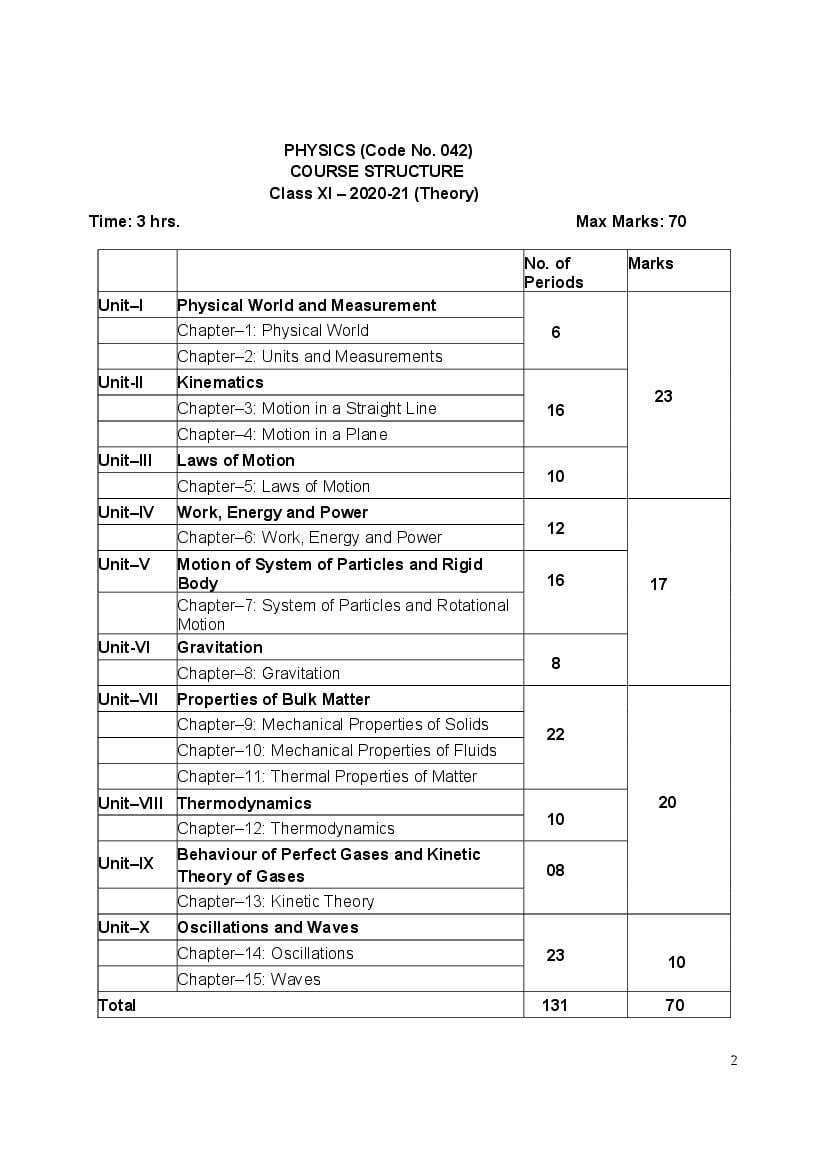
COURSE STRUCTURE
Class XI – 2020-21 (Theory)
Time: 3 hrs. Max Marks: 70
No. of Marks
Periods
Unit–I Physical World and Measurement
Chapter–1: Physical World 6
Chapter–2: Units and Measurements
Unit-II Kinematics
23
Chapter–3: Motion in a Straight Line 16
Chapter–4: Motion in a Plane
Unit–III Laws of Motion
10
Chapter–5: Laws of Motion
Unit–IV Work, Energy and Power
12
Chapter–6: Work, Energy and Power
Unit–V Motion of System of Particles and Rigid
Body 16 17
Chapter–7: System of Particles and Rotational
Motion
Unit-VI Gravitation
8
Chapter–8: Gravitation
Unit–VII Properties of Bulk Matter
Chapter–9: Mechanical Properties of Solids
22
Chapter–10: Mechanical Properties of Fluids
Chapter–11: Thermal Properties of Matter
Unit–VIII Thermodynamics 20
10
Chapter–12: Thermodynamics
Behaviour of Perfect Gases and Kinetic
Unit–IX 08
Theory of Gases
Chapter–13: Kinetic Theory
Unit–X Oscillations and Waves
Chapter–14: Oscillations 23 10
Chapter–15: Waves
Total 131 70
2
Page 2
Chapter–1: Physical World
Physics-scope and excitement; nature of physical laws; Physics, technology and society.
(To be discussed as a part of Introduction and integrated with other topics)
Chapter–2: Units and Measurements
Need for measurement: Units of measurement; systems of units; SI units, fundamental
and derived units. Length, mass and time measurements; accuracy and precision of
measuring instruments; errors in measurement; significant figures.
Dimensions of physical quantities, dimensional analysis and its applications.
Unit II: Kinematics 16 Periods
Chapter–3: Motion in a Straight Line
Elementary concepts of differentiation and integration for describing motion, uniform
and non- uniform motion, average speed and instantaneous velocity, uniformly
accelerated motion, velocity - time and position-time graphs.
Relations for uniformly accelerated motion (graphical treatment).
Chapter–4: Motion in a Plane
Scalar and vector quantities; position and displacement vectors, general vectors and
their notations; equality of vectors, multiplication of vectors by a real number; addition
and subtraction of vectors, relative velocity, Unit vector; resolution of a vector in a plane,
rectangular components, Scalar and Vector product of vectors.
Motion in a plane, cases of uniform velocity and uniform acceleration-projectile motion,
uniform circular motion.
3
Page 3
Chapter–5: Laws of Motion
Intuitive concept of force, Inertia, Newton's first law of motion; momentum and Newton's
second law of motion; impulse; Newton's third law of motion.(recapitulation only)
Law of conservation of linear momentum and its applications.
Equilibrium of concurrent forces, Static and kinetic friction, laws of friction, rolling friction,
lubrication.
Dynamics of uniform circular motion: Centripetal force, examples of circular motion
(vehicle on a level circular road, vehicle on a banked road).
Unit IV: Work, Energy and Power 12 Periods
Chapter–6: Work, Energy and Power
Work done by a constant force and a variable force; kinetic energy, work-energy
theorem, power.
Notion of potential energy, potential energy of a spring, conservative forces:
conservation of mechanical energy (kinetic and potential energies); non-conservative
forces: motion in a vertical circle; elastic and inelastic collisions in one and two
dimensions.
Unit V: Motion of System of Particles and Rigid Body 16 Periods
Chapter–7: System of Particles and Rotational Motion
Centre of mass of a two-particle system, momentum conservation and centre of mass
motion. Centre of mass of a rigid body; centre of mass of a uniform rod.
Moment of a force, torque, angular momentum, law of conservation of angular
momentum and its applications.
Equilibrium of rigid bodies, rigid body rotation and equations of rotational motion,
comparison of linear and rotational motions.
Moment of inertia, radius of gyration, values of moments of inertia for simple geometrical
objects (no derivation).
4
Page 4
Chapter–8: Gravitation
Universal law of gravitation. Acceleration due to gravity (recapitulation only) and its
variation with altitude and depth.
Gravitational potential energy and gravitational potential, escape velocity, orbital velocity
of a satellite, Geo-stationary satellites.
Unit VII: Properties of Bulk Matter 22 Periods
Chapter–9: Mechanical Properties of Solids
Stress-strain relationship, Hooke's law, Young's modulus, bulk modulus
Chapter–10: Mechanical Properties of Fluids
Pressure due to a fluid column; Pascal's law and its applications (hydraulic lift and
hydraulic brakes), effect of gravity on fluid pressure.
Viscosity, Stokes' law, terminal velocity, streamline and turbulent flow, critical velocity,
Bernoulli's theorem and its applications.
Surface energy and surface tension, angle of contact, excess of pressure across a curved
surface, application of surface tension ideas to drops, bubbles and capillary rise.
Chapter–11: Thermal Properties of Matter
Heat, temperature,( recapitulation only) thermal expansion; thermal expansion of solids,
liquids and gases, anomalous expansion of water; specific heat capacity; Cp, Cv -
calorimetry; change of state - latent heat capacity.
Heat transfer-conduction, convection and radiation (recapitulation only), thermal
conductivity, qualitative ideas of Blackbody radiation, Wein's displacement Law, Stefan's
law, Greenhouse effect.
5
Page 5
Chapter–12: Thermodynamics
Thermal equilibrium and definition of temperature (zeroth law of thermodynamics), heat,
work and internal energy. First law of thermodynamics, isothermal and adiabatic
processes.
Second law of thermodynamics: reversible and irreversible processes
Unit IX: Behaviour of Perfect Gases and Kinetic Theory of Gases 08 Periods
Chapter–13: Kinetic Theory
Equation of state of a perfect gas, work done in compressing a gas.
Kinetic theory of gases - assumptions, concept of pressure. Kinetic interpretation of
temperature; rms speed of gas molecules; degrees of freedom, law of equi-partition of
energy (statement only) and application to specific heat capacities of gases; concept of
mean free path, Avogadro's number.
Unit X: Oscillations and Waves 23 Periods
Chapter–14: Oscillations
Periodic motion - time period, frequency, displacement as a function of time, periodic
functions.
Simple harmonic motion (S.H.M) and its equation; phase; oscillations of a loaded spring-
restoring force and force constant; energy in S.H.M. Kinetic and potential energies;
simple pendulum derivation of expression for its time period. Free, forced and damped
oscillations (qualitative ideas only), resonance.
Chapter–15: Waves
Wave motion: Transverse and longitudinal waves, speed of travelling wave, displacement
relation for a progressive wave, principle of superposition of waves, reflection of waves,
standing waves in strings and organ pipes, Beats
6
Page 6
The record, to be submitted by the students, at the time of their annual examination, has
to include:
Record of at least 8 Experiments 4 from each section, to be performed by the students
Record of at least 6 Activities [with 3 each from section A and section B], to be
demonstrated by teacher.
EVALUATION SCHEME
Time Allowed: Three hours Max. Marks: 30
Two experiments one from each section (8+8)Marks
Practical record (experiment and activities) 7Marks
Viva on experiments, and activities 7 Marks
Total 30 Marks
SECTION–A
Experiments
1. To measure diameter of a small spherical/cylindrical body and to measure internal
diameter and depth of a given beaker/calorimeter using Vernier Callipers and hence
find its volume.
2. To measure diameter of a given wire and thickness of a given sheet using screw
gauge.
OR
To determine volume of an irregular lamina using screw gauge.
3. To determine radius of curvature of a given spherical surface by a spherometer.
4. To determine the mass of two different objects using a beam balance.
5. To find the weight of a given body using parallelogram law of vectors.
7
Page 7
of second's pendulum.
OR
To study variation of time period of a simple pendulum of a given length by taking
bobs of same size but different masses and interpret the result.
7. To study the relationship between force of limiting friction and normal reaction and
to find the co- efficient of friction between a block and a horizontal surface.
OR
To find the downward force, along an inclined plane, acting on a roller due to
gravitational pull of the earth and study its relationship with the angle of inclination θ
by plotting graph between force and sin θ.
Activities
1. To make a paper scale of given least count, e.g., 0.2cm, 0.5 cm.
2. To determine mass of a given body using a metre scale by principle of moments.
3. To plot a graph for a given set of data, with proper choice of scales and error bars.
4. To measure the force of limiting friction for rolling of a roller on a horizontal plane.
5. To study the variation in range of a projectile with angle of projection.
6. To study the conservation of energy of a ball rolling down on an inclined plane (using
a double inclined plane).
7. To study dissipation of energy of a simple pendulum by plotting a graph between
square of amplitude and time.
8
Page 8
Experiments
1. To determine Young's modulus of elasticity of the material of a given wire.
OR
To find the force constant of a helical spring by plotting a graph between load and
extension.
1. To study the variation in volume with pressure for a sample of air at constant
temperature by plotting graphs between P and V, and between P and 1/V.
2. To determine the surface tension of water by capillary rise method.
OR
To determine the coefficient of viscosity of a given viscous liquid by measuring
terminal velocity of a given spherical body.
3. To study the relationship between the temperature of a hot body and time by plotting
a cooling curve.
4. To determine specific heat capacity of a given solid by method of mixtures.
5. To study the relation between frequency and length of a given wire under constant
tension using sonometer.
OR
To study the relation between the length of a given wire and tension for constant
frequency using sonometer.
7. To find the speed of sound in air at room temperature using a resonance tube by
two resonance positions.
Activities
1. To observe change of state and plot a cooling curve for molten wax.
2. To observe and explain the effect of heating on a bi-metallic strip.
9
Page 9
observations.
4. To study the effect of detergent on surface tension of water by observing capillary rise.
5. To study the factors affecting the rate of loss of heat of a liquid.
6. To study the effect of load on depression of a suitably clamped metre scale loaded
at (i) its end (ii) in the middle.
7. To observe the decrease in pressure with increase in velocity of a fluid.
Practical Examination for Visually Impaired Students Class XI
Note: Same Evaluation scheme and general guidelines for visually impaired students as
given for Class XII may be followed.
A. Items for Identification/Familiarity of the apparatus for assessment in
practicals (All experiments)
Spherical ball, Cylindrical objects, vernier calipers, beaker, calorimeter, Screw gauge,
wire, Beam balance, spring balance, weight box, gram and milligram weights, forceps,
Parallelogram law of vectors apparatus, pulleys and pans used in the same ‘weights’
used, Bob and string used in a simple pendulum, meter scale, split cork, suspension
arrangement, stop clock/stop watch, Helical spring, suspension arrangement used,
weights, arrangement used for measuring extension, Sonometer, Wedges, pan and pulley
used in it, ‘weights’ Tuning Fork, Meter scale, Beam balance, Weight box, gram and
milligram weights, forceps, Resonance Tube, Tuning Fork, Meter scale, Flask/Beaker
used for adding water.
B. List of Practicals
1. To measure diameter of a small spherical/cylindrical body using vernier calipers.
2. To measure the internal diameter and depth of a given beaker/calorimeter using
vernier calipers and hence find its volume.
3. To measure diameter of given wire using screw gauge.
4. To measure thickness of a given sheet using screw gauge.
10
Page 10
6. To find the weight of given body using the parallelogram law of vectors.
7. Using a simple pendulum plot L-T and L-T2 graphs. Hence find the effective
length of second’s pendulum using appropriate length values.
8. To find the force constant of given helical spring by plotting a graph between
load and extension.
9. (i) To study the relation between frequency and length of a given wire under
constant tension using a sonometer.
(ii) To study the relation between the length of a given wire and tension, for
constant frequency, using a sonometer.
10. To find the speed of sound in air, at room temperature, using a resonance tube,
by observing the two resonance positions.
Note: The above practicals may be carried out in an experiential manner rather than
recording observations.
Prescribed Books:
1. Physics Part-I, Textbook for Class XI, Published by NCERT
2. Physics Part-II, Textbook for Class XI, Published by NCERT
3. Laboratory Manual of Physics, Class XI Published by NCERT
4. The list of other related books and manuals brought out by NCERT
(consider multimedia also).
11
Document Details
| Board / Org | CBSE |
| Exam | Class 11 |
| Type | Syllabus |
| Pages | 10 |
| Updated | 15 Jul 2026 |