WBCHSE Class 12 Syllabus 2024 Visual Arts
Finished viewing? Save it for later —
Download WBCHSE Class 12 Syllabus 2024 Visual Arts (PDF · 15 pages)About WBCHSE Class 12 Syllabus 2024 Visual Arts
WBCHSE Class 12 Syllabus 2024 Visual Arts is available here for free download. Published by West Bengal Board for Class 12, this syllabus can be viewed online or downloaded as a PDF (15 pages). Candidates preparing for Class 12 can use WBCHSE Class 12 Syllabus 2024 Visual Arts to understand the exam pattern, the type of questions asked, and the overall difficulty level.
Frequently Asked Questions
How can I download WBCHSE Class 12 Syllabus 2024 Visual Arts?
Open this page and click the Download button to save WBCHSE Class 12 Syllabus 2024 Visual Arts as a PDF. It is completely free on AglaSem Docs.
Is WBCHSE Class 12 Syllabus 2024 Visual Arts free to download?
Yes. WBCHSE Class 12 Syllabus 2024 Visual Arts can be viewed online and downloaded as a PDF free of cost on AglaSem Docs.
How many pages does WBCHSE Class 12 Syllabus 2024 Visual Arts have?
WBCHSE Class 12 Syllabus 2024 Visual Arts contains 15 pages, which you can read online or download together as a single PDF.
Where can I find more Class 12 study material?
You can find more Class 12 question papers, sample papers, syllabus, and answer keys on AglaSem Docs.
WBCHSE Class 12 Syllabus 2024 Visual Arts – Text
Read the full text of this syllabus below — useful to quickly search, copy and reference the content online without downloading the PDF.
📄 View text version (15 pages)
Page 1
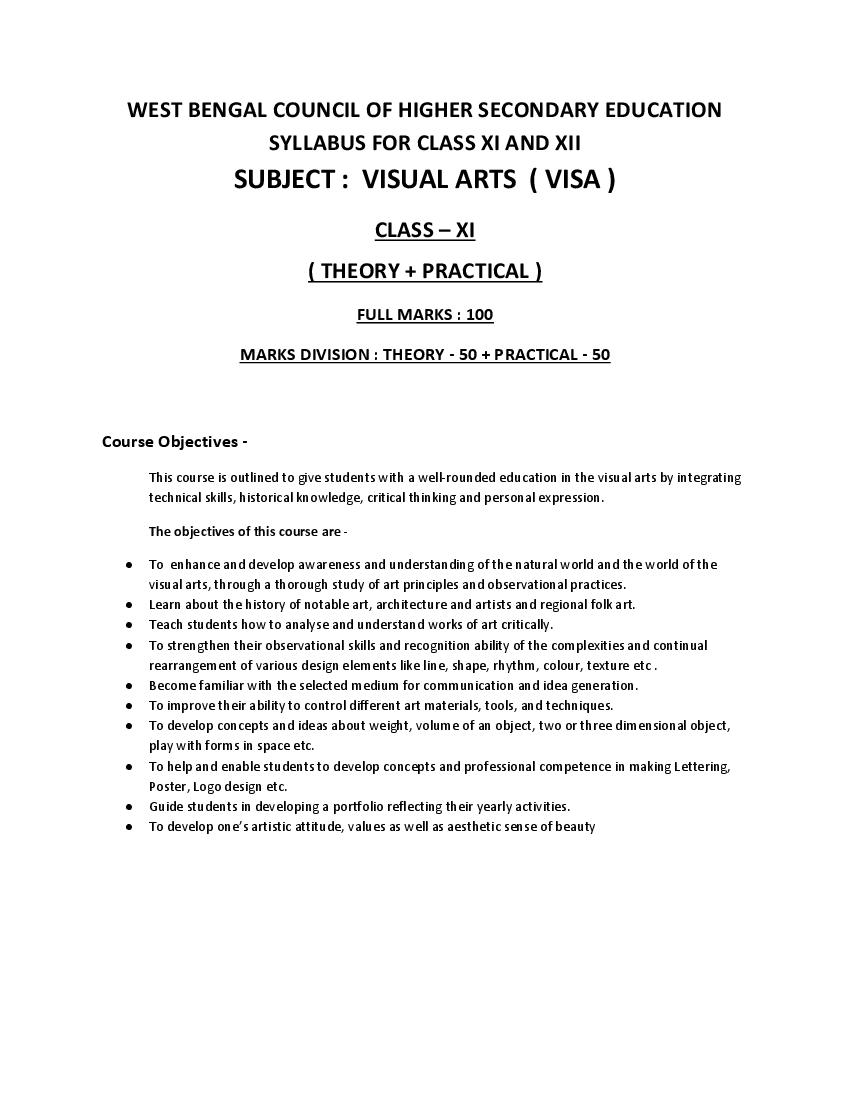
SYLLABUS FOR CLASS XI AND XII
SUBJECT : VISUAL ARTS ( VISA )
CLASS – XI
( THEORY + PRACTICAL )
FULL MARKS : 100
MARKS DIVISION : THEORY - 50 + PRACTICAL - 50
Course Objectives -
This course is outlined to give students with a well-rounded education in the visual arts by integrating
technical skills, historical knowledge, critical thinking and personal expression.
The objectives of this course are -
● To enhance and develop awareness and understanding of the natural world and the world of the
visual arts, through a thorough study of art principles and observational practices.
● Learn about the history of notable art, architecture and artists and regional folk art.
● Teach students how to analyse and understand works of art critically.
● To strengthen their observational skills and recognition ability of the complexities and continual
rearrangement of various design elements like line, shape, rhythm, colour, texture etc .
● Become familiar with the selected medium for communication and idea generation.
● To improve their ability to control different art materials, tools, and techniques.
● To develop concepts and ideas about weight, volume of an object, two or three dimensional object,
play with forms in space etc.
● To help and enable students to develop concepts and professional competence in making Lettering,
Poster, Logo design etc.
● Guide students in developing a portfolio reflecting their yearly activities.
● To develop one’s artistic attitude, values as well as aesthetic sense of beauty
Page 2
SEMESTER – I
SUBJECT : VISUAL ARTS ( VISA )
FULL MARKS : 20 CONTACT HOURS : 70 HOURS
COURSE CODE : THEORY
GROUP A - INDIAN AND WESTERN ART
UNIT No. TOPICS CONTACT MARKS
HOURS
Unit 1 Pre-historic Rock Painting 8 6
Indian Art ● Introduction to pre-historic cave painting in
India.
● Cave Paintings of Bhimbetka
Indus Valley Art
● Introduction to Indus Valley Art
● Sculpture - Dancing Girl, Priest, Mother Goddess 8
● Other artworks - Seals, Pottery, Toys and
Ornaments
Arts of Maurya and Sunga Period
● Introduction to Art during Mauryan and Sunga 9
Period
● Lion Capital of Sarnath, Bull Capital of Rampurva,
Capital of Lauriya Nandangarh, Elephant
Sculpture of Dhauli
● Yaksha and Yakshini sculptures of Bharhut
● Sanchi Stupa I, Bharhut Stupa(structure and
relief sculptures of gateways)
Unit 2 Pre-historic Art of Europe 8 6
Western Art ● Introduction to Pre-historic cave paintings of
Europe (Palaeolithic Age)
● Venus of Willendorf of Austria
● Altamira and Lascaux cave paintings
Egyptian Art and Architecture
● Introduction to Egyptian Art 8
● Great Pyramid of Giza- Structure and statue of
Sphinx
● Step Pyramid of Djoser
● Sculptures of Tutenkhamen, The Seated Scribe &
Nefertiti
● Wall Paintings of Pyramids
● Paintings of Papyrus
Page 3
HOURS
Greek and Roman Art
● Introduction to ancient Greek Art 9
● Greek Architecture- Parthenon Temple
● Greek Sculptures - Discobolus, Zeus of Olympia,
Athena of Parthenon, Doryphoros, Diadumenos,
Hermes of Praxiteles, Venus de Milo, Lacoon
Family, Nike of Samothrace
● Painting - Black and Red figure Vase Painting
● Roman Sculpture- Augustus from Prima Porta,
The Orator and Head of a Roman Patrician
GROUP B- CREATIVE HANDICRAFTS & DESIGN
UNIT No. TOPICS CONTACT MARKS
HOURS
Unit- 3 Clay Work 6 8
Creative
Handicrafts & ● Materials required for clay work
Design ● Preparation of clay
● Process of making clay sculpture
Traditional Clay Handicrafts of Bengal 8
● Dolls, Pottery, Toys, Idols etc.
Design
● Basic principles of design 6
● Introduction of Logo design
● Different types of Logo design
TOTAL 70 20
Page 4
SEMESTER – II
SUBJECT : VISUAL ARTS ( VISA )
Short and Descriptive Type Question & Answer
FULL MARKS : 30 CONTACT HOURS : 60 HOURS
COURSE CODE : THEORY
GROUP A - INDIAN AND WESTERN ART
UNIT No. TOPICS CONTACT MARKS
HOURS
Unit 1 Art of Mauryan Period 9 11
Indian Art ● Kushan Period- Introduction to Gandhara and Mathura
and Amaravati Art
➢ Amaravati Stupa
➢ Gandhara Buddha and Bodhisattva Sculptures,
Statue of Kaniska
➢ Seated Buddha and Katra Matura
● Gupta Period - Introduction of Art during the Gupta
Dynasty 9
➢ Ajanta Cave Paintings
➢ Seated Buddha Sculptures of Sarnath
Temple Sculptures and Architecture of Post-Gupta Period
● Introduction to Ellora Cave Temples; Kailashnath Temple
of Ellora 2
● Descent of Ganga (Pallava Period, Mahabalipuram and
7th Century AD)
● Sun Temple of Konark (13th Century)
Introduction to Indian Bronze sculpture
● Nataraja (Chola Period. 12th Century)
Unit- 2 Early Renaissance and Renaissance Period 15 10
Western ● Development of Art from Early Renaissance and
Art Renaissance Period
● Renaissance Art - Characteristic features and styles
● Artists and Artwork to be studied during these periods -
Artists Artwork
a. Giotto - Death of St. Francis
b. Botticelli - Birth of Venus
c. Van Eycks- - Ghent Altarpiece/
Adoration of the Mystic Lamb
d. Leonardo da Vinci - Monalisa & The Last Supper
e. Michelangelo - Pieta, Sistine Chapel Ceiling
Fresco
f. Raphael - Madonna Series 10
Page 5
HOURS
Baroque Art Movement
● Origin and Development of Baroque Art Movement
● Style and Characteristic Feature of Baroque Art
● Artworks to be studied -
➢ The Nightwatch by Rembrandt
➢ Girl with a Pearl Earring by Johannes Vermeer
➢ Ecstasy of Saint Teresa by Bernini
➢ The Elevation of the Cross by Rubens
GROUP B - CREATIVE HANDICRAFTS AND DESIGN
UNIT TOPICS CONTACT MARKS
No. HOURS
3 Wooden Work 15 9
● Materials needed for wooden work
● Different hand tools and equipment for wooden work
(with diagrams)
● Process of making wooden relief work
Wooden, cane and bamboo handicrafts of Bengal
TOTAL 60 30
Page 6
SUBJECT : VISUAL ARTS ( VISA )
COURSE CODE : PRACTICAL
FULL MARKS : 50 CONTACT HOURS : 50 HOURS
GROUP A- DRAWING & PAINTING
UNIT No. TOPICS CONTACT HOURS MARKS
1 Drawing 15 10
● Drawing from Nature such as trees, flowers, foliage,
fruits, vegetables, birds, animals, fish, human figures
etc. using pencil, dry pastel or pen and ink.
● Drawing Different Objects - cup & saucer, vase, jar,
glass, bottles etc.
● Drawing from Copy Book (Rupabali by Nandalal Bose)
2 Painting 20 15
● Study of still life or flowers or foliage or fruits or
vegetables or domestic or other artificial objects in
pastel & watercolour
● Painting Composition - Affairs from daily life (indoor &
outdoor), Games (indoor/outdoor), and Nature.
GROUP B- SCULPTURE, CRAFT AND DESIGN
UNIT TOPICS CONTACT MARKS
No. HOURS
1 ● Mask Making, Lettering (English & Bengali)& Logo 15 15
designing
Clay Modelling- Relief or Round (animal, bird, fish,
human figure etc.)
GROUP C - PORTFOLIO ASSESSMENT
UNIT TOPICS CONTACT HOURS MARKS
No.
1 Assessment of the entire year’s performance from —------------ 10
sketch to finished product
Note : No separate hour to be allotted for Portfolio Assessment since it will be a continuous evaluation as
mentioned in the syllabus.
Page 7
Group A - DRAWING & PAINTING
DRAWING
Draw from Nature such as fruits, foliage, vegetables, birds, animals or human figures or group of different
objects by pencil, pen –ink or dry pastel on a drawing paper of one fourth size. The drawings should be
proportionate to the size of the paper.
Draw from book Rupabali with exact measurement.
PAINTING
Draw and paint the still-life arranged on a place before you. Draw it from a fixed point of view on a
drawing paper of ¼ size using watercolour. The objects should be painted in realistic manner with proper
light and shade.
Make a composition on any of the following two subjects from the given syllabus on a 1/4 th drawing
paper. Use watercolour or poster colour for painting. Your composition should be original. Credit will be
given to a well composed drawing, proper use of medium, emphasis on the subject matter and utilisation
of full space.
Note: Drawing objects arrangement and selection of the subjects for composition to be decided by subject
teacher.
Group B-
Make a mask related with circus, different rituals or tribal dance from India or abroad by paper board and
poster colour. Decorate it with suitable materials.
Prepare a logo of any two FMCG products (packaged food items, snacks, soft drinks, cosmetics, laundry
detergents and cleaning agents)
Clay modelling must include basic human forms, birds, animals and vegetation in relief or round shapes.
Guidelines for Conducting Practical Examination
Instruction for the selection of the object for drawing and painting
A collection of artificial or natural things, which may include cut flowers, fruits, vegetables, growing
plants, domestic or other artificial items, human figures, birds, animals etc.
For still life one or two draperies (one in dark and other in light tone) must be included for background
and foreground.
Arrange necessary source of light for still life painting.
Page 8
syllabus.
Drawing papers should be provided by the examination centres. Other art materials like - colour, pencil,
board, and other necessary items to be carried by the examinee.
Instruction to decide the subject for sculpture, craft and design
Selection of subjects for design or clay modelling to be decided by the school from the topics mentioned
in the syllabus.
All necessary items (clay, board, colour etc.) to be carried by the examinee during the examination.
Group C- Portfolio Assessment
The entire year’s performance of the students from sketches to finished work to be evaluated.
Suggested Readings -
● Bharoter Chitrakala - Asoke Mitra ( 1st and 2nd part)
● Pashchim Europer Chitrakala- Ashoke Mitra
● Bageshwari Shilpo Prabandhabali- Abanindranath Thakur
● Shilpo O Shilpi- Krishnalal Das ( 1st, 2nd and 3rd part )
● Shilpe Bharat O Bahirbharat- Manindrabhushan Gupta
● Rupabali- Nandalal Bose
● Bharatiya Prachin Chitrakala- Surendranath Dasgupta
● Biswa Shilper Ruprekha - Mrinal Ghosh
● Shilpo Charcha - Atul Bose
● Ajanta Aporupa - Narayan Sanyal
● Bharat Shilpo - Nirmal Kumar Ghosh
● Cultural History of Ancient India - Jayanta Vyas
● The History of Indian Art- Sandhya Ketkar, Anil Rao
● The History of Western Art- Sandhya Ketkar
● A History of Fine Arts in India and the West – Edith Tomory
Page 9
SUBJECT : VISUAL ARTS ( VISA )
( THEORY + PRACTICAL )
Full Marks : 100
MARKS DIVISION : THEORY 50 + PRACTICAL 50
SEMESTER – III
FULL MARKS : 20 CONTACT HOURS : 70 HOURS
COURSE CODE : THEORY
GROUP A & B - INDIAN & WESTERN ART
UNIT No. TOPICS CONTACT HOURS MARKS
1 Miniature Paintings of India 12 6
Indian Art ● Introduction to Mughal Miniature Paintings in India
● Development & salient features of Mughal Miniature
Paintings during the reign of Samrat Akbar & Jahangir
● Notable artworks & artists of Mughal Miniature
Paintings during the reign of Samrat Akbar & Jahangir
● Rajput Miniature Painting - Introduction of Rajput
Miniature Painting
● Salient features & techniques, notable
artworks & artists of Rajasthani school of art
● Origin, salient features & techniques of Pahari
School of Art at Kangra, Basohli and Guler
● Ragamala Paintings - Introduction & characteristic
features with notable artworks
Temple Architecture of India
● Introduction to Hindu Temple Architecture
● Various styles of temple architecture - Nagara, Dravida
& Vesara style of temple architecture with examples
Terracotta temple of Bishnupur
● Origin, Structure & Terracotta relief sculpture of Jor-
Bangla Temple & Raas Mancha 7
Manuscript Painting of Bengal
● Pala Manuscript - Salient features, techniques &
notable paintings of the manuscript 6
Page 10
2 Romanticism, Realism & Impressionism 8 6
Western ● Origin & Development of Romanticism, Realism and
Art Impressionism art movement in Europe during 18th and
19th centuries.
Art works to be studied from these periods
17
John Constable a. The Hay Wain (1821),
b. Salisbury Cathedral from the
Meadows (1831)
William Turner a. The Slave Ship (1840)
b. Rain-Steam-Speed (1844)
Eugène Delacroix a. Orphan girl at the cemetery (1824),
b. Liberty leading the people (1830)
Francisco Goya a. The third of May 1808(1814)
b. Saturn Devouring his Son (1823)
Gustave Courbet a. The Stone Breakers (1849)
b. The Painter’s Studio (1955)
J.F Millet a. The Sower (1850)
b. The Gleaners (1857)
Claude Monet a. Impression Sunrise (1872)
b. The Waterlily Pond (1899)
Edouard Manet a. Olympia (1863),
b. The Fifer (1866)
Auguste Renoir a. Luncheon of the Boating Party (1881),
b. Two Sisters (1881)
Edgar Dega a. The Star - The Dancer on Stage (1878),
b. Little Dancer of Fourteen Years (1880)
Francisco Rodin a. The Thinker (1904)
b. The Gates of Hell (1917)
I.
J.F Millet a. The Sower (1850)
GROUP B - HANDICRAFTS, DESIGN AND SCULPTURE
3 Traditional Handicrafts of Bengal 8 8
● Solapith works, Jute works & Conch shell work
● Dashavatar Cards & Masks
● Nakshi Kantha, Silk and Tant sarees
● Alpana & Chalchitra
Plaster Casting
Materials needed for plaster casting
6
Process of plaster casting to make a mould
Poster Design
➢ Concept of poster, method and principles of poster
design 6
TOTAL 70 20
Page 11
SUBJECT : VISUAL ARTS ( VISA )
SEMESTER – IV
FULL MARKS : 30 CONTACT HOURS : 60 Hours
COURSE CODE : THEORY
GROUP A- INDIAN ART & WESTERN ART
UNIT No. TOPICS CONTACT MARKS
HOURS
1
Indian Art Traditional Art of Bengal 5 11
● Scroll Patachitra of Bengal
● Kalighat Patachitra
Bengal School of Painting
➢ Origin & Development of Bengal School of Art 7
➢ Contribution of Abanindranath Tagore & Nandalal Bose in
Indian Art
Modern Trends in Indian Art
● Critical Appreciation of Art Works created by the following 10
artists - Ravi Varma, Jamini Roy, Gaganendranath Tagore,
Rabindranath Tagore, Ramkinkar Baij, Amrita Shergil, Binod
Behari Mukhopadhyay, Debiprasad Roychowdhury &
M.F. Hussain
2 Post-Impressionism, Fauvism and Cubism Art movements in Europe
Western
Art ● Origin & Development & Salient Features
● Art Works to be studied during these periods - 8 10
Artists Art Work
Vincent Van Gogh a. Vase With Fifteen Sunflowers (1888),
b. The Starry Night (1889) 15
Paul Cezanne a. The Basket of Apples (1893)
b. The Card Players (1895)
Paul Gaguin a. Vision after the Sermon (1888)
b. Tahitan Women on the Beach (1891)
Georges Seurat A Sunday Afternoon on the Island of La
Grande Jatte (1886)
Henri Matisse a. The Open Window (1905)
Page 12
HOURS
b. The Dessert: Harmony in Red (1908)
Georges Braque Woman with a Guitar (1913)
Pablo Picasso a. Girl Before a Mirror (1932)
b. Guernica (1937)
GROUP B - HANDICRAFTS & DESIGN
UNIT No. TOPICS CONTACT MARKS
HOURS
3 Batik Design 7 9
g. Introduction to Batik Art
h. Origin & Development of Batik Design in India
i. Method, Materials and Principles of Batik Design
Traditional Handicrafts of India
● Pashmina of Kashmir
● Phulkari of Punjab 8
● Puppetry of Rajasthan
● Madhubani of Bihar
● Gond of Madhya Pradesh
● Dokra of West Bengal
● Bidri Craft Works of Karnataka
TOTAL 60 30
Page 13
SUBJECT : VISUAL ARTS ( VISA )
FULL MARKS : 50 CONTACT HOURS : 50 Hours
COURSE CODE : PRACTICAL
GROUP A - DRAWING AND PAINTING
UNIT No. TOPICS CONTACT HOURS MARKS
1 Drawing 15 10
➢ Drawing from architectures (buildings, houses,
boxes, almirah etc) showing perspectives with
soft pencil on paper.
➢ Drawing from Nature, landscapes, people,
animals, birds, flowers etc. with soft pencil on
paper.
2 Painting 15 15
Composition of a painting depicting any festival of India,
market or fair, street corner shop, fantasy or imagination
using pencil, pen & ink, oil pastels, watercolour or poster
colour or mixed media on paper.
GROUP B-CRAFTS AND DESIGN
UNIT No. TOPICS CONTACT HOURS MARKS
1 ● Decorative design on Art paper that will include 20 15
2 or 3 motifs suitable for T-shirt/saree/dress
material/bed sheet/carpet or any other form of
textile by poster colour Or Book cover design
● Painting pottery with poster / fabric colour
Or Make a poster on Social Awareness or
Environment using poster colour on paper.
GROUP C - PORTFOLIO ASSESSMENT
UNIT No. TOPICS CONTACT HOURS MARKS
1 Assessment of the entire year’s performance from sketch —---------- 10
to finished product.
Note: No separate hour to be allotted for Portfolio Assessment since it will be the entire year’s performance
as mentioned in the syllabus
Page 14
Group A( Drawing and Painting)
● Draw from nature, landscapes, people, animals, birds or groups of different things to form a
composition from daily life by pencil, pen–ink or dry pastel on a drawing paper of one fourth size. The
drawings should be proportionate to the size of the paper.
● Draw from architecture ( school building, houses, classroom, apartments from different points of view
like exterior view/interior view etc.), boxes, almirah, table, chair, benches etc showing proper
perspective by soft pencil on a 1/4th of full size art paper.
● Make a composition on any of the following two subjects from the given syllabus on a 1/4 th of full
size drawing paper. Use watercolour, poster colour or mixed media for paint. Your composition should
be original. Credit will be given to a well composed drawing, proper use of colour, emphasis of light
on the subject matter and utilisation of full space.
Group- B (Design)
● Make a design with two or three motifs suitable for T- shirt/ saree/ dress material/ bed sheet/ carpet
or any other form of textile by poster colour on art paper.
OR
Prepare a book cover ( front, back and spine) of a famous novel, story or poem book with suitable
illustration by watercolour, poster colour, pen-ink or mixed media on 1/4th of full size art paper.
● Decorate a clay pot with suitable motifs by poster or acrylic colour.
OR
Make a poster on any one of two specific subjects with a slogan from the syllabus by poster colour on
1/4th of art paper. Credit will be given to creativity, originality, emphasis on subject matter, composition,
proper utilisation of space, lettering and proper use of medium.
Group A
Instruction for the selection of the subject for drawing and painting
Life and Nature from our surroundings which may include plants, trees, gardens, animals, people or
groups of people to form a composition.
For perspective drawing, arrange/select necessary things like boxes,almirah, table, chair,bench etc. which
will be available inside the school premises or at the examination centre. For interior or exterior view of
any building or room, select the location inside or adjacent to the examination centre.
Drawing papers should be provided by the examination centres. Other art materials like - colour, pencil,
board and other necessary items to be carried by the examinee.
Page 15
Instruction to decide the subject for design
Instruction for design on clay pot and paper to be decided by W.B.C.H.S.E.
For creating a book cover, the examinee can choose any famous book they have read. The title and
author’s name should be mentioned.
Selection of the subjects for poster on social, environment or cultural issues to be decided by the
W.B.C.H.S.E.. The subject should be given according to Class XII standard.
All necessary items (clay pot, board, colour etc.) to be carried by the examinee during the examination.
The drawing papers should be provided by the examination centre.
Group C- Portfolio Assessment
The entire year’s performance of the students from sketches to finished work to be evaluated. Credit will be
given to creativity, originality, skills, technique, execution of composition, proper use of medium, experiment
quality etc.
General Instructions for Conducting Practical Examination
The duration for practical examination (excluding the break) will be of 4 hours
Each work of Groups A, B and C, after assessment is to be marked as “Examined” and duly signed.
Examinee will be able to take a break of 30 minutes after two and a half hours of examination.
Suggested Readings -
1. Bharoter Chitrakala - Asoke Mitra ( 1st and 2nd parts)
2. Paschim Europer Chitrakala- Ashoke Mitra
3. Bageshwari Shilpo Prabandhabali- Abanindranath Thakur
4. Shilpo O Shilpi- Krishnalal Das( 1st, 2nd and 3rd parts)
5. Shilpe Bharat O Bahirbharat- Manindrabhushan Gupta
6. Rupabali- Nandalal Bose
7. Bharatiya Prachin Chitrakala- Surendranath Dasgupta
8. Biswa Shilper Ruprekha - Mrinal Ghosh
9. Banglar Chitrakala- Ashok Bhattacharya
10. Darbari Shilper Swarup: Mughal Chitrakala- Ratnaboli Chattopadhyay
11. Paschimbanger Lokoshilpo O Shilpi Samaj- Tarapado Santra
12. Contemporary Art in India: A Perspective- Pran Nath Mago
Document Details
| Board / Org | West Bengal Board |
| Exam | Class 12 |
| Type | Syllabus |
| Pages | 15 |
| Updated | 22 Jul 2026 |