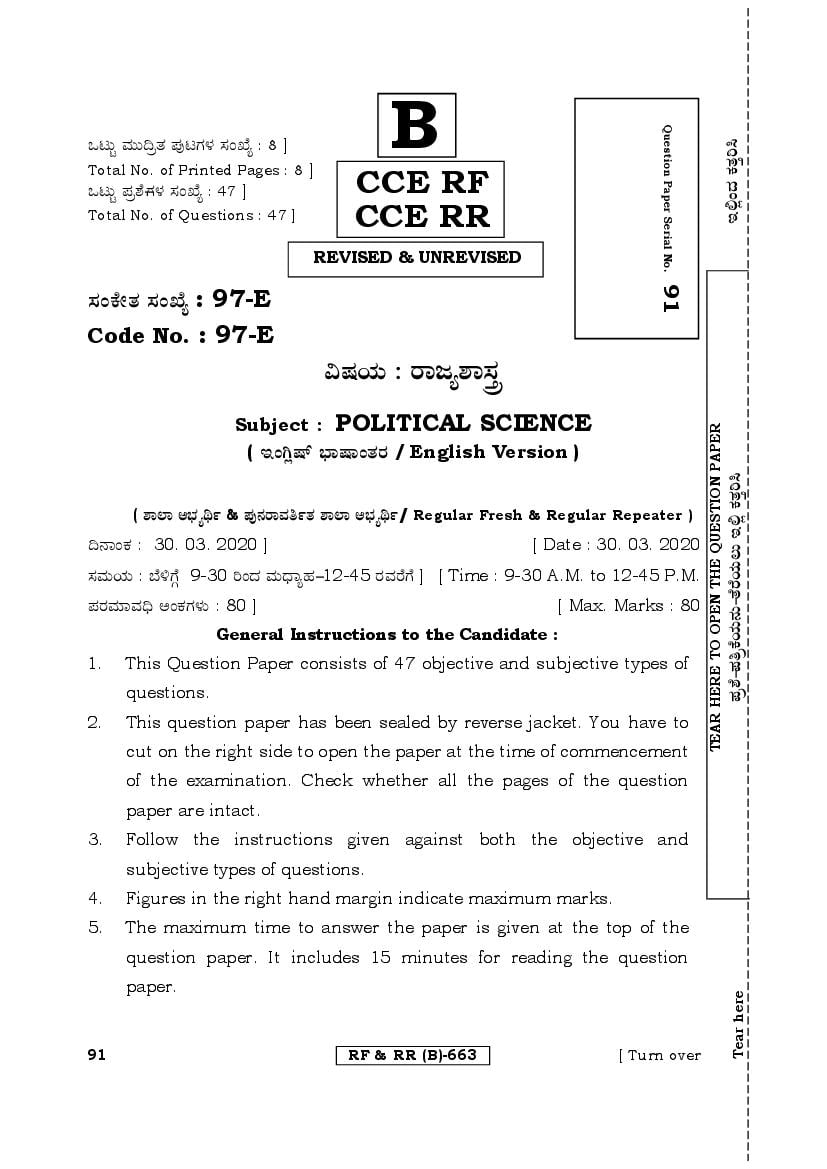
Karnataka SSLC Question Paper 2020 Political Science
Finished viewing? Save it for later —
Download Karnataka SSLC Question Paper 2020 Political Science (PDF · 8 pages)About Karnataka SSLC Question Paper 2020 Political Science
Karnataka SSLC Question Paper 2020 Political Science is available here for free download. Published by Karnataka Board for Class 10, this question paper can be viewed online or downloaded as a PDF (8 pages). Candidates preparing for Class 10 can use Karnataka SSLC Question Paper 2020 Political Science to understand the exam pattern, the type of questions asked, and the overall difficulty level.
Frequently Asked Questions
How can I download Karnataka SSLC Question Paper 2020 Political Science?
Open this page and click the Download button to save Karnataka SSLC Question Paper 2020 Political Science as a PDF. It is completely free on AglaSem Docs.
Is Karnataka SSLC Question Paper 2020 Political Science free to download?
Yes. Karnataka SSLC Question Paper 2020 Political Science can be viewed online and downloaded as a PDF free of cost on AglaSem Docs.
How many pages does Karnataka SSLC Question Paper 2020 Political Science have?
Karnataka SSLC Question Paper 2020 Political Science contains 8 pages, which you can read online or download together as a single PDF.
Where can I find more Class 10 study material?
You can find more Class 10 question papers, sample papers, syllabus, and answer keys on AglaSem Docs.
Karnataka SSLC Question Paper 2020 Political Science – Text
Read the full text of this question paper below — useful to quickly search, copy and reference the content online without downloading the PDF.
📄 View text version (8 pages)
Page 1
Question Paper Serial No.
Jlflo »⁄flfl¶√}⁄ Æ⁄‚¥lV⁄◊⁄ —⁄MSÊ¿ : 8 ]
BΔ«M•⁄ O⁄}⁄°¬“
Total No. of Printed Pages : 8 ]
Jlflo Æ⁄√ÀÊ-V⁄◊⁄ —⁄MSÊ¿ : 47 ] CCE RF
Total No. of Questions : 47 ] CCE RR
REVISED & UNREVISED
—⁄MOÊfi}⁄ —⁄MSÊ¿ : 97-E
91
Code No. : 97-E
…Œ⁄æ⁄fl : ¡¤d¿À¤—⁄°
Subject : POLITICAL SCIENCE
TEAR HERE TO OPEN THE QUESTION PAPER
( BMW«ŒÈ ∫¤Œ¤M}⁄¡⁄ / English Version )
Æ⁄√ÀÊ-Æ⁄~√OÊæ⁄fl´⁄fl-}Ê¡Êæ⁄flƒfl BΔ« O⁄}⁄°¬“
( À¤≈¤ @∫⁄¥¿£% & Æ⁄‚¥´⁄¡¤»⁄~%}⁄ À¤≈¤ @∫⁄¥¿£%/ Regular Fresh & Regular Repeater )
¶´¤MO⁄ : 30. 03. 2020 ] [ Date : 30. 03. 2020
—⁄»⁄flæ⁄fl : ∑ÊÿVÊX 9-30 ¬M•⁄ »⁄fl®¤¿‘⁄-12-45 ¡⁄»⁄¡ÊVÊ ] [ Time : 9-30 A.M. to 12-45 P.M.
Æ⁄¡⁄»⁄·¤»⁄© @MO⁄V⁄◊⁄fl : 80 ] [ Max. Marks : 80
General Instructions to the Candidate :
1. This Question Paper consists of 47 objective and subjective types of
questions.
2. This question paper has been sealed by reverse jacket. You have to
cut on the right side to open the paper at the time of commencement
of the examination. Check whether all the pages of the question
paper are intact.
3. Follow the instructions given against both the objective and
subjective types of questions.
4. Figures in the right hand margin indicate maximum marks.
5. The maximum time to answer the paper is given at the top of the
question paper. It includes 15 minutes for reading the question
paper.
Tear here
91 RF & RR (B)-663 [ Turn over
Page 2
I. Four choices are given for each of the following questions / incomplete
statements. Only one of them is correct or most appropriate. Choose the
correct answer and write the complete answer along with its letter of
alphabet. 10 × 1 = 10
1. The Chairman of Drafting Committee of Constitution of India was
(A) Dr. Babu Rajendra Prasad
(B) Jawaharlal Nehru
(C) Sardar Vallabhbhai Patel
(D) Dr. B. R. Ambedkar.
2. Preamble is a Yardstic of measuring the worth of constitution was
stated by
(A) Thakur Das Bhargava
(B) Sachidananda Sinha
(C) Bal Gangadhar Tilak
(D) K. M. Munsi.
3. The Government of Karnataka implemented the act of Right to
Education in the year
(A) 2011 (B) 2012
(C) 2013 (D) 2014.
4. As M.C. Chawla says, if the Directive Principles of State Policies are
literally implemented India becomes a
(A) developed country (B) heaven on this earth
(C) welfare state (D) sovereign country.
Page 3
5. The method of election of the President of India is borrowed from
(A) American Constitution
(B) British Constitution
(C) Irish Constitution
(D) South African Constitution.
6. The lower house of Britain is
(A) Lok Sabha (B) Federal Assembly
(C) House of Commons (D) House of Representatives.
7. The Supreme Court is situated at
(A) Bangalore (B) Kolkata
(C) New Delhi (D) Chennai.
8. The State Finance Bill should be first presented in
(A) Lok Sabha (B) Rajya Sabha
(C) Vidhan Sabha (D) Vidhan Parishad.
9. If the strength of a state's Vidhan Sabha is 150 then the strength
of its Vidhana Parishad
(A) 60 (B) 300
(C) 150 (D) 50.
10. Sabhas of Rigveda are related to
(A) Urban Administration
(B) Villages' Self Administration
(C) Marriage ceremony
(D) War pacts.
RF & RR (B)-663 [ Turn over
Page 4
II. 11. Match list ‘A’ with list ‘B’ and write it : 5×1=5
A B
a) The President i) Head of Supreme Court
b) The Vice President ii) Head of the state
c) The Prime Minister iii) Head of Rajya Sabha
d) Speaker iv) Head of the country
e) The Governor v) Head of Lok Sabha
vi) Head of Central Government
vii) Deputy Chairman of
Vidhana Parishad.
III. Answer the following questions in a sentence each : 15 × 1 = 15
12. What is a state without constitution according to Jellinek ?
13. Define Democracy.
14. Equality and Liberty are just like two faces of a coin. Why ?
15. What are the Directive Principles of State Policies according to
Granville Austin ?
16. Who dissolves Lok Sabha ?
17. Who appoints the Chief Justice of Supreme Court ?
18. What is the advisory power of Supreme Court ?
19. What are included in Vidhana Mandala ?
20. What is the strength of lower house of Karnataka ?
Page 5
21. Which is the method followed to remove the judges of High Court ?
22. What is the significance of Article 226 ?
23. Who is the father of local self-government ?
24. Where was Panchayat Raj System inaugurated in 1959 ?
25. What is the main objective of Production Committee of Gram
Panchayat ?
26. What is the term of members of Union Public Service
Commission ?
IV. Answer the following questions in about two to four sentences each :
14 × 2 = 28
27. The Act of 1935 is considered as a mile stone in constitutional
development. Why ?
28. What are the principles of secularism ?
29. What are the characteristics of fundamental rights ?
30. Every democratic country needs liberal principles. Substantiate.
31. Explain the role of socialist principles in providing social justice.
RF & RR (B)-663 [ Turn over
Page 6
32. Mention the qualifications required to be a member of Rajya
Sabha.
33. List out the functions of Supreme Court as court of records.
34. What are the executive functions of governor ?
35. How is a governor of a state appointed ?
36. Mention the financial powers of Vidhana Parishad.
37. Write the hierarchical order of the Revenue Court.
38. How are the Consumer Courts helpful to consumers ?
39. Who are the members of Zilla Panchayat ?
40. How can the members of Union Public Service Commission be
removed ?
V. Answer the following questions in about three to six sentences each :
6 × 3 = 18
41. What are the salient features of Indian Constitution ?
42. Name the fundamental rights assured in Constitution of India.
43. Gandhian principles aimed at allround development of our
country. Substantiate.
44. What are the Legislative powers of Rajya Sabha ?
Page 7
45. Article 32 is called as ‘Soul and heart of Constitution’. Why ?
46. Explain the functions of State Public Service Commission.
VI. Answer the following question in about eight to ten sentences : 1×4=4
47. Explain how the legislative organs controls central government.
RF & RR (B)-663 [ Turn over
Page 8
Document Details
| Board / Org | Karnataka Board |
| Exam | Class 10 |
| Type | Question Paper |
| Pages | 8 |
| Language | english |
| Updated | 22 Jul 2026 |