CBSE Class 10 Marking Scheme 2021 for Carnatic Music Vocal
Finished viewing? Save it for later —
Download CBSE Class 10 Marking Scheme 2021 for Carnatic Music Vocal (PDF · 7 pages)About CBSE Class 10 Marking Scheme 2021 for Carnatic Music Vocal
CBSE Class 10 Marking Scheme 2021 for Carnatic Music Vocal is available here for free download. Published by CBSE for Class 10, this sample paper can be viewed online or downloaded as a PDF (7 pages). Candidates preparing for Class 10 can use CBSE Class 10 Marking Scheme 2021 for Carnatic Music Vocal to understand the exam pattern, the type of questions asked, and the overall difficulty level.
Frequently Asked Questions
How can I download CBSE Class 10 Marking Scheme 2021 for Carnatic Music Vocal?
Open this page and click the Download button to save CBSE Class 10 Marking Scheme 2021 for Carnatic Music Vocal as a PDF. It is completely free on AglaSem Docs.
Is CBSE Class 10 Marking Scheme 2021 for Carnatic Music Vocal free to download?
Yes. CBSE Class 10 Marking Scheme 2021 for Carnatic Music Vocal can be viewed online and downloaded as a PDF free of cost on AglaSem Docs.
How many pages does CBSE Class 10 Marking Scheme 2021 for Carnatic Music Vocal have?
CBSE Class 10 Marking Scheme 2021 for Carnatic Music Vocal contains 7 pages, which you can read online or download together as a single PDF.
Where can I find more Class 10 study material?
You can find more Class 10 question papers, sample papers, syllabus, and answer keys on AglaSem Docs.
CBSE Class 10 Marking Scheme 2021 for Carnatic Music Vocal – Text
Read the full text of this sample paper below — useful to quickly search, copy and reference the content online without downloading the PDF.
📄 View text version (6 pages)
Page 1
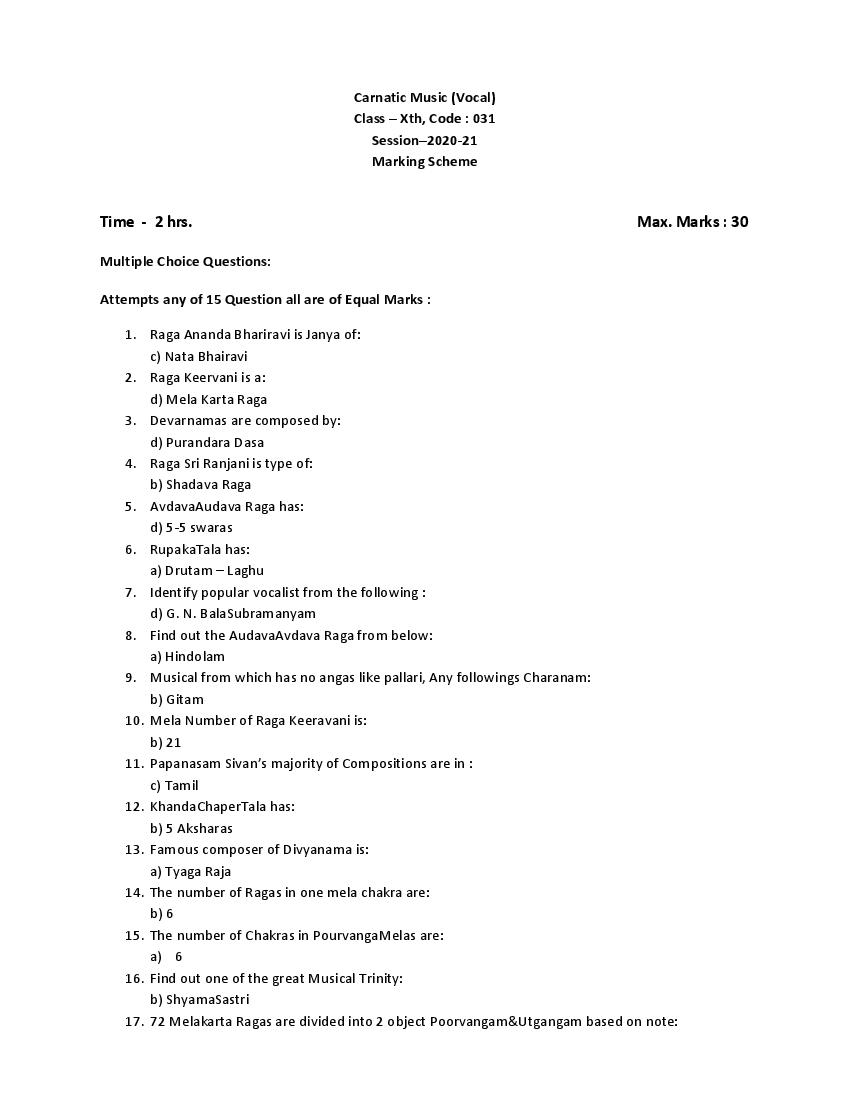
Class – Xth, Code : 031
Session–2020-21
Marking Scheme
Time - 2 hrs. Max. Marks : 30
Multiple Choice Questions:
Attempts any of 15 Question all are of Equal Marks :
1. Raga Ananda Bhariravi is Janya of:
c) Nata Bhairavi
2. Raga Keervani is a:
d) Mela Karta Raga
3. Devarnamas are composed by:
d) Purandara Dasa
4. Raga Sri Ranjani is type of:
b) Shadava Raga
5. AvdavaAudava Raga has:
d) 5-5 swaras
6. RupakaTala has:
a) Drutam – Laghu
7. Identify popular vocalist from the following :
d) G. N. BalaSubramanyam
8. Find out the AudavaAvdava Raga from below:
a) Hindolam
9. Musical from which has no angas like pallari, Any followings Charanam:
b) Gitam
10. Mela Number of Raga Keeravani is:
b) 21
11. Papanasam Sivan’s majority of Compositions are in :
c) Tamil
12. KhandaChaperTala has:
b) 5 Aksharas
13. Famous composer of Divyanama is:
a) Tyaga Raja
14. The number of Ragas in one mela chakra are:
b) 6
15. The number of Chakras in PourvangaMelas are:
a) 6
16. Find out one of the great Musical Trinity:
b) ShyamaSastri
17. 72 Melakarta Ragas are divided into 2 object Poorvangam&Utgangam based on note:
Page 2
18. Identify popular compose of Gitam from the following
d) Purrandara Dasa
19. Identify the Bhashanga Raga from the following
c) Bhairavi
20. Identify the string instrument from the following
d) Sitar
21. Identify the Raga with Vivadi note
d) Nattai
Part -B
Answer any Five Questions all question are equal marks 5x3 = 15
1. (a) Sriranjini : Raga Sri Ranjani is a Janya Raga. It is derived from 22 Melakarta Raga
Karaharapriya. Its:
Arohanam : SRGMDNS
Avarohanam : SNDMGRS
It is Shadava-Shadava raga takin sixdi both in ascending and descending order. It omits
Panchama. So it is also Varjya Raga. Besides Sadja it takes Chatusruti Rishabha and Chatusruti
Dhaivatam.
PRAYOGAM, GMDN – MDN – NDMDN – SNDMDN ‘’NDMDN” can be said ad Visesha Prayoga.
Musical Forms:
a. Saga Saga Mridanga – Tyagraja
b. Marubalka – Tyagraja
c. Sri Dum Durge – Muthuswami
d. Parvataraja Kumari – Tyagraja
e. GajaVadana – papanasam Sivan
(b) Raga Sudda Saveri : It is a janya raga derived from 29th Melakarta Raga Dhira
Sankarabharanam Its :
Arohanam : SRMPDS
Avarohanam : SDPMRS
It takes five notes both in Arohana & Avarohanam So It is Audava Audava raga.
It omits gandharv and rmishodam so it is Varjya Raga.
It Dikshitar school this raga is identified as Devakriya.
It Hindustani music it is identified with Raga Durga.
This raga is suitable for rendering at anytime of the day.
Musical Forms:
a. Darini Taluskkante – Tyagraja
b. Kalaharana – Tyagraja
c. Sri Gurugaha – Dikshita
d. Gitam – Analika
Page 3
are various types having different combinations of swaras like, Ragas having five notes only in
Arohana, Avarohana. They are identified as Audava-Audava.
Ragas having six notes in Arohana & six notes in Avarohana
Audava – Shadava & Vice Versa
Shadava – Audava
Ragas with 5 notes in Arohana & 7 Notes in Avarohana Audava Sampurna & Vice Versa.
Ragas with six notes in Arohana & 7 notges in Avorohana Shadava – Sampoorna &
Sampoorna Shadava.
The above are the varieties of Janya Raga.
Varjya raga also they are known because they leave are swara or two swaras. Janya Raga are
483 in total.
Example of Janya Raga
Raga Hansadwani
Raga Mohanam Audava – Audava
Raga Sri Ranjani – Shadava – Shadava
Raga Bhairav – Sampoorna Audava
(b) Janka Raga : Janka Raga are generic they are also known as Melakarta Raga. They are 72 in
number. Either ragas are generated fork only these 72 ragas. The are characterized by following
feature. They take seven notes taken in Arohana & Avarohana. The swaras alre found in same
order. They (Swara) should be in same request order and of homogeneous nature. They are also
known as sampoorna ragas. They are divided into two groups based on first 36 ragas based on
sad to not adhymama known as Poorvanga mela having six chakras. The second group of 36
Ragas basd on Prati Madhyam having six chakras identified as Uttarbanga Mela.
E.g. No. 15 Mayamalawagowla (Sudda Madhyam)
65 Mechikalyani (Prat Madhyamam)
3. Melakarta scheme gives a systematic approval to Janaka Ragas. They are 72 Ragas having seven
swaras both in Arohana and Avarohana in orderly manner. The swaras are of homogeneous
chakras & they are karma Sampoorna Ragas.
The Melakarta edivides the Rags into two parts; one, Poorvaganga based onSudda Madhyama
where 36 Ragas are basedon Sudda Madhyama are classified into six chakras. Each Chakra
having 6 Ragas. The chakras are Indu, Natra, Agni, Veda, Bana and Ritu.
Similarly 37 to 72 (36) Ragas are based on Prat Madhyama and are classified in Uttranga
chakras, each chakra certaining six ragas Poorvanga chakras are Rishi, Vasu, Brahma, Disi Rudra
and Aditya. The chakras are name of after number known as Bhuta Sankhya for eg. Indu first
chakras name refers to moon which is one fourth chakra’s has name is Veda which refers to four
Vedas.
Bun Poorvanga and Utranga ragas have Shadia Panchama and Madhyama as constant notes.
Variations are only in other notes rishabha gadhera dhaivati and aishade. This scheme is
scientifically formulated to know the scale of all Sudda madhyam & Prat madhyama based
Melakarta Ragas.
Page 4
endowed with excellent mesmerizing voice and very good looks. His style of unique in the music
world. He had established a distinguished “bani” or style which is followed by so many
musicians.
His father was G.V. Narayanaswamy and mother Visalam. He was born on 6 th July 1910 both his
parents could sing. He hailed from Gudalur and moved to Chennai. He was the first musicians to
have graduated from Presidency College of Madras in English literature. He was also talented in
singing classical music. His initial Gurus wer Madurai Subramania Iyer and Guruswamy
Bhagavatar.
His first concert was at the age of 18. His voice was powerful voice with fall of brigas and so rich
that he exhibited his effort less renderings of raga and reaching all its highest octave with ease.
He had mastery of rendering ragas. Tanam, Palalvi. He had joined Madras Music Academy in
1929. 1942 He received “sangeetha kalanidhi” Title In 1959 he received Presidential award from
Dr. S. Radha Krishnan.
He was fortunate is have accompanist all senior vidwans like Kumbokomam Raja manickan Pillai,
T Choudagga in Violin and Palghat Mani, Palani Subramania Pillai, Muruga Bhopathy & in Juniors
halgudi Jayarawan and Palghat Mani.
He had acted infew films which became hits only because of his songs. He had paired with the
renowned Vocalist M.S. Sabbulakshmi Shakuntalam Vasava dutta, Bhama Vijayam and Seth
Sawariya.
He was staunch devote of Daity Srividhya and a agreat composer of many varnams and kritis in
rare raga like Siva Sakthi.
He had lieft a host of disciples renowned were ML Vasanthakumari, TR Balu, Kalyanarama,
Trichur Ramachandran and many others.
Papanasam Sivan : Papanasam “Ramayya: Sivan was a Prominent Vocalist Musicians and a great
composer. Hew was born on 26.09.1890 in POLA GAM, Tanjere Dish. Hew was basically a film
music composer in Kannada language for about 10 years. Later became a great composer of
Tamil Kritis: he had studied Sanksrit from Travancore College. He has composed songs in
Sanskrit also.
His Parents were Ramamsitha Iyer and mother Yogambal. He was a great devote of Lord Shiva;
Every day he used to sing in the temple with full fernier and emotions that people used to call
him papanasam sivan. He had learnt Carnatic music from Noorani Mahadeva Bhagwathar and
Karamana Nella Kanta Desar Kerela. After his parents demise; he shifted Madras and so was
devoted to Mylapore Kapoleswaran (Ghiva Manifestation)
His osngs were simple and handle by common people. They were popularized through films by
D.K. Pattammal, M.K. Tyagraja Bhagwathar, D.K. Jayaraman.
He used to Participate in Tiruvaiyyaru and Nagapattinam temples every year Sapta Janam
Festival. He sang his over compositions and were applauded by people.
He had also acted in few films like Bhakta kuchela, Tyaga Bhoomi, Bhakta Cheta, Kubao kuchala.
They were all hit because of his songs. He was awarded sangeetha kala ardhi in 1970 by
Madaras Music academy. He died in 1.10.1973 when he wa 83; 1962-He was awarded Isai
Perarignar. He is survived by his daughter Neela Ramamurthy and Dr. Rukmani and Son krita
Vasan Sivan and Grandson Ashok Ramani. They also are musicians.
Page 5
Arohana Avarohana or in Avarohanana. They can be Shadava-Shadava six notes both Arohna
and Avarohana Example Sri Ranjani Raga
S rg m d m s–s n d m g r s
Shadava Audava : Arohana six notes Avarohana five notes
Example : Raga Bahudani - s g m p d n s - s n p m g s
Audava – Shadavam : Arohana five notes and Avarohana six notes
Example : s r g p d s – s n d p g r s
Sampoorna Shadavam:
Arohanam – all seven notes
Avaro – Ranam – Six notes
Ragam Bhairavam:
srgmpdns–sdpmgrs
Shadava Sampoorna :
Six notes in Arohana
Seven notes in Avarohana
Ragam Bhushaval
Srgmpds
smdpmgrs
(b) Audava Raga : Ragas which have five nots ineither Arohana or Avarohana or both the
variations can be Audava Audava, Audav Shadav, Audava Sampoorna.
Shadava – Audava, Sampoorna Audava
E.g. Mohanam s r g n d s
Raga sdpgrs
Audava Shadava 5 notes in Arohana 6 notes in Avarhona
Example Ragan Bowli s r g p d s
rndpgrs
Shadava Audava six notes in Arohana & five notes in Avarohana
Example:
Bahudari Raga : s g m r d n s
snpmgs
Audava Sampoorna five notes in Arohana six notes in Avarohana
Example:
Saveri: srmpds
sndpmgrs
& Sampoorna Audava
6. Ragan Mohanam Talam
th
(28 Melajanyam) Rupa Kam (Chathusra Jaathi)
Arohana s r2 g2 p2 d s Avrohana s d2 p g2 R2 s
G G ! P, P, !! D P ! S, S, !!
va ra ! vee na !! moo du Pa ni !!
R S ! D D, P, !! D P ! G G R, !!
va ma ! ru ha lo !! Cha na ! ra ni !!
Page 6
su nu ! chirapan !! ba ra ! ve ni !!
G P ! D S, D, !! D P ! G G R, !!
su ru ! chirapan !! ba ra ! ve ni !!
G G ! D P, G, !! P G ! G R S, !!
su ra ! mu tha kal !! ya . ! . . ni !!
G G ! G G, R, G !! P G ! P P !!
ni ru ! pa ma su bha !! gu na ! to ta !!
G G ! D P D !! D P ! S S !!
ni ra ! tha ja ya !! pra da ! see ta !!
D G ! R R S S !! D S ! D DD P !!
va ra ! da . pri ya !! Ran ga ! na ya ki !!
G P ! D S D P !! D P ! G G R S !!
va ! nehi tha phala !! da . ! . . ya ki !!
S R ! G . G !! G R ! P G R. !!
sa ra ! si . ja !! sa na ! Ja na ni !!
S R ! S G R S !! G R ! S S. !!
Ja Ya ! Ja Ya Ja Ya !! Ja ya ! va ni !!
7. Musicians have enriched the compositions with various decorative features which have added
to the beauty of the kriti. The decorative features can be sangathis with raga bhava, use of (1)
swara kshara (2) Chittai swara, (3) Swara Sahitya (4) Kattu Swara (5) use of gati (6) Prasa, (7)j
Mudras (8) Gamkas.
Swarakshara : It is highly intellectual attempt to use swara as representing word.
Tyagraja raga : Nee Bhakti Bhagya Jayanandan
Tyagraja raga : Sri Rama Padama (Feet)
PA DA MA
Invarnam PA DA SA
Pa da saroga (Navragamalika Varnam)
Chitta Swara: Walaja Krishna swamy Bhagvatar had added chitta swara to Tyagraja’s Sobhilla
Sapta swara Raga Jagan Mohini.
Patnam Subramaniya Iyeris “Raghuvamsa Sudha” in Raga Kadana Kudugalan by Chitta Swara
was given by Tiravaiyaru Subramaniya Iyer
Madhyamakala Sahitya : This is where composition in normal speed & the saityan in
Madhyamakala is added to improve the lustra of the kriti. Muthuswami Dikshitar kriti mostly
comprise this aspect.
Document Details
| Board / Org | CBSE |
| Exam | Class 10 |
| Type | Marking Scheme |
| Pages | 7 |
| Updated | 30 Apr 2026 |