Kerala Class 10 First Term Question Paper 2025 Biology
Finished viewing? Save it for later —
Download Kerala Class 10 First Term Question Paper 2025 Biology (PDF · 6 pages)About Kerala Class 10 First Term Question Paper 2025 Biology
Kerala Class 10 First Term Question Paper 2025 Biology is available here for free download. Published by Kerala Board for Class 10, this question paper can be viewed online or downloaded as a PDF (6 pages). Candidates preparing for Class 10 can use Kerala Class 10 First Term Question Paper 2025 Biology to understand the exam pattern, the type of questions asked, and the overall difficulty level.
Frequently Asked Questions
How can I download Kerala Class 10 First Term Question Paper 2025 Biology?
Open this page and click the Download button to save Kerala Class 10 First Term Question Paper 2025 Biology as a PDF. It is completely free on AglaSem Docs.
Is Kerala Class 10 First Term Question Paper 2025 Biology free to download?
Yes. Kerala Class 10 First Term Question Paper 2025 Biology can be viewed online and downloaded as a PDF free of cost on AglaSem Docs.
How many pages does Kerala Class 10 First Term Question Paper 2025 Biology have?
Kerala Class 10 First Term Question Paper 2025 Biology contains 6 pages, which you can read online or download together as a single PDF.
Where can I find more Class 10 study material?
You can find more Class 10 question papers, sample papers, syllabus, and answer keys on AglaSem Docs.
Kerala Class 10 First Term Question Paper 2025 Biology – Text
Read the full text of this question paper below — useful to quickly search, copy and reference the content online without downloading the PDF.
📄 View text version (6 pages)
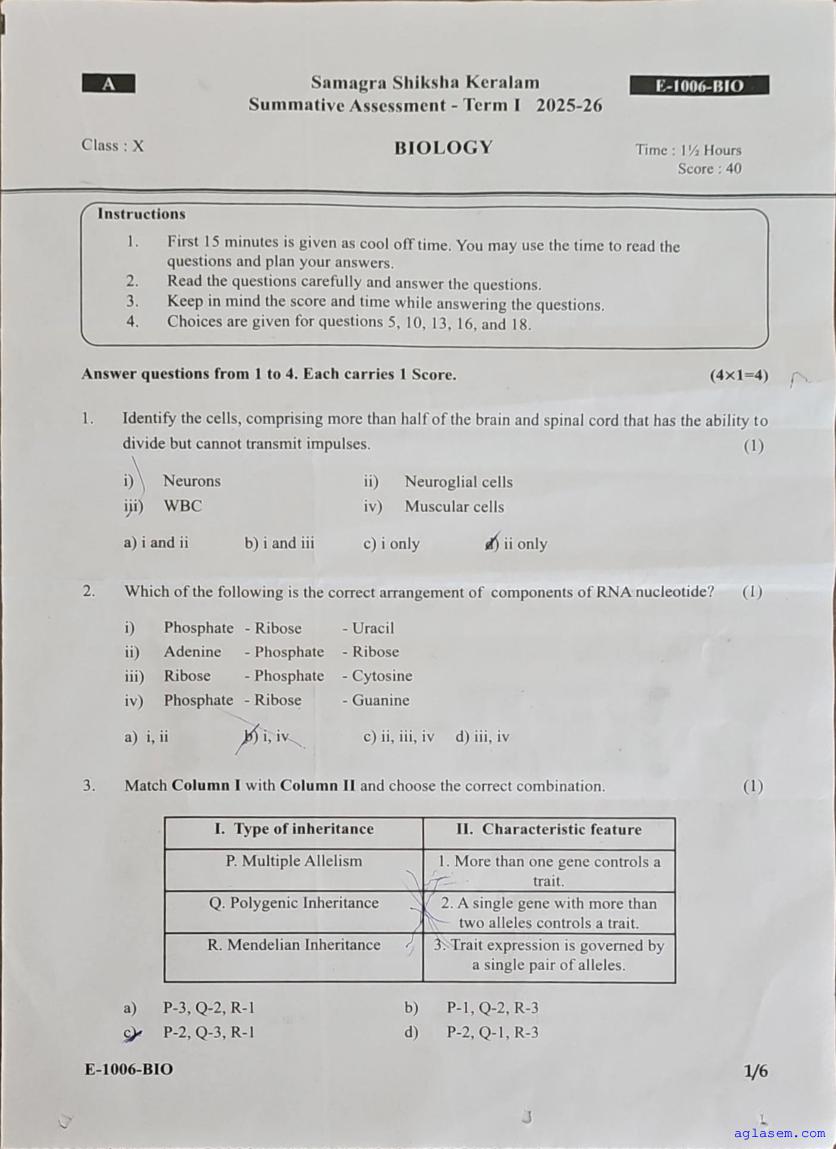
Page 1
Summative Assessment - Term 1 2025-26
Class : X BIOLOGY Time: Hours
Score : 40
Instructions
First 15 minutes is given as cool off time. You may use the time to read the
questions and plan your answers.
2. Read the questions carefully and answer the questions.
3. Keep in mind the score and time while answering the questions.
4. Choices are given for questions 5, 10, 13, 16, and 18.
Answer questions from 1 to 4. Each carries 1 Score.
1. Identify the cells, comprising more than half of the brain and spinal cord that has the ability to
divide but cannot transmit impulses. (l)
i) Neurons ii) Neuroglial cells
i)i) WBC iv) Muscular cells
a) i and ii b) i and iii c) i only ii only
2. Which of the following is the correct arrangement of components of RNA nucleotide? (l)
i) Phosphate - Ribose - Uracil
ii) Adenine - Phosphate - Ribose
iii) Ribose - Phosphate - Cytosine
iv) Phosphate - Ribose - Guanine
a) i, ii c) ii, iii, iv d) iii, iv
3. Match Column I with Column Il and choose the correct combination. (1)
I. Type of inheritance Il. Characteristic feature
P. Multiple Allelism I. More than one gene controls a
trait.
Q. Polygenic Inheritance 2. A single gene with more than
two alleles controls a trait.
R. Mendelian Inheritance BYTrait expression is governed by
a single pair of alleles.
a) P-3, Q-2, R-1 b) P-1, Q-2, R-3
d) P-2, Q-1, R-3
E-1006-BIO 1/6
Page 2
change in the bactcrin cnuscd this?
n) Over production Mutations c) Translation d) Speciation
Answer questions from 5 to ll. Ench carricq 2 Score. (7/2—14)
Observe the illustration of nuclcic acid strands and answer thc qucquong.
Q
a) Which one is the strand of DNA? Why? (l)
b) Write the nitrogen bases in this strand and pair them with their complementary
bases. (1)
OR
B) Observe the illustration related to a process causing variation and answer the questions.
a) Write any two causes of the process illustrated. (1)
b) This process plays a major role in evolution. How? (1)
6. Read the statement and answer the questions.
Synapses transmit nerve impulses between neurons and regulate
their direction and speed.
a) Identify the chemical substance involved here. (1)
b) Explain how the unidirectional transmission of impulses at a synapse is ensured. (1)
E-1006-BIO
Page 3
a) Identify the part illustrated and write how it is protected?
b) Based on its function, explain how damage to it affects the body? (1)
Explain DNA packaging in a cell with necessary additions to the given information. (2)
Histone Octamer Chromosome Histone
9. Neo-Darwinism addressed limitations in Darwin's theory by incorporating new scientific
discoveries.
a) What was the limitation? (l)
b) How did the concepts about genes and chromosomes help to overcome this
limitation? (l)
A) The fossil of Archaeopteryx is a milestone in evolutionary studies.
a) What evidence does it provide for supporting evolution? (1)
b) Mention another evidence from fossil studies. (1)
OR
B) One of the factors that influenced Charles Darwin to formulate the theory of evolution
was diversity in the beaks of finches on Galapagos Islands.
How did this variation help in the development of new species of finches?' (2)
ll. Read the statement and answer the questions.
The cerebral cortex of the human brain is modified into a complex neocortex.
a) Write any two advanced mental processes enabled by this brain development. (1)
b) Imagine a person stops learning new things. How would this affect their neocortex
over time? Justify your answer. (1)
E-1006-BIO 3/6
Page 4
I Observe the illustrntion nnd answer the questions.
x
z z
a) Identify 'P' and write how is it formed?
b) How docs the subsequent process lead to variation? (2)
13. A) Redraw the diagram. Label the parts correctly if there is any mistake and write their
tUnction. (3)
i) Cerebrum
ii) Thalamus
OR iii) Midbrain
Observe the illustrations and answer the questions.
Stimulus
X- Before stimulation Y- Stimulated neuron
a) Draw illustration 'Y' including the distribution of charges. (1)
b) How does this change help in the transmission of impulses? (2)
Analyse the situations and answer the questions.
Observation of farmer :
Red x White flowers —+Pink flowers
Black x White cattle —+Offspring with roan coat
a) Identify the specific patterns of inheritance demonstrated in the plant and the cattle
respectively. (1)
b) Differentiate between these two patterns of inheritance. (2)
E-1006-BIO 4/6
Page 5
and answer the question.
Explain this on the basis of Danvin's theory of natural sclcction. (3)
6. A) Analyse the statelnent and answer the questions.
llumnn beings have 23 pairs of chromosomes of which onc sct is inherited
from mother and other from thc fathcr.
a) How can you classify these chromosomes based on function?
b) Is the 23rd pair of chromosome same in all individuals. Explain? (2)
OR
B) Observe the illustration related to protein synthesis and answer the questions.
(X)
DNA > mRNA
a) Identify the stages indicated as 'X' and 'Y'
RNAs are essential for this process? Explain based on their functions. (2)
17 Observe Illustration of evolutionary tree and answer the questions.
Bacteria
Bacteria
Arc
Archaea
Protista
Plantae
Fungi
Hints : —LUCA o MRCA Animalia
a) Which domain shares a common ancestor with Eukarya? (1)
b) Which are the recently evolved kingdoms in Eukarya? (1)
c) How aré the kingdoms mentioned in the illustration related to LUCA? (1)
E-1006-BIO 5/6
Page 6
18. A) Observe the illustration of monohybrid cross and answer thc qucstions.
Jinrcnt J'lnnts
(Round seed) (Wrinkled sccd)
Gnmctcs
a) What are the alleles that control seed shape? (l)
b) Write the phenotype and genotype of Fl.
c) Illustrate the hybridization of the Fl generation with wrinkled seed plant. (2)
OR
B) Observe the illustration of dihybrid cross considering height of the plant and shape of
the seed and answer the questions.
Parent Plants
TTRR x
(Tall, Round seed) (Dwarf, wrinkled seed)
Gametes
tr
Fl ..
a) Fill in (i) and (ii). (1)
b) Are there any new traits appearing in the second generation that were not seen in the
parents? Why? (1)
c) Why are plants with traits like dwarfness and wrinkled seeds less frequent in the F2'
. generation compared to others? (2)
E-1006-BIO 6/6
Document Details
| Board / Org | Kerala Board |
| Exam | Class 10 |
| Type | Question Paper |
| Pages | 6 |
| Updated | 24 Sep 2026 |