Kerala Class 10 First Term Question Paper 2025 Maths
Finished viewing? Save it for later —
Download Kerala Class 10 First Term Question Paper 2025 Maths (PDF · 14 pages)About Kerala Class 10 First Term Question Paper 2025 Maths
Kerala Class 10 First Term Question Paper 2025 Maths is available here for free download. Published by Kerala Board for Class 10, this question paper can be viewed online or downloaded as a PDF (14 pages). Candidates preparing for Class 10 can use Kerala Class 10 First Term Question Paper 2025 Maths to understand the exam pattern, the type of questions asked, and the overall difficulty level.
Frequently Asked Questions
How can I download Kerala Class 10 First Term Question Paper 2025 Maths?
Open this page and click the Download button to save Kerala Class 10 First Term Question Paper 2025 Maths as a PDF. It is completely free on AglaSem Docs.
Is Kerala Class 10 First Term Question Paper 2025 Maths free to download?
Yes. Kerala Class 10 First Term Question Paper 2025 Maths can be viewed online and downloaded as a PDF free of cost on AglaSem Docs.
How many pages does Kerala Class 10 First Term Question Paper 2025 Maths have?
Kerala Class 10 First Term Question Paper 2025 Maths contains 14 pages, which you can read online or download together as a single PDF.
Where can I find more Class 10 study material?
You can find more Class 10 question papers, sample papers, syllabus, and answer keys on AglaSem Docs.
Kerala Class 10 First Term Question Paper 2025 Maths – Text
Read the full text of this question paper below — useful to quickly search, copy and reference the content online without downloading the PDF.
📄 View text version (7 pages)
Page 1
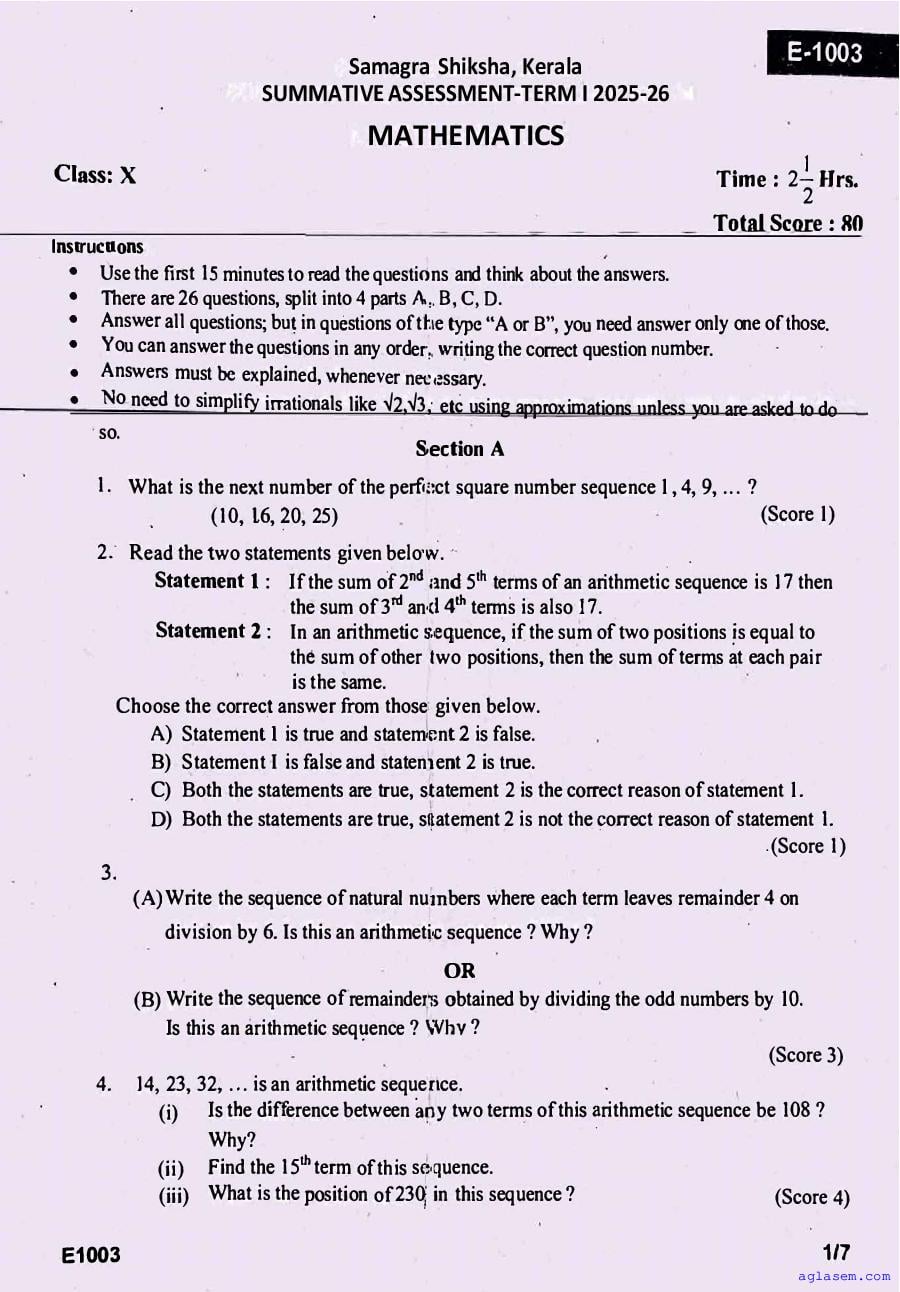
SUMMATIVE ASSESSMENT-TERM I 2025-26
MATHEMATICS
Class: X Time: 2_!_ ff rs.
2
TotalScru:.e : 80
Instructions
• Use the first 15 minutes to read the questions and think about the answers.
• There are 26 questions, split into 4 parts A,. B, C, D.
• Answer all questions; bu! in questions of the type "A or B", you need answer only one of those.
• You can answer the questions in any order·1, wri�ing the correct question number.
• Answers must be explained, whenever nec,essary.
• No need to simplify irrationals like ✓2,✓3,· etc using approximations unless you are asked
to do
so.
Section A
1. What is the next number of the perfo:ct square number sequence I, 4, 9, ... ?
(10, l6, �O, 25) (Score I)
2.. Read the two statements given belo·w. · .
Statement 1: If the sum o'f 2 and 5 terms of an arithmetic sequence is 17 then
nd th
the sum of 3rd and 4th terms is also 17.
Statement 2 : In an arithmetic &�,equence, if the sum of two positions �s equal to
the sum of other two positions, then the sum of terms at each pair
is the same.
Choose the correc� answer from those: given below.
A) Statement l is true and statem,ent 2 is false.
B) Statement I is false and staten1ent 2 is true.
C) Both the statements are true, statement 2 is the correct reason of statement I.
D) Both the statements are true, s1�atement 2 is not the 9orrect reason of statement 1.
. (Score 1)
3.
(A) Write the sequence of natural nu1nbers where each term leaves remainder 4 on
division by 6. Is this an arithmeti.,c sequence ? Why ? ·
OR
(B) Write the sequence of remainden, obtained by dividing the odd numbers by IO.
Is this an arithmetic seql;)ence ? \Vhv ?
(Score 3)
4. 14, 23, 32, ... is an arithmetic sequence.
(i) Is the difference between apy two terms of this �rithmetic sequence be 108?
Why?
(ii) Find the 15th term of this se\,quence.
(iii) What is the position of 230/ in this sequence ? (Score 4)
E1003 1/7
Page 2
A. The 4th tenn of an arithmetic sequence is :51 and the 6th term is 45.
(i) What is the 5th tenn ?
(ii) What number is to be added to the :.5th tenn to get its first term ?
(iii) Write the first three tenns of this sequence.
OR.
B. The sum of first 7 tenns of an arithmetic sequence is 133 and the sum of first 14
tenns is 511.
(i) What is the 4th term ?
(ii) What is the 11 th term ?
(iii) \\'rite the first three terms of this :',equence.
(Score 4)
6. The 5th tenn of an arithmetic sequence is 42 and its 8th term is 62.
(i) Find the 2nd term.
(ii) What is the 14th term ?
(iii) Calculate the sum of first 18 terms.
(Score 5)
Section B
7. , of a square
When each side • was reduced by 2 centimetres to make a smaller square, its
area became 81 squart: centimetres.
What was the length of a side of the original square ?
(7, 9, 11, I 3) (Score 1) ,
8. · The algebraic form of an arithmetic sequence is Sn+ 2 . What is its first tenn?
(2, 5, 7, 10) (Score 1)
9. Prove that the arithmetic sequence 6, IO, 14, ... does not contain any perfect square.
(Score 3)
10. The product of'two consecutive multiples of 4 is 672.
(i) Form a second degree equation based on the given statement.
(ii) What are the numbers ?
(Score 3)
2
11. The sum of the first n terms of an arithmetic sequence is 3n + 2n .
(i) , Write the first term.
(ii) What is the sum of first two terms?
(iii) Find the nth term of the sequence.
(Score 4)
E1003
2/7
Page 3
(A) A vegetable garden is in the shape of a rectangle. Its larger side is 8 metres longer than
the smaller side. Area of this garden is 180 square metres.
(i) Form a second degree equation based on the given data.
(ii) Find the sid~s of this rectangle.
OR
(B) One of the perpendicular sides of a right triangle is 2 centimetres more than the other.
The area of the right triangle is 24 square centimeters. Form a second degree equation.
Find the lengths of the sides of the right triangle.
(Score 4)
13. Consider the sequence of all three digit numbers which are multiples of 7.
(i) Find the first and last terms of this sequence.
(ii) How many terms are there in this sequence?
(iii} Find the sum of all terms of this sequence.
(Score 5)
14.
(A) (i) Calculate the sum of first 30 natural numbers.
(ii} Calculate the sum of first 30 natural numbers, which are multiples of 4.
(iii} Calculate the sum of first 30 terms of the sequence obtained by multiplying
the nanµ-al numbers by 4 and them adding 1. Calculate the sum of first n
terms of this sequence.
OR
(B} (i) Write the algebraic form of sum of first n terms of the arithmetic sequence
11, 13, 15, ...
(ii) How many tenns of this sequence starting from the first, is to be added to get
the sum as 600?
(Score 5)
Section C
t 5. A person is asked to say a number from the first 10 natural numbers.
(i) The probability for the number to be add is !
2
2
(ii) The probability for the number to be a multiple of 3 is
3.
. . 2
(iii) The probability for the number to be a pnme 1s
5.
..r. . 1
(iv) The probability for the number to be a peuect square as
4
A) (i) and (ii) are true.
B) (i) and (iii) are true.
C) (ii) and (iii) are true.
D) (iii) and (iv) arc true. (Score l)
E1003 3n
Page 4
repeating the digits. If one number is taken frotn this, what is the probability that the
number is greater than 500.
(Score I)
17.
Game Board I Game Board 2
In the figure, there are two game boards, where the small squares are all equal in size.
Playing by putting dots on each game board without looking into it. The game is won if
the dot is placed in the shaded part.
(i) What is the probability to win, if playing in the first game board ?
(ii) Playing with which game board gives better chance to win ?
(Score 3)
18. In the figure, a circle with centre C is divided in to 3 sectors: A dot is placed in the circle,
without looking into the circle.
(i) What is the probability that the dot is in the sector
with central angle 60°.
(ii) The probability that the dot is placed in the sector
4
with central angle x0. is 9 . What is x ?
(iii) What is the probability that the dot is in the shaded
region?
(Score 4)
19.
(A) Every two digit number less than 30 are written in slips of paper, and all the slips are
put in a box. If one slip is drawn,
(i) What is the probability that this number is a multiple of 5 ?
(ii) Write in decimal fonn, the probability that the sum of the digits being 5. .,
(iii) What is the probability that the sum of the digits being a perfect square ?
OR
E1003 4/7
Page 5
beads and 25 white beads. If one bead ·is taken from each box, then
(i) What is number of possible pairs?
(ii) What is the probability of both being black?
(iii) What is the probability of getting at least one white?
(iv) What is the probability of one being black and the other being white?
(Score 5)
Section D
20. In each of the figures below, three angle measurements are given. In which figure, all the
three angles are marked with the correct measurement?
A B C D
(Score I)
21 . Read the two statements given below.
Statement 1: In the figure O is the centre of the circle
· and PQ is a chord.
LPRQ =50°, LPSQ =50°
Statement 2: Angle in a semicircle is·90°.
Choose the correct answer from those given below.
A) Statement l is true and statement 2 is false.
B) Statement l is false and statement 2 is true.
C) Both statements are true and statement 2 is the reason of statement I.
D) Both statements are tiue and statement 2 is not the reason of statement l.
(Score l)
E.1003 sn
Page 6
22. In the figure, A, B, C, D, P are the points on the circle
with centre 0.
LAOB = •130°
(i) Find L ADB.
(ii) Find L BDC.
(iii) Find L BPC.
(Score 3)
23.
(A) ln the figure, centres of circles are
C and 0 . Circles intersect at P and R.
LPQR =70°
(l.) LPOR = ............
Q s
(ii) LPSR = ............ .
(iii) LPCR = ........... ..
OR
(B) In the figure (C, 0 are the centres of the
circles) Circles intersect at A and B.
AP and AQ are diameters of the circles.
Prove that P, B, Qare the points on a straight
line.
(Score 3)
E1003
Page 7
(A) In the figure O is the centre of the circle.
A, B, C, D are points on the circle.
L AEB = 30°, LCBE = 20°
(i) LBCE = .........
(ii) LADB = ........ .
(iii) LDAB == •••••••••
(iv) LABD = .........
OR
(B) In the figure 0, is the centre of the circle. A, B,
C, D are points on the circle.
LADB=20°
LBAC=50°
LCMD=?0°
E
(i) LBDC = .. :.... .
(ii) LACB ......... .
(iii) LABC = .........
(iv) LDCE = ........ . (Score 4)
25. In the figure, 0 is the centre of the circle. The
perpendicular chords AB and CD intersect at M.
P and Q are two points on the circle.
LADM = 40°
(i) What is L BCD ?
(ii) Prove that the arcs APC, BQD joined together
make a semi circle.
(Score 5)
0
26. Draw a triangle with circu~radius 4 centimetres and two of the angles 55° and 62 ~ .
(Score 5)
E1003
•
Document Details
| Board / Org | Kerala Board |
| Exam | Class 10 |
| Type | Question Paper |
| Pages | 14 |
| Updated | 24 Sep 2026 |